EMOTION & HEALTH
Presented By Siti Nur Rifhan Kamaruddin
What is Emotion?
• Definition: A mind and body’s integrated
response to a stimulus of some kind.
• Emotions involve Physiological arousal, Expressive
behaviours and Conscious experience
i.e Walking alone at night and you hear footsteps
Physio. Arousal : Heart beating fast
Expressive Behaviour: Walk faster or move towards
street lights
Conscious Experience: Feeling Fear, panic
Theories of Emotion
Does physiological activity precede or follow
emotional experience?
Does your heart pound because you are afraid….
Or are you afraid because you feel your heart
pounding?
Does cognition (thinking) precede emotion
(feeling)?
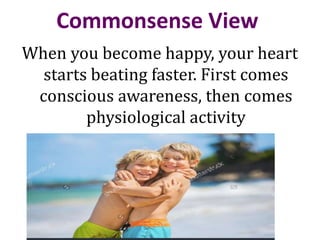
Commonsense View
When you become happy, your heart
starts beating faster. First comes
conscious awareness, then comes
physiological activity
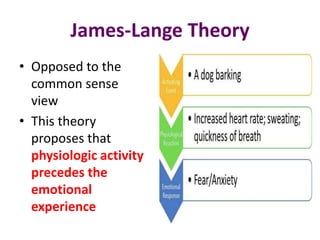
James-Lange Theory
• Opposed to the
common sense
view
• This theory
proposes that
physiologic activity
precedes the
emotional
experience
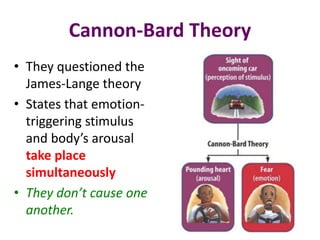
Cannon-Bard Theory
• They questioned the
James-Lange theory
• States that emotion-
triggering stimulus
and body’s arousal
take place
simultaneously
• They don’t cause one
another.
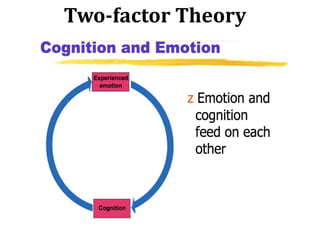
Two-factor Theory
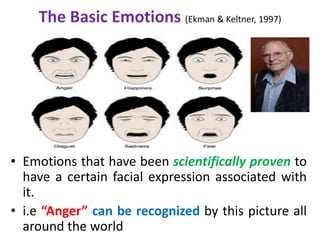
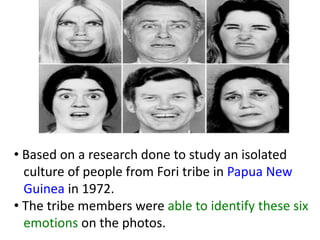
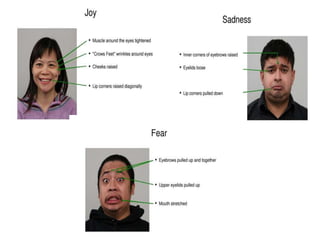
The Basic Emotions (Ekman & Keltner, 1997)
• Emotions that have been scientifically proven to
have a certain facial expression associated with
it.
• i.e “Anger” can be recognized by this picture all
around the world
• Based on a research done to study an isolated
culture of people from Fori tribe in Papua New
Guinea in 1972.
• The tribe members were able to identify these six
emotions on the photos.
Relation of Emotion to Health
• Emotion plays a big role in how we think and
how we behave. It affect our psychological
states and therefore, our bodies.
• Because , what is psychological is ultimately
biological
• For instance, chronic anger and depression
makes us vulnerable to all kinds of health
problems (Hypertension, Cardiovascular
disease and infection)
• Poor emotional health can weaken body’s
immune systems – vulnerable to infection
during emotionally difficult times.
• Also, when you don’t feel good, you may not
take care of your health as well as you should.
• May not feel like eating, exercising, taking
medicine
• Abuse of alcohol, tobacco and other drugs –
sign of poor emotional health
Introduction to Stress
• DEFINITION: The process by which we perceive
and response to certain events or stressors,
that we view as challeging or threatening.
• Stress isnt technically an emotion – more to a
reaction to a disturbing or distruptive stimulus.
• Reaction depends of own’s appraisal of the
stimulus.
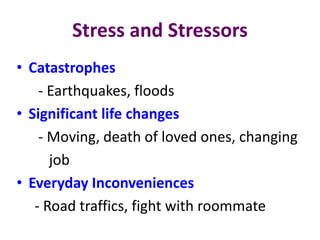
Stress and Stressors
• Catastrophes
- Earthquakes, floods
• Significant life changes
- Moving, death of loved ones, changing
job
• Everyday Inconveniences
- Road traffics, fight with roommate
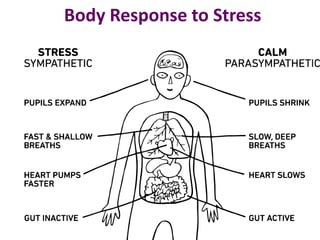
Body Response to Stress
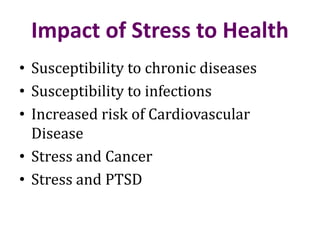
Impact of Stress to Health
• Susceptibility to chronic diseases
• Susceptibility to infections
• Increased risk of Cardiovascular
Disease
• Stress and Cancer
• Stress and PTSD
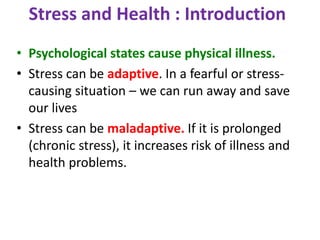
Stress and Health : Introduction
• Psychological states cause physical illness.
• Stress can be adaptive. In a fearful or stress-
causing situation – we can run away and save
our lives
• Stress can be maladaptive. If it is prolonged
(chronic stress), it increases risk of illness and
health problems.
Stress and Susceptibility to Disease
• B Lymphocytes fight bacterial infections,
T lymphocytes attack cancer cells and
viruses and microphages ingest foreign
substances.
• During stress, energy is mobilized away
from the immune system making it
vulnerable.
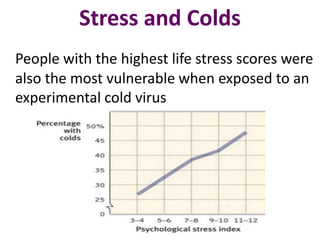
Stress and Colds
People with the highest life stress scores were
also the most vulnerable when exposed to an
experimental cold virus
Stress and Heart Disease
• Stress that leads to increase blood pressure
may result in Coronary Heart Disease, a
clogging of the vessels that nourish the heart
muscle.
• Supported by Personality Type
- Type A (competitive, hard driving, anger
prone people) are more likely to develop
CHD than Type B( Easygoing,
relaxed)
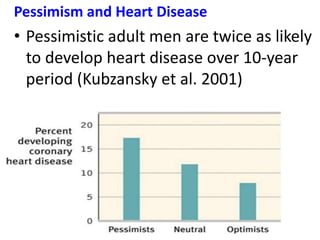
Pessimism and Heart Disease
• Pessimistic adult men are twice as likely
to develop heart disease over 10-year
period (Kubzansky et al. 2001)
Stress and Cancer
Stress does not create cancer cells.
Researchers disagree on whether the
stress influences the progression of
cancer.
However, they do agree that avoiding
stress and having hopeful attitude
help in coping with the disease.
Stress and PTSD
• When an individual is exposed to a severely stressful
experience (death, violence) it may result in PTSD.
• The trauma experienced is severe enough to causes stress
responses for months or even years after the event.
• The trauma overwhelms the victim’s ability to cope and
memories of the event trigger anxiety and physical stress
responses.
• CBT seeks to change the way a trauma victim feels and acts
by changing the patterns of thinking/behaviour.
Thank you! 
References
• Chapter 3 Basic Emotions, Paul Ekman. Handbook of Cognition and
Emotion. 1999 John Wiley & Sons Ltd.
• Emotion and Health: An Overview. P.Pandey and A.K Choubey. SIS J.Proj.
Psy. & Mental Health (2010) 17: 135-152
• Boundless. “Introduction to Stress.” Psychology (11th Edition). Boundless,
26 May. 2016.
• Boundless. “Biology of Emotion.” Psychology (11th Edition). Boundless, 08
Aug. 2016

Emotion and health

  • 1.
    EMOTION & HEALTH PresentedBy Siti Nur Rifhan Kamaruddin
  • 2.
    What is Emotion? •Definition: A mind and body’s integrated response to a stimulus of some kind. • Emotions involve Physiological arousal, Expressive behaviours and Conscious experience i.e Walking alone at night and you hear footsteps Physio. Arousal : Heart beating fast Expressive Behaviour: Walk faster or move towards street lights Conscious Experience: Feeling Fear, panic
  • 3.
    Theories of Emotion Doesphysiological activity precede or follow emotional experience? Does your heart pound because you are afraid…. Or are you afraid because you feel your heart pounding? Does cognition (thinking) precede emotion (feeling)?
  • 4.
    Commonsense View When youbecome happy, your heart starts beating faster. First comes conscious awareness, then comes physiological activity
  • 5.
    James-Lange Theory • Opposedto the common sense view • This theory proposes that physiologic activity precedes the emotional experience
  • 6.
    Cannon-Bard Theory • Theyquestioned the James-Lange theory • States that emotion- triggering stimulus and body’s arousal take place simultaneously • They don’t cause one another.
  • 7.
  • 8.
    The Basic Emotions(Ekman & Keltner, 1997) • Emotions that have been scientifically proven to have a certain facial expression associated with it. • i.e “Anger” can be recognized by this picture all around the world
  • 9.
    • Based ona research done to study an isolated culture of people from Fori tribe in Papua New Guinea in 1972. • The tribe members were able to identify these six emotions on the photos.
  • 12.
    Relation of Emotionto Health • Emotion plays a big role in how we think and how we behave. It affect our psychological states and therefore, our bodies. • Because , what is psychological is ultimately biological • For instance, chronic anger and depression makes us vulnerable to all kinds of health problems (Hypertension, Cardiovascular disease and infection)
  • 13.
    • Poor emotionalhealth can weaken body’s immune systems – vulnerable to infection during emotionally difficult times. • Also, when you don’t feel good, you may not take care of your health as well as you should. • May not feel like eating, exercising, taking medicine • Abuse of alcohol, tobacco and other drugs – sign of poor emotional health
  • 14.
    Introduction to Stress •DEFINITION: The process by which we perceive and response to certain events or stressors, that we view as challeging or threatening. • Stress isnt technically an emotion – more to a reaction to a disturbing or distruptive stimulus. • Reaction depends of own’s appraisal of the stimulus.
  • 15.
    Stress and Stressors •Catastrophes - Earthquakes, floods • Significant life changes - Moving, death of loved ones, changing job • Everyday Inconveniences - Road traffics, fight with roommate
  • 16.
  • 17.
    Impact of Stressto Health • Susceptibility to chronic diseases • Susceptibility to infections • Increased risk of Cardiovascular Disease • Stress and Cancer • Stress and PTSD
  • 18.
    Stress and Health: Introduction • Psychological states cause physical illness. • Stress can be adaptive. In a fearful or stress- causing situation – we can run away and save our lives • Stress can be maladaptive. If it is prolonged (chronic stress), it increases risk of illness and health problems.
  • 19.
    Stress and Susceptibilityto Disease • B Lymphocytes fight bacterial infections, T lymphocytes attack cancer cells and viruses and microphages ingest foreign substances. • During stress, energy is mobilized away from the immune system making it vulnerable.
  • 20.
    Stress and Colds Peoplewith the highest life stress scores were also the most vulnerable when exposed to an experimental cold virus
  • 21.
    Stress and HeartDisease • Stress that leads to increase blood pressure may result in Coronary Heart Disease, a clogging of the vessels that nourish the heart muscle. • Supported by Personality Type - Type A (competitive, hard driving, anger prone people) are more likely to develop CHD than Type B( Easygoing, relaxed)
  • 22.
    Pessimism and HeartDisease • Pessimistic adult men are twice as likely to develop heart disease over 10-year period (Kubzansky et al. 2001)
  • 23.
    Stress and Cancer Stressdoes not create cancer cells. Researchers disagree on whether the stress influences the progression of cancer. However, they do agree that avoiding stress and having hopeful attitude help in coping with the disease.
  • 24.
    Stress and PTSD •When an individual is exposed to a severely stressful experience (death, violence) it may result in PTSD. • The trauma experienced is severe enough to causes stress responses for months or even years after the event. • The trauma overwhelms the victim’s ability to cope and memories of the event trigger anxiety and physical stress responses. • CBT seeks to change the way a trauma victim feels and acts by changing the patterns of thinking/behaviour.
  • 25.
  • 26.
    References • Chapter 3Basic Emotions, Paul Ekman. Handbook of Cognition and Emotion. 1999 John Wiley & Sons Ltd. • Emotion and Health: An Overview. P.Pandey and A.K Choubey. SIS J.Proj. Psy. & Mental Health (2010) 17: 135-152 • Boundless. “Introduction to Stress.” Psychology (11th Edition). Boundless, 26 May. 2016. • Boundless. “Biology of Emotion.” Psychology (11th Edition). Boundless, 08 Aug. 2016

Editor's Notes

  • #3 # These can short flashes or long lingering responses that can be very clear or very confusing # Example : Say you are walking home at night alone, you hear footsteps behind you. Physiological arousal occurs in the form of your heart pounding. Your expressive behaviour could be like quickening your pace or moving towards the street lights and you conscious experience may include thinking like you gonna get robbed now, feeling fear and panic # These three pieces are there but psychologist are still puzzling on how the fit together. How do thinking and feeling interact? Which one comes first?
  • #7 # States that the emotion is first felt in the thalamus, then it is simultaneously direct to the cerebral cortex and the autonomic nervous systems. # Evidence supporting this theory: Even ppl with a suppressed nervous system can experience emotions too.
  • #8 #Today, Most psychologists agreed that emotions also tangled with our cognition. # Whether or not we are afraid of the dog on the side walk depends on whether we are interpreting the dog stimulus as threatening or friendly. Also What is our past history of dog is.
  • #9 # Others have seen suggested that Pride, Love should have been classified as basic emotions as well but Ekman has argued that these and other emotions are just familiar combination of the classic six # “Anger” can be recognized by this picture all around the world, no matter what age, religion or gender you are, or what language you speak
  • #10 Some researchers now say there are fewer than six basic emotions or some say there are more BUT the idea remains the same that : Emotion are biologically innate, universal to al humans, displayed through facial expressions.
  • #11 Across the cultures, people tended to match smiling faces with happiness, furrow browed, tight lipped faces with anger and so on.
  • #13 Regarding the Physical effects of emotional; it pretty much goes to the way we expect. Happiness is helpful while chronic anger and depression makes us vulnerable to all kinds of problems with health and well being.
  • #15 SIMPLY, STRESS IS OUR REACTION TO A STIMULUS THAT DISTURBS OUR PHYSICAL OR MENTAL EQUILIBRIUM.
  • #16 Any of these stressful event big or small, even the good things can fire up your sympathetic nervous system and triggers all the flight and fight response. Stress is ultimately natural body response.