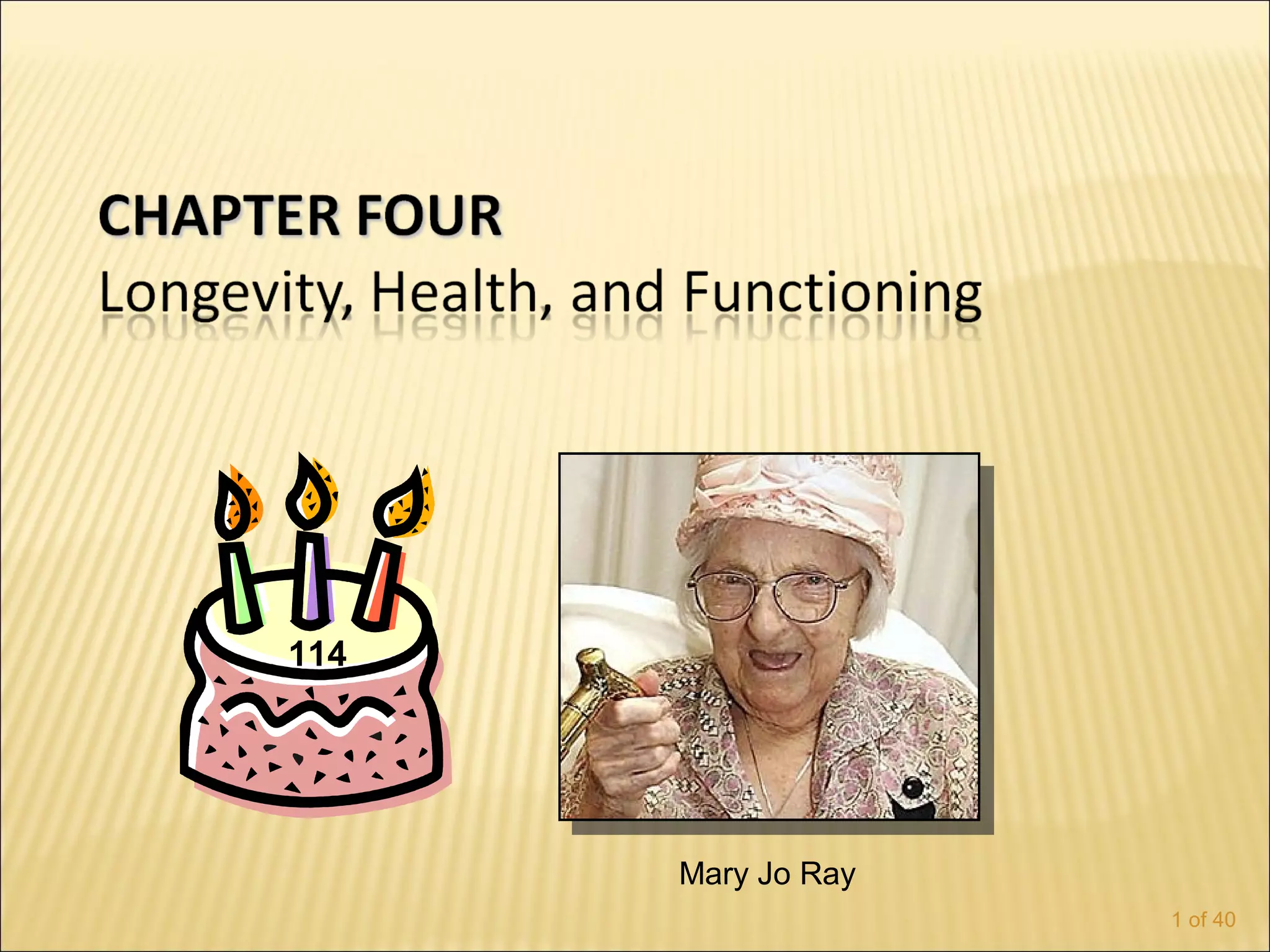
114


      Mary Jo Ray
                    1 of 40
Learning Objectives
   What are the average and maximum longevity for
    humans?
   What genetic and environmental factors influence
    longevity?
   What ethnic factors influence average longevity?
   What factors create gender differences in average
    longevity?


                                                        2 of 40
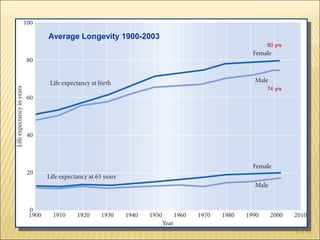
Average Longevity 1900-2003
                              80 yrs


                              74 yrs


                                       3 of 40
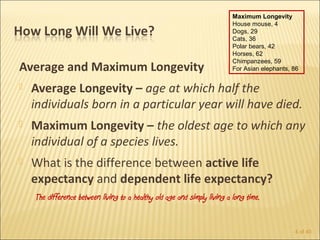
Maximum Longevity
                                                                           House mouse, 4
                                                                           Dogs, 29
                                                                           Cats, 36
                                                                           Polar bears, 42
                                                                           Horses, 62
                                                                           Chimpanzees, 59
Average and Maximum Longevity                                              For Asian elephants, 86


   Average Longevity – age at which half the
    individuals born in a particular year will have died.
   Maximum Longevity – the oldest age to which any
    individual of a species lives.
   What is the difference between active life
    expectancy and dependent life expectancy?
    The difference between living to a healthy old age and simply living a long time.


                                                                                                4 of 40
Genetic and Environmental
Factors in Average Longevity

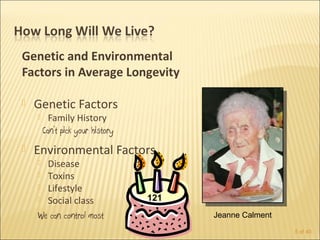
   Genetic Factors
         Family History
        Can’t pick your history
   Environmental Factors
     Disease
     Toxins
     Lifestyle
     Social class                121
    We can control most                 Jeanne Calment
                                                         5 of 40
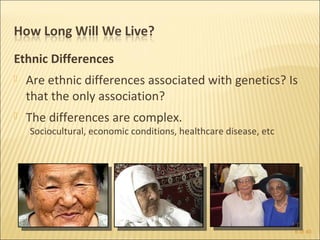
Ethnic Differences
   Are ethnic differences associated with genetics? Is
    that the only association?
   The differences are complex.
    Sociocultural, economic conditions, healthcare disease, etc


                                                                  6 of 40
Gender Differences in Average Longevity
Women have nearly a seven year edge over men.
Why?
     Men are more vulnerable to disease than women.
     Men are risk-takers.
     Men smoke and use alcohol more than women.
     Men allow stress to enter their lives more than women.
     Anything else?


                                                               7 of 40
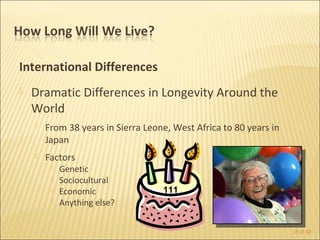
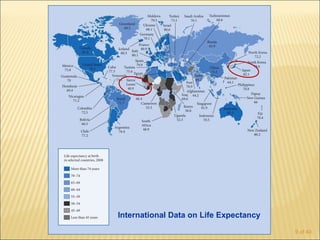
International Differences
   Dramatic Differences in Longevity Around the
    World
       From 38 years in Sierra Leone, West Africa to 80 years in
        Japan
       Factors
            Genetic
            Sociocultural
            Economic               111
            Anything else?


                                                                    8 of 40
International Data on Life Expectancy

                                        9 of 40
Learning Objectives
   What are the key issues in defining health and
    illness?
   How is quality of life assessed?
   What normative age-related changes occur in the
    immune system?
   What are the developmental trends in chronic and
    acute diseases?
   What are the key issues in stress across adulthood?


                                                          10 of 40
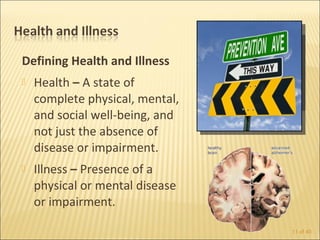
Defining Health and Illness
   Health – A state of
    complete physical, mental,
    and social well-being, and
    not just the absence of
    disease or impairment.
   Illness – Presence of a
    physical or mental disease
    or impairment.

                                 11 of 40
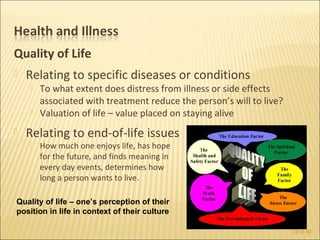
Quality of Life
   Relating to specific diseases or conditions
       To what extent does distress from illness or side effects
        associated with treatment reduce the person’s will to live?
       Valuation of life – value placed on staying alive
   Relating to end-of-life issues
       How much one enjoys life, has hope
        for the future, and finds meaning in
        every day events, determines how
        long a person wants to live.

Quality of life – one’s perception of their
position in life in context of their culture

                                                                      12 of 40
Changes in the Immune System
   How does the defense system work?
   How does aging affect the immune system?
       Not well understood; more susceptible to infection and cancer
   Aging is related to how well the system works.
   Autoimmunity
       Immune system can attack the body itself.
       Rheumatoid arthritis


                                                                   13 of 40
Changes in the Immune System – cont.
   Psychoneuroimmunology
       Psychology
       Neurological
       Immunological system changes
        (Cohen & Herbert, 1996)
   AIDS and Older Adults
       15,000 people over 65 have AIDS (CDC, 2008)
       Rapid progression from HIV positive to AIDS


                                                      14 of 40
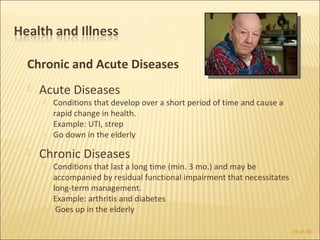
Chronic and Acute Diseases
   Acute Diseases
       Conditions that develop over a short period of time and cause a
        rapid change in health.
        Example: UTI, strep
       Go down in the elderly

   Chronic Diseases
       Conditions that last a long time (min. 3 mo.) and may be
        accompanied by residual functional impairment that necessitates
        long-term management.
        Example: arthritis and diabetes
        Goes up in the elderly

                                                                          15 of 40
The Role of Stress – bad for your health in the long run
   Stress as a Physiological State
       Sympathetic nervous system
        (heart rate, respiration, blood flow, muscle strength, etc)
       Impaired immune system, increase risk of cardiovascular
        disease, increase risk of cancer
       Gender differences? Men want to be alone, women want
         to be with other people. (fight or flight vs. tend and befriend)
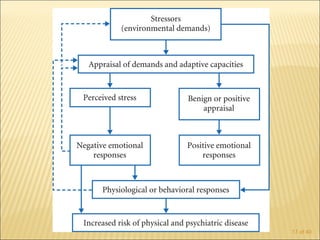
   Stress and Coping Paradigm
       Interaction of a thinking person and an event
        (People experience stress differently)
            Two people stuck in traffic – different levels of stress. Why?
                                                                              16 of 40
17 of 40
The Role of Stress (cont.)
   Appraisal (Lazarus and Folkman, 1984)
       Primary appraisal: categorize the event
       Secondary appraisal: evaluate the event
       Reappraisal: changes in the situation may change the
        appraisal
   Coping – dealing with stressful events
       Death of a spouse


                                                               18 of 40
The Role of Stress
   Aging, Stress and Coping
       Who has more stress? Older or Younger?
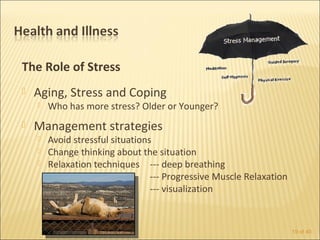
   Management strategies
       Avoid stressful situations
       Change thinking about the situation
       Relaxation techniques --- deep breathing
                                  --- Progressive Muscle Relaxation
                                  --- visualization


                                                                      19 of 40
Effects of Stress on Health
   Short-term stress vs. long-term stress
   Chronic Stress
       Immune system suppression
       Increased susceptibility to:
            Viral infections
            Risk of atherosclerosis
            Hypertension
            Impaired memory and cognition
            Inhibited menstruation – women


                                              20 of 40
Learning Objectives
   What are the most important issues in chronic
    disease?
   What are some common chronic conditions across
    adulthood?
   How can people manage chronic conditions?


                                                     21 of 40
General Issues in Chronic Conditions
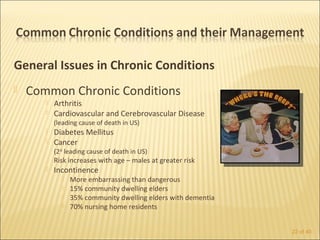
   Common Chronic Conditions
          Arthritis
          Cardiovascular and Cerebrovascular Disease
           (leading cause of death in US)
          Diabetes Mellitus
          Cancer
           (2nd leading cause of death in US)
           Risk increases with age – males at greater risk
          Incontinence
                More embarrassing than dangerous
                15% community dwelling elders
                35% community dwelling elders with dementia
                70% nursing home residents


                                                               22 of 40
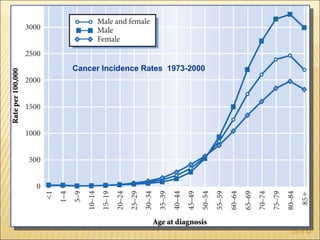
Cancer Incidence Rates 1973-2000


                                   23 of 40
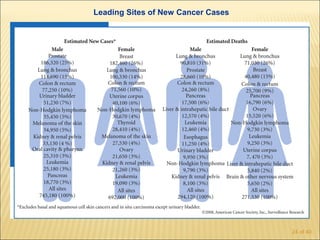
Leading Sites of New Cancer Cases


                                    24 of 40
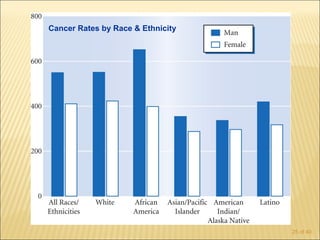
Cancer Rates by Race & Ethnicity


                                   25 of 40
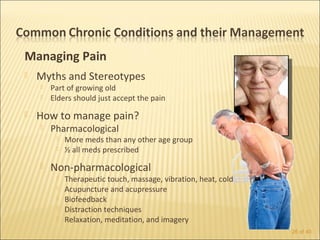
Managing Pain
   Myths and Stereotypes
       Part of growing old
       Elders should just accept the pain
   How to manage pain?
       Pharmacological
            More meds than any other age group
            ½ all meds prescribed
       Non-pharmacological
            Therapeutic touch, massage, vibration, heat, cold
            Acupuncture and acupressure
            Biofeedback
            Distraction techniques
            Relaxation, meditation, and imagery
                                                                 26 of 40
Learning Objectives
   What are the developmental trends in using
    medication?
   How does aging affect the way the medications work?
   What are the consequences of medication
    interactions?
   What are the important medication adherence issues?


                                                          27 of 40
Patterns of Medication Use
   Explosion of new medication available
       People over 60 take nearly 50% of all prescription and over
        the counter medication.
       New drugs can be dangerous to older adults.
       New drugs are frequently very expensive.


                                                                 28 of 40
Developmental Changes and Medication
   Absorption
       Time needed for medications to enter the bloodstream
       Once in the bloodstream the drug is distributed
        throughout the body.
       Drug Metabolism
       Drug Excretion
   Drugs not recommended for older adults
       Good strategy: “start low and go slow.”


                                                               29 of 40
Medication Side Effects and Interactions
   Polypharmacy
       The use of multiple medications in the same person
       Interactions
       Potentially dangerous

Adherence to Medication Regimens
       Difficult with older patients
       Many older patients go to more than one doctor so
        accurate knowledge of drugs taken is important.


                                                             30 of 40
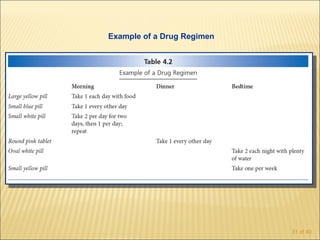
Example of a Drug Regimen


                            31 of 40
32 of 40
Functional Health and Disability
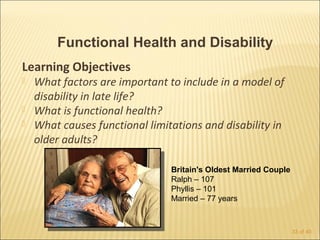
Learning Objectives
   What factors are important to include in a model of
    disability in late life?
   What is functional health?
   What causes functional limitations and disability in
    older adults?

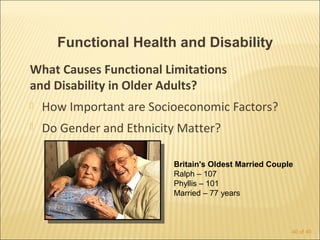
                                Britain's Oldest Married Couple
                                Ralph – 107
                                Phyllis – 101
                                Married – 77 years


                                                                  33 of 40
Functional Health and Disability
Disability in Late Life
   Definition of disability?
    Effects of a chronic condition on a person’s ability to engage in activities
    that are necessary, expected, or desired in their society

   Compression of morbidity
    Becoming disabled later with a shorter period of disability before death

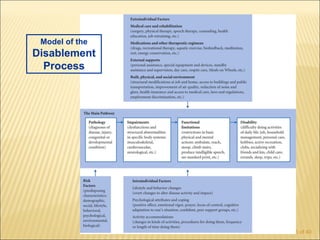
   A model of the disablement process
     Interventions strategies:
        Extraindividual factors – environmental & healthcare
         (surgery, meds, social support services, physical environment support)
        Intraindividual factors – behavioral & personality
         (exercising, positive outlook,etc)
                                                                                   34 of 40
Model of the
Disablement
  Process


                35 of 40
Functional Health and Disability

Determining Functional Health Status
   Determining Functional Health Status
       Frail older adults
        physical disabilities, very ill, cognitive decline or psychological
        disorders, and need assistance with everyday tasks
        *(minority of older adults; chance increases with age)
        *Needs help with more than one ADL
       Activities of daily living: ADL
        basic self-care task – eating, dressing, bathing, toileting, walking
       Instrumental activities of daily living: IADL
        actions requiring planning & intellectual competence
        (shopping, paying bills, taking meds correctly, keeping appointments)
                                                                                36 of 40
Functional Health and Disability

Limitations and Disability in Older Adults?
   Strong predictors
       Cerebrovascular disease
       Arthritis
       Coronary artery disease (weaker predictor)
   Other predictors
       Smoking
       Heavy drinking
       Physical inactivity
       Depression
       Social isolation and perceived poor health

                                                     37 of 40
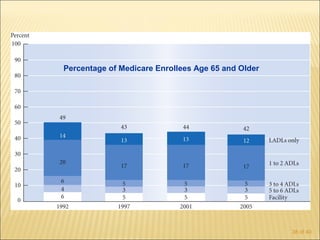
Percentage of Medicare Enrollees Age 65 and Older


                                                    38 of 40
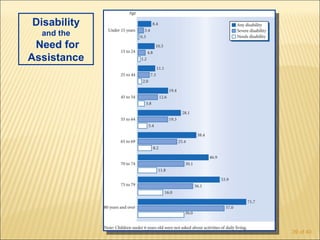
Disability
  and the
 Need for
Assistance


             39 of 40
Functional Health and Disability
What Causes Functional Limitations
and Disability in Older Adults?
   How Important are Socioeconomic Factors?
   Do Gender and Ethnicity Matter?

                          Britain's Oldest Married Couple
                          Ralph – 107
                          Phyllis – 101
                          Married – 77 years


                                                        40 of 40
41 of 40

4 HUS 133 Health and Functioning

  • 1.
    114 Mary Jo Ray 1 of 40
  • 2.
    Learning Objectives  What are the average and maximum longevity for humans?  What genetic and environmental factors influence longevity?  What ethnic factors influence average longevity?  What factors create gender differences in average longevity? 2 of 40
  • 3.
    Average Longevity 1900-2003 80 yrs 74 yrs 3 of 40
  • 4.
    Maximum Longevity House mouse, 4 Dogs, 29 Cats, 36 Polar bears, 42 Horses, 62 Chimpanzees, 59 Average and Maximum Longevity For Asian elephants, 86  Average Longevity – age at which half the individuals born in a particular year will have died.  Maximum Longevity – the oldest age to which any individual of a species lives.  What is the difference between active life expectancy and dependent life expectancy? The difference between living to a healthy old age and simply living a long time. 4 of 40
  • 5.
    Genetic and Environmental Factorsin Average Longevity  Genetic Factors  Family History Can’t pick your history  Environmental Factors  Disease  Toxins  Lifestyle  Social class 121 We can control most Jeanne Calment 5 of 40
  • 6.
    Ethnic Differences  Are ethnic differences associated with genetics? Is that the only association?  The differences are complex. Sociocultural, economic conditions, healthcare disease, etc 6 of 40
  • 7.
    Gender Differences inAverage Longevity Women have nearly a seven year edge over men. Why?  Men are more vulnerable to disease than women.  Men are risk-takers.  Men smoke and use alcohol more than women.  Men allow stress to enter their lives more than women.  Anything else? 7 of 40
  • 8.
    International Differences  Dramatic Differences in Longevity Around the World  From 38 years in Sierra Leone, West Africa to 80 years in Japan  Factors  Genetic  Sociocultural  Economic 111  Anything else? 8 of 40
  • 9.
    International Data onLife Expectancy 9 of 40
  • 10.
    Learning Objectives  What are the key issues in defining health and illness?  How is quality of life assessed?  What normative age-related changes occur in the immune system?  What are the developmental trends in chronic and acute diseases?  What are the key issues in stress across adulthood? 10 of 40
  • 11.
    Defining Health andIllness  Health – A state of complete physical, mental, and social well-being, and not just the absence of disease or impairment.  Illness – Presence of a physical or mental disease or impairment. 11 of 40
  • 12.
    Quality of Life  Relating to specific diseases or conditions  To what extent does distress from illness or side effects associated with treatment reduce the person’s will to live?  Valuation of life – value placed on staying alive  Relating to end-of-life issues  How much one enjoys life, has hope for the future, and finds meaning in every day events, determines how long a person wants to live. Quality of life – one’s perception of their position in life in context of their culture 12 of 40
  • 13.
    Changes in theImmune System  How does the defense system work?  How does aging affect the immune system?  Not well understood; more susceptible to infection and cancer  Aging is related to how well the system works.  Autoimmunity  Immune system can attack the body itself.  Rheumatoid arthritis 13 of 40
  • 14.
    Changes in theImmune System – cont.  Psychoneuroimmunology  Psychology  Neurological  Immunological system changes (Cohen & Herbert, 1996)  AIDS and Older Adults  15,000 people over 65 have AIDS (CDC, 2008)  Rapid progression from HIV positive to AIDS 14 of 40
  • 15.
    Chronic and AcuteDiseases  Acute Diseases  Conditions that develop over a short period of time and cause a rapid change in health. Example: UTI, strep  Go down in the elderly  Chronic Diseases  Conditions that last a long time (min. 3 mo.) and may be accompanied by residual functional impairment that necessitates long-term management. Example: arthritis and diabetes  Goes up in the elderly 15 of 40
  • 16.
    The Role ofStress – bad for your health in the long run  Stress as a Physiological State  Sympathetic nervous system (heart rate, respiration, blood flow, muscle strength, etc)  Impaired immune system, increase risk of cardiovascular disease, increase risk of cancer  Gender differences? Men want to be alone, women want to be with other people. (fight or flight vs. tend and befriend)  Stress and Coping Paradigm  Interaction of a thinking person and an event (People experience stress differently)  Two people stuck in traffic – different levels of stress. Why? 16 of 40
  • 17.
  • 18.
    The Role ofStress (cont.)  Appraisal (Lazarus and Folkman, 1984)  Primary appraisal: categorize the event  Secondary appraisal: evaluate the event  Reappraisal: changes in the situation may change the appraisal  Coping – dealing with stressful events  Death of a spouse 18 of 40
  • 19.
    The Role ofStress  Aging, Stress and Coping  Who has more stress? Older or Younger?  Management strategies  Avoid stressful situations  Change thinking about the situation  Relaxation techniques --- deep breathing --- Progressive Muscle Relaxation --- visualization 19 of 40
  • 20.
    Effects of Stresson Health  Short-term stress vs. long-term stress  Chronic Stress  Immune system suppression  Increased susceptibility to:  Viral infections  Risk of atherosclerosis  Hypertension  Impaired memory and cognition  Inhibited menstruation – women 20 of 40
  • 21.
    Learning Objectives  What are the most important issues in chronic disease?  What are some common chronic conditions across adulthood?  How can people manage chronic conditions? 21 of 40
  • 22.
    General Issues inChronic Conditions  Common Chronic Conditions  Arthritis  Cardiovascular and Cerebrovascular Disease (leading cause of death in US)  Diabetes Mellitus  Cancer (2nd leading cause of death in US) Risk increases with age – males at greater risk  Incontinence  More embarrassing than dangerous  15% community dwelling elders  35% community dwelling elders with dementia  70% nursing home residents 22 of 40
  • 23.
    Cancer Incidence Rates1973-2000 23 of 40
  • 24.
    Leading Sites ofNew Cancer Cases 24 of 40
  • 25.
    Cancer Rates byRace & Ethnicity 25 of 40
  • 26.
    Managing Pain  Myths and Stereotypes  Part of growing old  Elders should just accept the pain  How to manage pain?  Pharmacological  More meds than any other age group  ½ all meds prescribed  Non-pharmacological  Therapeutic touch, massage, vibration, heat, cold  Acupuncture and acupressure  Biofeedback  Distraction techniques  Relaxation, meditation, and imagery 26 of 40
  • 27.
    Learning Objectives  What are the developmental trends in using medication?  How does aging affect the way the medications work?  What are the consequences of medication interactions?  What are the important medication adherence issues? 27 of 40
  • 28.
    Patterns of MedicationUse  Explosion of new medication available  People over 60 take nearly 50% of all prescription and over the counter medication.  New drugs can be dangerous to older adults.  New drugs are frequently very expensive. 28 of 40
  • 29.
    Developmental Changes andMedication  Absorption  Time needed for medications to enter the bloodstream  Once in the bloodstream the drug is distributed throughout the body.  Drug Metabolism  Drug Excretion  Drugs not recommended for older adults  Good strategy: “start low and go slow.” 29 of 40
  • 30.
    Medication Side Effectsand Interactions  Polypharmacy  The use of multiple medications in the same person  Interactions  Potentially dangerous Adherence to Medication Regimens  Difficult with older patients  Many older patients go to more than one doctor so accurate knowledge of drugs taken is important. 30 of 40
  • 31.
    Example of aDrug Regimen 31 of 40
  • 32.
  • 33.
    Functional Health andDisability Learning Objectives  What factors are important to include in a model of disability in late life?  What is functional health?  What causes functional limitations and disability in older adults? Britain's Oldest Married Couple Ralph – 107 Phyllis – 101 Married – 77 years 33 of 40
  • 34.
    Functional Health andDisability Disability in Late Life  Definition of disability? Effects of a chronic condition on a person’s ability to engage in activities that are necessary, expected, or desired in their society  Compression of morbidity Becoming disabled later with a shorter period of disability before death  A model of the disablement process Interventions strategies:  Extraindividual factors – environmental & healthcare (surgery, meds, social support services, physical environment support)  Intraindividual factors – behavioral & personality (exercising, positive outlook,etc) 34 of 40
  • 35.
    Model of the Disablement Process 35 of 40
  • 36.
    Functional Health andDisability Determining Functional Health Status  Determining Functional Health Status  Frail older adults physical disabilities, very ill, cognitive decline or psychological disorders, and need assistance with everyday tasks *(minority of older adults; chance increases with age) *Needs help with more than one ADL  Activities of daily living: ADL basic self-care task – eating, dressing, bathing, toileting, walking  Instrumental activities of daily living: IADL actions requiring planning & intellectual competence (shopping, paying bills, taking meds correctly, keeping appointments) 36 of 40
  • 37.
    Functional Health andDisability Limitations and Disability in Older Adults?  Strong predictors  Cerebrovascular disease  Arthritis  Coronary artery disease (weaker predictor)  Other predictors  Smoking  Heavy drinking  Physical inactivity  Depression  Social isolation and perceived poor health 37 of 40
  • 38.
    Percentage of MedicareEnrollees Age 65 and Older 38 of 40
  • 39.
    Disability andthe Need for Assistance 39 of 40
  • 40.
    Functional Health andDisability What Causes Functional Limitations and Disability in Older Adults?  How Important are Socioeconomic Factors?  Do Gender and Ethnicity Matter? Britain's Oldest Married Couple Ralph – 107 Phyllis – 101 Married – 77 years 40 of 40
  • 41.

Editor's Notes

  • #4 Figure 4.1 Average Longevity for Men and Women in the United States 1900—2003
  • #10 Figure 4.2 International data on life expectancy
  • #18 Figure 4.4 An example of a transactional model of stress
  • #24 Figure 4.5 Cancer incidence crude rates, nine registries, 1973—2000
  • #25 Figure 4.6 Leading sites of new cancer cases and deaths—2008 estimates
  • #26 Figure 4.7 Cancer incidence rates by race and ethnicity, all types of cancer
  • #32 Table 4.2 Example of a Drug Regimen
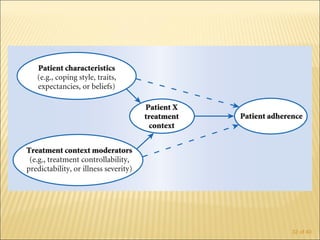
  • #33 Figure 4.8 Conceptual representation of the patient-by treatment-context
  • #36 Figure 4.9 A model of the disablement process
  • #39 Figure 4.10 Percentage of Medicare enrollees age 65 and over
  • #40 Figure 4.11 Prevalence of disability and the need for assistance by age