Properties of Matter November 6, 2009
Objectives Define matter,  conductivity, malleability, viscosity, solubility Describe physical properties of matter Explain what happens during physical changes
Definition Matter is anything that has mass and volume Everything is made of matter
Classifying Matter Matter Elements Compounds Homogeneous Heterogeneous All matter has physical and chemical properties.  Pure Substances Mixtures
Properties are characteristics used to describe an object Physical properties are those that can be observed  without  changing the identity of the substance
Extensive Properties Depends on the amount of matter present mass  volume length density  shape
 
 
Intensive Properties Independent of the amount of matter present color state melting and boiling point texture magnetic attraction brittleness  hardness  malleability  conductivity  viscosity
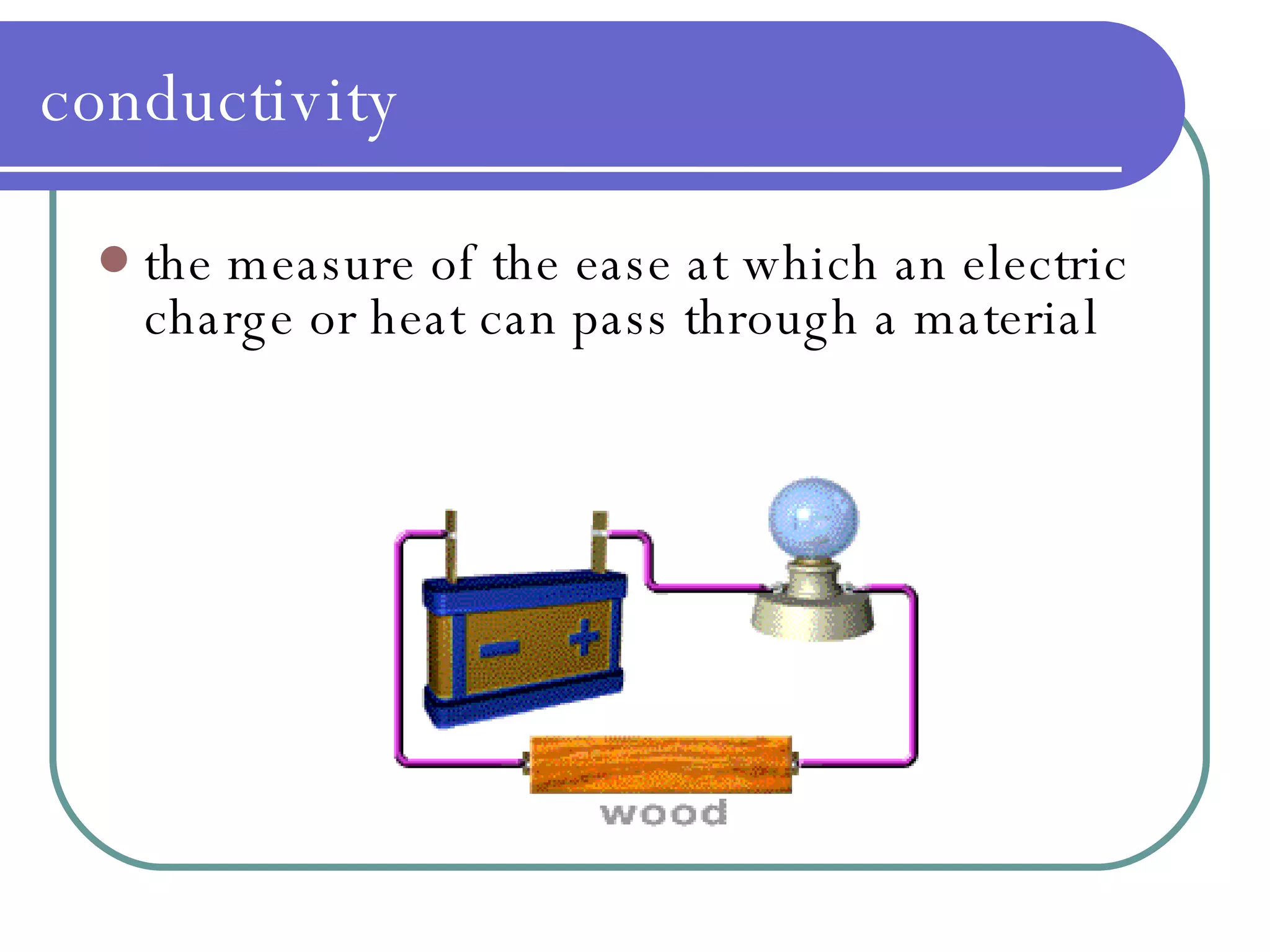
conductivity the measure of the ease at which an electric charge or heat can pass through a material
malleability the property of something that can be worked or hammered or shaped without breaking
viscosity The resistance of a liquid to flow Example: honey has a higher viscosity than water
 
solubility The ability to dissolve in another substance
Physical Changes in Matter   No new substances are made.  Examples: cutting, grinding, any phase change.   A physical change may involve changing the shape of the object. You can get the original materials back.

prop of matter

Editor's Notes

  • #7 Extensive Properties : depend upon the amount of the substance present. Examples: mass, length, volume
  • #10 Intensive Properties : independent of the amount of substance present. Examples: density, color, state, melting point, boiling point, texture, conductivity, malleability, ductility
  • #14 This is simply how readily the oil flows. A higher viscosity oil will withstand more heat than a lower viscosity oil. However, at colder temperatures it can actually become so thick that your starter cannot turn over the engine - and worse yet it won't flow to all the moving parts it should. A viscosity that is too low won't maintain a lubricating film on engine parts - allowing them to make metal-to-metal contact. Either extreme is very bad! The first number on a multi-grade oil indicates the "cold" viscosity of the lubricant - the second number the "hot" viscosity. For example, a SAE 10W-40 motor oil would have a viscosity rating of 10 at 0-degrees Fahrenheit (the W indicates "Winter") and a 40 rating at its maximum recommended temperature (not engine operating temperature - ambient air temperature).