Chapter 2:  Data Analysis Section 1:  Units of measurement
Intro problems:  D = m   V Calculate the density of a piece of bone with a mass of 3.8 g and a volume of 2.0 cm 3 A spoonful of sugar with a mass of 8.8 grams is poured into a 10 mL graduated cylinder. The volume reading is 5.5 mL.  What is the density of the sugar?
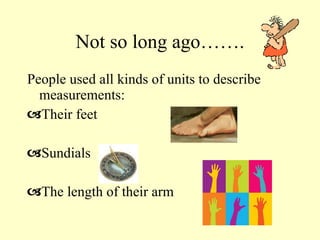
Not so long ago……. People used all kinds of units to describe measurements: Their feet Sundials The length of their arm
Needless to say, this led to much confusion! Scientist needed a way to report their findings in a way that everyone else understood. So, in 1795, the French developed a system of standard units, which was updated in 1960  The revised system is called the  Système Internationale d’Unités , which is abbreviated SI
SI Units A system of standard measures that every scientist uses It consists of 7 base units which have real measures in the real world
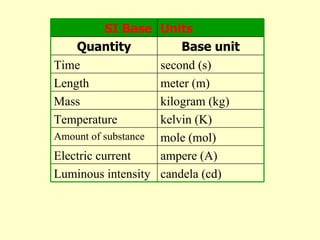
SI Base Units Quantity Base unit Time second (s) Length meter (m) Mass kilogram (kg) Temperature kelvin (K) Amount of substance mole (mol) Electric current ampere (A) Luminous intensity candela (cd)
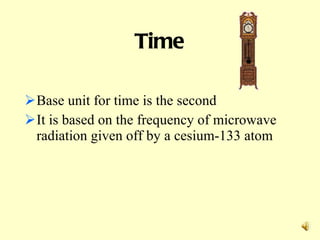
Time Base unit for time is the second It is based on the frequency of microwave radiation given off by a cesium-133 atom          
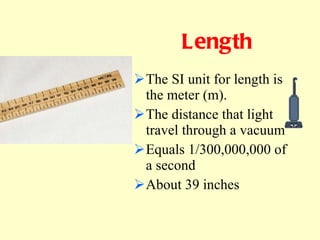
Length The SI unit for length is the meter (m). The distance that light travel through a vacuum Equals 1/300,000,000 of a second About 39 inches            
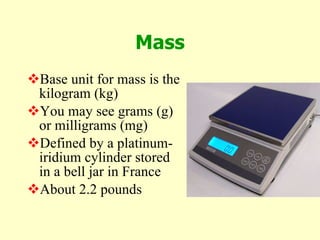
Mass Base unit for mass is the kilogram (kg) You may see grams (g) or milligrams (mg) Defined by a platinum-iridium cylinder stored in a bell jar in France About 2.2 pounds
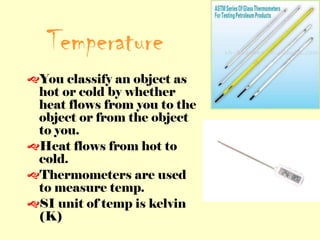
Temperature You classify an object as hot or cold by whether heat flows from you to the object or from the object to you.  Heat flows from hot to cold. Thermometers are used to measure temp. SI unit of temp is kelvin (K)
In science, the celsius and kelvin scales are most often used. To convert from celsius to kelvin: add 273 ex:  -39 º C + 273 =  234 K To convert from kelvin to celsius:  subtract 273  ex:  332 K – 273 =  59 ºC Temperature
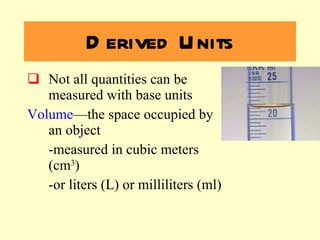
Derived Units Not all quantities can be measured with base units Volume —the space occupied by an object -measured in cubic meters (cm 3 )  -or liters (L) or milliliters (ml)
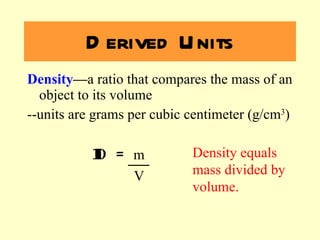
Density — a ratio that compares the mass of an object to its volume --units are grams per cubic centimeter (g/cm 3 ) D =  m   V Derived Units Density equals mass divided by volume.
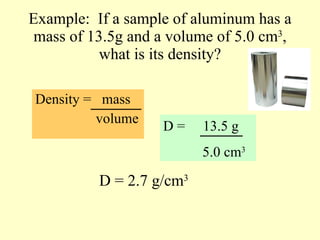
Example:  If a sample of aluminum has a mass of 13.5g and a volume of 5.0 cm 3 , what is its density? Density =  mass   volume D =  13.5 g 5.0 cm 3 D = 2.7 g/cm 3
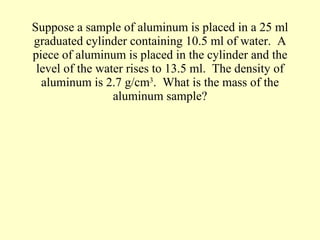
Suppose a sample of aluminum is placed in a 25 ml graduated cylinder containing 10.5 ml of water.  A piece of aluminum is placed in the cylinder and the level of the water rises to 13.5 ml.  The density of aluminum is 2.7 g/cm 3 .  What is the mass of the aluminum sample?
Practice Problems—pg. 29 # 1, 2, 3
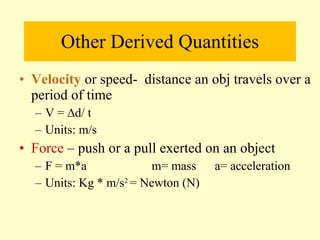
Other Derived Quantities Velocity  or speed-  distance an obj travels over a period of time V =  ∆ d/   t  Units: m/s Force  – push or a pull exerted on an object F = m*a  m= mass  a= acceleration Units: Kg * m/s 2  = Newton (N)
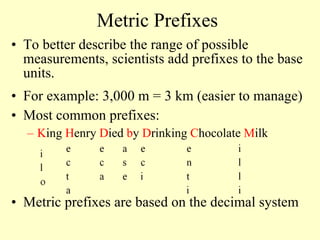
Metric Prefixes To better describe the range of possible measurements, scientists add prefixes to the base units.  For example: 3,000 m = 3 km (easier to manage) Most common prefixes: K ing  H enry  D ied  b y  D rinking  C hocolate  M ilk Metric prefixes are based on the decimal system
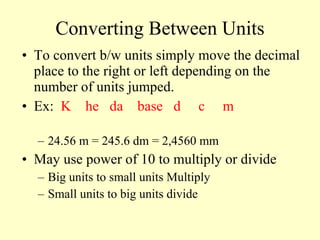
Converting Between Units To convert b/w units simply move the decimal place to the right or left depending on the number of units jumped. Ex:  K  he  da  base  d  c  m 24.56 m = 245.6 dm = 2,4560 mm May use power of 10 to multiply or divide Big units to small units Multiply Small units to big units divide
Section 2.2 Scientific Notation and Dimensional Analysis
Scientific Notation A way to handle very large or very small numbers Expresses numbers as a multiple of 10 factors Structure: a number between 1 and 10; and ten raised to a power, or exponent Positive exponents, number is > 1 Negative exponents, number is <1 Ex:  300,000,000,000  written in scientific notation is  3.0 x 10  11
Change the following data into scientific notation. a.  The diameter of the sun is 1 392 000 km. b.  The density of the sun’s lower atmosphere is 0.000 000 028 g/cm 3 .
Practice probs. Pg. 32  #12, 13
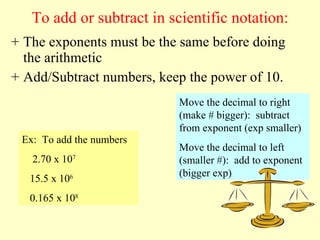
To add or subtract in scientific notation: The exponents must be the same before doing the arithmetic Add/Subtract numbers, keep the power of 10. Ex:  To add the numbers  2.70 x 10 7 15.5 x 10 6 0.165 x 10 8 Move the decimal to right (make # bigger):  subtract from exponent (exp smaller) Move the decimal to left (smaller #):  add to exponent (bigger exp)
Practice probs. Pg. 32  #14
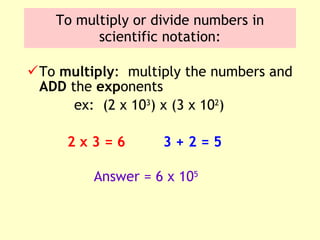
To multiply or divide numbers in scientific notation: To  multiply :  multiply the numbers and  ADD  the  exp onents ex:  (2 x 10 3 ) x (3 x 10 2 ) 2 x 3 = 6 3 + 2 = 5 Answer = 6 x 10 5
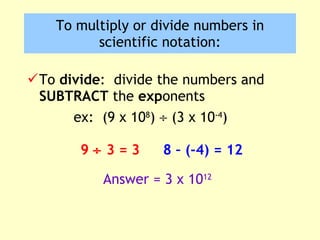
To  divide :  divide the numbers and  SUBTRACT  the  exp onents ex:  (9 x 10 8 )    (3 x 10 -4 ) To multiply or divide numbers in scientific notation: 9    3 = 3 8 – (-4) = 12 Answer = 3 x 10 12
Practice probs. Pg. 33  #15, 16
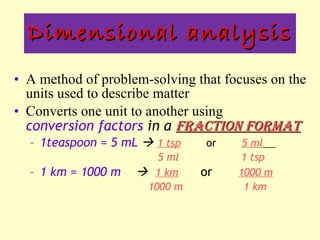
Dimensional analysis A method of problem-solving that focuses on the units used to describe matter Converts one unit to another using  conversion factors  in a  fraction format 1teaspoon = 5 mL     1 tsp   or  5 ml   5 ml  1 tsp 1 km = 1000 m     1 km   or  1000 m   1000 m   1 km
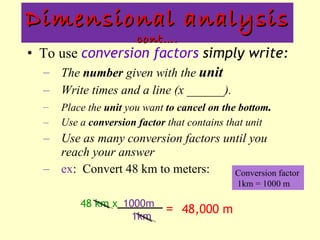
To use  conversion factors  simply write: The  number  given with the  unit   Write times and a line (x ______). Place the  unit  you want  to cancel on the bottom . Use a  conversion factor  that contains that unit Use as many conversion factors until you reach your answer ex :  Convert 48 km to meters: Dimensional analysis  cont…. 48 km x   1km =  48,000 m 1000m Conversion factor  1km = 1000 m
Practice: Convert 360 L to ml and to teaspoons:
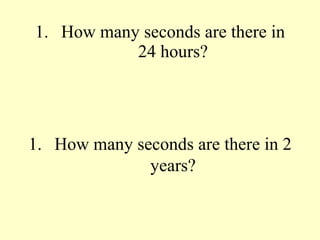
How many seconds are there in 24 hours? How many seconds are there in 2 years?
Practice probs. Pg. 34 #17, 18
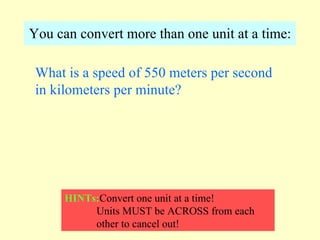
You can convert more than one unit at a time: What is a speed of 550 meters per second in kilometers per minute? HINTs: Convert one unit at a time! Units MUST be ACROSS from each  other to cancel out!
Section 2.3 How reliable are measurements:
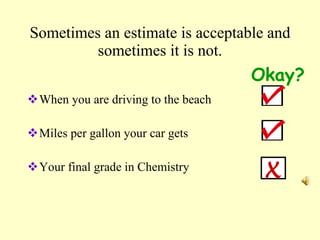
Sometimes an estimate is acceptable and sometimes it is not. When you are driving to the beach Miles per gallon your car gets Your final grade in Chemistry Okay? X
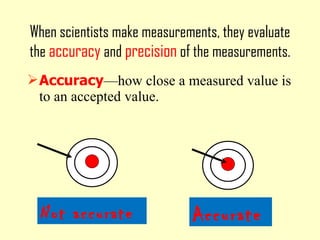
When scientists make measurements, they evaluate the  accuracy  and  precision  of the measurements. Accuracy —how close a measured value is to an accepted value. Not accurate Accurate
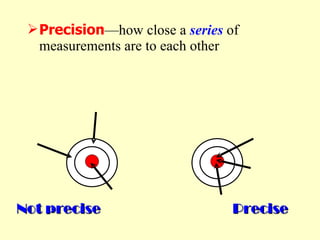
Precision —how close a  series  of measurements are to each other Not precise Precise
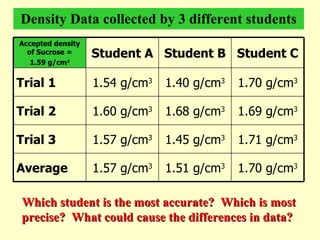
Density Data collected by 3 different students Which student is the most accurate?  Which is most precise?  What could cause the differences in data? Accepted density of Sucrose = 1.59 g/cm 3 Student A Student B Student C Trial 1 1.54 g/cm 3 1.40 g/cm 3 1.70 g/cm 3 Trial 2 1.60 g/cm 3 1.68 g/cm 3 1.69 g/cm 3 Trial 3 1.57 g/cm 3 1.45 g/cm 3 1.71 g/cm 3 Average 1.57 g/cm 3 1.51 g/cm 3 1.70 g/cm 3
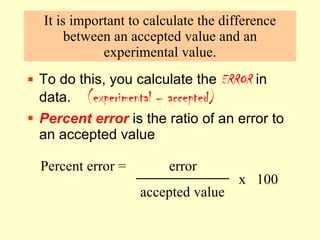
It is important to calculate the difference between an accepted value and an experimental value. To do this, you calculate the  ERROR  in data.  (experimental – accepted) Percent error   is the ratio of an error to an accepted value Percent error =  error    accepted value  x  100
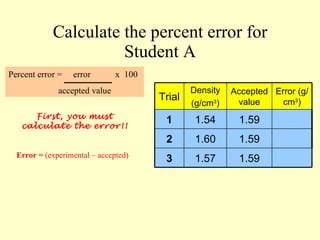
Calculate the percent error for Student A Percent error =  error  x  100   accepted value First, you must calculate the error!! Error =  (experimental – accepted) Trial Density (g/cm 3 ) Accepted value Error (g/cm 3 ) 1 1.54 1.59 2 1.60 1.59 3 1.57 1.59
Practice probs. Pg. 38 #29
Significant Figures Scientists indicate the precision of measurements by the number of digits they report (digits that are DEPENDABLE) Include all known digits and one estimated digit. A value of 3.52 g is more precise than a value of 3.5 g A reported chemistry test score of 93 is more precise than a score of 90
There are 2 different types of numbers Exact Measured Exact numbers are infinitely important Counting numbers : 2 soccer balls or 4 pizzas Exact relationships, predefined values  1 foot = 12 inches ,  1 m = 100 cm Measured number = they are measured with a measuring device (name all 4) so these numbers have ERROR. When you use your calculator your answer can only be as accurate as your worst measurement     Significant Figures
Learning Check Classify each of the following as an exact or a measured number. 1 yard = 3 feet The diameter of a red blood cell is 6 x 10 -4  cm. There are 6 hats on the shelf. Gold melts at 1064°C.
Classify each of the following as an exact (1) or a measured(2) number.  This is a defined relationship. A measuring tool is used to determine length. The number of hats is obtained by counting. A measuring tool is required.   Solution
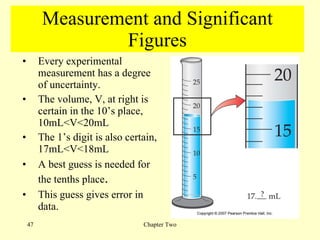
Measurement and Significant Figures Every experimental measurement has a degree of uncertainty. The volume, V, at right is certain in the 10’s place, 10mL<V<20mL The 1’s digit is also certain, 17mL<V<18mL A best guess is needed for the tenths place . This guess gives error in data. Chapter Two
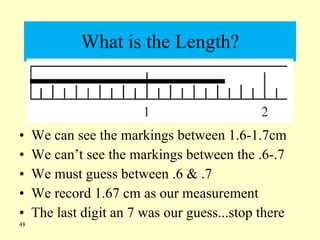
What is the Length? We can see the markings between 1.6-1.7cm We can’t see the markings between the .6-.7 We must guess between .6 & .7 We record 1.67 cm as our measurement The last digit an 7 was our guess...stop there
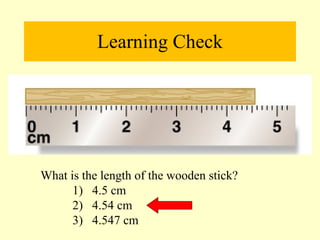
Learning Check What is the length of the wooden stick? 1)  4.5 cm  2)  4.54 cm  3)  4.547 cm
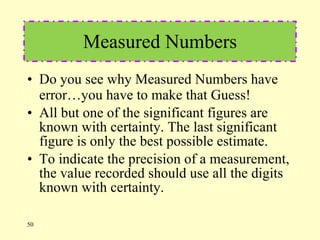
Measured Numbers Do you see why Measured Numbers have error…you have to make that Guess! All but one of the significant figures are known with certainty. The last significant figure is only the best possible estimate. To indicate the precision of a measurement, the value recorded should use all the digits known with certainty.
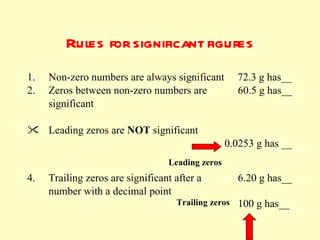
Rules for significant figures Non-zero numbers are always significant  72.3 g has__  Zeros between non-zero numbers are    60.5 g has__  significant Leading zeros are  NOT  significant     0.0253 g has __      4.  Trailing zeros are significant after a    6.20 g has__  number with a decimal point Trailing zeros Leading zeros 100 g has__
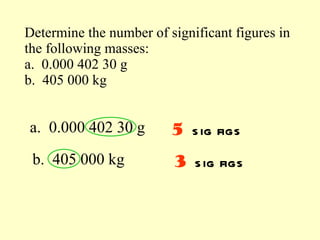
Determine the number of significant figures in the following masses: a.  0.000 402 30 g b.  405 000 kg a.  0.000 402 30 g b.  405 000 kg 5   sig figs 3   sig figs
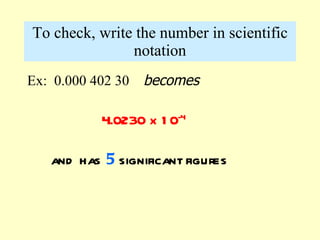
To check, write the number in scientific notation Ex:  0.000 402 30  becomes 4.0230 x 10 -4 and has  5  significant figures
Practice probs. Pg. 39 # 31, 32
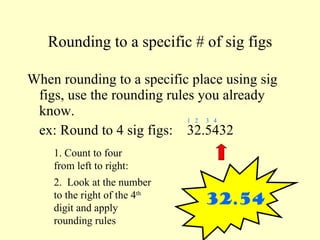
Rounding to a specific # of sig figs When rounding to a specific place using sig figs, use the rounding rules you already know. ex: Round to 4 sig figs:  32.5432 1. Count to four from left to right: 1  2  3  4 2.  Look at the number to the right of the 4 th  digit and apply rounding rules 32.54
Practice probs. Pg. 41 #34
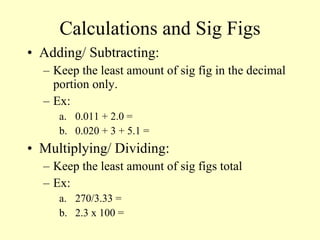
Calculations and Sig Figs Adding/ Subtracting: Keep the least amount of sig fig in the decimal portion only. Ex: 0.011 + 2.0 = 0.020 + 3 + 5.1 = Multiplying/ Dividing: Keep the least amount of sig figs total Ex: 270/3.33 = 2.3 x 100 =
Calculations and Sig Figs Follow your sig figs through the problem, but round at the end Ex:  (3.94 x 2.1) + 2.3418/ .004
Practice probs. Pg. 41 # 35, 36 pg. 42  #37, 38

Ch 2 data analysis

  • 1.
    Chapter 2: Data Analysis Section 1: Units of measurement
  • 2.
    Intro problems: D = m V Calculate the density of a piece of bone with a mass of 3.8 g and a volume of 2.0 cm 3 A spoonful of sugar with a mass of 8.8 grams is poured into a 10 mL graduated cylinder. The volume reading is 5.5 mL. What is the density of the sugar?
  • 3.
    Not so longago……. People used all kinds of units to describe measurements: Their feet Sundials The length of their arm
  • 4.
    Needless to say,this led to much confusion! Scientist needed a way to report their findings in a way that everyone else understood. So, in 1795, the French developed a system of standard units, which was updated in 1960 The revised system is called the Système Internationale d’Unités , which is abbreviated SI
  • 5.
    SI Units Asystem of standard measures that every scientist uses It consists of 7 base units which have real measures in the real world
  • 6.
    SI Base UnitsQuantity Base unit Time second (s) Length meter (m) Mass kilogram (kg) Temperature kelvin (K) Amount of substance mole (mol) Electric current ampere (A) Luminous intensity candela (cd)
  • 7.
    Time Base unitfor time is the second It is based on the frequency of microwave radiation given off by a cesium-133 atom          
  • 8.
    Length The SIunit for length is the meter (m). The distance that light travel through a vacuum Equals 1/300,000,000 of a second About 39 inches            
  • 9.
    Mass Base unitfor mass is the kilogram (kg) You may see grams (g) or milligrams (mg) Defined by a platinum-iridium cylinder stored in a bell jar in France About 2.2 pounds
  • 10.
    Temperature You classifyan object as hot or cold by whether heat flows from you to the object or from the object to you. Heat flows from hot to cold. Thermometers are used to measure temp. SI unit of temp is kelvin (K)
  • 11.
    In science, thecelsius and kelvin scales are most often used. To convert from celsius to kelvin: add 273 ex: -39 º C + 273 = 234 K To convert from kelvin to celsius: subtract 273 ex: 332 K – 273 = 59 ºC Temperature
  • 12.
    Derived Units Notall quantities can be measured with base units Volume —the space occupied by an object -measured in cubic meters (cm 3 ) -or liters (L) or milliliters (ml)
  • 13.
    Density — aratio that compares the mass of an object to its volume --units are grams per cubic centimeter (g/cm 3 ) D = m V Derived Units Density equals mass divided by volume.
  • 14.
    Example: Ifa sample of aluminum has a mass of 13.5g and a volume of 5.0 cm 3 , what is its density? Density = mass volume D = 13.5 g 5.0 cm 3 D = 2.7 g/cm 3
  • 15.
    Suppose a sampleof aluminum is placed in a 25 ml graduated cylinder containing 10.5 ml of water. A piece of aluminum is placed in the cylinder and the level of the water rises to 13.5 ml. The density of aluminum is 2.7 g/cm 3 . What is the mass of the aluminum sample?
  • 16.
  • 17.
    Other Derived QuantitiesVelocity or speed- distance an obj travels over a period of time V = ∆ d/ t Units: m/s Force – push or a pull exerted on an object F = m*a m= mass a= acceleration Units: Kg * m/s 2 = Newton (N)
  • 18.
    Metric Prefixes Tobetter describe the range of possible measurements, scientists add prefixes to the base units. For example: 3,000 m = 3 km (easier to manage) Most common prefixes: K ing H enry D ied b y D rinking C hocolate M ilk Metric prefixes are based on the decimal system
  • 19.
    Converting Between UnitsTo convert b/w units simply move the decimal place to the right or left depending on the number of units jumped. Ex: K he da base d c m 24.56 m = 245.6 dm = 2,4560 mm May use power of 10 to multiply or divide Big units to small units Multiply Small units to big units divide
  • 20.
    Section 2.2 ScientificNotation and Dimensional Analysis
  • 21.
    Scientific Notation Away to handle very large or very small numbers Expresses numbers as a multiple of 10 factors Structure: a number between 1 and 10; and ten raised to a power, or exponent Positive exponents, number is > 1 Negative exponents, number is <1 Ex: 300,000,000,000 written in scientific notation is 3.0 x 10 11
  • 22.
    Change the followingdata into scientific notation. a. The diameter of the sun is 1 392 000 km. b. The density of the sun’s lower atmosphere is 0.000 000 028 g/cm 3 .
  • 23.
  • 24.
    To add orsubtract in scientific notation: The exponents must be the same before doing the arithmetic Add/Subtract numbers, keep the power of 10. Ex: To add the numbers 2.70 x 10 7 15.5 x 10 6 0.165 x 10 8 Move the decimal to right (make # bigger): subtract from exponent (exp smaller) Move the decimal to left (smaller #): add to exponent (bigger exp)
  • 25.
  • 26.
    To multiply ordivide numbers in scientific notation: To multiply : multiply the numbers and ADD the exp onents ex: (2 x 10 3 ) x (3 x 10 2 ) 2 x 3 = 6 3 + 2 = 5 Answer = 6 x 10 5
  • 27.
    To divide: divide the numbers and SUBTRACT the exp onents ex: (9 x 10 8 )  (3 x 10 -4 ) To multiply or divide numbers in scientific notation: 9  3 = 3 8 – (-4) = 12 Answer = 3 x 10 12
  • 28.
  • 29.
    Dimensional analysis Amethod of problem-solving that focuses on the units used to describe matter Converts one unit to another using conversion factors in a fraction format 1teaspoon = 5 mL  1 tsp or 5 ml 5 ml 1 tsp 1 km = 1000 m  1 km or 1000 m 1000 m 1 km
  • 30.
    To use conversion factors simply write: The number given with the unit Write times and a line (x ______). Place the unit you want to cancel on the bottom . Use a conversion factor that contains that unit Use as many conversion factors until you reach your answer ex : Convert 48 km to meters: Dimensional analysis cont…. 48 km x 1km = 48,000 m 1000m Conversion factor 1km = 1000 m
  • 31.
    Practice: Convert 360L to ml and to teaspoons:
  • 32.
    How many secondsare there in 24 hours? How many seconds are there in 2 years?
  • 33.
  • 34.
    You can convertmore than one unit at a time: What is a speed of 550 meters per second in kilometers per minute? HINTs: Convert one unit at a time! Units MUST be ACROSS from each other to cancel out!
  • 35.
    Section 2.3 Howreliable are measurements:
  • 36.
    Sometimes an estimateis acceptable and sometimes it is not. When you are driving to the beach Miles per gallon your car gets Your final grade in Chemistry Okay? X
  • 37.
    When scientists makemeasurements, they evaluate the accuracy and precision of the measurements. Accuracy —how close a measured value is to an accepted value. Not accurate Accurate
  • 38.
    Precision —how closea series of measurements are to each other Not precise Precise
  • 39.
    Density Data collectedby 3 different students Which student is the most accurate? Which is most precise? What could cause the differences in data? Accepted density of Sucrose = 1.59 g/cm 3 Student A Student B Student C Trial 1 1.54 g/cm 3 1.40 g/cm 3 1.70 g/cm 3 Trial 2 1.60 g/cm 3 1.68 g/cm 3 1.69 g/cm 3 Trial 3 1.57 g/cm 3 1.45 g/cm 3 1.71 g/cm 3 Average 1.57 g/cm 3 1.51 g/cm 3 1.70 g/cm 3
  • 40.
    It is importantto calculate the difference between an accepted value and an experimental value. To do this, you calculate the ERROR in data. (experimental – accepted) Percent error is the ratio of an error to an accepted value Percent error = error accepted value x 100
  • 41.
    Calculate the percenterror for Student A Percent error = error x 100 accepted value First, you must calculate the error!! Error = (experimental – accepted) Trial Density (g/cm 3 ) Accepted value Error (g/cm 3 ) 1 1.54 1.59 2 1.60 1.59 3 1.57 1.59
  • 42.
  • 43.
    Significant Figures Scientistsindicate the precision of measurements by the number of digits they report (digits that are DEPENDABLE) Include all known digits and one estimated digit. A value of 3.52 g is more precise than a value of 3.5 g A reported chemistry test score of 93 is more precise than a score of 90
  • 44.
    There are 2different types of numbers Exact Measured Exact numbers are infinitely important Counting numbers : 2 soccer balls or 4 pizzas Exact relationships, predefined values 1 foot = 12 inches , 1 m = 100 cm Measured number = they are measured with a measuring device (name all 4) so these numbers have ERROR. When you use your calculator your answer can only be as accurate as your worst measurement  Significant Figures
  • 45.
    Learning Check Classifyeach of the following as an exact or a measured number. 1 yard = 3 feet The diameter of a red blood cell is 6 x 10 -4 cm. There are 6 hats on the shelf. Gold melts at 1064°C.
  • 46.
    Classify each ofthe following as an exact (1) or a measured(2) number. This is a defined relationship. A measuring tool is used to determine length. The number of hats is obtained by counting. A measuring tool is required. Solution
  • 47.
    Measurement and SignificantFigures Every experimental measurement has a degree of uncertainty. The volume, V, at right is certain in the 10’s place, 10mL<V<20mL The 1’s digit is also certain, 17mL<V<18mL A best guess is needed for the tenths place . This guess gives error in data. Chapter Two
  • 48.
    What is theLength? We can see the markings between 1.6-1.7cm We can’t see the markings between the .6-.7 We must guess between .6 & .7 We record 1.67 cm as our measurement The last digit an 7 was our guess...stop there
  • 49.
    Learning Check Whatis the length of the wooden stick? 1) 4.5 cm 2) 4.54 cm 3) 4.547 cm
  • 50.
    Measured Numbers Doyou see why Measured Numbers have error…you have to make that Guess! All but one of the significant figures are known with certainty. The last significant figure is only the best possible estimate. To indicate the precision of a measurement, the value recorded should use all the digits known with certainty.
  • 51.
    Rules for significantfigures Non-zero numbers are always significant 72.3 g has__ Zeros between non-zero numbers are 60.5 g has__ significant Leading zeros are NOT significant 0.0253 g has __ 4. Trailing zeros are significant after a 6.20 g has__ number with a decimal point Trailing zeros Leading zeros 100 g has__
  • 52.
    Determine the numberof significant figures in the following masses: a. 0.000 402 30 g b. 405 000 kg a. 0.000 402 30 g b. 405 000 kg 5 sig figs 3 sig figs
  • 53.
    To check, writethe number in scientific notation Ex: 0.000 402 30 becomes 4.0230 x 10 -4 and has 5 significant figures
  • 54.
  • 55.
    Rounding to aspecific # of sig figs When rounding to a specific place using sig figs, use the rounding rules you already know. ex: Round to 4 sig figs: 32.5432 1. Count to four from left to right: 1 2 3 4 2. Look at the number to the right of the 4 th digit and apply rounding rules 32.54
  • 56.
  • 57.
    Calculations and SigFigs Adding/ Subtracting: Keep the least amount of sig fig in the decimal portion only. Ex: 0.011 + 2.0 = 0.020 + 3 + 5.1 = Multiplying/ Dividing: Keep the least amount of sig figs total Ex: 270/3.33 = 2.3 x 100 =
  • 58.
    Calculations and SigFigs Follow your sig figs through the problem, but round at the end Ex: (3.94 x 2.1) + 2.3418/ .004
  • 59.
    Practice probs. Pg.41 # 35, 36 pg. 42 #37, 38