 anything   that occupies space and has
 mass.

 Macroscopic
 Microscopic
 Particulate
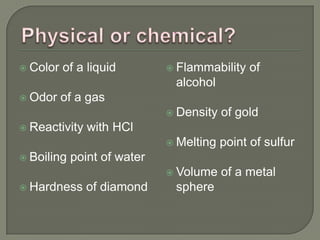
 Color   of a liquid         Flammability   of
                              alcohol
 Odor    of a gas
                              Density   of gold
 Reactivity   with HCl
                              Melting   point of sulfur
 Boiling   point of water
                              Volume    of a metal
 Hardness     of diamond     sphere
 Can be determined without changing the
 nature of the substance (color, odor,
 physical state, density, hardness, melting
 point and boiling point)
 Describes the ability of a substance to
 participate in chemical reactions (reactivity
 with oxygen, reactivity with acids,
 flammability)
 Donot depend o the amount of the sample
 being examined


 Depend   on the quantity of the sample
 Odor       Hardness


 Color      Volume


 Weight     Area


 Mass       Thickness


 Density    Freezing   point
 Has   definite shape and definite volume

 Rigid


 Molecules   are held tightly together

 Molecules   can “wiggle” or vibrate only very
 slightly
 Distinct
         volume independent of its
 container

 No   specific shape

 Molecules   slide over each other

 Pours   easily
 No   fixed volume or shape

 Moleculesare very far apart and are
 moving at high speeds

 Moleculescolliding repeatedly with each
 other and with the walls of the container
Copper
Nitrogen
 Highly   ionized state

 positively   charged ions

 Free   negatively charged electrons

 99%    of the matter in the universe
BOSE-EINSTEIN CONDENSATE (BEC)
 Predicted in 1924 by Albert Einstein, who
  built on the work of Styendra Bose

 Condensation    occurs when individual
 atoms meld into a “superatom” behaving
 as a single entity at just a few hundred
 billionths of a degree above absolute zero
Chemical   Initial state   Final state   Physical or
 System                                   Chemical
                                          Change?
PHYSICAL Change

 Changes  that alter the physical form of
 matter without changing its chemical
 identity.

 ALL   changes of state are physical changes
CHEMICAL Change

 Occurswhen the chemical identity of a
 substance is destroyed and a new
 substance is formed.

 Chemical   reactions
Indicators of Chemical change/reaction
 Color changes
 Odor changes
 Production of gas
 Production of solid or precipitate
Physical and Chemical Changes and Properties

                       Chemical             Physical

    Changes       Old substances       New form of old
                  destroyed            substance

                  New substances       No new substance
                  formed               formed


    Properties    Properties defined   Description by
                  by types of          senses
                  chemical changes
                  possible             Measurable
                                       properties
ENDOTHERMIC Process

 The   system absorbs heat

SURROUNDINGS            HEAT

 SYSTEM

 Melting   of ice
EXOTHERMIC Process

 The   system evolves heat

SYSTEM    HEAT

 SURROUNDINGS
 Combustion


 Freezing    of water

 Melting   of ice

 Boiling   of water

 Condensing     steam
 Has  its own set of chemical and physical
  properties
 Cannot be separated into parts by physical
  means
 Has a definite, fixed composition that does
  not vary from one sample to another
 Consists of two or more chemicals
 Properties depend on the substances on it
 Compositions can vary
 Definedby its atomic number
 Cannot be decomposed into simpler
  substances
                        Atomic Number - the number
                        of protons in an unreacted
                        atom
                        Mass Number - the number of
                        protons and neutrons together
Hydrogen     H    63.0%
Oxygen       O    25.5%
Carbon       C    9.45%
Nitrogen     N    1.35%
Calcium      Ca
Phosphorus   P
Chlorine     Cl
Sulfur       S        0.7%
Sodium       Na
Potassium    K
Magnesium    Mg
a  substance made of more than one type
  of atom
 Composed of 2 or more elements
 Atoms combined in fixed proportions
 Can be decomposed into two or more
  other substances by chemical change
 Turnblue litmus to red
 React with many metals
 React with bases
 An acid can be defined as a substance
  that yields hydrogen ions (H+) when
  dissolved in water.
 HCl
  • Pure substance, hydrogen chloride
  • Dissolved in water (H+ Cl-), hydrochloric acid


 Anoxoacid is an acid that contains
 hydrogen, oxygen, and another element.
 Cause color changes in plant dyes.
 React with certain metals to produce
  hydrogen gas.
2HCl (aq) + Mg (s)                  MgCl2 (aq) + H2 (g)


 Reactwith carbonates and bicarbonates to
 produce carbon dioxide gas
2HCl (aq) + CaCO3 (s)          CaCl2 (aq) + CO2 (g) + H2O (l)


 Aqueous        acid solutions conduct electricity.
 pH   – A Measure of Acidity
 Turnred litmus to blue
 React with acids
A base can be defined as a substance that
 yields hydroxide ions (OH-) when dissolved
 in water.
         NaOH         sodium hydroxide

         KOH          potassium hydroxide

         Ba(OH)2      barium hydroxide
       A salt, is defined as the product formed
    from the neutralization reaction of acids
    and bases. Salts are ionic compounds
    composed of cations (positively charged
    ions) and anions (negative ions) so that
    the product is electrically neutral (without a
    net charge)
acid + base      salt + water


HCl (aq) + NaOH (aq)     NaCl (aq) + H2O
H+ + Cl- + Na+ + OH-     Na+ + Cl- + H2O
           H+ + OH-      H2O


                                           4.3
Wala akong boses

Kaya please, konting katahimikan at pag-
 itindi ang aking hiling 

                                  Salamat,
                              Ma’am Pie 
1.   Identify the physical state of the following:

     a) Helium in a toy balloon
     b) vitamin tablets in a bottle
     c) mercury in a thermometer
2. Identify the type of property in the
  following statements:

a.   Yellow-green chlorine gas attacks silvery
     sodium metal to form white crystals of
     sodium chloride.


b.   A magnet separates the mixture of black
     iron shavings and white sand.
3. State which type of change occurs in the
  following statements:

a.   Passing an electric current through
     molten magnesium chloride yields molten
     magnesium and gaseous chlorine.

b.   The iron in discarded automobiles forms
     reddish brown, crumbly rust.
c. Chopping a log

d. Burning a log

e. Toasting a slice of bread
4. What is the key difference between an
  element and a compound?


5. List two differences between a compound
  and a mixture.

6. Make a concept of the Classification of
  Matter.
HETEROGENEOUS
 Varies in composition and or properties
  from one part of the mixture to another


HOMOGENEOUS
 Has the same/uniform composition and
  properties throughout
Kind of mixture   Particle size   Examples   Characteristics
SUSPENSION
 >1000 nm
 Particles are more or
  less evenly dispersed
  throughout a liquid or
  gas
 Different parts
  separate over time
SOLUTION
 0.2-2.0 nm
 A homogeneous mixture of two or more
  substances uniformly dispersed throughout
  a single phase
Gas              Liquid            Solid
Gas      Oxygen and                         The odor of a
         other gases in   Water vapor in    solid --
         nitrogen (air)   air (humidity)    molecules of
                                            that solid being
                                            dissolved in the
                                            air
Liquid   Carbon dioxide   Ethanol           Sucrose (table
         in water         (common           sugar) in water;
         (carbonated      alcohol) in       sodium chloride
         water)           water; various    (table salt) in
                          hydrocarbons in   water
                          each other
                          (petroleum) *
Solid    Hydrogen         Water in          Steel, Brass,
         dissolved to     activated         other metal
         palladium        charcoal          alloys
COLLOID
 2.0-1000 nm
 Consists of tiny particles that are
  suspended in a liquid, solid, or gas

 Stable   heterogeneous mixtures

 Exhibits   Tyndall effect
 Decantation
  • separates liquids from solids that have settled


 Evaporation
  • Separates the solid (residue) from the liquid
   (filtrate) parts of the mixture
 Distillation
 Filtration
 Centrifugation
 Chromatography
 Sugar    dissolved in water

 Mixture   of ethyl alcohol and water

 Mixture   of salt and sand

 Iron   filings, mongo seeds and salt mixture

MATTER

  • 2.
     anything that occupies space and has mass.  Macroscopic  Microscopic  Particulate
  • 3.
     Color of a liquid  Flammability of alcohol  Odor of a gas  Density of gold  Reactivity with HCl  Melting point of sulfur  Boiling point of water  Volume of a metal  Hardness of diamond sphere
  • 4.
     Can bedetermined without changing the nature of the substance (color, odor, physical state, density, hardness, melting point and boiling point)
  • 5.
     Describes theability of a substance to participate in chemical reactions (reactivity with oxygen, reactivity with acids, flammability)
  • 6.
     Donot dependo the amount of the sample being examined  Depend on the quantity of the sample
  • 7.
     Odor  Hardness  Color  Volume  Weight  Area  Mass  Thickness  Density  Freezing point
  • 12.
     Has definite shape and definite volume  Rigid  Molecules are held tightly together  Molecules can “wiggle” or vibrate only very slightly
  • 14.
     Distinct volume independent of its container  No specific shape  Molecules slide over each other  Pours easily
  • 16.
     No fixed volume or shape  Moleculesare very far apart and are moving at high speeds  Moleculescolliding repeatedly with each other and with the walls of the container
  • 19.
  • 20.
  • 21.
     Highly ionized state  positively charged ions   Free negatively charged electrons  99% of the matter in the universe
  • 22.
    BOSE-EINSTEIN CONDENSATE (BEC) Predicted in 1924 by Albert Einstein, who built on the work of Styendra Bose  Condensation occurs when individual atoms meld into a “superatom” behaving as a single entity at just a few hundred billionths of a degree above absolute zero
  • 25.
    Chemical Initial state Final state Physical or System Chemical Change?
  • 26.
    PHYSICAL Change  Changes that alter the physical form of matter without changing its chemical identity.  ALL changes of state are physical changes
  • 27.
    CHEMICAL Change  Occurswhenthe chemical identity of a substance is destroyed and a new substance is formed.  Chemical reactions
  • 28.
    Indicators of Chemicalchange/reaction  Color changes  Odor changes  Production of gas  Production of solid or precipitate
  • 29.
    Physical and ChemicalChanges and Properties Chemical Physical Changes Old substances New form of old destroyed substance New substances No new substance formed formed Properties Properties defined Description by by types of senses chemical changes possible Measurable properties
  • 30.
    ENDOTHERMIC Process  The system absorbs heat SURROUNDINGS HEAT SYSTEM  Melting of ice
  • 31.
    EXOTHERMIC Process  The system evolves heat SYSTEM HEAT SURROUNDINGS
  • 32.
     Combustion  Freezing of water  Melting of ice  Boiling of water  Condensing steam
  • 34.
     Has its own set of chemical and physical properties  Cannot be separated into parts by physical means  Has a definite, fixed composition that does not vary from one sample to another
  • 35.
     Consists oftwo or more chemicals  Properties depend on the substances on it  Compositions can vary
  • 36.
     Definedby itsatomic number  Cannot be decomposed into simpler substances Atomic Number - the number of protons in an unreacted atom Mass Number - the number of protons and neutrons together
  • 38.
    Hydrogen H 63.0% Oxygen O 25.5% Carbon C 9.45% Nitrogen N 1.35% Calcium Ca Phosphorus P Chlorine Cl Sulfur S 0.7% Sodium Na Potassium K Magnesium Mg
  • 39.
    a substancemade of more than one type of atom  Composed of 2 or more elements  Atoms combined in fixed proportions  Can be decomposed into two or more other substances by chemical change
  • 40.
     Turnblue litmusto red  React with many metals  React with bases
  • 41.
     An acidcan be defined as a substance that yields hydrogen ions (H+) when dissolved in water.  HCl • Pure substance, hydrogen chloride • Dissolved in water (H+ Cl-), hydrochloric acid  Anoxoacid is an acid that contains hydrogen, oxygen, and another element.
  • 42.
     Cause colorchanges in plant dyes.  React with certain metals to produce hydrogen gas. 2HCl (aq) + Mg (s) MgCl2 (aq) + H2 (g)  Reactwith carbonates and bicarbonates to produce carbon dioxide gas 2HCl (aq) + CaCO3 (s) CaCl2 (aq) + CO2 (g) + H2O (l)  Aqueous acid solutions conduct electricity.
  • 43.
     pH – A Measure of Acidity
  • 46.
     Turnred litmusto blue  React with acids
  • 47.
    A base canbe defined as a substance that yields hydroxide ions (OH-) when dissolved in water. NaOH sodium hydroxide KOH potassium hydroxide Ba(OH)2 barium hydroxide
  • 48.
    A salt, is defined as the product formed from the neutralization reaction of acids and bases. Salts are ionic compounds composed of cations (positively charged ions) and anions (negative ions) so that the product is electrically neutral (without a net charge)
  • 49.
    acid + base salt + water HCl (aq) + NaOH (aq) NaCl (aq) + H2O H+ + Cl- + Na+ + OH- Na+ + Cl- + H2O H+ + OH- H2O 4.3
  • 51.
    Wala akong boses Kayaplease, konting katahimikan at pag- itindi ang aking hiling  Salamat, Ma’am Pie 
  • 52.
    1. Identify the physical state of the following: a) Helium in a toy balloon b) vitamin tablets in a bottle c) mercury in a thermometer
  • 53.
    2. Identify thetype of property in the following statements: a. Yellow-green chlorine gas attacks silvery sodium metal to form white crystals of sodium chloride. b. A magnet separates the mixture of black iron shavings and white sand.
  • 54.
    3. State whichtype of change occurs in the following statements: a. Passing an electric current through molten magnesium chloride yields molten magnesium and gaseous chlorine. b. The iron in discarded automobiles forms reddish brown, crumbly rust.
  • 55.
    c. Chopping alog d. Burning a log e. Toasting a slice of bread
  • 56.
    4. What isthe key difference between an element and a compound? 5. List two differences between a compound and a mixture. 6. Make a concept of the Classification of Matter.
  • 57.
    HETEROGENEOUS  Varies incomposition and or properties from one part of the mixture to another HOMOGENEOUS  Has the same/uniform composition and properties throughout
  • 59.
    Kind of mixture Particle size Examples Characteristics
  • 60.
    SUSPENSION  >1000 nm Particles are more or less evenly dispersed throughout a liquid or gas  Different parts separate over time
  • 62.
    SOLUTION  0.2-2.0 nm A homogeneous mixture of two or more substances uniformly dispersed throughout a single phase
  • 63.
    Gas Liquid Solid Gas Oxygen and The odor of a other gases in Water vapor in solid -- nitrogen (air) air (humidity) molecules of that solid being dissolved in the air Liquid Carbon dioxide Ethanol Sucrose (table in water (common sugar) in water; (carbonated alcohol) in sodium chloride water) water; various (table salt) in hydrocarbons in water each other (petroleum) * Solid Hydrogen Water in Steel, Brass, dissolved to activated other metal palladium charcoal alloys
  • 64.
    COLLOID  2.0-1000 nm Consists of tiny particles that are suspended in a liquid, solid, or gas  Stable heterogeneous mixtures  Exhibits Tyndall effect
  • 66.
     Decantation • separates liquids from solids that have settled  Evaporation • Separates the solid (residue) from the liquid (filtrate) parts of the mixture
  • 67.
  • 68.
  • 69.
  • 70.
  • 72.
     Sugar dissolved in water  Mixture of ethyl alcohol and water  Mixture of salt and sand  Iron filings, mongo seeds and salt mixture