PROPERTIES OF MATTER 6 th  Grade Matter Unit
Characteristic Properties The properties that are most useful in identifying a substance are its characteristic properties.  Remember the difference between physical and chemical properties.  Physical properties can be observed! (with your eyes!) IDENTITY OF SUBSTANCE DOES NOT CHANGE! You can observe chemical properties only in situations in which the identity of the substance could change.
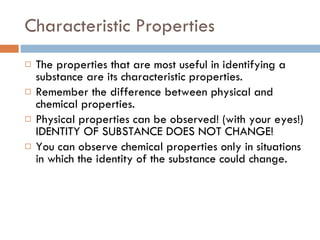
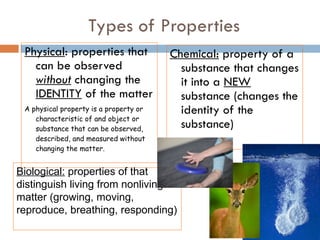
Types of Properties Physical : properties that can be observed  without  changing the  IDENTITY  of the matter A physical property is a property or characteristic of and object or substance that can be observed, described, and measured without changing the matter. Chemical:  property of a substance that changes it into a  NEW  substance (changes the identity of the substance) Biological:  properties of that distinguish living from nonliving matter (growing, moving, reproduce, breathing, responding)
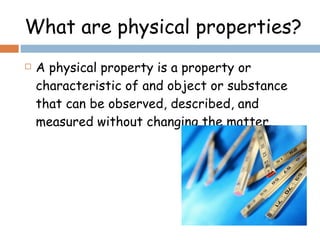
What are physical properties? A physical property is a property or characteristic of and object or substance that can be observed, described, and measured without changing the matter.
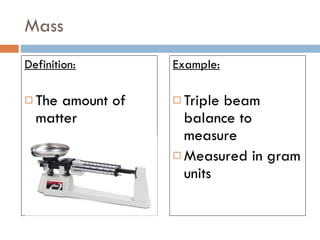
Mass Definition: The amount of matter Example: Triple beam balance to measure Measured in gram units
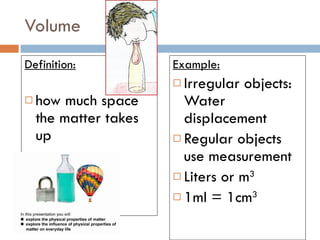
Volume Definition: how much space the matter takes up Example: Irregular objects: Water displacement Regular objects use measurement Liters or m 3 1ml = 1cm 3
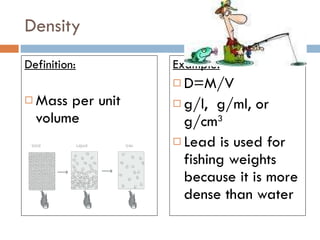
Density Definition: Mass per unit volume Example: D=M/V  g/l,  g/ml, or  g/cm 3   Lead is used for fishing weights because it is more dense than water
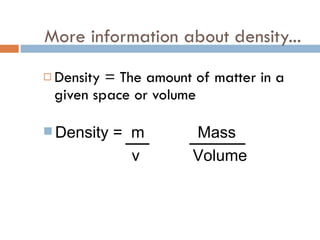
More information about density... Density = The amount of matter in a given space or volume Density =  m  Mass v  Volume
More information about density... Most substances have a unique density: Water = 1.00 g/mL Gold = 19.32 g/mL (See page 13 in your book for a bigger list) Density < 1 - The object will float in water Density > 1 – The object will sink in water
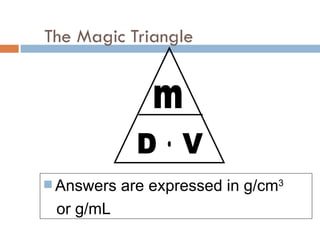
The Magic Triangle Answers are expressed in g/cm 3 or g/mL m D  V
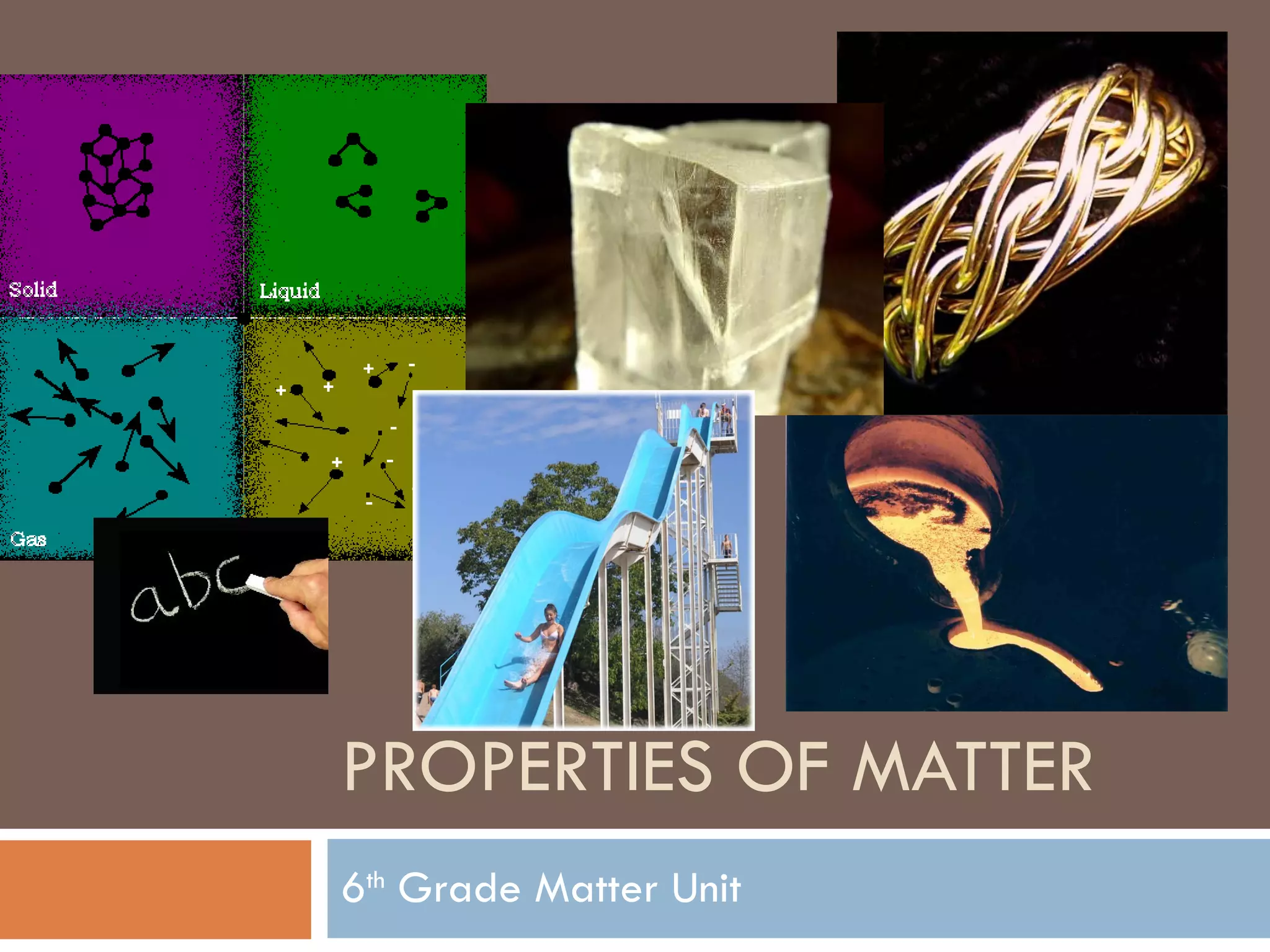
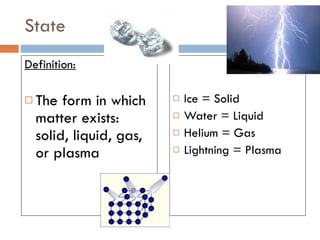
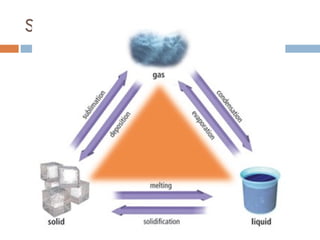
State Definition: The form in which matter exists: solid, liquid, gas, or plasma Ice = Solid Water = Liquid Helium = Gas Lightning = Plasma
Important Temperatures Melting Point:  The temperature when a solid becomes a liquid. Boiling Point:  The temperature when a liquid becomes a gas. Freezing Point:  The temperature when a liquid becomes a solid. Condensation Point:  The temperature when a gas becomes a liquid.
State
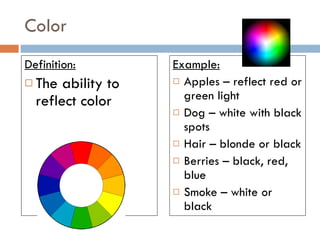
Color Definition: The ability to reflect color Example: Apples – reflect red or green light Dog – white with black spots Hair – blonde or black Berries – black, red, blue Smoke – white or black
Odor Definition: The smell or non smell of matter Odorless, flowery, spicy, nauseating, sweet
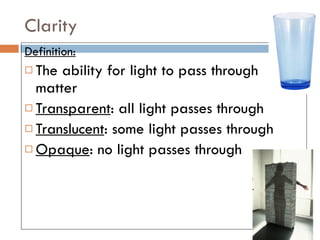
Clarity Definition: The ability for light to pass through matter Transparent : all light passes through Translucent : some light passes through  Opaque : no light passes through
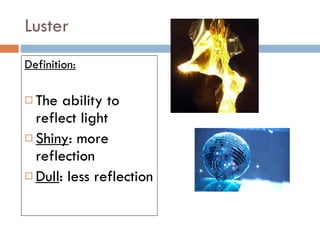
Luster Definition: The ability to reflect light Shiny : more reflection Dull : less reflection
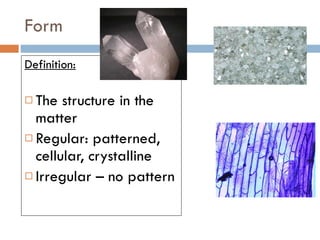
Form Definition: The structure in the matter  Regular: patterned, cellular, crystalline Irregular – no pattern
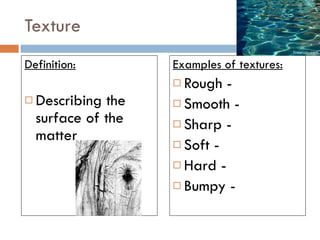
Texture Definition: Describing the surface of the matter Examples of textures: Rough - Smooth - Sharp - Soft - Hard - Bumpy -
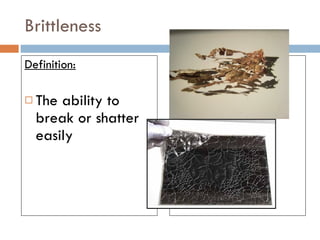
Brittleness Definition: The ability to break or shatter easily  Example:
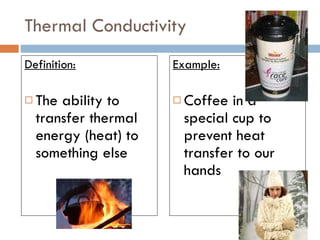
Thermal Conductivity Definition: The ability to transfer thermal energy (heat) to something else Example: Coffee in a special cup to prevent heat transfer to our hands
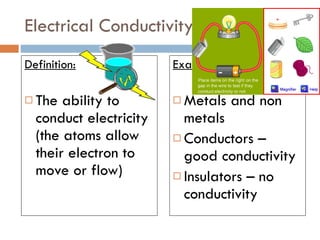
Electrical Conductivity Definition: The ability to conduct electricity (the atoms allow their electron to move or flow) Example: Metals and non metals Conductors – good conductivity  Insulators – no conductivity
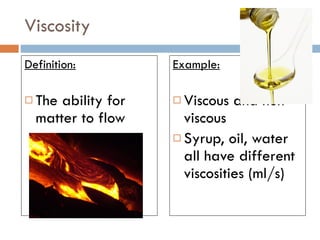
Viscosity Definition: The ability for matter to flow Example: Viscous and non- viscous Syrup, oil, water all have different viscosities (ml/s)
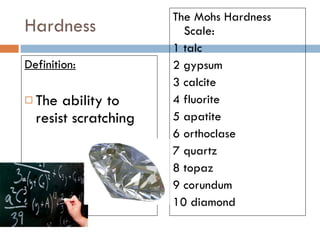
Hardness Definition: The ability to resist scratching The Mohs Hardness Scale:  1 talc  2 gypsum  3 calcite  4 fluorite  5 apatite  6 orthoclase  7 quartz  8 topaz  9 corundum  10 diamond
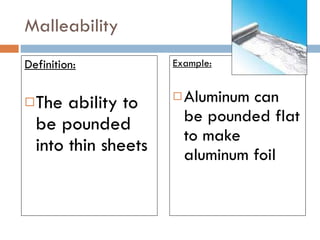
Malleability Definition: The ability to be pounded into thin sheets Example: Aluminum can be pounded flat to make aluminum foil
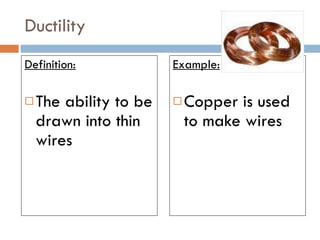
Ductility Definition: The ability to be drawn into thin wires Example: Copper is used to make wires
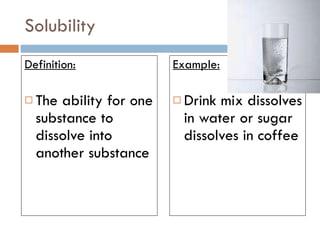
Example: Drink mix dissolves in water or sugar dissolves in coffee Solubility Definition: The ability for one substance to dissolve into another substance
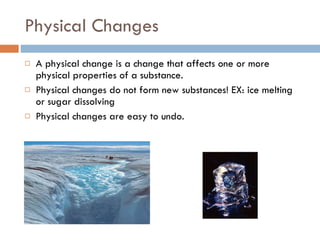
Physical Changes A physical change is a change that affects one or more physical properties of a substance. Physical changes do not form new substances! EX: ice melting or sugar dissolving Physical changes are easy to undo.
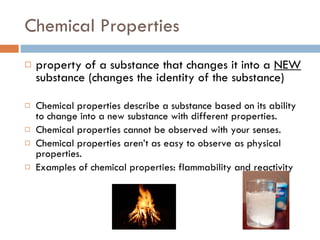
Chemical Properties property of a substance that changes it into a  NEW  substance (changes the identity of the substance) Chemical properties describe a substance based on its ability to change into a new substance with different properties. Chemical properties cannot be observed with your senses. Chemical properties aren’t as easy to observe as physical properties. Examples of chemical properties: flammability and reactivity
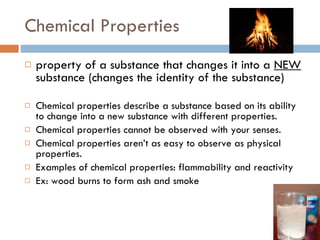
Chemical Properties property of a substance that changes it into a  NEW  substance (changes the identity of the substance) Chemical properties describe a substance based on its ability to change into a new substance with different properties. Chemical properties cannot be observed with your senses. Chemical properties aren’t as easy to observe as physical properties. Examples of chemical properties: flammability and reactivity  Ex: wood burns to form ash and smoke
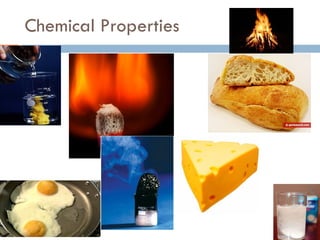
Chemical Properties
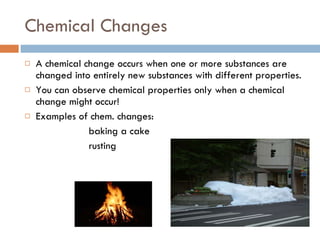
Chemical Changes A chemical change occurs when one or more substances are changed into entirely new substances with different properties. You can observe chemical properties only when a chemical change might occur! Examples of chem. changes: baking a cake rusting
Clues to chemical changes Color change Fizzing or bubbling (gas production) Heat Production of light, sound, or odor. Chemical changes are not usually reversible!

Matter Properties And Changes

  • 1.
    PROPERTIES OF MATTER6 th Grade Matter Unit
  • 2.
    Characteristic Properties Theproperties that are most useful in identifying a substance are its characteristic properties. Remember the difference between physical and chemical properties. Physical properties can be observed! (with your eyes!) IDENTITY OF SUBSTANCE DOES NOT CHANGE! You can observe chemical properties only in situations in which the identity of the substance could change.
  • 3.
    Types of PropertiesPhysical : properties that can be observed without changing the IDENTITY of the matter A physical property is a property or characteristic of and object or substance that can be observed, described, and measured without changing the matter. Chemical: property of a substance that changes it into a NEW substance (changes the identity of the substance) Biological: properties of that distinguish living from nonliving matter (growing, moving, reproduce, breathing, responding)
  • 4.
    What are physicalproperties? A physical property is a property or characteristic of and object or substance that can be observed, described, and measured without changing the matter.
  • 5.
    Mass Definition: Theamount of matter Example: Triple beam balance to measure Measured in gram units
  • 6.
    Volume Definition: howmuch space the matter takes up Example: Irregular objects: Water displacement Regular objects use measurement Liters or m 3 1ml = 1cm 3
  • 7.
    Density Definition: Massper unit volume Example: D=M/V g/l, g/ml, or g/cm 3 Lead is used for fishing weights because it is more dense than water
  • 8.
    More information aboutdensity... Density = The amount of matter in a given space or volume Density = m Mass v Volume
  • 9.
    More information aboutdensity... Most substances have a unique density: Water = 1.00 g/mL Gold = 19.32 g/mL (See page 13 in your book for a bigger list) Density < 1 - The object will float in water Density > 1 – The object will sink in water
  • 10.
    The Magic TriangleAnswers are expressed in g/cm 3 or g/mL m D V
  • 11.
    State Definition: Theform in which matter exists: solid, liquid, gas, or plasma Ice = Solid Water = Liquid Helium = Gas Lightning = Plasma
  • 12.
    Important Temperatures MeltingPoint: The temperature when a solid becomes a liquid. Boiling Point: The temperature when a liquid becomes a gas. Freezing Point: The temperature when a liquid becomes a solid. Condensation Point: The temperature when a gas becomes a liquid.
  • 13.
  • 14.
    Color Definition: Theability to reflect color Example: Apples – reflect red or green light Dog – white with black spots Hair – blonde or black Berries – black, red, blue Smoke – white or black
  • 15.
    Odor Definition: Thesmell or non smell of matter Odorless, flowery, spicy, nauseating, sweet
  • 16.
    Clarity Definition: Theability for light to pass through matter Transparent : all light passes through Translucent : some light passes through Opaque : no light passes through
  • 17.
    Luster Definition: Theability to reflect light Shiny : more reflection Dull : less reflection
  • 18.
    Form Definition: Thestructure in the matter Regular: patterned, cellular, crystalline Irregular – no pattern
  • 19.
    Texture Definition: Describingthe surface of the matter Examples of textures: Rough - Smooth - Sharp - Soft - Hard - Bumpy -
  • 20.
    Brittleness Definition: Theability to break or shatter easily Example:
  • 21.
    Thermal Conductivity Definition:The ability to transfer thermal energy (heat) to something else Example: Coffee in a special cup to prevent heat transfer to our hands
  • 22.
    Electrical Conductivity Definition:The ability to conduct electricity (the atoms allow their electron to move or flow) Example: Metals and non metals Conductors – good conductivity Insulators – no conductivity
  • 23.
    Viscosity Definition: Theability for matter to flow Example: Viscous and non- viscous Syrup, oil, water all have different viscosities (ml/s)
  • 24.
    Hardness Definition: Theability to resist scratching The Mohs Hardness Scale: 1 talc 2 gypsum 3 calcite 4 fluorite 5 apatite 6 orthoclase 7 quartz 8 topaz 9 corundum 10 diamond
  • 25.
    Malleability Definition: Theability to be pounded into thin sheets Example: Aluminum can be pounded flat to make aluminum foil
  • 26.
    Ductility Definition: Theability to be drawn into thin wires Example: Copper is used to make wires
  • 27.
    Example: Drink mixdissolves in water or sugar dissolves in coffee Solubility Definition: The ability for one substance to dissolve into another substance
  • 28.
    Physical Changes Aphysical change is a change that affects one or more physical properties of a substance. Physical changes do not form new substances! EX: ice melting or sugar dissolving Physical changes are easy to undo.
  • 29.
    Chemical Properties propertyof a substance that changes it into a NEW substance (changes the identity of the substance) Chemical properties describe a substance based on its ability to change into a new substance with different properties. Chemical properties cannot be observed with your senses. Chemical properties aren’t as easy to observe as physical properties. Examples of chemical properties: flammability and reactivity
  • 30.
    Chemical Properties propertyof a substance that changes it into a NEW substance (changes the identity of the substance) Chemical properties describe a substance based on its ability to change into a new substance with different properties. Chemical properties cannot be observed with your senses. Chemical properties aren’t as easy to observe as physical properties. Examples of chemical properties: flammability and reactivity Ex: wood burns to form ash and smoke
  • 31.
  • 32.
    Chemical Changes Achemical change occurs when one or more substances are changed into entirely new substances with different properties. You can observe chemical properties only when a chemical change might occur! Examples of chem. changes: baking a cake rusting
  • 33.
    Clues to chemicalchanges Color change Fizzing or bubbling (gas production) Heat Production of light, sound, or odor. Chemical changes are not usually reversible!