Matter—Properties and Change 
Section 3.1 Properties of Matter 
Section 3.2 Changes in Matter 
Section 3.3 Mixtures of Matter 
Section 3.4 Elements and 
Compounds 
Exit 
Click a hyperlink or folder tab to view 
the corresponding slides.
Section 3.1 Properties of Matter 
• Identify the characteristics of a substance. 
• Distinguish between physical and chemical 
properties. 
• Differentiate among the physical states of matter. 
density: a ratio that compares the mass of an 
object to its volume
Section 3.1 Properties of Matter (cont.) 
states of matter 
solid 
liquid 
gas 
vapor 
physical property 
extensive property 
intensive property 
chemical property 
Most common substances exist as 
solids, liquids, and gases, which have 
diverse physical and chemical 
properties.
Substances 
• Matter is anything that has mass and takes 
up space. 
• Matter is everything around us. 
• Matter with a uniform and unchanging 
composition is a substance.
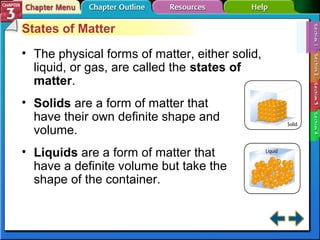
States of Matter 
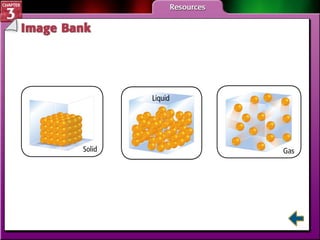
• The physical forms of matter, either solid, 
liquid, or gas, are called the states of 
matter. 
• Solids are a form of matter that 
have their own definite shape and 
volume. 
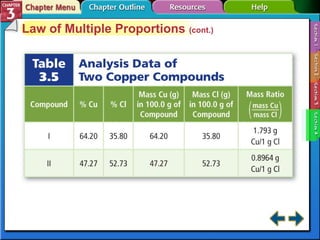
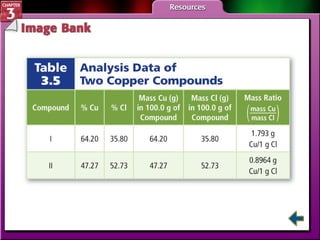
• Liquids are a form of matter that 
have a definite volume but take the 
shape of the container.
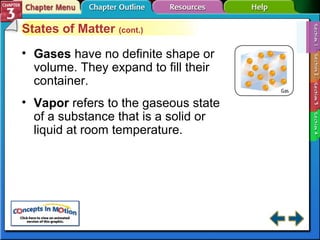
States of Matter (cont.) 
• Gases have no definite shape or 
volume. They expand to fill their 
container. 
• Vapor refers to the gaseous state 
of a substance that is a solid or 
liquid at room temperature.
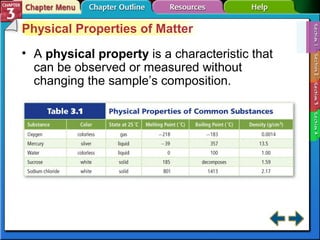
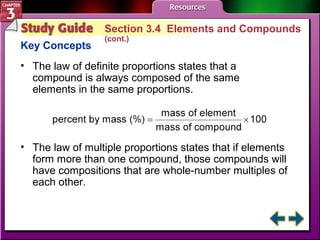
Physical Properties of Matter 
• A physical property is a characteristic that 
can be observed or measured without 
changing the sample’s composition.
Physical Properties of Matter (cont.) 
• Extensive properties are dependent on 
the amount of substance present, such as 
mass, length, or volume. 
• Intensive properties are independent of the 
amount of substance present, such as 
density.
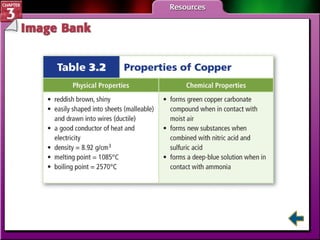
Chemical Properties of Matter 
• The ability of a substance to combine with 
or change into one or more other 
substances is called a chemical property. 
– Iron forming rust 
– Copper turning green in the air
Observing Properties of Matter 
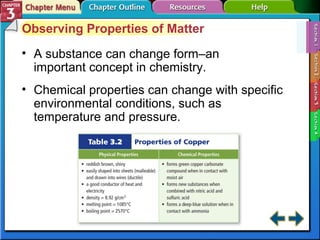
• A substance can change form–an 
important concept in chemistry. 
• Chemical properties can change with specific 
environmental conditions, such as 
temperature and pressure.
A. A 
B. B 
C. C 
D. D 
0% 0% 0% 0% 
A 
B 
C 
D 
Section 3.1 Assessment 
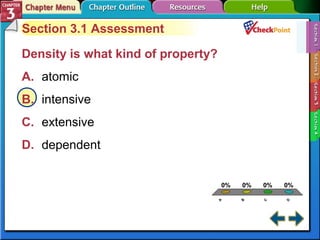
Density is what kind of property? 
A. atomic 
B. intensive 
C. extensive 
D. dependent
A. A 
B. B 
C. C 
D. D 
0% 0% 0% 0% 
A 
B 
C 
D 
Section 3.1 Assessment 
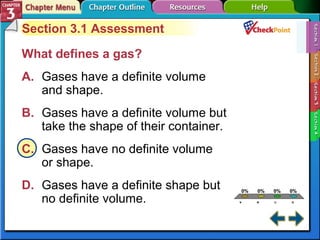
What defines a gas? 
A. Gases have a definite volume 
and shape. 
B. Gases have a definite volume but 
take the shape of their container. 
C. Gases have no definite volume 
or shape. 
D. Gases have a definite shape but 
no definite volume.
Section 3.2 Changes in Matter 
• Define physical change and list several common 
physical changes. 
• Define chemical change and list several indications 
that a chemical change has taken place. 
• Apply the law of conservation of mass to chemical 
reactions. 
observation: orderly, direct information gathering 
about a phenomenon
Section 3.2 Changes in Matter (cont.) 
physical change 
phase change 
chemical change 
law of conservation of mass 
Matter can undergo physical and 
chemical changes.
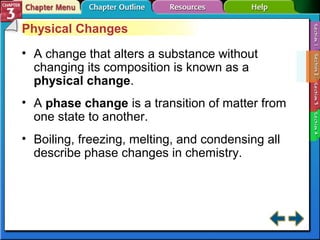
Physical Changes 
• A change that alters a substance without 
changing its composition is known as a 
physical change. 
• A phase change is a transition of matter from 
one state to another. 
• Boiling, freezing, melting, and condensing all 
describe phase changes in chemistry.
Chemical Changes 
• A change that involves one or more 
substances turning into new substances is 
called a chemical change. 
• Decomposing, rusting, exploding, burning, or 
oxidizing are all terms that describe chemical 
changes.
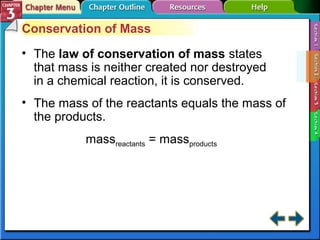
Conservation of Mass 
• The law of conservation of mass states 
that mass is neither created nor destroyed 
in a chemical reaction, it is conserved. 
• The mass of the reactants equals the mass of 
the products. 
massreactants = massproducts
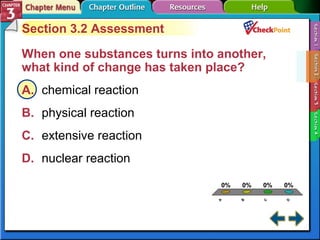
Section 3.2 Assessment 
When one substances turns into another, 
what kind of change has taken place? 
A. chemical reaction 
B. physical reaction 
C. extensive reaction 
D. nuclear reaction 
A. A 
B. B 
C. C 
D. D 
0% 0% 0% 0% 
A 
B 
C 
D
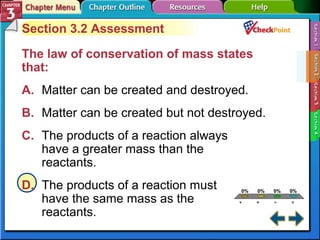
The law of conservation of mass states 
that: 
A. Matter can be created and destroyed. 
B. Matter can be created but not destroyed. 
C. The products of a reaction always 
A. A 
B. B 
C. C 
D. D 
Section 3.2 Assessment 
0% 0% 0% 0% 
A 
B 
C 
D 
have a greater mass than the 
reactants. 
D. The products of a reaction must 
have the same mass as the 
reactants.
Section 3.3 Mixtures of Matter 
• Contrast mixtures and substances. 
• Classify mixtures as homogeneous or 
heterogeneous. 
• List and describe several techniques used to 
separate mixtures. 
substance: a form of matter that has a uniform and 
unchanging composition; also known as a pure 
substance
Section 3.3 Mixtures of Matter (cont.) 
mixture 
heterogeneous mixture 
homogeneous mixture 
solution 
filtration 
distillation 
crystallization 
sublimation 
chromatography 
Most everyday matter occurs as 
mixtures—combinations of two or 
more substances.
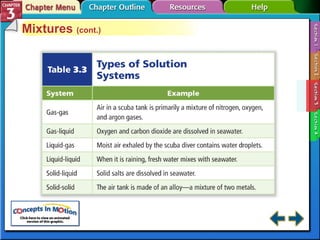
Mixtures 
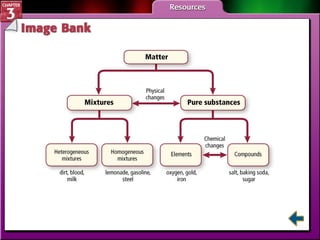
• A mixture is a combination of two or more 
pure substances in which each pure 
substance retains its individual chemical 
properties. 
• A homogenous mixture is a mixture where 
the composition is constant throughout.
Mixtures (cont.) 
• Homogeneous mixtures are also called 
solutions. 
• A heterogeneous mixture is a mixture 
where the individual substances remain 
distinct.
Mixtures (cont.)
Separating Mixtures 
• Filtration is a technique that uses a porous 
barrier to separate a solid from a liquid in a 
heterogeneous mixture. 
• Distillation is a separation technique for 
homogeneous mixtures that is based on the 
differences in boiling points of substances. 
• Crystallization is a separation technique for 
homogenous mixtures that results in the 
formation of pure solid particles from a 
solution containing the dissolved substance.
Separating Mixtures (cont.) 
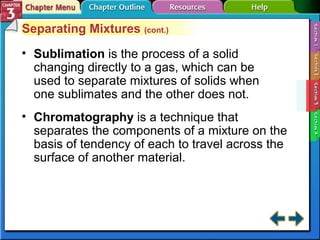
• Sublimation is the process of a solid 
changing directly to a gas, which can be 
used to separate mixtures of solids when 
one sublimates and the other does not. 
• Chromatography is a technique that 
separates the components of a mixture on the 
basis of tendency of each to travel across the 
surface of another material.
Section 3.3 Assessment 
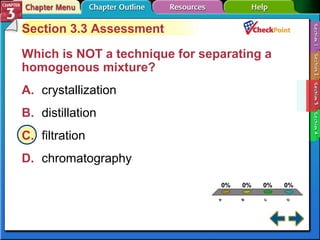
Which is NOT a technique for separating a 
homogenous mixture? 
A. crystallization 
B. distillation 
C. filtration 
D. chromatography 
A. A 
B. B 
C. C 
D. D 
0% 0% 0% 0% 
A 
B 
C 
D
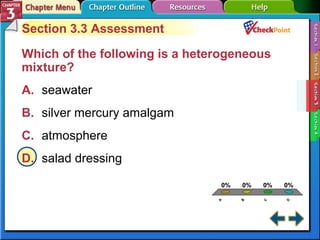
Which of the following is a heterogeneous 
mixture? 
A. seawater 
B. silver mercury amalgam 
C. atmosphere 
D. salad dressing 
A. A 
B. B 
C. C 
D. D 
Section 3.3 Assessment 
0% 0% 0% 0% 
A 
B 
C 
D
Section 3.4 Elements and Compounds 
• Distinguish between elements and compounds. 
• Describe the organization of elements in the periodic 
table. 
• Explain how all compounds obey the laws of definite 
and multiple proportions. 
proportion: the relation of one part to another or 
to the whole with respect to quantity
Section 3.4 Elements and Compounds (cont.) 
element 
periodic table 
compound 
law of definite proportions 
percent by mass 
law of multiple proportions 
A compound is a combination of two or 
more elements.
Elements 
• An element is a pure substance that cannot 
be separated into simpler substances by 
physical or chemical means. 
• 92 elements occur naturally on Earth. 
• Each element has a unique name and a one, 
two, or three-letter symbol. 
• The periodic table organizes the elements 
into a grid of horizontal rows called periods 
and vertical columns called groups.
Compounds 
• A compound is a made up of two or more 
elements combined chemically. 
• Most of the matter in the universe exists as 
compounds. 
• Table salt, NaCl, and water, H2O, are 
compounds.
Compounds (cont.) 
• Elements can never be separated. 
• Compounds can be broken into components 
by chemical means.
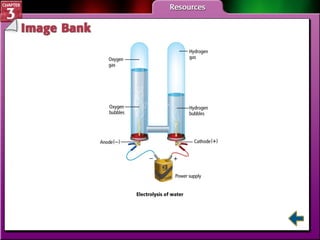
Compounds (cont.) 
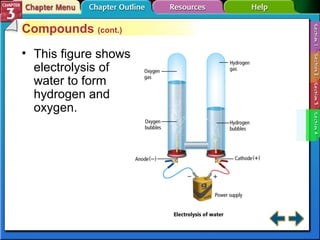
• This figure shows 
electrolysis of 
water to form 
hydrogen and 
oxygen.
Compounds (cont.) 
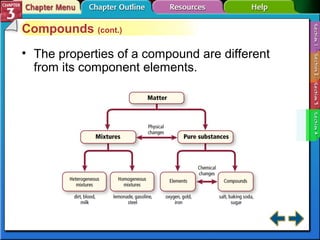
• The properties of a compound are different 
from its component elements.
Law of Definite Proportions 
• The law of definite proportions states 
that a compound is always composed of 
the same elements in the same proportion 
by mass, no matter how large or small the 
sample.
Law of Definite Proportions (cont.) 
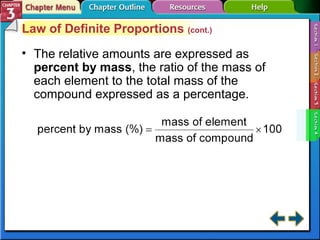
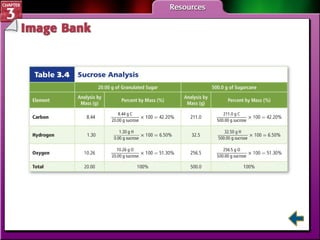
• The relative amounts are expressed as 
percent by mass, the ratio of the mass of 
each element to the total mass of the 
compound expressed as a percentage.
Law of Definite Proportions (cont.) 
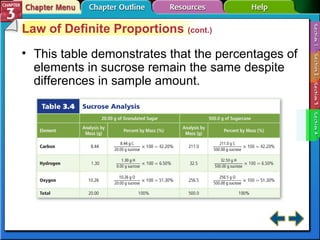
• This table demonstrates that the percentages of 
elements in sucrose remain the same despite 
differences in sample amount.
Law of Multiple Proportions 
• The law of multiple proportions states 
that when different compounds are formed 
by a combination of the same elements, 
different masses of one element combine 
with the same relative mass of the other 
element in whole number ratios. 
– H2O2 and H2O 
– Copper(I) chloride and copper(II) chloride
Law of Multiple Proportions (cont.)
A. A 
B. B 
C. C 
D. D 
0% 0% 0% 0% 
A 
B 
C 
D 
Section 3.4 Assessment 
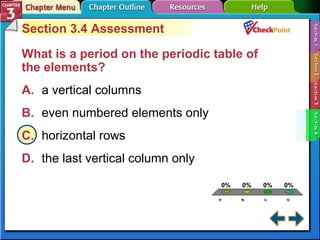
What is a period on the periodic table of 
the elements? 
A. a vertical columns 
B. even numbered elements only 
C. horizontal rows 
D. the last vertical column only
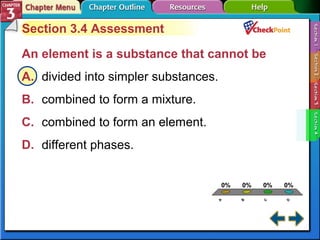
An element is a substance that cannot be 
A. divided into simpler substances. 
B. combined to form a mixture. 
C. combined to form an element. 
D. different phases. 
A. A 
B. B 
C. C 
D. D 
Section 3.4 Assessment 
0% 0% 0% 0% 
A 
B 
C 
D
Chemistry Online 
Study Guide 
Chapter Assessment 
Standardized Test Practice 
Image Bank 
Concepts in Motion
Section 3.1 Properties of Matter 
Key Concepts 
• The three common states of matter are solid, liquid, 
and gas. 
• Physical properties can be observed without altering a 
substance’s composition. 
• Chemical properties describe a substance’s ability to 
combine with or change into one or more new 
substances. 
• External conditions can affect both physical and 
chemical properties.
Section 3.2 Changes in Matter 
Key Concepts 
• A physical change alters the physical properties of a 
substance without changing its composition. 
• A chemical change, also known as a chemical reaction, 
involves a change in a substance’s composition. 
• In a chemical reaction, reactants form products. 
• The law of conservation of mass states that mass is 
neither created nor destroyed during a chemical 
reaction; it is conserved. 
massreactants = massproducts
Section 3.3 Mixtures of Matter 
Key Concepts 
• A mixture is a physical blend of two or more pure 
substances in any proportion. 
• Solutions are homogeneous mixtures. 
• Mixtures can be separated by physical means. 
Common separation techniques include filtration, 
distillation, crystallization, sublimation, and 
chromatography.
Section 3.4 Elements and Compounds 
Key Concepts 
• Elements cannot be broken down into simpler 
substances. 
• Elements are organized in the periodic table of the 
elements. 
• Compounds are chemical combinations of two or more 
elements and their properties differ from the properties 
of their component elements.
Section 3.4 Elements and Compounds 
(cont.) Key Concepts 
• The law of definite proportions states that a 
compound is always composed of the same 
elements in the same proportions. 
• The law of multiple proportions states that if elements 
form more than one compound, those compounds will 
have compositions that are whole-number multiples of 
each other.
A. A 
B. B 
C. C 
D. D 
0% 0% 0% 0% 
A 
B 
C 
D 
Which of the following is NOT a physical 
property of water? 
A. Ice melts at 0°C. 
B. Water boils at 100. 
C. Water reacts violently with 
pure sodium. 
D. Water is a liquid at room 
temperature.
28.0 grams of nitrogen gas reacts 
completely with 6.0 grams of hydrogen to 
form 34.0 grams of ammonia. What does 
this demonstrate? 
A. the law of conservation of energy 
B. sublimation 
C. distillation 
D. the law of conservation of mass 
A. A 
B. B 
C. C 
D. D 
0% 0% 0% 0% 
A 
B 
C 
D
A. A 
B. B 
C. C 
D. D 
0% 0% 0% 0% 
A 
B 
C 
D 
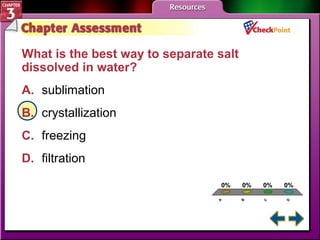
What is the best way to separate salt 
dissolved in water? 
A. sublimation 
B. crystallization 
C. freezing 
D. filtration
A. A 
B. B 
C. C 
D. D 
0% 0% 0% 0% 
A 
B 
C 
D 
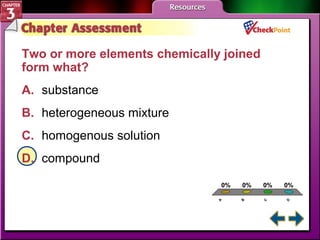
Two or more elements chemically joined 
form what? 
A. substance 
B. heterogeneous mixture 
C. homogenous solution 
D. compound
A. A 
B. B 
C. C 
D. D 
0% 0% 0% 0% 
A 
B 
C 
D 
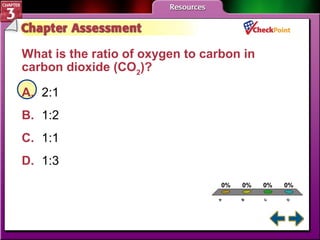
What is the ratio of oxygen to carbon in 
carbon dioxide (CO2)? 
A. 2:1 
B. 1:2 
C. 1:1 
D. 1:3
A. A 
B. B 
C. C 
D. D 
0% 0% 0% 0% 
A 
B 
C 
D 
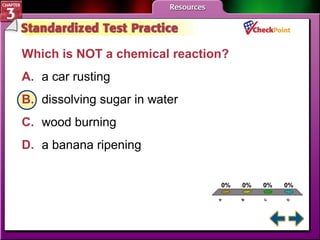
Which is NOT a chemical reaction? 
A. a car rusting 
B. dissolving sugar in water 
C. wood burning 
D. a banana ripening
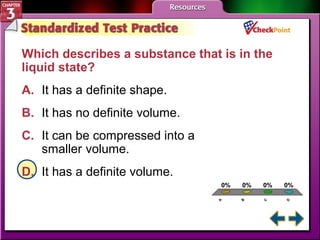
Which describes a substance that is in the 
liquid state? 
A. It has a definite shape. 
B. It has no definite volume. 
C. It can be compressed into a 
A. A 
B. B 
C. C 
D. D 
0% 0% 0% 0% 
A 
B 
C 
D 
smaller volume. 
D. It has a definite volume.
A. A 
B. B 
C. C 
D. D 
0% 0% 0% 0% 
A 
B 
C 
D 
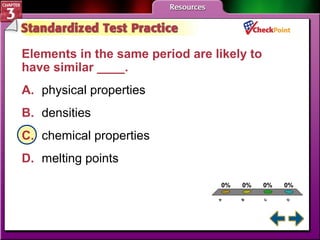
Elements in the same period are likely to 
have similar ____. 
A. physical properties 
B. densities 
C. chemical properties 
D. melting points
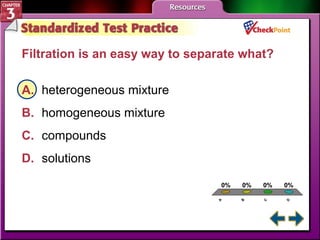
Filtration is an easy way to separate what? 
A. A 
B. B 
C. C 
D. D 
0% 0% 0% 0% 
A 
B 
C 
D 
A. heterogeneous mixture 
B. homogeneous mixture 
C. compounds 
D. solutions
A. A 
B. B 
C. C 
D. D 
0% 0% 0% 0% 
A 
B 
C 
D 
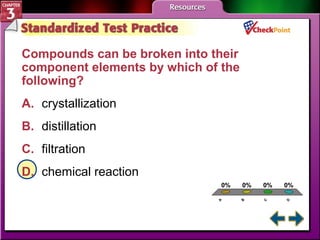
Compounds can be broken into their 
component elements by which of the 
following? 
A. crystallization 
B. distillation 
C. filtration 
D. chemical reaction
Click on an image to enlarge.
3.4 Three Common States of Matter 
3.10 Conservation of Mass 
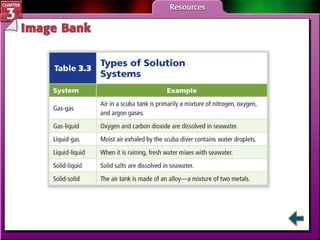
3.3 Types of Solution Systems
Click any of the background top tabs 
to display the respective folder. 
Within the Chapter Outline, clicking a section 
tab on the right side of the screen will bring you 
to the first slide in each respective section. 
Simple navigation buttons will allow you to 
progress to the next slide or the previous slide. 
The Chapter Resources Menu will allow you to 
access chapter specific resources from the Chapter 
Menu or any Chapter Outline slide. From within any 
feature, click the Resources tab to return to this 
slide. 
The “Return” button will allow you to return to the 
slide that you were viewing when you clicked either 
the Resources or Help tab. 
To exit the presentation, click the Exit button on the Chapter Menu slide or 
hit Escape [Esc] on your keyboards while viewing any Chapter Outline slide.
This slide is intentionally blank.

chemistry chapter 03 (all sections in one powerpoint)

  • 2.
    Matter—Properties and Change Section 3.1 Properties of Matter Section 3.2 Changes in Matter Section 3.3 Mixtures of Matter Section 3.4 Elements and Compounds Exit Click a hyperlink or folder tab to view the corresponding slides.
  • 3.
    Section 3.1 Propertiesof Matter • Identify the characteristics of a substance. • Distinguish between physical and chemical properties. • Differentiate among the physical states of matter. density: a ratio that compares the mass of an object to its volume
  • 4.
    Section 3.1 Propertiesof Matter (cont.) states of matter solid liquid gas vapor physical property extensive property intensive property chemical property Most common substances exist as solids, liquids, and gases, which have diverse physical and chemical properties.
  • 5.
    Substances • Matteris anything that has mass and takes up space. • Matter is everything around us. • Matter with a uniform and unchanging composition is a substance.
  • 6.
    States of Matter • The physical forms of matter, either solid, liquid, or gas, are called the states of matter. • Solids are a form of matter that have their own definite shape and volume. • Liquids are a form of matter that have a definite volume but take the shape of the container.
  • 7.
    States of Matter(cont.) • Gases have no definite shape or volume. They expand to fill their container. • Vapor refers to the gaseous state of a substance that is a solid or liquid at room temperature.
  • 8.
    Physical Properties ofMatter • A physical property is a characteristic that can be observed or measured without changing the sample’s composition.
  • 9.
    Physical Properties ofMatter (cont.) • Extensive properties are dependent on the amount of substance present, such as mass, length, or volume. • Intensive properties are independent of the amount of substance present, such as density.
  • 10.
    Chemical Properties ofMatter • The ability of a substance to combine with or change into one or more other substances is called a chemical property. – Iron forming rust – Copper turning green in the air
  • 11.
    Observing Properties ofMatter • A substance can change form–an important concept in chemistry. • Chemical properties can change with specific environmental conditions, such as temperature and pressure.
  • 12.
    A. A B.B C. C D. D 0% 0% 0% 0% A B C D Section 3.1 Assessment Density is what kind of property? A. atomic B. intensive C. extensive D. dependent
  • 13.
    A. A B.B C. C D. D 0% 0% 0% 0% A B C D Section 3.1 Assessment What defines a gas? A. Gases have a definite volume and shape. B. Gases have a definite volume but take the shape of their container. C. Gases have no definite volume or shape. D. Gases have a definite shape but no definite volume.
  • 15.
    Section 3.2 Changesin Matter • Define physical change and list several common physical changes. • Define chemical change and list several indications that a chemical change has taken place. • Apply the law of conservation of mass to chemical reactions. observation: orderly, direct information gathering about a phenomenon
  • 16.
    Section 3.2 Changesin Matter (cont.) physical change phase change chemical change law of conservation of mass Matter can undergo physical and chemical changes.
  • 17.
    Physical Changes •A change that alters a substance without changing its composition is known as a physical change. • A phase change is a transition of matter from one state to another. • Boiling, freezing, melting, and condensing all describe phase changes in chemistry.
  • 18.
    Chemical Changes •A change that involves one or more substances turning into new substances is called a chemical change. • Decomposing, rusting, exploding, burning, or oxidizing are all terms that describe chemical changes.
  • 19.
    Conservation of Mass • The law of conservation of mass states that mass is neither created nor destroyed in a chemical reaction, it is conserved. • The mass of the reactants equals the mass of the products. massreactants = massproducts
  • 20.
    Section 3.2 Assessment When one substances turns into another, what kind of change has taken place? A. chemical reaction B. physical reaction C. extensive reaction D. nuclear reaction A. A B. B C. C D. D 0% 0% 0% 0% A B C D
  • 21.
    The law ofconservation of mass states that: A. Matter can be created and destroyed. B. Matter can be created but not destroyed. C. The products of a reaction always A. A B. B C. C D. D Section 3.2 Assessment 0% 0% 0% 0% A B C D have a greater mass than the reactants. D. The products of a reaction must have the same mass as the reactants.
  • 23.
    Section 3.3 Mixturesof Matter • Contrast mixtures and substances. • Classify mixtures as homogeneous or heterogeneous. • List and describe several techniques used to separate mixtures. substance: a form of matter that has a uniform and unchanging composition; also known as a pure substance
  • 24.
    Section 3.3 Mixturesof Matter (cont.) mixture heterogeneous mixture homogeneous mixture solution filtration distillation crystallization sublimation chromatography Most everyday matter occurs as mixtures—combinations of two or more substances.
  • 25.
    Mixtures • Amixture is a combination of two or more pure substances in which each pure substance retains its individual chemical properties. • A homogenous mixture is a mixture where the composition is constant throughout.
  • 26.
    Mixtures (cont.) •Homogeneous mixtures are also called solutions. • A heterogeneous mixture is a mixture where the individual substances remain distinct.
  • 27.
  • 28.
    Separating Mixtures •Filtration is a technique that uses a porous barrier to separate a solid from a liquid in a heterogeneous mixture. • Distillation is a separation technique for homogeneous mixtures that is based on the differences in boiling points of substances. • Crystallization is a separation technique for homogenous mixtures that results in the formation of pure solid particles from a solution containing the dissolved substance.
  • 29.
    Separating Mixtures (cont.) • Sublimation is the process of a solid changing directly to a gas, which can be used to separate mixtures of solids when one sublimates and the other does not. • Chromatography is a technique that separates the components of a mixture on the basis of tendency of each to travel across the surface of another material.
  • 30.
    Section 3.3 Assessment Which is NOT a technique for separating a homogenous mixture? A. crystallization B. distillation C. filtration D. chromatography A. A B. B C. C D. D 0% 0% 0% 0% A B C D
  • 31.
    Which of thefollowing is a heterogeneous mixture? A. seawater B. silver mercury amalgam C. atmosphere D. salad dressing A. A B. B C. C D. D Section 3.3 Assessment 0% 0% 0% 0% A B C D
  • 33.
    Section 3.4 Elementsand Compounds • Distinguish between elements and compounds. • Describe the organization of elements in the periodic table. • Explain how all compounds obey the laws of definite and multiple proportions. proportion: the relation of one part to another or to the whole with respect to quantity
  • 34.
    Section 3.4 Elementsand Compounds (cont.) element periodic table compound law of definite proportions percent by mass law of multiple proportions A compound is a combination of two or more elements.
  • 35.
    Elements • Anelement is a pure substance that cannot be separated into simpler substances by physical or chemical means. • 92 elements occur naturally on Earth. • Each element has a unique name and a one, two, or three-letter symbol. • The periodic table organizes the elements into a grid of horizontal rows called periods and vertical columns called groups.
  • 36.
    Compounds • Acompound is a made up of two or more elements combined chemically. • Most of the matter in the universe exists as compounds. • Table salt, NaCl, and water, H2O, are compounds.
  • 37.
    Compounds (cont.) •Elements can never be separated. • Compounds can be broken into components by chemical means.
  • 38.
    Compounds (cont.) •This figure shows electrolysis of water to form hydrogen and oxygen.
  • 39.
    Compounds (cont.) •The properties of a compound are different from its component elements.
  • 40.
    Law of DefiniteProportions • The law of definite proportions states that a compound is always composed of the same elements in the same proportion by mass, no matter how large or small the sample.
  • 41.
    Law of DefiniteProportions (cont.) • The relative amounts are expressed as percent by mass, the ratio of the mass of each element to the total mass of the compound expressed as a percentage.
  • 42.
    Law of DefiniteProportions (cont.) • This table demonstrates that the percentages of elements in sucrose remain the same despite differences in sample amount.
  • 43.
    Law of MultipleProportions • The law of multiple proportions states that when different compounds are formed by a combination of the same elements, different masses of one element combine with the same relative mass of the other element in whole number ratios. – H2O2 and H2O – Copper(I) chloride and copper(II) chloride
  • 44.
    Law of MultipleProportions (cont.)
  • 45.
    A. A B.B C. C D. D 0% 0% 0% 0% A B C D Section 3.4 Assessment What is a period on the periodic table of the elements? A. a vertical columns B. even numbered elements only C. horizontal rows D. the last vertical column only
  • 46.
    An element isa substance that cannot be A. divided into simpler substances. B. combined to form a mixture. C. combined to form an element. D. different phases. A. A B. B C. C D. D Section 3.4 Assessment 0% 0% 0% 0% A B C D
  • 48.
    Chemistry Online StudyGuide Chapter Assessment Standardized Test Practice Image Bank Concepts in Motion
  • 49.
    Section 3.1 Propertiesof Matter Key Concepts • The three common states of matter are solid, liquid, and gas. • Physical properties can be observed without altering a substance’s composition. • Chemical properties describe a substance’s ability to combine with or change into one or more new substances. • External conditions can affect both physical and chemical properties.
  • 50.
    Section 3.2 Changesin Matter Key Concepts • A physical change alters the physical properties of a substance without changing its composition. • A chemical change, also known as a chemical reaction, involves a change in a substance’s composition. • In a chemical reaction, reactants form products. • The law of conservation of mass states that mass is neither created nor destroyed during a chemical reaction; it is conserved. massreactants = massproducts
  • 51.
    Section 3.3 Mixturesof Matter Key Concepts • A mixture is a physical blend of two or more pure substances in any proportion. • Solutions are homogeneous mixtures. • Mixtures can be separated by physical means. Common separation techniques include filtration, distillation, crystallization, sublimation, and chromatography.
  • 52.
    Section 3.4 Elementsand Compounds Key Concepts • Elements cannot be broken down into simpler substances. • Elements are organized in the periodic table of the elements. • Compounds are chemical combinations of two or more elements and their properties differ from the properties of their component elements.
  • 53.
    Section 3.4 Elementsand Compounds (cont.) Key Concepts • The law of definite proportions states that a compound is always composed of the same elements in the same proportions. • The law of multiple proportions states that if elements form more than one compound, those compounds will have compositions that are whole-number multiples of each other.
  • 54.
    A. A B.B C. C D. D 0% 0% 0% 0% A B C D Which of the following is NOT a physical property of water? A. Ice melts at 0°C. B. Water boils at 100. C. Water reacts violently with pure sodium. D. Water is a liquid at room temperature.
  • 55.
    28.0 grams ofnitrogen gas reacts completely with 6.0 grams of hydrogen to form 34.0 grams of ammonia. What does this demonstrate? A. the law of conservation of energy B. sublimation C. distillation D. the law of conservation of mass A. A B. B C. C D. D 0% 0% 0% 0% A B C D
  • 56.
    A. A B.B C. C D. D 0% 0% 0% 0% A B C D What is the best way to separate salt dissolved in water? A. sublimation B. crystallization C. freezing D. filtration
  • 57.
    A. A B.B C. C D. D 0% 0% 0% 0% A B C D Two or more elements chemically joined form what? A. substance B. heterogeneous mixture C. homogenous solution D. compound
  • 58.
    A. A B.B C. C D. D 0% 0% 0% 0% A B C D What is the ratio of oxygen to carbon in carbon dioxide (CO2)? A. 2:1 B. 1:2 C. 1:1 D. 1:3
  • 59.
    A. A B.B C. C D. D 0% 0% 0% 0% A B C D Which is NOT a chemical reaction? A. a car rusting B. dissolving sugar in water C. wood burning D. a banana ripening
  • 60.
    Which describes asubstance that is in the liquid state? A. It has a definite shape. B. It has no definite volume. C. It can be compressed into a A. A B. B C. C D. D 0% 0% 0% 0% A B C D smaller volume. D. It has a definite volume.
  • 61.
    A. A B.B C. C D. D 0% 0% 0% 0% A B C D Elements in the same period are likely to have similar ____. A. physical properties B. densities C. chemical properties D. melting points
  • 62.
    Filtration is aneasy way to separate what? A. A B. B C. C D. D 0% 0% 0% 0% A B C D A. heterogeneous mixture B. homogeneous mixture C. compounds D. solutions
  • 63.
    A. A B.B C. C D. D 0% 0% 0% 0% A B C D Compounds can be broken into their component elements by which of the following? A. crystallization B. distillation C. filtration D. chemical reaction
  • 64.
    Click on animage to enlarge.
  • 73.
    3.4 Three CommonStates of Matter 3.10 Conservation of Mass 3.3 Types of Solution Systems
  • 74.
    Click any ofthe background top tabs to display the respective folder. Within the Chapter Outline, clicking a section tab on the right side of the screen will bring you to the first slide in each respective section. Simple navigation buttons will allow you to progress to the next slide or the previous slide. The Chapter Resources Menu will allow you to access chapter specific resources from the Chapter Menu or any Chapter Outline slide. From within any feature, click the Resources tab to return to this slide. The “Return” button will allow you to return to the slide that you were viewing when you clicked either the Resources or Help tab. To exit the presentation, click the Exit button on the Chapter Menu slide or hit Escape [Esc] on your keyboards while viewing any Chapter Outline slide.
  • 75.
    This slide isintentionally blank.