
Chapter 2 – Matter & Change
    By Kendon Smith – Columbia Central HS – Brooklyn, MI
Chapter 2 – Matter and Change

I.     Properties of Matter

     1. Matter is defined as anything that has
          mass and volume.

       a. Mass: the amount of matter an object
            contains.

       b. Volume: the amount of space an object
                     occupies.
2. Describing Matter
a. Extensive Property: property that depends
     on the amount of matter in a sample
b. Intensive Property: property that depends
      on the type of matter in a sample

Examples: Identify the following properties of
          a sample as extensive or intensive.

Mass: ___    Color: ___    Flammability: ___

Volume: ___ Density: ___ Melting Point: ___
3.     Identifying Substances
     a. Substance: matter that has uniform and
                     definite composition.
      - Uniform means it is the same throughout
          the sample.
      - Definite composition means chemically
          the same all over the planet!

Examples: Water? Sand? Copper? Salt?
b. Physical Property – a quality or condition
  of a substance that can be measured or

     observed without changing a
     substance’s composition.

Examples:
color, solubility, odor, hardness, density,
  melting point, boiling point, physical state,
  mass, volume
4.    States of Matter
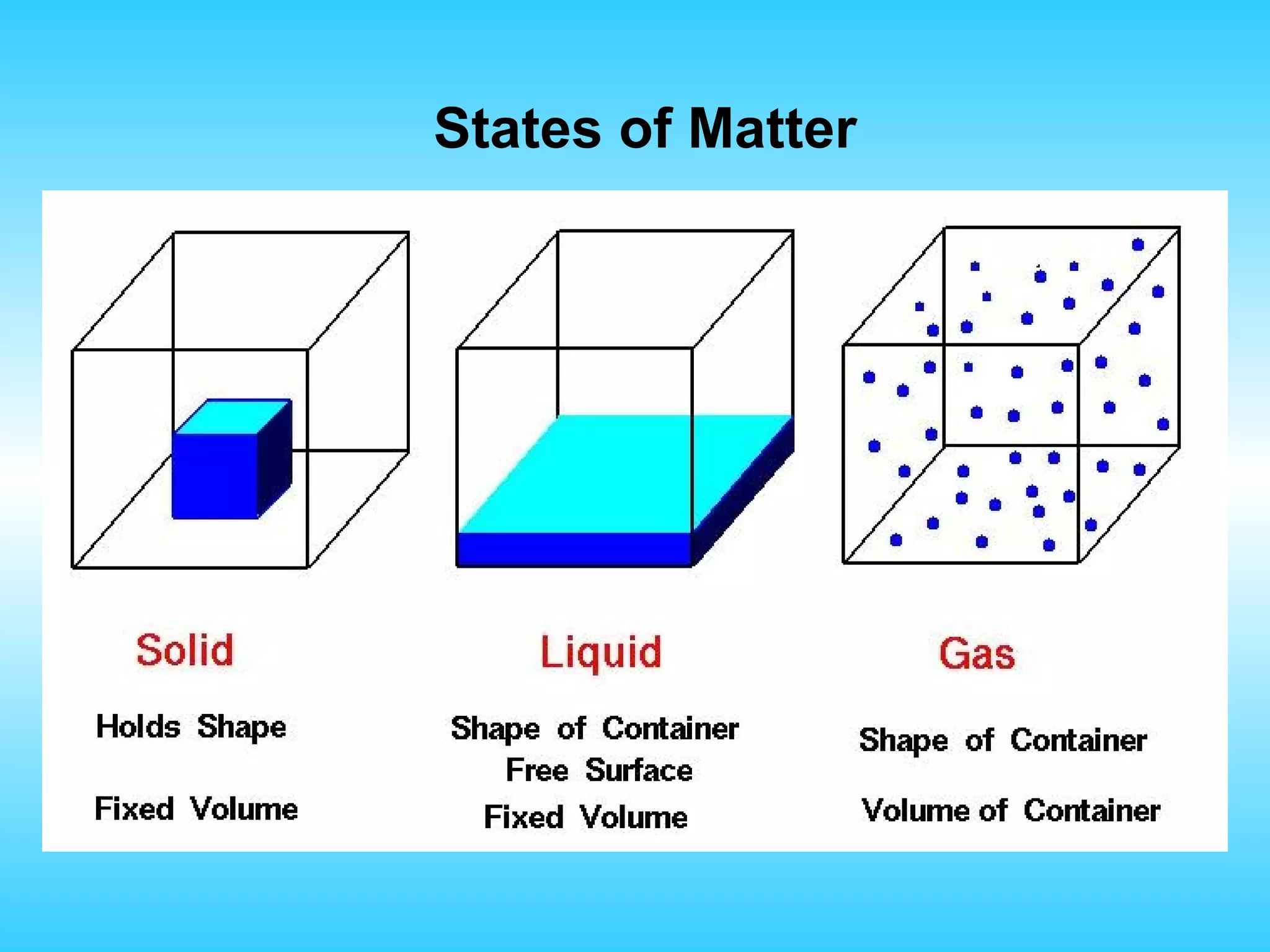
A. Solids – form of matter with definite shape
               and definite volume
     - Particles are packed tightly together

B. Liquids – form of matter with indefinite
                shape and definite volume
     - Liquids take the shape of their container
     - Particles in liquids are almost incompressible
     - Particles in liquids usually expand slightly
          when heated.
     - Particles in a liquid are close together, but
          can flow past each other
4.     States of Matter
C. Gases – form of matter with indefinite
              shape and indefinite volume
      - Particles in gases very far apart
           compared to liquids and solids.
      - Particles in gases are easily compressed,
           pushing closer together.
     * Vapors – Gaseous substances that are
                  liquids or solids at room
                  temperature.
States of Matter
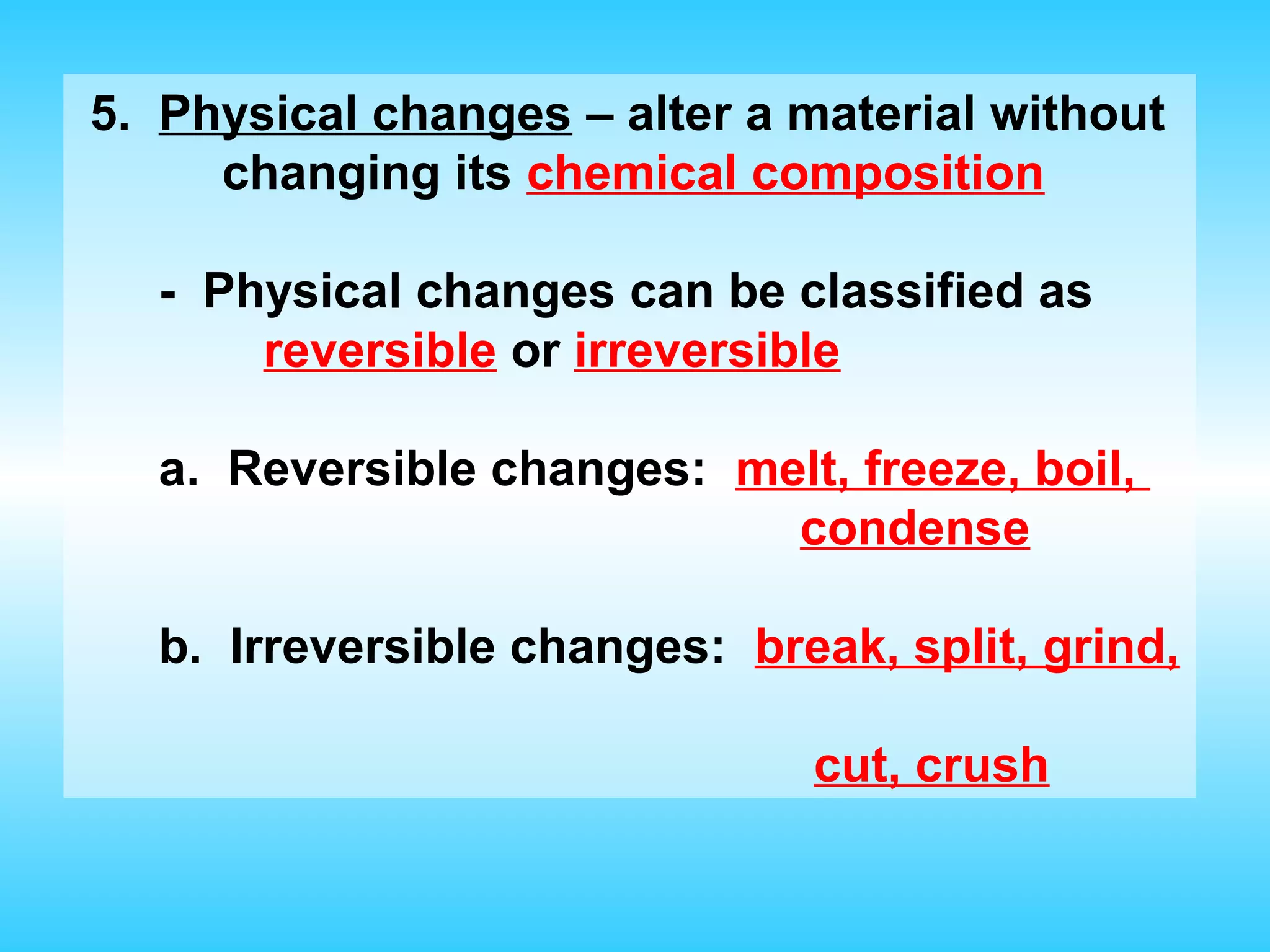
5. Physical changes – alter a material without
     changing its chemical composition

  - Physical changes can be classified as
      reversible or irreversible

  a. Reversible changes: melt, freeze, boil,
                           condense

  b. Irreversible changes: break, split, grind,

                              cut, crush
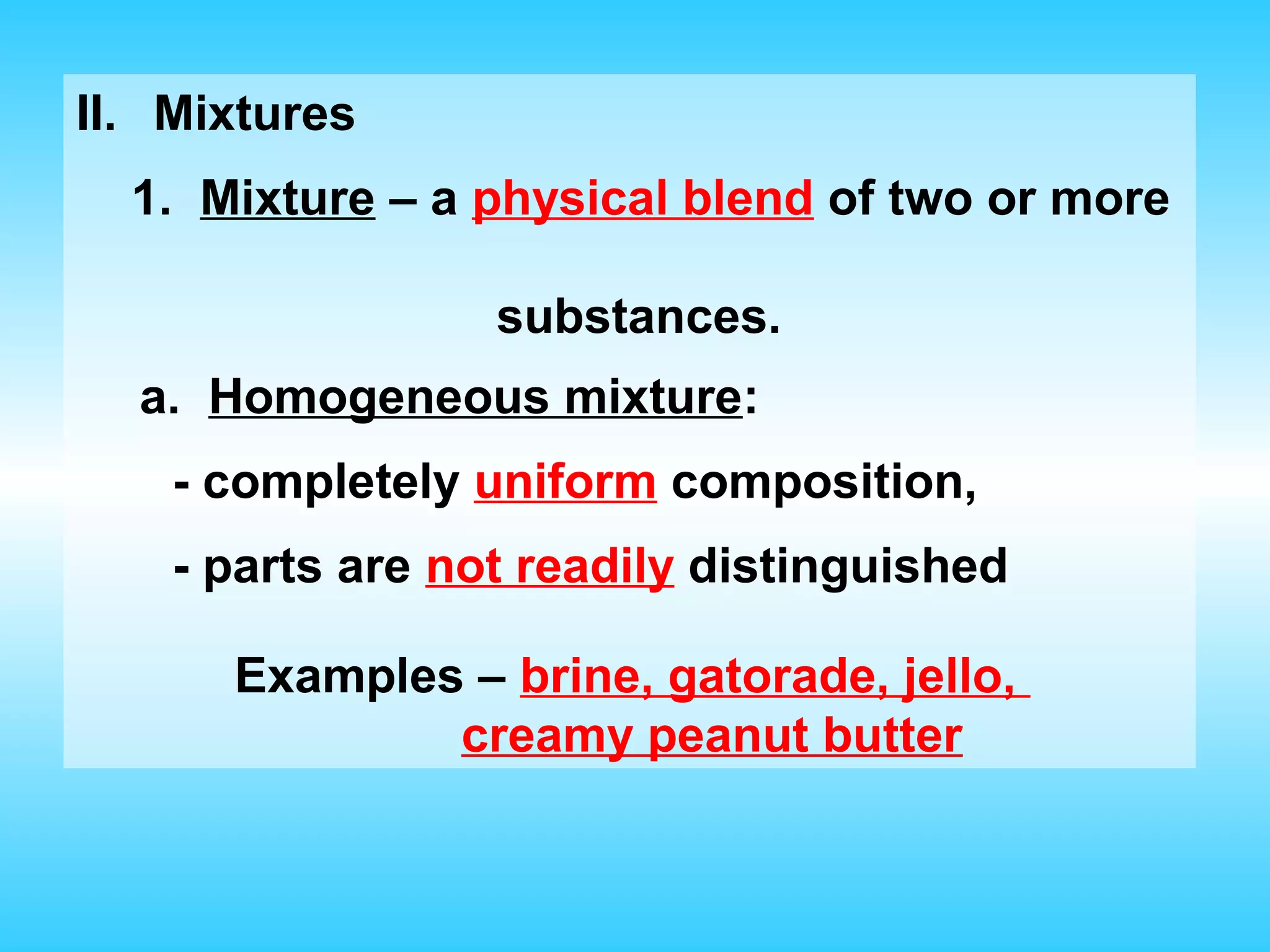
II. Mixtures
  1. Mixture – a physical blend of two or more

                  substances.
  a. Homogeneous mixture:
    - completely uniform composition,
    - parts are not readily distinguished

      Examples – brine, gatorade, jello,
              creamy peanut butter
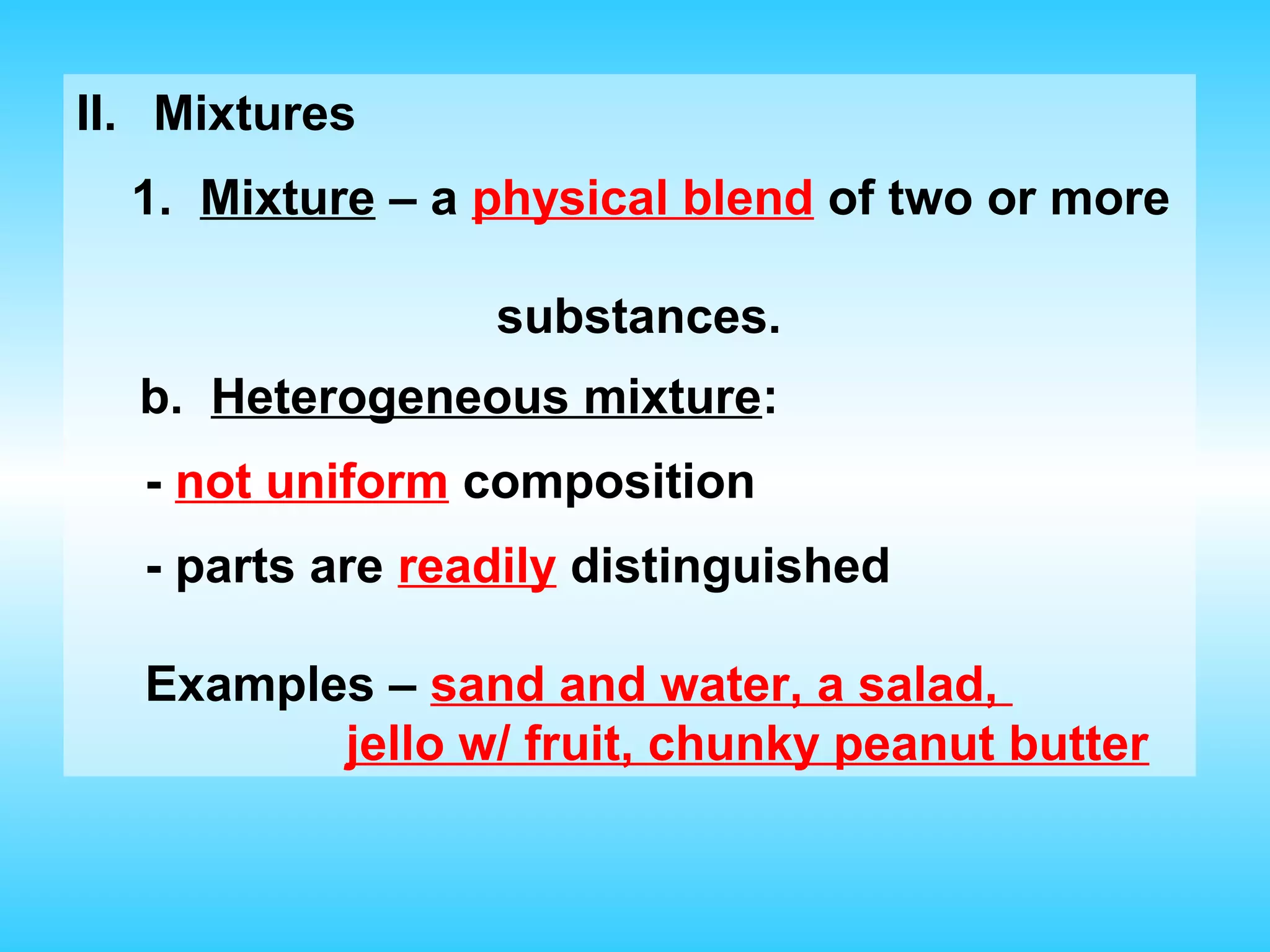
II. Mixtures
  1. Mixture – a physical blend of two or more

                 substances.
  b. Heterogeneous mixture:
  - not uniform composition
  - parts are readily distinguished

  Examples – sand and water, a salad,
         jello w/ fruit, chunky peanut butter
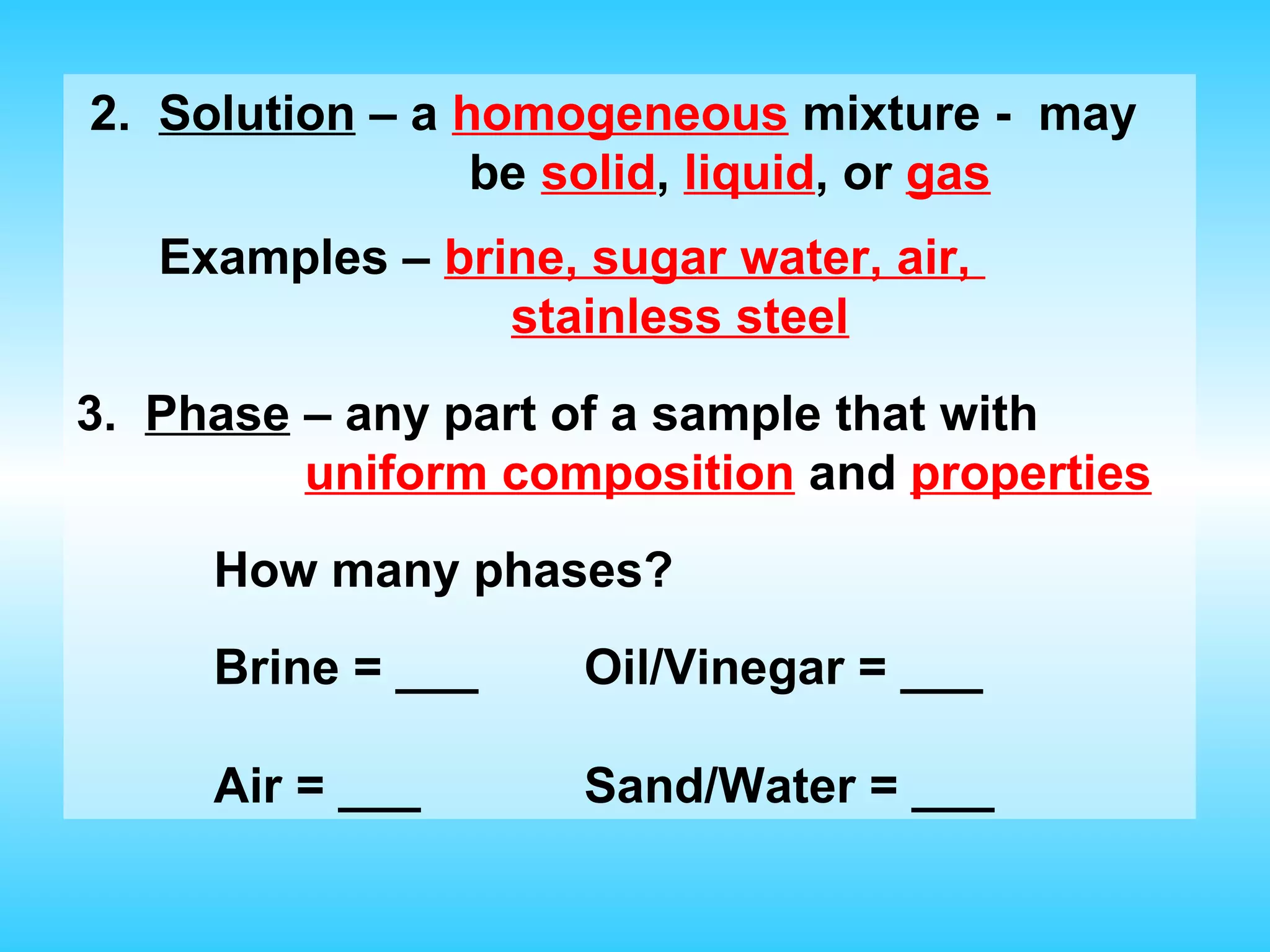
2. Solution – a homogeneous mixture - may
                 be solid, liquid, or gas
   Examples – brine, sugar water, air,
                 stainless steel
3. Phase – any part of a sample that with
         uniform composition and properties
     How many phases?
     Brine = ___     Oil/Vinegar = ___

     Air = ___       Sand/Water = ___
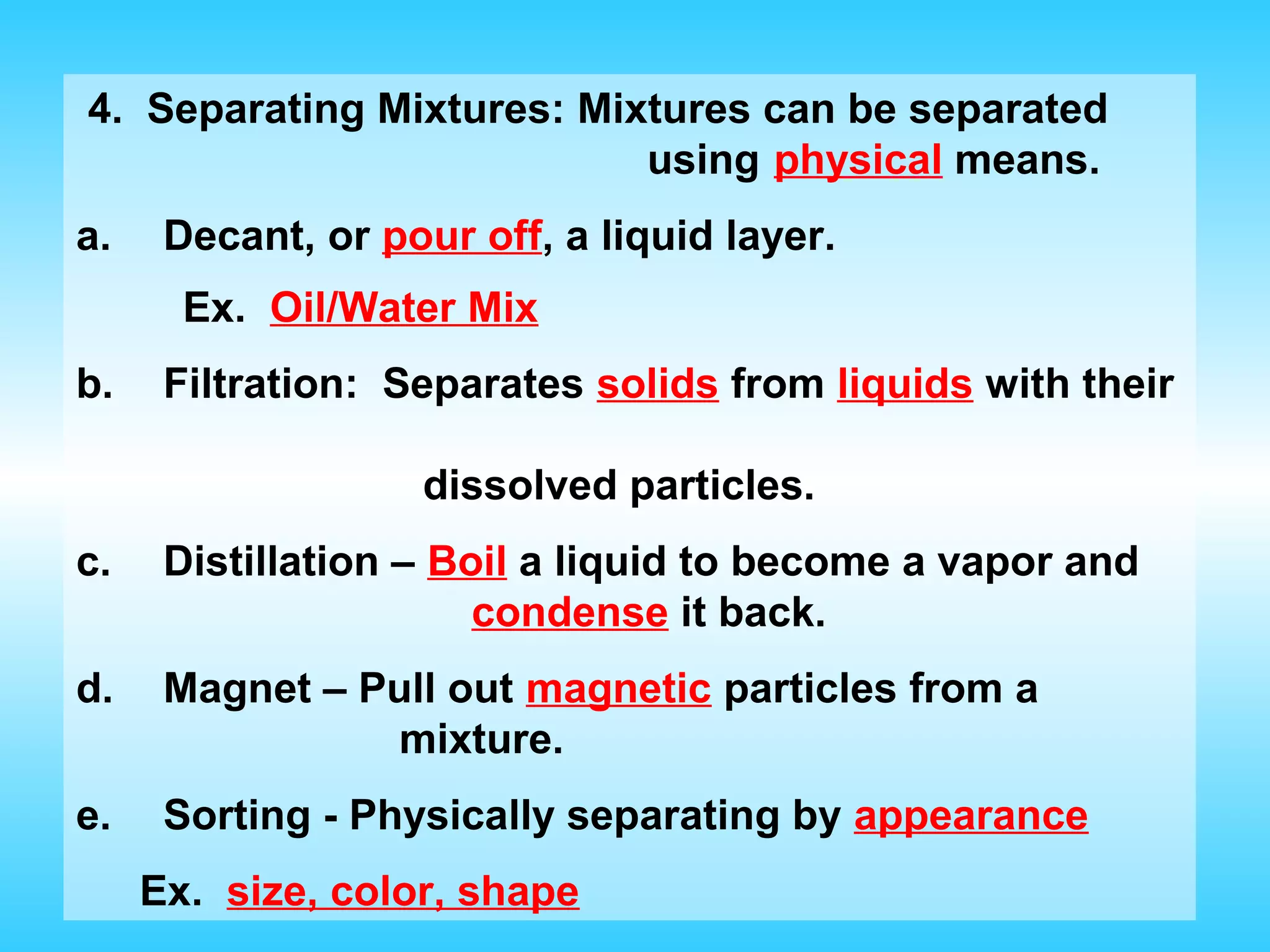
4. Separating Mixtures: Mixtures can be separated
                           using physical means.
a.    Decant, or pour off, a liquid layer.
       Ex. Oil/Water Mix
b.    Filtration: Separates solids from liquids with their

                   dissolved particles.
c.    Distillation – Boil a liquid to become a vapor and
                       condense it back.
d.    Magnet – Pull out magnetic particles from a
                mixture.
e.    Sorting - Physically separating by appearance
     Ex. size, color, shape
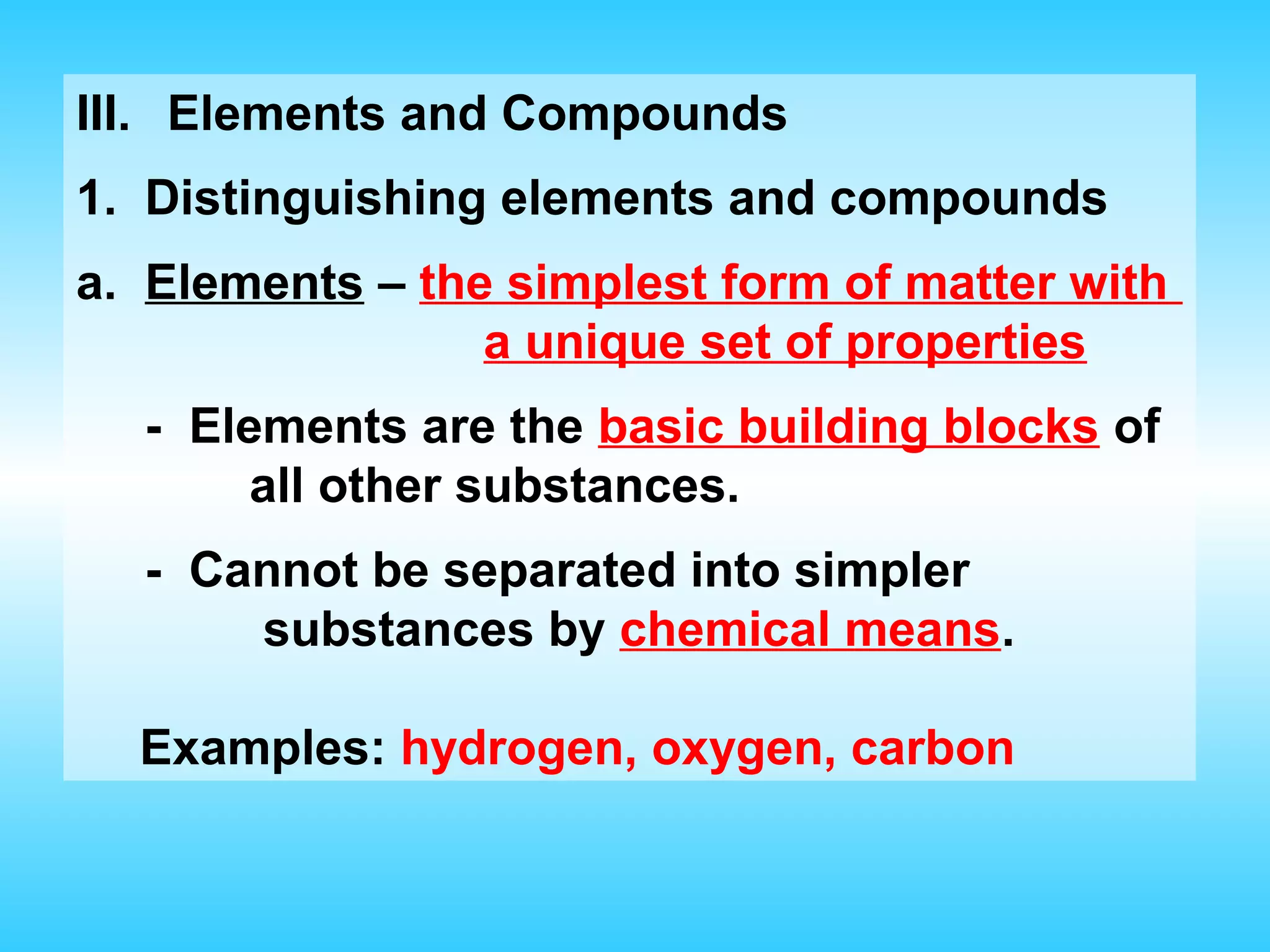
III. Elements and Compounds
1. Distinguishing elements and compounds
a. Elements – the simplest form of matter with
                 a unique set of properties
  - Elements are the basic building blocks of
       all other substances.
  - Cannot be separated into simpler
      substances by chemical means.

  Examples: hydrogen, oxygen, carbon
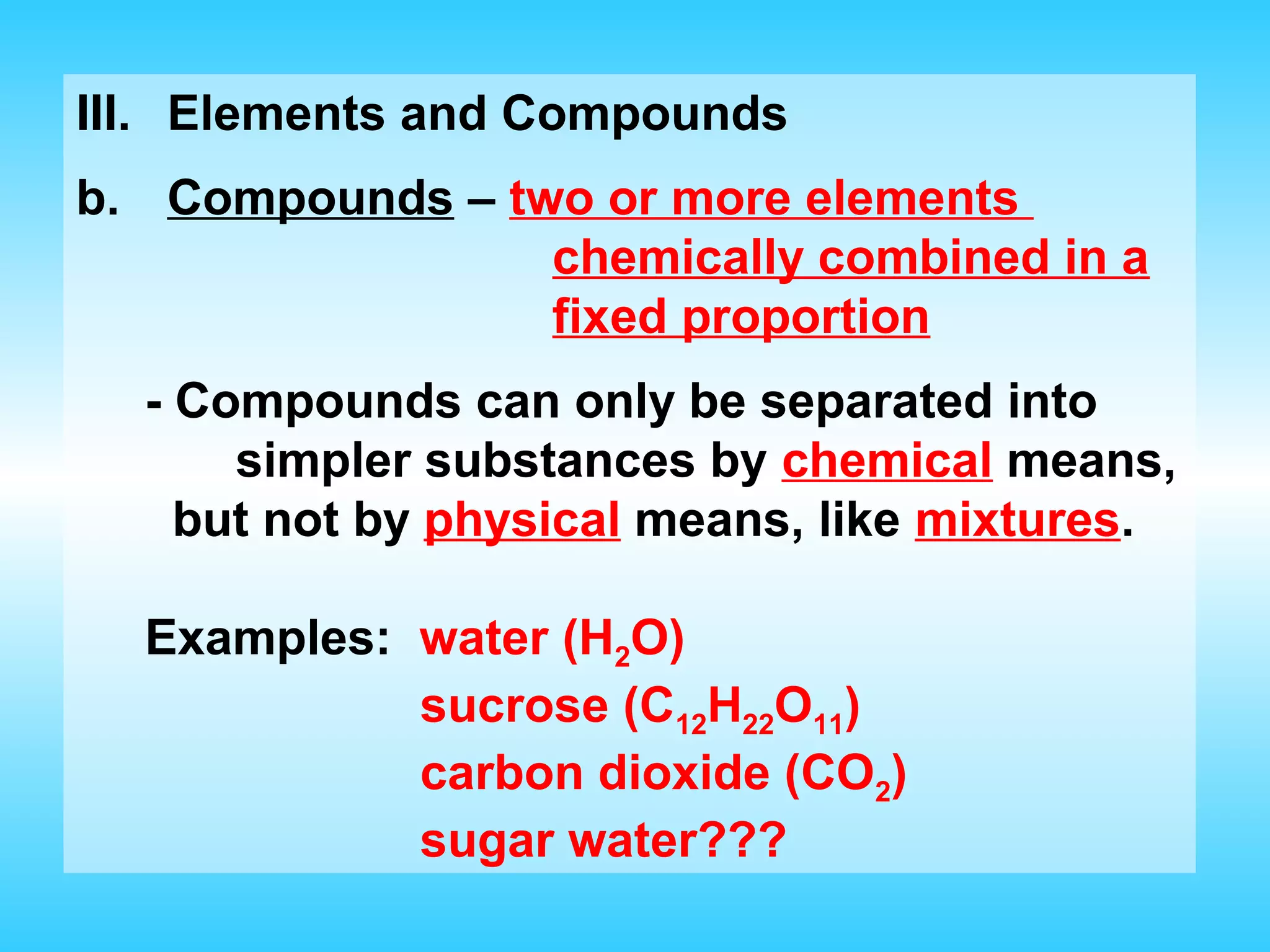
III. Elements and Compounds
b. Compounds – two or more elements
                 chemically combined in a
                 fixed proportion
  - Compounds can only be separated into
      simpler substances by chemical means,
    but not by physical means, like mixtures.

  Examples: water (H2O)
            sucrose (C12H22O11)
            carbon dioxide (CO2)
            sugar water???
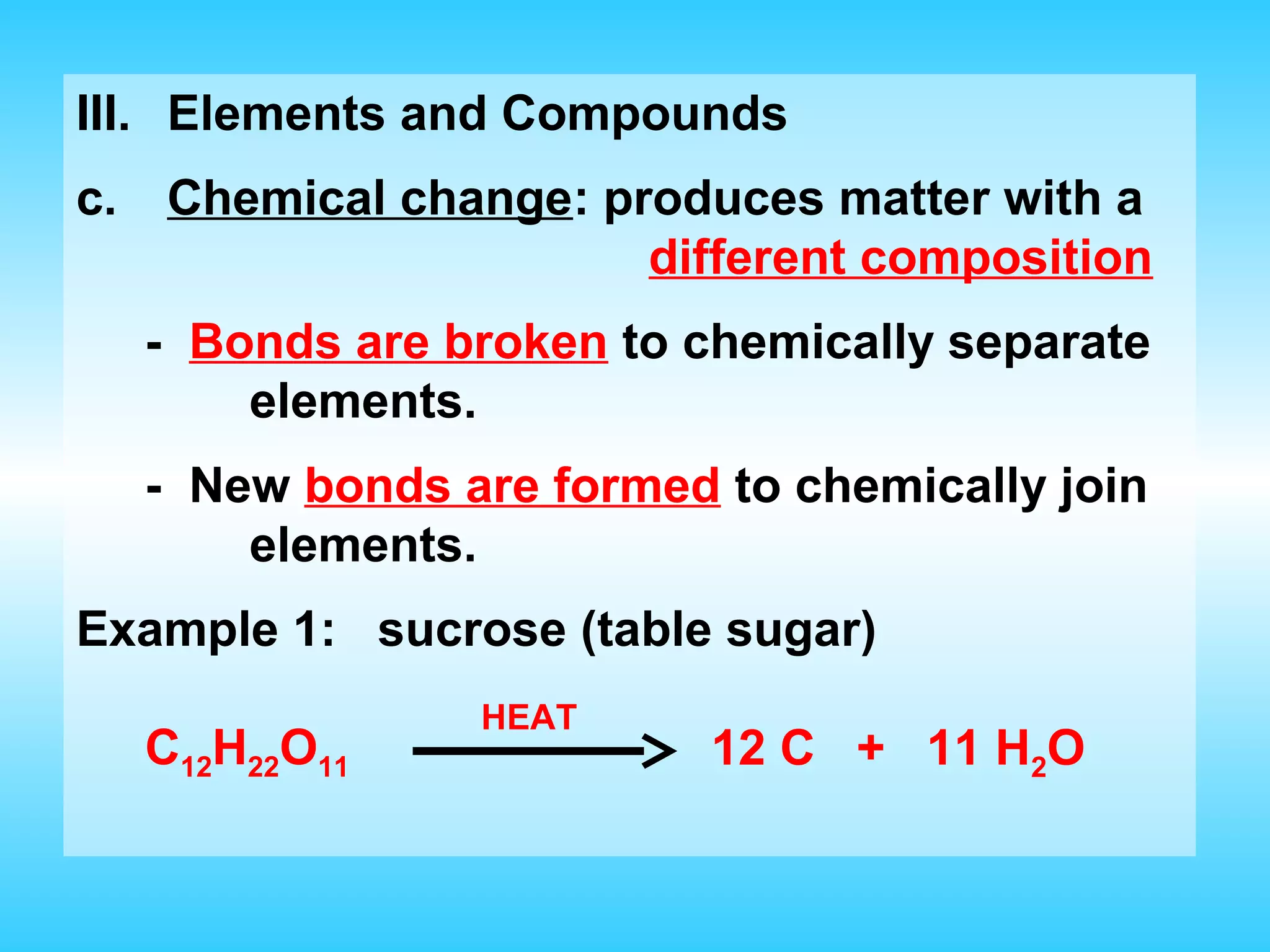
III. Elements and Compounds
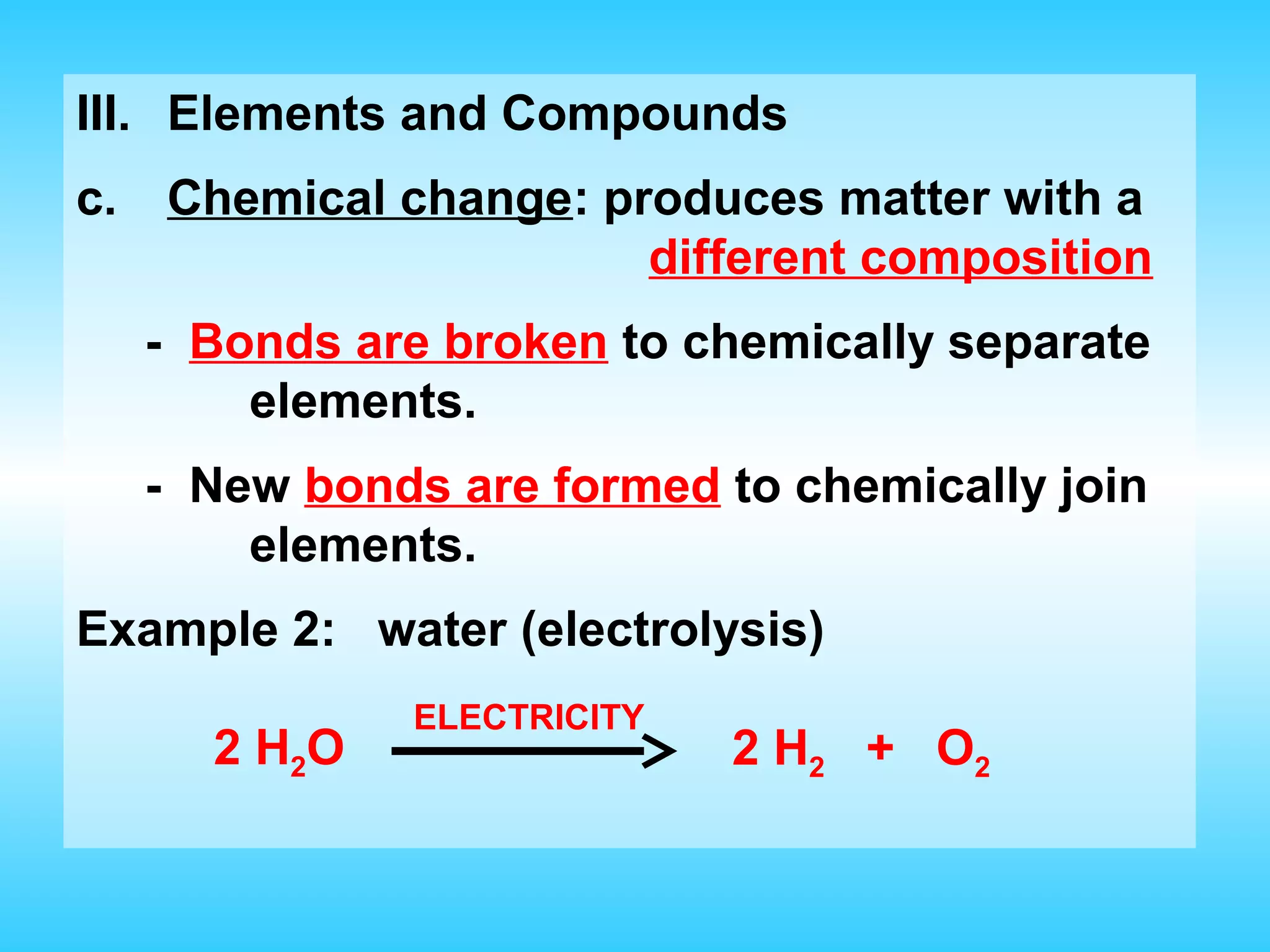
c.   Chemical change: produces matter with a
                        different composition
     - Bonds are broken to chemically separate
         elements.
     - New bonds are formed to chemically join
         elements.
Example 1: sucrose (table sugar)
                  HEAT
     C12H22O11              12 C + 11 H2O
III. Elements and Compounds
c.   Chemical change: produces matter with a
                        different composition
     - Bonds are broken to chemically separate
         elements.
     - New bonds are formed to chemically join
         elements.
Example 2: water (electrolysis)
               ELECTRICITY
       2 H2O                 2 H2 + O2
III. Elements and Compounds
2.   Properties of Compounds
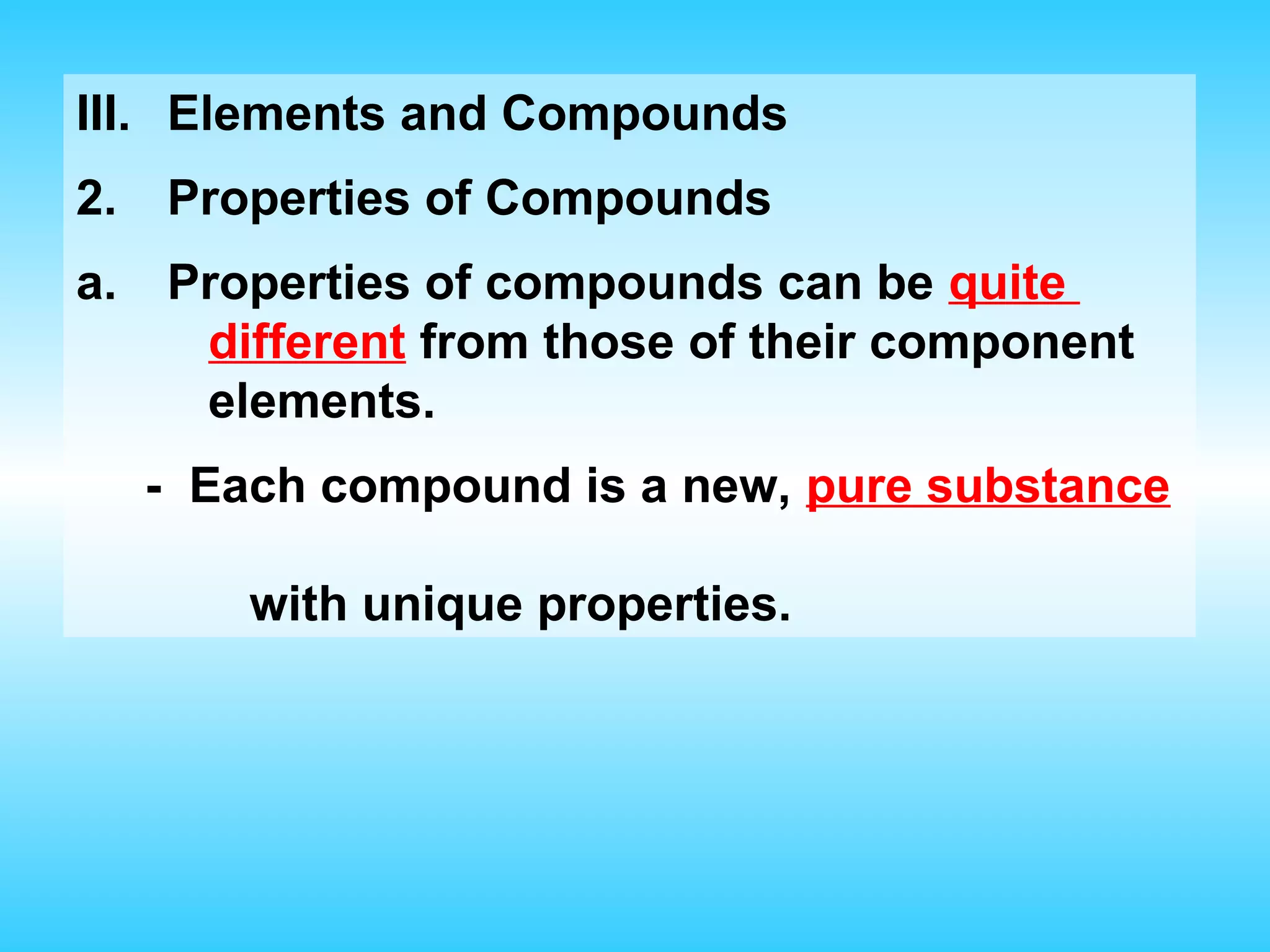
a.   Properties of compounds can be quite
      different from those of their component
      elements.
     - Each compound is a new, pure substance

         with unique properties.
a. Properties of compounds can be quite different
      from those of their component elements.

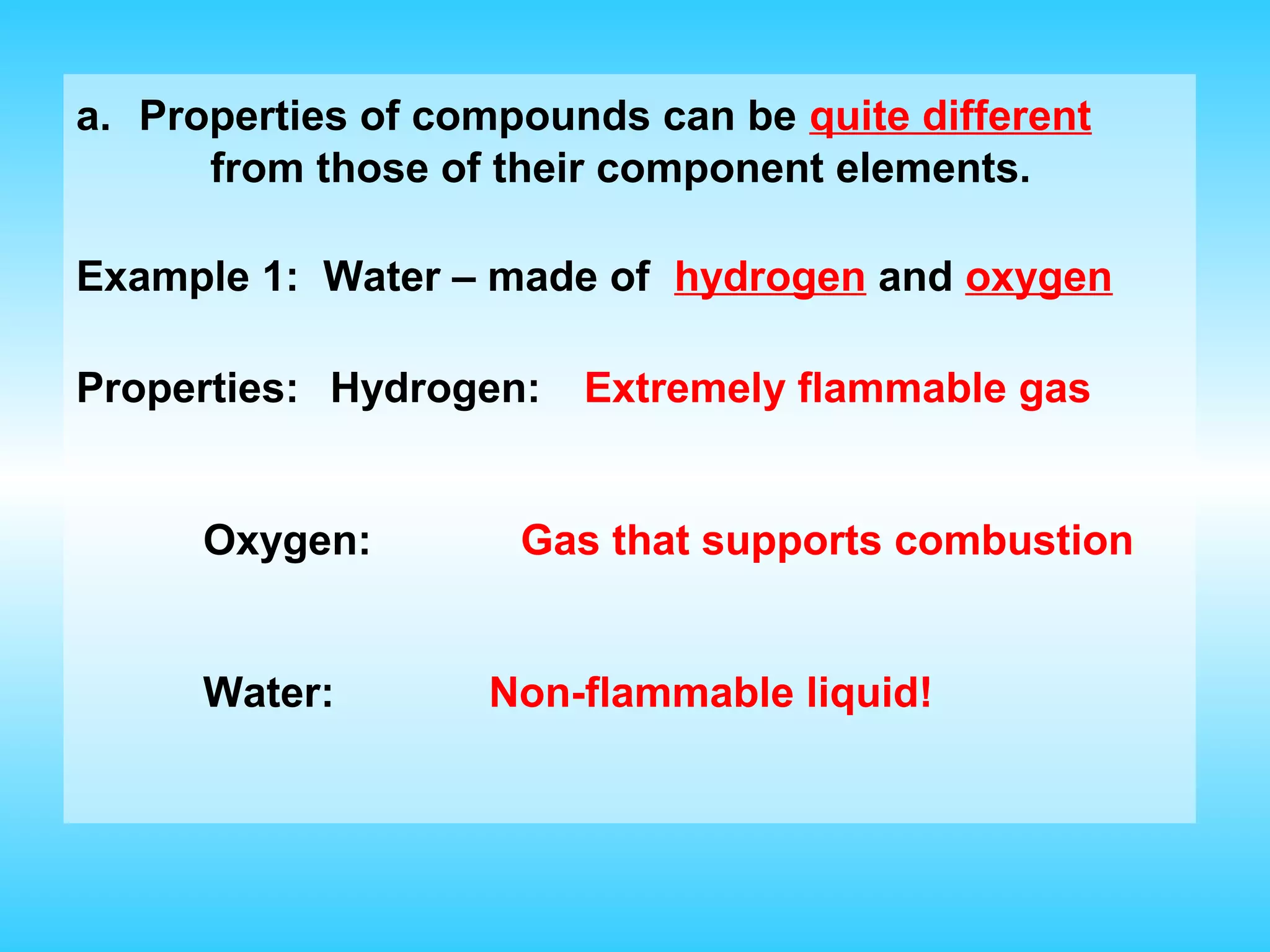
Example 1: Water – made of hydrogen and oxygen

Properties: Hydrogen:   Extremely flammable gas


      Oxygen:        Gas that supports combustion


      Water:       Non-flammable liquid!
a. Properties of compounds can be quite different
      from those of their component elements.

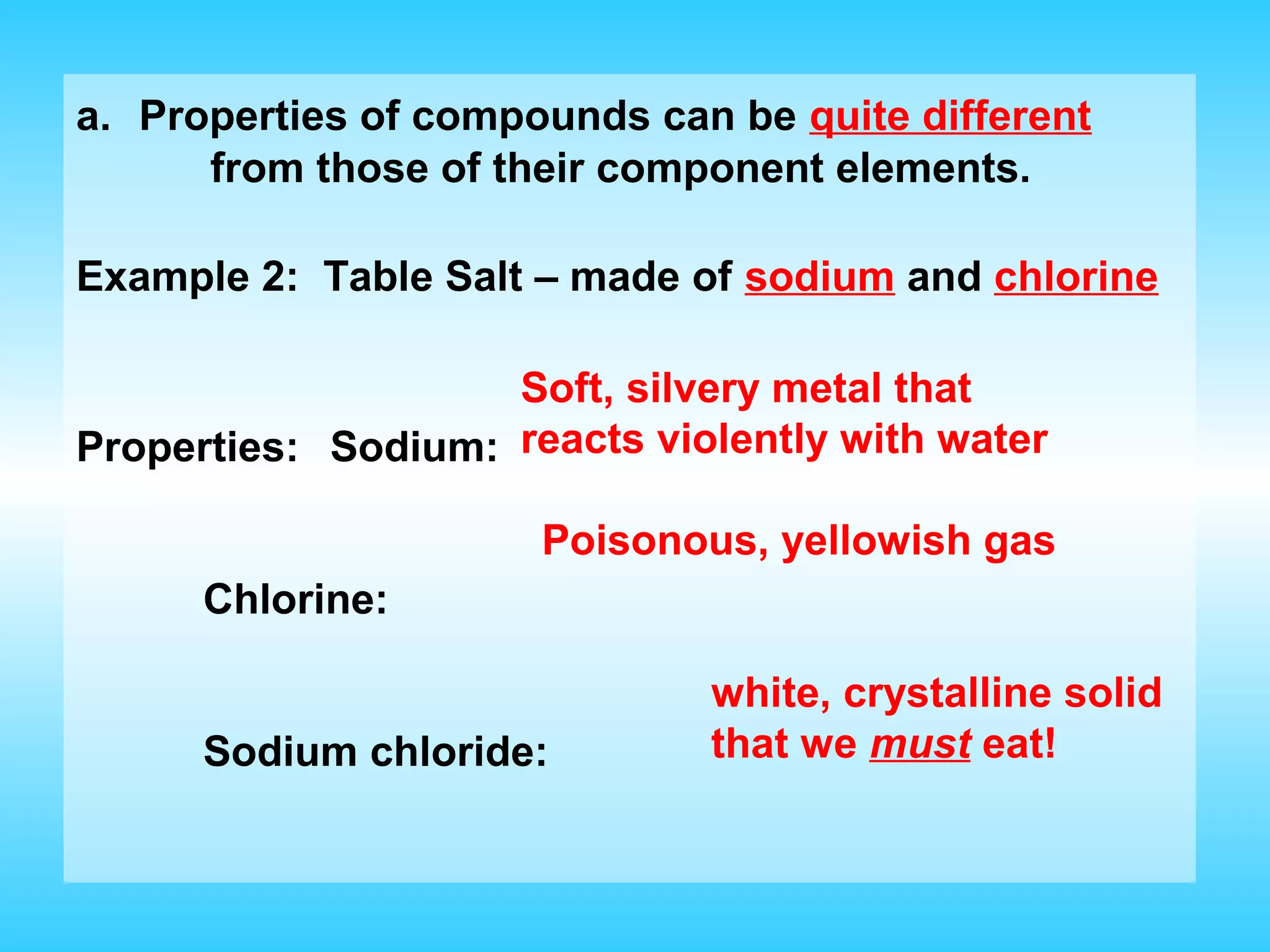
Example 2: Table Salt – made of sodium and chlorine

                    Soft, silvery metal that
Properties: Sodium: reacts violently with water

                      Poisonous, yellowish gas
      Chlorine:

                              white, crystalline solid
      Sodium chloride:        that we must eat!
III. Elements and Compounds
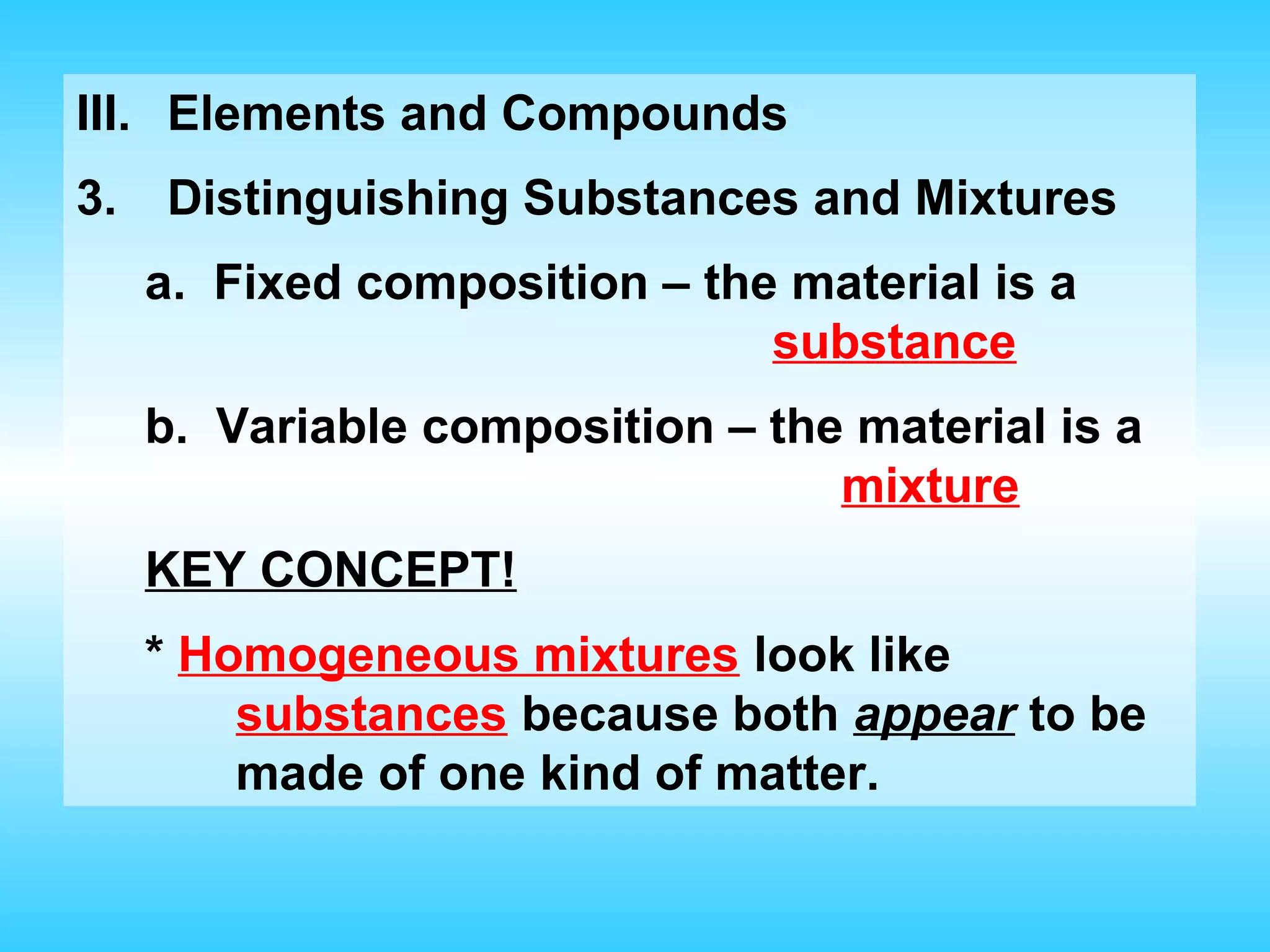
3.   Distinguishing Substances and Mixtures
     a. Fixed composition – the material is a
                               substance
     b. Variable composition – the material is a
                                  mixture
     KEY CONCEPT!
     * Homogeneous mixtures look like
         substances because both appear to be
         made of one kind of matter.
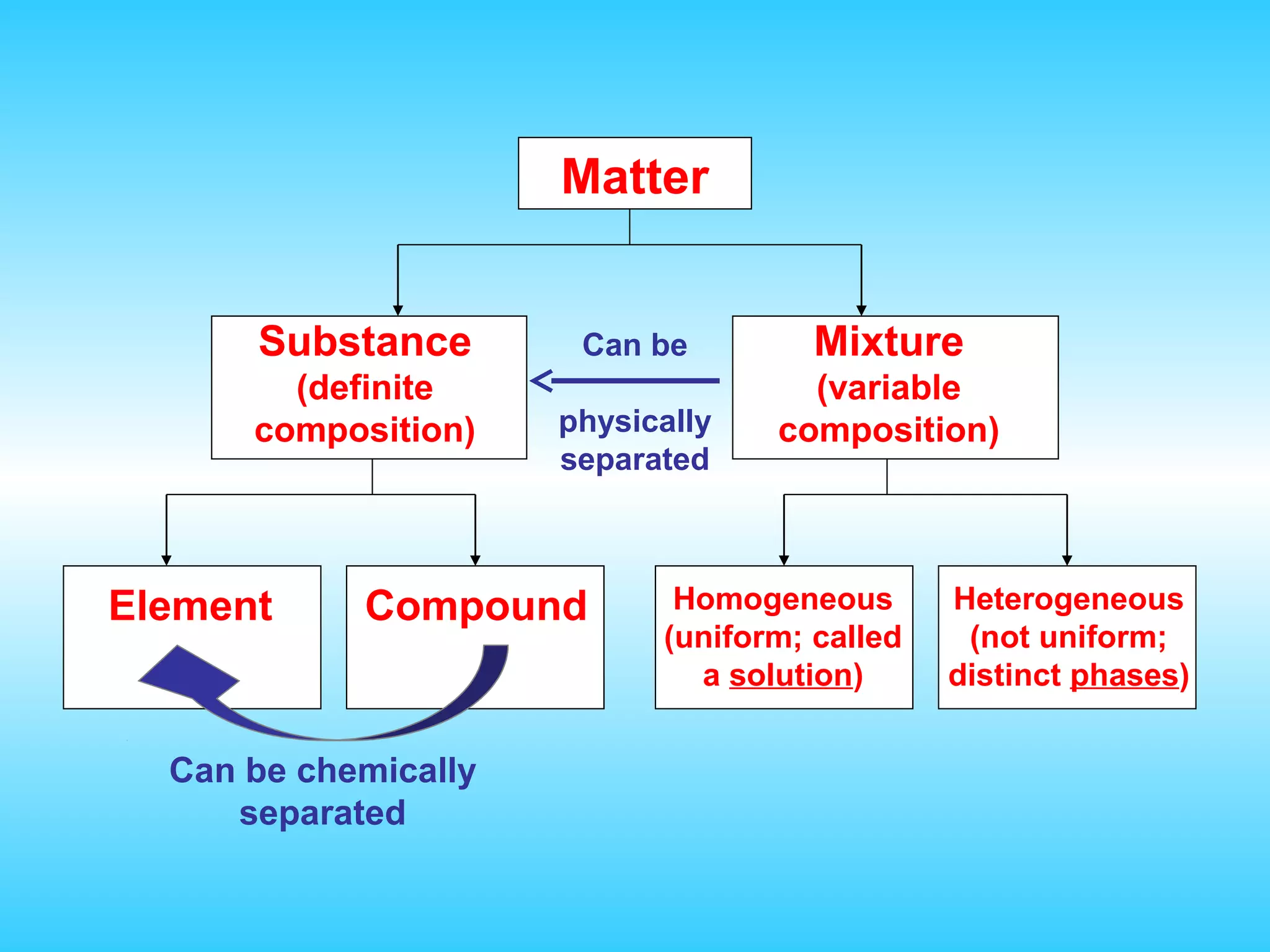
Matter


      Substance        Can be         Mixture
        (definite                    (variable
      composition)    physically   composition)
                      separated


Element     Compound         Homogeneous       Heterogeneous
                            (uniform; called    (not uniform;
                              a solution)      distinct phases)


  Can be chemically
     separated
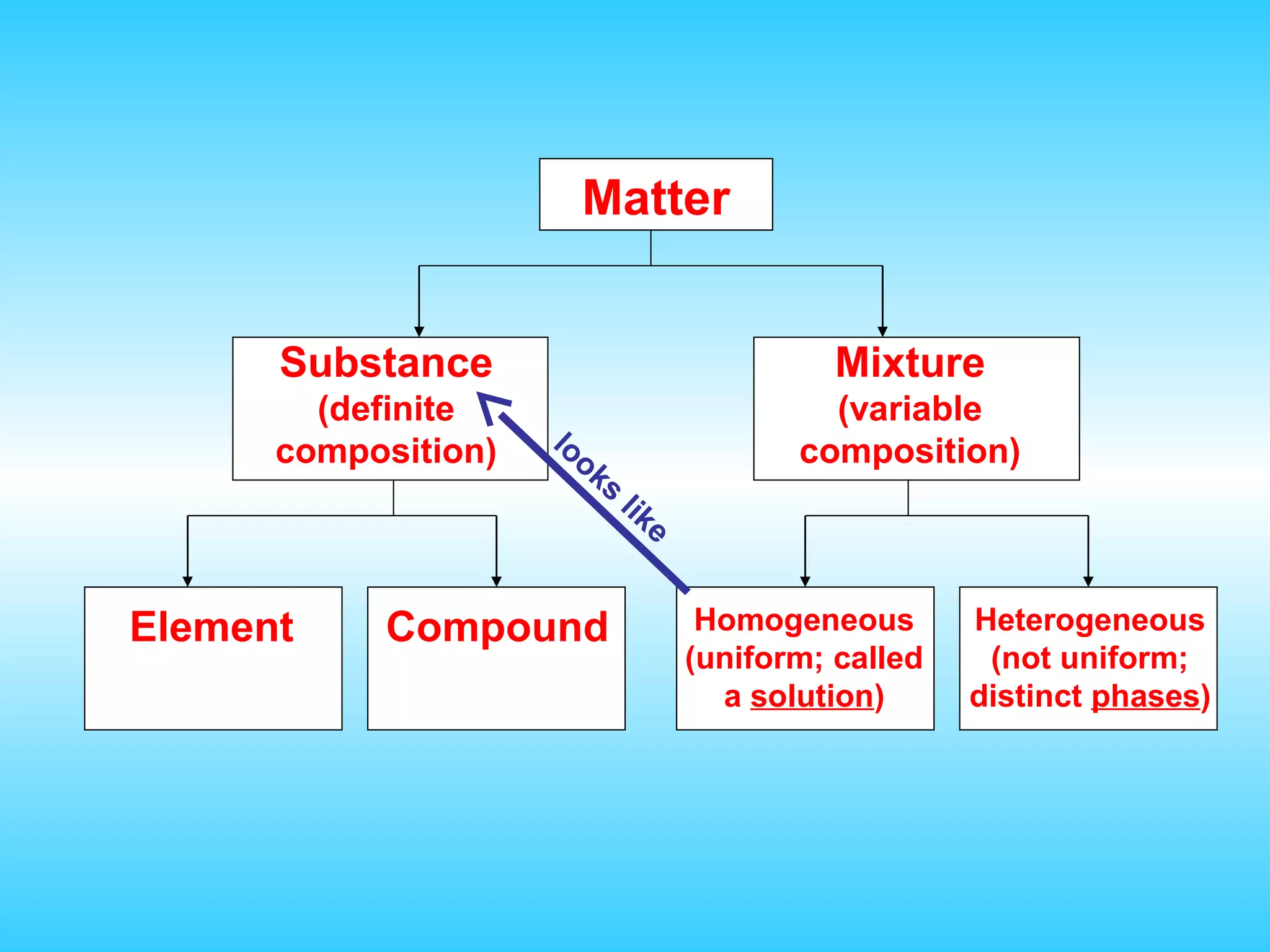
Matter


      Substance                               Mixture
        (definite                            (variable
                     lo
      composition)     ok                  composition)
                         s
                             lik
                                e


Element    Compound                  Homogeneous       Heterogeneous
                                    (uniform; called    (not uniform;
                                      a solution)      distinct phases)
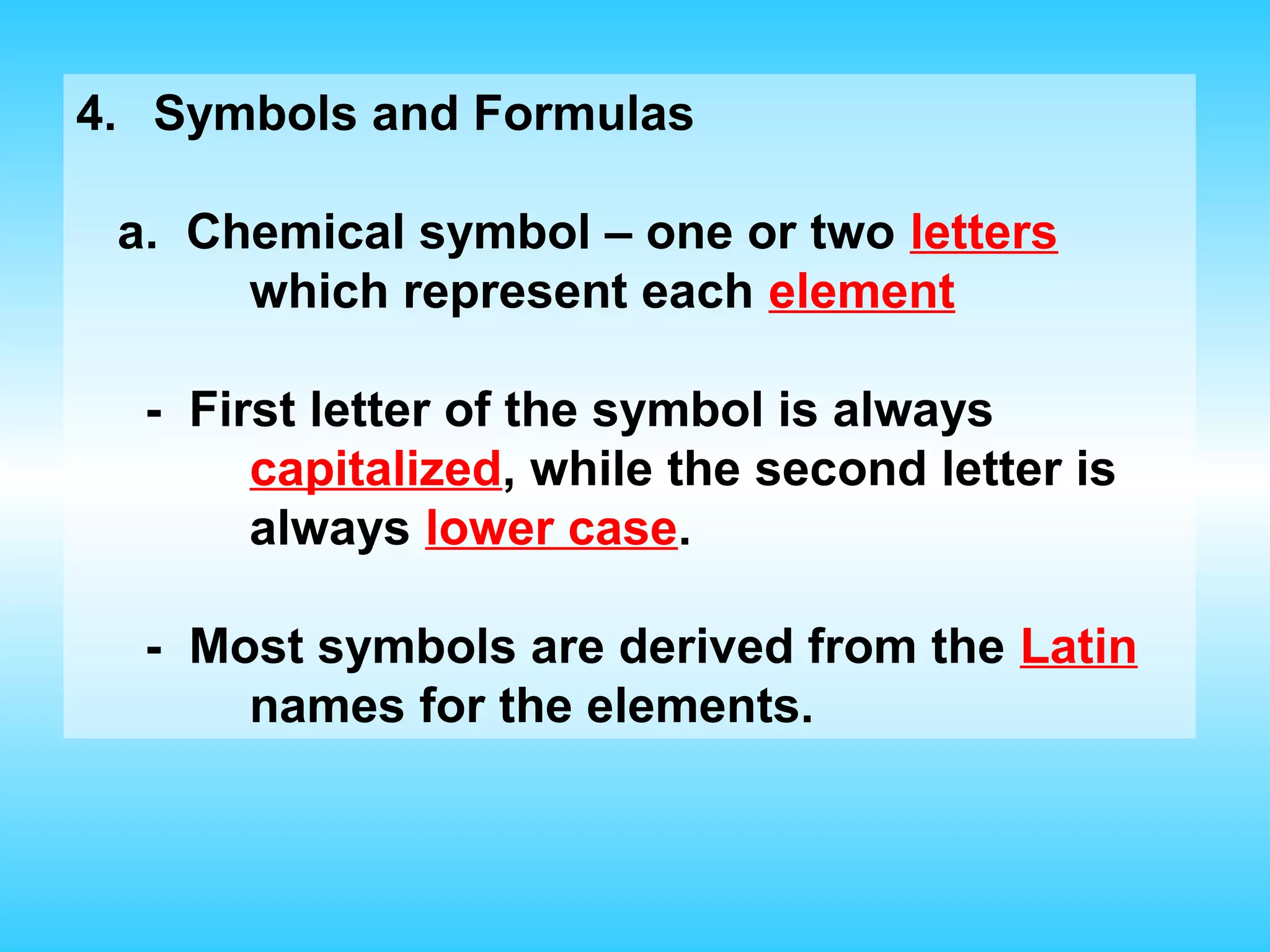
4. Symbols and Formulas

 a. Chemical symbol – one or two letters
      which represent each element

  - First letter of the symbol is always
       capitalized, while the second letter is
       always lower case.

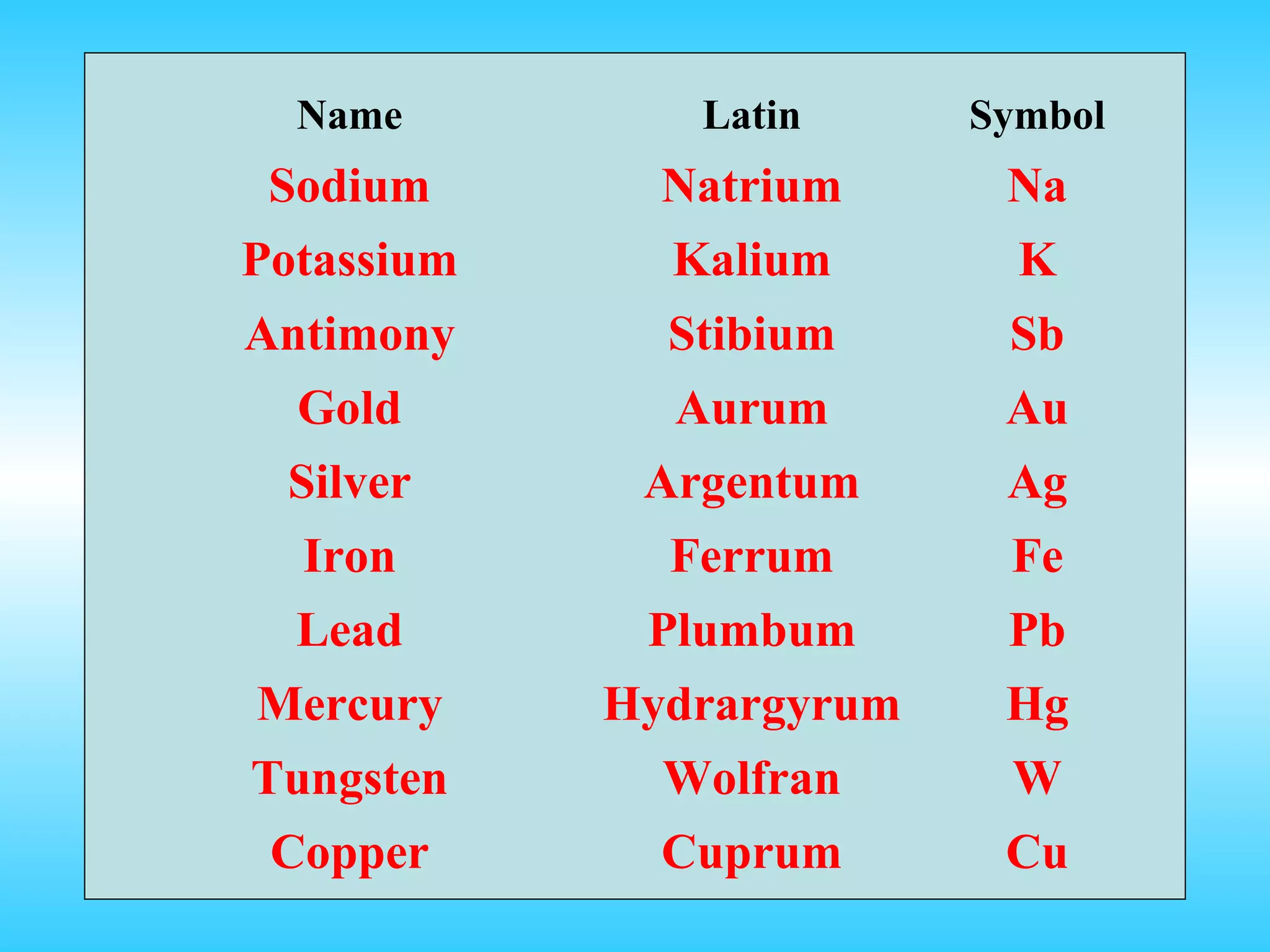
  - Most symbols are derived from the Latin
      names for the elements.
Name         Latin      Symbol
 Sodium       Natrium      Na
Potassium     Kalium       K
Antimony      Stibium      Sb
  Gold        Aurum        Au
 Silver      Argentum      Ag
  Iron        Ferrum       Fe
  Lead       Plumbum       Pb
Mercury     Hydrargyrum    Hg
Tungsten      Wolfran      W
 Copper       Cuprum       Cu
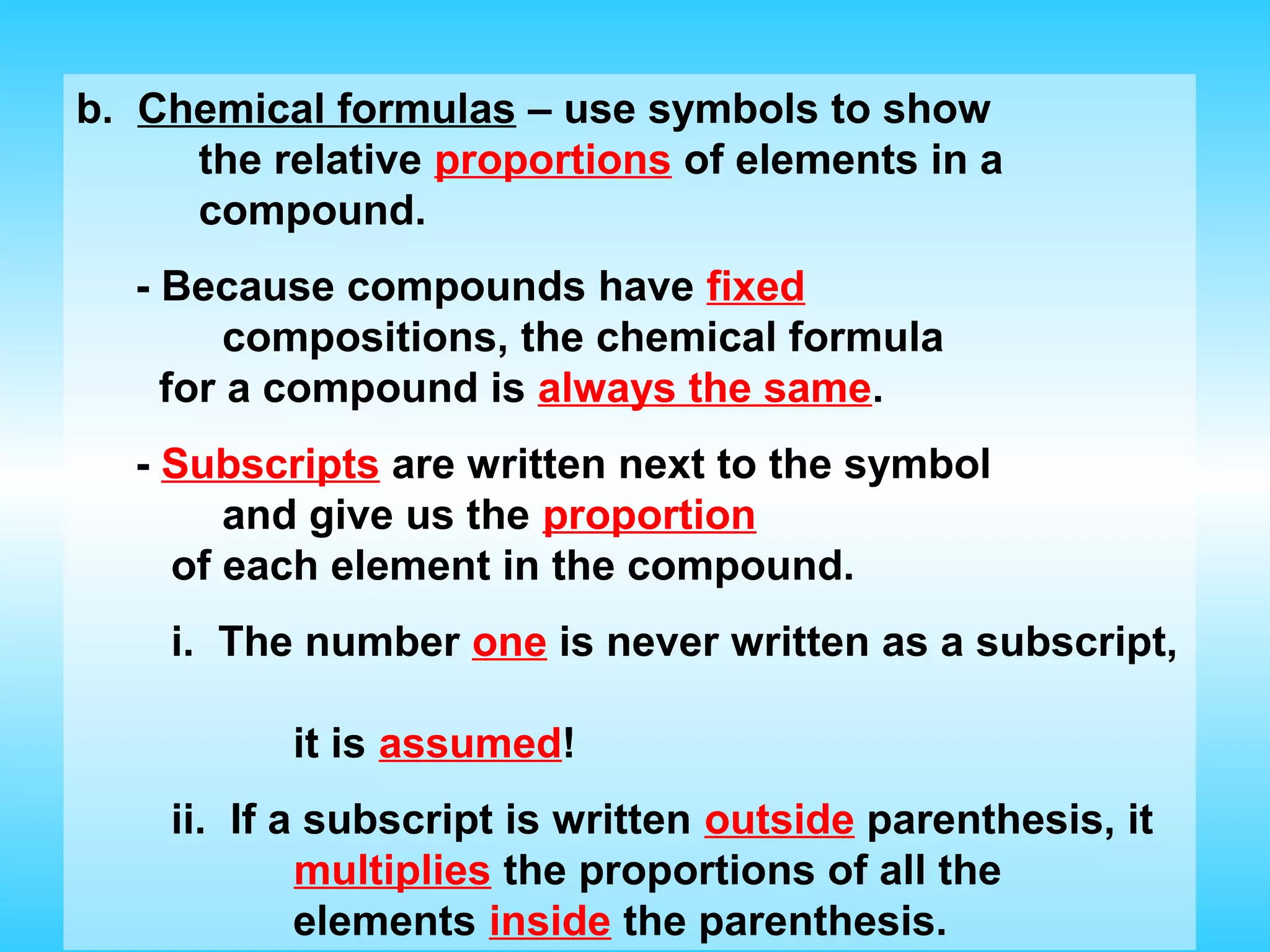
b. Chemical formulas – use symbols to show
     the relative proportions of elements in a
     compound.
  - Because compounds have fixed
        compositions, the chemical formula
    for a compound is always the same.
  - Subscripts are written next to the symbol
       and give us the proportion
    of each element in the compound.
    i. The number one is never written as a subscript,

          it is assumed!
    ii. If a subscript is written outside parenthesis, it
            multiplies the proportions of all the
            elements inside the parenthesis.
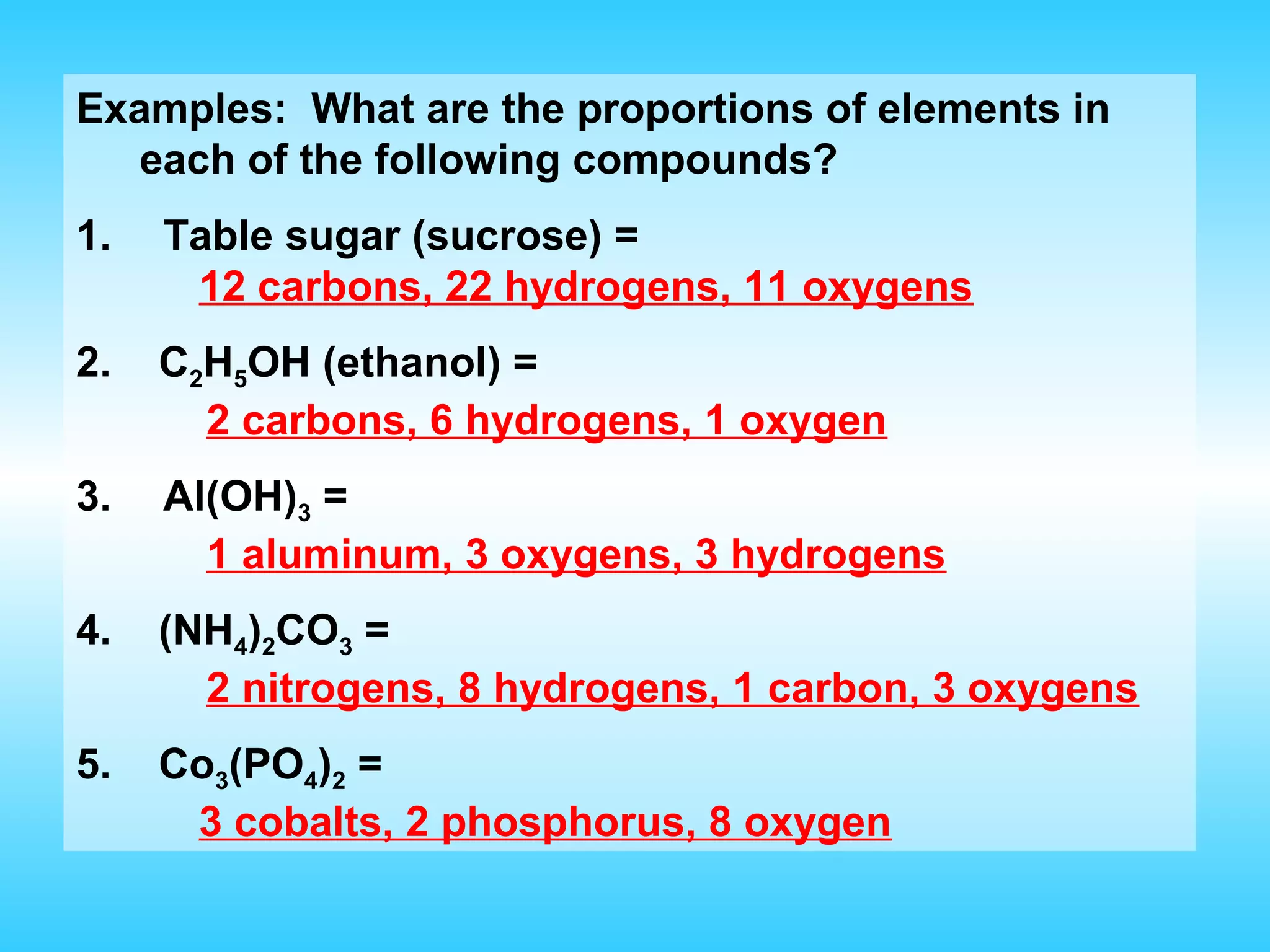
Examples: What are the proportions of elements in
   each of the following compounds?
1.   Table sugar (sucrose) =
      12 carbons, 22 hydrogens, 11 oxygens
2.   C2H5OH (ethanol) =
       2 carbons, 6 hydrogens, 1 oxygen
3.   Al(OH)3 =
       1 aluminum, 3 oxygens, 3 hydrogens
4.   (NH4)2CO3 =
       2 nitrogens, 8 hydrogens, 1 carbon, 3 oxygens
5.   Co3(PO4)2 =
      3 cobalts, 2 phosphorus, 8 oxygen
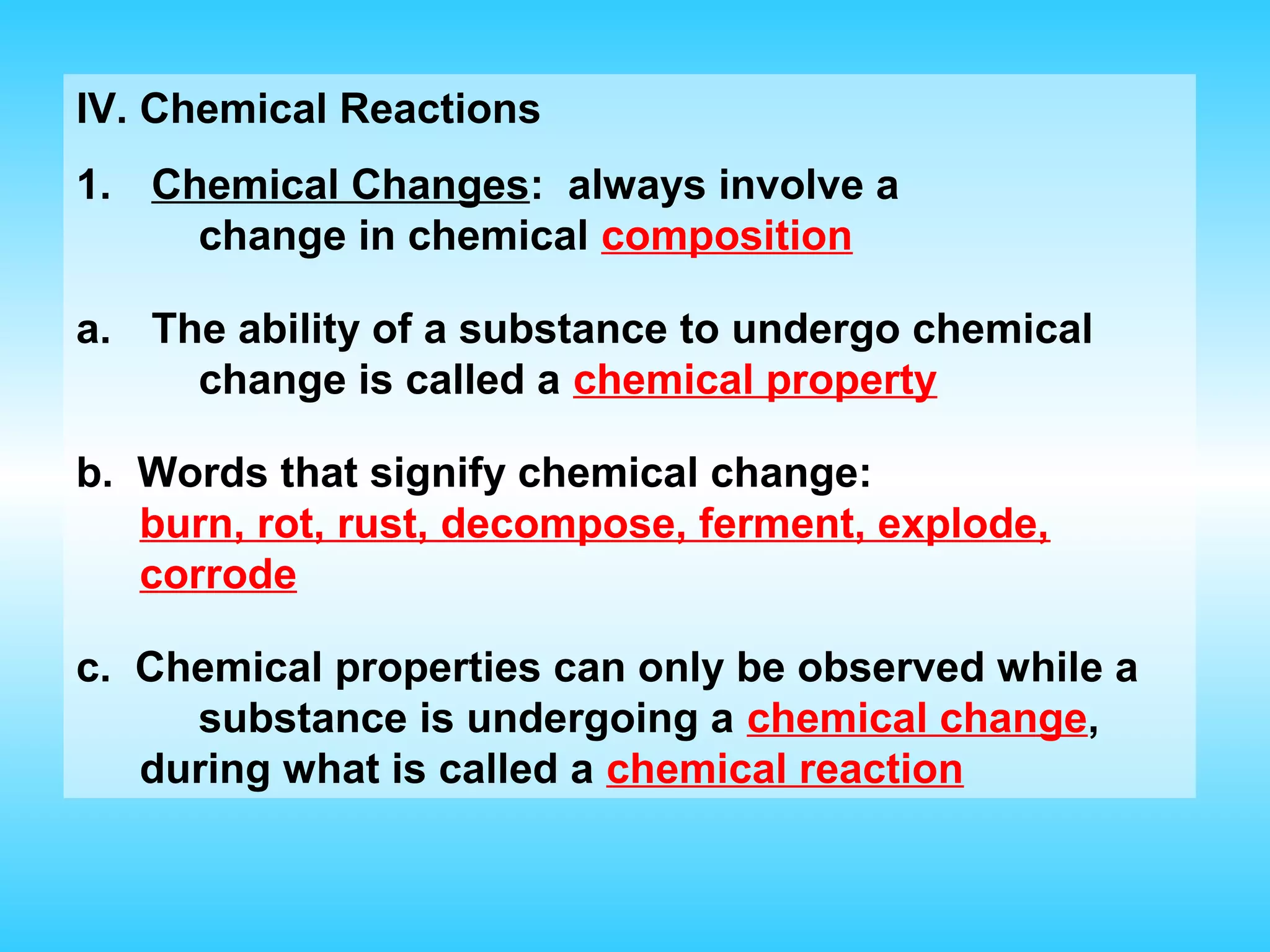
IV. Chemical Reactions
1. Chemical Changes: always involve a
     change in chemical composition

a. The ability of a substance to undergo chemical
     change is called a chemical property

b. Words that signify chemical change:
   burn, rot, rust, decompose, ferment, explode,
   corrode

c. Chemical properties can only be observed while a
     substance is undergoing a chemical change,
   during what is called a chemical reaction
IV. Chemical Reactions

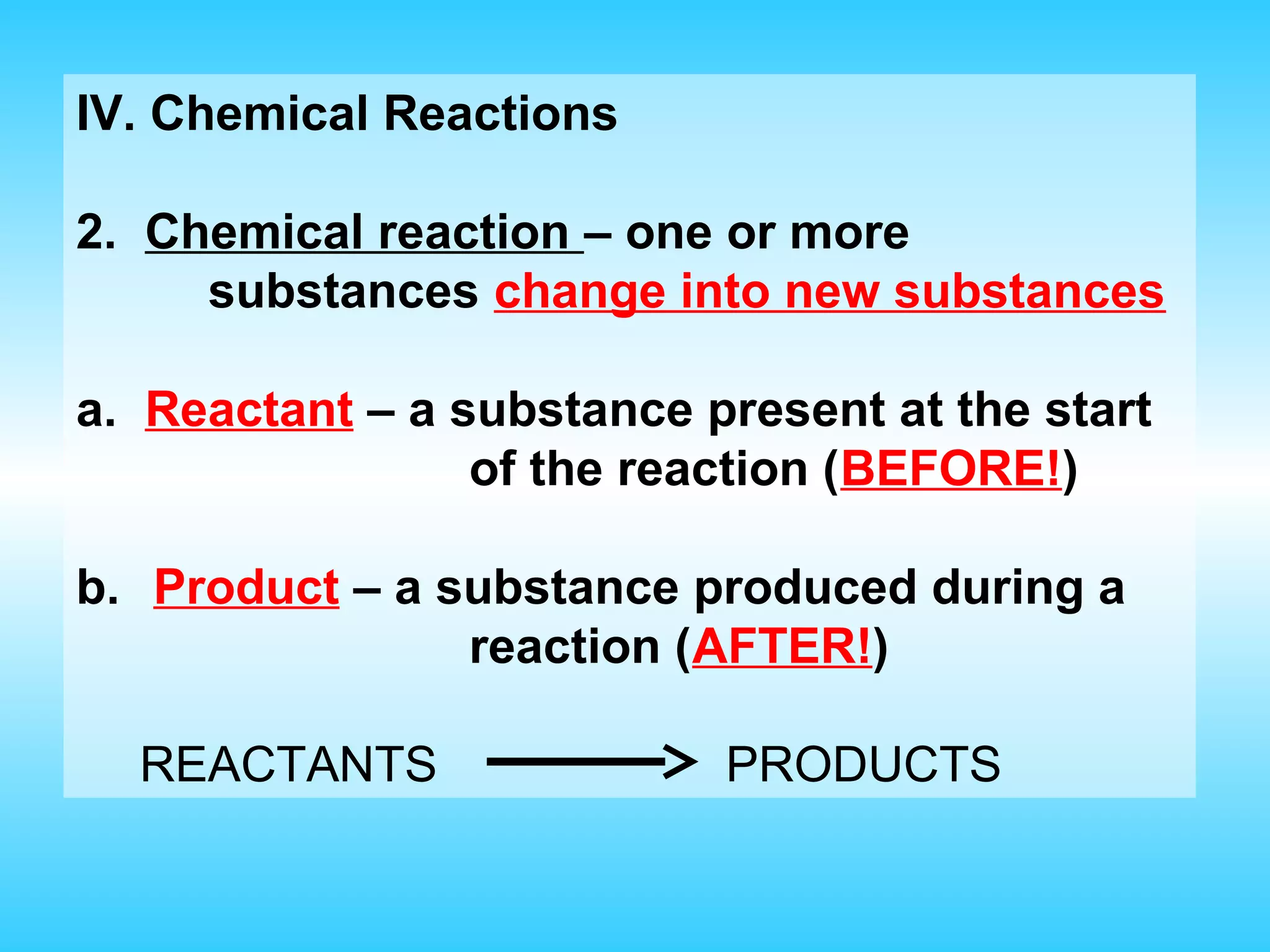
2. Chemical reaction – one or more
     substances change into new substances

a. Reactant – a substance present at the start
                 of the reaction (BEFORE!)

b. Product – a substance produced during a
                reaction (AFTER!)

  REACTANTS                PRODUCTS
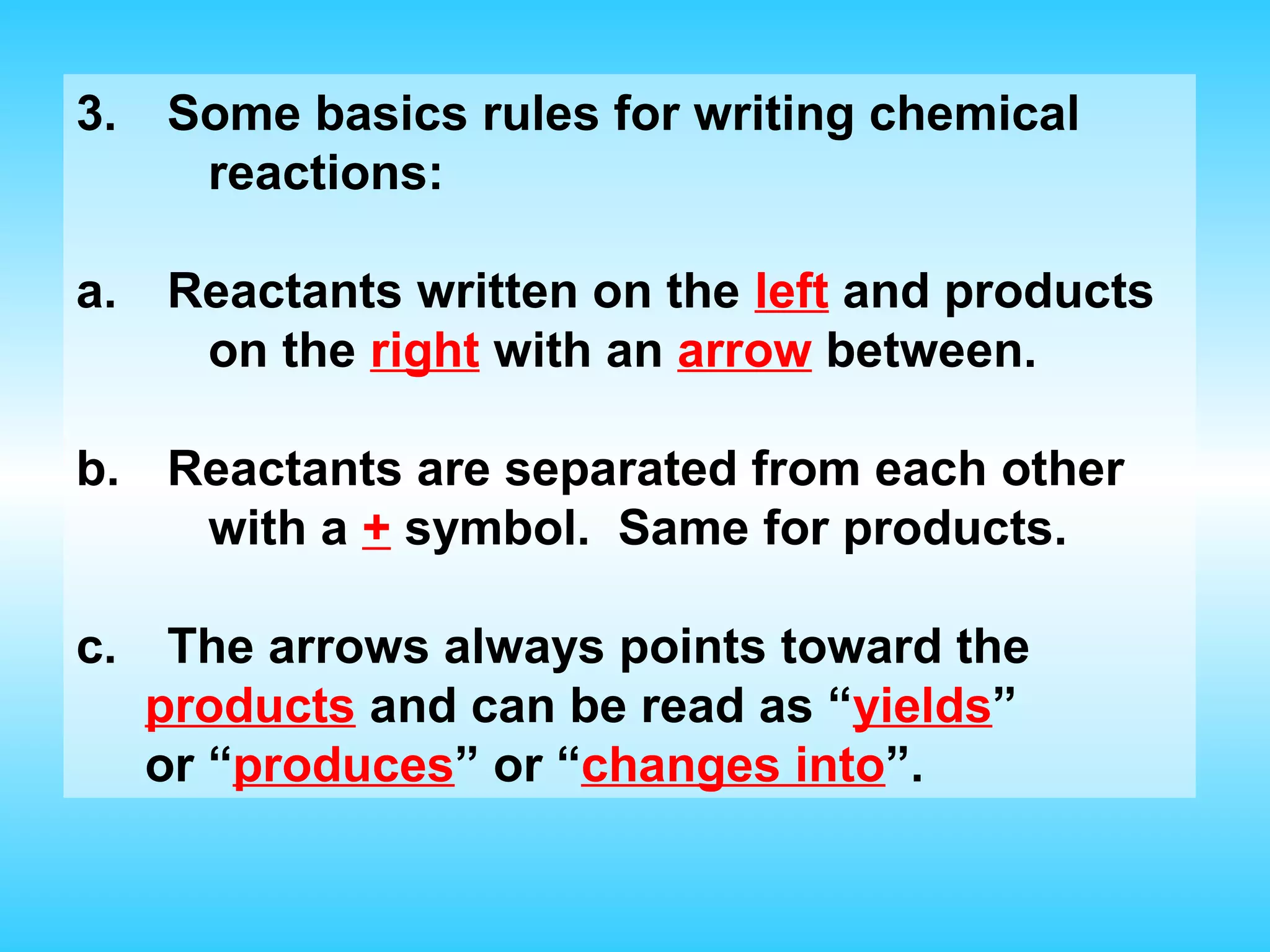
3.   Some basics rules for writing chemical
      reactions:

a.   Reactants written on the left and products
      on the right with an arrow between.

b. Reactants are separated from each other
    with a + symbol. Same for products.

c.    The arrows always points toward the
     products and can be read as “yields”
     or “produces” or “changes into”.
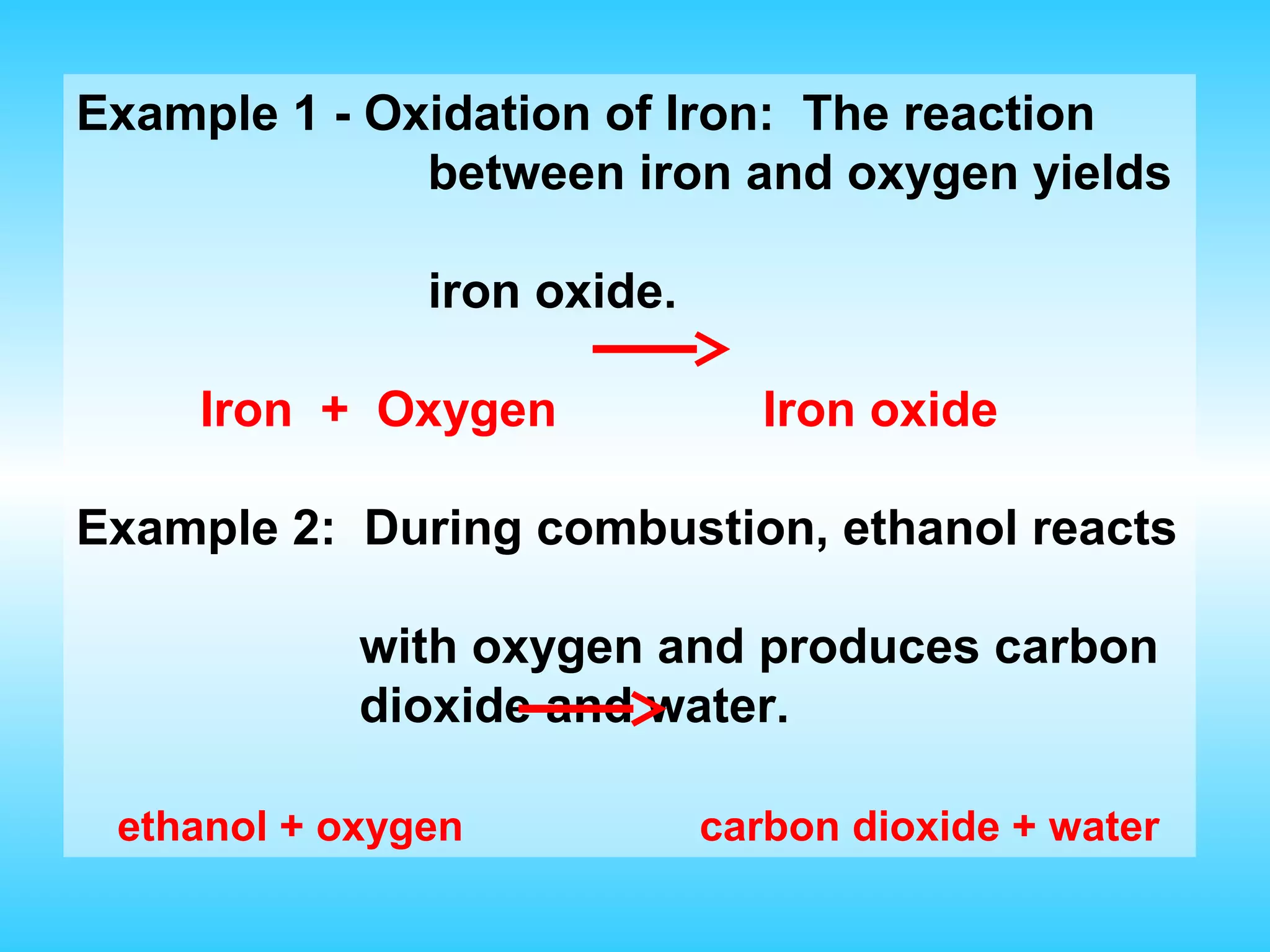
Example 1 - Oxidation of Iron: The reaction
              between iron and oxygen yields

               iron oxide.

    Iron + Oxygen               Iron oxide

Example 2: During combustion, ethanol reacts

            with oxygen and produces carbon
            dioxide and water.

 ethanol + oxygen            carbon dioxide + water
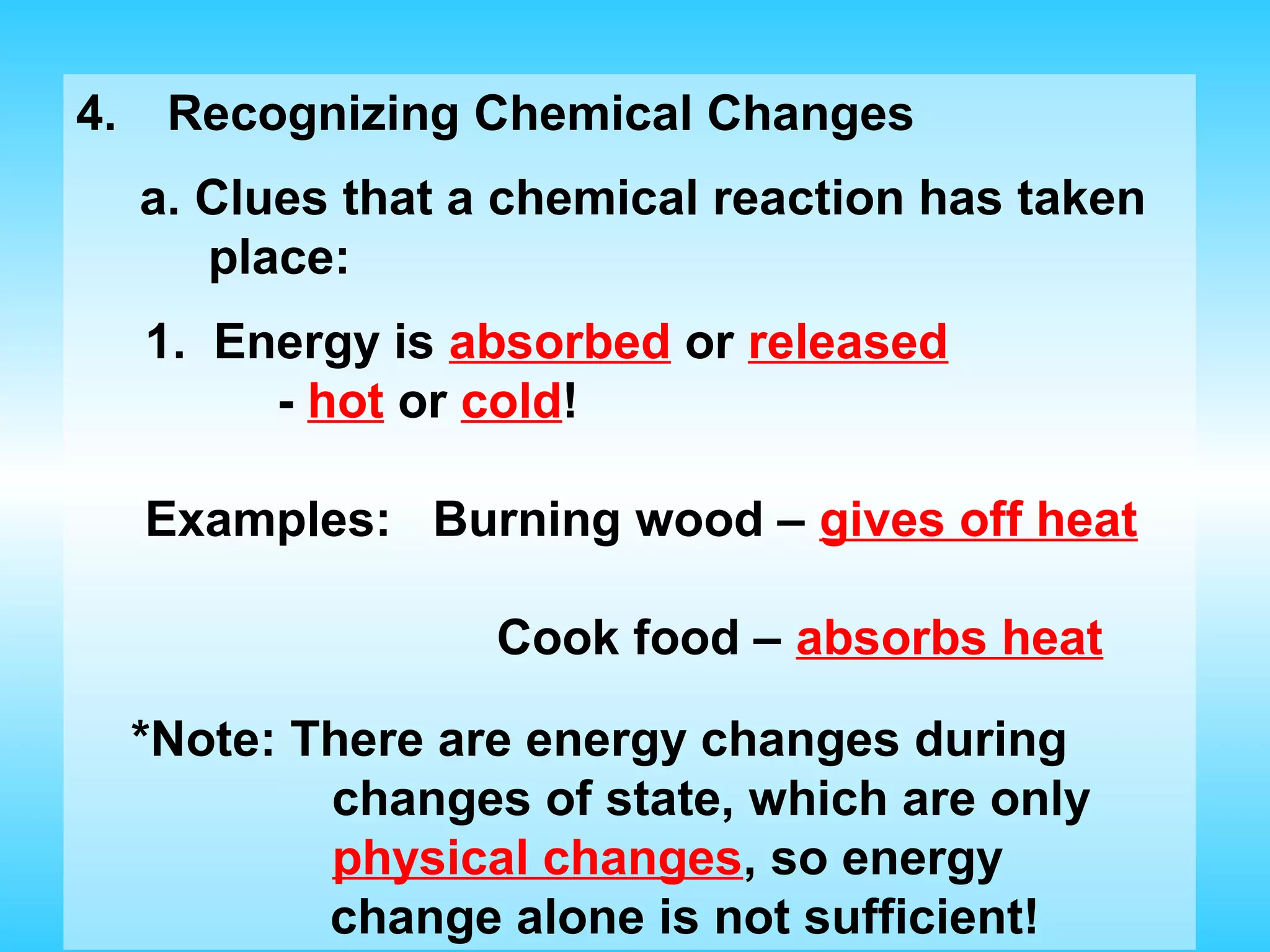
4.    Recognizing Chemical Changes
     a. Clues that a chemical reaction has taken
        place:
     1. Energy is absorbed or released
          - hot or cold!

     Examples: Burning wood – gives off heat

                    Cook food – absorbs heat

     *Note: There are energy changes during
             changes of state, which are only
             physical changes, so energy
             change alone is not sufficient!
a. Clues that a chemical reaction has taken
    place:

2. Change in color = new chemical has been
                       formed!

3. Change in odor = smells are caused by
                      chemicals!

4. Production of gas = you will see bubbles!

5. Production of a precipitate = a solid formed
     from liquid mixtures.
5.   Conservation of Mass

a.   Law of Conservation of Mass:
      mass cannot be created or destroyed

b. In a chemical reaction, the mass of all the
      reactants must equal the mass of all the
      products.
Examples:

10g of ice melt = 10g of water (phys. change)

2.5 kg of wood burn & produce 0.4 kg of ash?
- 2.1 kg of water vapor, carbon dioxide, and
    other gases released to air

1.5 grams of magnesium ribbon burns and the
   ashes weigh 2.1 grams
- combined with oxygen in the air to produce
    magnesium oxide
Chapter 2 - Matter and Change

Chapter 2 - Matter and Change

  • 1.
    Chapter 2 –Matter & Change By Kendon Smith – Columbia Central HS – Brooklyn, MI
  • 2.
    Chapter 2 –Matter and Change I. Properties of Matter 1. Matter is defined as anything that has mass and volume. a. Mass: the amount of matter an object contains. b. Volume: the amount of space an object occupies.
  • 3.
    2. Describing Matter a.Extensive Property: property that depends on the amount of matter in a sample b. Intensive Property: property that depends on the type of matter in a sample Examples: Identify the following properties of a sample as extensive or intensive. Mass: ___ Color: ___ Flammability: ___ Volume: ___ Density: ___ Melting Point: ___
  • 4.
    3. Identifying Substances a. Substance: matter that has uniform and definite composition. - Uniform means it is the same throughout the sample. - Definite composition means chemically the same all over the planet! Examples: Water? Sand? Copper? Salt?
  • 5.
    b. Physical Property– a quality or condition of a substance that can be measured or observed without changing a substance’s composition. Examples: color, solubility, odor, hardness, density, melting point, boiling point, physical state, mass, volume
  • 6.
    4. States of Matter A. Solids – form of matter with definite shape and definite volume - Particles are packed tightly together B. Liquids – form of matter with indefinite shape and definite volume - Liquids take the shape of their container - Particles in liquids are almost incompressible - Particles in liquids usually expand slightly when heated. - Particles in a liquid are close together, but can flow past each other
  • 7.
    4. States of Matter C. Gases – form of matter with indefinite shape and indefinite volume - Particles in gases very far apart compared to liquids and solids. - Particles in gases are easily compressed, pushing closer together. * Vapors – Gaseous substances that are liquids or solids at room temperature.
  • 8.
  • 9.
    5. Physical changes– alter a material without changing its chemical composition - Physical changes can be classified as reversible or irreversible a. Reversible changes: melt, freeze, boil, condense b. Irreversible changes: break, split, grind, cut, crush
  • 10.
    II. Mixtures 1. Mixture – a physical blend of two or more substances. a. Homogeneous mixture: - completely uniform composition, - parts are not readily distinguished Examples – brine, gatorade, jello, creamy peanut butter
  • 11.
    II. Mixtures 1. Mixture – a physical blend of two or more substances. b. Heterogeneous mixture: - not uniform composition - parts are readily distinguished Examples – sand and water, a salad, jello w/ fruit, chunky peanut butter
  • 12.
    2. Solution –a homogeneous mixture - may be solid, liquid, or gas Examples – brine, sugar water, air, stainless steel 3. Phase – any part of a sample that with uniform composition and properties How many phases? Brine = ___ Oil/Vinegar = ___ Air = ___ Sand/Water = ___
  • 13.
    4. Separating Mixtures:Mixtures can be separated using physical means. a. Decant, or pour off, a liquid layer. Ex. Oil/Water Mix b. Filtration: Separates solids from liquids with their dissolved particles. c. Distillation – Boil a liquid to become a vapor and condense it back. d. Magnet – Pull out magnetic particles from a mixture. e. Sorting - Physically separating by appearance Ex. size, color, shape
  • 14.
    III. Elements andCompounds 1. Distinguishing elements and compounds a. Elements – the simplest form of matter with a unique set of properties - Elements are the basic building blocks of all other substances. - Cannot be separated into simpler substances by chemical means. Examples: hydrogen, oxygen, carbon
  • 15.
    III. Elements andCompounds b. Compounds – two or more elements chemically combined in a fixed proportion - Compounds can only be separated into simpler substances by chemical means, but not by physical means, like mixtures. Examples: water (H2O) sucrose (C12H22O11) carbon dioxide (CO2) sugar water???
  • 16.
    III. Elements andCompounds c. Chemical change: produces matter with a different composition - Bonds are broken to chemically separate elements. - New bonds are formed to chemically join elements. Example 1: sucrose (table sugar) HEAT C12H22O11 12 C + 11 H2O
  • 17.
    III. Elements andCompounds c. Chemical change: produces matter with a different composition - Bonds are broken to chemically separate elements. - New bonds are formed to chemically join elements. Example 2: water (electrolysis) ELECTRICITY 2 H2O 2 H2 + O2
  • 18.
    III. Elements andCompounds 2. Properties of Compounds a. Properties of compounds can be quite different from those of their component elements. - Each compound is a new, pure substance with unique properties.
  • 19.
    a. Properties ofcompounds can be quite different from those of their component elements. Example 1: Water – made of hydrogen and oxygen Properties: Hydrogen: Extremely flammable gas Oxygen: Gas that supports combustion Water: Non-flammable liquid!
  • 20.
    a. Properties ofcompounds can be quite different from those of their component elements. Example 2: Table Salt – made of sodium and chlorine Soft, silvery metal that Properties: Sodium: reacts violently with water Poisonous, yellowish gas Chlorine: white, crystalline solid Sodium chloride: that we must eat!
  • 21.
    III. Elements andCompounds 3. Distinguishing Substances and Mixtures a. Fixed composition – the material is a substance b. Variable composition – the material is a mixture KEY CONCEPT! * Homogeneous mixtures look like substances because both appear to be made of one kind of matter.
  • 22.
    Matter Substance Can be Mixture (definite (variable composition) physically composition) separated Element Compound Homogeneous Heterogeneous (uniform; called (not uniform; a solution) distinct phases) Can be chemically separated
  • 23.
    Matter Substance Mixture (definite (variable lo composition) ok composition) s lik e Element Compound Homogeneous Heterogeneous (uniform; called (not uniform; a solution) distinct phases)
  • 24.
    4. Symbols andFormulas a. Chemical symbol – one or two letters which represent each element - First letter of the symbol is always capitalized, while the second letter is always lower case. - Most symbols are derived from the Latin names for the elements.
  • 25.
    Name Latin Symbol Sodium Natrium Na Potassium Kalium K Antimony Stibium Sb Gold Aurum Au Silver Argentum Ag Iron Ferrum Fe Lead Plumbum Pb Mercury Hydrargyrum Hg Tungsten Wolfran W Copper Cuprum Cu
  • 26.
    b. Chemical formulas– use symbols to show the relative proportions of elements in a compound. - Because compounds have fixed compositions, the chemical formula for a compound is always the same. - Subscripts are written next to the symbol and give us the proportion of each element in the compound. i. The number one is never written as a subscript, it is assumed! ii. If a subscript is written outside parenthesis, it multiplies the proportions of all the elements inside the parenthesis.
  • 27.
    Examples: What arethe proportions of elements in each of the following compounds? 1. Table sugar (sucrose) = 12 carbons, 22 hydrogens, 11 oxygens 2. C2H5OH (ethanol) = 2 carbons, 6 hydrogens, 1 oxygen 3. Al(OH)3 = 1 aluminum, 3 oxygens, 3 hydrogens 4. (NH4)2CO3 = 2 nitrogens, 8 hydrogens, 1 carbon, 3 oxygens 5. Co3(PO4)2 = 3 cobalts, 2 phosphorus, 8 oxygen
  • 28.
    IV. Chemical Reactions 1.Chemical Changes: always involve a change in chemical composition a. The ability of a substance to undergo chemical change is called a chemical property b. Words that signify chemical change: burn, rot, rust, decompose, ferment, explode, corrode c. Chemical properties can only be observed while a substance is undergoing a chemical change, during what is called a chemical reaction
  • 29.
    IV. Chemical Reactions 2.Chemical reaction – one or more substances change into new substances a. Reactant – a substance present at the start of the reaction (BEFORE!) b. Product – a substance produced during a reaction (AFTER!) REACTANTS PRODUCTS
  • 30.
    3. Some basics rules for writing chemical reactions: a. Reactants written on the left and products on the right with an arrow between. b. Reactants are separated from each other with a + symbol. Same for products. c. The arrows always points toward the products and can be read as “yields” or “produces” or “changes into”.
  • 31.
    Example 1 -Oxidation of Iron: The reaction between iron and oxygen yields iron oxide. Iron + Oxygen Iron oxide Example 2: During combustion, ethanol reacts with oxygen and produces carbon dioxide and water. ethanol + oxygen carbon dioxide + water
  • 32.
    4. Recognizing Chemical Changes a. Clues that a chemical reaction has taken place: 1. Energy is absorbed or released - hot or cold! Examples: Burning wood – gives off heat Cook food – absorbs heat *Note: There are energy changes during changes of state, which are only physical changes, so energy change alone is not sufficient!
  • 33.
    a. Clues thata chemical reaction has taken place: 2. Change in color = new chemical has been formed! 3. Change in odor = smells are caused by chemicals! 4. Production of gas = you will see bubbles! 5. Production of a precipitate = a solid formed from liquid mixtures.
  • 34.
    5. Conservation of Mass a. Law of Conservation of Mass: mass cannot be created or destroyed b. In a chemical reaction, the mass of all the reactants must equal the mass of all the products.
  • 35.
    Examples: 10g of icemelt = 10g of water (phys. change) 2.5 kg of wood burn & produce 0.4 kg of ash? - 2.1 kg of water vapor, carbon dioxide, and other gases released to air 1.5 grams of magnesium ribbon burns and the ashes weigh 2.1 grams - combined with oxygen in the air to produce magnesium oxide