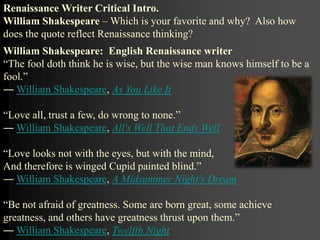
William Shakespeare: English Renaissance writer
“The fool doth think he is wise, but the wise man knows himself to be a
fool.”
― William Shakespeare, As You Like It
“Love all, trust a few, do wrong to none.”
― William Shakespeare, All's Well That Ends Well
“Love looks not with the eyes, but with the mind,
And therefore is winged Cupid painted blind.”
― William Shakespeare, A Midsummer Night's Dream
“Be not afraid of greatness. Some are born great, some achieve
greatness, and others have greatness thrust upon them.”
― William Shakespeare, Twelfth Night
Renaissance Writer Critical Intro.
William Shakespeare – Which is your favorite and why? Also how
does the quote reflect Renaissance thinking?
Protestant Reformation 1517
Renaissance's effect
 People began to question their lives and
authority
Catholic Church had been
biggest authority of the
Middle Ages.
I. Conflicts that challenged the
authority of the Church in Rome
A. Merchants challenged the Church’s
opposition to usury (charging interest)
B. German & Eng. nobility disliked Italian
domination of the Church
C. Church’s great political power & wealth
caused conflict
D. Corruption & sale of indulgences
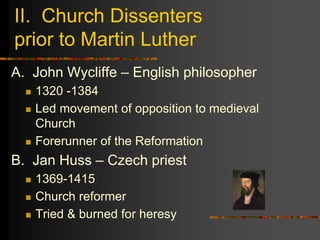
II. Church Dissenters
prior to Martin Luther
A. John Wycliffe – English philosopher
 1320 -1384
 Led movement of opposition to medieval
Church
 Forerunner of the Reformation
B. Jan Huss – Czech priest
 1369-1415
 Church reformer
 Tried & burned for heresy
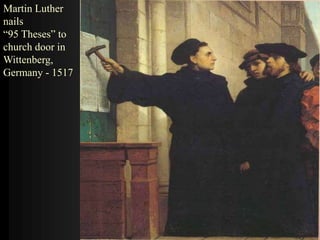
Martin Luther
nails
“95 Theses” to
church door in
Wittenberg,
Germany - 1517
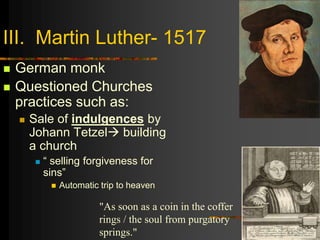
III. Martin Luther- 1517
 German monk
 Questioned Churches
practices such as:
 Sale of indulgences by
Johann Tetzel building
a church
 “ selling forgiveness for
sins”
 Automatic trip to heaven
"As soon as a coin in the coffer
rings / the soul from purgatory
springs."
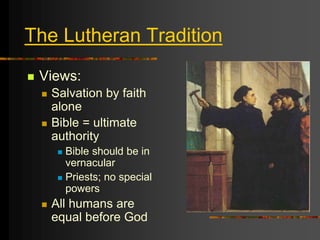
The Lutheran Tradition
 Views:
 Salvation by faith
alone
 Bible = ultimate
authority
 Bible should be in
vernacular
 Priests; no special
powers
 All humans are
equal before God
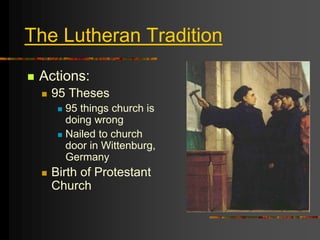
The Lutheran Tradition
 Actions:
 95 Theses
 95 things church is
doing wrong
 Nailed to church
door in Wittenburg,
Germany
 Birth of Protestant
Church
11
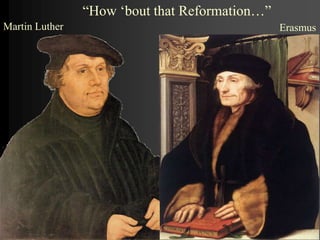
Martin Luther Erasmus
“How ‘bout that Reformation…”
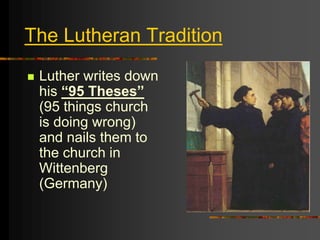
The Lutheran Tradition
 Luther writes down
his “95 Theses”
(95 things church
is doing wrong)
and nails them to
the church in
Wittenberg
(Germany)
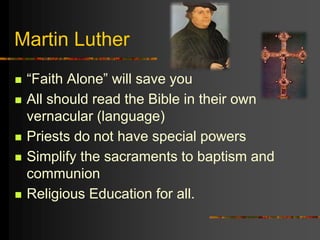
Martin Luther
 “Faith Alone” will save you
 All should read the Bible in their own
vernacular (language)
 Priests do not have special powers
 Simplify the sacraments to baptism and
communion
 Religious Education for all.
How will people react?
 How will the church react?
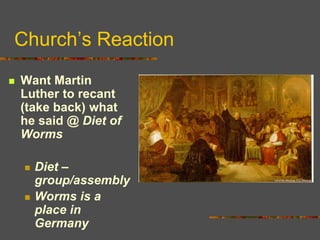
Church’s Reaction
 Want Martin
Luther to recant
(take back) what
he said @ Diet of
Worms
 Diet –
group/assembly
 Worms is a
place in
Germany
Luther says NO!!!!!!!!!!
Hier stehe ich. Ich kann nicht anders. Gott
helfe mir. Amen." ("Here I stand. I can do
nothing else. God help me. Amen.")
He is excommunicated from church and
forced into hiding for the rest of his life
Results of Luther’s actions?
- Opened people’s eyes to corruption of the
church
-new churches created based on own beliefs– ex
John Calvin-- Calvinism
-Ex. Protestant, Lutheran, Baptists, Puritans,
Methodists, Calvinists, and so on.
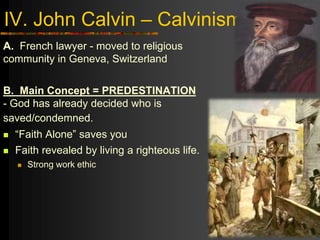
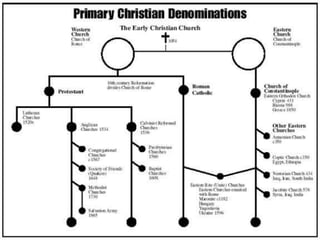
IV. John Calvin – Calvinism
A. French lawyer - moved to religious
community in Geneva, Switzerland
B. Main Concept = PREDESTINATION
- God has already decided who is
saved/condemned.
 “Faith Alone” saves you
 Faith revealed by living a righteous life.
 Strong work ethic
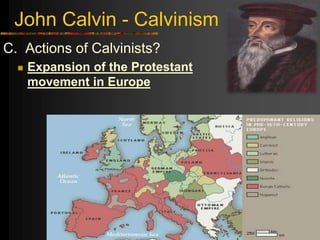
John Calvin - Calvinism
C. Actions of Calvinists?
 Expansion of the Protestant
movement in Europe
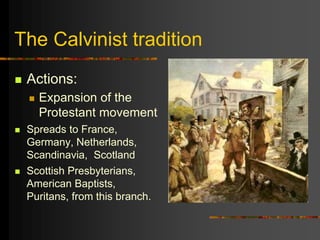
The Calvinist tradition
 Actions:
 Expansion of the
Protestant movement
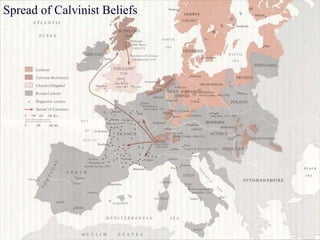
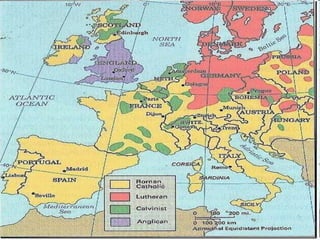
 Spreads to France,
Germany, Netherlands,
Scandinavia, Scotland
 Scottish Presbyterians,
American Baptists,
Puritans, from this branch.
23
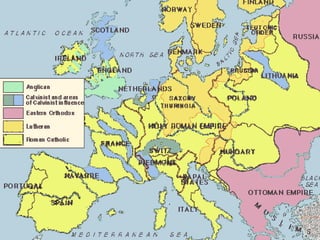
Spread of Calvinist Beliefs
24
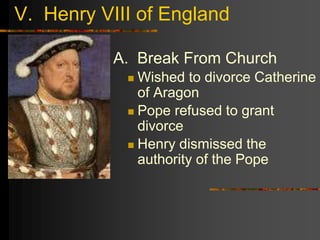
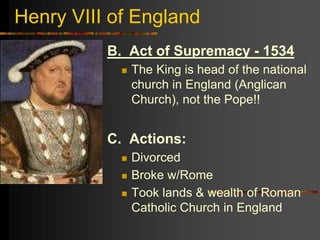
V. Henry VIII of England
A. Break From Church
 Wished to divorce Catherine
of Aragon
 Pope refused to grant
divorce
 Henry dismissed the
authority of the Pope
Henry VIII of England
B. Act of Supremacy - 1534
 The King is head of the national
church in England (Anglican
Church), not the Pope!!
C. Actions:
 Divorced
 Broke w/Rome
 Took lands & wealth of Roman
Catholic Church in England
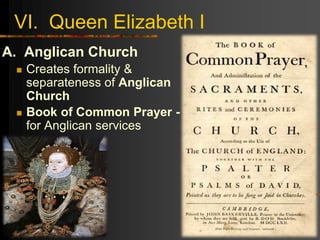
VI. Queen Elizabeth I
A. Anglican Church
 Creates formality &
separateness of Anglican
Church
 Book of Common Prayer -
for Anglican services
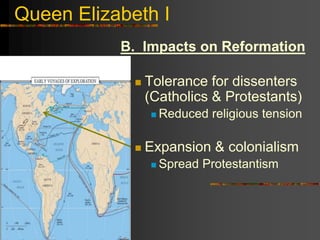
Queen Elizabeth I
B. Impacts on Reformation
 Tolerance for dissenters
(Catholics & Protestants)
 Reduced religious tension
 Expansion & colonialism
 Spread Protestantism
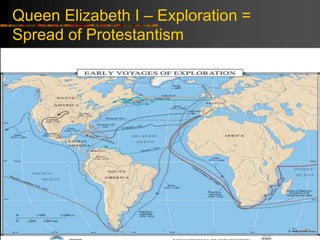
Queen Elizabeth I – Exploration =
Spread of Protestantism
Queen Elizabeth I
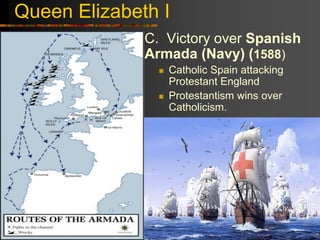
C. Victory over Spanish
Armada (Navy) (1588)
 Catholic Spain attacking
Protestant England
 Protestantism wins over
Catholicism.
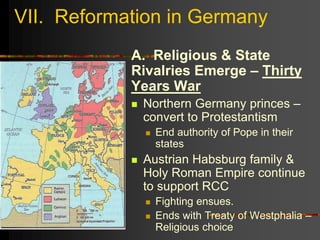
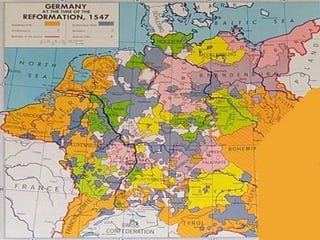
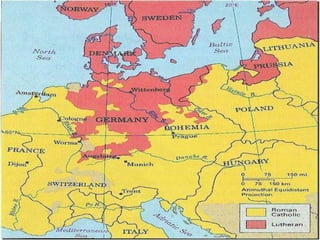
VII. Reformation in Germany
A. Religious & State
Rivalries Emerge – Thirty
Years War
 Northern Germany princes –
convert to Protestantism
 End authority of Pope in their
states
 Austrian Habsburg family &
Holy Roman Empire continue
to support RCC
 Fighting ensues.
 Ends with Treaty of Westphalia –
Religious choice
34
35
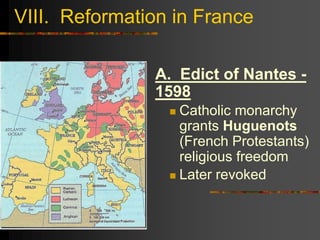
VIII. Reformation in France
A. Edict of Nantes -
1598
 Catholic monarchy
grants Huguenots
(French Protestants)
religious freedom
 Later revoked
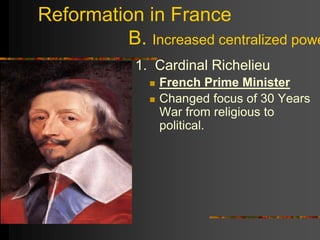
Reformation in France
B. Increased centralized powe
1. Cardinal Richelieu
 French Prime Minister
 Changed focus of 30 Years
War from religious to
political.
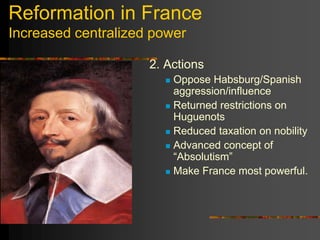
Reformation in France
Increased centralized power
2. Actions
 Oppose Habsburg/Spanish
aggression/influence
 Returned restrictions on
Huguenots
 Reduced taxation on nobility
 Advanced concept of
“Absolutism”
 Make France most powerful.
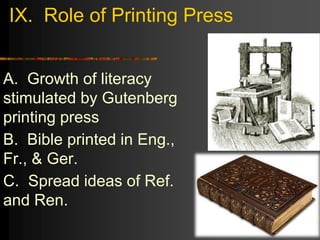
IX. Role of Printing Press
A. Growth of literacy
stimulated by Gutenberg
printing press
B. Bible printed in Eng.,
Fr., & Ger.
C. Spread ideas of Ref.
and Ren.
X. The COUNTER-Reformation
Or,
The Catholic
Church
Strikes Back!!
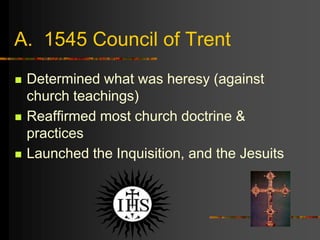
A. 1545 Council of Trent
 Determined what was heresy (against
church teachings)
 Reaffirmed most church doctrine &
practices
 Launched the Inquisition, and the Jesuits
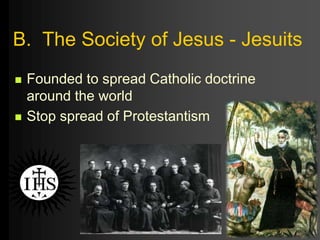
B. The Society of Jesus - Jesuits
 Founded to spread Catholic doctrine
around the world
 Stop spread of Protestantism
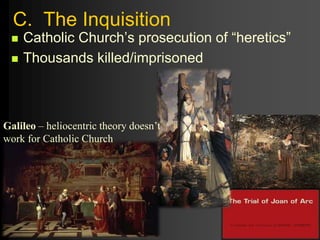
C. The Inquisition
 Catholic Church’s prosecution of “heretics”
 Thousands killed/imprisoned
Galileo – heliocentric theory doesn’t
work for Catholic Church
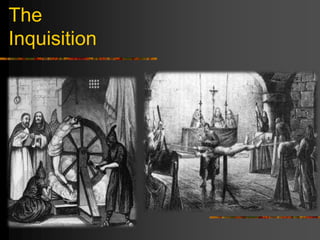
The
Inquisition
XI. Changing Ideas
A. Growth of:
Secularism
Individualism
Religious tolerance
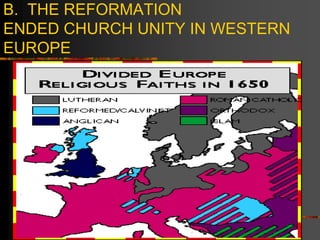
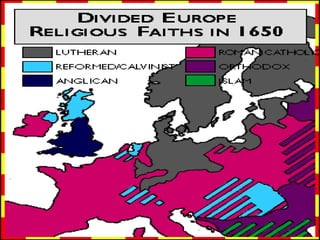
B. THE REFORMATION
ENDED CHURCH UNITY IN WESTERN
EUROPE
Protestant Reformation

Protestant Reformation

  • 1.
    William Shakespeare: EnglishRenaissance writer “The fool doth think he is wise, but the wise man knows himself to be a fool.” ― William Shakespeare, As You Like It “Love all, trust a few, do wrong to none.” ― William Shakespeare, All's Well That Ends Well “Love looks not with the eyes, but with the mind, And therefore is winged Cupid painted blind.” ― William Shakespeare, A Midsummer Night's Dream “Be not afraid of greatness. Some are born great, some achieve greatness, and others have greatness thrust upon them.” ― William Shakespeare, Twelfth Night Renaissance Writer Critical Intro. William Shakespeare – Which is your favorite and why? Also how does the quote reflect Renaissance thinking?
  • 2.
  • 3.
    Renaissance's effect  Peoplebegan to question their lives and authority
  • 4.
    Catholic Church hadbeen biggest authority of the Middle Ages.
  • 5.
    I. Conflicts thatchallenged the authority of the Church in Rome A. Merchants challenged the Church’s opposition to usury (charging interest) B. German & Eng. nobility disliked Italian domination of the Church C. Church’s great political power & wealth caused conflict D. Corruption & sale of indulgences
  • 6.
    II. Church Dissenters priorto Martin Luther A. John Wycliffe – English philosopher  1320 -1384  Led movement of opposition to medieval Church  Forerunner of the Reformation B. Jan Huss – Czech priest  1369-1415  Church reformer  Tried & burned for heresy
  • 7.
    Martin Luther nails “95 Theses”to church door in Wittenberg, Germany - 1517
  • 8.
    III. Martin Luther-1517  German monk  Questioned Churches practices such as:  Sale of indulgences by Johann Tetzel building a church  “ selling forgiveness for sins”  Automatic trip to heaven "As soon as a coin in the coffer rings / the soul from purgatory springs."
  • 9.
    The Lutheran Tradition Views:  Salvation by faith alone  Bible = ultimate authority  Bible should be in vernacular  Priests; no special powers  All humans are equal before God
  • 10.
    The Lutheran Tradition Actions:  95 Theses  95 things church is doing wrong  Nailed to church door in Wittenburg, Germany  Birth of Protestant Church
  • 11.
    11 Martin Luther Erasmus “How‘bout that Reformation…”
  • 12.
    The Lutheran Tradition Luther writes down his “95 Theses” (95 things church is doing wrong) and nails them to the church in Wittenberg (Germany)
  • 13.
    Martin Luther  “FaithAlone” will save you  All should read the Bible in their own vernacular (language)  Priests do not have special powers  Simplify the sacraments to baptism and communion  Religious Education for all.
  • 14.
    How will peoplereact?  How will the church react?
  • 15.
    Church’s Reaction  WantMartin Luther to recant (take back) what he said @ Diet of Worms  Diet – group/assembly  Worms is a place in Germany
  • 16.
    Luther says NO!!!!!!!!!! Hierstehe ich. Ich kann nicht anders. Gott helfe mir. Amen." ("Here I stand. I can do nothing else. God help me. Amen.") He is excommunicated from church and forced into hiding for the rest of his life
  • 17.
    Results of Luther’sactions? - Opened people’s eyes to corruption of the church -new churches created based on own beliefs– ex John Calvin-- Calvinism -Ex. Protestant, Lutheran, Baptists, Puritans, Methodists, Calvinists, and so on.
  • 19.
    IV. John Calvin– Calvinism A. French lawyer - moved to religious community in Geneva, Switzerland B. Main Concept = PREDESTINATION - God has already decided who is saved/condemned.  “Faith Alone” saves you  Faith revealed by living a righteous life.  Strong work ethic
  • 20.
    John Calvin -Calvinism C. Actions of Calvinists?  Expansion of the Protestant movement in Europe
  • 21.
    The Calvinist tradition Actions:  Expansion of the Protestant movement  Spreads to France, Germany, Netherlands, Scandinavia, Scotland  Scottish Presbyterians, American Baptists, Puritans, from this branch.
  • 22.
  • 23.
  • 24.
    V. Henry VIIIof England A. Break From Church  Wished to divorce Catherine of Aragon  Pope refused to grant divorce  Henry dismissed the authority of the Pope
  • 25.
    Henry VIII ofEngland B. Act of Supremacy - 1534  The King is head of the national church in England (Anglican Church), not the Pope!! C. Actions:  Divorced  Broke w/Rome  Took lands & wealth of Roman Catholic Church in England
  • 26.
    VI. Queen ElizabethI A. Anglican Church  Creates formality & separateness of Anglican Church  Book of Common Prayer - for Anglican services
  • 27.
    Queen Elizabeth I B.Impacts on Reformation  Tolerance for dissenters (Catholics & Protestants)  Reduced religious tension  Expansion & colonialism  Spread Protestantism
  • 28.
    Queen Elizabeth I– Exploration = Spread of Protestantism
  • 29.
    Queen Elizabeth I C.Victory over Spanish Armada (Navy) (1588)  Catholic Spain attacking Protestant England  Protestantism wins over Catholicism.
  • 30.
    VII. Reformation inGermany A. Religious & State Rivalries Emerge – Thirty Years War  Northern Germany princes – convert to Protestantism  End authority of Pope in their states  Austrian Habsburg family & Holy Roman Empire continue to support RCC  Fighting ensues.  Ends with Treaty of Westphalia – Religious choice
  • 31.
  • 32.
  • 33.
    VIII. Reformation inFrance A. Edict of Nantes - 1598  Catholic monarchy grants Huguenots (French Protestants) religious freedom  Later revoked
  • 34.
    Reformation in France B.Increased centralized powe 1. Cardinal Richelieu  French Prime Minister  Changed focus of 30 Years War from religious to political.
  • 35.
    Reformation in France Increasedcentralized power 2. Actions  Oppose Habsburg/Spanish aggression/influence  Returned restrictions on Huguenots  Reduced taxation on nobility  Advanced concept of “Absolutism”  Make France most powerful.
  • 36.
    IX. Role ofPrinting Press A. Growth of literacy stimulated by Gutenberg printing press B. Bible printed in Eng., Fr., & Ger. C. Spread ideas of Ref. and Ren.
  • 37.
    X. The COUNTER-Reformation Or, TheCatholic Church Strikes Back!!
  • 38.
    A. 1545 Councilof Trent  Determined what was heresy (against church teachings)  Reaffirmed most church doctrine & practices  Launched the Inquisition, and the Jesuits
  • 39.
    B. The Societyof Jesus - Jesuits  Founded to spread Catholic doctrine around the world  Stop spread of Protestantism
  • 40.
    C. The Inquisition Catholic Church’s prosecution of “heretics”  Thousands killed/imprisoned Galileo – heliocentric theory doesn’t work for Catholic Church
  • 41.
  • 42.
    XI. Changing Ideas A.Growth of: Secularism Individualism Religious tolerance
  • 43.
    B. THE REFORMATION ENDEDCHURCH UNITY IN WESTERN EUROPE