The
“Gunpowder Empires”
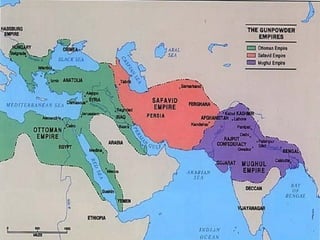
Islamic Land-based Empires
Critical Intro:
• What was the main reasoning for the
religious conflict between the Ottomans
and Safavids?
• What was the religious commonality
between the Ottomans and Mughals?
• How were the 3 “Gunpowder Empires”
more similar to Russia rather than Western
Europe?
Islamic Land-Based Empires – 1450-1750
“Gunpowder Empires”
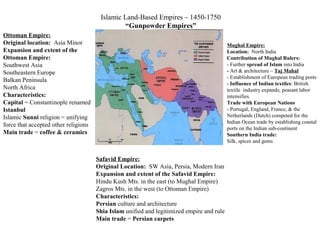
Ottoman Empire:
Original location: Asia Minor
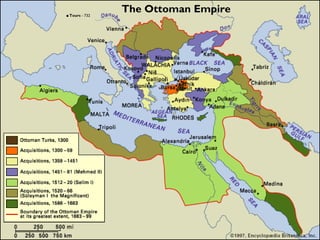
Expansion and extent of the
Ottoman Empire:
Southwest Asia
Southeastern Europe
Balkan Peninsula
North Africa
Characteristics:
Capital = Constantinople renamed
Istanbul
Islamic Sunni religion = unifying
force that accepted other religions
Main trade = coffee & ceramics
Mughal Empire:
Location: North India
Contribution of Mughal Rulers:
- Further spread of Islam into India
- Art & architecture – Taj Mahal
- Establishment of European trading posts
- Influence of Indian textiles: British
textile industry expands; peasant labor
intensifies.
Trade with European Nations
- Portugal, England, France, & the
Netherlands (Dutch) competed for the
Indian Ocean trade by establishing coastal
ports on the Indian sub-continent
Southern India trade:
Silk, spices and gems
Safavid Empire:
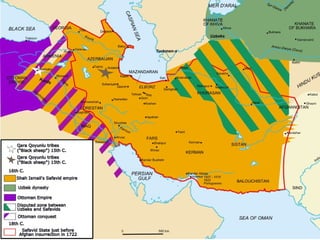
Original Location: SW Asia, Persia, Modern Iran
Expansion and extent of the Safavid Empire:
Hindu Kush Mts. in the east (to Mughal Empire)
Zagros Mts. in the west (to Ottoman Empire)
Characteristics:
Persian culture and architecture
Shia Islam unified and legitimized empire and rule
Main trade = Persian carpets
.Tours - 732
The Ottoman Empire
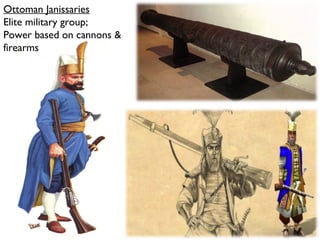
Ottoman Janissaries
Elite military group;
Power based on cannons &
firearms
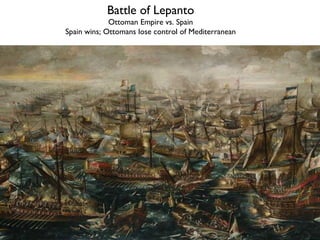
Battle of Lepanto
Ottoman Empire vs. Spain
Spain wins; Ottomans lose control of Mediterranean
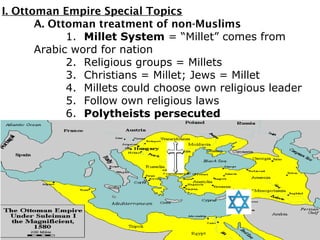
I. Ottoman Empire Special Topics
A. Ottoman treatment of non-Muslims
1. Millet System = “Millet” comes from
Arabic word for nation
2. Religious groups = Millets
3. Christians = Millet; Jews = Millet
4. Millets could choose own religious leader
5. Follow own religious laws
6. Polytheists persecuted
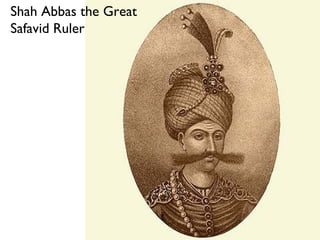
Shah Abbas the Great
Safavid Ruler
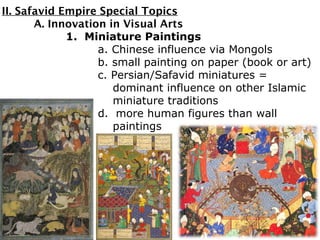
II. Safavid Empire Special Topics
A. Innovation in Visual Arts
1. Miniature Paintings
a. Chinese influence via Mongols
b. small painting on paper (book or art)
c. Persian/Safavid miniatures =
dominant influence on other Islamic
miniature traditions
d. more human figures than wall
paintings
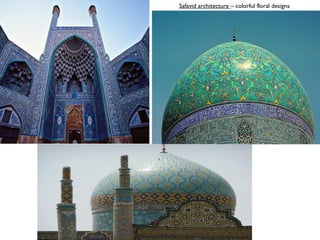
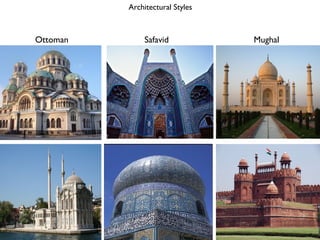
Safavid architecture – colorful floral designs
II. Safavid Empire Special Topics
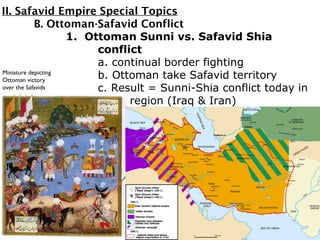
B. Ottoman-Safavid Conflict
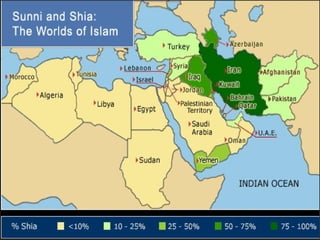
1. Ottoman Sunni vs. Safavid Shia
conflict
a. continual border fighting
b. Ottoman take Safavid territory
c. Result = Sunni-Shia conflict today in
region (Iraq & Iran)
Miniature depicting
Ottoman victory
over the Safavids
Architectural Styles
Ottoman Safavid Mughal
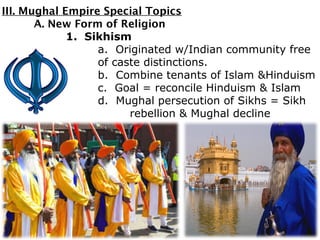
III. Mughal Empire Special Topics
A. New Form of Religion
1. Sikhism
a. Originated w/Indian community free
of caste distinctions.
b. Combine tenants of Islam &Hinduism
c. Goal = reconcile Hinduism & Islam
d. Mughal persecution of Sikhs = Sikh
rebellion & Mughal decline
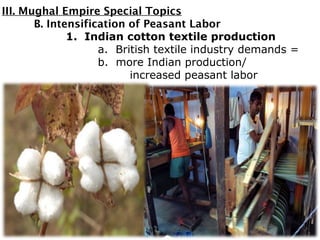
III. Mughal Empire Special Topics
B. Intensification of Peasant Labor
1. Indian cotton textile production
a. British textile industry demands =
b. more Indian production/
increased peasant labor
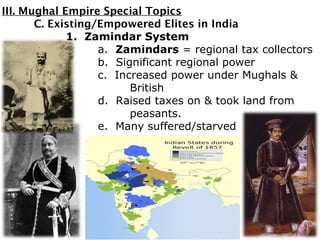
III. Mughal Empire Special Topics
C. Existing/Empowered Elites in India
1. Zamindar System
a. Zamindars = regional tax collectors
b. Significant regional power
c. Increased power under Mughals &
British
d. Raised taxes on & took land from
peasants.
e. Many suffered/starved
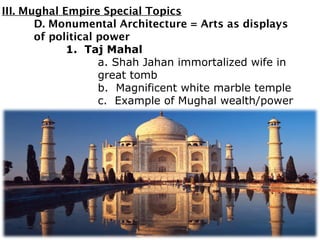
III. Mughal Empire Special Topics
D. Monumental Architecture = Arts as displays
of political power
1. Taj Mahal
a. Shah Jahan immortalized wife in
great tomb
b. Magnificent white marble temple
c. Example of Mughal wealth/power
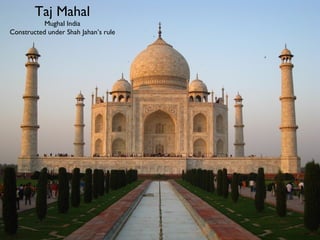
Taj Mahal
Mughal India
Constructed under Shah Jahan’s rule
On which seas did the Ottomans have the greatest influence?
What is the commonality between Tours and Vienna?
Significant accomplishment of Suleiman the Magnificent?
In short, how did Janissaries gain power & influence?
Describe the “Devshirme” system.
Like the Byzantine Empire before it, the Ottoman Empire enjoyed commercial success by
controlling which narrow waterway?
Reasons contributing to Ottoman decline?
Economically, how were the Ottomans weakened by European nations?
Which form of Islam dominated Ottoman society?
Technologically, what attitudes kept the Ottomans behind the Europeans?
Significance of Battle of Lepanto?
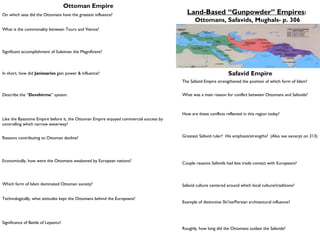
Ottoman Empire
Land-Based “Gunpowder” Empires:
Ottomans, Safavids, Mughals- p. 306
The Safavid Empire strengthened the position of which form of Islam?
What was a main reason for conflict between Ottomans and Safavids?
How are these conflicts reflected in this region today?
Greatest Safavid ruler? His emphasis/strengths? (Also see excerpt on 313)
Couple reasons Safavids had less trade contact with Europeans?
Safavid culture centered around which local culture/traditions?
Example of distinctive Shi’ite/Persian architectural influence?
Roughly, how long did the Ottomans outlast the Safavids?
Safavid Empire
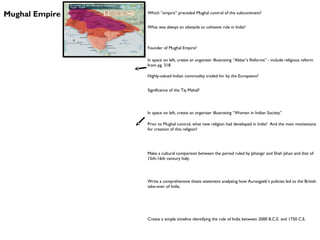
Which “empire” preceded Mughal control of the subcontinent?
What was always an obstacle to cohesive rule in India?
Founder of Mughal Empire?
In space on left, create an organizer illustrating “Akbar’s Reforms” - include religious reform
from pg. 318
Highly-valued Indian commodity traded for by the Europeans?
Significance of the Taj Mahal?
In space on left, create an organizer illustrating “Women in Indian Society”
Prior to Mughal control, what new religion had developed in India? And the main motivations
for creation of this religion?
Make a cultural comparison between the period ruled by Jahangir and Shah Jahan and that of
15th-16th century Italy.
Write a comprehensive thesis statement analyzing how Aurangzeb’s policies led to the British
take-over of India.
Create a simple timeline identifying the rule of India between 2000 B.C.E. and 1750 C.E.
Mughal Empire

Gunpowder Empires

  • 1.
  • 2.
    Critical Intro: • Whatwas the main reasoning for the religious conflict between the Ottomans and Safavids? • What was the religious commonality between the Ottomans and Mughals? • How were the 3 “Gunpowder Empires” more similar to Russia rather than Western Europe?
  • 3.
    Islamic Land-Based Empires– 1450-1750 “Gunpowder Empires” Ottoman Empire: Original location: Asia Minor Expansion and extent of the Ottoman Empire: Southwest Asia Southeastern Europe Balkan Peninsula North Africa Characteristics: Capital = Constantinople renamed Istanbul Islamic Sunni religion = unifying force that accepted other religions Main trade = coffee & ceramics Mughal Empire: Location: North India Contribution of Mughal Rulers: - Further spread of Islam into India - Art & architecture – Taj Mahal - Establishment of European trading posts - Influence of Indian textiles: British textile industry expands; peasant labor intensifies. Trade with European Nations - Portugal, England, France, & the Netherlands (Dutch) competed for the Indian Ocean trade by establishing coastal ports on the Indian sub-continent Southern India trade: Silk, spices and gems Safavid Empire: Original Location: SW Asia, Persia, Modern Iran Expansion and extent of the Safavid Empire: Hindu Kush Mts. in the east (to Mughal Empire) Zagros Mts. in the west (to Ottoman Empire) Characteristics: Persian culture and architecture Shia Islam unified and legitimized empire and rule Main trade = Persian carpets
  • 5.
    .Tours - 732 TheOttoman Empire
  • 6.
    Ottoman Janissaries Elite militarygroup; Power based on cannons & firearms
  • 7.
    Battle of Lepanto OttomanEmpire vs. Spain Spain wins; Ottomans lose control of Mediterranean
  • 8.
    I. Ottoman EmpireSpecial Topics A. Ottoman treatment of non-Muslims 1. Millet System = “Millet” comes from Arabic word for nation 2. Religious groups = Millets 3. Christians = Millet; Jews = Millet 4. Millets could choose own religious leader 5. Follow own religious laws 6. Polytheists persecuted
  • 10.
    Shah Abbas theGreat Safavid Ruler
  • 11.
    II. Safavid EmpireSpecial Topics A. Innovation in Visual Arts 1. Miniature Paintings a. Chinese influence via Mongols b. small painting on paper (book or art) c. Persian/Safavid miniatures = dominant influence on other Islamic miniature traditions d. more human figures than wall paintings
  • 12.
    Safavid architecture –colorful floral designs
  • 13.
    II. Safavid EmpireSpecial Topics B. Ottoman-Safavid Conflict 1. Ottoman Sunni vs. Safavid Shia conflict a. continual border fighting b. Ottoman take Safavid territory c. Result = Sunni-Shia conflict today in region (Iraq & Iran) Miniature depicting Ottoman victory over the Safavids
  • 16.
  • 17.
    III. Mughal EmpireSpecial Topics A. New Form of Religion 1. Sikhism a. Originated w/Indian community free of caste distinctions. b. Combine tenants of Islam &Hinduism c. Goal = reconcile Hinduism & Islam d. Mughal persecution of Sikhs = Sikh rebellion & Mughal decline
  • 18.
    III. Mughal EmpireSpecial Topics B. Intensification of Peasant Labor 1. Indian cotton textile production a. British textile industry demands = b. more Indian production/ increased peasant labor
  • 19.
    III. Mughal EmpireSpecial Topics C. Existing/Empowered Elites in India 1. Zamindar System a. Zamindars = regional tax collectors b. Significant regional power c. Increased power under Mughals & British d. Raised taxes on & took land from peasants. e. Many suffered/starved
  • 21.
    III. Mughal EmpireSpecial Topics D. Monumental Architecture = Arts as displays of political power 1. Taj Mahal a. Shah Jahan immortalized wife in great tomb b. Magnificent white marble temple c. Example of Mughal wealth/power
  • 22.
    Taj Mahal Mughal India Constructedunder Shah Jahan’s rule
  • 24.
    On which seasdid the Ottomans have the greatest influence? What is the commonality between Tours and Vienna? Significant accomplishment of Suleiman the Magnificent? In short, how did Janissaries gain power & influence? Describe the “Devshirme” system. Like the Byzantine Empire before it, the Ottoman Empire enjoyed commercial success by controlling which narrow waterway? Reasons contributing to Ottoman decline? Economically, how were the Ottomans weakened by European nations? Which form of Islam dominated Ottoman society? Technologically, what attitudes kept the Ottomans behind the Europeans? Significance of Battle of Lepanto? Ottoman Empire Land-Based “Gunpowder” Empires: Ottomans, Safavids, Mughals- p. 306 The Safavid Empire strengthened the position of which form of Islam? What was a main reason for conflict between Ottomans and Safavids? How are these conflicts reflected in this region today? Greatest Safavid ruler? His emphasis/strengths? (Also see excerpt on 313) Couple reasons Safavids had less trade contact with Europeans? Safavid culture centered around which local culture/traditions? Example of distinctive Shi’ite/Persian architectural influence? Roughly, how long did the Ottomans outlast the Safavids? Safavid Empire
  • 25.
    Which “empire” precededMughal control of the subcontinent? What was always an obstacle to cohesive rule in India? Founder of Mughal Empire? In space on left, create an organizer illustrating “Akbar’s Reforms” - include religious reform from pg. 318 Highly-valued Indian commodity traded for by the Europeans? Significance of the Taj Mahal? In space on left, create an organizer illustrating “Women in Indian Society” Prior to Mughal control, what new religion had developed in India? And the main motivations for creation of this religion? Make a cultural comparison between the period ruled by Jahangir and Shah Jahan and that of 15th-16th century Italy. Write a comprehensive thesis statement analyzing how Aurangzeb’s policies led to the British take-over of India. Create a simple timeline identifying the rule of India between 2000 B.C.E. and 1750 C.E. Mughal Empire