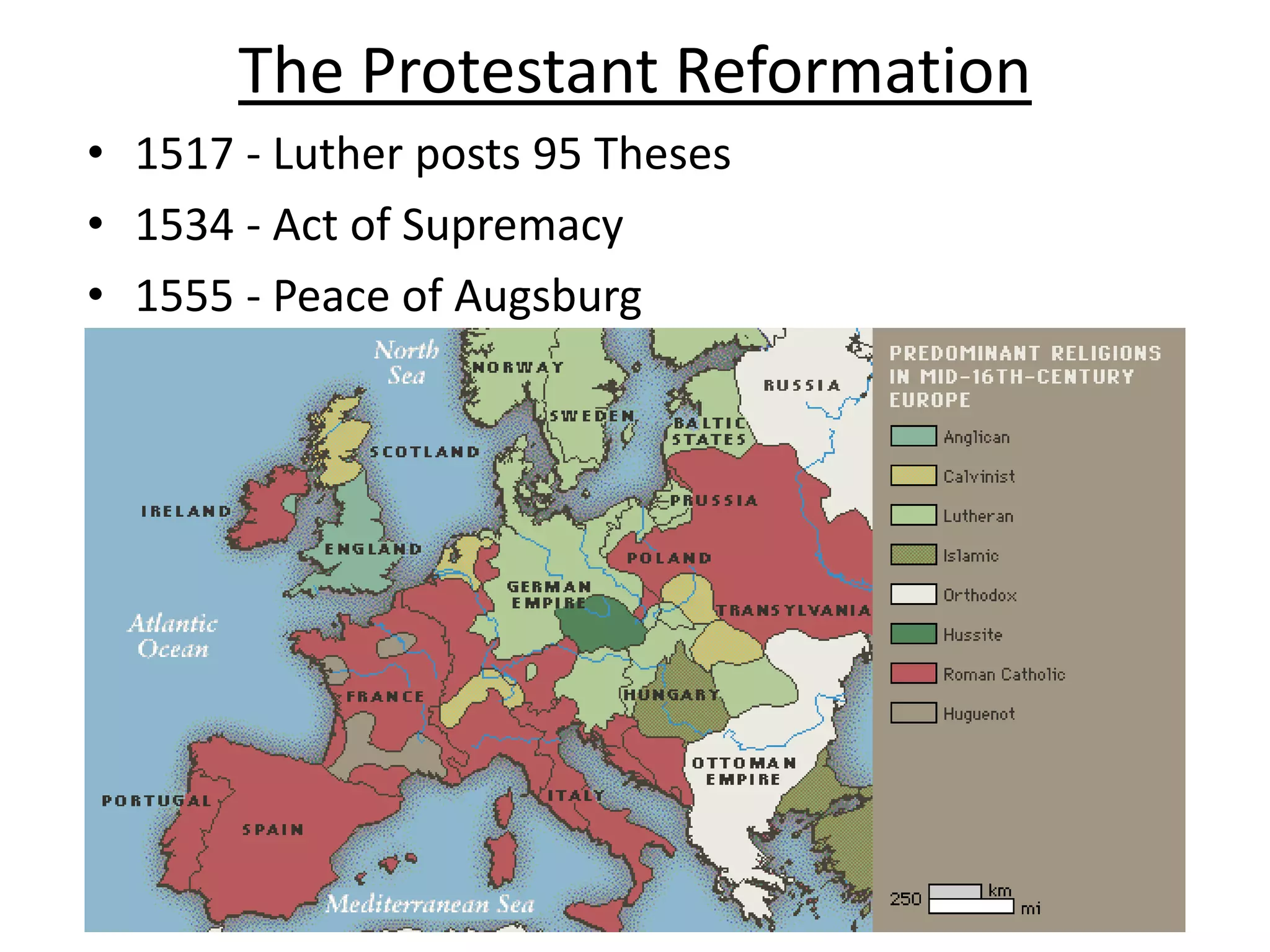
The Protestant Reformation1517 - Luther posts 95 Theses1534 - Act of Supremacy1555 - Peace of Augsburg
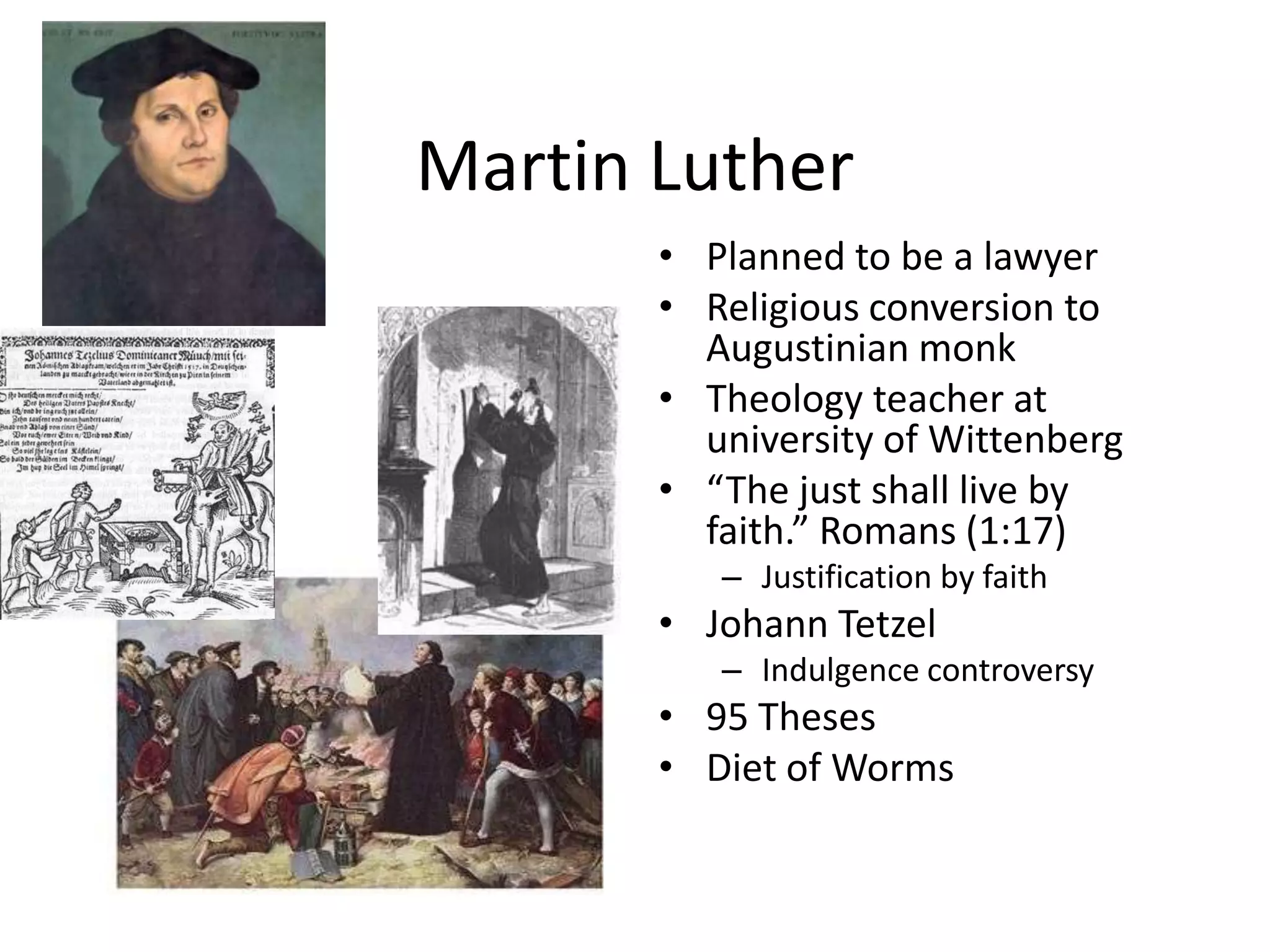
Martin LutherPlanned to be a lawyerReligious conversion to Augustinian monkTheology teacher at university of Wittenberg“The just shall live by faith.” Romans (1:17)Justification by faithJohann TetzelIndulgence controversy95 ThesesDiet of Worms
Lutheranism“Justification by faith”“Sola scriptura”Baptism and holy communionPriesthood of believersGerman translation of BibleAbolished monasteries and celibacy of clergy
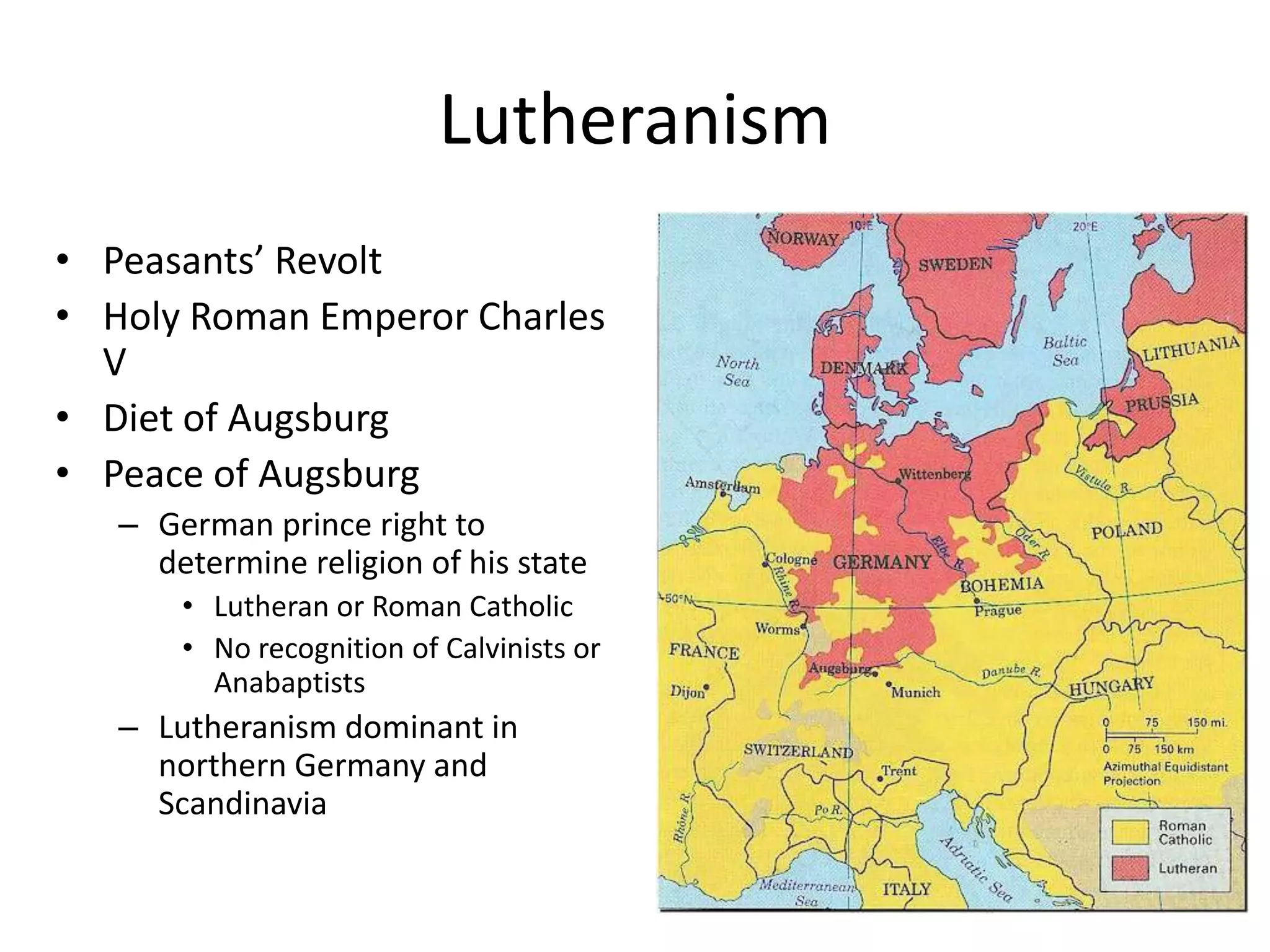
LutheranismPeasants’ RevoltHoly Roman Emperor Charles VDiet of AugsburgPeace of AugsburgGerman prince right to determine religion of his stateLutheran or Roman CatholicNo recognition of Calvinists or AnabaptistsLutheranism dominant in northern Germany and Scandinavia
CalvinismUlrich ZwingliHumanist and Catholic priestSacraments only symbolic ceremoniesRejected celibacy of clergyEmphasized simplicity in worshipKilled by Catholic forcesJohn CalvinProtestantExile in GenevaInstitutes of the Christian ReligionPredestinationSalvation by electionPuritanismTheocracy
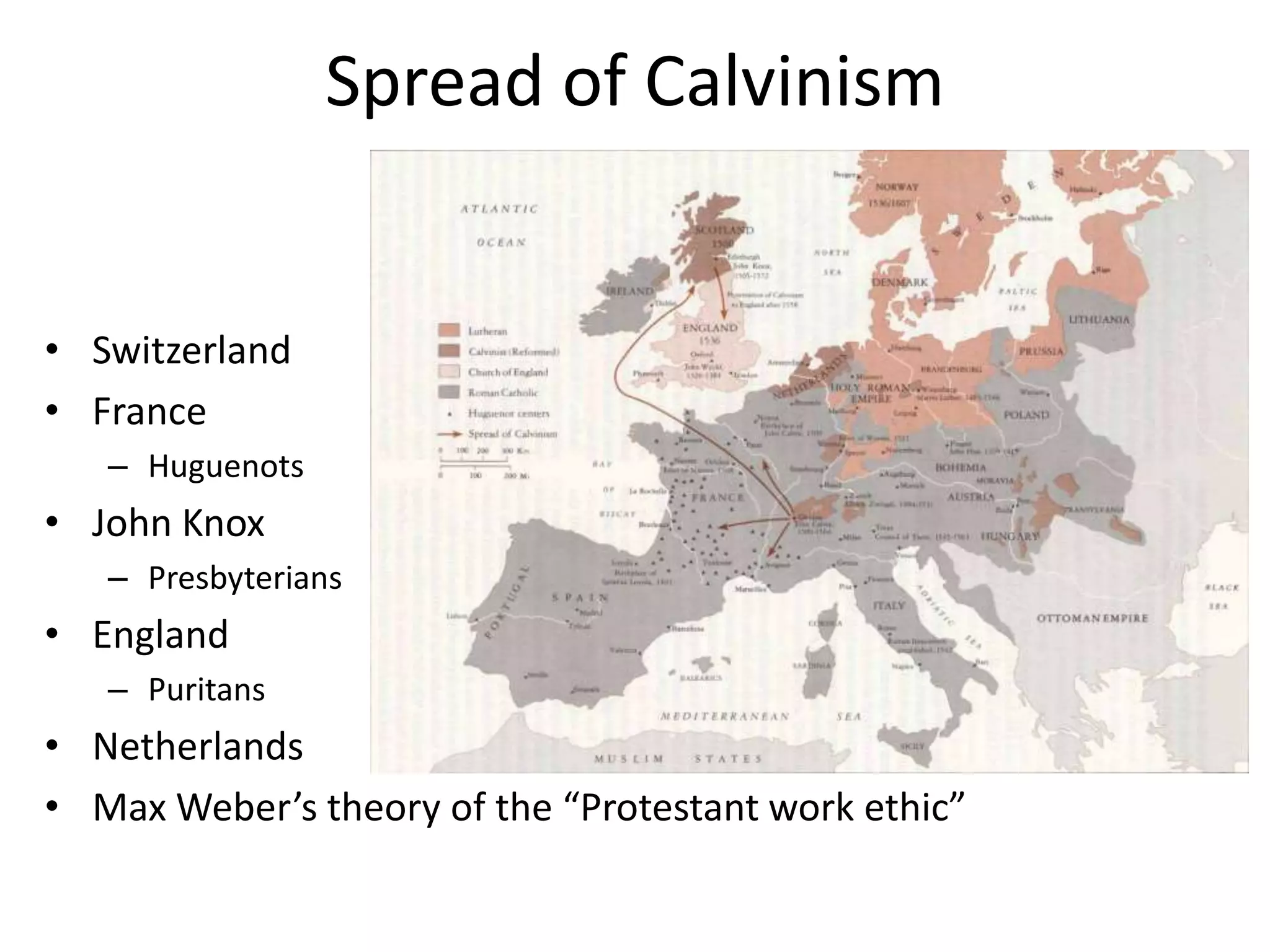
Spread of CalvinismSwitzerlandFranceHuguenotsJohn KnoxPresbyteriansEnglandPuritansNetherlandsMax Weber’s theory of the “Protestant work ethic”
AnglicanismKing Henry VIIIDivorce of Catherine of AragonThomas CramnerAct of SupremacyKing head of Church of EnglandSix ArticlesNo papal supremacySold monasteriesSupported by English peoplePapal taxes“Babylonian Captivity”Monastic landExecution of Thomas MoreEdward VI42 ArticlesMore ProtestantCramner’s Book of Common PrayerBloody MaryExecuted CramnerMarried Philip IIElizabeth ILast Tudor39 ArticlesOppositionPilgrims - SeparatistsMary Queen of ScotsPhilip II
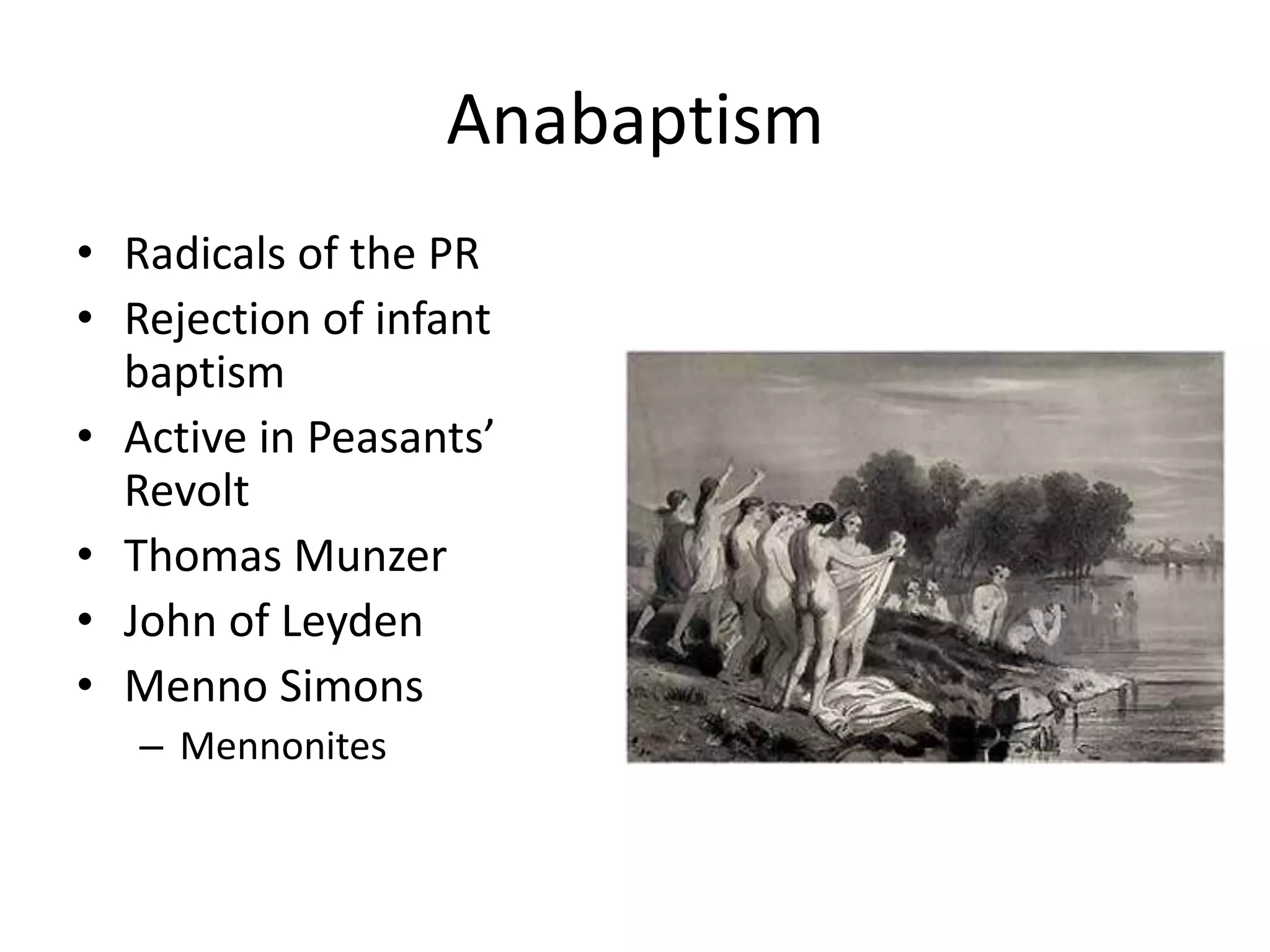
AnabaptismRadicals of the PRRejection of infant baptismActive in Peasants’ RevoltThomas MunzerJohn of LeydenMenno SimonsMennonites
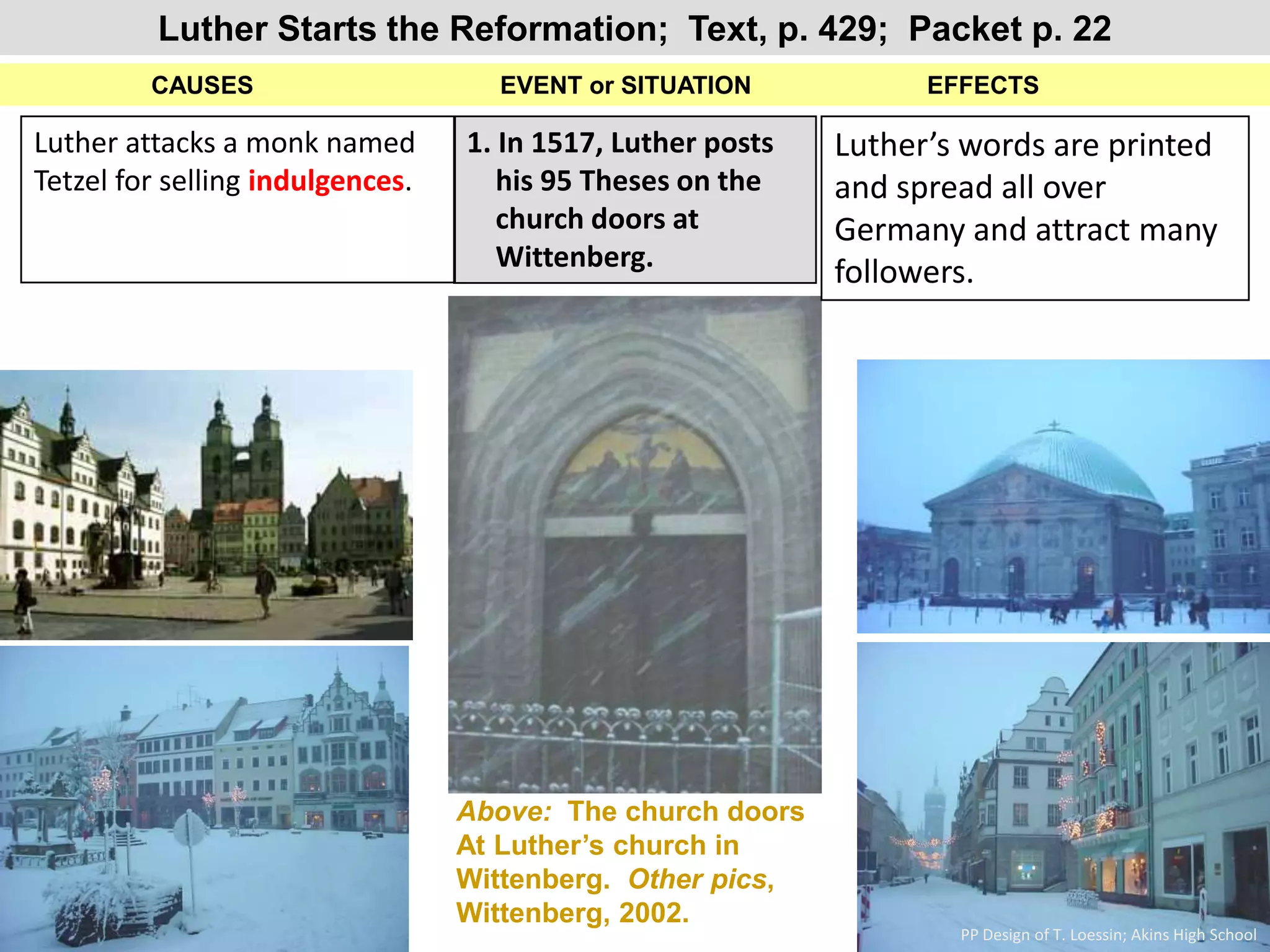
Luther Starts the Reformation;  Text, p. 429;  Packet p. 22           CAUSES                                    EVENT or SITUATION 		             EFFECTS1. In 1517, Luther posts     his 95 Theses on the     church doors at     Wittenberg.Luther attacks a monk named Tetzel for selling indulgences.Luther’s words are printed and spread all over Germany and attract many followers.Above:  The church doors At Luther’s church in Wittenberg.  Other pics, Wittenberg, 2002. PP Design of T. Loessin; Akins High School
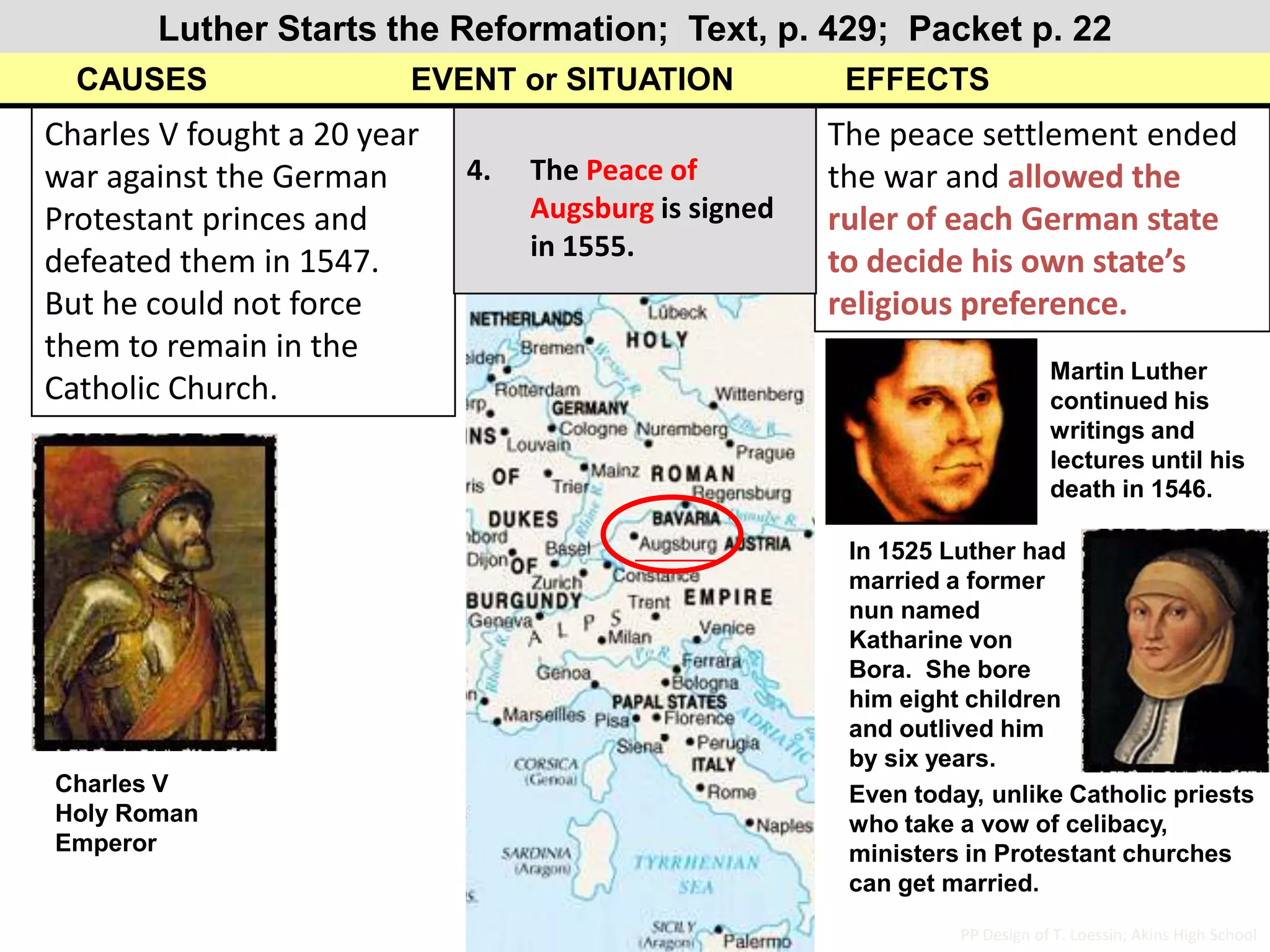
Luther Starts the Reformation;  Text, p. 429;  Packet p. 22                       CAUSES                       EVENT or SITUATION	        EFFECTSThe peace settlement ended the war and allowed the ruler of each German state to decide his own state’s religious preference.Charles V fought a 20 year war against the German Protestant princes and defeated them in 1547.  But he could not force them to remain in the Catholic Church.The Peace of Augsburg is signed in 1555.Martin Luther continued his writings and lectures until his death in 1546.In 1525 Luther had married a former nun named Katharine von Bora.  She bore him eight children and outlived him by six years.Charles VHoly Roman EmperorEven today, unlike Catholic priests who take a vow of celibacy, ministers in Protestant churches  can get married.PP Design of T. Loessin; Akins High School
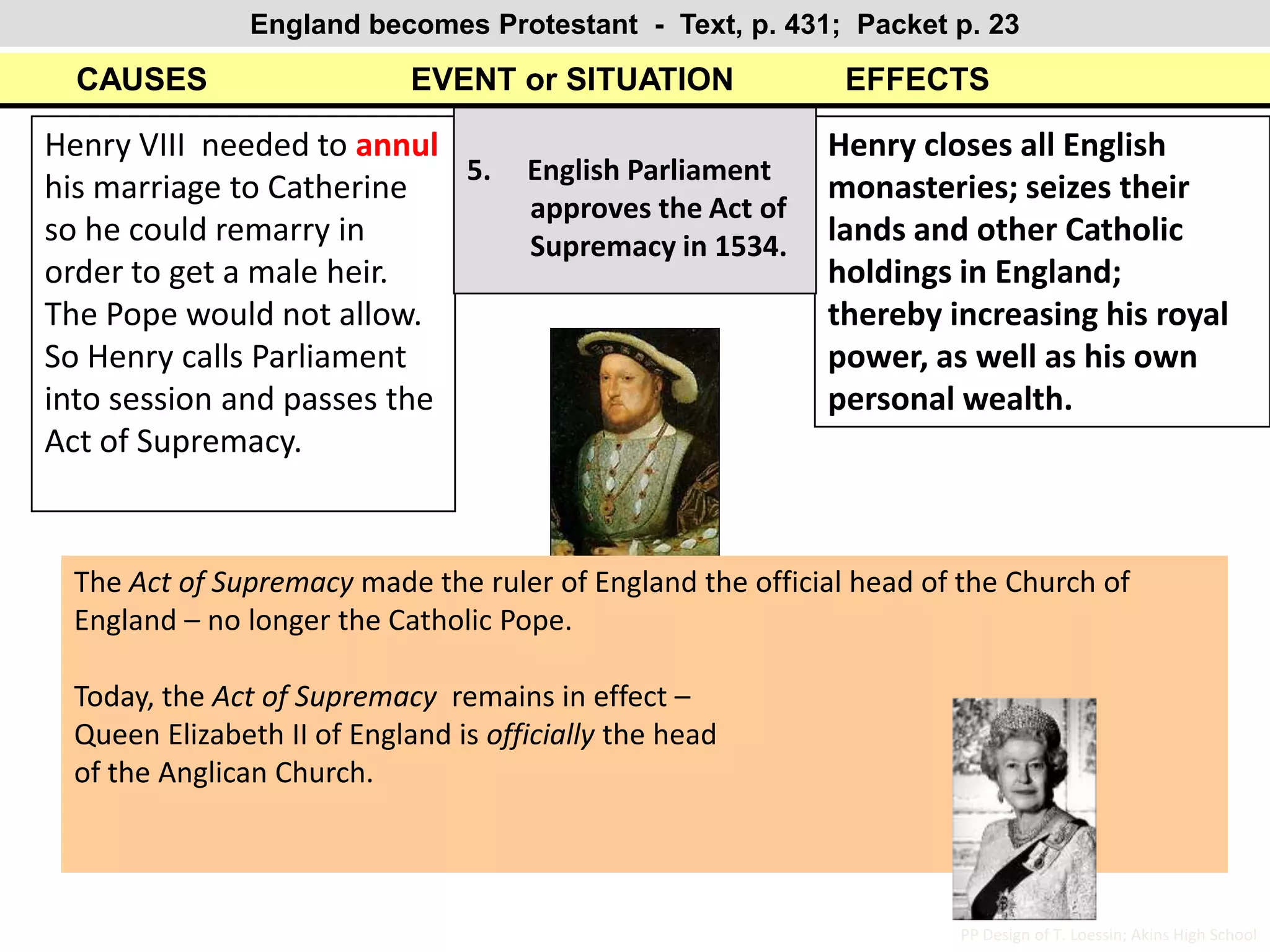
England becomes Protestant  -  Text, p. 431;  Packet p. 23CAUSES                       EVENT or SITUATION	        EFFECTS5.     English Parliament approves the Act of Supremacy in 1534.Henry closes all English monasteries; seizes their lands and other Catholic holdings in England; thereby increasing his royal power, as well as his own personal wealth.Henry VIII  needed to annul his marriage to Catherine so he could remarry in order to get a male heir.  The Pope would not allow.So Henry calls Parliament into session and passes the Act of Supremacy.The Act of Supremacy made the ruler of England the official head of the Church of England – no longer the Catholic Pope.  Today, the Act of Supremacy  remains in effect –Queen Elizabeth II of England is officially the head of the Anglican Church.PP Design of T. Loessin; Akins High School
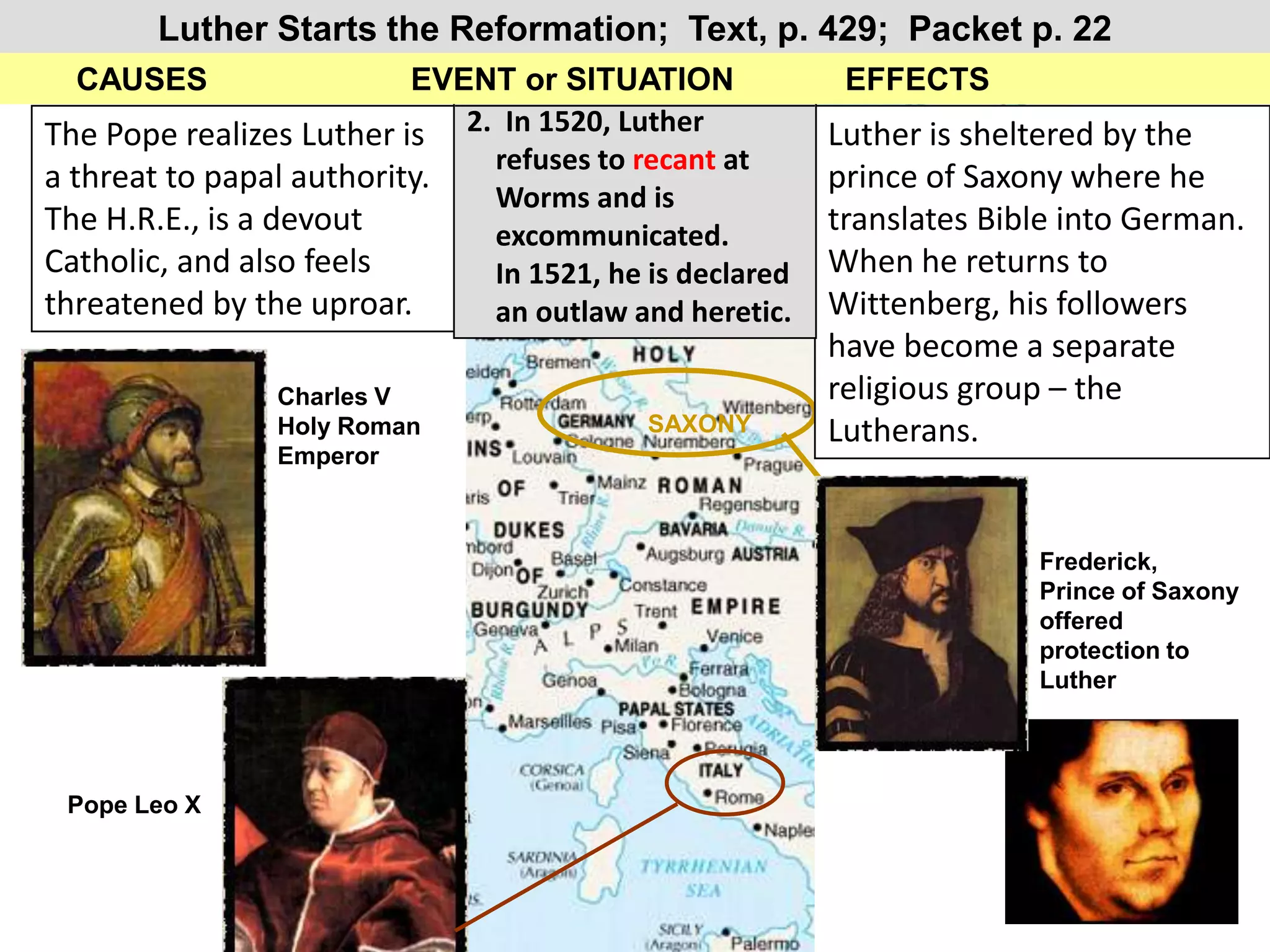
Luther Starts the Reformation;  Text, p. 429;  Packet p. 22CAUSES                       EVENT or SITUATION	        EFFECTS2.  In 1520, Luther     refuses to recant at    Worms and is    excommunicated.      In 1521, he is declared    an outlaw and heretic.Luther is sheltered by the prince of Saxony where he translates Bible into German.When he returns to Wittenberg, his followers have become a separate religious group – the Lutherans.The Pope realizes Luther is a threat to papal authority.The H.R.E., is a devout Catholic, and also feels threatened by the uproar.Charles VHoly Roman EmperorSAXONYFrederick, Prince of Saxonyofferedprotection to LutherMartin LutherPope Leo X
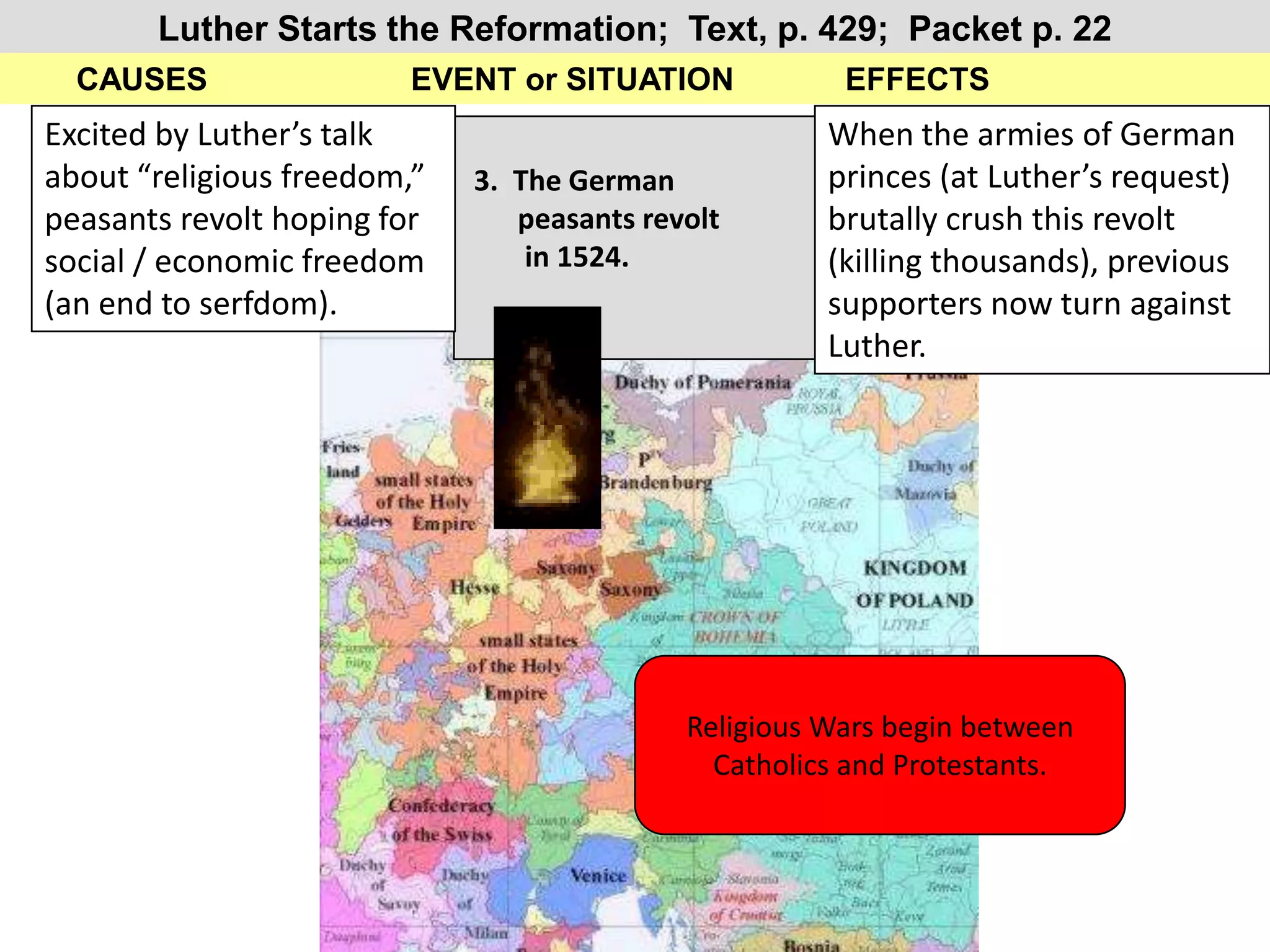
Luther Starts the Reformation;  Text, p. 429;  Packet p. 22CAUSES                       EVENT or SITUATION	        EFFECTSExcited by Luther’s talk about “religious freedom,” peasants revolt hoping for social / economic freedom (an end to serfdom).When the armies of German princes (at Luther’s request) brutally crush this revolt (killing thousands), previous supporters now turn against Luther. 3.  The German       peasants revolt         in 1524.Religious Wars begin between Catholics and Protestants.
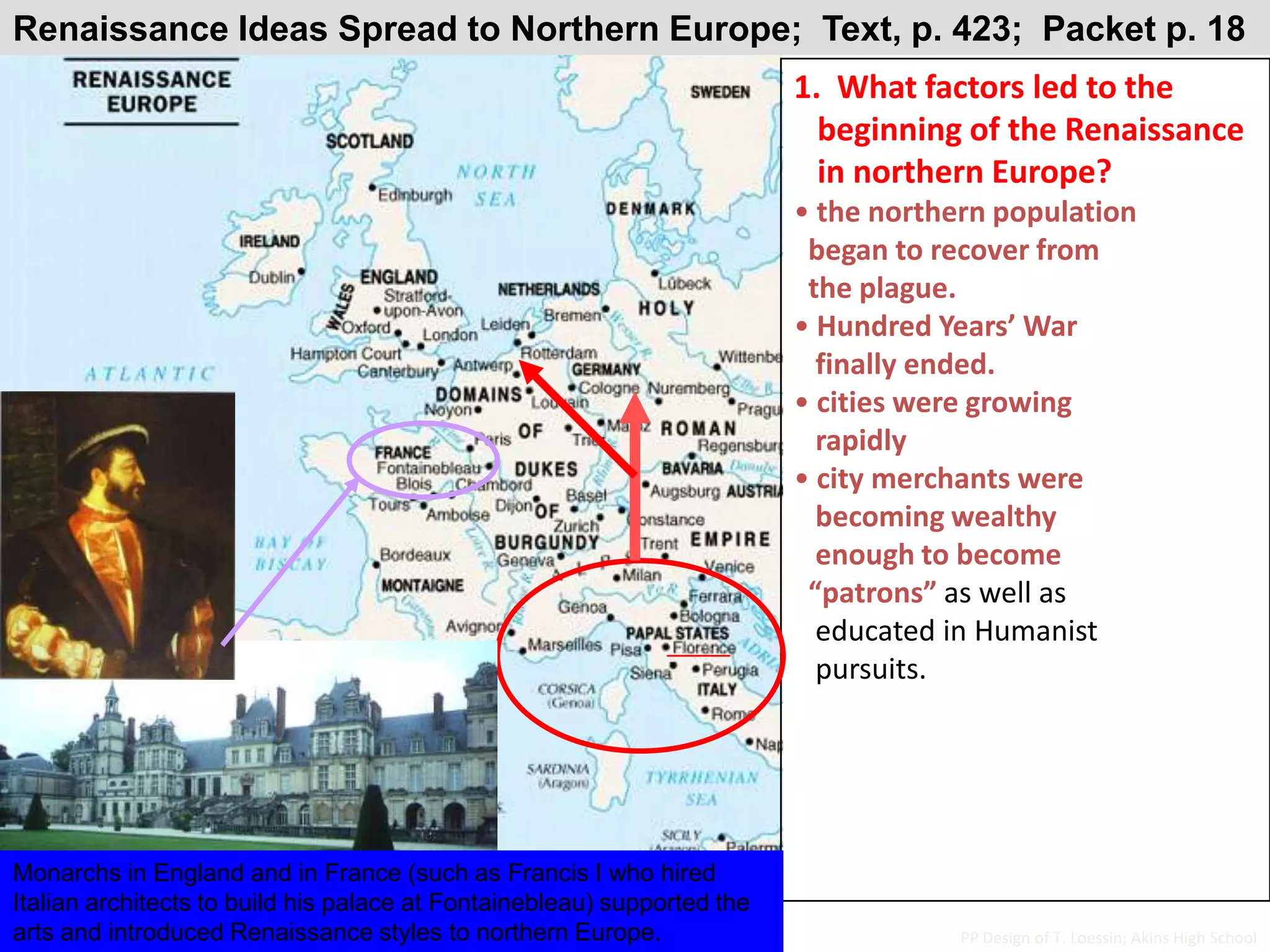
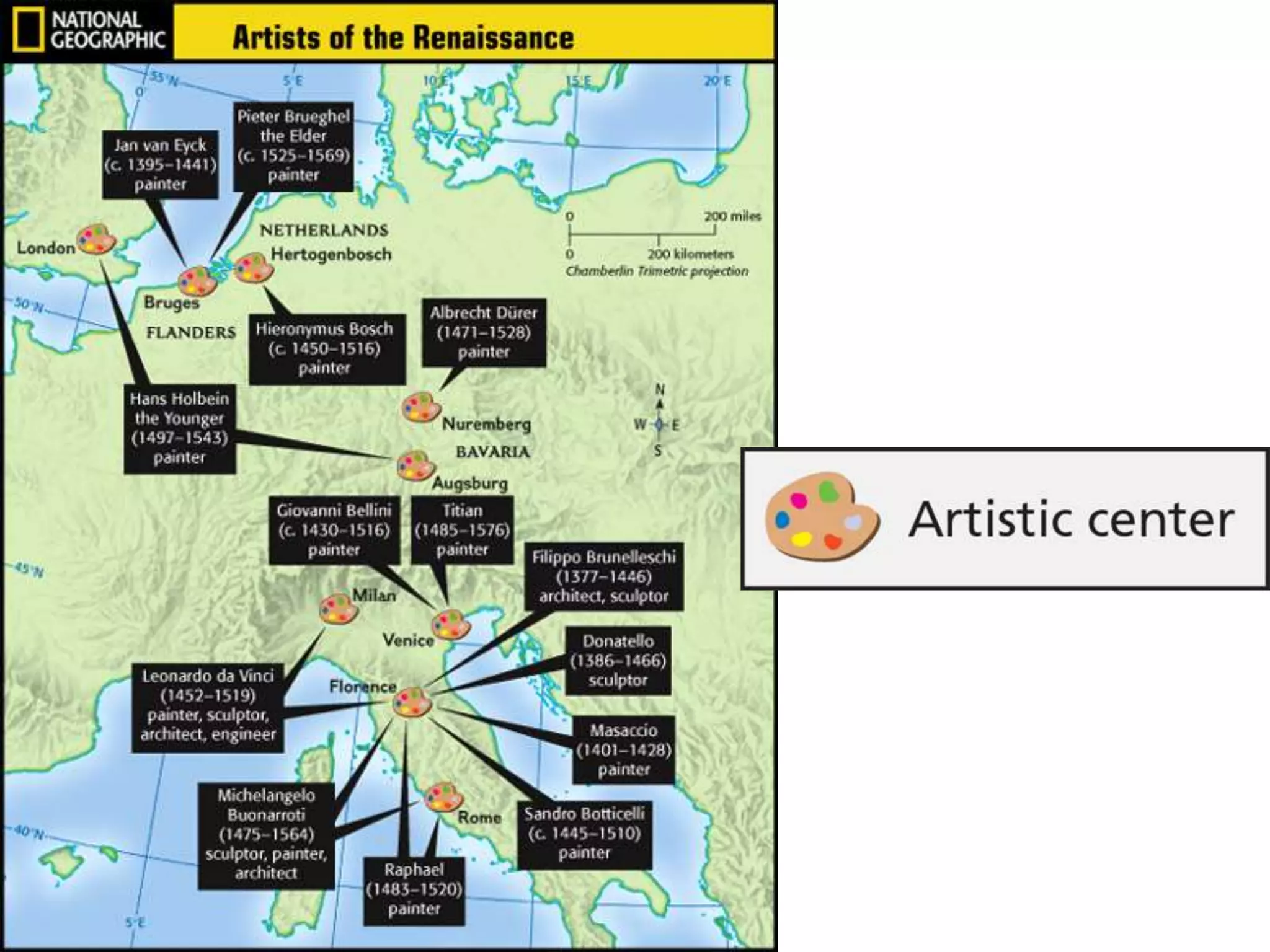
Renaissance Ideas Spread to Northern Europe;  Text, p. 423;  Packet p. 181.  What factors led to the      beginning of the Renaissance   in northern Europe? the northern population  began to recover from  the plague. Hundred Years’ War   finally ended. cities were growing   rapidly city merchants were    becoming wealthy   enough to become  “patrons” as well as   educated in Humanist   pursuits.Monarchs in England and in France (such as Francis I who hired Italian architects to build his palace at Fontainebleau) supported the arts and introduced Renaissance styles to northern Europe.PP Design of T. Loessin; Akins High School
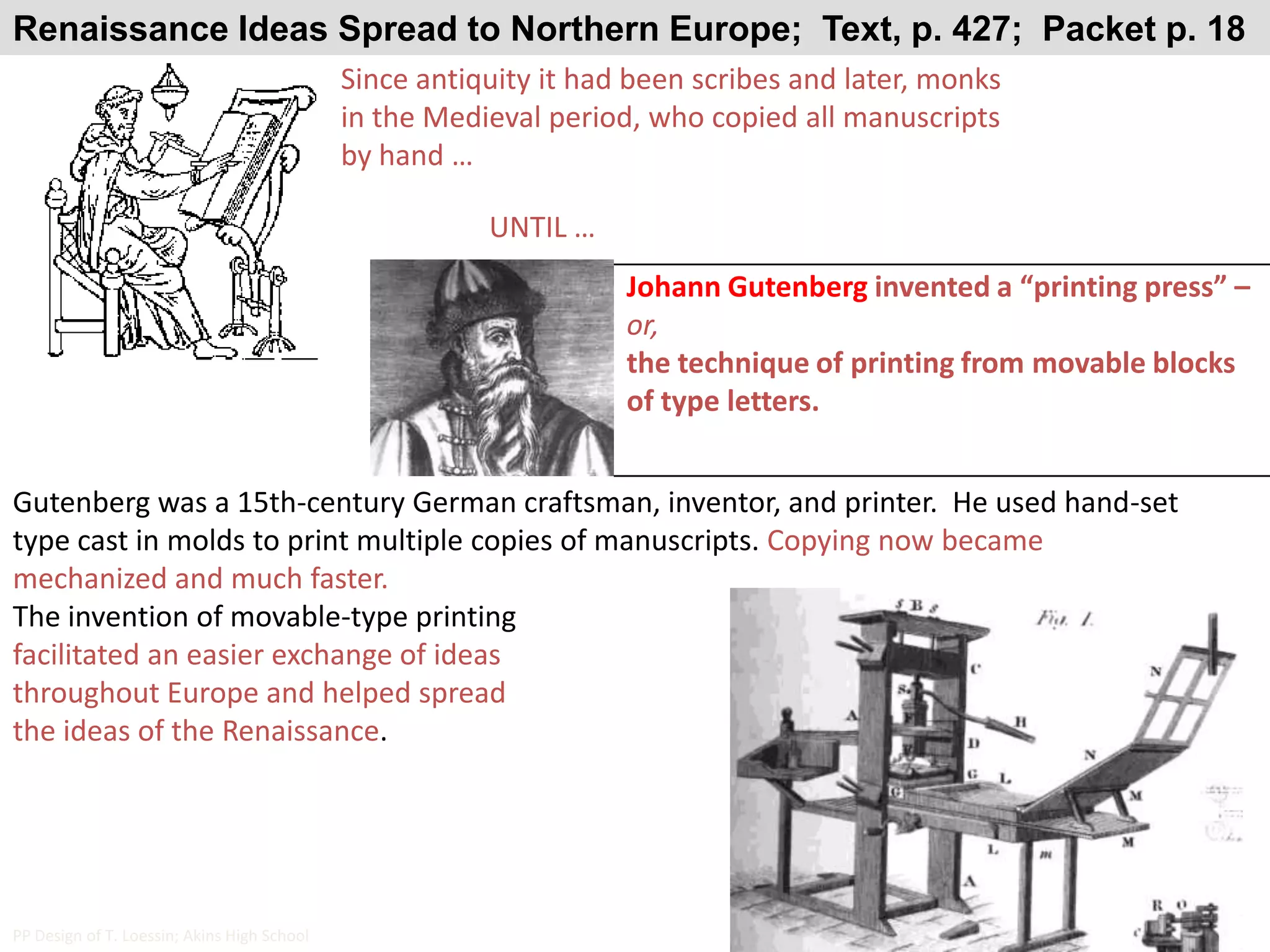
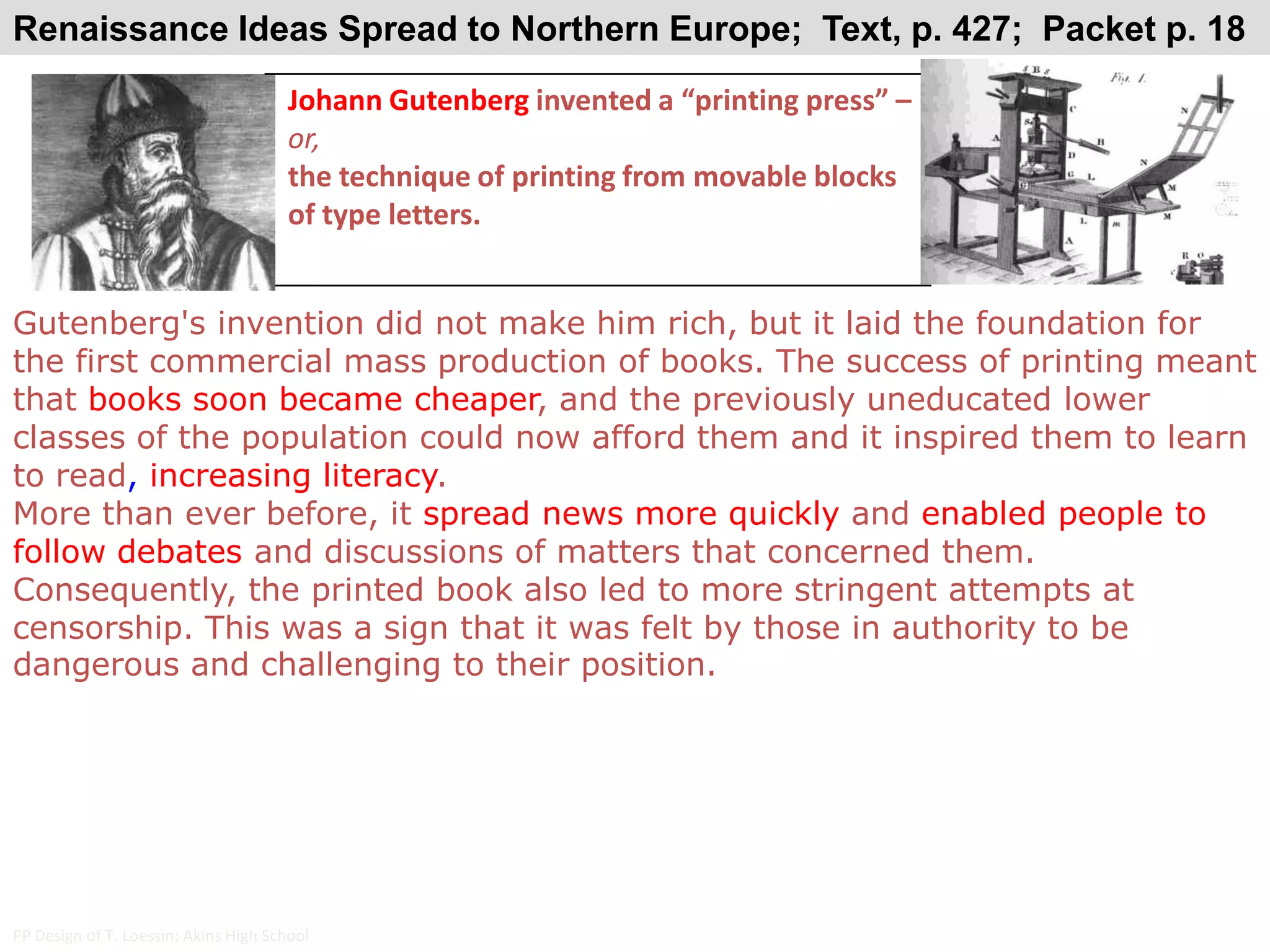
Renaissance Ideas Spread to Northern Europe;  Text, p. 427;  Packet p. 18Since antiquity it had been scribes and later, monks in the Medieval period, who copied all manuscripts by hand …UNTIL …Johann Gutenberg invented a “printing press” – or,the technique of printing from movable blocks of type letters.Gutenberg was a 15th-century German craftsman, inventor, and printer.  He used hand-set type cast in molds to print multiple copies of manuscripts. Copying now became mechanized and much faster.The invention of movable-type printing facilitated an easier exchange of ideas throughout Europe and helped spread the ideas of the Renaissance.PP Design of T. Loessin; Akins High School
Renaissance Ideas Spread to Northern Europe;  Text, p. 427;  Packet p. 18Johann Gutenberg invented a “printing press” – or,the technique of printing from movable blocks of type letters.Gutenberg's invention did not make him rich, but it laid the foundation for the first commercial mass production of books. The success of printing meant that books soon became cheaper, and the previously uneducated lower classes of the population could now afford them and it inspired them to learn to read, increasing literacy. More than ever before, it spread news more quickly and enabled people to follow debates and discussions of matters that concerned them. Consequently, the printed book also led to more stringent attempts at censorship. This was a sign that it was felt by those in authority to be dangerous and challenging to their position.PP Design of T. Loessin; Akins High School
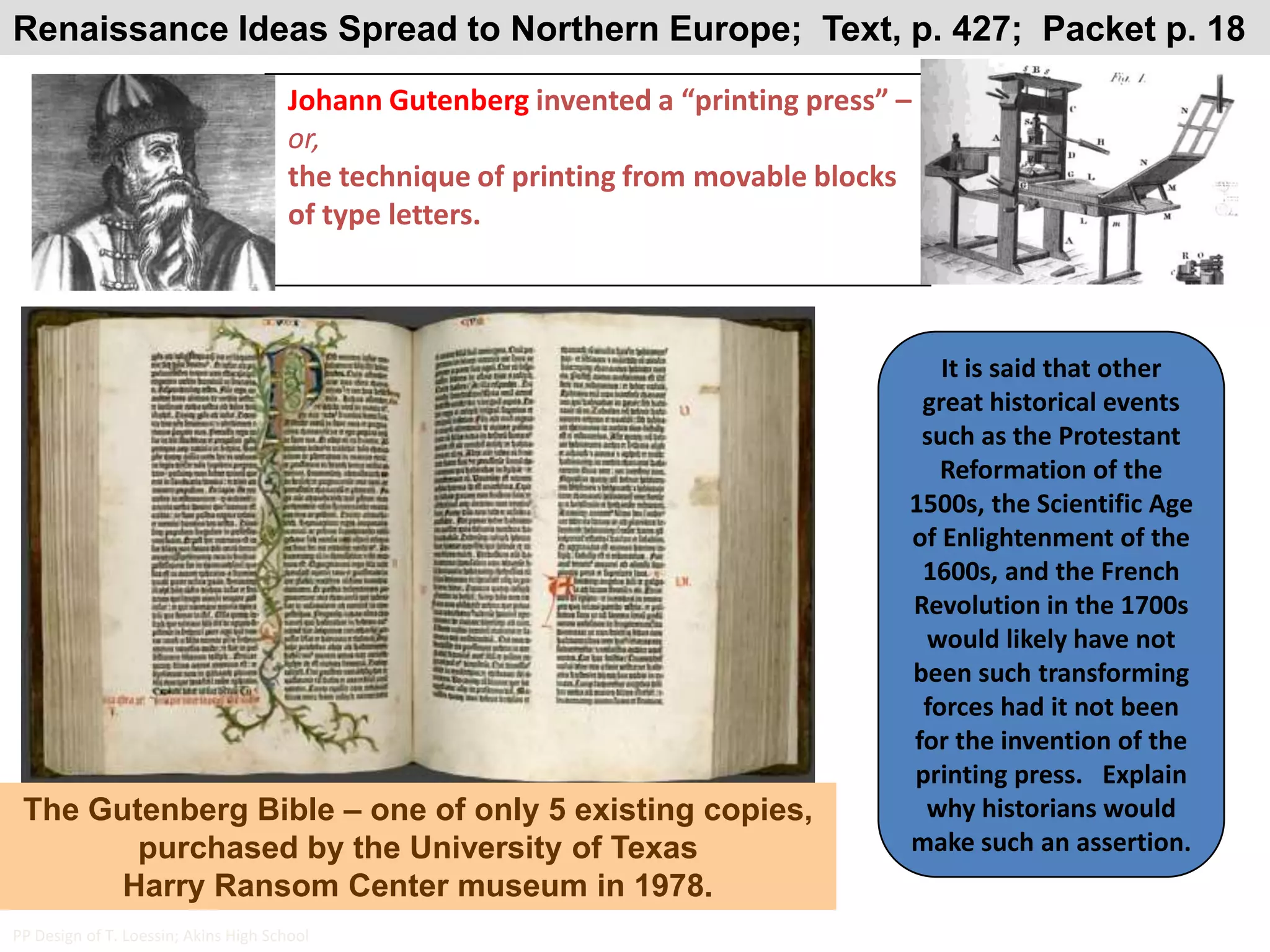
Renaissance Ideas Spread to Northern Europe;  Text, p. 427;  Packet p. 18Johann Gutenberg invented a “printing press” – or,the technique of printing from movable blocks of type letters.It is said that other great historical events such as the Protestant Reformation of the 1500s, the Scientific Age of Enlightenment of the 1600s, and the French Revolution in the 1700s would likely have not been such transforming forces had it not been for the invention of the printing press.   Explain why historians would make such an assertion. The Gutenberg Bible – one of only 5 existing copies, purchased by the University of Texas Harry Ransom Center museum in 1978.PP Design of T. Loessin; Akins High School
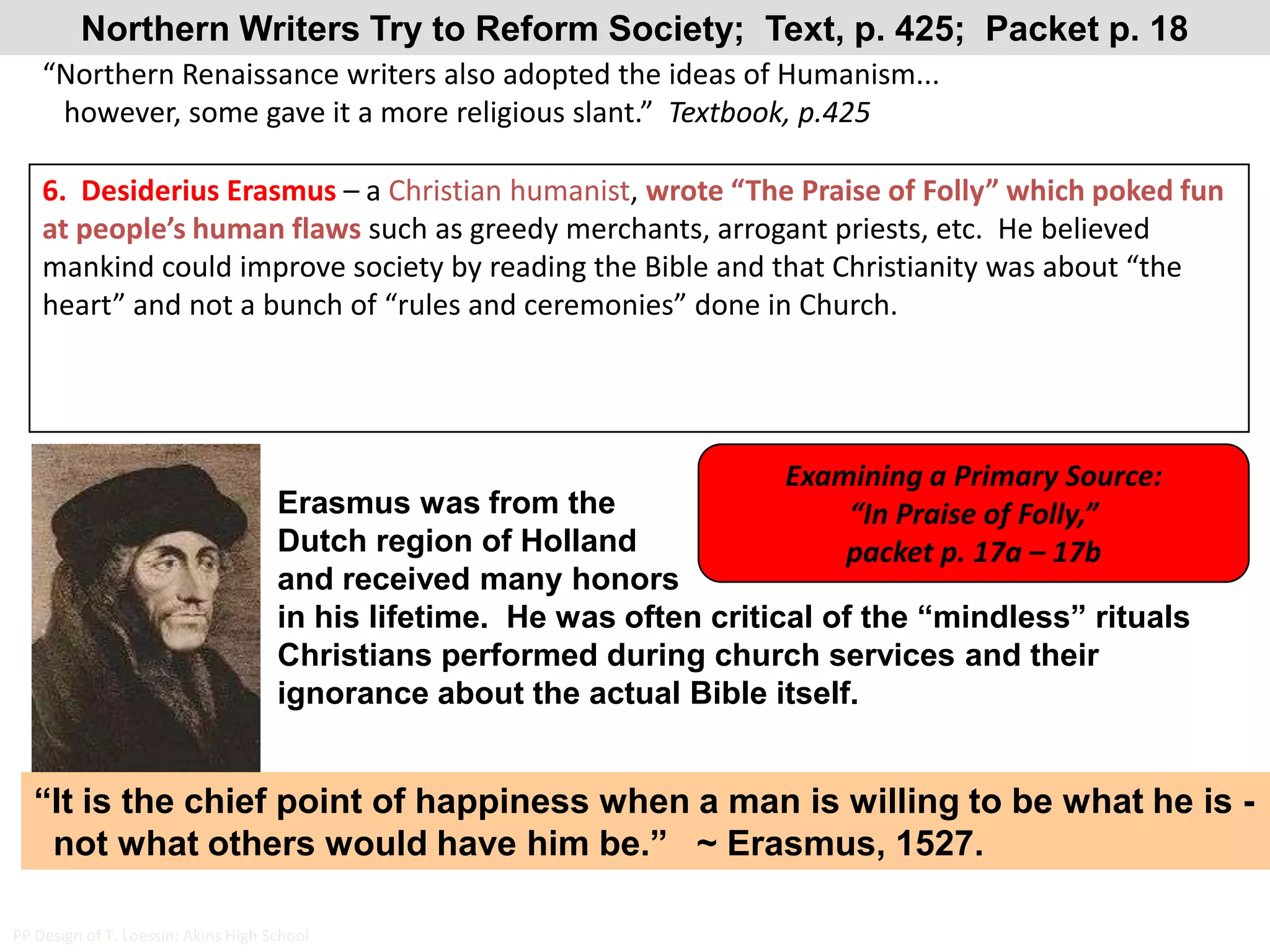
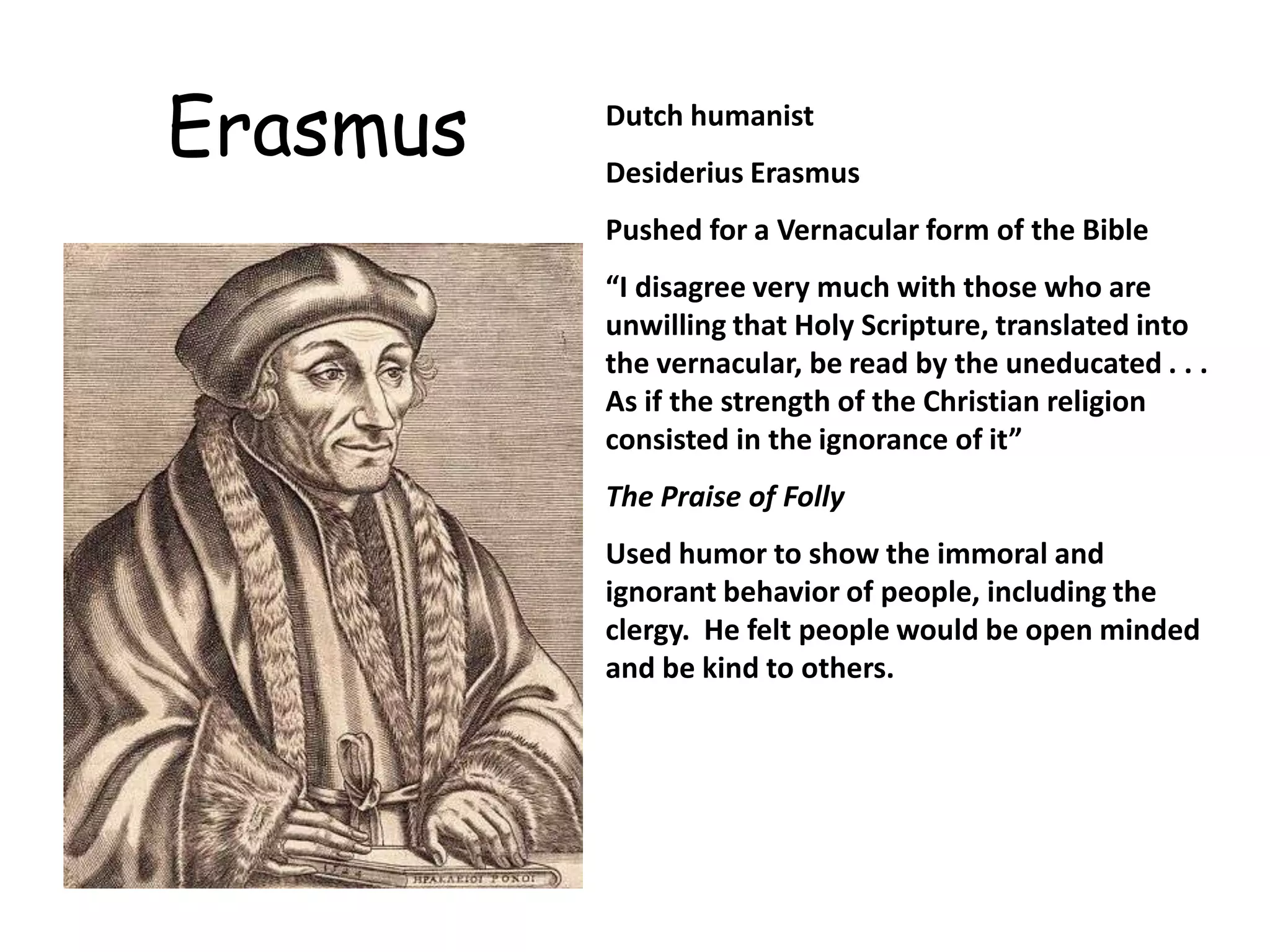
Northern Writers Try to Reform Society;  Text, p. 425;  Packet p. 18“Northern Renaissance writers also adopted the ideas of Humanism...   however, some gave it a more religious slant.”  Textbook, p.4256.  Desiderius Erasmus – a Christian humanist, wrote “The Praise of Folly” which poked fun at people’s human flaws such as greedy merchants, arrogant priests, etc.  He believed mankind could improve society by reading the Bible and that Christianity was about “the heart” and not a bunch of “rules and ceremonies” done in Church.Examining a Primary Source:  “In Praise of Folly,” packet p. 17a – 17bErasmus was from the Dutch region of Holland and received many honors in his lifetime.  He was often critical of the “mindless” rituals Christians performed during church services and their ignorance about the actual Bible itself.“It is the chief point of happiness when a man is willing to be what he is -  not what others would have him be.”   ~ Erasmus, 1527.PP Design of T. Loessin; Akins High School
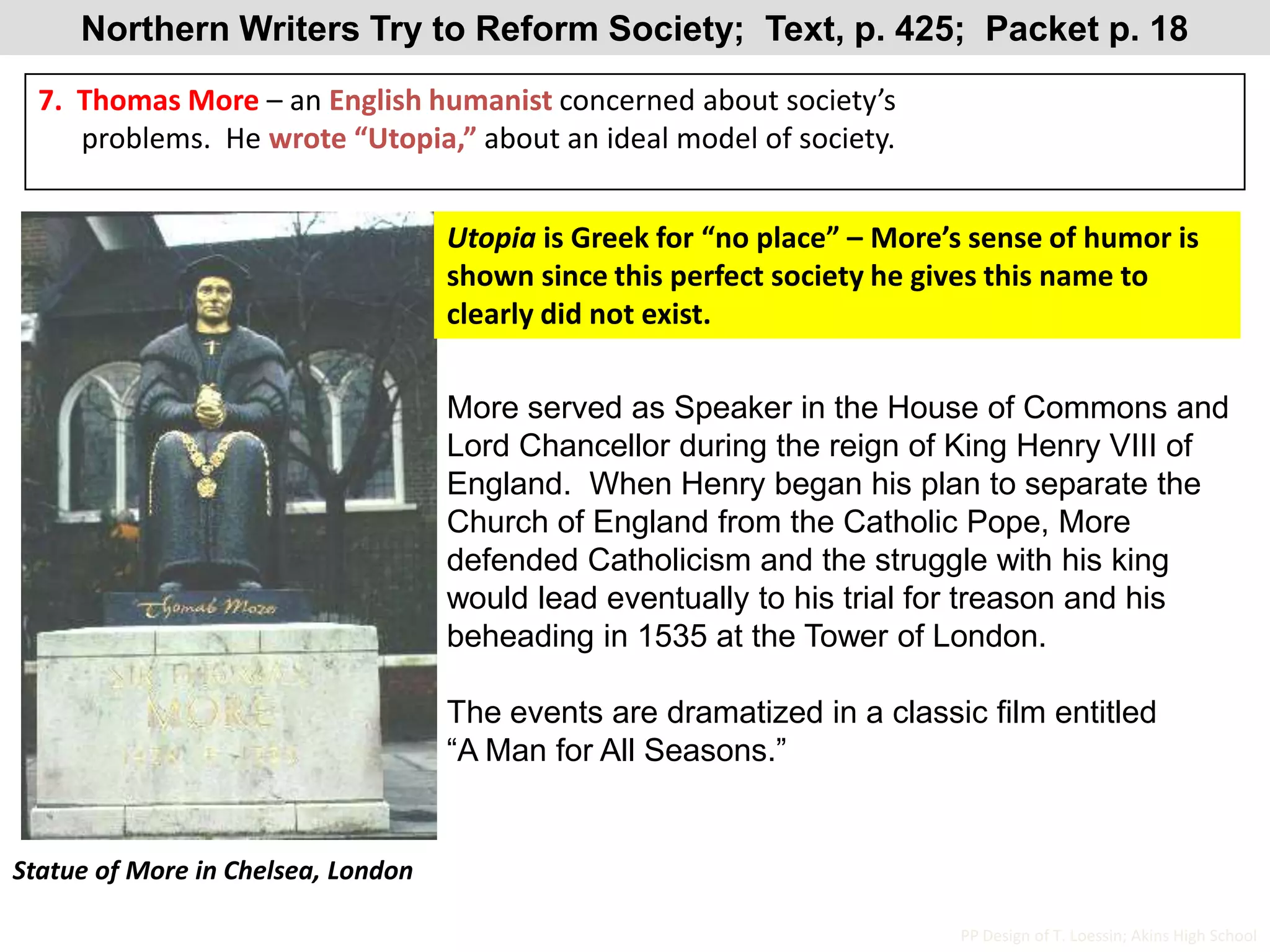
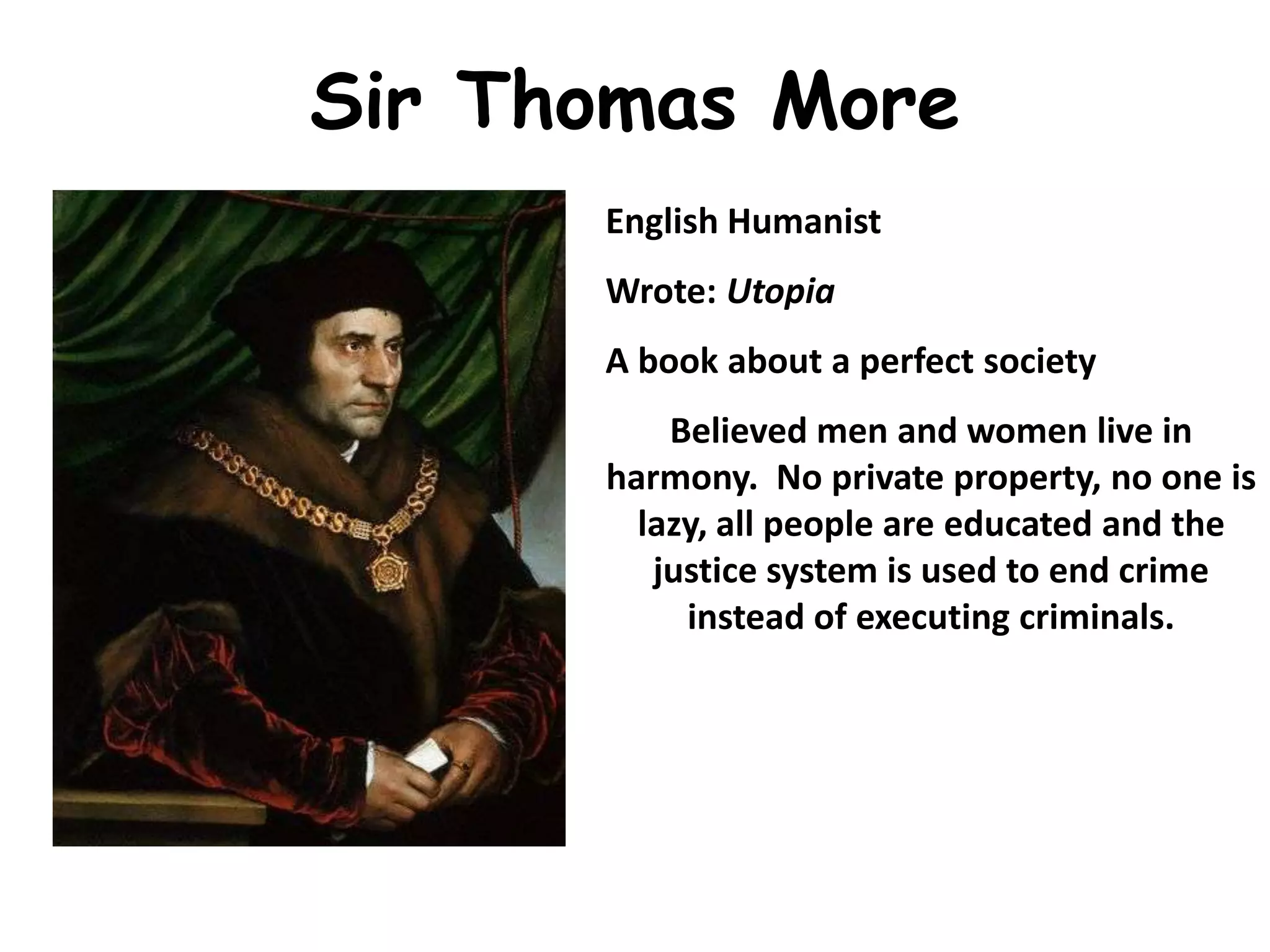
Northern Writers Try to Reform Society;  Text, p. 425;  Packet p. 187.  Thomas More – an English humanist concerned about society’s       problems.  He wrote “Utopia,” about an ideal model of society.Utopia is Greek for “no place” – More’s sense of humor is shown since this perfect society he gives this name to clearly did not exist.More served as Speaker in the House of Commons and Lord Chancellor during the reign of King Henry VIII of England.  When Henry began his plan to separate the Church of England from the Catholic Pope, More defended Catholicism and the struggle with his king would lead eventually to his trial for treason and his beheading in 1535 at the Tower of London.The events are dramatized in a classic film entitled “A Man for All Seasons.”Statue of More in Chelsea, LondonPP Design of T. Loessin; Akins High School
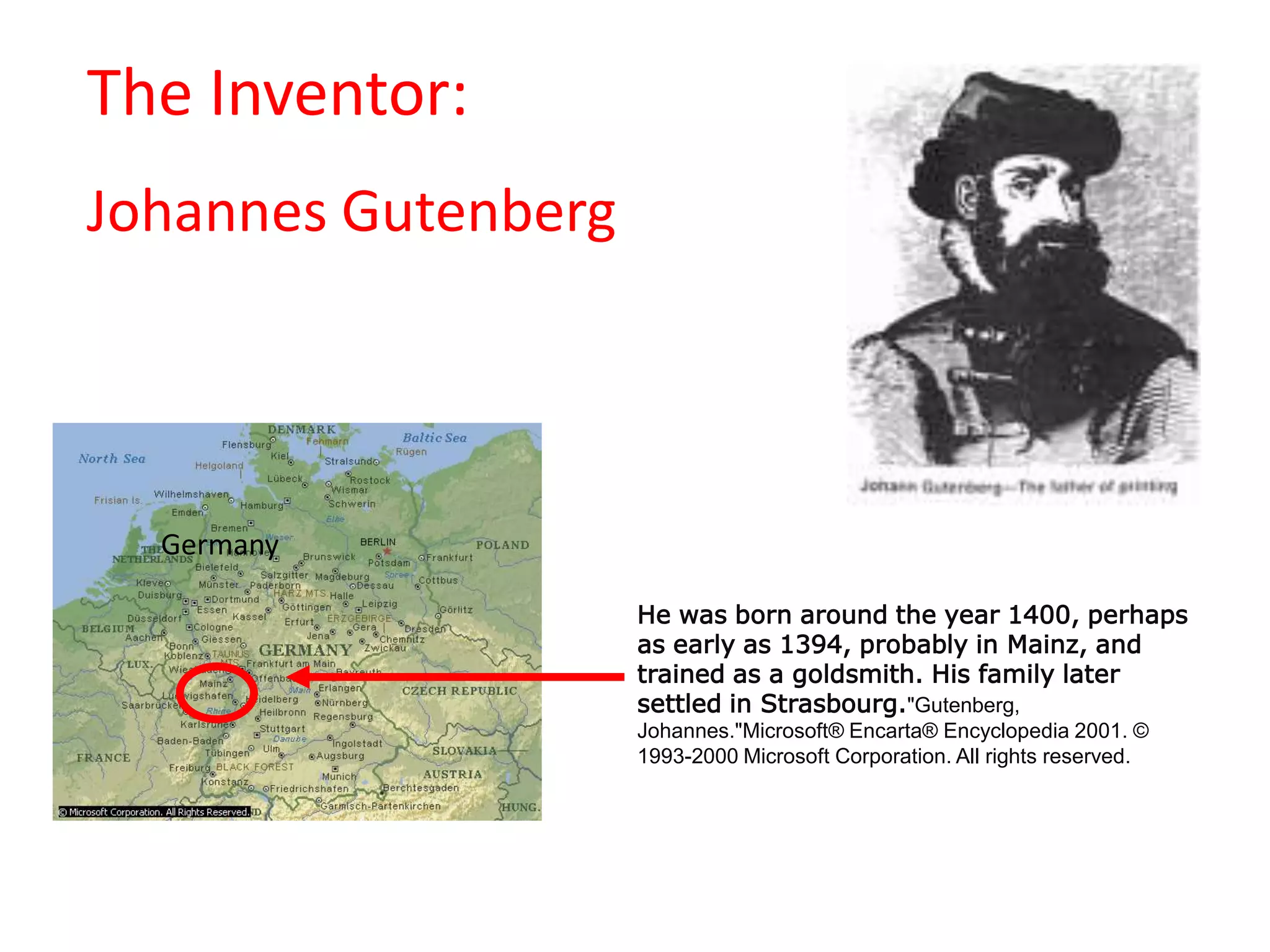
                                           The Inventor:Johannes GutenbergGermanyHe was born around the year 1400, perhaps as early as 1394, probably in Mainz, and trained as a goldsmith. His family later settled in Strasbourg."Gutenberg, Johannes."Microsoft® Encarta® Encyclopedia 2001. © 1993-2000 Microsoft Corporation. All rights reserved.
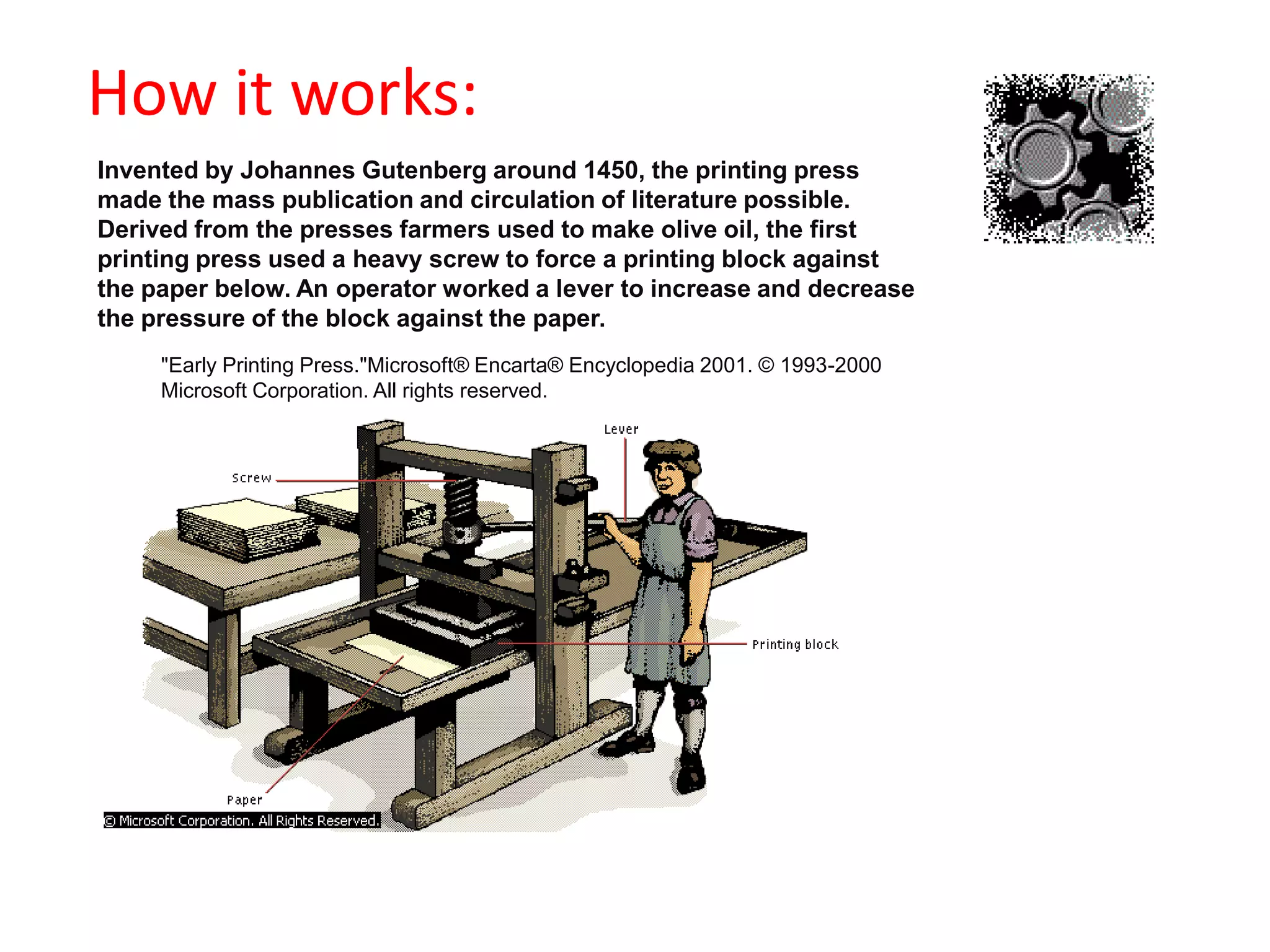
                                           How it works:Invented by Johannes Gutenberg around 1450, the printing press made the mass publication and circulation of literature possible. Derived from the presses farmers used to make olive oil, the first printing press used a heavy screw to force a printing block against the paper below. An operator worked a lever to increase and decrease the pressure of the block against the paper. "Early Printing Press."Microsoft® Encarta® Encyclopedia 2001. © 1993-2000 Microsoft Corporation. All rights reserved.
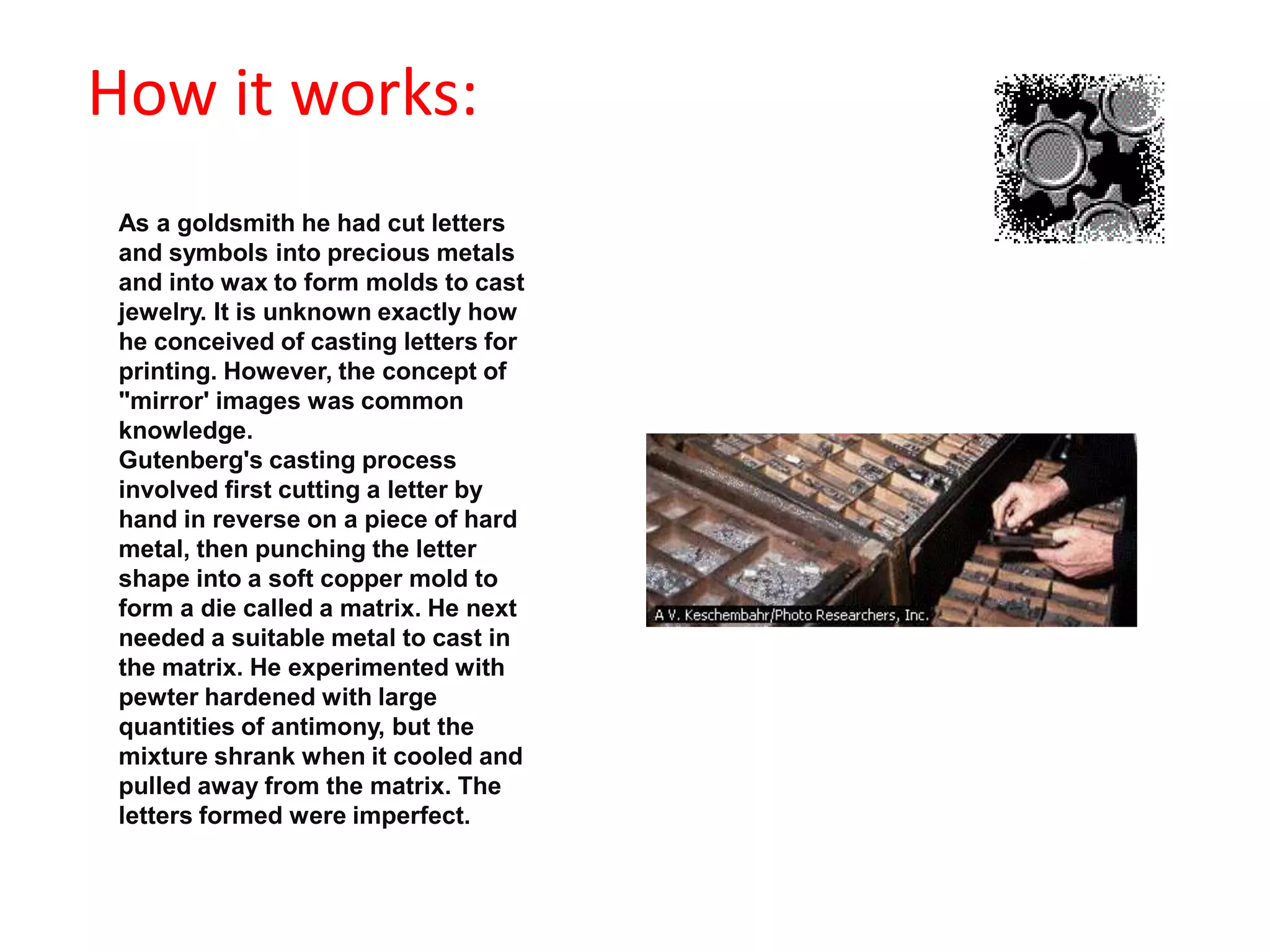
                                           How it works:As a goldsmith he had cut letters and symbols into precious metals and into wax to form molds to cast jewelry. It is unknown exactly how he conceived of casting letters for printing. However, the concept of "mirror' images was common knowledge. Gutenberg's casting process involved first cutting a letter by hand in reverse on a piece of hard metal, then punching the letter shape into a soft copper mold to form a die called a matrix. He next needed a suitable metal to cast in the matrix. He experimented with pewter hardened with large quantities of antimony, but the mixture shrank when it cooled and pulled away from the matrix. The letters formed were imperfect.
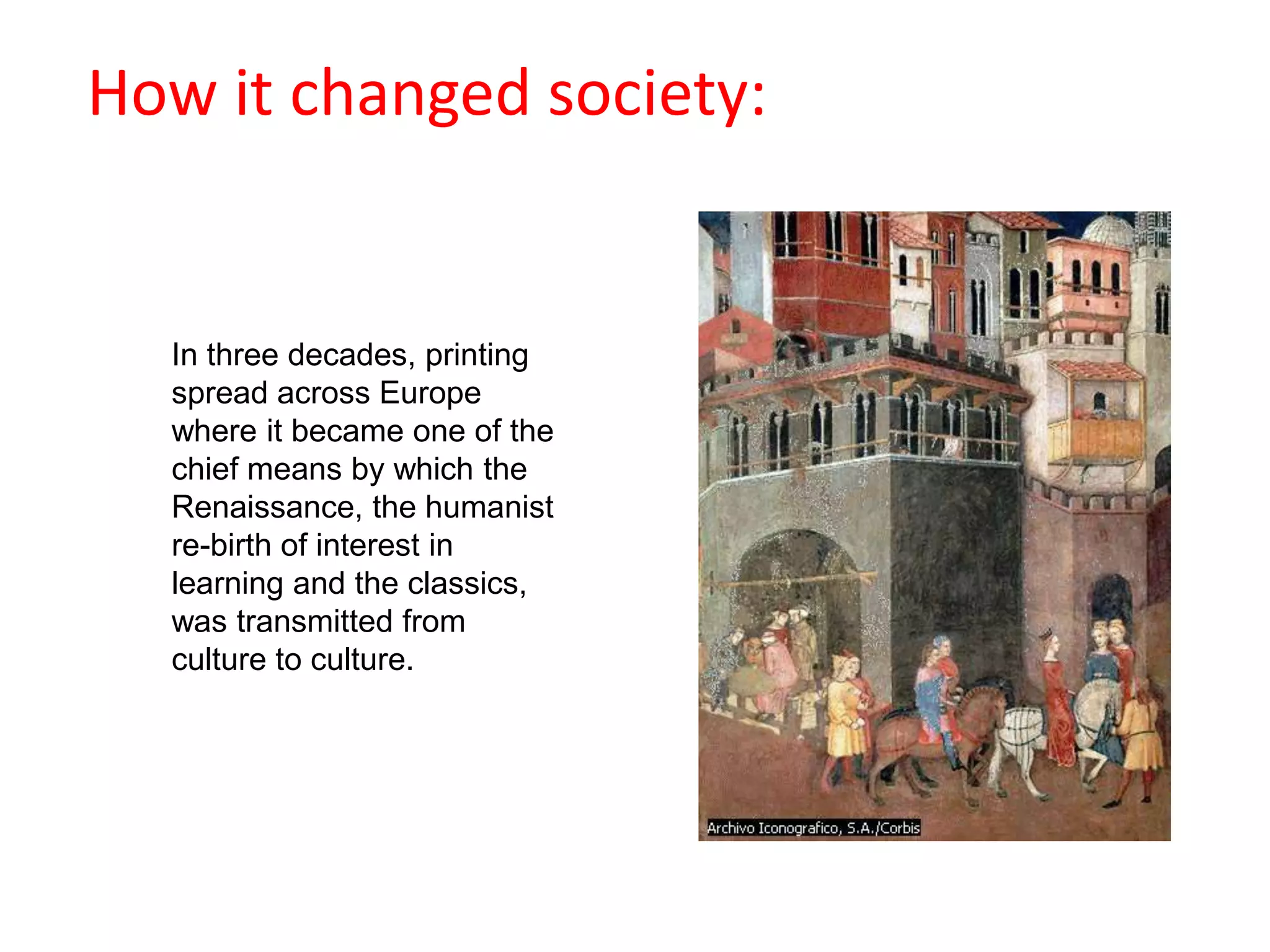
                                           How it works:Gutenberg's most notable work, a forty-two-line-a-page Bible, was begun in 1452 and completed by 1455. Each page contained around 2,800 characters. Two pages were printed at the same time, 50 5,600 pieces of type were needed to make each two-page printing. It was the practice for the next two pages to be composed during the press run of the current two, so at least 11,200 letters were needed to even begin printing. Working a normal workday (twelve hours), it took two craftsmen more than thirty-seven workdays just to prepare the initial type. At this rate, more than three years were needed to complete just two hundred copies of Gutenberg's Bible.
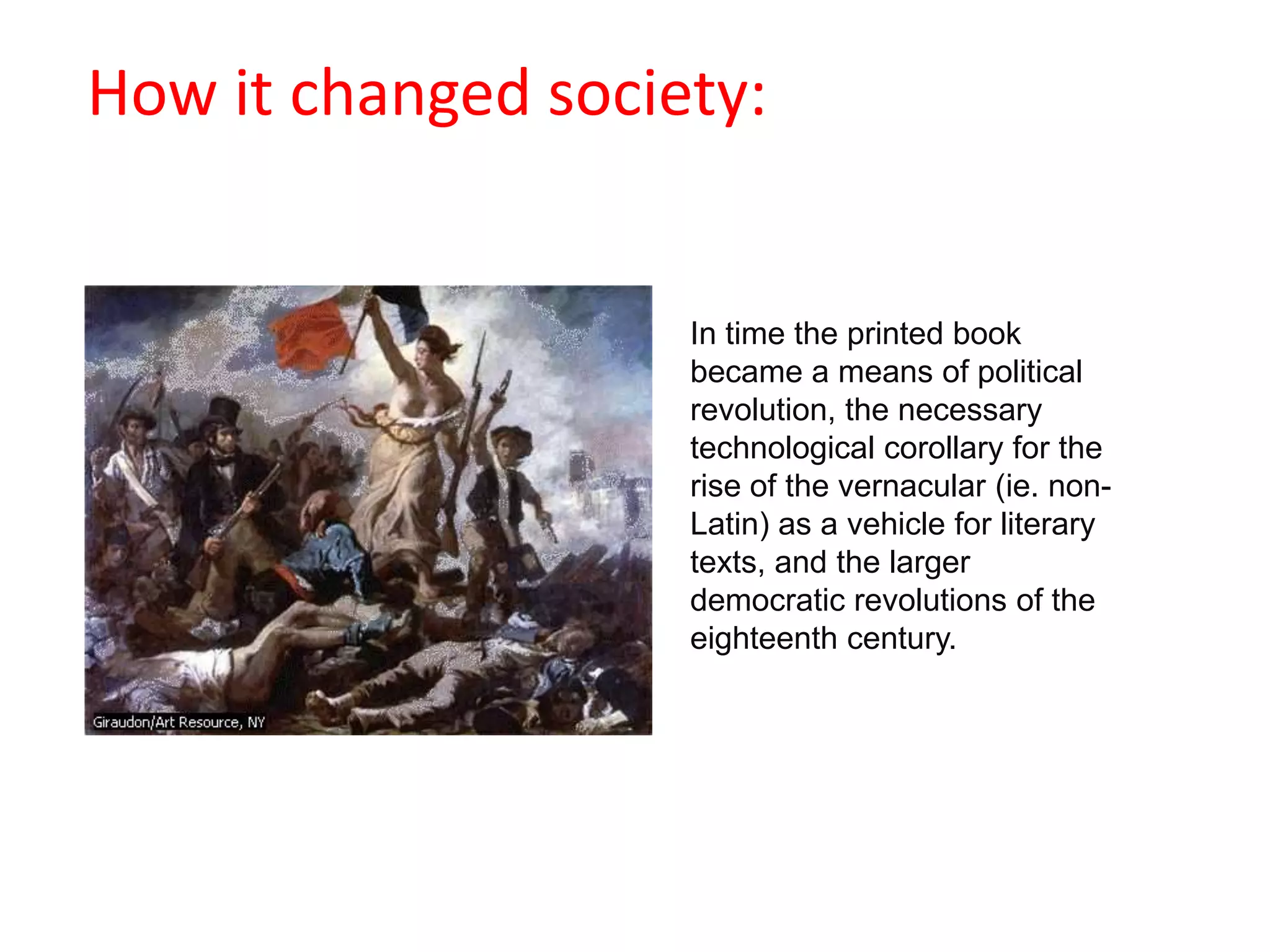
How it changed society:In three decades, printing spread across Europe where it became one of the chief means by which the Renaissance, the humanist re-birth of interest in learning and the classics, was transmitted from culture to culture.
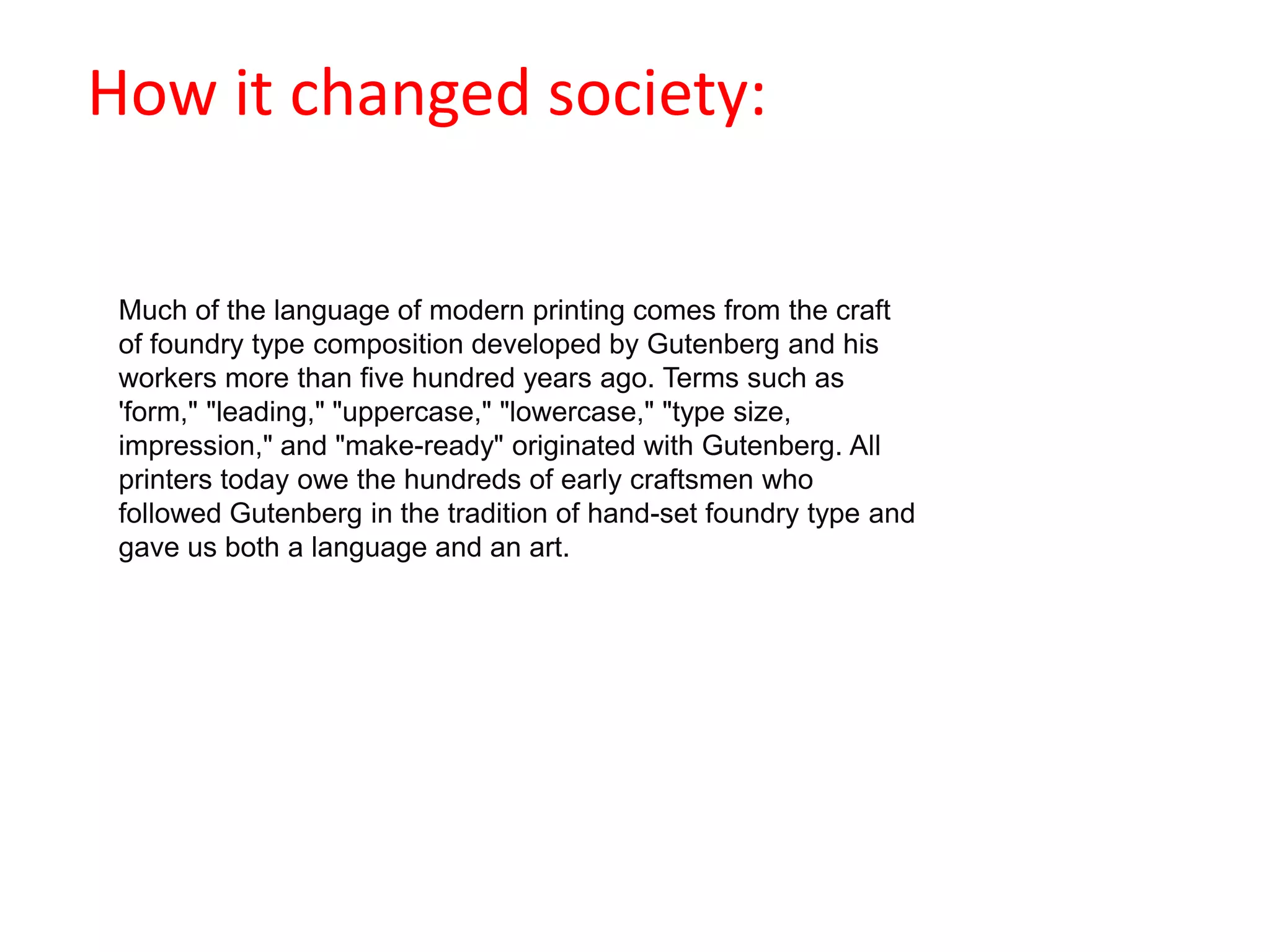
                                           How it changed society:In time the printed book became a means of political revolution, the necessary technological corollary for the rise of the vernacular (ie. non-Latin) as a vehicle for literary texts, and the larger democratic revolutions of the eighteenth century.
                                           How it changed society:Much of the language of modern printing comes from the craft of foundry type composition developed by Gutenberg and his workers more than five hundred years ago. Terms such as 'form," "leading," "uppercase," "lowercase," "type size, impression," and "make-ready" originated with Gutenberg. All printers today owe the hundreds of early craftsmen who followed Gutenberg in the tradition of hand-set foundry type and gave us both a language and an art.
ErasmusDutch humanistDesiderius ErasmusPushed for a Vernacular form of the Bible“I disagree very much with those who are unwilling that Holy Scripture, translated into the vernacular, be read by the uneducated . . . As if the strength of the Christian religion consisted in the ignorance of it”The Praise of FollyUsed humor to show the immoral and ignorant behavior of people, including the clergy.  He felt people would be open minded and be kind to others.
Sir Thomas MoreEnglish HumanistWrote: Utopia A book about a perfect societyBelieved men and women live in harmony.  No private property, no one is lazy, all people are educated and the justice system is used to end crime instead of executing criminals.

Lesson Two: Other Helpful Slides

  • 2.
    The Protestant Reformation1517- Luther posts 95 Theses1534 - Act of Supremacy1555 - Peace of Augsburg
  • 3.
    Martin LutherPlanned tobe a lawyerReligious conversion to Augustinian monkTheology teacher at university of Wittenberg“The just shall live by faith.” Romans (1:17)Justification by faithJohann TetzelIndulgence controversy95 ThesesDiet of Worms
  • 4.
    Lutheranism“Justification by faith”“Solascriptura”Baptism and holy communionPriesthood of believersGerman translation of BibleAbolished monasteries and celibacy of clergy
  • 5.
    LutheranismPeasants’ RevoltHoly RomanEmperor Charles VDiet of AugsburgPeace of AugsburgGerman prince right to determine religion of his stateLutheran or Roman CatholicNo recognition of Calvinists or AnabaptistsLutheranism dominant in northern Germany and Scandinavia
  • 6.
    CalvinismUlrich ZwingliHumanist andCatholic priestSacraments only symbolic ceremoniesRejected celibacy of clergyEmphasized simplicity in worshipKilled by Catholic forcesJohn CalvinProtestantExile in GenevaInstitutes of the Christian ReligionPredestinationSalvation by electionPuritanismTheocracy
  • 7.
    Spread of CalvinismSwitzerlandFranceHuguenotsJohnKnoxPresbyteriansEnglandPuritansNetherlandsMax Weber’s theory of the “Protestant work ethic”
  • 8.
    AnglicanismKing Henry VIIIDivorceof Catherine of AragonThomas CramnerAct of SupremacyKing head of Church of EnglandSix ArticlesNo papal supremacySold monasteriesSupported by English peoplePapal taxes“Babylonian Captivity”Monastic landExecution of Thomas MoreEdward VI42 ArticlesMore ProtestantCramner’s Book of Common PrayerBloody MaryExecuted CramnerMarried Philip IIElizabeth ILast Tudor39 ArticlesOppositionPilgrims - SeparatistsMary Queen of ScotsPhilip II
  • 9.
    AnabaptismRadicals of thePRRejection of infant baptismActive in Peasants’ RevoltThomas MunzerJohn of LeydenMenno SimonsMennonites
  • 10.
    Luther Starts theReformation; Text, p. 429; Packet p. 22 CAUSES EVENT or SITUATION EFFECTS1. In 1517, Luther posts his 95 Theses on the church doors at Wittenberg.Luther attacks a monk named Tetzel for selling indulgences.Luther’s words are printed and spread all over Germany and attract many followers.Above: The church doors At Luther’s church in Wittenberg. Other pics, Wittenberg, 2002. PP Design of T. Loessin; Akins High School
  • 11.
    Luther Starts theReformation; Text, p. 429; Packet p. 22                       CAUSES EVENT or SITUATION EFFECTSThe peace settlement ended the war and allowed the ruler of each German state to decide his own state’s religious preference.Charles V fought a 20 year war against the German Protestant princes and defeated them in 1547. But he could not force them to remain in the Catholic Church.The Peace of Augsburg is signed in 1555.Martin Luther continued his writings and lectures until his death in 1546.In 1525 Luther had married a former nun named Katharine von Bora. She bore him eight children and outlived him by six years.Charles VHoly Roman EmperorEven today, unlike Catholic priests who take a vow of celibacy, ministers in Protestant churches can get married.PP Design of T. Loessin; Akins High School
  • 12.
    England becomes Protestant - Text, p. 431; Packet p. 23CAUSES EVENT or SITUATION EFFECTS5. English Parliament approves the Act of Supremacy in 1534.Henry closes all English monasteries; seizes their lands and other Catholic holdings in England; thereby increasing his royal power, as well as his own personal wealth.Henry VIII needed to annul his marriage to Catherine so he could remarry in order to get a male heir. The Pope would not allow.So Henry calls Parliament into session and passes the Act of Supremacy.The Act of Supremacy made the ruler of England the official head of the Church of England – no longer the Catholic Pope. Today, the Act of Supremacy remains in effect –Queen Elizabeth II of England is officially the head of the Anglican Church.PP Design of T. Loessin; Akins High School
  • 13.
    Luther Starts theReformation; Text, p. 429; Packet p. 22CAUSES EVENT or SITUATION EFFECTS2. In 1520, Luther refuses to recant at Worms and is excommunicated. In 1521, he is declared an outlaw and heretic.Luther is sheltered by the prince of Saxony where he translates Bible into German.When he returns to Wittenberg, his followers have become a separate religious group – the Lutherans.The Pope realizes Luther is a threat to papal authority.The H.R.E., is a devout Catholic, and also feels threatened by the uproar.Charles VHoly Roman EmperorSAXONYFrederick, Prince of Saxonyofferedprotection to LutherMartin LutherPope Leo X
  • 14.
    Luther Starts theReformation; Text, p. 429; Packet p. 22CAUSES EVENT or SITUATION EFFECTSExcited by Luther’s talk about “religious freedom,” peasants revolt hoping for social / economic freedom (an end to serfdom).When the armies of German princes (at Luther’s request) brutally crush this revolt (killing thousands), previous supporters now turn against Luther. 3. The German peasants revolt in 1524.Religious Wars begin between Catholics and Protestants.
  • 15.
    Renaissance Ideas Spreadto Northern Europe; Text, p. 423; Packet p. 181. What factors led to the beginning of the Renaissance in northern Europe? the northern population began to recover from the plague. Hundred Years’ War finally ended. cities were growing rapidly city merchants were becoming wealthy enough to become “patrons” as well as educated in Humanist pursuits.Monarchs in England and in France (such as Francis I who hired Italian architects to build his palace at Fontainebleau) supported the arts and introduced Renaissance styles to northern Europe.PP Design of T. Loessin; Akins High School
  • 17.
    Renaissance Ideas Spreadto Northern Europe; Text, p. 427; Packet p. 18Since antiquity it had been scribes and later, monks in the Medieval period, who copied all manuscripts by hand …UNTIL …Johann Gutenberg invented a “printing press” – or,the technique of printing from movable blocks of type letters.Gutenberg was a 15th-century German craftsman, inventor, and printer. He used hand-set type cast in molds to print multiple copies of manuscripts. Copying now became mechanized and much faster.The invention of movable-type printing facilitated an easier exchange of ideas throughout Europe and helped spread the ideas of the Renaissance.PP Design of T. Loessin; Akins High School
  • 18.
    Renaissance Ideas Spreadto Northern Europe; Text, p. 427; Packet p. 18Johann Gutenberg invented a “printing press” – or,the technique of printing from movable blocks of type letters.Gutenberg's invention did not make him rich, but it laid the foundation for the first commercial mass production of books. The success of printing meant that books soon became cheaper, and the previously uneducated lower classes of the population could now afford them and it inspired them to learn to read, increasing literacy. More than ever before, it spread news more quickly and enabled people to follow debates and discussions of matters that concerned them. Consequently, the printed book also led to more stringent attempts at censorship. This was a sign that it was felt by those in authority to be dangerous and challenging to their position.PP Design of T. Loessin; Akins High School
  • 19.
    Renaissance Ideas Spreadto Northern Europe; Text, p. 427; Packet p. 18Johann Gutenberg invented a “printing press” – or,the technique of printing from movable blocks of type letters.It is said that other great historical events such as the Protestant Reformation of the 1500s, the Scientific Age of Enlightenment of the 1600s, and the French Revolution in the 1700s would likely have not been such transforming forces had it not been for the invention of the printing press. Explain why historians would make such an assertion. The Gutenberg Bible – one of only 5 existing copies, purchased by the University of Texas Harry Ransom Center museum in 1978.PP Design of T. Loessin; Akins High School
  • 21.
    Northern Writers Tryto Reform Society; Text, p. 425; Packet p. 18“Northern Renaissance writers also adopted the ideas of Humanism... however, some gave it a more religious slant.” Textbook, p.4256. Desiderius Erasmus – a Christian humanist, wrote “The Praise of Folly” which poked fun at people’s human flaws such as greedy merchants, arrogant priests, etc. He believed mankind could improve society by reading the Bible and that Christianity was about “the heart” and not a bunch of “rules and ceremonies” done in Church.Examining a Primary Source: “In Praise of Folly,” packet p. 17a – 17bErasmus was from the Dutch region of Holland and received many honors in his lifetime. He was often critical of the “mindless” rituals Christians performed during church services and their ignorance about the actual Bible itself.“It is the chief point of happiness when a man is willing to be what he is - not what others would have him be.” ~ Erasmus, 1527.PP Design of T. Loessin; Akins High School
  • 22.
    Northern Writers Tryto Reform Society; Text, p. 425; Packet p. 187. Thomas More – an English humanist concerned about society’s problems. He wrote “Utopia,” about an ideal model of society.Utopia is Greek for “no place” – More’s sense of humor is shown since this perfect society he gives this name to clearly did not exist.More served as Speaker in the House of Commons and Lord Chancellor during the reign of King Henry VIII of England. When Henry began his plan to separate the Church of England from the Catholic Pope, More defended Catholicism and the struggle with his king would lead eventually to his trial for treason and his beheading in 1535 at the Tower of London.The events are dramatized in a classic film entitled “A Man for All Seasons.”Statue of More in Chelsea, LondonPP Design of T. Loessin; Akins High School
  • 23.
                                               The Inventor:Johannes GutenbergGermanyHewas born around the year 1400, perhaps as early as 1394, probably in Mainz, and trained as a goldsmith. His family later settled in Strasbourg."Gutenberg, Johannes."Microsoft® Encarta® Encyclopedia 2001. © 1993-2000 Microsoft Corporation. All rights reserved.
  • 24.
                                               How it works:Inventedby Johannes Gutenberg around 1450, the printing press made the mass publication and circulation of literature possible. Derived from the presses farmers used to make olive oil, the first printing press used a heavy screw to force a printing block against the paper below. An operator worked a lever to increase and decrease the pressure of the block against the paper. "Early Printing Press."Microsoft® Encarta® Encyclopedia 2001. © 1993-2000 Microsoft Corporation. All rights reserved.
  • 25.
                                               How it works:Asa goldsmith he had cut letters and symbols into precious metals and into wax to form molds to cast jewelry. It is unknown exactly how he conceived of casting letters for printing. However, the concept of "mirror' images was common knowledge. Gutenberg's casting process involved first cutting a letter by hand in reverse on a piece of hard metal, then punching the letter shape into a soft copper mold to form a die called a matrix. He next needed a suitable metal to cast in the matrix. He experimented with pewter hardened with large quantities of antimony, but the mixture shrank when it cooled and pulled away from the matrix. The letters formed were imperfect.
  • 26.
                                               How it works:Gutenberg'smost notable work, a forty-two-line-a-page Bible, was begun in 1452 and completed by 1455. Each page contained around 2,800 characters. Two pages were printed at the same time, 50 5,600 pieces of type were needed to make each two-page printing. It was the practice for the next two pages to be composed during the press run of the current two, so at least 11,200 letters were needed to even begin printing. Working a normal workday (twelve hours), it took two craftsmen more than thirty-seven workdays just to prepare the initial type. At this rate, more than three years were needed to complete just two hundred copies of Gutenberg's Bible.
  • 27.
    How it changedsociety:In three decades, printing spread across Europe where it became one of the chief means by which the Renaissance, the humanist re-birth of interest in learning and the classics, was transmitted from culture to culture.
  • 28.
                                               How it changedsociety:In time the printed book became a means of political revolution, the necessary technological corollary for the rise of the vernacular (ie. non-Latin) as a vehicle for literary texts, and the larger democratic revolutions of the eighteenth century.
  • 29.
                                               How it changedsociety:Much of the language of modern printing comes from the craft of foundry type composition developed by Gutenberg and his workers more than five hundred years ago. Terms such as 'form," "leading," "uppercase," "lowercase," "type size, impression," and "make-ready" originated with Gutenberg. All printers today owe the hundreds of early craftsmen who followed Gutenberg in the tradition of hand-set foundry type and gave us both a language and an art.
  • 30.
    ErasmusDutch humanistDesiderius ErasmusPushedfor a Vernacular form of the Bible“I disagree very much with those who are unwilling that Holy Scripture, translated into the vernacular, be read by the uneducated . . . As if the strength of the Christian religion consisted in the ignorance of it”The Praise of FollyUsed humor to show the immoral and ignorant behavior of people, including the clergy. He felt people would be open minded and be kind to others.
  • 31.
    Sir Thomas MoreEnglishHumanistWrote: Utopia A book about a perfect societyBelieved men and women live in harmony. No private property, no one is lazy, all people are educated and the justice system is used to end crime instead of executing criminals.