
Carbohydrate
Deependra Shrestha
M.Sc.Cli. Biochemistry
First Year
8th May 2016
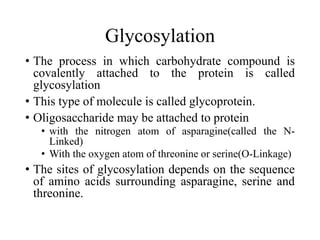
Glycosylation
• The process in which carbohydrate compound is
covalently attached to the protein is called
glycosylation
• This type of molecule is called glycoprotein.
• Oligosaccharide may be attached to protein
• with the nitrogen atom of asparagine(called the N-
Linked)
• With the oxygen atom of threonine or serine(O-Linkage)
• The sites of glycosylation depends on the sequence
of amino acids surrounding asparagine, serine and
threonine.
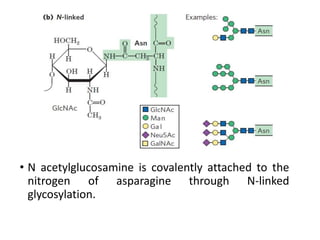
• N acetylglucosamine is covalently attached to the
nitrogen of asparagine through N-linked
glycosylation.
N-Linked
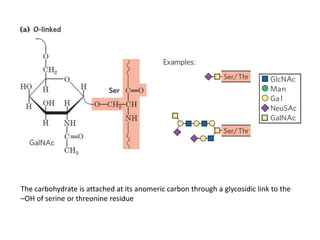
The carbohydrate is attached at its anomeric carbon through a glycosidic link to the
–OH of serine or threonine residue
Glycosaminoglycans
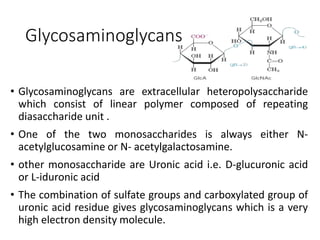
• Glycosaminoglycans are extracellular heteropolysaccharide
which consist of linear polymer composed of repeating
diasaccharide unit .
• One of the two monosaccharides is always either N-
acetylglucosamine or N- acetylgalactosamine.
• other monosaccharide are Uronic acid i.e. D-glucuronic acid
or L-iduronic acid
• The combination of sulfate groups and carboxylated group of
uronic acid residue gives glycosaminoglycans which is a very
high electron density molecule.
Glycosaminoglycans
• the important component of ECM
• form a meshwork with fibrous proteins like
collagen, elastin, fibronectin etc
Hyaluronic acid
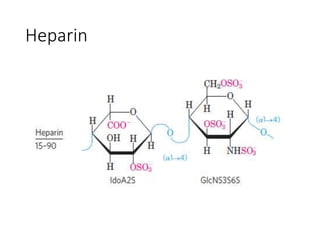
Heparin
Chondroitin sulfate
Dermatan sulfate
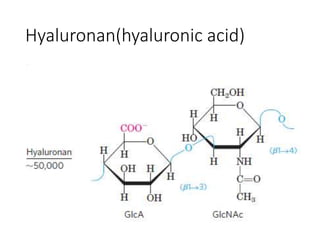
Hyaluronic acid:
• The Greek hyalos means “glass”; hyaluronan can have glassy
or translucent appearance
• contains alternating residues of D-glucuronic acid and N-
acetylglucosamine linked by (β1→4) and (β1→3) linkages
• 50, 000 repeats of the basic disaccharide unit
• High molecular weight of several million
• Present in connective tissues, cartilage, synovial fluid and
vitreous humor
• Hydrolyzed by Hyaluronidase present in
• some pathogenic bacteria
• sperm of many species of animal
Hyaluronan(hyaluronic acid)
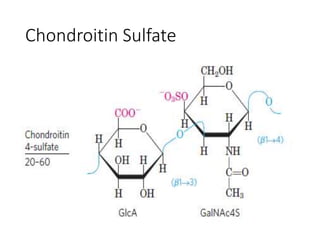
Chondroitin Sulphate:
• Greek chondros, “cartilage”
• 20-60 repeated units of glucoronic acid and N-
acetylgalactosamine sulphate linked by (β1→3) and
(β1→4) linkage.
• Widely distributed in cartilage, tendons, ligaments, and
the wall of the aorta
• Contributes to the tensile strength of cartilage, tendon,
ligament and the walls of aorta.
Chondroitin Sulfate
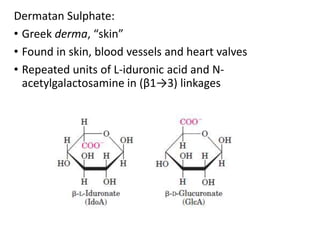
Dermatan Sulphate:
• Greek derma, “skin”
• Found in skin, blood vessels and heart valves
• Repeated units of L-iduronic acid and N-
acetylgalactosamine in (β1→3) linkages
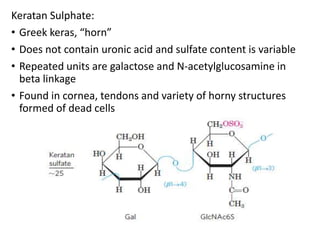
Keratan Sulphate:
• Greek keras, “horn”
• Does not contain uronic acid and sulfate content is variable
• Repeated units are galactose and N-acetylglucosamine in
beta linkage
• Found in cornea, tendons and variety of horny structures
formed of dead cells
Heparan sulphate:
• Greek hepar, “liver”
• Variable arrangement of sulfated and non sulfated sugar
• Repeated units of sulphated glucosamine and L-iduronic
acid by (α1→4) linkage
• Heparin is a fractionated form of heparan sulfate
derived mostly from mast cells
• In vivo, used as anticoagulant as it binds antithrombin
(activates antithrombin)
• The interaction is strongly electrostatic as it has the
highest negative charge density of any known biological
macromolecule
Heparin
Glycoconjugates
• Polysaccharides that serve as information carriers
communication between cells and their extracellular
surroundings
serve as recognition sites for extracellular signal molecule
Labelling of proteins for transport to specific organelles and
also destruction if protein is malformed or if overproduced
Recognition site for extracellular signal molecule
Cell to cell recognition and adhesions
• Biologically active molecule.
Glycoconjugates
• specific oligosaccharide chains attached to components of
the plasma membrane to form a carbohydrate layer which
is known as glycocalyx
• serves as an information-rich surface
• informational carbohydrate is covalently joined to a
protein or a lipid
• Types
Proteoglycans
Glycoprotein
Glycolipid
Proteoglycans
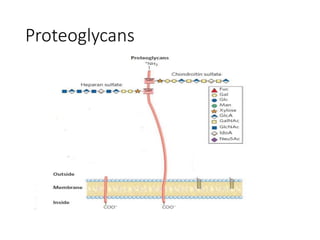
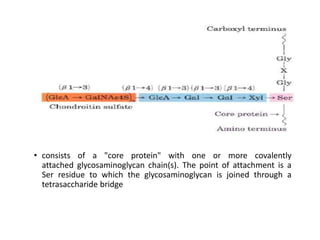
• consists of a "core protein" with one or more covalently
attached glycosaminoglycan chain(s). The point of attachment is a
Ser residue to which the glycosaminoglycan is joined through a
tetrasaccharide bridge
Proteoglycans
• Macromolecules of the extracellular matrix in which one
or more sulfated glycosaminoglycan chains are joined
covalently to the membrane protein or a secreted protein
• The glycosaminoglycan chain can bind to extracellular
proteins through electrostatic interaction with the
negatively charged groups on the polysaccharide
• Major component of ECM
Proteoglycans
• Many are secreted into the extracellular matrix, but some
are integral membrane proteins
• Eg. basal lamina, the sheet like ECM, contains a family of
core proteins, each with several covalently attached
heparan sulfate chains
• two major families of heparn sulfate proteoglycans:
• Syndecans
• Glypicans
Proteoglycans
Proteoglycans
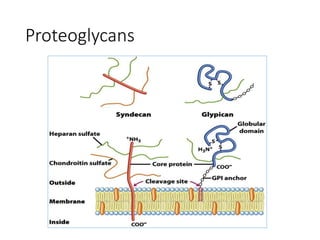
• Syndecans: have single transmembrane domain and
an extracellular domain bearing 3-5 chains of
heparan or chondroitin sulfate
• Glypicans: are attached to membrane by a lipid
anchor (GPI anchor)
• Both of these can be shed into extracellular space in
the form of syndecan ectodomains and glypicans
Proteoglycans
Functions:
• can bind to a variety of extracellular ligands and thereby
modulate the ligand’s interaction with specific receptors
of the cell surface
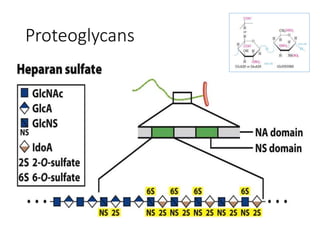
Eg. Heparan sulphate
• demonstrate 2 structures: NS domain and NA domain
• NS domain - Highly sulfated domain
• NA domain - having unmodified GlcNAc and GlcA residues
Proteoglycans
Proteoglycans
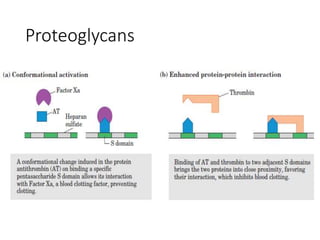
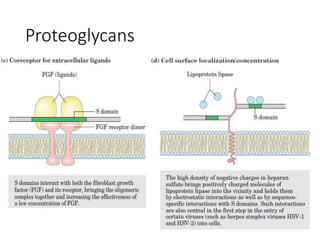
• NS domains bind specifically to extracellular proteins and
signaling molecules to alter their activities
• change in activity may result from :
• a conformational change in the protein
• enhanced protein-protein interactions
• As a co-receptor for extracellular ligands
• Cell surface localization/concentration
Proteoglycans
Proteoglycans
Proteoglycans
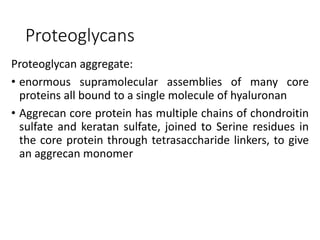
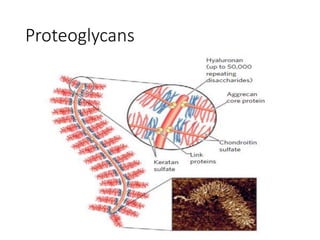
Proteoglycan aggregate:
• enormous supramolecular assemblies of many core
proteins all bound to a single molecule of hyaluronan
• Aggrecan core protein has multiple chains of chondroitin
sulfate and keratan sulfate, joined to Serine residues in
the core protein through tetrasaccharide linkers, to give
an aggrecan monomer
Proteoglycans
Proteoglycans
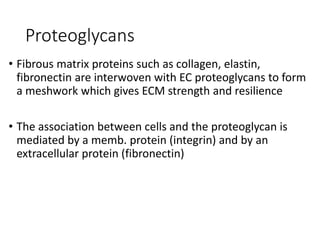
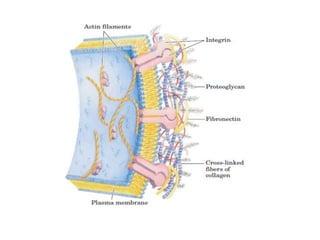
• Fibrous matrix proteins such as collagen, elastin,
fibronectin are interwoven with EC proteoglycans to form
a meshwork which gives ECM strength and resilience
• The association between cells and the proteoglycan is
mediated by a memb. protein (integrin) and by an
extracellular protein (fibronectin)
Glycoproteins
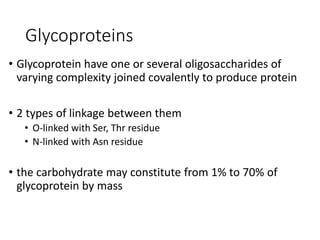
• Glycoprotein have one or several oligosaccharides of
varying complexity joined covalently to produce protein
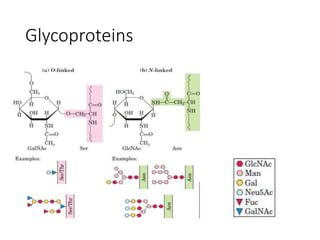
• 2 types of linkage between them
• O-linked with Ser, Thr residue
• N-linked with Asn residue
• the carbohydrate may constitute from 1% to 70% of
glycoprotein by mass
Glycoproteins
Glycoproteins
Eg.
• Mucin: secreted or membrane glycoproteins that
can contain large numbers of O-linked
oligosaccharide chains
• Glycophorin A
• Immunoglobulins
• FSH, LH, TSH
Glycoproteins
• advantages of adding oligosaccharides to proteins are
:
• hydrophilic clusters of carbohydrate alter the polarity and
solubility of the proteins
• Serves as destination labels and also act in protein quality
control, targeting misfolded proteins for degradation
• Oligosaccharide chains also protect some proteins from
attack by proteolytic enzymes.
• Oligosacharide chains are rich in information forming
highly specific sites for recognition and binding by carb.
binding proteins known as lectins
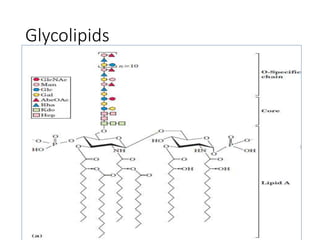
Glycolipids
• Are membrane sphingolipids having covalently bound
oligosaccharide (the hydrophilic head group exposed on
the outer surface of the cell)
Eg.
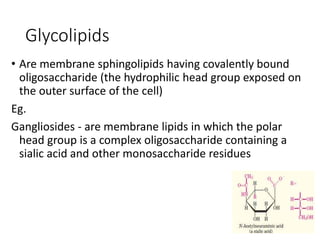
Gangliosides - are membrane lipids in which the polar
head group is a complex oligosaccharide containing a
sialic acid and other monosaccharide residues
Glycolipids
Lipopolysaccharides:
• Present in the outer membrane of Gram –ve
bacteria
• are prime targets of the antibodies and are
therefore important determinants of the serotype
of bacterial strains
Glycolipids
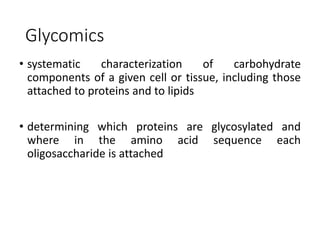
Glycomics
• systematic characterization of carbohydrate
components of a given cell or tissue, including those
attached to proteins and to lipids
• determining which proteins are glycosylated and
where in the amino acid sequence each
oligosaccharide is attached
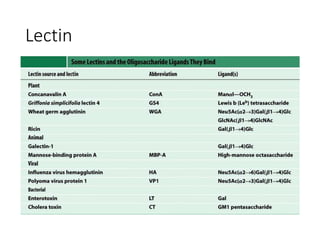
Lectin
• proteins that bind carbohydrates with high
specificity and with moderate to high affinity
• serve in a wide variety of cell-cell recognition,
signaling and adhesion processes and in
intracellular targeting of newly synthesized proteins
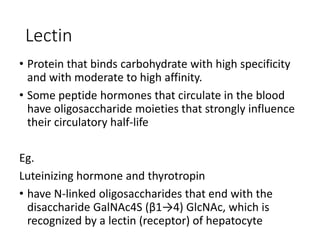
Lectin
• Protein that binds carbohydrate with high specificity
and with moderate to high affinity.
• Some peptide hormones that circulate in the blood
have oligosaccharide moieties that strongly influence
their circulatory half-life
Eg.
Luteinizing hormone and thyrotropin
• have N-linked oligosaccharides that end with the
disaccharide GalNAc4S (β1→4) GlcNAc, which is
recognized by a lectin (receptor) of hepatocyte
Lectin
• Oligosaccharide chains of many plasma glycoproteins
protect those proteins from uptake and degradation
in the liver
Eg.
• ceruIoplasmin, a copper-containing serum
glycoprotein has several oligosaccharide chains
ending in Neu5Ac
• Plasma membrane of hepatocytes has lectin
molecules that specifically bind oligosaccharide
chains without Neu5Ac
Lectin
• receptor that recognizes hydrolytic enzymes
containing mannose-6-phosphate and targets these
proteins for delivery to the lysosomes.
• I-cell disease is one type of defect in this particular
system.
Lectin
• lectin of the influenza virus, known as the HA
(hemagglutinin) protein is essential for viral entry
and infection; oseltamivir and zanamivir
• Lectins on the surface of the HSV-I and HSV-2 bind
specifically to heparan sulfate on the host cell
surface as a first step in the infection cycle
Lectin
• microbial pathogens have lectins that mediate
bacterial adhesion to host cells or the entry of toxin
into cells
E.g. Helicobacter pylori
• adheres to the inner surface of the stomach as
bacterial membrane Iectins interact with specific
oligosaccharides of membrane glycoproteins of the
gastric epithelial cells
Lectin
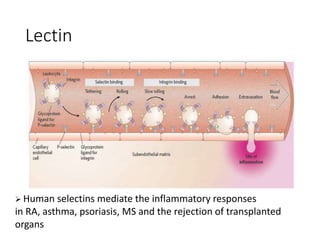
Selectins :
• are a family of plasma membrane lectins that mediate
cell-cell recognition and adhesion in a wide range of
cellular processes
E.g.
• movement of immune cells (neutrophils) through the
capillary wall from blood to tissues, at sites of infection
or inflammation
Lectin
 Human selectins mediate the inflammatory responses
in RA, asthma, psoriasis, MS and the rejection of transplanted
organs
Thank you
•Reference
• Tietz textbook of Clinical chemistry And molecular
Diagnostics. 5th edition
• Lehninger Principles Of Biochemistry
• Lippincott’s illustrated reviews: Biochemistry
• Practical Manual of Biochemistry

Carbohydrates

  • 1.
  • 2.
    Glycosylation • The processin which carbohydrate compound is covalently attached to the protein is called glycosylation • This type of molecule is called glycoprotein. • Oligosaccharide may be attached to protein • with the nitrogen atom of asparagine(called the N- Linked) • With the oxygen atom of threonine or serine(O-Linkage) • The sites of glycosylation depends on the sequence of amino acids surrounding asparagine, serine and threonine.
  • 3.
    • N acetylglucosamineis covalently attached to the nitrogen of asparagine through N-linked glycosylation. N-Linked
  • 4.
    The carbohydrate isattached at its anomeric carbon through a glycosidic link to the –OH of serine or threonine residue
  • 5.
    Glycosaminoglycans • Glycosaminoglycans areextracellular heteropolysaccharide which consist of linear polymer composed of repeating diasaccharide unit . • One of the two monosaccharides is always either N- acetylglucosamine or N- acetylgalactosamine. • other monosaccharide are Uronic acid i.e. D-glucuronic acid or L-iduronic acid • The combination of sulfate groups and carboxylated group of uronic acid residue gives glycosaminoglycans which is a very high electron density molecule.
  • 6.
    Glycosaminoglycans • the importantcomponent of ECM • form a meshwork with fibrous proteins like collagen, elastin, fibronectin etc Hyaluronic acid Heparin Chondroitin sulfate Dermatan sulfate
  • 7.
    Hyaluronic acid: • TheGreek hyalos means “glass”; hyaluronan can have glassy or translucent appearance • contains alternating residues of D-glucuronic acid and N- acetylglucosamine linked by (β1→4) and (β1→3) linkages • 50, 000 repeats of the basic disaccharide unit • High molecular weight of several million • Present in connective tissues, cartilage, synovial fluid and vitreous humor • Hydrolyzed by Hyaluronidase present in • some pathogenic bacteria • sperm of many species of animal
  • 8.
  • 9.
    Chondroitin Sulphate: • Greekchondros, “cartilage” • 20-60 repeated units of glucoronic acid and N- acetylgalactosamine sulphate linked by (β1→3) and (β1→4) linkage. • Widely distributed in cartilage, tendons, ligaments, and the wall of the aorta • Contributes to the tensile strength of cartilage, tendon, ligament and the walls of aorta.
  • 10.
  • 11.
    Dermatan Sulphate: • Greekderma, “skin” • Found in skin, blood vessels and heart valves • Repeated units of L-iduronic acid and N- acetylgalactosamine in (β1→3) linkages
  • 12.
    Keratan Sulphate: • Greekkeras, “horn” • Does not contain uronic acid and sulfate content is variable • Repeated units are galactose and N-acetylglucosamine in beta linkage • Found in cornea, tendons and variety of horny structures formed of dead cells
  • 13.
    Heparan sulphate: • Greekhepar, “liver” • Variable arrangement of sulfated and non sulfated sugar • Repeated units of sulphated glucosamine and L-iduronic acid by (α1→4) linkage • Heparin is a fractionated form of heparan sulfate derived mostly from mast cells • In vivo, used as anticoagulant as it binds antithrombin (activates antithrombin) • The interaction is strongly electrostatic as it has the highest negative charge density of any known biological macromolecule
  • 14.
  • 15.
    Glycoconjugates • Polysaccharides thatserve as information carriers communication between cells and their extracellular surroundings serve as recognition sites for extracellular signal molecule Labelling of proteins for transport to specific organelles and also destruction if protein is malformed or if overproduced Recognition site for extracellular signal molecule Cell to cell recognition and adhesions • Biologically active molecule.
  • 16.
    Glycoconjugates • specific oligosaccharidechains attached to components of the plasma membrane to form a carbohydrate layer which is known as glycocalyx • serves as an information-rich surface • informational carbohydrate is covalently joined to a protein or a lipid • Types Proteoglycans Glycoprotein Glycolipid
  • 17.
  • 18.
    • consists ofa "core protein" with one or more covalently attached glycosaminoglycan chain(s). The point of attachment is a Ser residue to which the glycosaminoglycan is joined through a tetrasaccharide bridge
  • 19.
    Proteoglycans • Macromolecules ofthe extracellular matrix in which one or more sulfated glycosaminoglycan chains are joined covalently to the membrane protein or a secreted protein • The glycosaminoglycan chain can bind to extracellular proteins through electrostatic interaction with the negatively charged groups on the polysaccharide • Major component of ECM
  • 20.
    Proteoglycans • Many aresecreted into the extracellular matrix, but some are integral membrane proteins • Eg. basal lamina, the sheet like ECM, contains a family of core proteins, each with several covalently attached heparan sulfate chains • two major families of heparn sulfate proteoglycans: • Syndecans • Glypicans
  • 21.
  • 22.
    Proteoglycans • Syndecans: havesingle transmembrane domain and an extracellular domain bearing 3-5 chains of heparan or chondroitin sulfate • Glypicans: are attached to membrane by a lipid anchor (GPI anchor) • Both of these can be shed into extracellular space in the form of syndecan ectodomains and glypicans
  • 23.
    Proteoglycans Functions: • can bindto a variety of extracellular ligands and thereby modulate the ligand’s interaction with specific receptors of the cell surface Eg. Heparan sulphate • demonstrate 2 structures: NS domain and NA domain • NS domain - Highly sulfated domain • NA domain - having unmodified GlcNAc and GlcA residues
  • 24.
  • 25.
    Proteoglycans • NS domainsbind specifically to extracellular proteins and signaling molecules to alter their activities • change in activity may result from : • a conformational change in the protein • enhanced protein-protein interactions • As a co-receptor for extracellular ligands • Cell surface localization/concentration
  • 26.
  • 27.
  • 28.
    Proteoglycans Proteoglycan aggregate: • enormoussupramolecular assemblies of many core proteins all bound to a single molecule of hyaluronan • Aggrecan core protein has multiple chains of chondroitin sulfate and keratan sulfate, joined to Serine residues in the core protein through tetrasaccharide linkers, to give an aggrecan monomer
  • 29.
  • 30.
    Proteoglycans • Fibrous matrixproteins such as collagen, elastin, fibronectin are interwoven with EC proteoglycans to form a meshwork which gives ECM strength and resilience • The association between cells and the proteoglycan is mediated by a memb. protein (integrin) and by an extracellular protein (fibronectin)
  • 32.
    Glycoproteins • Glycoprotein haveone or several oligosaccharides of varying complexity joined covalently to produce protein • 2 types of linkage between them • O-linked with Ser, Thr residue • N-linked with Asn residue • the carbohydrate may constitute from 1% to 70% of glycoprotein by mass
  • 33.
  • 34.
    Glycoproteins Eg. • Mucin: secretedor membrane glycoproteins that can contain large numbers of O-linked oligosaccharide chains • Glycophorin A • Immunoglobulins • FSH, LH, TSH
  • 35.
    Glycoproteins • advantages ofadding oligosaccharides to proteins are : • hydrophilic clusters of carbohydrate alter the polarity and solubility of the proteins • Serves as destination labels and also act in protein quality control, targeting misfolded proteins for degradation • Oligosaccharide chains also protect some proteins from attack by proteolytic enzymes. • Oligosacharide chains are rich in information forming highly specific sites for recognition and binding by carb. binding proteins known as lectins
  • 36.
    Glycolipids • Are membranesphingolipids having covalently bound oligosaccharide (the hydrophilic head group exposed on the outer surface of the cell) Eg. Gangliosides - are membrane lipids in which the polar head group is a complex oligosaccharide containing a sialic acid and other monosaccharide residues
  • 37.
    Glycolipids Lipopolysaccharides: • Present inthe outer membrane of Gram –ve bacteria • are prime targets of the antibodies and are therefore important determinants of the serotype of bacterial strains
  • 38.
  • 39.
    Glycomics • systematic characterizationof carbohydrate components of a given cell or tissue, including those attached to proteins and to lipids • determining which proteins are glycosylated and where in the amino acid sequence each oligosaccharide is attached
  • 40.
    Lectin • proteins thatbind carbohydrates with high specificity and with moderate to high affinity • serve in a wide variety of cell-cell recognition, signaling and adhesion processes and in intracellular targeting of newly synthesized proteins
  • 41.
    Lectin • Protein thatbinds carbohydrate with high specificity and with moderate to high affinity. • Some peptide hormones that circulate in the blood have oligosaccharide moieties that strongly influence their circulatory half-life Eg. Luteinizing hormone and thyrotropin • have N-linked oligosaccharides that end with the disaccharide GalNAc4S (β1→4) GlcNAc, which is recognized by a lectin (receptor) of hepatocyte
  • 42.
    Lectin • Oligosaccharide chainsof many plasma glycoproteins protect those proteins from uptake and degradation in the liver Eg. • ceruIoplasmin, a copper-containing serum glycoprotein has several oligosaccharide chains ending in Neu5Ac • Plasma membrane of hepatocytes has lectin molecules that specifically bind oligosaccharide chains without Neu5Ac
  • 43.
    Lectin • receptor thatrecognizes hydrolytic enzymes containing mannose-6-phosphate and targets these proteins for delivery to the lysosomes. • I-cell disease is one type of defect in this particular system.
  • 44.
    Lectin • lectin ofthe influenza virus, known as the HA (hemagglutinin) protein is essential for viral entry and infection; oseltamivir and zanamivir • Lectins on the surface of the HSV-I and HSV-2 bind specifically to heparan sulfate on the host cell surface as a first step in the infection cycle
  • 45.
    Lectin • microbial pathogenshave lectins that mediate bacterial adhesion to host cells or the entry of toxin into cells E.g. Helicobacter pylori • adheres to the inner surface of the stomach as bacterial membrane Iectins interact with specific oligosaccharides of membrane glycoproteins of the gastric epithelial cells
  • 46.
    Lectin Selectins : • area family of plasma membrane lectins that mediate cell-cell recognition and adhesion in a wide range of cellular processes E.g. • movement of immune cells (neutrophils) through the capillary wall from blood to tissues, at sites of infection or inflammation
  • 47.
    Lectin  Human selectinsmediate the inflammatory responses in RA, asthma, psoriasis, MS and the rejection of transplanted organs
  • 48.
    Thank you •Reference • Tietztextbook of Clinical chemistry And molecular Diagnostics. 5th edition • Lehninger Principles Of Biochemistry • Lippincott’s illustrated reviews: Biochemistry • Practical Manual of Biochemistry

Editor's Notes

  • #3 Immunoglobulin FSH LH TSH Lactalbumin Protein secreted by pancrease such as ribonuclease
  • #4 This process requires participation of a special lipid known as dolichol phosphate
  • #5 Polarity and solubility Linear structure Bulkiness of oligosaccharide prevents proteolytic digestion Congenital disorder of glycosylation
  • #7 Space in the tissue of multicellular animals filled with gel like material Diffusion of nutrient and oxygen Basement membrane Consist of collagens laminin
  • #8 Hydrolysed glycosaminoglycal coat around the ovum
  • #15 Starch Glycogen Cellulose Chitin Dextran Peptidopglycan Agaros GAG
  • #22 Protease and enzyme which cuts near the membrane surface phospolipase
  • #23 Protease enzyme which cuts near the membrane surface
  • #30 Force atomic microscope Fibrous matrix protein Crosslink gives whole ECM strength Found in collagen Fibrionectin elastin
  • #39 Occurs on TST
  • #40 Polarity and solubility of protein Structure changes due to oligosaccharide charge Bulkiness of oligosaccharide avoid proteolytic digestyion
  • #42 Synthesize by adrenal cortex Destruction by hepatocytes
  • #43 Similar mechanism seen in old erythrocyte sialidase
  • #46 Oligosaccharide lewis b