Glycoproteins
(N & O glycosylation)
• Objectives
• Glycoproteins
• Biological role of glycoproteins
• Glycosylation
• Disease
Glycoproteins
• They are proteins that contain oligosaccharide
(glycan) chains covalently attached to their
polypeptide backbones.
• Eight sugars predominate in human
glycoproteins
• Glucose, Galactose, Mannose, N-Acetyl
neuraminic acid, Fucose, N-Acetylgalactosamine,
N-Acetylglucosamine, Xylose .
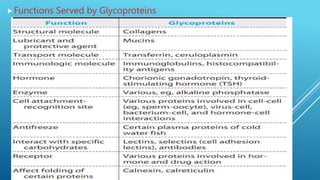
Functions Served by Glycoproteins
 Classes of Glycoproteins:
 O-Linked
Glycoproteins
GalNAcSer(Thr)
linkage
GlcNAc-Ser[Thr]
linkage
 N-Linked
Glycoproteins
Amide nitrogen of asparagine and Nacetylglucosamine (GlcNAcAsn)
 GPI-Linked
Glycoproteins
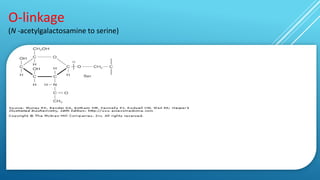
 O-glycosidic linkage-hydroxyl side chain of serine or threonine and a
sugar such as Nacetylgalactosamine (GalNAc-Ser[Thr])
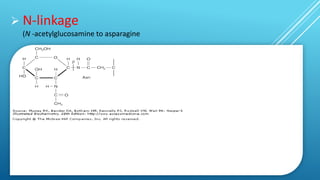
 N-glycosidic linkage-amide nitrogen of asparagine and Nacetylglucosamine
(GlcNAcAsn)
 Glycosylphosphatidylinositol-anchored
(GPI-anchored, or GPI-linked)- carboxyl terminal amino acid of a
protein via a phosphoryl-ethanolamine moiety joined to an oligosaccharide
(glycan), which in turn is linked via glucosamine to phosphatidylinosito
O-linkage
(N -acetylgalactosamine to serine)
 N-linkage
(N -acetylglucosamine to asparagine
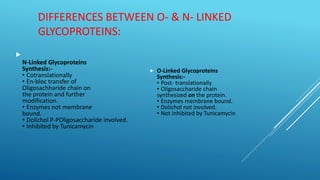
DIFFERENCES BETWEEN O- & N- LINKED
GLYCOPROTEINS:

N-Linked Glycoproteins
Synthesis:-
• Cotranslationally
• En-bloc transfer of
Oligosachharide chain on
the protein and further
modification.
• Enzymes not membrane
bound.
• Dolichol P-POligosaccharide involved.
• Inhibited by Tunicamycin
 O-Linked Glycoproteins
Synthesis:-
• Post- translationally
• Oligosaccharide chain
synthesized on the protein.
• Enzymes membrane bound.
• Dolichol not involved.
• Not inhibited by Tunicamycin
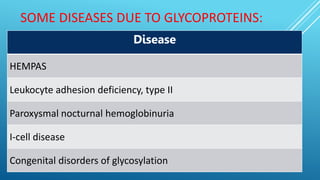
SOME DISEASES DUE TO GLYCOPROTEINS:
Disease
HEMPAS
Leukocyte adhesion deficiency, type II
Paroxysmal nocturnal hemoglobinuria
I-cell disease
Congenital disorders of glycosylation
 HEMPAS:
 Hereditary Erythroblastic Multinuclearity With A Positive Acidified
Lysis Test .
 Also known as Congenital Dyserythropoietic Anemia Type II.
 Claimed to be due to defects in alpha–mannosidase II
 Characterized by
– Ineffective erythropoiesis
– Hemolysis & erythroblast morphological abnormalities
– Hypoglycosylation of some red blood cell (RBC) membrane proteins.
 Treatment consists of frequent blood transfusions and chelation
therapy
 Leukocyte adhesion deficiency (LAD)
 A congenital disorder of glycosylation
 Mutations affecting the activity of a Golgi-located GDP-fuc
transporter
 Marked decrease in neutrophil rolling
 Subjects suffer
– Life-threatening, recurrent bacterial infections
– Psychomotor and mental retardation
 The condition appears to respond to oral fucose
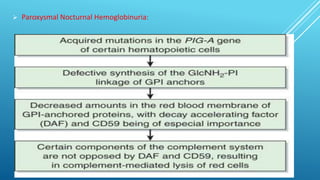
 Paroxysmal Nocturnal Hemoglobinuria:
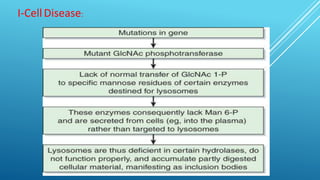
I-CellDisease:
 Congenital Disorder of Glycosylation
Previously called carbohydrate-deficient glycoprotein
syndrome.
 Glycosylation of a variety of tissue proteins and/or lipids is
deficient or defective.
 CDG-I mainly in ER & related to steps prior processing of
glycan chains and transfer of oligosac chain to protein.
 CDG-II includes all defects localized in the processing of Nglycans on the
glycosylated protein. These are situated mainly
in the Golgi compartment.
 Often cause serious, sometimes fatal, malfunction of several
different organ systems (especially the nervous system,
muscles, and intestines) in affected infants

glyco.pptx

  • 1.
    Glycoproteins (N & Oglycosylation)
  • 2.
    • Objectives • Glycoproteins •Biological role of glycoproteins • Glycosylation • Disease
  • 3.
    Glycoproteins • They areproteins that contain oligosaccharide (glycan) chains covalently attached to their polypeptide backbones. • Eight sugars predominate in human glycoproteins • Glucose, Galactose, Mannose, N-Acetyl neuraminic acid, Fucose, N-Acetylgalactosamine, N-Acetylglucosamine, Xylose .
  • 4.
  • 5.
     Classes ofGlycoproteins:  O-Linked Glycoproteins GalNAcSer(Thr) linkage GlcNAc-Ser[Thr] linkage  N-Linked Glycoproteins Amide nitrogen of asparagine and Nacetylglucosamine (GlcNAcAsn)  GPI-Linked Glycoproteins
  • 6.
     O-glycosidic linkage-hydroxylside chain of serine or threonine and a sugar such as Nacetylgalactosamine (GalNAc-Ser[Thr])  N-glycosidic linkage-amide nitrogen of asparagine and Nacetylglucosamine (GlcNAcAsn)  Glycosylphosphatidylinositol-anchored (GPI-anchored, or GPI-linked)- carboxyl terminal amino acid of a protein via a phosphoryl-ethanolamine moiety joined to an oligosaccharide (glycan), which in turn is linked via glucosamine to phosphatidylinosito
  • 7.
  • 8.
  • 9.
    DIFFERENCES BETWEEN O-& N- LINKED GLYCOPROTEINS:  N-Linked Glycoproteins Synthesis:- • Cotranslationally • En-bloc transfer of Oligosachharide chain on the protein and further modification. • Enzymes not membrane bound. • Dolichol P-POligosaccharide involved. • Inhibited by Tunicamycin  O-Linked Glycoproteins Synthesis:- • Post- translationally • Oligosaccharide chain synthesized on the protein. • Enzymes membrane bound. • Dolichol not involved. • Not inhibited by Tunicamycin
  • 10.
    SOME DISEASES DUETO GLYCOPROTEINS: Disease HEMPAS Leukocyte adhesion deficiency, type II Paroxysmal nocturnal hemoglobinuria I-cell disease Congenital disorders of glycosylation
  • 11.
     HEMPAS:  HereditaryErythroblastic Multinuclearity With A Positive Acidified Lysis Test .  Also known as Congenital Dyserythropoietic Anemia Type II.  Claimed to be due to defects in alpha–mannosidase II  Characterized by – Ineffective erythropoiesis – Hemolysis & erythroblast morphological abnormalities – Hypoglycosylation of some red blood cell (RBC) membrane proteins.  Treatment consists of frequent blood transfusions and chelation therapy
  • 12.
     Leukocyte adhesiondeficiency (LAD)  A congenital disorder of glycosylation  Mutations affecting the activity of a Golgi-located GDP-fuc transporter  Marked decrease in neutrophil rolling  Subjects suffer – Life-threatening, recurrent bacterial infections – Psychomotor and mental retardation  The condition appears to respond to oral fucose
  • 13.
     Paroxysmal NocturnalHemoglobinuria:
  • 14.
  • 15.
     Congenital Disorderof Glycosylation Previously called carbohydrate-deficient glycoprotein syndrome.  Glycosylation of a variety of tissue proteins and/or lipids is deficient or defective.  CDG-I mainly in ER & related to steps prior processing of glycan chains and transfer of oligosac chain to protein.  CDG-II includes all defects localized in the processing of Nglycans on the glycosylated protein. These are situated mainly in the Golgi compartment.  Often cause serious, sometimes fatal, malfunction of several different organ systems (especially the nervous system, muscles, and intestines) in affected infants