GLYCOPROTEINS
Dr. Nishtha Wadhwa
Department of Biochemistry
St. John’s Medical College
1
LEARNING OBJECTIVES:
• What are glycoproteins and the types of
linkages ?
• Importance of protein glycosylation.
• Synthesis & Degradation of glycoproteins.
• Biomedical Importance of Glycoproteins.
- Congenital Disorders of Glycosylation
- ABO Blood grouping system
2
INTRODUCTION
3
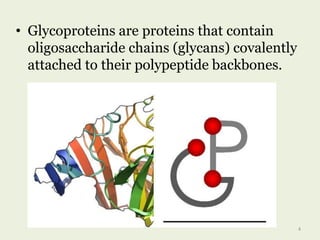
• Glycoproteins are proteins that contain
oligosaccharide chains (glycans) covalently
attached to their polypeptide backbones.
4
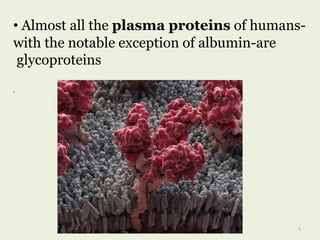
• Almost all the plasma proteins of humans-
with the notable exception of albumin-are
glycoproteins
.
5
•Glycosylation (enzymic attachment of
sugars) is the most frequent post-translational
modification of proteins.
•Nonenzymic attachment of sugars to proteins
can also occur, and is referred to as
glycation.
6
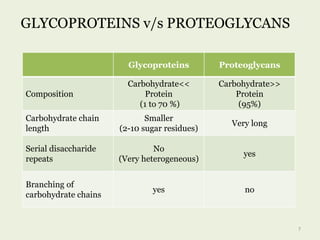
Glycoproteins Proteoglycans
Composition
Carbohydrate<<
Protein
(1 to 70 %)
Carbohydrate>>
Protein
(95%)
Carbohydrate chain
length
Smaller
(2-10 sugar residues)
Very long
Serial disaccharide
repeats
No
(Very heterogeneous)
yes
Branching of
carbohydrate chains
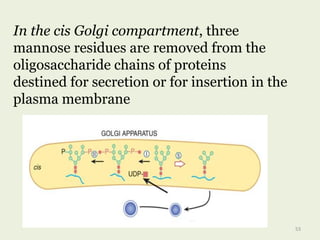
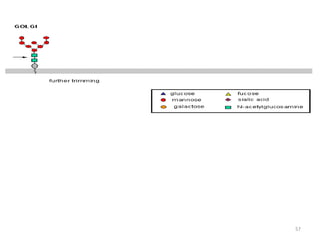
yes no
GLYCOPROTEINS v/s PROTEOGLYCANS
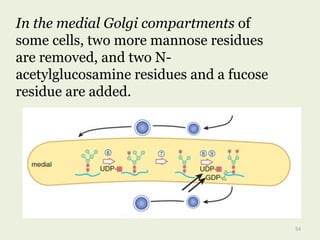
7
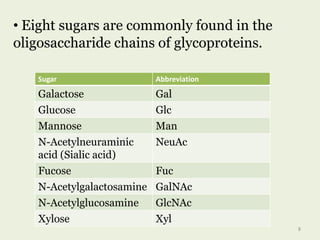
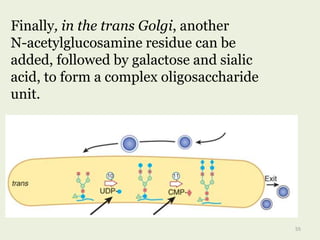
• Eight sugars are commonly found in the
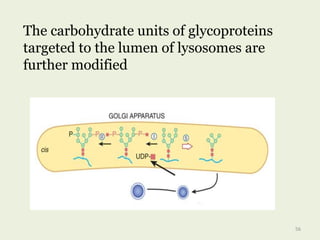
oligosaccharide chains of glycoproteins.
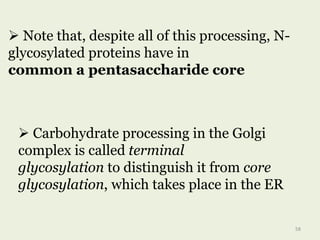
Sugar Abbreviation
Galactose Gal
Glucose Glc
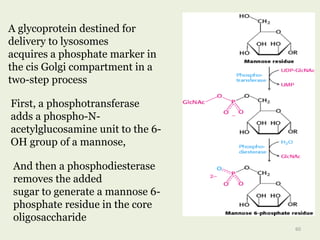
Mannose Man
N-Acetylneuraminic
acid (Sialic acid)
NeuAc
Fucose Fuc
N-Acetylgalactosamine GalNAc
N-Acetylglucosamine GlcNAc
Xylose Xyl
8
 The percentage of carbohydrate in
glycoproteins is highly variable.
• Some glycoproteins such as IgG contain low
amounts (4%) of carbohydrate by weight, while
glycophorin, the human red cell membrane
glycoprotein, contains 60% carbohydrate
9
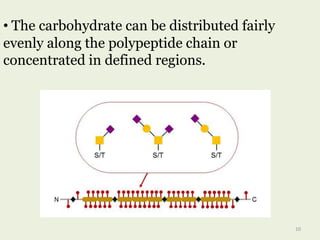
• The carbohydrate can be distributed fairly
evenly along the polypeptide chain or
concentrated in defined regions.
10
Functions of oligosaccharide chains
of Glycoproteins:
• Increase in the polarity (and solubility) of a
protein
• Prevent degradation of the protein by proteinases
• Stabilisation of the protein structure
11
• May affect sites of metastases selected by
cancer cells
• Important determinant in receptor–ligand
binding
• Control of protein half-life in blood
Functions of oligosaccharide chains
of Glycoproteins:
12
FUNCTIONS OF
GLYCOPROTEINS
13
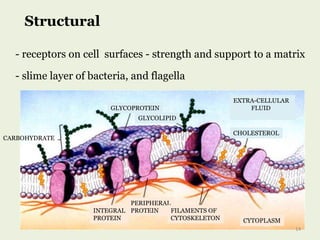
- receptors on cell surfaces - strength and support to a matrix
- slime layer of bacteria, and flagella
Structural
EXTRA-CELLULAR
FLUIDGLYCOPROTEIN
GLYCOLIPID
INTEGRAL
PROTEIN
PERIPHERAL
PROTEIN FILAMENTS OF
CYTOSKELETON CYTOPLASM
CHOLESTEROL
CARBOHYDRATE
14
• Mucin … form a highly viscous gel
– Protect internal epithelial surfaces
• Act as a lubricant
– Human lacrimal glands produce a glycoprotein which
protects the corneal epithelium
Protection
15
Reproduction
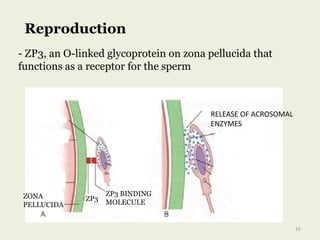
- ZP3, an O-linked glycoprotein on zona pellucida that
functions as a receptor for the sperm
16
ZONA
PELLUCIDA
ZP3
ZP3 BINDING
MOLECULE
RELEASE OF ACROSOMAL
ENZYMES
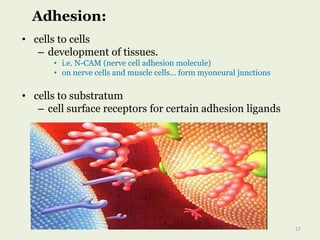
• cells to cells
– development of tissues.
• i.e. N-CAM (nerve cell adhesion molecule)
• on nerve cells and muscle cells… form myoneural junctions
• cells to substratum
– cell surface receptors for certain adhesion ligands
Adhesion:
17
– Oxidoreductases
– Transferases
– Hydrolases
Hormones
- Chorionic gonadotropin,
- Thyroid stimulating hormone (TSH)
Enzymes
18
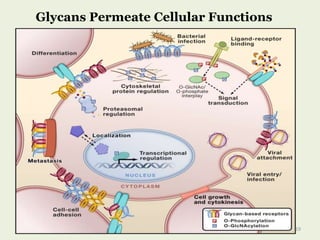
Glycans Permeate Cellular Functions
19
TYPES
20
Based on the nature of the linkage between their
polypeptide chains and their oligosaccharide
chains, glycoproteins can be divided into three
major classes :
O-Linked
N-Linked
GPI-anchored
21
O-Linked
Glycoproteins
GalNAcSer(Thr)
linkage
Gal-Gal-Xyl-Ser
linkage
Galhydroxylysi
ne
GlcNAc-Ser[Thr]
N-Linked
Glycoproteins
Complex
Hybrid
High-
mannose
GPI-Linked
Glycoproteins
Other minor
groups
22
•cell surface glycoproteins
•mucins
•viral glycoproteins
O-glycosidic linkage
 Hydroxyl side chain of serine
or threonine and a sugar such
as Nacetylgalactosamine
(GalNAc-Ser[Thr])
 Anomeric carbon of NAG …
attached to O of serine or
threonine
23
• Four subclasses of O-glycosidic linkages are
found in human glycoproteins :
O-glycosidic
linkages
GalNAcSer(
Thr)
Gal-Gal-Xyl-
Ser
Galhydroxyl
ysine
GlcNAc-
Ser[Thr]
•Predominant
linkage
24
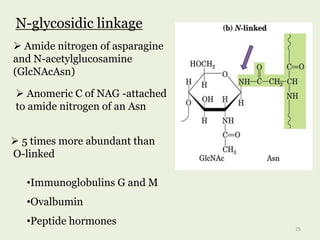
N-glycosidic linkage
 Amide nitrogen of asparagine
and N-acetylglucosamine
(GlcNAcAsn)
 Anomeric C of NAG -attached
to amide nitrogen of an Asn
 5 times more abundant than
O-linked
•Immunoglobulins G and M
•Ovalbumin
•Peptide hormones
25
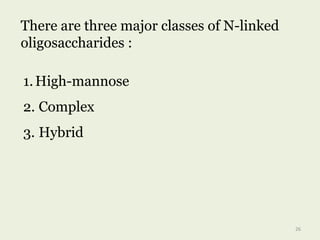
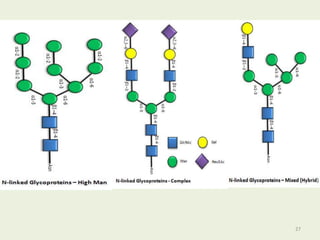
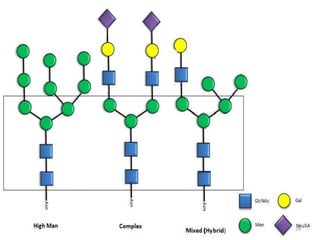
There are three major classes of N-linked
oligosaccharides :
1.High-mannose
2. Complex
3. Hybrid
26
27
 All N-linked oligosaccharides have in
common a pentasaccharide core
consisting of three mannose and two N-
acetylglucosamine residues.
28
29
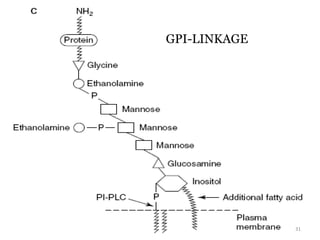
 Carboxyl terminal amino acid of a protein via
a phosphoryl-ethanolamine moiety joined to an
oligosaccharide (glycan), which in turn is linked
via glucosamine to phosphatidylinositol
Glycosylphosphatidylinositol-anchored
(GPI-anchored, or GPI-linked)
30
GPI-LINKAGE
31
Functions of GPI linkage:
(1) The GPI anchor may allow greatly enhanced mobility of
a protein in the plasma membrane
(2) Some GPI anchors may connect with signal
transduction pathways.
(3) It has been shown that GPI structures can target
certain proteins to apical domains and
also basolateral domains of the plasma membrane of
certain polarized epithelial cells.
32
• Acetylcholinesterase (red cell membrane)
• Alkaline phosphatase (intestinal, placental)
• Decay-accelerating factor (red cell membrane)
• 5’-Nucleotidase (T lymphocytes, other cells)
 Some GPI-Linked Proteins :
33
SYNTHESIS
34
A) Biosynthesis of O-Linked
Glycoproteins
• Membrane-bound glycoprotein
glycosyltransferases.
• The enzymes assembling O-linked chains are
located in the Golgi apparatus.
35
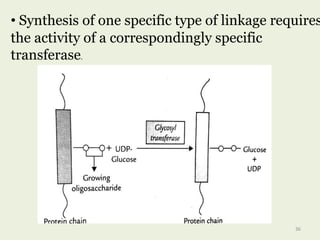
• Synthesis of one specific type of linkage requires
the activity of a correspondingly specific
transferase.
36
Biosynthesis of N-Linked Glycoproteins:
The sequence of N-linked oligosaccharide units of a
glycoprotein is determined by
1) The sequence and conformation of the protein
undergoing glycosylation
 Glycosylation occurs at the Asn residue of an
Asn-XSer/Thr tripeptide sequence, where X is any
amino acid except proline, aspartic
acid, or glutamic acid.
(2) The glycosyltransferases present in the Golgi
compartment in which they are processed.
37
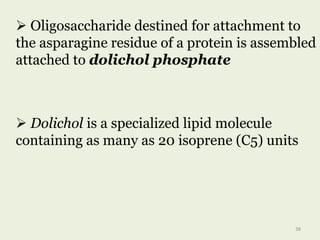
 Oligosaccharide destined for attachment to
the asparagine residue of a protein is assembled
attached to dolichol phosphate
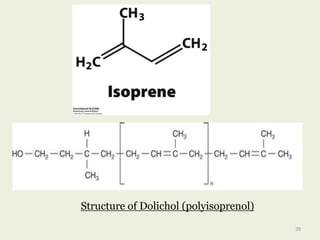
 Dolichol is a specialized lipid molecule
containing as many as 20 isoprene (C5) units
38
Structure of Dolichol (polyisoprenol)
39
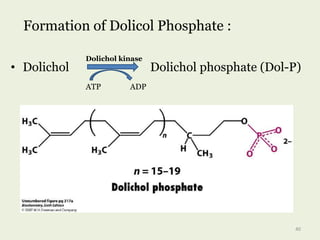
• Dolichol Dolichol phosphate (Dol-P)
ATP ADP
Dolichol kinase
Formation of Dolicol Phosphate :
40
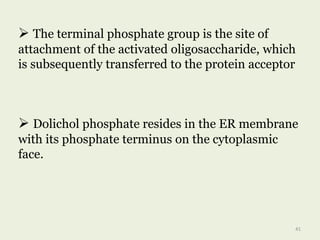
 The terminal phosphate group is the site of
attachment of the activated oligosaccharide, which
is subsequently transferred to the protein acceptor
41
 Dolichol phosphate resides in the ER membrane
with its phosphate terminus on the cytoplasmic
face.
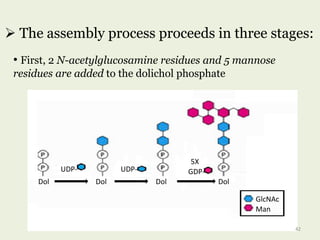
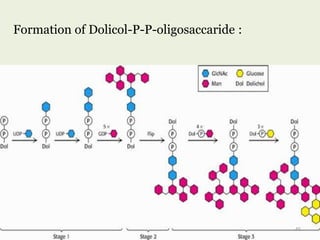
 The assembly process proceeds in three stages:
• First, 2 N-acetylglucosamine residues and 5 mannose
residues are added to the dolichol phosphate
Dol Dol DolDol
UDP- UDP- GDP-
5X
GlcNAc
Man
42
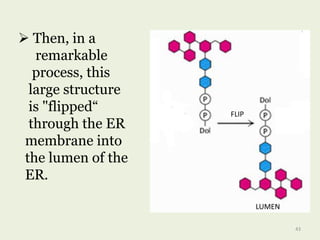
 Then, in a
remarkable
process, this
large structure
is "flipped“
through the ER
membrane into
the lumen of the
ER.
FLIP
LUMEN
43
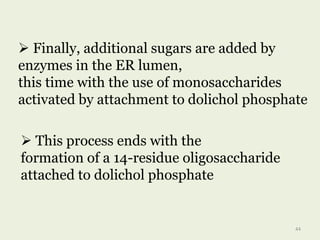
 This process ends with the
formation of a 14-residue oligosaccharide
attached to dolichol phosphate
 Finally, additional sugars are added by
enzymes in the ER lumen,
this time with the use of monosaccharides
activated by attachment to dolichol phosphate
44
Formation of Dolicol-P-P-oligosaccaride :
45
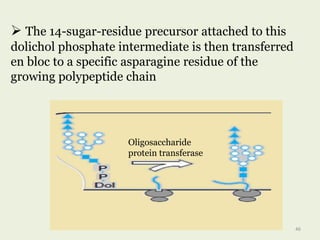
 The 14-sugar-residue precursor attached to this
dolichol phosphate intermediate is then transferred
en bloc to a specific asparagine residue of the
growing polypeptide chain
Oligosaccharide
protein transferase
46
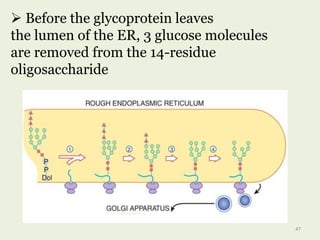
 Before the glycoprotein leaves
the lumen of the ER, 3 glucose molecules
are removed from the 14-residue
oligosaccharide
47
48
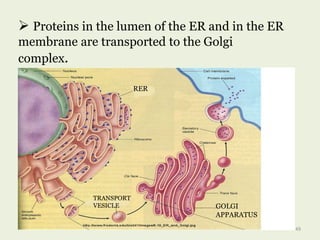
 Proteins in the lumen of the ER and in the ER
membrane are transported to the Golgi
complex.
RER
GOLGI
APPARATUS
TRANSPORT
VESICLE
49
 The Golgi complex has two principal roles.
• First, carbohydrate units of glycoproteins
are altered and elaborated in the Golgi
complex.
• Second, the Golgi complex is the major sorting
center of the cell.
50
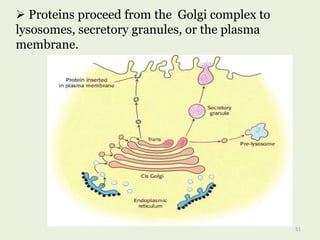
 Proteins proceed from the Golgi complex to
lysosomes, secretory granules, or the plasma
membrane.
51
 The N-linked carbohydrate units of
glycoproteins are further modified in each of
the compartments of the Golgi
complex.
52
In the cis Golgi compartment, three
mannose residues are removed from the
oligosaccharide chains of proteins
destined for secretion or for insertion in the
plasma membrane
53
In the medial Golgi compartments of
some cells, two more mannose residues
are removed, and two N-
acetylglucosamine residues and a fucose
residue are added.
54
Finally, in the trans Golgi, another
N-acetylglucosamine residue can be
added, followed by galactose and sialic
acid, to form a complex oligosaccharide
unit.
55
The carbohydrate units of glycoproteins
targeted to the lumen of lysosomes are
further modified
56
57
 Note that, despite all of this processing, N-
glycosylated proteins have in
common a pentasaccharide core
 Carbohydrate processing in the Golgi
complex is called terminal
glycosylation to distinguish it from core
glycosylation, which takes place in the ER
58
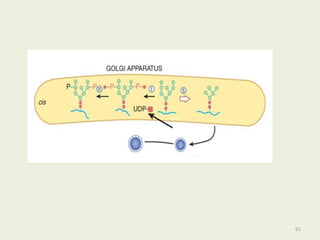
Mannose 6-phosphate Targets
Lysosomal Enzymes to Their
Destinations
 A carbohydrate marker directs certain
proteins from the Golgi complex to
lysosomes.
59
And then a phosphodiesterase
removes the added
sugar to generate a mannose 6-
phosphate residue in the core
oligosaccharide
A glycoprotein destined for
delivery to lysosomes
acquires a phosphate marker in
the cis Golgi compartment in a
two-step process
First, a phosphotransferase
adds a phospho-N-
acetylglucosamine unit to the 6-
OH group of a mannose,
60
61
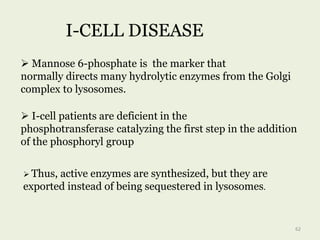
 Mannose 6-phosphate is the marker that
normally directs many hydrolytic enzymes from the Golgi
complex to lysosomes.
 I-cell patients are deficient in the
phosphotransferase catalyzing the first step in the addition
of the phosphoryl group
 Thus, active enzymes are synthesized, but they are
exported instead of being sequestered in lysosomes.
I-CELL DISEASE
62
 The lysosomes contain large inclusions of undigested
glycosaminoglycans and glycolipids ,hence the "I" in the
name of the disease.
 Very high levels of the enzymes are present in the blood
and urine.
 Patients with I-cell disease suffer severe psychomotor
retardation and skeletal deformities.
63
 Biochemical diagnosis is based on strongly increased
plasma lysosomal enzyme activities and is confirmed by
the decrease of GlcNAc phosphotransferase activity in
fibroblasts
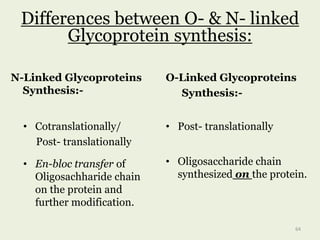
Differences between O- & N- linked
Glycoprotein synthesis:
N-Linked Glycoproteins
Synthesis:-
O-Linked Glycoproteins
Synthesis:-
• En-bloc transfer of
Oligosachharide chain
on the protein and
further modification.
• Oligosaccharide chain
synthesized on the protein.
• Cotranslationally/
Post- translationally
• Post- translationally
64
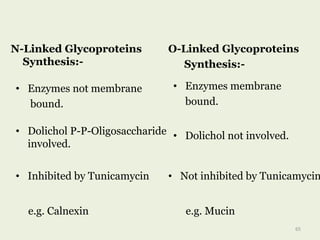
• Dolichol P-P-Oligosaccharide
involved.
• Dolichol not involved.
e.g. Calnexin e.g. Mucin
N-Linked Glycoproteins
Synthesis:-
O-Linked Glycoproteins
Synthesis:-
• Enzymes not membrane
bound.
• Inhibited by Tunicamycin
• Enzymes membrane
bound.
• Not inhibited by Tunicamycin
65
Oligosaccharide Cleavage as a Timing
Device for Protein Degradation
 Newly synthesized serum glycoproteins contain N-
linked oligosaccharides in which sialic acid residues
cap galactose residues.
66
As these glycoproteins circulate, enzymes on the blood
vessel walls cleave off the sialic acid groups, exposing the
galactose residues
 The liver, the asialoglycoprotein receptor binds
the exposed galactose residues of these
glycoproteins with very high affinity
67
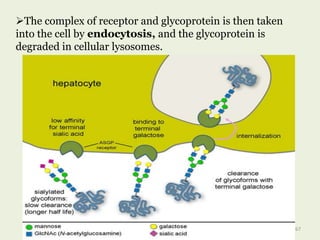
The complex of receptor and glycoprotein is then taken
into the cell by endocytosis, and the glycoprotein is
degraded in cellular lysosomes.
Highest affinity binding of glycoprotein to the
asialoglycoprotein receptor requires three free
galactose residues.
Oligosaccharides with only one or two exposed
galactose residues bind less tightly.
 This is an elegant way for the body to keep track
of how long glycoproteins have been in circulation
68
69
BIOMEDICAL IMPORTANCE
CONGENITAL DISORDERS OF
GLYCOSYLATION:
 Autosomal recessive disorders
Multisystem disorders
Generally affect the central nervous system,
resulting in psychomotor retardation and other
features
At least 15 distinct disorders have been recognized
70
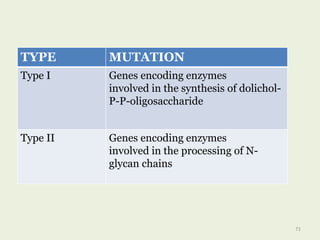
TYPE MUTATION
Type I Genes encoding enzymes
involved in the synthesis of dolichol-
P-P-oligosaccharide
Type II Genes encoding enzymes
involved in the processing of N-
glycan chains
71
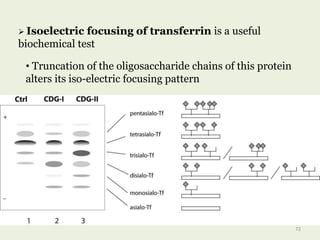
 Isoelectric focusing of transferrin is a useful
biochemical test
• Truncation of the oligosaccharide chains of this protein
alters its iso-electric focusing pattern
72
ABO BLOOD GROUP SYSTEM
 ABO substances(antigen) are complex oligosaccharides
present in most cells and in certain secretions of body
 Genes for ABO substances are present on
chromosome 9
73
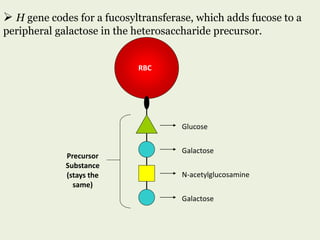
 Involves H gene and ABO genes
Glucose
Galactose
N-acetylglucosamine
Galactose
Precursor
Substance
(stays the
same)
RBC
 H gene codes for a fucosyltransferase, which adds fucose to a
peripheral galactose in the heterosaccharide precursor.
Glucose
Galactose
N-acetylglucosamine
Galactose
H antigen
RBC
Fucose
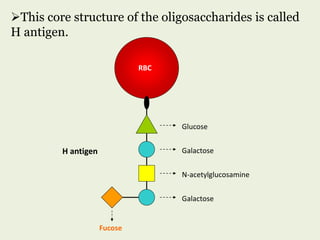
This core structure of the oligosaccharides is called
H antigen.
76
The H antigen is the foundation upon which A
and B antigens are built
A and B genes code for enzymes that add a sugar
to the H antigen
ABO BLOOD GROUP SYSTEM
A and B Antigen
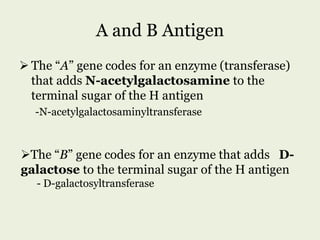
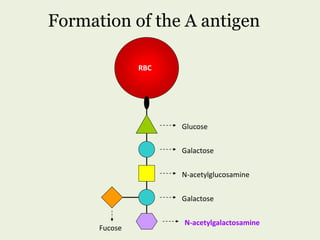
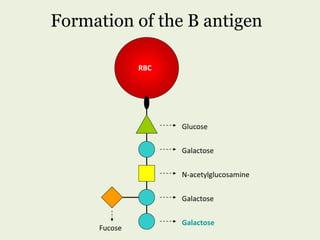
 The “A” gene codes for an enzyme (transferase)
that adds N-acetylgalactosamine to the
terminal sugar of the H antigen
-N-acetylgalactosaminyltransferase
The “B” gene codes for an enzyme that adds D-
galactose to the terminal sugar of the H antigen
- D-galactosyltransferase
Formation of the A antigen
Glucose
Galactose
N-acetylglucosamine
Galactose
RBC
Fucose
N-acetylgalactosamine
Formation of the B antigen
Glucose
Galactose
N-acetylglucosamine
Galactose
RBC
Fucose
Galactose
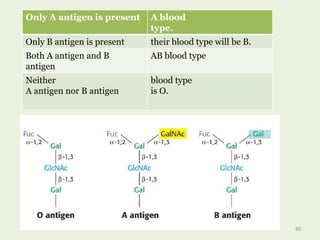
Only A antigen is present A blood
type.
Only B antigen is present their blood type will be B.
Both A antigen and B
antigen
AB blood type
Neither
A antigen nor B antigen
blood type
is O.
80
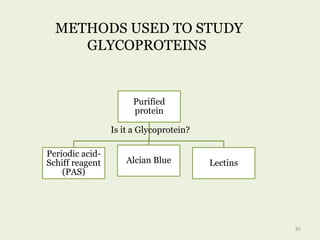
METHODS USED TO STUDY
GLYCOPROTEINS
Purified
protein
Periodic acid-
Schiff reagent
(PAS)
Alcian Blue Lectins
81
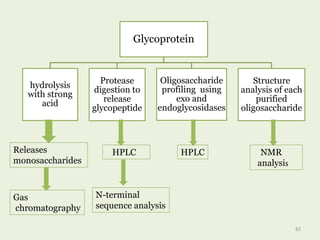
Is it a Glycoprotein?
Glycoprotein
hydrolysis
with strong
acid
Protease
digestion to
release
glycopeptide
Oligosaccharide
profiling using
exo and
endoglycosidases
Structure
analysis of each
purified
oligosaccharide
Releases
monosaccharides
Gas
chromatography
HPLC
N-terminal
sequence analysis
HPLC NMR
analysis
82
83
REFERENCES
1. Harper’s Illustrated Biochemistry Twenty-Eighth Edition
2. Jeremy M Berg , John M. Tymoczko, Lubert Stryer :
Biochemistry- Fifth Edition
3. Lehninger Principles of biochemistry -Fifth Edition
4. H. Robert Horton, Laurence A. Moran, K. Gray Scrimgeour,
Marc D. Perry, J. David Rawn : Principles of Biochemistry-
Fourth Edition
5. Devlin, Thomas M: Textbook of Biochemistry : With
Clinical Correlations- Fourth Edition
THANK-YOU

Glycoproteins

  • 1.
    GLYCOPROTEINS Dr. Nishtha Wadhwa Departmentof Biochemistry St. John’s Medical College 1
  • 2.
    LEARNING OBJECTIVES: • Whatare glycoproteins and the types of linkages ? • Importance of protein glycosylation. • Synthesis & Degradation of glycoproteins. • Biomedical Importance of Glycoproteins. - Congenital Disorders of Glycosylation - ABO Blood grouping system 2
  • 3.
  • 4.
    • Glycoproteins areproteins that contain oligosaccharide chains (glycans) covalently attached to their polypeptide backbones. 4
  • 5.
    • Almost allthe plasma proteins of humans- with the notable exception of albumin-are glycoproteins . 5
  • 6.
    •Glycosylation (enzymic attachmentof sugars) is the most frequent post-translational modification of proteins. •Nonenzymic attachment of sugars to proteins can also occur, and is referred to as glycation. 6
  • 7.
    Glycoproteins Proteoglycans Composition Carbohydrate<< Protein (1 to70 %) Carbohydrate>> Protein (95%) Carbohydrate chain length Smaller (2-10 sugar residues) Very long Serial disaccharide repeats No (Very heterogeneous) yes Branching of carbohydrate chains yes no GLYCOPROTEINS v/s PROTEOGLYCANS 7
  • 8.
    • Eight sugarsare commonly found in the oligosaccharide chains of glycoproteins. Sugar Abbreviation Galactose Gal Glucose Glc Mannose Man N-Acetylneuraminic acid (Sialic acid) NeuAc Fucose Fuc N-Acetylgalactosamine GalNAc N-Acetylglucosamine GlcNAc Xylose Xyl 8
  • 9.
     The percentageof carbohydrate in glycoproteins is highly variable. • Some glycoproteins such as IgG contain low amounts (4%) of carbohydrate by weight, while glycophorin, the human red cell membrane glycoprotein, contains 60% carbohydrate 9
  • 10.
    • The carbohydratecan be distributed fairly evenly along the polypeptide chain or concentrated in defined regions. 10
  • 11.
    Functions of oligosaccharidechains of Glycoproteins: • Increase in the polarity (and solubility) of a protein • Prevent degradation of the protein by proteinases • Stabilisation of the protein structure 11
  • 12.
    • May affectsites of metastases selected by cancer cells • Important determinant in receptor–ligand binding • Control of protein half-life in blood Functions of oligosaccharide chains of Glycoproteins: 12
  • 13.
  • 14.
    - receptors oncell surfaces - strength and support to a matrix - slime layer of bacteria, and flagella Structural EXTRA-CELLULAR FLUIDGLYCOPROTEIN GLYCOLIPID INTEGRAL PROTEIN PERIPHERAL PROTEIN FILAMENTS OF CYTOSKELETON CYTOPLASM CHOLESTEROL CARBOHYDRATE 14
  • 15.
    • Mucin …form a highly viscous gel – Protect internal epithelial surfaces • Act as a lubricant – Human lacrimal glands produce a glycoprotein which protects the corneal epithelium Protection 15
  • 16.
    Reproduction - ZP3, anO-linked glycoprotein on zona pellucida that functions as a receptor for the sperm 16 ZONA PELLUCIDA ZP3 ZP3 BINDING MOLECULE RELEASE OF ACROSOMAL ENZYMES
  • 17.
    • cells tocells – development of tissues. • i.e. N-CAM (nerve cell adhesion molecule) • on nerve cells and muscle cells… form myoneural junctions • cells to substratum – cell surface receptors for certain adhesion ligands Adhesion: 17
  • 18.
    – Oxidoreductases – Transferases –Hydrolases Hormones - Chorionic gonadotropin, - Thyroid stimulating hormone (TSH) Enzymes 18
  • 19.
  • 20.
  • 21.
    Based on thenature of the linkage between their polypeptide chains and their oligosaccharide chains, glycoproteins can be divided into three major classes : O-Linked N-Linked GPI-anchored 21
  • 22.
  • 23.
    •cell surface glycoproteins •mucins •viralglycoproteins O-glycosidic linkage  Hydroxyl side chain of serine or threonine and a sugar such as Nacetylgalactosamine (GalNAc-Ser[Thr])  Anomeric carbon of NAG … attached to O of serine or threonine 23
  • 24.
    • Four subclassesof O-glycosidic linkages are found in human glycoproteins : O-glycosidic linkages GalNAcSer( Thr) Gal-Gal-Xyl- Ser Galhydroxyl ysine GlcNAc- Ser[Thr] •Predominant linkage 24
  • 25.
    N-glycosidic linkage  Amidenitrogen of asparagine and N-acetylglucosamine (GlcNAcAsn)  Anomeric C of NAG -attached to amide nitrogen of an Asn  5 times more abundant than O-linked •Immunoglobulins G and M •Ovalbumin •Peptide hormones 25
  • 26.
    There are threemajor classes of N-linked oligosaccharides : 1.High-mannose 2. Complex 3. Hybrid 26
  • 27.
  • 28.
     All N-linkedoligosaccharides have in common a pentasaccharide core consisting of three mannose and two N- acetylglucosamine residues. 28
  • 29.
  • 30.
     Carboxyl terminalamino acid of a protein via a phosphoryl-ethanolamine moiety joined to an oligosaccharide (glycan), which in turn is linked via glucosamine to phosphatidylinositol Glycosylphosphatidylinositol-anchored (GPI-anchored, or GPI-linked) 30
  • 31.
  • 32.
    Functions of GPIlinkage: (1) The GPI anchor may allow greatly enhanced mobility of a protein in the plasma membrane (2) Some GPI anchors may connect with signal transduction pathways. (3) It has been shown that GPI structures can target certain proteins to apical domains and also basolateral domains of the plasma membrane of certain polarized epithelial cells. 32
  • 33.
    • Acetylcholinesterase (redcell membrane) • Alkaline phosphatase (intestinal, placental) • Decay-accelerating factor (red cell membrane) • 5’-Nucleotidase (T lymphocytes, other cells)  Some GPI-Linked Proteins : 33
  • 34.
  • 35.
    A) Biosynthesis ofO-Linked Glycoproteins • Membrane-bound glycoprotein glycosyltransferases. • The enzymes assembling O-linked chains are located in the Golgi apparatus. 35
  • 36.
    • Synthesis ofone specific type of linkage requires the activity of a correspondingly specific transferase. 36
  • 37.
    Biosynthesis of N-LinkedGlycoproteins: The sequence of N-linked oligosaccharide units of a glycoprotein is determined by 1) The sequence and conformation of the protein undergoing glycosylation  Glycosylation occurs at the Asn residue of an Asn-XSer/Thr tripeptide sequence, where X is any amino acid except proline, aspartic acid, or glutamic acid. (2) The glycosyltransferases present in the Golgi compartment in which they are processed. 37
  • 38.
     Oligosaccharide destinedfor attachment to the asparagine residue of a protein is assembled attached to dolichol phosphate  Dolichol is a specialized lipid molecule containing as many as 20 isoprene (C5) units 38
  • 39.
    Structure of Dolichol(polyisoprenol) 39
  • 40.
    • Dolichol Dolicholphosphate (Dol-P) ATP ADP Dolichol kinase Formation of Dolicol Phosphate : 40
  • 41.
     The terminalphosphate group is the site of attachment of the activated oligosaccharide, which is subsequently transferred to the protein acceptor 41  Dolichol phosphate resides in the ER membrane with its phosphate terminus on the cytoplasmic face.
  • 42.
     The assemblyprocess proceeds in three stages: • First, 2 N-acetylglucosamine residues and 5 mannose residues are added to the dolichol phosphate Dol Dol DolDol UDP- UDP- GDP- 5X GlcNAc Man 42
  • 43.
     Then, ina remarkable process, this large structure is "flipped“ through the ER membrane into the lumen of the ER. FLIP LUMEN 43
  • 44.
     This processends with the formation of a 14-residue oligosaccharide attached to dolichol phosphate  Finally, additional sugars are added by enzymes in the ER lumen, this time with the use of monosaccharides activated by attachment to dolichol phosphate 44
  • 45.
  • 46.
     The 14-sugar-residueprecursor attached to this dolichol phosphate intermediate is then transferred en bloc to a specific asparagine residue of the growing polypeptide chain Oligosaccharide protein transferase 46
  • 47.
     Before theglycoprotein leaves the lumen of the ER, 3 glucose molecules are removed from the 14-residue oligosaccharide 47
  • 48.
  • 49.
     Proteins inthe lumen of the ER and in the ER membrane are transported to the Golgi complex. RER GOLGI APPARATUS TRANSPORT VESICLE 49
  • 50.
     The Golgicomplex has two principal roles. • First, carbohydrate units of glycoproteins are altered and elaborated in the Golgi complex. • Second, the Golgi complex is the major sorting center of the cell. 50
  • 51.
     Proteins proceedfrom the Golgi complex to lysosomes, secretory granules, or the plasma membrane. 51
  • 52.
     The N-linkedcarbohydrate units of glycoproteins are further modified in each of the compartments of the Golgi complex. 52
  • 53.
    In the cisGolgi compartment, three mannose residues are removed from the oligosaccharide chains of proteins destined for secretion or for insertion in the plasma membrane 53
  • 54.
    In the medialGolgi compartments of some cells, two more mannose residues are removed, and two N- acetylglucosamine residues and a fucose residue are added. 54
  • 55.
    Finally, in thetrans Golgi, another N-acetylglucosamine residue can be added, followed by galactose and sialic acid, to form a complex oligosaccharide unit. 55
  • 56.
    The carbohydrate unitsof glycoproteins targeted to the lumen of lysosomes are further modified 56
  • 57.
  • 58.
     Note that,despite all of this processing, N- glycosylated proteins have in common a pentasaccharide core  Carbohydrate processing in the Golgi complex is called terminal glycosylation to distinguish it from core glycosylation, which takes place in the ER 58
  • 59.
    Mannose 6-phosphate Targets LysosomalEnzymes to Their Destinations  A carbohydrate marker directs certain proteins from the Golgi complex to lysosomes. 59
  • 60.
    And then aphosphodiesterase removes the added sugar to generate a mannose 6- phosphate residue in the core oligosaccharide A glycoprotein destined for delivery to lysosomes acquires a phosphate marker in the cis Golgi compartment in a two-step process First, a phosphotransferase adds a phospho-N- acetylglucosamine unit to the 6- OH group of a mannose, 60
  • 61.
  • 62.
     Mannose 6-phosphateis the marker that normally directs many hydrolytic enzymes from the Golgi complex to lysosomes.  I-cell patients are deficient in the phosphotransferase catalyzing the first step in the addition of the phosphoryl group  Thus, active enzymes are synthesized, but they are exported instead of being sequestered in lysosomes. I-CELL DISEASE 62
  • 63.
     The lysosomescontain large inclusions of undigested glycosaminoglycans and glycolipids ,hence the "I" in the name of the disease.  Very high levels of the enzymes are present in the blood and urine.  Patients with I-cell disease suffer severe psychomotor retardation and skeletal deformities. 63  Biochemical diagnosis is based on strongly increased plasma lysosomal enzyme activities and is confirmed by the decrease of GlcNAc phosphotransferase activity in fibroblasts
  • 64.
    Differences between O-& N- linked Glycoprotein synthesis: N-Linked Glycoproteins Synthesis:- O-Linked Glycoproteins Synthesis:- • En-bloc transfer of Oligosachharide chain on the protein and further modification. • Oligosaccharide chain synthesized on the protein. • Cotranslationally/ Post- translationally • Post- translationally 64
  • 65.
    • Dolichol P-P-Oligosaccharide involved. •Dolichol not involved. e.g. Calnexin e.g. Mucin N-Linked Glycoproteins Synthesis:- O-Linked Glycoproteins Synthesis:- • Enzymes not membrane bound. • Inhibited by Tunicamycin • Enzymes membrane bound. • Not inhibited by Tunicamycin 65
  • 66.
    Oligosaccharide Cleavage asa Timing Device for Protein Degradation  Newly synthesized serum glycoproteins contain N- linked oligosaccharides in which sialic acid residues cap galactose residues. 66 As these glycoproteins circulate, enzymes on the blood vessel walls cleave off the sialic acid groups, exposing the galactose residues  The liver, the asialoglycoprotein receptor binds the exposed galactose residues of these glycoproteins with very high affinity
  • 67.
    67 The complex ofreceptor and glycoprotein is then taken into the cell by endocytosis, and the glycoprotein is degraded in cellular lysosomes.
  • 68.
    Highest affinity bindingof glycoprotein to the asialoglycoprotein receptor requires three free galactose residues. Oligosaccharides with only one or two exposed galactose residues bind less tightly.  This is an elegant way for the body to keep track of how long glycoproteins have been in circulation 68
  • 69.
  • 70.
    CONGENITAL DISORDERS OF GLYCOSYLATION: Autosomal recessive disorders Multisystem disorders Generally affect the central nervous system, resulting in psychomotor retardation and other features At least 15 distinct disorders have been recognized 70
  • 71.
    TYPE MUTATION Type IGenes encoding enzymes involved in the synthesis of dolichol- P-P-oligosaccharide Type II Genes encoding enzymes involved in the processing of N- glycan chains 71
  • 72.
     Isoelectric focusingof transferrin is a useful biochemical test • Truncation of the oligosaccharide chains of this protein alters its iso-electric focusing pattern 72
  • 73.
    ABO BLOOD GROUPSYSTEM  ABO substances(antigen) are complex oligosaccharides present in most cells and in certain secretions of body  Genes for ABO substances are present on chromosome 9 73  Involves H gene and ABO genes
  • 74.
    Glucose Galactose N-acetylglucosamine Galactose Precursor Substance (stays the same) RBC  Hgene codes for a fucosyltransferase, which adds fucose to a peripheral galactose in the heterosaccharide precursor.
  • 75.
    Glucose Galactose N-acetylglucosamine Galactose H antigen RBC Fucose This corestructure of the oligosaccharides is called H antigen.
  • 76.
    76 The H antigenis the foundation upon which A and B antigens are built A and B genes code for enzymes that add a sugar to the H antigen ABO BLOOD GROUP SYSTEM
  • 77.
    A and BAntigen  The “A” gene codes for an enzyme (transferase) that adds N-acetylgalactosamine to the terminal sugar of the H antigen -N-acetylgalactosaminyltransferase The “B” gene codes for an enzyme that adds D- galactose to the terminal sugar of the H antigen - D-galactosyltransferase
  • 78.
    Formation of theA antigen Glucose Galactose N-acetylglucosamine Galactose RBC Fucose N-acetylgalactosamine
  • 79.
    Formation of theB antigen Glucose Galactose N-acetylglucosamine Galactose RBC Fucose Galactose
  • 80.
    Only A antigenis present A blood type. Only B antigen is present their blood type will be B. Both A antigen and B antigen AB blood type Neither A antigen nor B antigen blood type is O. 80
  • 81.
    METHODS USED TOSTUDY GLYCOPROTEINS Purified protein Periodic acid- Schiff reagent (PAS) Alcian Blue Lectins 81 Is it a Glycoprotein?
  • 82.
    Glycoprotein hydrolysis with strong acid Protease digestion to release glycopeptide Oligosaccharide profilingusing exo and endoglycosidases Structure analysis of each purified oligosaccharide Releases monosaccharides Gas chromatography HPLC N-terminal sequence analysis HPLC NMR analysis 82
  • 83.
    83 REFERENCES 1. Harper’s IllustratedBiochemistry Twenty-Eighth Edition 2. Jeremy M Berg , John M. Tymoczko, Lubert Stryer : Biochemistry- Fifth Edition 3. Lehninger Principles of biochemistry -Fifth Edition 4. H. Robert Horton, Laurence A. Moran, K. Gray Scrimgeour, Marc D. Perry, J. David Rawn : Principles of Biochemistry- Fourth Edition 5. Devlin, Thomas M: Textbook of Biochemistry : With Clinical Correlations- Fourth Edition THANK-YOU