& ITS DISORDERS/ DISEASES
The lymphatic system is
responsible for the
production, transport and
filtration of lymph fluid
throughout the body. In
addition to its important
circulatory functions, the
lymphatic system also has
important immunological
functions.
The network of lymph
vessels is divided into:
Capillaries
Pre-collectors
Collectors
Trunks
Lymph Nodes
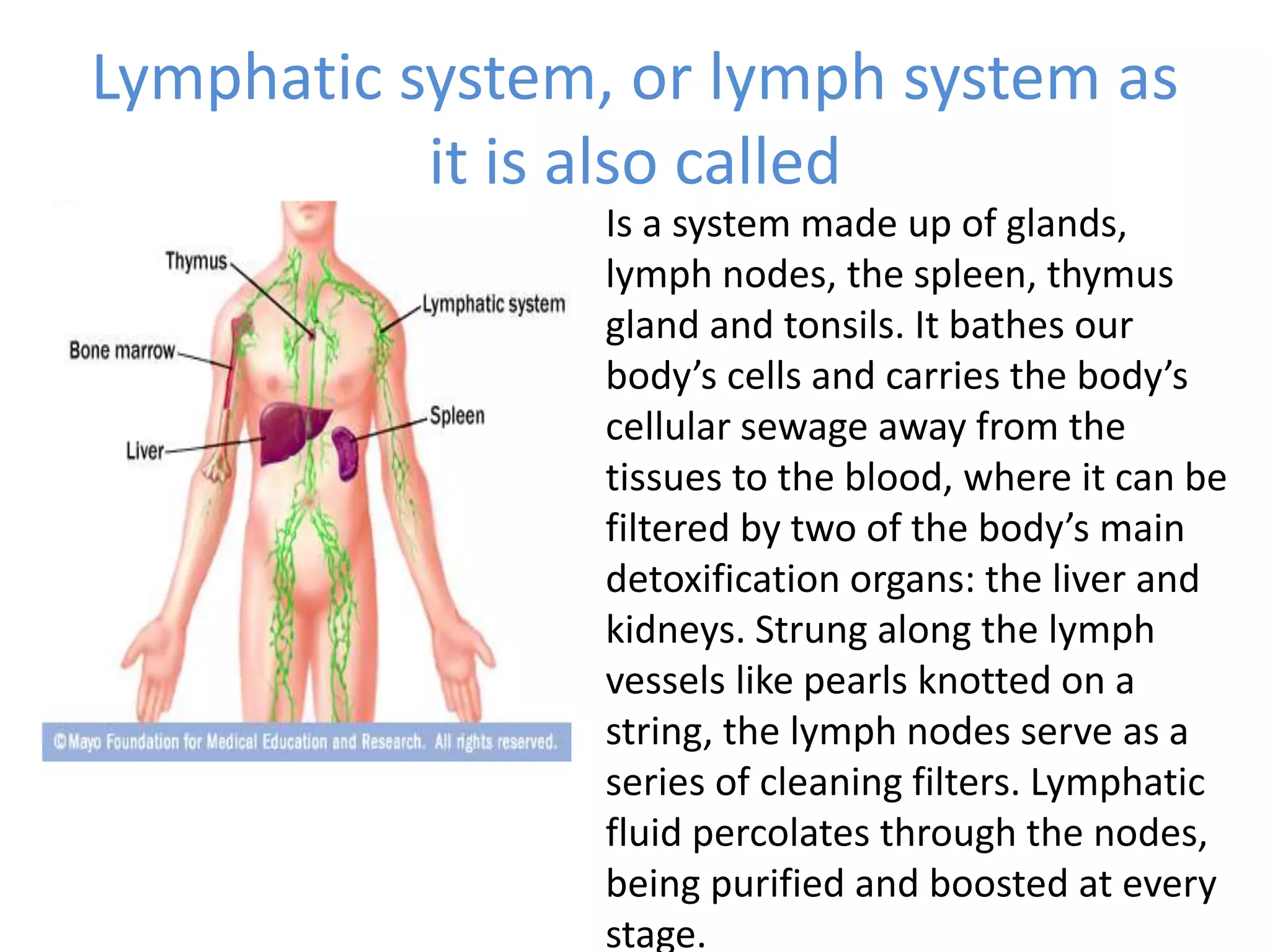
Lymphatic system, or lymph system as
it is also called
Is a system made up of glands,
lymph nodes, the spleen, thymus
gland and tonsils. It bathes our
body’s cells and carries the body’s
cellular sewage away from the
tissues to the blood, where it can be
filtered by two of the body’s main
detoxification organs: the liver and
kidneys. Strung along the lymph
vessels like pearls knotted on a
string, the lymph nodes serve as a
series of cleaning filters. Lymphatic
fluid percolates through the nodes,
being purified and boosted at every
stage.
The lymph capillaries form the beginning of the lymphatic system. Here, large
molecules (proteins) and interstitial fluid are absorbed and flow towards the pre-
collectors, which channel the lymph fluid into the larger collectors.
The collectors have valves similar to veins which determine the direction of flow.
The lymph collector segment bordered by a distal and proximal valve is known as
a lymphangion. Here, the lymph flow is supported by intrinsic contractions of the
lymphangion which is regulated by the sympathetic nervous system and lymph
volume.
Breathing (diaphragm)
Muscle contractions
Vasomotion (pulsation of arteries)
External compression
Manual lymphatic drainage
Short stretch bandages
Gradient compression garments
On its way into the circulatory system, lymph passes through lymph nodes, which
are stationed throughout the body. While the axilla and inguinal areas are the
most well known for lymph nodes, the head and neck also contain a large
quantity, as do the intestines, which contain Peyer’s patches.
The main functions of the lymph
nodes:
Filter bacteria, toxins and dead cells
Produce lymphocytes for fighting infection
Concentrate and filter lymph fluid
Regulate protein concentration in lymph
Finally, the lymphatic fluid is returned to the circulatory system
through the major lymphatic trunks, such as the thoracic duct.
Approximately two liters of lymph fluid flow are collected and
returned back into blood circulation every day.
Three main functions of the lymphatic
system:
Fight infection: the lymphatic system transports a watery, clear fluid
full of lymphocytes. Lymphocytes are infection-fighting cells. The
colorless fluid is known as lymph. Lymph fluid can also appear clearish
yellow to white in appearance, depending on how concentrated it is.
Lipid (fat) absorption: the lymphatic system absorbs lipids from the
intestine and transports them to the blood.
Drain excess fluid: as the blood circulates through the body’s tissues,
it leaves behind waste products such as proteins and fluids. Excess
fluid is drained through capillaries and into the lymphatic system
where it is filtered and returned to the blood.
 Harmful materials
that enter lymph
vessels
Bacteria
Viruses
Cancer cells
Cell debris
 Materials returned
to the blood
Water
Blood cells
Proteins
 LYMPH NODES:
Filter lymph before it
is returned to the
blood
 Defense cells within
lymph nodes
Macrophages –
engulf and destroy
foreign substances
Lymphocytes –
provide immune
response to antigens
Other Lymphoid Organs
 Several other organs
contribute to lymphatic
function
 Spleen
 Thymus
 Tonsils
 Peyer’s patches
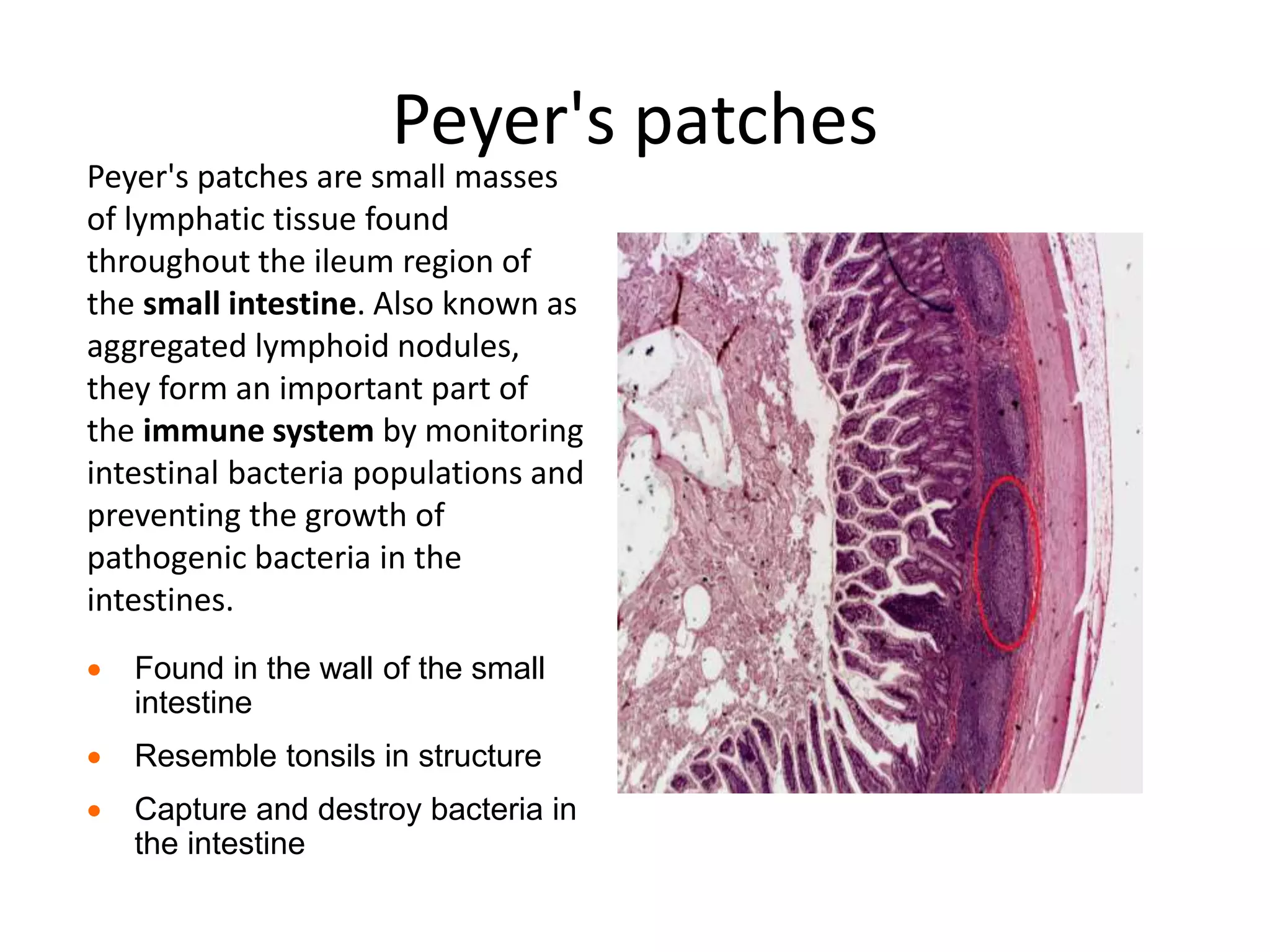
Peyer's patches
Peyer's patches are small masses
of lymphatic tissue found
throughout the ileum region of
the small intestine. Also known as
aggregated lymphoid nodules,
they form an important part of
the immune system by monitoring
intestinal bacteria populations and
preventing the growth of
pathogenic bacteria in the
intestines.
 Found in the wall of the small
intestine
 Resemble tonsils in structure
 Capture and destroy bacteria in
the intestine
Lymphatic disease
Lymphatic disease is a class of disorders
which directly affect the components of
the lymphatic system.
Diseases and disorder Hodgkin's
Disease/Hodgkin's Lymphoma.
Non-Hodgkin's Lymphoma.
Lymphadenitis is an infection of the lymph
nodes usually caused by a virus, bacteria
or fungi. ...
Lymphangitis.
Lymphedema.
Lymphocytosis.
To continue with
Inflammation/ Infection/ Diseases

Lymphatic system

  • 1.
    & ITS DISORDERS/DISEASES The lymphatic system is responsible for the production, transport and filtration of lymph fluid throughout the body. In addition to its important circulatory functions, the lymphatic system also has important immunological functions.
  • 2.
    The network oflymph vessels is divided into: Capillaries Pre-collectors Collectors Trunks
  • 3.
  • 4.
    Lymphatic system, orlymph system as it is also called Is a system made up of glands, lymph nodes, the spleen, thymus gland and tonsils. It bathes our body’s cells and carries the body’s cellular sewage away from the tissues to the blood, where it can be filtered by two of the body’s main detoxification organs: the liver and kidneys. Strung along the lymph vessels like pearls knotted on a string, the lymph nodes serve as a series of cleaning filters. Lymphatic fluid percolates through the nodes, being purified and boosted at every stage.
  • 5.
    The lymph capillariesform the beginning of the lymphatic system. Here, large molecules (proteins) and interstitial fluid are absorbed and flow towards the pre- collectors, which channel the lymph fluid into the larger collectors. The collectors have valves similar to veins which determine the direction of flow. The lymph collector segment bordered by a distal and proximal valve is known as a lymphangion. Here, the lymph flow is supported by intrinsic contractions of the lymphangion which is regulated by the sympathetic nervous system and lymph volume. Breathing (diaphragm) Muscle contractions Vasomotion (pulsation of arteries) External compression Manual lymphatic drainage Short stretch bandages Gradient compression garments On its way into the circulatory system, lymph passes through lymph nodes, which are stationed throughout the body. While the axilla and inguinal areas are the most well known for lymph nodes, the head and neck also contain a large quantity, as do the intestines, which contain Peyer’s patches.
  • 6.
    The main functionsof the lymph nodes: Filter bacteria, toxins and dead cells Produce lymphocytes for fighting infection Concentrate and filter lymph fluid Regulate protein concentration in lymph Finally, the lymphatic fluid is returned to the circulatory system through the major lymphatic trunks, such as the thoracic duct. Approximately two liters of lymph fluid flow are collected and returned back into blood circulation every day.
  • 7.
    Three main functionsof the lymphatic system: Fight infection: the lymphatic system transports a watery, clear fluid full of lymphocytes. Lymphocytes are infection-fighting cells. The colorless fluid is known as lymph. Lymph fluid can also appear clearish yellow to white in appearance, depending on how concentrated it is. Lipid (fat) absorption: the lymphatic system absorbs lipids from the intestine and transports them to the blood. Drain excess fluid: as the blood circulates through the body’s tissues, it leaves behind waste products such as proteins and fluids. Excess fluid is drained through capillaries and into the lymphatic system where it is filtered and returned to the blood.
  • 9.
     Harmful materials thatenter lymph vessels Bacteria Viruses Cancer cells Cell debris  Materials returned to the blood Water Blood cells Proteins
  • 10.
     LYMPH NODES: Filterlymph before it is returned to the blood  Defense cells within lymph nodes Macrophages – engulf and destroy foreign substances Lymphocytes – provide immune response to antigens Other Lymphoid Organs  Several other organs contribute to lymphatic function  Spleen  Thymus  Tonsils  Peyer’s patches
  • 11.
    Peyer's patches Peyer's patchesare small masses of lymphatic tissue found throughout the ileum region of the small intestine. Also known as aggregated lymphoid nodules, they form an important part of the immune system by monitoring intestinal bacteria populations and preventing the growth of pathogenic bacteria in the intestines.  Found in the wall of the small intestine  Resemble tonsils in structure  Capture and destroy bacteria in the intestine
  • 12.
    Lymphatic disease Lymphatic diseaseis a class of disorders which directly affect the components of the lymphatic system. Diseases and disorder Hodgkin's Disease/Hodgkin's Lymphoma. Non-Hodgkin's Lymphoma. Lymphadenitis is an infection of the lymph nodes usually caused by a virus, bacteria or fungi. ... Lymphangitis. Lymphedema. Lymphocytosis. To continue with Inflammation/ Infection/ Diseases