






1
Case Control Study
2
OUTLINE
 Definition of case control.
 Checklist.
 Study design.
 Advantages of case control study.
 Disadvantages of case control study.
 Summary.
 References.
3
.
 Compare patient with and without disease to
determine how they may differ and ton what
they are exposed to.
 Collect data on exposure retrospectively.
 An observational study because on
intervention is attempted and no attempt is
made to alter the course of disease.
4
DEFINITION
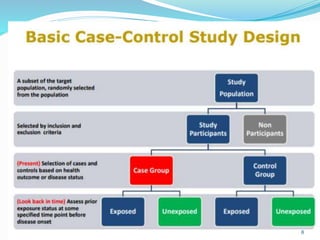
 Case control studies start with a disease and
work backward to find association between
exposure and the disease.
5
CASECONTROLCHECKLIST
KEY COMPONENTS
 Study base
All people in study I f developed the disease
• Case definition:
Clear definition
 Controls
Random sample of those without disease
6
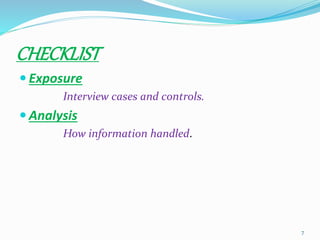
CHECKLIST
 Exposure
Interview cases and controls.
 Analysis
How information handled.
7
8
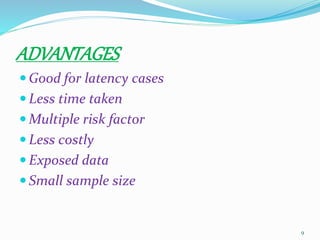
ADVANTAGES
 Good for latency cases
 Less time taken
 Multiple risk factor
 Less costly
 Exposed data
 Small sample size
9
ADVANTAGES
 Small sample size
 Generate hypothesis for future study
 Multiple exposures
 No follow up
10
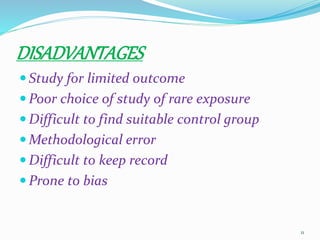
DISADVANTAGES
 Study for limited outcome
 Poor choice of study of rare exposure
 Difficult to find suitable control group
 Methodological error
 Difficult to keep record
 Prone to bias
11
EXAMPLE:1
 The average risk of human immuno deficiency virus
(HIV) infection after percutaneous HIV infected blood
is 0.3 percent, but he factors that influence this risk not
well understood. We conducted a study consisting of
health care workers with occupational, percutaneous
exposure to HIV infected blood. There were patients
were those who became, seropositive after exposure to
HIV, as reported by national surveillance system in
France, Italy, & the United States. The controls were
health care workers in a prospective surveillance
project who were exposed to HIV but did not
seroconvert.
12
EXAMPLE:2
 Obesity is a major factor for Cardiovascular
Diseases (CVS) but the most predictive measure for
different ethinic population is not clear. It is aimed to
assess whether obesity is stronger indicator of
Myocardial Infraction than BMI. A study of acute
Myocardial Infraction with 27098 participants in
different countries (12461 cases & 14637 controls). To
assess relation between BMI & Myocardial Infraction
for each group.
13
SUMMARY:
1) Control study is a study that works, backwards, beginning
with health endpoint outcome and then hunting back for
possible causes that might caused the outcomes.
2)Things to keep in mind.
Potential bias
Recall
Selection
3) Defining control groups
Who are appropiate & controls in your study.
A study should be statistically powered.
14
REFERENCES:
 Google Scholars.com
 RESEARCH METHADOLOGY STEPS PDF.
15
16
17

Case Control Study

  • 1.
  • 2.
  • 3.
    OUTLINE  Definition ofcase control.  Checklist.  Study design.  Advantages of case control study.  Disadvantages of case control study.  Summary.  References. 3
  • 4.
    .  Compare patientwith and without disease to determine how they may differ and ton what they are exposed to.  Collect data on exposure retrospectively.  An observational study because on intervention is attempted and no attempt is made to alter the course of disease. 4
  • 5.
    DEFINITION  Case controlstudies start with a disease and work backward to find association between exposure and the disease. 5
  • 6.
    CASECONTROLCHECKLIST KEY COMPONENTS  Studybase All people in study I f developed the disease • Case definition: Clear definition  Controls Random sample of those without disease 6
  • 7.
    CHECKLIST  Exposure Interview casesand controls.  Analysis How information handled. 7
  • 8.
  • 9.
    ADVANTAGES  Good forlatency cases  Less time taken  Multiple risk factor  Less costly  Exposed data  Small sample size 9
  • 10.
    ADVANTAGES  Small samplesize  Generate hypothesis for future study  Multiple exposures  No follow up 10
  • 11.
    DISADVANTAGES  Study forlimited outcome  Poor choice of study of rare exposure  Difficult to find suitable control group  Methodological error  Difficult to keep record  Prone to bias 11
  • 12.
    EXAMPLE:1  The averagerisk of human immuno deficiency virus (HIV) infection after percutaneous HIV infected blood is 0.3 percent, but he factors that influence this risk not well understood. We conducted a study consisting of health care workers with occupational, percutaneous exposure to HIV infected blood. There were patients were those who became, seropositive after exposure to HIV, as reported by national surveillance system in France, Italy, & the United States. The controls were health care workers in a prospective surveillance project who were exposed to HIV but did not seroconvert. 12
  • 13.
    EXAMPLE:2  Obesity isa major factor for Cardiovascular Diseases (CVS) but the most predictive measure for different ethinic population is not clear. It is aimed to assess whether obesity is stronger indicator of Myocardial Infraction than BMI. A study of acute Myocardial Infraction with 27098 participants in different countries (12461 cases & 14637 controls). To assess relation between BMI & Myocardial Infraction for each group. 13
  • 14.
    SUMMARY: 1) Control studyis a study that works, backwards, beginning with health endpoint outcome and then hunting back for possible causes that might caused the outcomes. 2)Things to keep in mind. Potential bias Recall Selection 3) Defining control groups Who are appropiate & controls in your study. A study should be statistically powered. 14
  • 15.
    REFERENCES:  Google Scholars.com RESEARCH METHADOLOGY STEPS PDF. 15
  • 16.
  • 17.