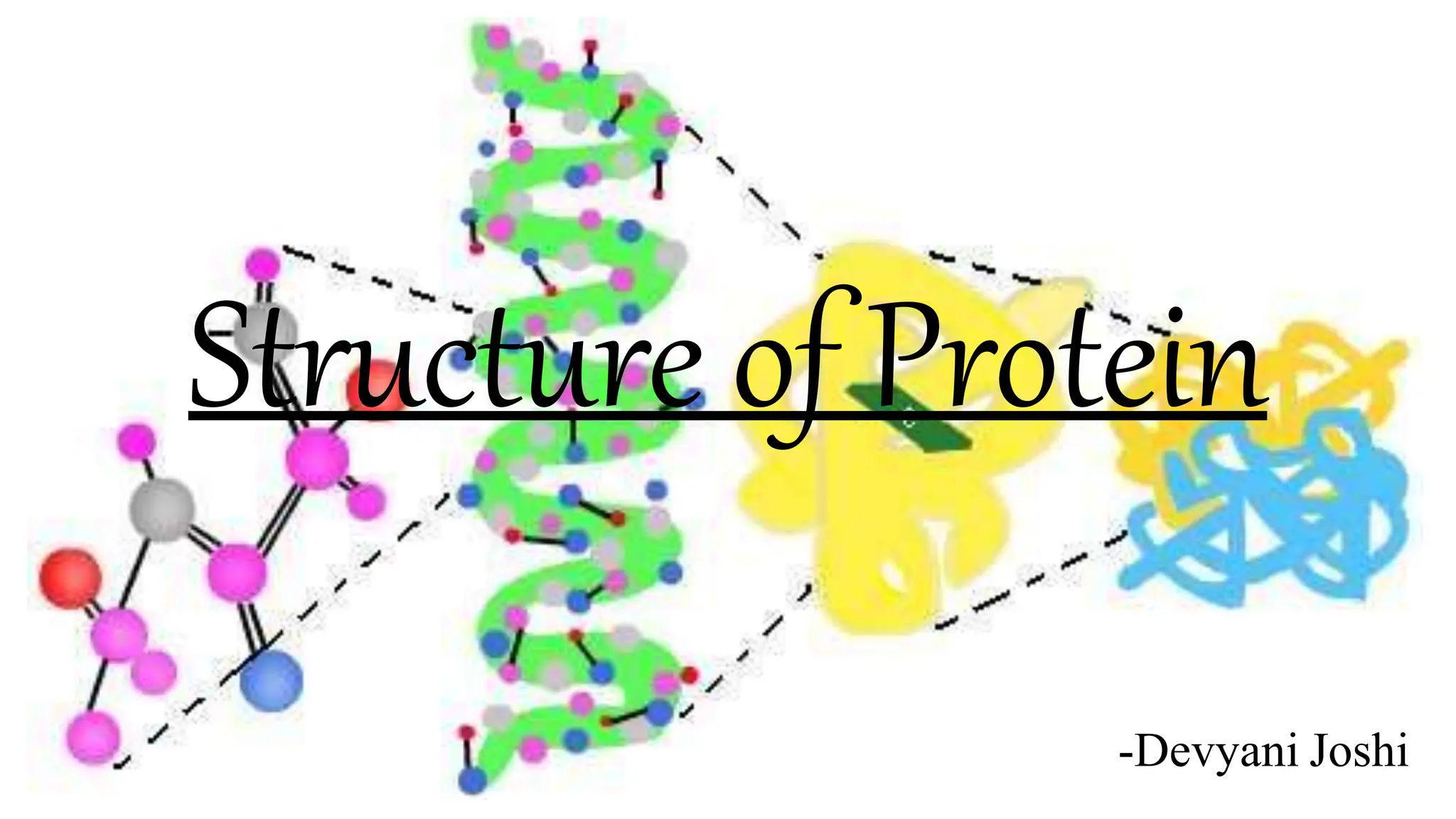
Structure of Protein
-Devyani Joshi
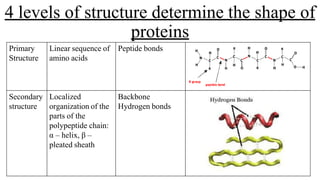
4 levels of structure determine the shape of
proteins
Primary
Structure
Linear sequence of
amino acids
Peptide bonds
Secondary
structure
Localized
organization of the
parts of the
polypeptide chain:
α – helix, β –
pleated sheath
Backbone
Hydrogen bonds
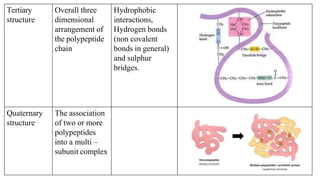
Tertiary
structure
Overall three
dimensional
arrangement of
the polypeptide
chain
Hydrophobic
interactions,
Hydrogen bonds
(non covalent
bonds in general)
and sulphur
bridges.
Quaternary
structure
The association
of two or more
polypeptides
into a multi –
subunit complex
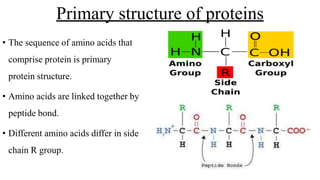
Primary structure of proteins
• The sequence of amino acids that
comprise protein is primary
protein structure.
• Amino acids are linked together by
peptide bond.
• Different amino acids differ in side
chain R group.
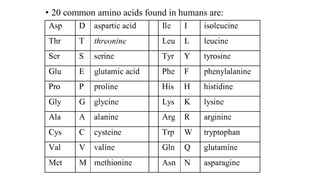
• 20 common amino acids found in humans are:
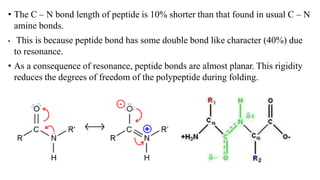
• The C – N bond length of peptide is 10% shorter than that found in usual C – N
amine bonds.
• This is because peptide bond has some double bond like character (40%) due
to resonance.
• As a consequence of resonance, peptide bonds are almost planar. This rigidity
reduces the degrees of freedom of the polypeptide during folding.
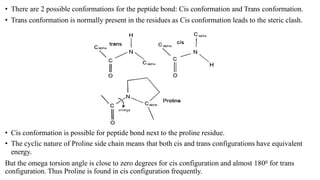
• There are 2 possible conformations for the peptide bond: Cis conformation and Trans conformation.
• Trans conformation is normally present in the residues as Cis conformation leads to the steric clash.
• Cis conformation is possible for peptide bond next to the proline residue.
• The cyclic nature of Proline side chain means that both cis and trans configurations have equivalent
energy.
But the omega torsion angle is close to zero degrees for cis configuration and almost 1800 for trans
configuration. Thus Proline is found in cis configuration frequently.
Secondary structure of protein
•These are the regions of ordered structures formed by
interaction of hydrogen bond donor and hydrogen
bond acceptor residues of the repeating peptide unit.
•There are three main secondary structures – α helix, β
pleated sheet and β turn.
The α – helix
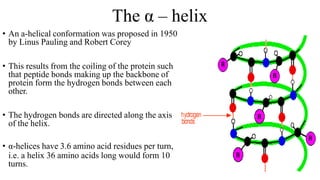
• An a-helical conformation was proposed in 1950
by Linus Pauling and Robert Corey
• This results from the coiling of the protein such
that peptide bonds making up the backbone of
protein form the hydrogen bonds between each
other.
• The hydrogen bonds are directed along the axis
of the helix.
• α-helices have 3.6 amino acid residues per turn,
i.e. a helix 36 amino acids long would form 10
turns.
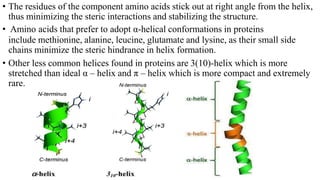
• The residues of the component amino acids stick out at right angle from the helix,
thus minimizing the steric interactions and stabilizing the structure.
• Amino acids that prefer to adopt α-helical conformations in proteins
include methionine, alanine, leucine, glutamate and lysine, as their small side
chains minimize the steric hindrance in helix formation.
• Other less common helices found in proteins are 3(10)-helix which is more
stretched than ideal α – helix and π – helix which is more compact and extremely
rare.
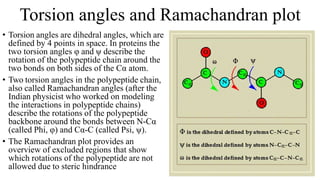
• Torsion angles are dihedral angles, which are
defined by 4 points in space. In proteins the
two torsion angles φ and ψ describe the
rotation of the polypeptide chain around the
two bonds on both sides of the Cα atom.
• Two torsion angles in the polypeptide chain,
also called Ramachandran angles (after the
Indian physicist who worked on modeling
the interactions in polypeptide chains)
describe the rotations of the polypeptide
backbone around the bonds between N-Cα
(called Phi, φ) and Cα-C (called Psi, ψ).
• The Ramachandran plot provides an
overview of excluded regions that show
which rotations of the polypeptide are not
allowed due to steric hindrance
Torsion angles and Ramachandran plot
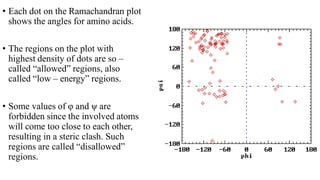
• Each dot on the Ramachandran plot
shows the angles for amino acids.
• The regions on the plot with
highest density of dots are so –
called “allowed” regions, also
called “low – energy” regions.
• Some values of φ and ψ are
forbidden since the involved atoms
will come too close to each other,
resulting in a steric clash. Such
regions are called “disallowed”
regions.
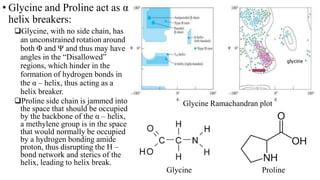
• Glycine and Proline act as α
helix breakers:
Glycine, with no side chain, has
an unconstrained rotation around
both Φ and Ψ and thus may have
angles in the “Disallowed”
regions, which hinder in the
formation of hydrogen bonds in
the α – helix, thus acting as a
helix breaker.
Proline side chain is jammed into
the space that should be occupied
by the backbone of the α – helix,
a methylene group is in the space
that would normally be occupied
by a hydrogen bonding amide
proton, thus disrupting the H –
bond network and sterics of the
helix, leading to helix break.
Glycine Ramachandran plot
Glycine Proline
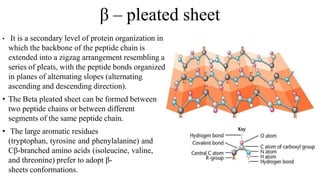
β – pleated sheet
• It is a secondary level of protein organization in
which the backbone of the peptide chain is
extended into a zigzag arrangement resembling a
series of pleats, with the peptide bonds organized
in planes of alternating slopes (alternating
ascending and descending direction).
• The Beta pleated sheet can be formed between
two peptide chains or between different
segments of the same peptide chain.
• The large aromatic residues
(tryptophan, tyrosine and phenylalanine) and
Cβ-branched amino acids (isoleucine, valine,
and threonine) prefer to adopt β-
sheets conformations.
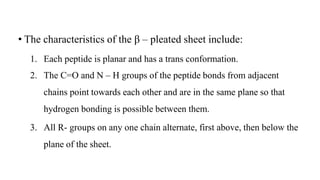
• The characteristics of the β – pleated sheet include:
1. Each peptide is planar and has a trans conformation.
2. The C=O and N – H groups of the peptide bonds from adjacent
chains point towards each other and are in the same plane so that
hydrogen bonding is possible between them.
3. All R- groups on any one chain alternate, first above, then below the
plane of the sheet.
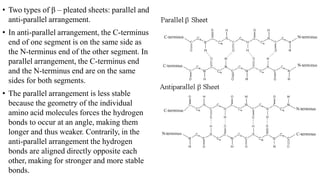
• Two types of β – pleated sheets: parallel and
anti-parallel arrangement.
• In anti-parallel arrangement, the C-terminus
end of one segment is on the same side as
the N-terminus end of the other segment. In
parallel arrangement, the C-terminus end
and the N-terminus end are on the same
sides for both segments.
• The parallel arrangement is less stable
because the geometry of the individual
amino acid molecules forces the hydrogen
bonds to occur at an angle, making them
longer and thus weaker. Contrarily, in the
anti-parallel arrangement the hydrogen
bonds are aligned directly opposite each
other, making for stronger and more stable
bonds.
Tight turns
• There are different types of the tight turns depending on the number of atoms
forming the turn:
1. Delta turn It is the smallest tight turn which involves only two amino acid residues and
the intraturn hydrogen bond for a delta-turn is formed between the backbone
NH(i) and the backbone CO(i+1).
2. Gamma turn It involves three amino acid residues and the intraturn hydrogen bond for a
gamma-turn is formed between the backbone CO(i) and the backbone
NH(i+2).
3. Beta turn A beta-turn involves four amino acid residues and may or may not be
stabilized by the intraturn hydrogen bond between the backbone CO(i) and
the backbone NH(i+3).
4. Alpha turn An alpha-turn involves five amino acid residues where the distance between
the Calpha(i) and the Calpha(i+4) is less than 7Å and the pentapeptide chain is
not in a helical conformation.
5. Pi turn It is the largest tight turn which involves six amino acid residues.
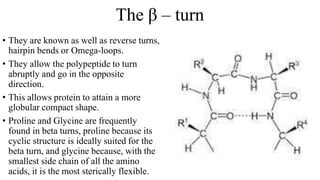
The β – turn
• They are known as well as reverse turns,
hairpin bends or Omega-loops.
• They allow the polypeptide to turn
abruptly and go in the opposite
direction.
• This allows protein to attain a more
globular compact shape.
• Proline and Glycine are frequently
found in beta turns, proline because its
cyclic structure is ideally suited for the
beta turn, and glycine because, with the
smallest side chain of all the amino
acids, it is the most sterically flexible.
Tertiary structure of protein
• 3 – dimensional conformation of a polypeptide chain in its folded state
• Secondary structure and loops come together to form “Domain”, the smallest tertiary
structural unit.
• The structural domains usually contain 100 – 200 amino acids and fold stably.
• Domains may be considered to be the connected units which are to varying extent
independent of their structure, function and folding behavior.
• Each domain can be described by its fold i.e. how the secondary structural elements
are arranged.
•The bonding interactions involved in the tertiary structure
are intramolecular bonds including Disulphide bridges
and non covalent interactions like ionic bonds, hydrogen
bonds, van der waals and hydrophobic interactions.
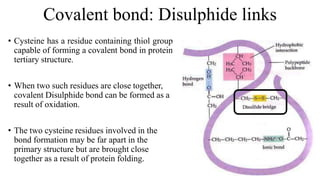
Covalent bond: Disulphide links
• Cysteine has a residue containing thiol group
capable of forming a covalent bond in protein
tertiary structure.
• When two such residues are close together,
covalent Disulphide bond can be formed as a
result of oxidation.
• The two cysteine residues involved in the
bond formation may be far apart in the
primary structure but are brought close
together as a result of protein folding.
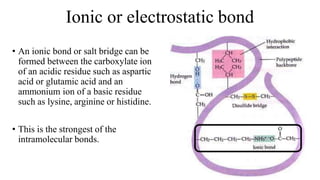
Ionic or electrostatic bond
• An ionic bond or salt bridge can be
formed between the carboxylate ion
of an acidic residue such as aspartic
acid or glutamic acid and an
ammonium ion of a basic residue
such as lysine, arginine or histidine.
• This is the strongest of the
intramolecular bonds.
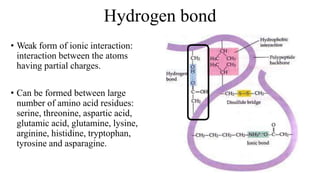
Hydrogen bond
• Weak form of ionic interaction:
interaction between the atoms
having partial charges.
• Can be formed between large
number of amino acid residues:
serine, threonine, aspartic acid,
glutamic acid, glutamine, lysine,
arginine, histidine, tryptophan,
tyrosine and asparagine.
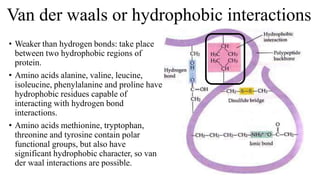
Van der waals or hydrophobic interactions
• Weaker than hydrogen bonds: take place
between two hydrophobic regions of
protein.
• Amino acids alanine, valine, leucine,
isoleucine, phenylalanine and proline have
hydrophobic residues capable of
interacting with hydrogen bond
interactions.
• Amino acids methionine, tryptophan,
threonine and tyrosine contain polar
functional groups, but also have
significant hydrophobic character, so van
der waal interactions are possible.
Relative importance of bonding
interactions
• Most important interactions in tertiary structure: van der waals and
hydrogen bonding interactions
Least important interactions: covalent and ionic bonding
• Two reasons for this:
1. More opportunity for van der waals and hydrogen bonding
interactions
2. Presence of water surrounding the protein structure
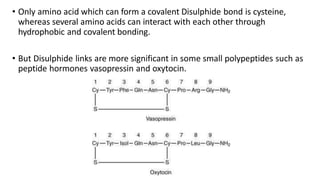
• Only amino acid which can form a covalent Disulphide bond is cysteine,
whereas several amino acids can interact with each other through
hydrophobic and covalent bonding.
• But Disulphide links are more significant in some small polypeptides such as
peptide hormones vasopressin and oxytocin.
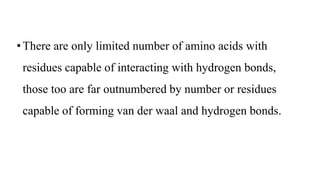
• There are only limited number of amino acids with
residues capable of interacting with hydrogen bonds,
those too are far outnumbered by number or residues
capable of forming van der waal and hydrogen bonds.
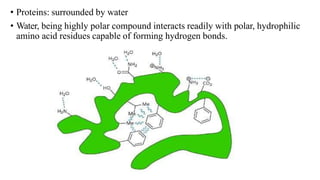
• Proteins: surrounded by water
• Water, being highly polar compound interacts readily with polar, hydrophilic
amino acid residues capable of forming hydrogen bonds.
• Most stable tertiary structure has most of the hydrophilic groups
on the surface so that they interact with water and most of the
hydrophobic groups in center so they avoid water and interact
with each other.
• Hydrophilic amino acids form a hydrogen bond with water and
thus number of ionic and hydrogen bonds contributing to tertiary
structure is reduced, this leaves van der waal and hydrophobic
interactions to largely determine the three – dimensional shape of
the protein.
Quaternary structure of proteins
• The structure that results from the assembly of several polypeptides to make a
unique functional protein; stabilized through several non – covalent
interactions between the side chains of amino acids with different peptide
chains.
• Thus, not all the proteins show a quaternary level of organization. For a protein
to have quaternary structure:
1. The protein should be formed by more than one peptide chain
2. These chains cannot be attached by covalent bond among them.
• Insulin is formed by two peptide chains, but since these two chains are linked
by disulphide linkage, Insulin does not qualify as quaternary protein.
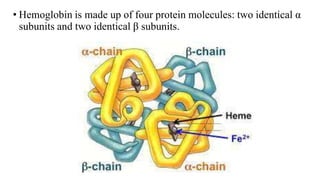
• Hemoglobin is formed by four peptide chains which are associated through non
covalent bonds, thus hemoglobin is a typical example of quaternary protein.
• Hemoglobin is made up of four protein molecules: two identical α
subunits and two identical β subunits.
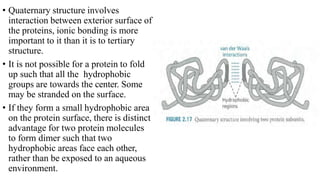
• Quaternary structure involves
interaction between exterior surface of
the proteins, ionic bonding is more
important to it than it is to tertiary
structure.
• It is not possible for a protein to fold
up such that all the hydrophobic
groups are towards the center. Some
may be stranded on the surface.
• If they form a small hydrophobic area
on the protein surface, there is distinct
advantage for two protein molecules
to form dimer such that two
hydrophobic areas face each other,
rather than be exposed to an aqueous
environment.
structureofproteins-161119045143.pptx

structureofproteins-161119045143.pptx

  • 1.
  • 2.
    4 levels ofstructure determine the shape of proteins Primary Structure Linear sequence of amino acids Peptide bonds Secondary structure Localized organization of the parts of the polypeptide chain: α – helix, β – pleated sheath Backbone Hydrogen bonds
  • 3.
    Tertiary structure Overall three dimensional arrangement of thepolypeptide chain Hydrophobic interactions, Hydrogen bonds (non covalent bonds in general) and sulphur bridges. Quaternary structure The association of two or more polypeptides into a multi – subunit complex
  • 4.
    Primary structure ofproteins • The sequence of amino acids that comprise protein is primary protein structure. • Amino acids are linked together by peptide bond. • Different amino acids differ in side chain R group.
  • 5.
    • 20 commonamino acids found in humans are:
  • 6.
    • The C– N bond length of peptide is 10% shorter than that found in usual C – N amine bonds. • This is because peptide bond has some double bond like character (40%) due to resonance. • As a consequence of resonance, peptide bonds are almost planar. This rigidity reduces the degrees of freedom of the polypeptide during folding.
  • 7.
    • There are2 possible conformations for the peptide bond: Cis conformation and Trans conformation. • Trans conformation is normally present in the residues as Cis conformation leads to the steric clash. • Cis conformation is possible for peptide bond next to the proline residue. • The cyclic nature of Proline side chain means that both cis and trans configurations have equivalent energy. But the omega torsion angle is close to zero degrees for cis configuration and almost 1800 for trans configuration. Thus Proline is found in cis configuration frequently.
  • 8.
    Secondary structure ofprotein •These are the regions of ordered structures formed by interaction of hydrogen bond donor and hydrogen bond acceptor residues of the repeating peptide unit. •There are three main secondary structures – α helix, β pleated sheet and β turn.
  • 9.
    The α –helix • An a-helical conformation was proposed in 1950 by Linus Pauling and Robert Corey • This results from the coiling of the protein such that peptide bonds making up the backbone of protein form the hydrogen bonds between each other. • The hydrogen bonds are directed along the axis of the helix. • α-helices have 3.6 amino acid residues per turn, i.e. a helix 36 amino acids long would form 10 turns.
  • 10.
    • The residuesof the component amino acids stick out at right angle from the helix, thus minimizing the steric interactions and stabilizing the structure. • Amino acids that prefer to adopt α-helical conformations in proteins include methionine, alanine, leucine, glutamate and lysine, as their small side chains minimize the steric hindrance in helix formation. • Other less common helices found in proteins are 3(10)-helix which is more stretched than ideal α – helix and π – helix which is more compact and extremely rare.
  • 11.
    • Torsion anglesare dihedral angles, which are defined by 4 points in space. In proteins the two torsion angles φ and ψ describe the rotation of the polypeptide chain around the two bonds on both sides of the Cα atom. • Two torsion angles in the polypeptide chain, also called Ramachandran angles (after the Indian physicist who worked on modeling the interactions in polypeptide chains) describe the rotations of the polypeptide backbone around the bonds between N-Cα (called Phi, φ) and Cα-C (called Psi, ψ). • The Ramachandran plot provides an overview of excluded regions that show which rotations of the polypeptide are not allowed due to steric hindrance Torsion angles and Ramachandran plot
  • 12.
    • Each doton the Ramachandran plot shows the angles for amino acids. • The regions on the plot with highest density of dots are so – called “allowed” regions, also called “low – energy” regions. • Some values of φ and ψ are forbidden since the involved atoms will come too close to each other, resulting in a steric clash. Such regions are called “disallowed” regions.
  • 13.
    • Glycine andProline act as α helix breakers: Glycine, with no side chain, has an unconstrained rotation around both Φ and Ψ and thus may have angles in the “Disallowed” regions, which hinder in the formation of hydrogen bonds in the α – helix, thus acting as a helix breaker. Proline side chain is jammed into the space that should be occupied by the backbone of the α – helix, a methylene group is in the space that would normally be occupied by a hydrogen bonding amide proton, thus disrupting the H – bond network and sterics of the helix, leading to helix break. Glycine Ramachandran plot Glycine Proline
  • 14.
    β – pleatedsheet • It is a secondary level of protein organization in which the backbone of the peptide chain is extended into a zigzag arrangement resembling a series of pleats, with the peptide bonds organized in planes of alternating slopes (alternating ascending and descending direction). • The Beta pleated sheet can be formed between two peptide chains or between different segments of the same peptide chain. • The large aromatic residues (tryptophan, tyrosine and phenylalanine) and Cβ-branched amino acids (isoleucine, valine, and threonine) prefer to adopt β- sheets conformations.
  • 15.
    • The characteristicsof the β – pleated sheet include: 1. Each peptide is planar and has a trans conformation. 2. The C=O and N – H groups of the peptide bonds from adjacent chains point towards each other and are in the same plane so that hydrogen bonding is possible between them. 3. All R- groups on any one chain alternate, first above, then below the plane of the sheet.
  • 16.
    • Two typesof β – pleated sheets: parallel and anti-parallel arrangement. • In anti-parallel arrangement, the C-terminus end of one segment is on the same side as the N-terminus end of the other segment. In parallel arrangement, the C-terminus end and the N-terminus end are on the same sides for both segments. • The parallel arrangement is less stable because the geometry of the individual amino acid molecules forces the hydrogen bonds to occur at an angle, making them longer and thus weaker. Contrarily, in the anti-parallel arrangement the hydrogen bonds are aligned directly opposite each other, making for stronger and more stable bonds.
  • 17.
    Tight turns • Thereare different types of the tight turns depending on the number of atoms forming the turn: 1. Delta turn It is the smallest tight turn which involves only two amino acid residues and the intraturn hydrogen bond for a delta-turn is formed between the backbone NH(i) and the backbone CO(i+1). 2. Gamma turn It involves three amino acid residues and the intraturn hydrogen bond for a gamma-turn is formed between the backbone CO(i) and the backbone NH(i+2). 3. Beta turn A beta-turn involves four amino acid residues and may or may not be stabilized by the intraturn hydrogen bond between the backbone CO(i) and the backbone NH(i+3). 4. Alpha turn An alpha-turn involves five amino acid residues where the distance between the Calpha(i) and the Calpha(i+4) is less than 7Å and the pentapeptide chain is not in a helical conformation. 5. Pi turn It is the largest tight turn which involves six amino acid residues.
  • 18.
    The β –turn • They are known as well as reverse turns, hairpin bends or Omega-loops. • They allow the polypeptide to turn abruptly and go in the opposite direction. • This allows protein to attain a more globular compact shape. • Proline and Glycine are frequently found in beta turns, proline because its cyclic structure is ideally suited for the beta turn, and glycine because, with the smallest side chain of all the amino acids, it is the most sterically flexible.
  • 19.
    Tertiary structure ofprotein • 3 – dimensional conformation of a polypeptide chain in its folded state • Secondary structure and loops come together to form “Domain”, the smallest tertiary structural unit. • The structural domains usually contain 100 – 200 amino acids and fold stably. • Domains may be considered to be the connected units which are to varying extent independent of their structure, function and folding behavior. • Each domain can be described by its fold i.e. how the secondary structural elements are arranged.
  • 20.
    •The bonding interactionsinvolved in the tertiary structure are intramolecular bonds including Disulphide bridges and non covalent interactions like ionic bonds, hydrogen bonds, van der waals and hydrophobic interactions.
  • 21.
    Covalent bond: Disulphidelinks • Cysteine has a residue containing thiol group capable of forming a covalent bond in protein tertiary structure. • When two such residues are close together, covalent Disulphide bond can be formed as a result of oxidation. • The two cysteine residues involved in the bond formation may be far apart in the primary structure but are brought close together as a result of protein folding.
  • 22.
    Ionic or electrostaticbond • An ionic bond or salt bridge can be formed between the carboxylate ion of an acidic residue such as aspartic acid or glutamic acid and an ammonium ion of a basic residue such as lysine, arginine or histidine. • This is the strongest of the intramolecular bonds.
  • 23.
    Hydrogen bond • Weakform of ionic interaction: interaction between the atoms having partial charges. • Can be formed between large number of amino acid residues: serine, threonine, aspartic acid, glutamic acid, glutamine, lysine, arginine, histidine, tryptophan, tyrosine and asparagine.
  • 24.
    Van der waalsor hydrophobic interactions • Weaker than hydrogen bonds: take place between two hydrophobic regions of protein. • Amino acids alanine, valine, leucine, isoleucine, phenylalanine and proline have hydrophobic residues capable of interacting with hydrogen bond interactions. • Amino acids methionine, tryptophan, threonine and tyrosine contain polar functional groups, but also have significant hydrophobic character, so van der waal interactions are possible.
  • 25.
    Relative importance ofbonding interactions • Most important interactions in tertiary structure: van der waals and hydrogen bonding interactions Least important interactions: covalent and ionic bonding • Two reasons for this: 1. More opportunity for van der waals and hydrogen bonding interactions 2. Presence of water surrounding the protein structure
  • 26.
    • Only aminoacid which can form a covalent Disulphide bond is cysteine, whereas several amino acids can interact with each other through hydrophobic and covalent bonding. • But Disulphide links are more significant in some small polypeptides such as peptide hormones vasopressin and oxytocin.
  • 27.
    • There areonly limited number of amino acids with residues capable of interacting with hydrogen bonds, those too are far outnumbered by number or residues capable of forming van der waal and hydrogen bonds.
  • 28.
    • Proteins: surroundedby water • Water, being highly polar compound interacts readily with polar, hydrophilic amino acid residues capable of forming hydrogen bonds.
  • 29.
    • Most stabletertiary structure has most of the hydrophilic groups on the surface so that they interact with water and most of the hydrophobic groups in center so they avoid water and interact with each other. • Hydrophilic amino acids form a hydrogen bond with water and thus number of ionic and hydrogen bonds contributing to tertiary structure is reduced, this leaves van der waal and hydrophobic interactions to largely determine the three – dimensional shape of the protein.
  • 30.
    Quaternary structure ofproteins • The structure that results from the assembly of several polypeptides to make a unique functional protein; stabilized through several non – covalent interactions between the side chains of amino acids with different peptide chains. • Thus, not all the proteins show a quaternary level of organization. For a protein to have quaternary structure: 1. The protein should be formed by more than one peptide chain 2. These chains cannot be attached by covalent bond among them. • Insulin is formed by two peptide chains, but since these two chains are linked by disulphide linkage, Insulin does not qualify as quaternary protein. • Hemoglobin is formed by four peptide chains which are associated through non covalent bonds, thus hemoglobin is a typical example of quaternary protein.
  • 31.
    • Hemoglobin ismade up of four protein molecules: two identical α subunits and two identical β subunits.
  • 32.
    • Quaternary structureinvolves interaction between exterior surface of the proteins, ionic bonding is more important to it than it is to tertiary structure. • It is not possible for a protein to fold up such that all the hydrophobic groups are towards the center. Some may be stranded on the surface. • If they form a small hydrophobic area on the protein surface, there is distinct advantage for two protein molecules to form dimer such that two hydrophobic areas face each other, rather than be exposed to an aqueous environment.