BY- MANIKANT MANI
M.Sc microbiology
sem- 1
INTORDUCTION
Protein structure is the three-dimensional
arrangement of atoms in an amino acid-chain
molecule. Proteins are polymers – specifically
polypeptides – formed from sequences of
amino acids, the monomers of the polymer. ...
Very large aggregates can be formed
from protein subunits.
Proteins are an important class of biological macromolecules which
are the polymers of amino acids.
 Biochemists have distinguished several levels of structural
organization of proteins. They are:
Primary structure
Secondary structure
Tertiary structure
Quaternary structure
PRIMARY STRUCTURE
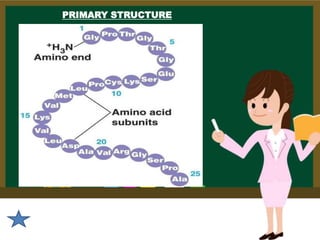
The primary structure of protein refers to the sequence of amino
acids present in the polypeptide chain.
Amino acids are covalently linked by peptide
bonds.
Each component amino acid in a polypeptide is
called a “residue” or “moiety”
By convention, the 10 structure of a protein
starts from the amino-terminal (N) end and
ends in the carboxyl-terminal (C) end.
PRIMARY STRUCTURE
SECONDARY STRUCTURE
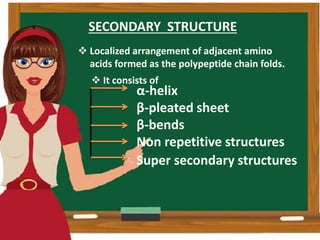
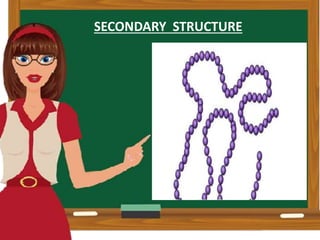
 Localized arrangement of adjacent amino
acids formed as the polypeptide chain folds.
 It consists of
α-helix
β-pleated sheet
β-bends
Non repetitive structures
Super secondary structures
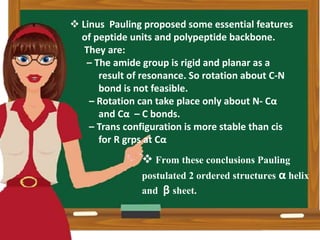
 Linus Pauling proposed some essential features
of peptide units and polypeptide backbone.
They are:
– The amide group is rigid and planar as a
result of resonance. So rotation about C-N
bond is not feasible.
– Rotation can take place only about N- Cα
and Cα – C bonds.
– Trans configuration is more stable than cis
for R grps at Cα
 From these conclusions Pauling
postulated 2 ordered structures α helix
and β sheet.
SECONDARY STRUCTURE
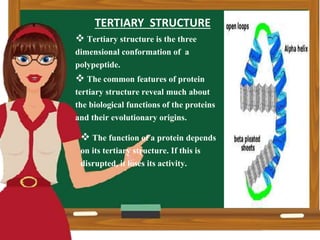
TERTIARY STRUCTURE
 Tertiary structure is the three
dimensional conformation of a
polypeptide.
 The common features of protein
tertiary structure reveal much about
the biological functions of the proteins
and their evolutionary origins.
 The function of a protein depends
on its tertiary structure. If this is
disrupted, it loses its activity.
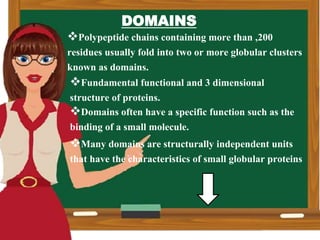
DOMAINS
Polypeptide chains containing more than ,200
residues usually fold into two or more globular clusters
known as domains.
Fundamental functional and 3 dimensional
structure of proteins.
Domains often have a specific function such as the
binding of a small molecule.
Many domains are structurally independent units
that have the characteristics of small globular proteins
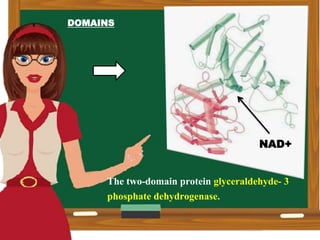
DOMAINS
The two-domain protein glyceraldehyde- 3
phosphate dehydrogenase.
NAD+
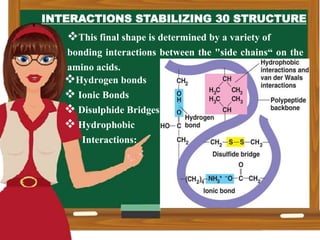
INTERACTIONS STABILIZING 30 STRUCTURE
This final shape is determined by a variety of
bonding interactions between the "side chains“ on the
amino acids.
Hydrogen bonds
 Ionic Bonds
 Disulphide Bridges
 Hydrophobic
Interactions:
TERTIARY STRUCTURE
DETERMINATION OF TERTIARYSTRUCTURE
• The known protein structures have come to
light through:
• X-ray crystallographic studies
• Nuclear Magnetic Resonance studies
• The atomic coordinates of most of these
structures are deposited in a database known
as the Protein Data Bank (PDB).
• It allows the tertiary structures of a variety
of proteins to be analyzed and compared.
QUATERNARYSTRUCTURE
• The biological function of some molecules is
determined by multiple polypeptide chains –
multimeric proteins.
• Arrangement of polypeptide sub unit is called
quaternary structure.
• Sub units are held together by non covalent
interactions.
• Eg: Hemoglobin has the subunit composition
a2b2
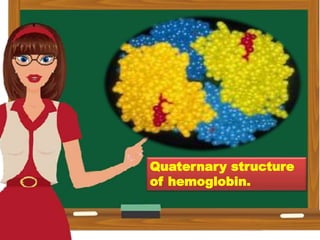
Quaternary structure of
hemoglobin
Quaternary structure
of hemoglobin.
Thank you…
Manikant mani
email.-manikant8541@gmail.com

protein structure ppt by manikant mani

  • 1.
    BY- MANIKANT MANI M.Scmicrobiology sem- 1
  • 2.
    INTORDUCTION Protein structure isthe three-dimensional arrangement of atoms in an amino acid-chain molecule. Proteins are polymers – specifically polypeptides – formed from sequences of amino acids, the monomers of the polymer. ... Very large aggregates can be formed from protein subunits.
  • 3.
    Proteins are animportant class of biological macromolecules which are the polymers of amino acids.  Biochemists have distinguished several levels of structural organization of proteins. They are: Primary structure Secondary structure Tertiary structure Quaternary structure
  • 4.
    PRIMARY STRUCTURE The primarystructure of protein refers to the sequence of amino acids present in the polypeptide chain. Amino acids are covalently linked by peptide bonds. Each component amino acid in a polypeptide is called a “residue” or “moiety” By convention, the 10 structure of a protein starts from the amino-terminal (N) end and ends in the carboxyl-terminal (C) end.
  • 5.
  • 6.
    SECONDARY STRUCTURE  Localizedarrangement of adjacent amino acids formed as the polypeptide chain folds.  It consists of α-helix β-pleated sheet β-bends Non repetitive structures Super secondary structures
  • 7.
     Linus Paulingproposed some essential features of peptide units and polypeptide backbone. They are: – The amide group is rigid and planar as a result of resonance. So rotation about C-N bond is not feasible. – Rotation can take place only about N- Cα and Cα – C bonds. – Trans configuration is more stable than cis for R grps at Cα  From these conclusions Pauling postulated 2 ordered structures α helix and β sheet.
  • 8.
  • 9.
    TERTIARY STRUCTURE  Tertiarystructure is the three dimensional conformation of a polypeptide.  The common features of protein tertiary structure reveal much about the biological functions of the proteins and their evolutionary origins.  The function of a protein depends on its tertiary structure. If this is disrupted, it loses its activity.
  • 10.
    DOMAINS Polypeptide chains containingmore than ,200 residues usually fold into two or more globular clusters known as domains. Fundamental functional and 3 dimensional structure of proteins. Domains often have a specific function such as the binding of a small molecule. Many domains are structurally independent units that have the characteristics of small globular proteins
  • 11.
    DOMAINS The two-domain proteinglyceraldehyde- 3 phosphate dehydrogenase. NAD+
  • 12.
    INTERACTIONS STABILIZING 30STRUCTURE This final shape is determined by a variety of bonding interactions between the "side chains“ on the amino acids. Hydrogen bonds  Ionic Bonds  Disulphide Bridges  Hydrophobic Interactions:
  • 13.
  • 14.
    DETERMINATION OF TERTIARYSTRUCTURE •The known protein structures have come to light through: • X-ray crystallographic studies • Nuclear Magnetic Resonance studies • The atomic coordinates of most of these structures are deposited in a database known as the Protein Data Bank (PDB). • It allows the tertiary structures of a variety of proteins to be analyzed and compared.
  • 15.
    QUATERNARYSTRUCTURE • The biologicalfunction of some molecules is determined by multiple polypeptide chains – multimeric proteins. • Arrangement of polypeptide sub unit is called quaternary structure. • Sub units are held together by non covalent interactions. • Eg: Hemoglobin has the subunit composition a2b2
  • 16.
  • 17.