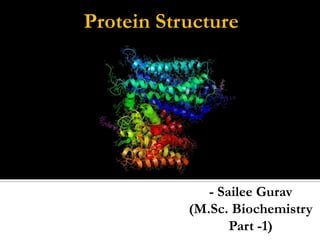
Protein Structure

- Sailee Gurav
(M.Sc. Biochemistry
Part -1)
๏‚ก
๏‚ก

๏‚ก

Itโ€Ÿs completely defined & predictable.
Each amino acid in one of these giant
macromolecules is located at a specific site
within the structure , giving the protein the
precise shape.
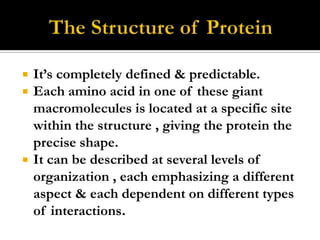
It can be described at several levels of
organization , each emphasizing a different
aspect & each dependent on different types
of interactions.
๏‚ง

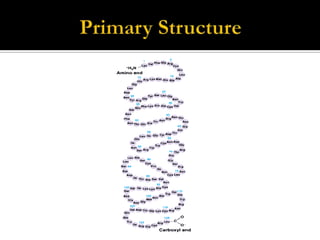
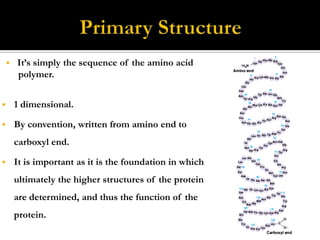
Itโ€Ÿs simply the sequence of the amino acid
polymer.

๏‚ง

1 dimensional.

๏‚ง

By convention, written from amino end to

carboxyl end.
๏‚ง

It is important as it is the foundation in which
ultimately the higher structures of the protein

are determined, and thus the function of the
protein.
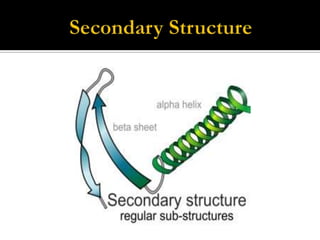
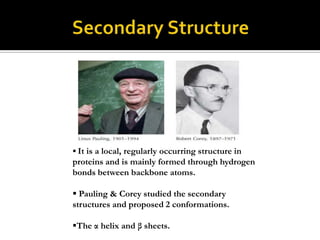
๏‚ง It is a local, regularly occurring structure in

proteins and is mainly formed through hydrogen
bonds between backbone atoms.

๏‚ง Pauling & Corey studied the secondary
structures and proposed 2 conformations.
๏‚งThe ฮฑ helix and ฮฒ sheets.
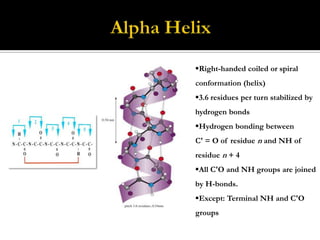
๏‚งRight-handed coiled or spiral

conformation (helix)
๏‚ง3.6 residues per turn stabilized by
hydrogen bonds
๏‚งHydrogen bonding between

C' = O of residue n and NH of
residue n + 4
๏‚งAll C'O and NH groups are joined
by H-bonds.
๏‚งExcept: Terminal NH and C'O
groups
๏‚ก

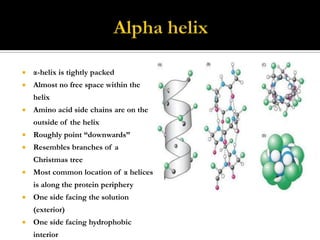
ฮฑ-helix is tightly packed

๏‚ก

Almost no free space within the
helix

๏‚ก

Amino acid side chains are on the
outside of the helix

๏‚ก

Roughly point โ€œdownwardsโ€

๏‚ก

Resembles branches of a
Christmas tree

๏‚ก

Most common location of ฮฑ helices

is along the protein periphery
๏‚ก

One side facing the solution
(exterior)

๏‚ก

One side facing hydrophobic
interior
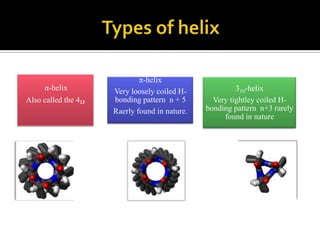
ฮฑ-helix
Also called the 4โ‚โ‚ƒ

ฯ€-helix
Very loosely coiled Hbonding pattern n + 5
Raerly found in nature.

310-helix
Very tightley coiled Hbonding pattern n+3 rarely
found in nature
๏‚ก

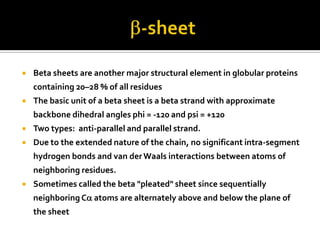
Beta sheets are another major structural element in globular proteins
containing 20โ€“28 % of all residues

๏‚ก

The basic unit of a beta sheet is a beta strand with approximate
backbone dihedral angles phi = -120 and psi = +120

๏‚ก

Two types: anti-parallel and parallel strand.

๏‚ก

Due to the extended nature of the chain, no significant intra-segment
hydrogen bonds and van der Waals interactions between atoms of
neighboring residues.

๏‚ก

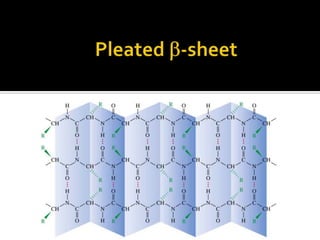
Sometimes called the beta "pleated" sheet since sequentially
neighboring Ca atoms are alternately above and below the plane of
the sheet
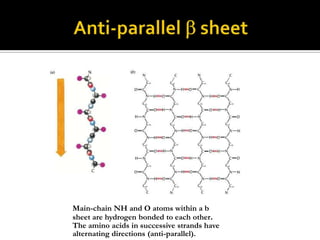
Main-chain NH and O atoms within a b
sheet are hydrogen bonded to each other.
The amino acids in successive strands have
alternating directions (anti-parallel).
๏‚ก

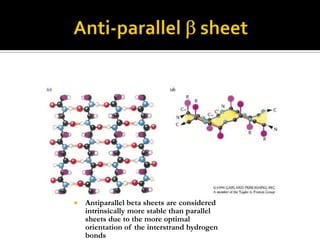
Antiparallel beta sheets are considered
intrinsically more stable than parallel
sheets due to the more optimal
orientation of the interstrand hydrogen
bonds
๏‚ก

Different types
๏‚ง Hairpin loops โ€“ often between anti-parallel beta strands
๏‚ง Omega loops โ€“ beginning and end close (6-16 residues)
๏‚ง Extended loops โ€“ more than 16 residues

๏‚ก

Secondary structures are joined together by additional
structures called loops.

๏‚ก

These patterns are called motifs

๏‚ก

Defining motifs-small, specific combinations of secondary
structure elements
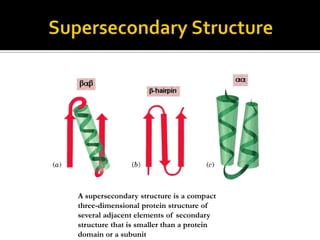
A supersecondary structure is a compact
three-dimensional protein structure of
several adjacent elements of secondary
structure that is smaller than a protein
domain or a subunit
๏‚ก

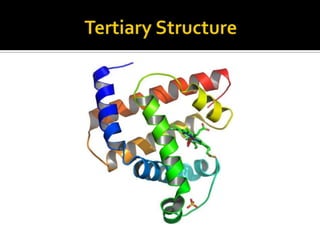
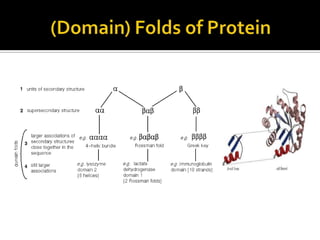
Tertiary structures is defined as the overall arrangement of polypeptide
chains in three-dimensional space, describing how secondary structures
arrange into supersecondary structures that in turn arrange into domains
and domains into tertiary structures.

๏‚ก

Components:
๏‚ง Motif : a recognizable subcomponent of the fold โ€“ several motifs

usually comprise a domain
๏‚ง Fold: used differently in different contexts โ€“ most broadly a

reproducible and recognizable 3 dimensional arrangement
๏‚ง Domain: a compact and self folding component of the protein that

usually represents a discreet structural and functional unit
๏‚ก

Tertiary structures can be divided into three main
classes:
a domain
b domains
a/b domains
๏‚ง The domain is the unit of tertiary structure
๏‚ก

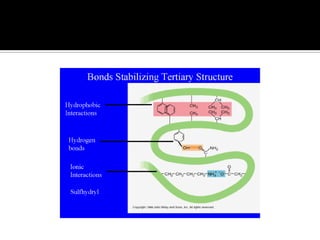
In globular proteins
๏‚ง Tertiary interactions are frequently stabilized by sequestration

of hydrophobic amino acid residues in the protein core
๏‚ง Consequent enrichment of charged or hydrophilic residues

on the protein's water-exposed surface.
๏‚ก

In secreted proteins
๏‚ง disulfide bonds between cysteine residue helps to maintain

the protein's tertiary structure
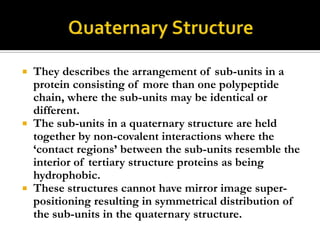
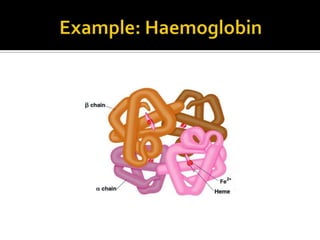
They describes the arrangement of sub-units in a
protein consisting of more than one polypeptide
chain, where the sub-units may be identical or
different.
๏‚ก The sub-units in a quaternary structure are held
together by non-covalent interactions where the
โ€žcontact regionsโ€Ÿ between the sub-units resemble the
interior of tertiary structure proteins as being
hydrophobic.
๏‚ก These structures cannot have mirror image superpositioning resulting in symmetrical distribution of
the sub-units in the quaternary structure.
๏‚ก
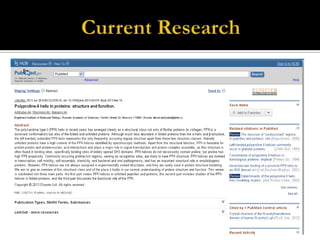
Poly proline -II helix in proteins:
Structure & Function.
The polyproline type II (PPII) helix in recent years has
emerged clearly as a structural class not only of fibrillar
proteins but also of the folded and unfolded proteins.
๏‚ก The left-handed, extended PPII helix represents the only
frequently occurring regular structure .
๏‚ก Natively unfolded proteins have a high content of the
PPII helices identified by spectroscopic methods.
๏‚ก PPII is favorable for protein-protein and protein-nucleic
acid interactions and plays a major role in signal
transduction and protein complex assembly.
๏‚ก
๏‚ก
๏‚ก

๏‚ก

PPII helices do not necessarily contain proline,
but proline has high PPII propensity.
PPII helices are involved in transcription, cell
motility, self-assembly, elasticity, and bacterial
and viral pathogenesis, & has an important
structural role in amyloidogenic proteins.
PPII helices are not always assigned in
experimentally solved structures, & they are
rarely used in protein structure modeling.
๏‚ก
๏‚ก
๏‚ก
๏‚ก
๏‚ก
๏‚ก

Lehninger Principles Of Biochemistry,
Fourth Edition.
Biochemistry, by Voet & Voet, 3rd edition.
Harperโ€™s Illustrated Biochemistry, 26th
edition.
Biochemistry , by Dr.U.Satyanarayana.
www.ncbi.nlm.nih.gov/
biochemistrycourse.blogspot.in/
Protein structure

Protein structure

  • 1.
    Protein Structure - SaileeGurav (M.Sc. Biochemistry Part -1)
  • 2.
    ๏‚ก ๏‚ก ๏‚ก Itโ€Ÿs completely defined& predictable. Each amino acid in one of these giant macromolecules is located at a specific site within the structure , giving the protein the precise shape. It can be described at several levels of organization , each emphasizing a different aspect & each dependent on different types of interactions.
  • 5.
    ๏‚ง Itโ€Ÿs simply thesequence of the amino acid polymer. ๏‚ง 1 dimensional. ๏‚ง By convention, written from amino end to carboxyl end. ๏‚ง It is important as it is the foundation in which ultimately the higher structures of the protein are determined, and thus the function of the protein.
  • 7.
    ๏‚ง It isa local, regularly occurring structure in proteins and is mainly formed through hydrogen bonds between backbone atoms. ๏‚ง Pauling & Corey studied the secondary structures and proposed 2 conformations. ๏‚งThe ฮฑ helix and ฮฒ sheets.
  • 8.
    ๏‚งRight-handed coiled orspiral conformation (helix) ๏‚ง3.6 residues per turn stabilized by hydrogen bonds ๏‚งHydrogen bonding between C' = O of residue n and NH of residue n + 4 ๏‚งAll C'O and NH groups are joined by H-bonds. ๏‚งExcept: Terminal NH and C'O groups
  • 9.
    ๏‚ก ฮฑ-helix is tightlypacked ๏‚ก Almost no free space within the helix ๏‚ก Amino acid side chains are on the outside of the helix ๏‚ก Roughly point โ€œdownwardsโ€ ๏‚ก Resembles branches of a Christmas tree ๏‚ก Most common location of ฮฑ helices is along the protein periphery ๏‚ก One side facing the solution (exterior) ๏‚ก One side facing hydrophobic interior
  • 10.
    ฮฑ-helix Also called the4โ‚โ‚ƒ ฯ€-helix Very loosely coiled Hbonding pattern n + 5 Raerly found in nature. 310-helix Very tightley coiled Hbonding pattern n+3 rarely found in nature
  • 12.
    ๏‚ก Beta sheets areanother major structural element in globular proteins containing 20โ€“28 % of all residues ๏‚ก The basic unit of a beta sheet is a beta strand with approximate backbone dihedral angles phi = -120 and psi = +120 ๏‚ก Two types: anti-parallel and parallel strand. ๏‚ก Due to the extended nature of the chain, no significant intra-segment hydrogen bonds and van der Waals interactions between atoms of neighboring residues. ๏‚ก Sometimes called the beta "pleated" sheet since sequentially neighboring Ca atoms are alternately above and below the plane of the sheet
  • 13.
    Main-chain NH andO atoms within a b sheet are hydrogen bonded to each other. The amino acids in successive strands have alternating directions (anti-parallel).
  • 14.
    ๏‚ก Antiparallel beta sheetsare considered intrinsically more stable than parallel sheets due to the more optimal orientation of the interstrand hydrogen bonds
  • 15.
    ๏‚ก Different types ๏‚ง Hairpinloops โ€“ often between anti-parallel beta strands ๏‚ง Omega loops โ€“ beginning and end close (6-16 residues) ๏‚ง Extended loops โ€“ more than 16 residues ๏‚ก Secondary structures are joined together by additional structures called loops. ๏‚ก These patterns are called motifs ๏‚ก Defining motifs-small, specific combinations of secondary structure elements
  • 16.
    A supersecondary structureis a compact three-dimensional protein structure of several adjacent elements of secondary structure that is smaller than a protein domain or a subunit
  • 18.
    ๏‚ก Tertiary structures isdefined as the overall arrangement of polypeptide chains in three-dimensional space, describing how secondary structures arrange into supersecondary structures that in turn arrange into domains and domains into tertiary structures. ๏‚ก Components: ๏‚ง Motif : a recognizable subcomponent of the fold โ€“ several motifs usually comprise a domain ๏‚ง Fold: used differently in different contexts โ€“ most broadly a reproducible and recognizable 3 dimensional arrangement ๏‚ง Domain: a compact and self folding component of the protein that usually represents a discreet structural and functional unit
  • 19.
    ๏‚ก Tertiary structures canbe divided into three main classes: a domain b domains a/b domains ๏‚ง The domain is the unit of tertiary structure
  • 21.
    ๏‚ก In globular proteins ๏‚งTertiary interactions are frequently stabilized by sequestration of hydrophobic amino acid residues in the protein core ๏‚ง Consequent enrichment of charged or hydrophilic residues on the protein's water-exposed surface. ๏‚ก In secreted proteins ๏‚ง disulfide bonds between cysteine residue helps to maintain the protein's tertiary structure
  • 24.
    They describes thearrangement of sub-units in a protein consisting of more than one polypeptide chain, where the sub-units may be identical or different. ๏‚ก The sub-units in a quaternary structure are held together by non-covalent interactions where the โ€žcontact regionsโ€Ÿ between the sub-units resemble the interior of tertiary structure proteins as being hydrophobic. ๏‚ก These structures cannot have mirror image superpositioning resulting in symmetrical distribution of the sub-units in the quaternary structure. ๏‚ก
  • 27.
    Poly proline -IIhelix in proteins: Structure & Function. The polyproline type II (PPII) helix in recent years has emerged clearly as a structural class not only of fibrillar proteins but also of the folded and unfolded proteins. ๏‚ก The left-handed, extended PPII helix represents the only frequently occurring regular structure . ๏‚ก Natively unfolded proteins have a high content of the PPII helices identified by spectroscopic methods. ๏‚ก PPII is favorable for protein-protein and protein-nucleic acid interactions and plays a major role in signal transduction and protein complex assembly. ๏‚ก
  • 28.
    ๏‚ก ๏‚ก ๏‚ก PPII helices donot necessarily contain proline, but proline has high PPII propensity. PPII helices are involved in transcription, cell motility, self-assembly, elasticity, and bacterial and viral pathogenesis, & has an important structural role in amyloidogenic proteins. PPII helices are not always assigned in experimentally solved structures, & they are rarely used in protein structure modeling.
  • 29.
    ๏‚ก ๏‚ก ๏‚ก ๏‚ก ๏‚ก ๏‚ก Lehninger Principles OfBiochemistry, Fourth Edition. Biochemistry, by Voet & Voet, 3rd edition. Harperโ€™s Illustrated Biochemistry, 26th edition. Biochemistry , by Dr.U.Satyanarayana. www.ncbi.nlm.nih.gov/ biochemistrycourse.blogspot.in/