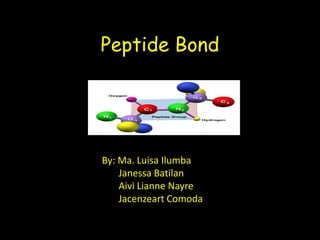
Peptide Bond
By: Ma. Luisa Ilumba
Janessa Batilan
Aivi Lianne Nayre
Jacenzeart Comoda
In this learning we will examine the biochemistry behind
the formation of peptide bonds.
Inside cells, peptide bonds are formed
within ribosomes during a process called
translation..
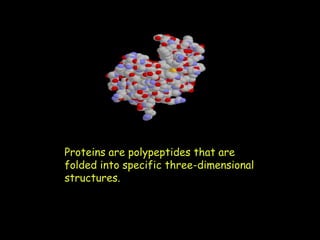
Proteins are polypeptides that are
folded into specific three-dimensional
structures.
Polypeptides are composed of amino acids
Covalently bonded to each other like
beads of strings.
The covalent bond that holds the amino
acids together is called “peptide bond”.
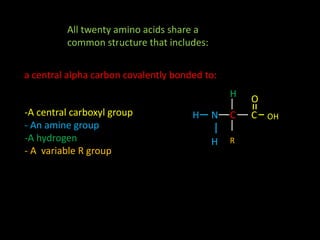
All twenty amino acids share a
common structure that includes:
a central alpha carbon covalently bonded to:
-A central carboxyl group
- An amine group
-A hydrogen
- A variable R group
C
C
H
NH
H
C
O
R
OH
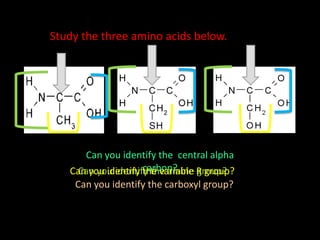
Study the three amino acids below.
Can you identify the central alpha
carbon?
Can you identify the carboxyl group?
Can you identify the amine group?Can you identify the variable R group?
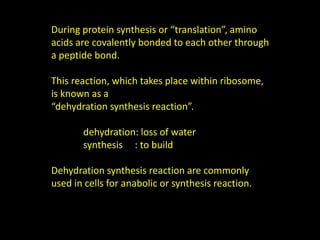
During protein synthesis or “translation”, amino
acids are covalently bonded to each other through
a peptide bond.
This reaction, which takes place within ribosome,
is known as a
“dehydration synthesis reaction”.
dehydration: loss of water
synthesis : to build
Dehydration synthesis reaction are commonly
used in cells for anabolic or synthesis reaction.
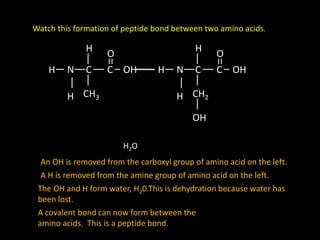
Watch this formation of peptide bond between two amino acids.
C
H
NH
H CH3
C
O
OH C
H
NH
H CH2
C
O
OH
OH
An OH is removed from the carboxyl group of amino acid on the left.
A H is removed from the amine group of amino acid on the left.
The OH and H form water, H20.This is dehydration because water has
been lost.
A covalent bond can now form between the
amino acids. This is a peptide bond.
H2O

Peptide bond

  • 1.
    Peptide Bond By: Ma.Luisa Ilumba Janessa Batilan Aivi Lianne Nayre Jacenzeart Comoda
  • 2.
    In this learningwe will examine the biochemistry behind the formation of peptide bonds. Inside cells, peptide bonds are formed within ribosomes during a process called translation..
  • 3.
    Proteins are polypeptidesthat are folded into specific three-dimensional structures.
  • 4.
    Polypeptides are composedof amino acids Covalently bonded to each other like beads of strings. The covalent bond that holds the amino acids together is called “peptide bond”.
  • 5.
    All twenty aminoacids share a common structure that includes: a central alpha carbon covalently bonded to: -A central carboxyl group - An amine group -A hydrogen - A variable R group C C H NH H C O R OH
  • 6.
    Study the threeamino acids below. Can you identify the central alpha carbon? Can you identify the carboxyl group? Can you identify the amine group?Can you identify the variable R group?
  • 7.
    During protein synthesisor “translation”, amino acids are covalently bonded to each other through a peptide bond. This reaction, which takes place within ribosome, is known as a “dehydration synthesis reaction”. dehydration: loss of water synthesis : to build Dehydration synthesis reaction are commonly used in cells for anabolic or synthesis reaction.
  • 8.
    Watch this formationof peptide bond between two amino acids. C H NH H CH3 C O OH C H NH H CH2 C O OH OH An OH is removed from the carboxyl group of amino acid on the left. A H is removed from the amine group of amino acid on the left. The OH and H form water, H20.This is dehydration because water has been lost. A covalent bond can now form between the amino acids. This is a peptide bond. H2O