Amino Acids, Peptides and
Protein
1
Amino Acids
2
• Amino acid:
Amino acid: a compound that contains an amino group, a
carboxyl group and a side-chain that is specific to each amino
acid. serve as the building blocks of proteins.
• 
-Amino acid
-Amino acid:
: an amino acid in which the amino group is on
the carbon adjacent to the carboxyl group
• The are 20 common α-amino acids used by the ribosomes to make
proteins. These 20 have L chirality at the α-carbon.
• Central aminated and carboxylated carbon atom : alpha carbon :
alpha amino acid; except proline and hydroxyproline (alpha imino
acids (imino group NH); side group of amino acid : substituent
group
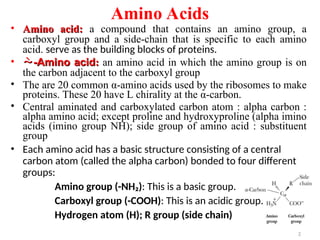
• Each amino acid has a basic structure consisting of a central
carbon atom (called the alpha carbon) bonded to four different
groups:
Amino group (-NH₂): This is a basic group.
Carboxyl group (-COOH): This is an acidic group.
Hydrogen atom (H); R group (side chain)
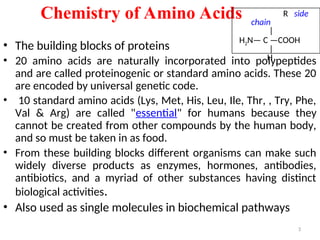
• The building blocks of proteins
• 20 amino acids are naturally incorporated into polypeptides
and are called proteinogenic or standard amino acids. These 20
are encoded by universal genetic code.
• 10 standard amino acids (Lys, Met, His, Leu, Ile, Thr, , Try, Phe,
Val & Arg) are called "essential" for humans because they
cannot be created from other compounds by the human body,
and so must be taken in as food.
• From these building blocks different organisms can make such
widely diverse products as enzymes, hormones, antibodies,
antibiotics, and a myriad of other substances having distinct
biological activities.
• Also used as single molecules in biochemical pathways
Chemistry of Amino Acids R side
chain
|
H2N— C —COOH
|
H
3
Chemistry of Amino Acids
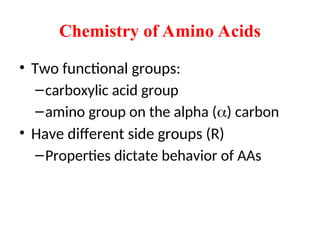
• Two functional groups:
–carboxylic acid group
–amino group on the alpha () carbon
• Have different side groups (R)
–Properties dictate behavior of AAs
Stereochemistry of AAs
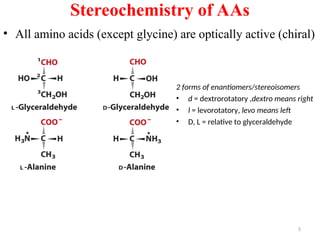
• All amino acids (except glycine) are optically active (chiral)
2 forms of enantiomers/stereoisomers
• d = dextrorotatory ,dextro means right
• l = levorotatory, levo means left
• D, L = relative to glyceraldehyde
5
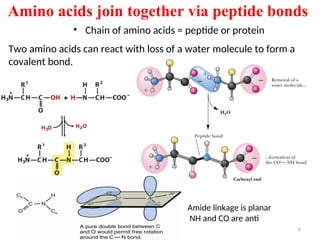
Amino acids join together via peptide bonds
Two amino acids can react with loss of a water molecule to form a
covalent bond.
6
• Chain of amino acids = peptide or protein
Amide linkage is planar
NH and CO are anti
Classification of Amino Acids
 Classification based on side-chain structure:
– Non-polar amino acids.
– Polar, uncharged amino acids.
– Acidic amino acids.
– Basic amino acids.
 Other side chain structural classifications:
– Aromatic, cyclic, hydroxyl, and thiol amino acids.
7
Essential Amino Acids
• An essential amino acid is an amino acid that cannot be
synthesized itself by the organism (usually referring to humans),
and therefore must be supplied in the diet.
• 10 amino acids are essential amino acid
• They are - arg, his, ile, leu, lys, met, phe, thr, trp, val
• Must obtain from the diet
• An adequate diet must contain these essential amino acids.
Typically, they are supplied by meat and dairy products
• Essential amino acids help the body function and regulate
neurotransmitters, chemicals in the brain that control mood and
behavior.
• A lack of essential amino acids can cause emotional or physical
difficulties and lead to health disorder
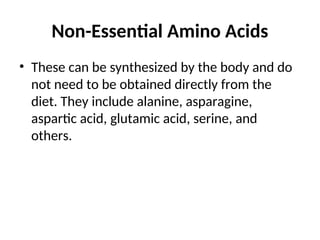
Non-Essential Amino Acids
• These can be synthesized by the body and do
not need to be obtained directly from the
diet. They include alanine, asparagine,
aspartic acid, glutamic acid, serine, and
others.
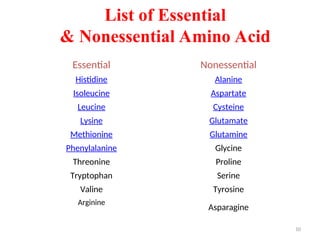
List of Essential
& Nonessential Amino Acid
Essential Nonessential
Histidine Alanine
Isoleucine Aspartate
Leucine Cysteine
Lysine Glutamate
Methionine Glutamine
Phenylalanine Glycine
Threonine Proline
Tryptophan Serine
Valine Tyrosine
Arginine
Asparagine
10
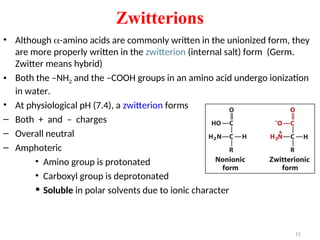
• Although -amino acids are commonly written in the unionized form, they
are more properly written in the zwitterion (internal salt) form (Germ.
Zwitter means hybrid)
• Both the –NH2 and the –COOH groups in an amino acid undergo ionization
in water.
• At physiological pH (7.4), a zwitterion forms
– Both + and – charges
– Overall neutral
– Amphoteric
• Amino group is protonated
• Carboxyl group is deprotonated
• Soluble in polar solvents due to ionic character
Zwitterions
11
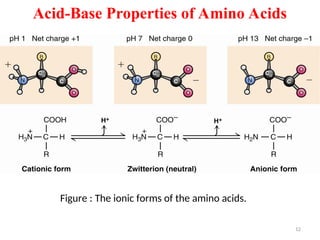
Acid-Base Properties of Amino Acids
Figure : The ionic forms of the amino acids.
12
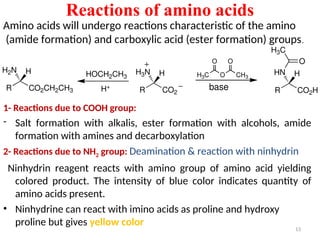
Reactions of amino acids
1- Reactions due to COOH group:
- Salt formation with alkalis, ester formation with alcohols, amide
formation with amines and decarboxylation
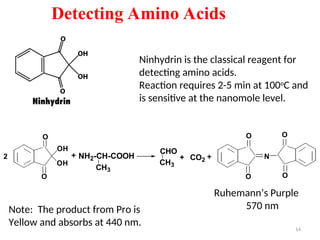
2- Reactions due to NH2 group: Deamination & reaction with ninhydrin
Ninhydrin reagent reacts with amino group of amino acid yielding
colored product. The intensity of blue color indicates quantity of
amino acids present.
• Ninhydrine can react with imino acids as proline and hydroxy
proline but gives yellow color
13
R CO2
H3N H H3C O CH3
O O
base R CO2H
HN H
O
H3C
HOCH2CH3
H+
R CO2CH2CH3
H2N H
Amino acids will undergo reactions characteristic of the amino
(amide formation) and carboxylic acid (ester formation) groups.
Detecting Amino Acids
Ninhydrin is the classical reagent for
detecting amino acids.
Reaction requires 2-5 min at 100o
C and
is sensitive at the nanomole level.
Ruhemann’s Purple
570 nm
OH
O
O
OH
NH2-CH-COOH
CH3
+
O
O
O
O
N
CO2
CH3
CHO
+ +
2
Note: The product from Pro is
Yellow and absorbs at 440 nm. 14
Peptides and Proteins
•20 amino acids are commonly found in protein.
•These 20 amino acids are linked together through “peptide
bond forming peptides and proteins.
•The chains containing less than 50 amino acids are called
“peptides”, while those containing greater than 50 amino
acids are called “proteins”.
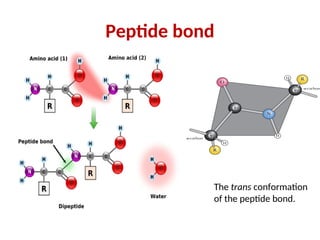
Peptide bond formation: Peptide bond
Peptide bond is the
is the amide bond
between the -carboxyl group of one amino acid and the -
 
amino group of another
15
Peptide bond
The trans conformation
of the peptide bond.
Peptides and Proteins
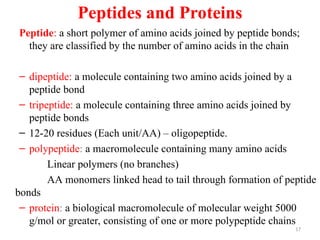
Peptide: a short polymer of amino acids joined by peptide bonds;
they are classified by the number of amino acids in the chain
– dipeptide: a molecule containing two amino acids joined by a
peptide bond
– tripeptide: a molecule containing three amino acids joined by
peptide bonds
– 12-20 residues (Each unit/AA) – oligopeptide.
– polypeptide: a macromolecule containing many amino acids
Linear polymers (no branches)
AA monomers linked head to tail through formation of peptide
bonds
– protein: a biological macromolecule of molecular weight 5000
g/mol or greater, consisting of one or more polypeptide chains
17
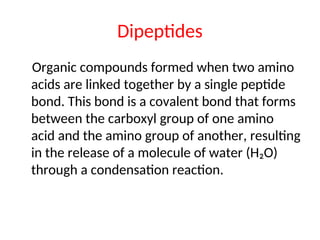
Dipeptides
Organic compounds formed when two amino
acids are linked together by a single peptide
bond. This bond is a covalent bond that forms
between the carboxyl group of one amino
acid and the amino group of another, resulting
in the release of a molecule of water (H₂O)
through a condensation reaction.
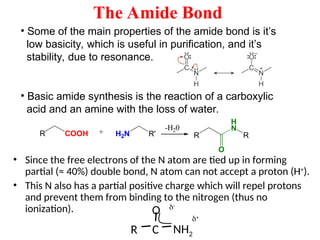
The Amide Bond
H2N R'
+
R COOH R
O
H
N
R
-H20
• Basic amide synthesis is the reaction of a carboxylic
acid and an amine with the loss of water.
• Some of the main properties of the amide bond is it’s
low basicity, which is useful in purification, and it’s
stability, due to resonance.
• Since the free electrons of the N atom are tied up in forming
partial (≈ 40%) double bond, N atom can not accept a proton (H+
).
• This N also has a partial positive charge which will repel protons
and prevent them from binding to the nitrogen (thus no
ionization).
R C
O
NH2


20
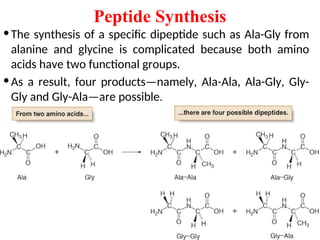
•The synthesis of a specific dipeptide such as Ala-Gly from
alanine and glycine is complicated because both amino
acids have two functional groups.
•As a result, four products—namely, Ala-Ala, Ala-Gly, Gly-
Gly and Gly-Ala—are possible.
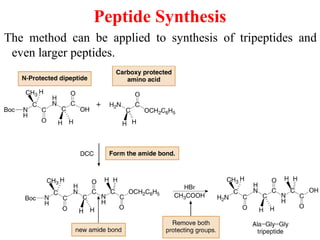
Peptide Synthesis
21
The method can be applied to synthesis of tripeptides and
even larger peptides.
Peptide Synthesis
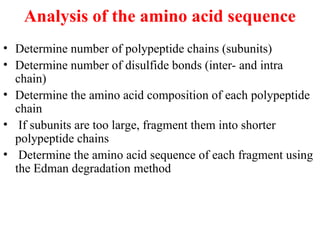
Analysis of the amino acid sequence
• Determine number of polypeptide chains (subunits)
• Determine number of disulfide bonds (inter- and intra
chain)
• Determine the amino acid composition of each polypeptide
chain
• If subunits are too large, fragment them into shorter
polypeptide chains
• Determine the amino acid sequence of each fragment using
the Edman degradation method
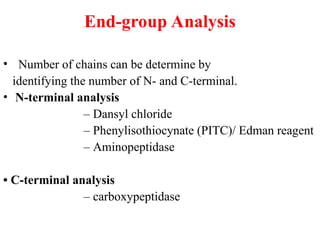
End-group Analysis
• Number of chains can be determine by
identifying the number of N- and C-terminal.
• N-terminal analysis
– Dansyl chloride
– Phenylisothiocynate (PITC)/ Edman reagent
– Aminopeptidase
• C-terminal analysis
– carboxypeptidase
Classification of Amino Acids
• Classification based on structure and chemical nature
• Classification based on acid-base properties
• Classification based on number of carboxyl groups
• Classification based on polarity
Classification based on structure and chemical nature
• Amino acids with aliphatic side chain
• Amino acids with hydroxyl group
• Sulphur- containing amino acids
• Acidic amino acids
• basic amino acids
• Aromatic amino acids
• Imino amino acids

aminoacid notes cell biology botany .ppt

  • 1.
    Amino Acids, Peptidesand Protein 1
  • 2.
    Amino Acids 2 • Aminoacid: Amino acid: a compound that contains an amino group, a carboxyl group and a side-chain that is specific to each amino acid. serve as the building blocks of proteins. •  -Amino acid -Amino acid: : an amino acid in which the amino group is on the carbon adjacent to the carboxyl group • The are 20 common α-amino acids used by the ribosomes to make proteins. These 20 have L chirality at the α-carbon. • Central aminated and carboxylated carbon atom : alpha carbon : alpha amino acid; except proline and hydroxyproline (alpha imino acids (imino group NH); side group of amino acid : substituent group • Each amino acid has a basic structure consisting of a central carbon atom (called the alpha carbon) bonded to four different groups: Amino group (-NH₂): This is a basic group. Carboxyl group (-COOH): This is an acidic group. Hydrogen atom (H); R group (side chain)
  • 3.
    • The buildingblocks of proteins • 20 amino acids are naturally incorporated into polypeptides and are called proteinogenic or standard amino acids. These 20 are encoded by universal genetic code. • 10 standard amino acids (Lys, Met, His, Leu, Ile, Thr, , Try, Phe, Val & Arg) are called "essential" for humans because they cannot be created from other compounds by the human body, and so must be taken in as food. • From these building blocks different organisms can make such widely diverse products as enzymes, hormones, antibodies, antibiotics, and a myriad of other substances having distinct biological activities. • Also used as single molecules in biochemical pathways Chemistry of Amino Acids R side chain | H2N— C —COOH | H 3
  • 4.
    Chemistry of AminoAcids • Two functional groups: –carboxylic acid group –amino group on the alpha () carbon • Have different side groups (R) –Properties dictate behavior of AAs
  • 5.
    Stereochemistry of AAs •All amino acids (except glycine) are optically active (chiral) 2 forms of enantiomers/stereoisomers • d = dextrorotatory ,dextro means right • l = levorotatory, levo means left • D, L = relative to glyceraldehyde 5
  • 6.
    Amino acids jointogether via peptide bonds Two amino acids can react with loss of a water molecule to form a covalent bond. 6 • Chain of amino acids = peptide or protein Amide linkage is planar NH and CO are anti
  • 7.
    Classification of AminoAcids  Classification based on side-chain structure: – Non-polar amino acids. – Polar, uncharged amino acids. – Acidic amino acids. – Basic amino acids.  Other side chain structural classifications: – Aromatic, cyclic, hydroxyl, and thiol amino acids. 7
  • 8.
    Essential Amino Acids •An essential amino acid is an amino acid that cannot be synthesized itself by the organism (usually referring to humans), and therefore must be supplied in the diet. • 10 amino acids are essential amino acid • They are - arg, his, ile, leu, lys, met, phe, thr, trp, val • Must obtain from the diet • An adequate diet must contain these essential amino acids. Typically, they are supplied by meat and dairy products • Essential amino acids help the body function and regulate neurotransmitters, chemicals in the brain that control mood and behavior. • A lack of essential amino acids can cause emotional or physical difficulties and lead to health disorder
  • 9.
    Non-Essential Amino Acids •These can be synthesized by the body and do not need to be obtained directly from the diet. They include alanine, asparagine, aspartic acid, glutamic acid, serine, and others.
  • 10.
    List of Essential &Nonessential Amino Acid Essential Nonessential Histidine Alanine Isoleucine Aspartate Leucine Cysteine Lysine Glutamate Methionine Glutamine Phenylalanine Glycine Threonine Proline Tryptophan Serine Valine Tyrosine Arginine Asparagine 10
  • 11.
    • Although -aminoacids are commonly written in the unionized form, they are more properly written in the zwitterion (internal salt) form (Germ. Zwitter means hybrid) • Both the –NH2 and the –COOH groups in an amino acid undergo ionization in water. • At physiological pH (7.4), a zwitterion forms – Both + and – charges – Overall neutral – Amphoteric • Amino group is protonated • Carboxyl group is deprotonated • Soluble in polar solvents due to ionic character Zwitterions 11
  • 12.
    Acid-Base Properties ofAmino Acids Figure : The ionic forms of the amino acids. 12
  • 13.
    Reactions of aminoacids 1- Reactions due to COOH group: - Salt formation with alkalis, ester formation with alcohols, amide formation with amines and decarboxylation 2- Reactions due to NH2 group: Deamination & reaction with ninhydrin Ninhydrin reagent reacts with amino group of amino acid yielding colored product. The intensity of blue color indicates quantity of amino acids present. • Ninhydrine can react with imino acids as proline and hydroxy proline but gives yellow color 13 R CO2 H3N H H3C O CH3 O O base R CO2H HN H O H3C HOCH2CH3 H+ R CO2CH2CH3 H2N H Amino acids will undergo reactions characteristic of the amino (amide formation) and carboxylic acid (ester formation) groups.
  • 14.
    Detecting Amino Acids Ninhydrinis the classical reagent for detecting amino acids. Reaction requires 2-5 min at 100o C and is sensitive at the nanomole level. Ruhemann’s Purple 570 nm OH O O OH NH2-CH-COOH CH3 + O O O O N CO2 CH3 CHO + + 2 Note: The product from Pro is Yellow and absorbs at 440 nm. 14
  • 15.
    Peptides and Proteins •20amino acids are commonly found in protein. •These 20 amino acids are linked together through “peptide bond forming peptides and proteins. •The chains containing less than 50 amino acids are called “peptides”, while those containing greater than 50 amino acids are called “proteins”. Peptide bond formation: Peptide bond Peptide bond is the is the amide bond between the -carboxyl group of one amino acid and the -   amino group of another 15
  • 16.
    Peptide bond The transconformation of the peptide bond.
  • 17.
    Peptides and Proteins Peptide:a short polymer of amino acids joined by peptide bonds; they are classified by the number of amino acids in the chain – dipeptide: a molecule containing two amino acids joined by a peptide bond – tripeptide: a molecule containing three amino acids joined by peptide bonds – 12-20 residues (Each unit/AA) – oligopeptide. – polypeptide: a macromolecule containing many amino acids Linear polymers (no branches) AA monomers linked head to tail through formation of peptide bonds – protein: a biological macromolecule of molecular weight 5000 g/mol or greater, consisting of one or more polypeptide chains 17
  • 18.
    Dipeptides Organic compounds formedwhen two amino acids are linked together by a single peptide bond. This bond is a covalent bond that forms between the carboxyl group of one amino acid and the amino group of another, resulting in the release of a molecule of water (H₂O) through a condensation reaction.
  • 19.
    The Amide Bond H2NR' + R COOH R O H N R -H20 • Basic amide synthesis is the reaction of a carboxylic acid and an amine with the loss of water. • Some of the main properties of the amide bond is it’s low basicity, which is useful in purification, and it’s stability, due to resonance. • Since the free electrons of the N atom are tied up in forming partial (≈ 40%) double bond, N atom can not accept a proton (H+ ). • This N also has a partial positive charge which will repel protons and prevent them from binding to the nitrogen (thus no ionization). R C O NH2  
  • 20.
    20 •The synthesis ofa specific dipeptide such as Ala-Gly from alanine and glycine is complicated because both amino acids have two functional groups. •As a result, four products—namely, Ala-Ala, Ala-Gly, Gly- Gly and Gly-Ala—are possible. Peptide Synthesis
  • 21.
    21 The method canbe applied to synthesis of tripeptides and even larger peptides. Peptide Synthesis
  • 22.
    Analysis of theamino acid sequence • Determine number of polypeptide chains (subunits) • Determine number of disulfide bonds (inter- and intra chain) • Determine the amino acid composition of each polypeptide chain • If subunits are too large, fragment them into shorter polypeptide chains • Determine the amino acid sequence of each fragment using the Edman degradation method
  • 23.
    End-group Analysis • Numberof chains can be determine by identifying the number of N- and C-terminal. • N-terminal analysis – Dansyl chloride – Phenylisothiocynate (PITC)/ Edman reagent – Aminopeptidase • C-terminal analysis – carboxypeptidase
  • 24.
    Classification of AminoAcids • Classification based on structure and chemical nature • Classification based on acid-base properties • Classification based on number of carboxyl groups • Classification based on polarity
  • 25.
    Classification based onstructure and chemical nature • Amino acids with aliphatic side chain • Amino acids with hydroxyl group • Sulphur- containing amino acids • Acidic amino acids • basic amino acids • Aromatic amino acids • Imino amino acids