Amino acids
&
Proteins
Dr. Farhana Atia
Assistant Professor
Department of Biochemistry
Nilphamari Medical College, Nilphamari
Email: farhana.atia@gmail.com
Amino acids
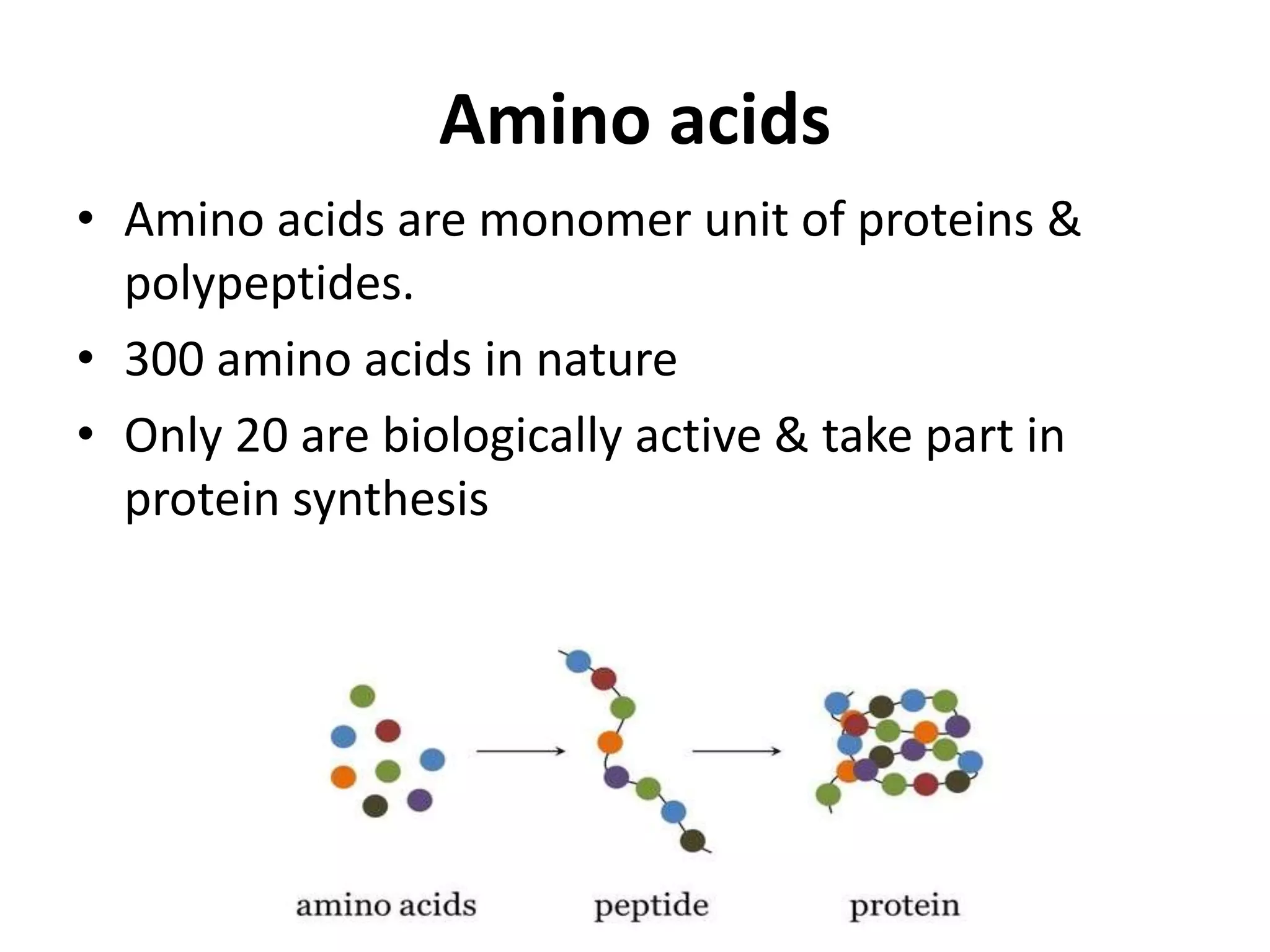
• Amino acids are monomer unit of proteins &
polypeptides.
• 300 amino acids in nature
• Only 20 are biologically active & take part in
protein synthesis
Biomedical Importance
• Support infant growth & maintain health in
adult
• Perform a multitude of structural, hormonal &
catalytic functions essential for life
• Amino acids & their derivatives participates in
various intracellular function such as
– nerve transmission
– regulation of cell growth
– biosynthesis of porphyrin, purine, pyrimidine,
urea
• Short polymer of amino acid [polypeptides] perform
prominent role in neuro-endocrine system as
hormones, hormone releasing factor, neuro-
modulators or neurotransmitters.
• Genetic defect in metabolism of amino acids can
result in severe illness such as
– Phenyl ketonuria,
– Albinism,
– Maple syrup urine disease etc.
• Amino aciduria, another genetic disease result from
an impaired ability to transport specific amino acid
to cell
Structure
• Each amino acid [except proline]
has
– A carboxyl group
– An amino group
– A side chain (R)
Bonding to α carbon
• At physiologic pH (7.4) carboxyl
group is dissociated (COO⁻) &
amino group is protonated (NH₃⁺)
• Proline- side chain & α amino group
form a ring structure [imino group]
a
• In protein all carboxyl & amino groups are combined in
peptide linkage & not available for chemical reaction
except for hydrogen bond formation.
• So side chain (R) dictate role of amino acid in protein
• Based on side chain amino acid may be-
• Non polar
• Oily or lipid like property & promote hydrophobic
interaction that stabilize protein structure
• buried within the hydrophobic core of the protein.
• Polar
• Prefer to reside in an aqueous environment
• Generally found exposed on the surface of a protein.
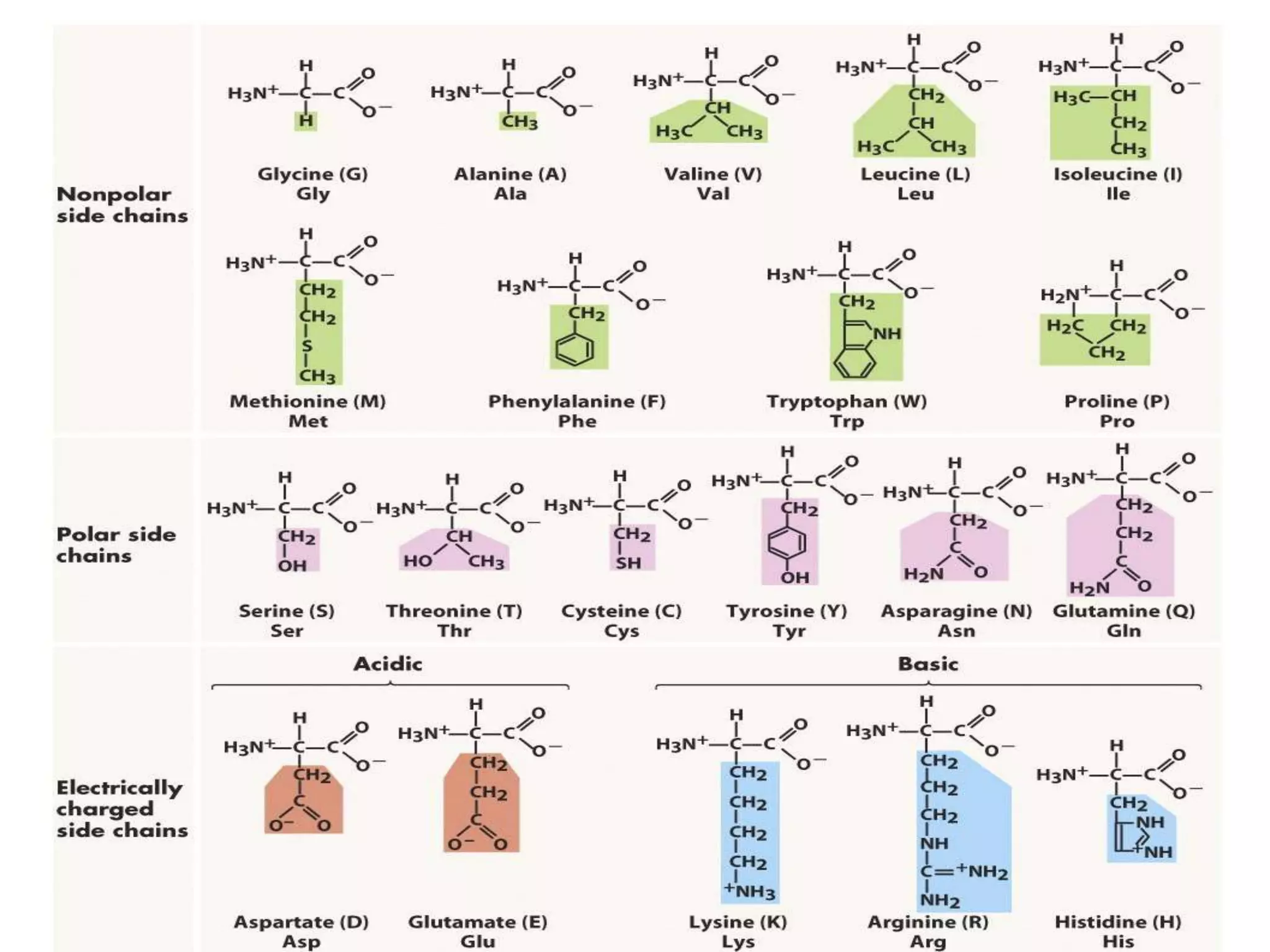
Classification of amino acid
According to R group based on their polarity
1. Non polar & hydrophobic R group
2. Uncharged polar side chain/ neutral aa
3. Positively charged R group/ Basic aa
4. Negatively charged R group/ Acidic aa
Essential amino acid
• Ten of 20 amino acid needed for synthesis of body
protein are essential
• They can not be synthesized in human at adequate rate
• So must be supplied in diet
• 8 are essential all the time
• Arginine & histidine: required only in period of rapid
tissue growth [childhood & recovery from illness]
Properties of amino acid
• The genetic code specify 20 α-amino acid
• Selenocysteine is referred to as 21st amino acid
• Only L- α-aa occur in protein (D-aa in microorganism)
• May have +ve/ -ve/ zero net charge
• Soluble in polar solvent (water, ethanol), insoluble in
non polar solvent (benzene, ether)
• Isoelectric point (pI): pH at which an amino acid is
electrically neutral (bears no net charge)
– Imp: amino acid may be precipitated at this pH
(separated)
• Zwitter ion: Dipolar form of a molecule which
contain same amount of +ve & -ve ion. At pI,
amino acid become zwitter ion
– COOH looses H⁺ [COO⁻], -NH₂ gains H⁺ [NH₃⁺]
Diprotonated form Deprotonated formDipolar form
Peptide bond
• Peptide bond is the amide
linkage that is formed
between two amino acids,
which results in (net) release
of a molecule of water (H2O)
• Bond formed between
carboxyl group of one amino
acid & amino group of
another
• Not broken by denaturation
Characteristics of peptide bond
• Partial double bond
• Rigid & coplanar
• Trans configuration
• Uncharged (neither accept or give off proton) but
polar
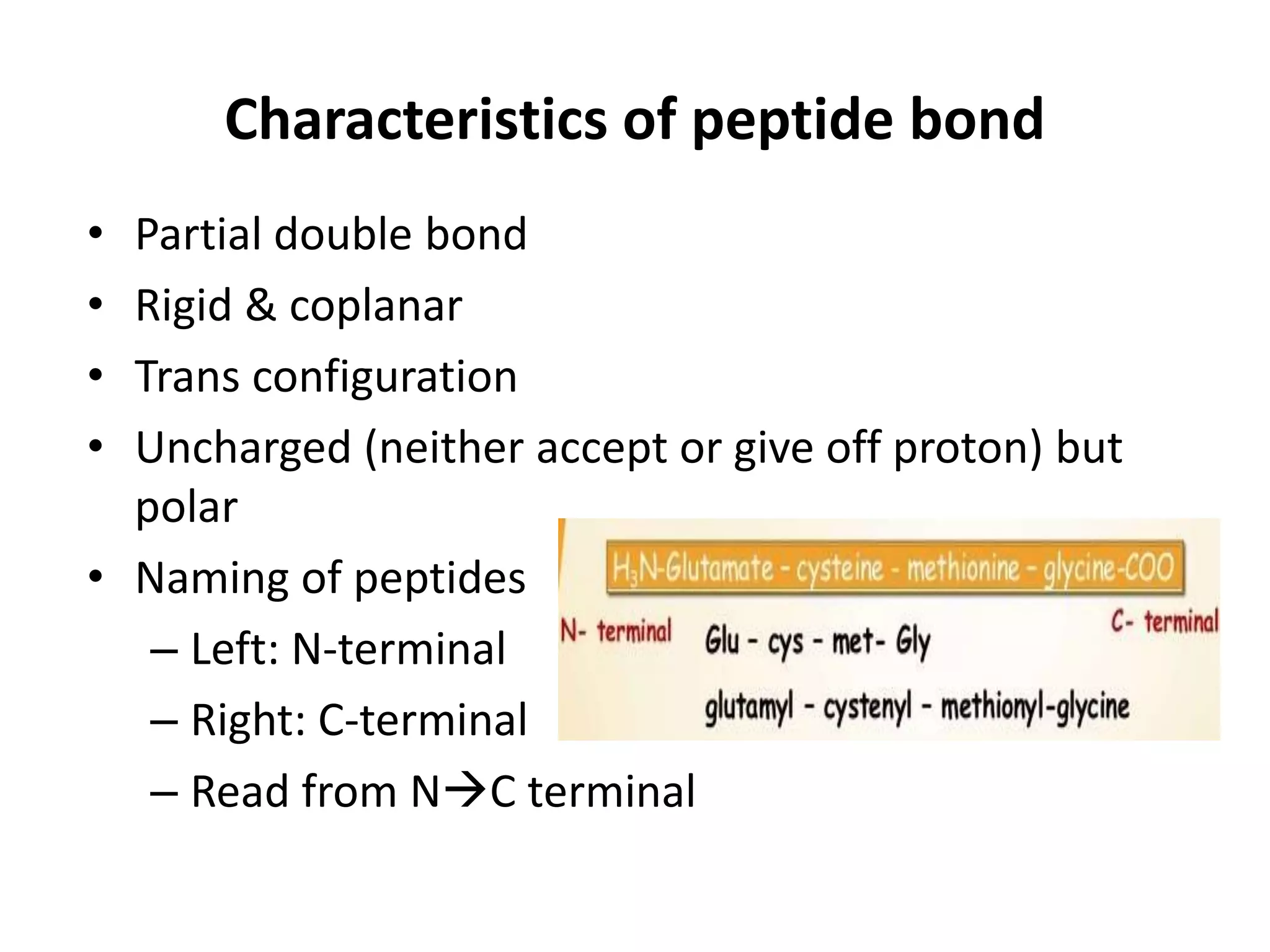
• Naming of peptides
– Left: N-terminal
– Right: C-terminal
– Read from NC terminal
Dipeptide: 1 bond between 2 amino acids
Tripeptide: 2 bonds between 3 amino acids
Polypeptide: long peptide chain containing large
number of amino acid
– Usually 3-100 amino acids
– Molecular wt <10,000
• Protein: Complex organic nitrogenous
compound composed of >100 amino acids
linked together by peptide bond
• High molecular weight > 10,000
Properties
• Colloid in nature
• Soluble in water, salt solution, dilute acid &
alkali
• Coagulates by weak & strong acid
• Each protein has an iso-electric pH & can be
precipitated
• Denatured by many kinds of physical &
chemical treatment
Proteins
Biomedical importance
• Physically & functionally complex macromolecule that
perform multiple critical roles
• Internal protein network (cytoskeleton) maintains
cellular shape & physical integrity
• Actin & myosin- contractile machinery of muscle
• Maintain colloidal osmotic pressure
• Hemoglobin transports O₂
• Circulating antibodies defend against foreign invaders
• Receptor enables cell to sense & responds to
hormones & other environmental cues
• Transport various molecule by forming complex (LP)
• Enzyme catalyze reaction
– Generate energy
– Synthesize & degrade biomolecules
– Replicate & transcribe genes
– Process mRNA
• Act as transporter/ carrier (ferritin)
• Proteins are subject to physical & functional
changes that mirror the life cycle of organism in
which they reside
• In molecular medicine, identification of biomarkers
(proteins) is related to specific physiologic state/
disease
Based on biological function
Structure of protein
Proteins have different level of structural organization
1. Primary structure
2. Secondary structure
3. Tertiary structure
4. Quaternary structure
Primary structure
• Denotes the number &
sequence of amino acid
in protein
• Sequence is determined
by gene
• Maintained by covalent
bond of peptide linkage
• Determine biological
activity of protein
• Single amino acid
change have profound
effect
Insulin
Secondary structure
• Configurational relationship
between residues (3-4 aa) in
the linear sequence
• Preserved by non covalent
bond/ force
– Hydrogen bond
– Hydrophobic interaction
– Electrostatic bond
– Van der Waals force
1. α-helix
2. β-pleated sheet
Tertiary structure
• Denotes the overall
arrangement & inter
relationship of various
region/ domain of single
polypeptide chain
• Formed when α-helix & β-
sheet are held together by
weak interaction
• Domain: Functional & 3-
dimensional structural unit
of a polypeptide chain
• Maintained by non covalent
interaction
• Eg- immunoglobulins
Quaternary structure
• Results when 2/ more
polypeptide chain held
together by non covalent
force
• PP chain- structurally
identical/ totally
unrelated
• Each pp chain termed-
monomer/ subunit
• Dimer- CPK
• Tetramer- Hb, Ig, LDH
Denaturation
• Unfolding & disorganization or nonspecific
alteration in the secondary, tertiary &
quaternary structure of protein molecule
• Primary structure is not altered [no hydrolysis
of peptide bond]
• Results in
– ↓ solubility
– ↑ precipitability
– May lose biological activity
Denaturation
• Denatured protein has more exposed site for
enzyme action
• Cooking denatured easy digestion
Denaturation
Denaturing agents are-
• Heat
• Organic solvent [Urea]
• Mechanical mixing
• Strong acid/ base
• Detergents
• Ions of heavy metal [Hg, Pb]
• X-ray, UV ray, high pressure
Renaturation: may/may not be possible
• Some protein can return to their functional
shape but
• Most protein is permanently disorganized
• Uremia Ig chains disrupt Dialysis (urea
removed) chain reassociate, function
regained
Amino acid & Protein

Amino acid & Protein

  • 1.
    Amino acids & Proteins Dr. FarhanaAtia Assistant Professor Department of Biochemistry Nilphamari Medical College, Nilphamari Email: farhana.atia@gmail.com
  • 2.
    Amino acids • Aminoacids are monomer unit of proteins & polypeptides. • 300 amino acids in nature • Only 20 are biologically active & take part in protein synthesis
  • 3.
    Biomedical Importance • Supportinfant growth & maintain health in adult • Perform a multitude of structural, hormonal & catalytic functions essential for life • Amino acids & their derivatives participates in various intracellular function such as – nerve transmission – regulation of cell growth – biosynthesis of porphyrin, purine, pyrimidine, urea
  • 4.
    • Short polymerof amino acid [polypeptides] perform prominent role in neuro-endocrine system as hormones, hormone releasing factor, neuro- modulators or neurotransmitters. • Genetic defect in metabolism of amino acids can result in severe illness such as – Phenyl ketonuria, – Albinism, – Maple syrup urine disease etc. • Amino aciduria, another genetic disease result from an impaired ability to transport specific amino acid to cell
  • 5.
    Structure • Each aminoacid [except proline] has – A carboxyl group – An amino group – A side chain (R) Bonding to α carbon • At physiologic pH (7.4) carboxyl group is dissociated (COO⁻) & amino group is protonated (NH₃⁺) • Proline- side chain & α amino group form a ring structure [imino group] a
  • 6.
    • In proteinall carboxyl & amino groups are combined in peptide linkage & not available for chemical reaction except for hydrogen bond formation. • So side chain (R) dictate role of amino acid in protein • Based on side chain amino acid may be- • Non polar • Oily or lipid like property & promote hydrophobic interaction that stabilize protein structure • buried within the hydrophobic core of the protein. • Polar • Prefer to reside in an aqueous environment • Generally found exposed on the surface of a protein.
  • 7.
    Classification of aminoacid According to R group based on their polarity 1. Non polar & hydrophobic R group 2. Uncharged polar side chain/ neutral aa 3. Positively charged R group/ Basic aa 4. Negatively charged R group/ Acidic aa
  • 9.
    Essential amino acid •Ten of 20 amino acid needed for synthesis of body protein are essential • They can not be synthesized in human at adequate rate • So must be supplied in diet • 8 are essential all the time • Arginine & histidine: required only in period of rapid tissue growth [childhood & recovery from illness]
  • 10.
    Properties of aminoacid • The genetic code specify 20 α-amino acid • Selenocysteine is referred to as 21st amino acid • Only L- α-aa occur in protein (D-aa in microorganism) • May have +ve/ -ve/ zero net charge • Soluble in polar solvent (water, ethanol), insoluble in non polar solvent (benzene, ether) • Isoelectric point (pI): pH at which an amino acid is electrically neutral (bears no net charge) – Imp: amino acid may be precipitated at this pH (separated)
  • 11.
    • Zwitter ion:Dipolar form of a molecule which contain same amount of +ve & -ve ion. At pI, amino acid become zwitter ion – COOH looses H⁺ [COO⁻], -NH₂ gains H⁺ [NH₃⁺] Diprotonated form Deprotonated formDipolar form
  • 12.
    Peptide bond • Peptidebond is the amide linkage that is formed between two amino acids, which results in (net) release of a molecule of water (H2O) • Bond formed between carboxyl group of one amino acid & amino group of another • Not broken by denaturation
  • 13.
    Characteristics of peptidebond • Partial double bond • Rigid & coplanar • Trans configuration • Uncharged (neither accept or give off proton) but polar • Naming of peptides – Left: N-terminal – Right: C-terminal – Read from NC terminal
  • 14.
    Dipeptide: 1 bondbetween 2 amino acids Tripeptide: 2 bonds between 3 amino acids Polypeptide: long peptide chain containing large number of amino acid – Usually 3-100 amino acids – Molecular wt <10,000 • Protein: Complex organic nitrogenous compound composed of >100 amino acids linked together by peptide bond • High molecular weight > 10,000
  • 15.
    Properties • Colloid innature • Soluble in water, salt solution, dilute acid & alkali • Coagulates by weak & strong acid • Each protein has an iso-electric pH & can be precipitated • Denatured by many kinds of physical & chemical treatment Proteins
  • 16.
    Biomedical importance • Physically& functionally complex macromolecule that perform multiple critical roles • Internal protein network (cytoskeleton) maintains cellular shape & physical integrity • Actin & myosin- contractile machinery of muscle • Maintain colloidal osmotic pressure • Hemoglobin transports O₂ • Circulating antibodies defend against foreign invaders • Receptor enables cell to sense & responds to hormones & other environmental cues • Transport various molecule by forming complex (LP)
  • 17.
    • Enzyme catalyzereaction – Generate energy – Synthesize & degrade biomolecules – Replicate & transcribe genes – Process mRNA • Act as transporter/ carrier (ferritin) • Proteins are subject to physical & functional changes that mirror the life cycle of organism in which they reside • In molecular medicine, identification of biomarkers (proteins) is related to specific physiologic state/ disease
  • 19.
  • 20.
    Structure of protein Proteinshave different level of structural organization 1. Primary structure 2. Secondary structure 3. Tertiary structure 4. Quaternary structure
  • 21.
    Primary structure • Denotesthe number & sequence of amino acid in protein • Sequence is determined by gene • Maintained by covalent bond of peptide linkage • Determine biological activity of protein • Single amino acid change have profound effect Insulin
  • 22.
    Secondary structure • Configurationalrelationship between residues (3-4 aa) in the linear sequence • Preserved by non covalent bond/ force – Hydrogen bond – Hydrophobic interaction – Electrostatic bond – Van der Waals force 1. α-helix 2. β-pleated sheet
  • 23.
    Tertiary structure • Denotesthe overall arrangement & inter relationship of various region/ domain of single polypeptide chain • Formed when α-helix & β- sheet are held together by weak interaction • Domain: Functional & 3- dimensional structural unit of a polypeptide chain • Maintained by non covalent interaction • Eg- immunoglobulins
  • 24.
    Quaternary structure • Resultswhen 2/ more polypeptide chain held together by non covalent force • PP chain- structurally identical/ totally unrelated • Each pp chain termed- monomer/ subunit • Dimer- CPK • Tetramer- Hb, Ig, LDH
  • 25.
    Denaturation • Unfolding &disorganization or nonspecific alteration in the secondary, tertiary & quaternary structure of protein molecule • Primary structure is not altered [no hydrolysis of peptide bond] • Results in – ↓ solubility – ↑ precipitability – May lose biological activity
  • 26.
    Denaturation • Denatured proteinhas more exposed site for enzyme action • Cooking denatured easy digestion
  • 27.
    Denaturation Denaturing agents are- •Heat • Organic solvent [Urea] • Mechanical mixing • Strong acid/ base • Detergents • Ions of heavy metal [Hg, Pb] • X-ray, UV ray, high pressure
  • 28.
    Renaturation: may/may notbe possible • Some protein can return to their functional shape but • Most protein is permanently disorganized • Uremia Ig chains disrupt Dialysis (urea removed) chain reassociate, function regained