Prepared By:
 Mariam rafiq malik
The Biocatalysts
EnzymesCourse : Biochemistry – 1
Course Incharge : Dr. Suad Naheed
Enzymesare protein moleculesin cells which work as catalysts. Enzymes speedup chemical
reactionsin the body, but do not get used up in the process.
 Almost all biochemical reactions in living things need enzymes. With an enzyme, chemical reactions
go much faster than they would without the enzyme. The substancesat the start of the reaction are
called substrates. The substances at the end of the reaction are the products. Enzymes work on the substrates,
and turn them into products.
 The first enzyme was found in 1833, by Anselme Payen.
Introduction
Enzymesare large molecules made from
many amino acids.
 The amino acids link together in a long chain,
which is folded up into a complex structure.
Enzymes have a part which holds the substrate:a
"claw, cleft, hollow or knob to grasp,
hold, stretchand bend the molecule it acts on,
the substrate"
There are thousands of different enzymes. Enzymes have names which show what they do.
Enzyme names usually end in –aseto show that they are enzymes. Examples of this include ATP
synthase.
 It makes a chemical called ATP. Another example is DNA polymerase. It reads an intact DNA strand
and uses it as a template to make a new strand.
One example of an enzyme is amylase, found in saliva. It breaks down starchmolecules into
smaller glucoseand maltose molecules. Another kind of enzyme is lipase. It breaks
down fatsinto smaller molecules.
The proteasesare a whole class of enzymes. They break down other enzymes and proteins back into
amino acids. Nucleasesare enzymes that cut DNA or RNA, often in specific place in the molecule.
 Enzymes are not only for breakinglarge chemicalsinto smaller chemicals. Other enzymes take smaller chemicalsand build them up into bigger
chemicals, and do many other chemical tasks.
 Most enzymes will not work unless the temperatureand pHare just right. In mammals the right temperature is usuallyabout 37oC
degrees(body temperature).
 The correct pH can vary greatly. Pepsin is an example of an enzyme that works best when pH is about 1.5.
 Heating an enzyme above a certaintemperature will destroy the enzyme permanently.It will be broken down by protease and the chemicals will
be used again.
Some chemicals can help an
enzyme do its job even better.
These are called activators.
Sometimes, a chemical can slow
down an enzyme or even make the
enzyme not work at all. These are
called inhibitors. Most drugs
are chemicals that either speed up
or slow down some enzyme in the
human body.
Enzymes are able to do various and numerous jobs, which can be roughly sorted into two
types: biological functions and industrial applications. On the biological aspect, enzymes
are instrumental substances to many functions in living organisms.
They can move parts of a cell’s internal structure and reorganize them to regulate cell
activities. They deliver packages from one part to another inside cells. They pull
chromosomes apart when the cells undergo mitosis. They pull cilia to trigger cell
movement or to help cells move mucus up your airway as a routine to keep the airway
clear. Common enzymes involved in these movement mentioned above are myosin
ATPase, kinesin ATPase, and dynein ATPase.
Functions
They can generate energy for living
organisms. Adenosine triphosphate, also
known as ATP, is the main storage form of
chemical energy. ATP is a charged battery
that can release energy that powers
biological activities. Enzymes are the
transformer to turn energy into proper
chemical forms and store it in ATP
molecules. Most of these enzymes are called
ATP synthases, which act as ion pumps
through passive transport mechanisms.
Many nutritional ingredients are in the form of
large molecules such as sugar, proteins, and fat,
which cannot be up taken easily by human body.
Hence, these ingredients are broken down by
enzymes into smaller pieces before absorption,
and this process is called catabolism.
In addition, enzymes are the important players in many other
functions, including immune responses, hormone and neural
signal transduction and regulation, and aging processes.
Beer brewing. Many enzymes are involved in
production in a brewery. These enzymes work in a
chain or synergy to give the correct levels of
alcohols and carbohydrates for the best quality and
flavor. The list is long but not exhaustive: amylases,
glucanases, proteases, beta glucanases,
arabinoxylans, amyloglucosidases, and acetolactate
decarboxylases.
Food processing.Amylases from fungi and
plants are used in the production of sugars from
starch in making corn syrup. Catalytic enzymes
are used in breaking down raw plant tissues into
dietary fibers, removing lactose from milk for
lactose-intolerant consumers, and in the baking
process when yeast raises the dough.
Applications
Dairy industry. Amylases, proteases, and lipases are often used to treat milk.
These enzyme pre-digest carbohydrates, proteins, and fats before human
consumption, so that our bodies absorbthese nutrition conveniently. Lipases are
also used in ripening blue-mold cheese, and some other enzymes could be used to
kill the bacteria in the milk.
Meat tenderizing. As a modern culinary art, papain is often
used to soften meats before cooking, which give a tender and
smooth texture of the final dishes.
Paper industry. Enzymes
like amylases, xylanases, and
cellulases can lower the
viscosity of pulp and remove
lignin in order to soften and
brighten paper.
Biofuel industry. Enzymes, such as
cellulases, can assist the conversion of biomass to
cellulosic ethanol, which is then used in
automobile gasoline. Some esterases are also
used to convert natural plant oils into
hydrocarbons that can be used as or blended in
fuels to reduce carbon emission.
Cleaning industry. Proteases, amylases, lipases and
cellulasesare often used in cleaning products, such as laundry
detergents and dish soaps to assist removal of protein, oil, and
greasy stains. They can also act as fabric conditioners.
Rubber industry. Catalase enzymes can convert
latex into foam rubber.
Molecular biology. DNA ligase and polymerases
are now widely used in genetic engineering, pharmaceutical,
structural biology, and also play an important role in forensic
sciences.
Class 1. Oxidoreductases.
To this class belong all enzymes catalysing oxidoreduction reactions. The substrate that is oxidized is
regarded as hydrogen donor. The systematic name is based on donor:acceptor oxidoreductase. The
common name will be dehydrogenase, wherever this is possible; as an alternative, reductase can be
used. Oxidase is only used in cases where O2 is the acceptor.
Class 2. Transferases.
Transferases are enzymes transferring a group, e.g. a methyl group or a glycosyl group, from one compound (generally
regarded as donor) to another compound (generally regarded as acceptor). The systematic names are formed according to the
scheme donor:acceptor grouptransferase.
The common names are normally formed according to acceptor grouptransferase or donor grouptransferase. In many cases,
the donor is a cofactor (coenzyme) charged with the group to be transferred.
Classes
Class 3. Hydrolases.
These enzymes catalyse the hydrolytic cleavage of C-O, C-N, C-C and some other bonds, including
phosphoric anhydride bonds.
Although the systematic name always includes hydrolase, the common name is, in many cases,
formed by the name of the substrate with the suffix -ase. It is understood that the name of the
substrate with this suffix means a hydrolytic enzyme.
Class 4. Lyases.
Lyases are enzymes cleaving C-C, C-O, C-N, and other bonds by elimination, leaving
double bonds or rings, or conversely adding groups to double bonds. The systematic name is
formed according to the pattern substrate group-lyase.
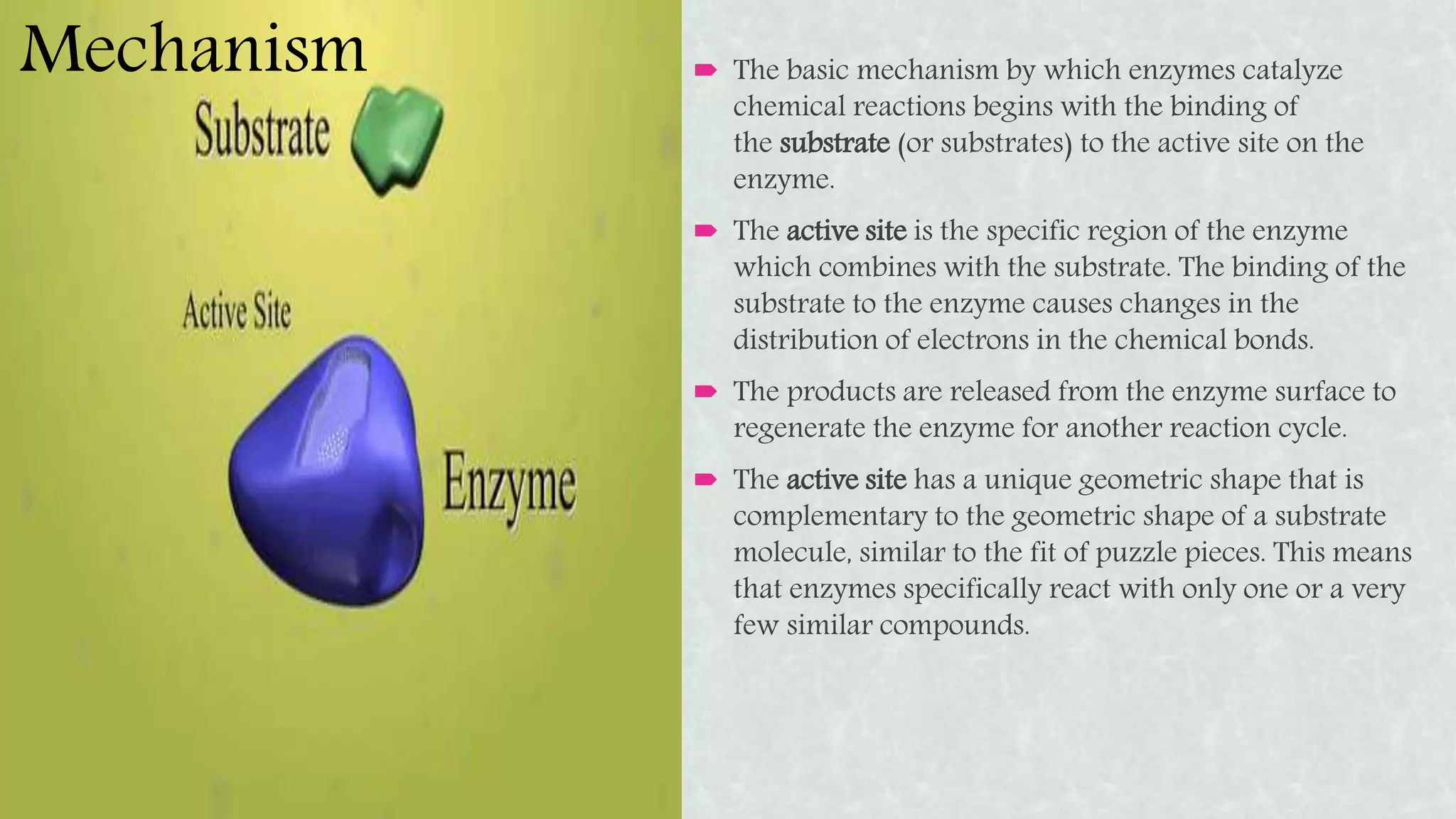
 The basic mechanism by which enzymes catalyze
chemical reactions begins with the binding of
the substrate (or substrates) to the active site on the
enzyme.
 The active site is the specific region of the enzyme
which combines with the substrate. The binding of the
substrate to the enzyme causes changes in the
distribution of electrons in the chemical bonds.
 The products are released from the enzyme surface to
regenerate the enzyme for another reaction cycle.
 The active site has a unique geometric shape that is
complementary to the geometric shape of a substrate
molecule, similar to the fit of puzzle pieces. This means
that enzymes specifically react with only one or a very
few similar compounds.
Mechanism
Lock and Key Theory:
 The specific action of an enzyme with a
single substrate can be explained using
a Lock and Key analogy first postulated in
1894 by Emil Fischer. In this analogy, the
lock is the enzyme and the key is the
substrate. Only the correctly sized key
(substrate) fits into the key hole (active
site) of the lock (enzyme).
 Smaller keys, larger keys, or incorrectly
positioned teeth on keys (incorrectly
shaped or sized substrate molecules) do
not fit into the lock (enzyme). Only the
correctly shaped key opens a particular
lock. This is illustrated in graphic on the
left.
Induced Fit Theory:
 Not all experimental evidence can be
adequately explained by using the so-
called rigid enzyme model assumed by
the lock and key theory. For this reason,
a modification called the induced-fit
theory has been proposed.
 The induced-fit theory assumes that the
substrate plays a role in determining the
final shape of the enzyme and that the
enzyme is partially flexible.
 This explains why certain compounds
can bind to the enzyme but do not react
because the enzyme has been distorted
too much.
The effect of substrate concentration on
enzyme activity
A simple chemical reaction with a single substrate shows a linear
relationship between the rate of formation of product and the
concentration of substrate, as shown below:
Km + Vmax
For an enzyme-catalysed reaction, there is usually a hyperbolic relationship between the
rate of reaction and the concentration of substrate, as shown below:
• At low concentration of substrate, there is a steep increase
in the rate of reaction with increasing substrate
concentration.
• The catalytic site of the enzyme is empty, waiting for
substrate to bind, for much of the time, and the rate at
which product can be formed is limited by the
concentration of substrate which is available.
• As the concentration of substrate increases, the enzyme
becomes saturated with substrate. As soon as the catalytic
site is empty, more substrate is available to bind and
undergo reaction.
• The rate of formation of product now depends on the
activity of the enzyme itself, and adding more substrate
will not affect the rate of the reaction to any significant
effect.
The rate of reaction when the enzyme is saturated
with substrate is the maximum rate of
reaction, Vmax.
The relationship between rate of reaction and
concentration of substrate depends on the affinity
of the enzyme for its substrate. This is usually
expressed as the Km (Michaelis constant) of the
enzyme, an inverse measure of affinity.
For practical purposes, Km is the
concentration of substrate which
permits the enzyme to achieve half
Vmax.
An enzyme with a high Km has a low affinity for its
substrate, and requires a greater concentration of
substrate to achieve Vmax."
The importance of determining Km and Vmax
The Km of an enzyme, relative to the concentration of its substrate under normal conditions permits prediction of
whether or not the rate of formation of product will be affected by the availability of substrate.
An enzyme with a low Km relative to the physiological
concentration of substrate, as shown above, is normally
saturated with substrate, and will act at a more or less
constant rate, regardless of variations in the
concentration of substrate within the physiological
range.
An enzyme with a high Km relative
to the physiological concentration of
substrate, as shown above, is not
normally saturated with substrate,
and its activity will vary as the
concentration of substrate varies, so
that the rate of formation of product
will depend on the availability of
substrate.
If two enzymes, in different
pathways, compete for the
same substrate, then knowing
the values of Km and Vmax for
both enzymes permits
prediction of the metabolic fate
of the substrate and the relative
amount that will flow through
each pathway under various
conditions.
THANKYOU
REFRENCES:
 http://www.sbcs.qmul.ac.uk/iubmb/enzyme/rules.html
 https://www.creative-
enzymes.com/resource/enzymes-functions_2.html
 http://www.biotopics.co.uk/other/enzyme.html
 https://www.ucl.ac.uk/~ucbcdab/enzass/substrate.htm

Enzymes and their properties

  • 1.
    Prepared By:  Mariamrafiq malik The Biocatalysts EnzymesCourse : Biochemistry – 1 Course Incharge : Dr. Suad Naheed
  • 2.
    Enzymesare protein moleculesincells which work as catalysts. Enzymes speedup chemical reactionsin the body, but do not get used up in the process.  Almost all biochemical reactions in living things need enzymes. With an enzyme, chemical reactions go much faster than they would without the enzyme. The substancesat the start of the reaction are called substrates. The substances at the end of the reaction are the products. Enzymes work on the substrates, and turn them into products.  The first enzyme was found in 1833, by Anselme Payen. Introduction
  • 3.
    Enzymesare large moleculesmade from many amino acids.  The amino acids link together in a long chain, which is folded up into a complex structure. Enzymes have a part which holds the substrate:a "claw, cleft, hollow or knob to grasp, hold, stretchand bend the molecule it acts on, the substrate"
  • 4.
    There are thousandsof different enzymes. Enzymes have names which show what they do. Enzyme names usually end in –aseto show that they are enzymes. Examples of this include ATP synthase.  It makes a chemical called ATP. Another example is DNA polymerase. It reads an intact DNA strand and uses it as a template to make a new strand. One example of an enzyme is amylase, found in saliva. It breaks down starchmolecules into smaller glucoseand maltose molecules. Another kind of enzyme is lipase. It breaks down fatsinto smaller molecules. The proteasesare a whole class of enzymes. They break down other enzymes and proteins back into amino acids. Nucleasesare enzymes that cut DNA or RNA, often in specific place in the molecule.
  • 5.
     Enzymes arenot only for breakinglarge chemicalsinto smaller chemicals. Other enzymes take smaller chemicalsand build them up into bigger chemicals, and do many other chemical tasks.  Most enzymes will not work unless the temperatureand pHare just right. In mammals the right temperature is usuallyabout 37oC degrees(body temperature).  The correct pH can vary greatly. Pepsin is an example of an enzyme that works best when pH is about 1.5.  Heating an enzyme above a certaintemperature will destroy the enzyme permanently.It will be broken down by protease and the chemicals will be used again.
  • 6.
    Some chemicals canhelp an enzyme do its job even better. These are called activators. Sometimes, a chemical can slow down an enzyme or even make the enzyme not work at all. These are called inhibitors. Most drugs are chemicals that either speed up or slow down some enzyme in the human body.
  • 7.
    Enzymes are ableto do various and numerous jobs, which can be roughly sorted into two types: biological functions and industrial applications. On the biological aspect, enzymes are instrumental substances to many functions in living organisms. They can move parts of a cell’s internal structure and reorganize them to regulate cell activities. They deliver packages from one part to another inside cells. They pull chromosomes apart when the cells undergo mitosis. They pull cilia to trigger cell movement or to help cells move mucus up your airway as a routine to keep the airway clear. Common enzymes involved in these movement mentioned above are myosin ATPase, kinesin ATPase, and dynein ATPase. Functions
  • 8.
    They can generateenergy for living organisms. Adenosine triphosphate, also known as ATP, is the main storage form of chemical energy. ATP is a charged battery that can release energy that powers biological activities. Enzymes are the transformer to turn energy into proper chemical forms and store it in ATP molecules. Most of these enzymes are called ATP synthases, which act as ion pumps through passive transport mechanisms.
  • 9.
    Many nutritional ingredientsare in the form of large molecules such as sugar, proteins, and fat, which cannot be up taken easily by human body. Hence, these ingredients are broken down by enzymes into smaller pieces before absorption, and this process is called catabolism.
  • 10.
    In addition, enzymesare the important players in many other functions, including immune responses, hormone and neural signal transduction and regulation, and aging processes.
  • 11.
    Beer brewing. Manyenzymes are involved in production in a brewery. These enzymes work in a chain or synergy to give the correct levels of alcohols and carbohydrates for the best quality and flavor. The list is long but not exhaustive: amylases, glucanases, proteases, beta glucanases, arabinoxylans, amyloglucosidases, and acetolactate decarboxylases. Food processing.Amylases from fungi and plants are used in the production of sugars from starch in making corn syrup. Catalytic enzymes are used in breaking down raw plant tissues into dietary fibers, removing lactose from milk for lactose-intolerant consumers, and in the baking process when yeast raises the dough. Applications
  • 12.
    Dairy industry. Amylases,proteases, and lipases are often used to treat milk. These enzyme pre-digest carbohydrates, proteins, and fats before human consumption, so that our bodies absorbthese nutrition conveniently. Lipases are also used in ripening blue-mold cheese, and some other enzymes could be used to kill the bacteria in the milk. Meat tenderizing. As a modern culinary art, papain is often used to soften meats before cooking, which give a tender and smooth texture of the final dishes.
  • 13.
    Paper industry. Enzymes likeamylases, xylanases, and cellulases can lower the viscosity of pulp and remove lignin in order to soften and brighten paper. Biofuel industry. Enzymes, such as cellulases, can assist the conversion of biomass to cellulosic ethanol, which is then used in automobile gasoline. Some esterases are also used to convert natural plant oils into hydrocarbons that can be used as or blended in fuels to reduce carbon emission.
  • 14.
    Cleaning industry. Proteases,amylases, lipases and cellulasesare often used in cleaning products, such as laundry detergents and dish soaps to assist removal of protein, oil, and greasy stains. They can also act as fabric conditioners. Rubber industry. Catalase enzymes can convert latex into foam rubber.
  • 15.
    Molecular biology. DNAligase and polymerases are now widely used in genetic engineering, pharmaceutical, structural biology, and also play an important role in forensic sciences.
  • 16.
    Class 1. Oxidoreductases. Tothis class belong all enzymes catalysing oxidoreduction reactions. The substrate that is oxidized is regarded as hydrogen donor. The systematic name is based on donor:acceptor oxidoreductase. The common name will be dehydrogenase, wherever this is possible; as an alternative, reductase can be used. Oxidase is only used in cases where O2 is the acceptor. Class 2. Transferases. Transferases are enzymes transferring a group, e.g. a methyl group or a glycosyl group, from one compound (generally regarded as donor) to another compound (generally regarded as acceptor). The systematic names are formed according to the scheme donor:acceptor grouptransferase. The common names are normally formed according to acceptor grouptransferase or donor grouptransferase. In many cases, the donor is a cofactor (coenzyme) charged with the group to be transferred. Classes
  • 17.
    Class 3. Hydrolases. Theseenzymes catalyse the hydrolytic cleavage of C-O, C-N, C-C and some other bonds, including phosphoric anhydride bonds. Although the systematic name always includes hydrolase, the common name is, in many cases, formed by the name of the substrate with the suffix -ase. It is understood that the name of the substrate with this suffix means a hydrolytic enzyme. Class 4. Lyases. Lyases are enzymes cleaving C-C, C-O, C-N, and other bonds by elimination, leaving double bonds or rings, or conversely adding groups to double bonds. The systematic name is formed according to the pattern substrate group-lyase.
  • 18.
     The basicmechanism by which enzymes catalyze chemical reactions begins with the binding of the substrate (or substrates) to the active site on the enzyme.  The active site is the specific region of the enzyme which combines with the substrate. The binding of the substrate to the enzyme causes changes in the distribution of electrons in the chemical bonds.  The products are released from the enzyme surface to regenerate the enzyme for another reaction cycle.  The active site has a unique geometric shape that is complementary to the geometric shape of a substrate molecule, similar to the fit of puzzle pieces. This means that enzymes specifically react with only one or a very few similar compounds. Mechanism
  • 19.
    Lock and KeyTheory:  The specific action of an enzyme with a single substrate can be explained using a Lock and Key analogy first postulated in 1894 by Emil Fischer. In this analogy, the lock is the enzyme and the key is the substrate. Only the correctly sized key (substrate) fits into the key hole (active site) of the lock (enzyme).  Smaller keys, larger keys, or incorrectly positioned teeth on keys (incorrectly shaped or sized substrate molecules) do not fit into the lock (enzyme). Only the correctly shaped key opens a particular lock. This is illustrated in graphic on the left.
  • 20.
    Induced Fit Theory: Not all experimental evidence can be adequately explained by using the so- called rigid enzyme model assumed by the lock and key theory. For this reason, a modification called the induced-fit theory has been proposed.  The induced-fit theory assumes that the substrate plays a role in determining the final shape of the enzyme and that the enzyme is partially flexible.  This explains why certain compounds can bind to the enzyme but do not react because the enzyme has been distorted too much.
  • 21.
    The effect ofsubstrate concentration on enzyme activity A simple chemical reaction with a single substrate shows a linear relationship between the rate of formation of product and the concentration of substrate, as shown below: Km + Vmax
  • 22.
    For an enzyme-catalysedreaction, there is usually a hyperbolic relationship between the rate of reaction and the concentration of substrate, as shown below: • At low concentration of substrate, there is a steep increase in the rate of reaction with increasing substrate concentration. • The catalytic site of the enzyme is empty, waiting for substrate to bind, for much of the time, and the rate at which product can be formed is limited by the concentration of substrate which is available. • As the concentration of substrate increases, the enzyme becomes saturated with substrate. As soon as the catalytic site is empty, more substrate is available to bind and undergo reaction. • The rate of formation of product now depends on the activity of the enzyme itself, and adding more substrate will not affect the rate of the reaction to any significant effect.
  • 23.
    The rate ofreaction when the enzyme is saturated with substrate is the maximum rate of reaction, Vmax. The relationship between rate of reaction and concentration of substrate depends on the affinity of the enzyme for its substrate. This is usually expressed as the Km (Michaelis constant) of the enzyme, an inverse measure of affinity. For practical purposes, Km is the concentration of substrate which permits the enzyme to achieve half Vmax. An enzyme with a high Km has a low affinity for its substrate, and requires a greater concentration of substrate to achieve Vmax."
  • 24.
    The importance ofdetermining Km and Vmax The Km of an enzyme, relative to the concentration of its substrate under normal conditions permits prediction of whether or not the rate of formation of product will be affected by the availability of substrate. An enzyme with a low Km relative to the physiological concentration of substrate, as shown above, is normally saturated with substrate, and will act at a more or less constant rate, regardless of variations in the concentration of substrate within the physiological range.
  • 25.
    An enzyme witha high Km relative to the physiological concentration of substrate, as shown above, is not normally saturated with substrate, and its activity will vary as the concentration of substrate varies, so that the rate of formation of product will depend on the availability of substrate. If two enzymes, in different pathways, compete for the same substrate, then knowing the values of Km and Vmax for both enzymes permits prediction of the metabolic fate of the substrate and the relative amount that will flow through each pathway under various conditions.
  • 26.
    THANKYOU REFRENCES:  http://www.sbcs.qmul.ac.uk/iubmb/enzyme/rules.html  https://www.creative- enzymes.com/resource/enzymes-functions_2.html http://www.biotopics.co.uk/other/enzyme.html  https://www.ucl.ac.uk/~ucbcdab/enzass/substrate.htm