VIGNAN PHARMACY COLLEGE
Vadlamudi – 522 213, Guntur (Dt), Andhra Pradesh,
INDIA
1
PRESENTED BY
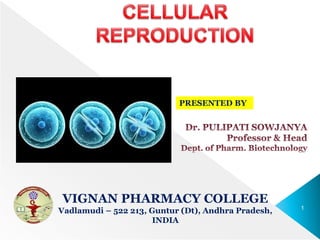
Cells reproduce by dividing into two in the process called
cell division
Each dividing cell is called mother cell or parent cell,
and its descendants are called daughter cells
The parent cell transmits copies of its hereditary
information (DNA) to its daughter cells which in turn,
pass it to their own daughter cells, becoming yet another
parent cell, and so on and so forth
2
Vignan Pharmacy College, Vadlamudi, Guntur (Dt)
As a cell prepares to divide, the DNA inside
the nucleus becomes organized into
chromosomes
This is to ensure that both of the new cells
get all of the genetic information from the
original cell
3
Vignan Pharmacy College, Vadlamudi, Guntur (Dt)
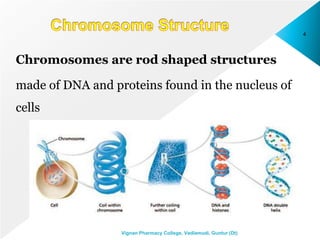
Chromosomes are rod shaped structures
made of DNA and proteins found in the nucleus of
cells
4
Vignan Pharmacy College, Vadlamudi, Guntur (Dt)
Chromosomes consist of 2 identical
halves called chromatids
– When a cell divides, each of the two
new cells will receive one chromatid
• Two chromatids are attached at the
centromere
Between cell divisions, DNA is not so
tightly
coiled
• This form is called chromatin
5
Vignan Pharmacy College, Vadlamudi, Guntur (Dt)
Animal chromosomes are categorized as either sex
chromosomes or autosomes
– Sex chromosomes determine the sex of an
organism
• In humans, sex chromosomes are X or Y
(females = XX, males = XY)
– All of the other chromosomes are autosomes
Every cell of an organism produced by sexual reproduction
has two copies of each autosome (one from each parent)
• The two copies are called homologous chromosomes
– Same size and shape and carry genes for the same traits
6
Vignan Pharmacy College, Vadlamudi, Guntur (Dt)
Diploid – cells that have
2 sets of chromosomes (46 total in humans)
Haploid – cells that only
have 1 set of chromosomes (23 total in humans)
• Only sperm and egg cells are haploid
7
Vignan Pharmacy College, Vadlamudi, Guntur (Dt)
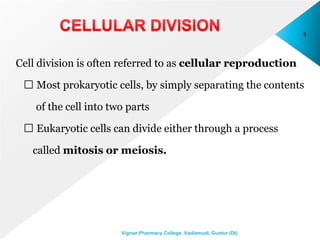
Cell division is often referred to as cellular reproduction
Most prokaryotic cells, by simply separating the contents
of the cell into two parts
Eukaryotic cells can divide either through a process
called mitosis or meiosis.
8
Vignan Pharmacy College, Vadlamudi, Guntur (Dt)
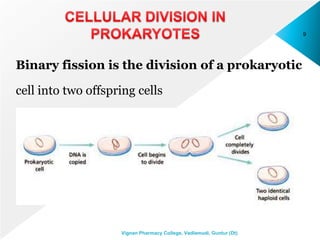
Binary fission is the division of a prokaryotic
cell into two offspring cells
9
Vignan Pharmacy College, Vadlamudi, Guntur (Dt)
Two types of cell division
– Mitosis results in new cells that are
identical to the original cell
– Meiosis occurs during the formation of
gametes (haploid reproductive cells)
10
Vignan Pharmacy College, Vadlamudi, Guntur (Dt)
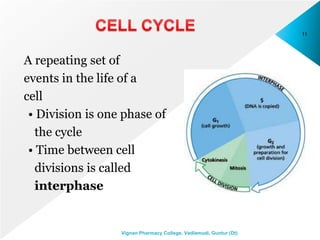
A repeating set of
events in the life of a
cell
• Division is one phase of
the cycle
• Time between cell
divisions is called
interphase
11
Vignan Pharmacy College, Vadlamudi, Guntur (Dt)
1. G1 phase – offspring cells grow to mature
size
2. S phase – the cell’s DNA is copied
3. G2 phase – cell prepares for cell division
• Cells can exit the cycle and enter into the G0
phase to stop dividing (ex: fully developed brain
cells)
12
Vignan Pharmacy College, Vadlamudi, Guntur (Dt)
13
Vignan Pharmacy College, Vadlamudi, Guntur (Dt)
14
Vignan Pharmacy College, Vadlamudi, Guntur (Dt)
Prophase (Gk. Pro – before or first,
phasis – appearance or stage
DNA condenses into chromosomes
• Nuclear membrane breaks down
• Centrosomes form and
microtubules grow from them (called
the mitotic spindle)
15
Vignan Pharmacy College, Vadlamudi, Guntur (Dt)
Metaphase (Gk. Meta – after or
second, phasis – stage)
Chromosomes line up in
the middle of the cell
• Spindle fibers attach to
the centromere of each
chromosome
16
Vignan Pharmacy College, Vadlamudi, Guntur (Dt)
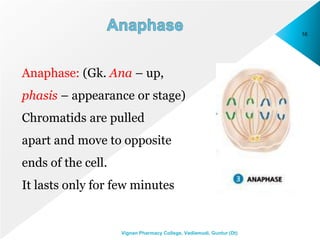
Anaphase: (Gk. Ana – up,
phasis – appearance or stage)
Chromatids are pulled
apart and move to opposite
ends of the cell.
It lasts only for few minutes
17
Vignan Pharmacy College, Vadlamudi, Guntur (Dt)
Telophase: (Gk. Telos – end,
phasis – appearance or stage
Chromosomes reach opposite
ends of the cell
• Spindle fibers disassemble
• Chromosomes unravel
• Nuclear membranes reform
18
Vignan Pharmacy College, Vadlamudi, Guntur (Dt)
Surface to Volume Ratio: Increase in cell size reduces surface area
to volume ratio and decreases efficiency in exchange of materials.
Nucleo-cytoplasmic Ratio: Nucleus controls all metabolic activities
occuring in the cytoplasm. Increased volume of cytoplasm due to
cell growth reduces the nucleo-cytoplasmic ratio.
Equitable distribution of genetic material: Qualitative and
quantitative equitable distribution of chromosomes in all the body
cells of an organism by mitotic divisions maintains similar genetic
constitution in them.
19
Vignan Pharmacy College, Vadlamudi, Guntur (Dt)
Growth of Multicellular Organisms: It occurs due to increase in
number of cells rather than increase in cell size because smaller
cells are more efficient.
Asexual Reproduction: It helps in vegetative propagation of
plants and asexual reproduction in lower organisms. Unicellular
organisms multiply by this method.
Healing of wounds: Mitotic divisions in healthy cells surrounding
the area of injury help in healing the wounds.
Regeneration: The lost organs in plants and animals like
earthworm, tail of lizard can be regenerated by mitosis.
20
Vignan Pharmacy College, Vadlamudi, Guntur (Dt)
A cell spends most of its time in interphase
• What tells the cells to exit interphase and
begin dividing?
• There are three main checkpoints that act as
“traffic signals” for the cell to divide or not to
divide
21
Vignan Pharmacy College, Vadlamudi, Guntur (Dt)
1. Cell growth (G1)
checkpoint – controls whether
the cell will divide
2. DNA synthesis (G2)
checkpoint – make sure DNA
was copied properly
3. Mitosis checkpoint –
signals tell the cell to exit mitosis
22
Vignan Pharmacy College, Vadlamudi, Guntur (Dt)
• If a mutation occurs in one of the genes that
regulates the cell cycle, cell growth and
division could be disrupted
• This disruption could lead to cancer – the
uncontrolled growth of cells
Vignan Pharmacy College, Vadlamudi, Guntur (Dt) 23
https://www.youtube.com/watch?v=DwAFZb8juMQ
24
Vignan Pharmacy College, Vadlamudi, Guntur (Dt)
• A process of nuclear division that reduces the
number of chromosomes in new cells to half
the number in the original cell
25
Vignan Pharmacy College, Vadlamudi, Guntur (Dt)
• Meiosis produces gametes, which are haploid
reproductive cells
• Cells preparing to divide by meiosis undergo the
G1, S, and G2 phases of interphase
– Cells begin meiosis with a duplicate set of
chromosomes, just like mitosis
• Cells undergoing meiosis divide twice, resulting
in 4 haploid (1n) cells
26
Vignan Pharmacy College, Vadlamudi, Guntur (Dt)
• First cell division = Meiosis I
– Prophase I, Metaphase I, Anaphase I, Telophase I
and Cytokinesis I
• Second cell division = Meiosis II
– Prophase II, Metaphase II, Anaphase II,
Telophase II and Cytokinesis II
27
Vignan Pharmacy College, Vadlamudi, Guntur (Dt)
28
Vignan Pharmacy College, Vadlamudi, Guntur (Dt)
29
Vignan Pharmacy College, Vadlamudi, Guntur (Dt)
• DNA coils tightly into chromosomes
• Spindle fibers appear
• Nuclear membrane is assembles
• Synapsis occurs - homologous chromosomes
line up next to each other
– Each pair is called a tetrad
30
Vignan Pharmacy College, Vadlamudi, Guntur (Dt)
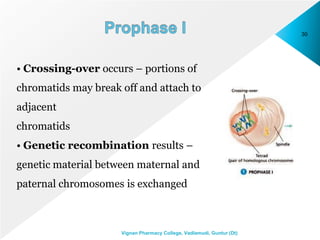
• Crossing-over occurs – portions of
chromatids may break off and attach to
adjacent
chromatids
• Genetic recombination results –
genetic material between maternal and
paternal chromosomes is exchanged
31
Vignan Pharmacy College, Vadlamudi, Guntur (Dt)
• Tetrads line up along
the middle of the cell
• Spindle fibers attach to
the centromere of each
homologous
chromosome
32
Vignan Pharmacy College, Vadlamudi, Guntur (Dt)
• Each homologous chromosome
moves to an opposite end of the
cell
• Random separation of homologous
chromosomes is called independent
assortment and results in genetic
variation
33
Vignan Pharmacy College, Vadlamudi, Guntur (Dt)
• Chromosomes reachopposite
ends of thecell and cytokinesis
begins
• Two new cells areproduced, each
containing onechromosome from
each homologous pair (haploid –
1n)
34
Vignan Pharmacy College, Vadlamudi, Guntur (Dt)
• Spindle fibers form and
begin to move the
chromosomes toward
the midline of the
dividing cell
35
Vignan Pharmacy College, Vadlamudi, Guntur (Dt)
• Chromosomes move to
the midline of the
dividing cell
36
Vignan Pharmacy College, Vadlamudi, Guntur (Dt)
• Chromatids separate
and move toward
opposite ends of the
cell
37
Vignan Pharmacy College, Vadlamudi, Guntur (Dt)
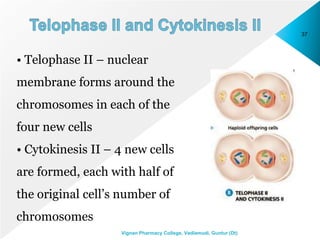
• Telophase II – nuclear
membrane forms around the
chromosomes in each of the
four new cells
• Cytokinesis II – 4 new cells
are formed, each with half of
the original cell’s number of
chromosomes
38
Vignan Pharmacy College, Vadlamudi, Guntur (Dt)
• Telophase II – nuclear
membrane forms around the
chromosomes in each of the
four new cells
• Cytokinesis II – 4 new cells
are formed, each with half of
the original cell’s number of
chromosomes
39
Vignan Pharmacy College, Vadlamudi, Guntur (Dt)
MITOSIS
Occurs in somatic or body
cells
Direct cellular division
Produce two diploid
daughter cells
The daughter cells are
exactly alike
MEIOSIS
Occurs in reproductive
cells or gametes
Has two successive division
(meiosis I and meiosis II)
Produce four haploid
daughter cells
The daughter cells are not
all alike
Vignan Pharmacy College, Vadlamudi, Guntur (Dt) 40
https://www.youtube.com/watch?v=-Lx0oLPnRQg&t=81s
41
Vignan Pharmacy College, Vadlamudi, Guntur (Dt)
Gametes (egg & sperm)
form
Four haploid cells with one
copy of each chromosome
One allele of each gene
Different combinations of
alleles for different genes
along the chromosome
42
Vignan Pharmacy College, Vadlamudi, Guntur (Dt)
• In animals, the only cells that
divide by meiosis are those
that produce gametes within
the reproductive organs
– In humans – testes
(males) and ovaries (females)
43
Vignan Pharmacy College, Vadlamudi, Guntur (Dt)
SPERMATOGENESIS
• In the testes – male gametes
known as sperm cells or
spermatozoa are produced
• One diploid cell divides
meiotically to form four haploid
cells called spermatids – each
develops into a mature sperm cells
44
Vignan Pharmacy College, Vadlamudi, Guntur (Dt)
OOGENESIS
• Production of mature egg cells, or
ova
• A diploid reproductive cell
divides meiotically to produce one
mature egg cell (ovum) and three
polar bodies which will degenerate
– cytoplasm is not evenly
distributed in cytokinesis
45
Vignan Pharmacy College, Vadlamudi, Guntur (Dt)
• Production of offspring through meiosis and
the union of a sperm and an egg
• Offspring are genetically different because genes
are combined in new ways
• Advantage: enables species to adapt rapidly to
new conditions
46
Vignan Pharmacy College, Vadlamudi, Guntur (Dt)
Sexual Reproduction: Meiosis and fertilization are essential
in the life cycle of sexually reproducing organisms.
Maintenance of Chromosome Number: Fertilization of
haploid gametes doubles the chromosome number in the
zygote. Meiosis halves the chromosome number during
different stages of life cycle. Thus, it helps in maintaining the
same chromosome number in a species.
Segregation of Alleles: Meiosis helps in segregation of
alleles of different characters due to disjunction of
homologous chromosomes of each bivalent in meiosis-I.
47
Vignan Pharmacy College, Vadlamudi, Guntur (Dt)
Crossing over: Crossing over between non-sister chromatids
of paternal and maternal homologous chromosomes of each
bivalent during prophase-I of meiosis helps in recombination
of linked genes.
Gene Mutations: The chances of gene mutations increase
during meiosis due to breakage and reunion of DNA
molecules during crossing over. Mutations are fountain head
of all variations.
Evolution: Variations produced during meiosis from the basis
of evolution due to natural selection of better recombinants.
48
Vignan Pharmacy College, Vadlamudi, Guntur (Dt)
The cell cycle is regulated to fit the needs of the organism.
Important discoveries in the last decade helped to understand
the regulation of cell cycle and how abnormalities in cell cycle
regulation contribute to the development of cancer.
Gene therapy technique to repair the genetic defects that cause
cancer.
49

Cellular Reproduction

  • 1.
    VIGNAN PHARMACY COLLEGE Vadlamudi– 522 213, Guntur (Dt), Andhra Pradesh, INDIA 1 PRESENTED BY
  • 2.
    Cells reproduce bydividing into two in the process called cell division Each dividing cell is called mother cell or parent cell, and its descendants are called daughter cells The parent cell transmits copies of its hereditary information (DNA) to its daughter cells which in turn, pass it to their own daughter cells, becoming yet another parent cell, and so on and so forth 2 Vignan Pharmacy College, Vadlamudi, Guntur (Dt)
  • 3.
    As a cellprepares to divide, the DNA inside the nucleus becomes organized into chromosomes This is to ensure that both of the new cells get all of the genetic information from the original cell 3 Vignan Pharmacy College, Vadlamudi, Guntur (Dt)
  • 4.
    Chromosomes are rodshaped structures made of DNA and proteins found in the nucleus of cells 4 Vignan Pharmacy College, Vadlamudi, Guntur (Dt)
  • 5.
    Chromosomes consist of2 identical halves called chromatids – When a cell divides, each of the two new cells will receive one chromatid • Two chromatids are attached at the centromere Between cell divisions, DNA is not so tightly coiled • This form is called chromatin 5 Vignan Pharmacy College, Vadlamudi, Guntur (Dt)
  • 6.
    Animal chromosomes arecategorized as either sex chromosomes or autosomes – Sex chromosomes determine the sex of an organism • In humans, sex chromosomes are X or Y (females = XX, males = XY) – All of the other chromosomes are autosomes Every cell of an organism produced by sexual reproduction has two copies of each autosome (one from each parent) • The two copies are called homologous chromosomes – Same size and shape and carry genes for the same traits 6 Vignan Pharmacy College, Vadlamudi, Guntur (Dt)
  • 7.
    Diploid – cellsthat have 2 sets of chromosomes (46 total in humans) Haploid – cells that only have 1 set of chromosomes (23 total in humans) • Only sperm and egg cells are haploid 7 Vignan Pharmacy College, Vadlamudi, Guntur (Dt)
  • 8.
    Cell division isoften referred to as cellular reproduction Most prokaryotic cells, by simply separating the contents of the cell into two parts Eukaryotic cells can divide either through a process called mitosis or meiosis. 8 Vignan Pharmacy College, Vadlamudi, Guntur (Dt)
  • 9.
    Binary fission isthe division of a prokaryotic cell into two offspring cells 9 Vignan Pharmacy College, Vadlamudi, Guntur (Dt)
  • 10.
    Two types ofcell division – Mitosis results in new cells that are identical to the original cell – Meiosis occurs during the formation of gametes (haploid reproductive cells) 10 Vignan Pharmacy College, Vadlamudi, Guntur (Dt)
  • 11.
    A repeating setof events in the life of a cell • Division is one phase of the cycle • Time between cell divisions is called interphase 11 Vignan Pharmacy College, Vadlamudi, Guntur (Dt)
  • 12.
    1. G1 phase– offspring cells grow to mature size 2. S phase – the cell’s DNA is copied 3. G2 phase – cell prepares for cell division • Cells can exit the cycle and enter into the G0 phase to stop dividing (ex: fully developed brain cells) 12 Vignan Pharmacy College, Vadlamudi, Guntur (Dt)
  • 13.
    13 Vignan Pharmacy College,Vadlamudi, Guntur (Dt)
  • 14.
    14 Vignan Pharmacy College,Vadlamudi, Guntur (Dt) Prophase (Gk. Pro – before or first, phasis – appearance or stage DNA condenses into chromosomes • Nuclear membrane breaks down • Centrosomes form and microtubules grow from them (called the mitotic spindle)
  • 15.
    15 Vignan Pharmacy College,Vadlamudi, Guntur (Dt) Metaphase (Gk. Meta – after or second, phasis – stage) Chromosomes line up in the middle of the cell • Spindle fibers attach to the centromere of each chromosome
  • 16.
    16 Vignan Pharmacy College,Vadlamudi, Guntur (Dt) Anaphase: (Gk. Ana – up, phasis – appearance or stage) Chromatids are pulled apart and move to opposite ends of the cell. It lasts only for few minutes
  • 17.
    17 Vignan Pharmacy College,Vadlamudi, Guntur (Dt) Telophase: (Gk. Telos – end, phasis – appearance or stage Chromosomes reach opposite ends of the cell • Spindle fibers disassemble • Chromosomes unravel • Nuclear membranes reform
  • 18.
    18 Vignan Pharmacy College,Vadlamudi, Guntur (Dt) Surface to Volume Ratio: Increase in cell size reduces surface area to volume ratio and decreases efficiency in exchange of materials. Nucleo-cytoplasmic Ratio: Nucleus controls all metabolic activities occuring in the cytoplasm. Increased volume of cytoplasm due to cell growth reduces the nucleo-cytoplasmic ratio. Equitable distribution of genetic material: Qualitative and quantitative equitable distribution of chromosomes in all the body cells of an organism by mitotic divisions maintains similar genetic constitution in them.
  • 19.
    19 Vignan Pharmacy College,Vadlamudi, Guntur (Dt) Growth of Multicellular Organisms: It occurs due to increase in number of cells rather than increase in cell size because smaller cells are more efficient. Asexual Reproduction: It helps in vegetative propagation of plants and asexual reproduction in lower organisms. Unicellular organisms multiply by this method. Healing of wounds: Mitotic divisions in healthy cells surrounding the area of injury help in healing the wounds. Regeneration: The lost organs in plants and animals like earthworm, tail of lizard can be regenerated by mitosis.
  • 20.
    20 Vignan Pharmacy College,Vadlamudi, Guntur (Dt) A cell spends most of its time in interphase • What tells the cells to exit interphase and begin dividing? • There are three main checkpoints that act as “traffic signals” for the cell to divide or not to divide
  • 21.
    21 Vignan Pharmacy College,Vadlamudi, Guntur (Dt) 1. Cell growth (G1) checkpoint – controls whether the cell will divide 2. DNA synthesis (G2) checkpoint – make sure DNA was copied properly 3. Mitosis checkpoint – signals tell the cell to exit mitosis
  • 22.
    22 Vignan Pharmacy College,Vadlamudi, Guntur (Dt) • If a mutation occurs in one of the genes that regulates the cell cycle, cell growth and division could be disrupted • This disruption could lead to cancer – the uncontrolled growth of cells
  • 23.
    Vignan Pharmacy College,Vadlamudi, Guntur (Dt) 23 https://www.youtube.com/watch?v=DwAFZb8juMQ
  • 24.
    24 Vignan Pharmacy College,Vadlamudi, Guntur (Dt) • A process of nuclear division that reduces the number of chromosomes in new cells to half the number in the original cell
  • 25.
    25 Vignan Pharmacy College,Vadlamudi, Guntur (Dt) • Meiosis produces gametes, which are haploid reproductive cells • Cells preparing to divide by meiosis undergo the G1, S, and G2 phases of interphase – Cells begin meiosis with a duplicate set of chromosomes, just like mitosis • Cells undergoing meiosis divide twice, resulting in 4 haploid (1n) cells
  • 26.
    26 Vignan Pharmacy College,Vadlamudi, Guntur (Dt) • First cell division = Meiosis I – Prophase I, Metaphase I, Anaphase I, Telophase I and Cytokinesis I • Second cell division = Meiosis II – Prophase II, Metaphase II, Anaphase II, Telophase II and Cytokinesis II
  • 27.
    27 Vignan Pharmacy College,Vadlamudi, Guntur (Dt)
  • 28.
    28 Vignan Pharmacy College,Vadlamudi, Guntur (Dt)
  • 29.
    29 Vignan Pharmacy College,Vadlamudi, Guntur (Dt) • DNA coils tightly into chromosomes • Spindle fibers appear • Nuclear membrane is assembles • Synapsis occurs - homologous chromosomes line up next to each other – Each pair is called a tetrad
  • 30.
    30 Vignan Pharmacy College,Vadlamudi, Guntur (Dt) • Crossing-over occurs – portions of chromatids may break off and attach to adjacent chromatids • Genetic recombination results – genetic material between maternal and paternal chromosomes is exchanged
  • 31.
    31 Vignan Pharmacy College,Vadlamudi, Guntur (Dt) • Tetrads line up along the middle of the cell • Spindle fibers attach to the centromere of each homologous chromosome
  • 32.
    32 Vignan Pharmacy College,Vadlamudi, Guntur (Dt) • Each homologous chromosome moves to an opposite end of the cell • Random separation of homologous chromosomes is called independent assortment and results in genetic variation
  • 33.
    33 Vignan Pharmacy College,Vadlamudi, Guntur (Dt) • Chromosomes reachopposite ends of thecell and cytokinesis begins • Two new cells areproduced, each containing onechromosome from each homologous pair (haploid – 1n)
  • 34.
    34 Vignan Pharmacy College,Vadlamudi, Guntur (Dt) • Spindle fibers form and begin to move the chromosomes toward the midline of the dividing cell
  • 35.
    35 Vignan Pharmacy College,Vadlamudi, Guntur (Dt) • Chromosomes move to the midline of the dividing cell
  • 36.
    36 Vignan Pharmacy College,Vadlamudi, Guntur (Dt) • Chromatids separate and move toward opposite ends of the cell
  • 37.
    37 Vignan Pharmacy College,Vadlamudi, Guntur (Dt) • Telophase II – nuclear membrane forms around the chromosomes in each of the four new cells • Cytokinesis II – 4 new cells are formed, each with half of the original cell’s number of chromosomes
  • 38.
    38 Vignan Pharmacy College,Vadlamudi, Guntur (Dt) • Telophase II – nuclear membrane forms around the chromosomes in each of the four new cells • Cytokinesis II – 4 new cells are formed, each with half of the original cell’s number of chromosomes
  • 39.
    39 Vignan Pharmacy College,Vadlamudi, Guntur (Dt) MITOSIS Occurs in somatic or body cells Direct cellular division Produce two diploid daughter cells The daughter cells are exactly alike MEIOSIS Occurs in reproductive cells or gametes Has two successive division (meiosis I and meiosis II) Produce four haploid daughter cells The daughter cells are not all alike
  • 40.
    Vignan Pharmacy College,Vadlamudi, Guntur (Dt) 40 https://www.youtube.com/watch?v=-Lx0oLPnRQg&t=81s
  • 41.
    41 Vignan Pharmacy College,Vadlamudi, Guntur (Dt) Gametes (egg & sperm) form Four haploid cells with one copy of each chromosome One allele of each gene Different combinations of alleles for different genes along the chromosome
  • 42.
    42 Vignan Pharmacy College,Vadlamudi, Guntur (Dt) • In animals, the only cells that divide by meiosis are those that produce gametes within the reproductive organs – In humans – testes (males) and ovaries (females)
  • 43.
    43 Vignan Pharmacy College,Vadlamudi, Guntur (Dt) SPERMATOGENESIS • In the testes – male gametes known as sperm cells or spermatozoa are produced • One diploid cell divides meiotically to form four haploid cells called spermatids – each develops into a mature sperm cells
  • 44.
    44 Vignan Pharmacy College,Vadlamudi, Guntur (Dt) OOGENESIS • Production of mature egg cells, or ova • A diploid reproductive cell divides meiotically to produce one mature egg cell (ovum) and three polar bodies which will degenerate – cytoplasm is not evenly distributed in cytokinesis
  • 45.
    45 Vignan Pharmacy College,Vadlamudi, Guntur (Dt) • Production of offspring through meiosis and the union of a sperm and an egg • Offspring are genetically different because genes are combined in new ways • Advantage: enables species to adapt rapidly to new conditions
  • 46.
    46 Vignan Pharmacy College,Vadlamudi, Guntur (Dt) Sexual Reproduction: Meiosis and fertilization are essential in the life cycle of sexually reproducing organisms. Maintenance of Chromosome Number: Fertilization of haploid gametes doubles the chromosome number in the zygote. Meiosis halves the chromosome number during different stages of life cycle. Thus, it helps in maintaining the same chromosome number in a species. Segregation of Alleles: Meiosis helps in segregation of alleles of different characters due to disjunction of homologous chromosomes of each bivalent in meiosis-I.
  • 47.
    47 Vignan Pharmacy College,Vadlamudi, Guntur (Dt) Crossing over: Crossing over between non-sister chromatids of paternal and maternal homologous chromosomes of each bivalent during prophase-I of meiosis helps in recombination of linked genes. Gene Mutations: The chances of gene mutations increase during meiosis due to breakage and reunion of DNA molecules during crossing over. Mutations are fountain head of all variations. Evolution: Variations produced during meiosis from the basis of evolution due to natural selection of better recombinants.
  • 48.
    48 Vignan Pharmacy College,Vadlamudi, Guntur (Dt) The cell cycle is regulated to fit the needs of the organism. Important discoveries in the last decade helped to understand the regulation of cell cycle and how abnormalities in cell cycle regulation contribute to the development of cancer. Gene therapy technique to repair the genetic defects that cause cancer.
  • 49.