Immunization for various
diseases & Immunization
schedule
Dr. PULIPATI SOWJANYA
Professor & Head
Dept. of Pharmaceutical Biotechnology
Vignan Pharmacy College
Vadlamudi, Guntur (Dt)
Presented By
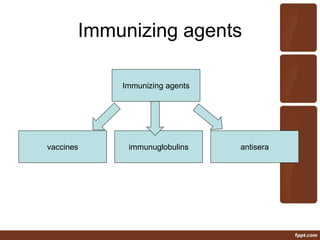
Immunizing agents
Immunizing agents
antiseraimmunuglobulinsvaccines
Vaccination
• Vaccination is a method of giving
antigen to stimulate the immune
response through active immunization.
• A vaccine is an immuno-biological
substance designed to produce specific
protection against a given disease.
• A vaccine is “antigenic” but not
“pathogenic”.
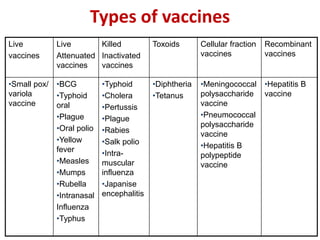
Types of vaccines
Live
vaccines
Live
Attenuated
vaccines
Killed
Inactivated
vaccines
Toxoids Cellular fraction
vaccines
Recombinant
vaccines
•Small pox/
variola
vaccine
•BCG
•Typhoid
oral
•Plague
•Oral polio
•Yellow
fever
•Measles
•Mumps
•Rubella
•Intranasal
Influenza
•Typhus
•Typhoid
•Cholera
•Pertussis
•Plague
•Rabies
•Salk polio
•Intra-
muscular
influenza
•Japanise
encephalitis
•Diphtheria
•Tetanus
•Meningococcal
polysaccharide
vaccine
•Pneumococcal
polysaccharide
vaccine
•Hepatitis B
polypeptide
vaccine
•Hepatitis B
vaccine
Types of vaccines
• Live vaccines
• Attenuated live vaccines
• Inactivated (killed vaccines)
• Toxoids
• Polysaccharide and polypeptide (cellular
fraction) vaccines
• Surface antigen (recombinant) vaccines.
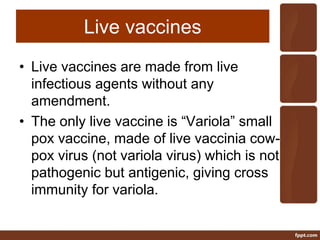
Live vaccines
• Live vaccines are made from live
infectious agents without any
amendment.
• The only live vaccine is “Variola” small
pox vaccine, made of live vaccinia cow-
pox virus (not variola virus) which is not
pathogenic but antigenic, giving cross
immunity for variola.
Live attenuated (Avirulent) vaccines
• Virulent pathogenic organisms are treated to
become attenuated and avirulent but antigenic.
They have lost their capacity to induce full-
blown disease but retain their immunogenicity.
• Live attenuated vaccines should not be
administered to persons with suppressed
immune response due to:
– Leukemia and lymphoma
– Other malignancies
– Receiving corticosteroids and anti-metabolic agents
– Radiation
– pregnancy
Inactivated (killed) vaccines
• Organisms are killed or inactivated by
heat or chemicals but remain antigenic.
• They are usually safe but less effective
than live attenuated vaccines.
• The only absolute contraindication to
their administration is a severe local or
general reaction to a previous dose.
Toxoids
• They are prepared by detoxifying the
exotoxins of some bacteria rendering them
antigenic but not pathogenic.
• Adjuvant (e.g. alum precipitation) is used to
increase the potency of vaccine.
• The antibodies produces in the body as a
consequence of toxoid administration
neutralize the toxic moiety produced during
infection rather than act upon the organism
itself.
• In general toxoids are highly efficacious and
safe immunizing agents.
Polysaccharide and polypeptide
(cellular fraction) vaccines
• They are prepared from extracted cellular
fractions e.g. meningococcal vaccine from
the polysaccharide antigen of the cell wall,
the pneumococcal vaccine from the
polysaccharide contained in the capsule of
the organism, and hepatitis B polypeptide
vaccine.
• Their efficacy and safety appear to be high.
Surface antigen (recombinant)
vaccines
• It is prepared by cloning HBsAg gene
in yeast cells where it is expressed.
HBsAg produced is then used for
vaccine preparations.
• Their efficacy and safety also appear
to be high.
Routes of administration
• Deep subcutaneous or intramuscular
route (most vaccines)
• Oral route (sabin vaccine, oral BCG
vaccine)
• Intradermal route (BCG vaccine)
• Scarification (small pox vaccine)
• Intranasal route (live attenuated
influenza vaccine)
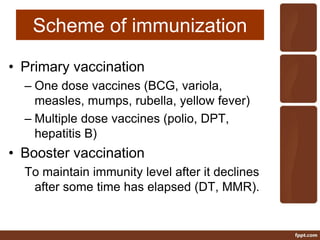
Scheme of immunization
• Primary vaccination
– One dose vaccines (BCG, variola,
measles, mumps, rubella, yellow fever)
– Multiple dose vaccines (polio, DPT,
hepatitis B)
• Booster vaccination
To maintain immunity level after it declines
after some time has elapsed (DT, MMR).
Periods of maintained immunity
due to vaccines
• Short period (months): cholera vaccine
• Two years: TAB vaccine
• Three to five years: DPT vaccine
• Five or more years: BCG vaccine
• Ten years: yellow fever vaccine
• Solid immunity: measles, mumps, and
rubella vaccines.
Levels of effectiveness
• Absolutely protective(100%): yellow fever
vaccine
• Almost absolutely protective (99%): Variola,
measles, mumps, rubella vaccines, and
diphtheria and tetanus toxoids.
• Highly protective (80-95%): polio, BCG,
Hepatitis B, and pertussis vaccines.
• Moderately protective (40-60%) TAB, cholera
vaccine and influenza killed vaccine.
Immunization for various diseases

Immunization for various diseases

  • 1.
    Immunization for various diseases& Immunization schedule Dr. PULIPATI SOWJANYA Professor & Head Dept. of Pharmaceutical Biotechnology Vignan Pharmacy College Vadlamudi, Guntur (Dt) Presented By
  • 2.
  • 4.
    Vaccination • Vaccination isa method of giving antigen to stimulate the immune response through active immunization. • A vaccine is an immuno-biological substance designed to produce specific protection against a given disease. • A vaccine is “antigenic” but not “pathogenic”.
  • 5.
    Types of vaccines Live vaccines Live Attenuated vaccines Killed Inactivated vaccines ToxoidsCellular fraction vaccines Recombinant vaccines •Small pox/ variola vaccine •BCG •Typhoid oral •Plague •Oral polio •Yellow fever •Measles •Mumps •Rubella •Intranasal Influenza •Typhus •Typhoid •Cholera •Pertussis •Plague •Rabies •Salk polio •Intra- muscular influenza •Japanise encephalitis •Diphtheria •Tetanus •Meningococcal polysaccharide vaccine •Pneumococcal polysaccharide vaccine •Hepatitis B polypeptide vaccine •Hepatitis B vaccine
  • 6.
    Types of vaccines •Live vaccines • Attenuated live vaccines • Inactivated (killed vaccines) • Toxoids • Polysaccharide and polypeptide (cellular fraction) vaccines • Surface antigen (recombinant) vaccines.
  • 7.
    Live vaccines • Livevaccines are made from live infectious agents without any amendment. • The only live vaccine is “Variola” small pox vaccine, made of live vaccinia cow- pox virus (not variola virus) which is not pathogenic but antigenic, giving cross immunity for variola.
  • 8.
    Live attenuated (Avirulent)vaccines • Virulent pathogenic organisms are treated to become attenuated and avirulent but antigenic. They have lost their capacity to induce full- blown disease but retain their immunogenicity. • Live attenuated vaccines should not be administered to persons with suppressed immune response due to: – Leukemia and lymphoma – Other malignancies – Receiving corticosteroids and anti-metabolic agents – Radiation – pregnancy
  • 9.
    Inactivated (killed) vaccines •Organisms are killed or inactivated by heat or chemicals but remain antigenic. • They are usually safe but less effective than live attenuated vaccines. • The only absolute contraindication to their administration is a severe local or general reaction to a previous dose.
  • 10.
    Toxoids • They areprepared by detoxifying the exotoxins of some bacteria rendering them antigenic but not pathogenic. • Adjuvant (e.g. alum precipitation) is used to increase the potency of vaccine. • The antibodies produces in the body as a consequence of toxoid administration neutralize the toxic moiety produced during infection rather than act upon the organism itself. • In general toxoids are highly efficacious and safe immunizing agents.
  • 11.
    Polysaccharide and polypeptide (cellularfraction) vaccines • They are prepared from extracted cellular fractions e.g. meningococcal vaccine from the polysaccharide antigen of the cell wall, the pneumococcal vaccine from the polysaccharide contained in the capsule of the organism, and hepatitis B polypeptide vaccine. • Their efficacy and safety appear to be high.
  • 12.
    Surface antigen (recombinant) vaccines •It is prepared by cloning HBsAg gene in yeast cells where it is expressed. HBsAg produced is then used for vaccine preparations. • Their efficacy and safety also appear to be high.
  • 13.
    Routes of administration •Deep subcutaneous or intramuscular route (most vaccines) • Oral route (sabin vaccine, oral BCG vaccine) • Intradermal route (BCG vaccine) • Scarification (small pox vaccine) • Intranasal route (live attenuated influenza vaccine)
  • 14.
    Scheme of immunization •Primary vaccination – One dose vaccines (BCG, variola, measles, mumps, rubella, yellow fever) – Multiple dose vaccines (polio, DPT, hepatitis B) • Booster vaccination To maintain immunity level after it declines after some time has elapsed (DT, MMR).
  • 15.
    Periods of maintainedimmunity due to vaccines • Short period (months): cholera vaccine • Two years: TAB vaccine • Three to five years: DPT vaccine • Five or more years: BCG vaccine • Ten years: yellow fever vaccine • Solid immunity: measles, mumps, and rubella vaccines.
  • 16.
    Levels of effectiveness •Absolutely protective(100%): yellow fever vaccine • Almost absolutely protective (99%): Variola, measles, mumps, rubella vaccines, and diphtheria and tetanus toxoids. • Highly protective (80-95%): polio, BCG, Hepatitis B, and pertussis vaccines. • Moderately protective (40-60%) TAB, cholera vaccine and influenza killed vaccine.