MICROBIAL BIOTRANSFORMATION
BY
ASAWE TEJASWINI L.
ASSISTANT PROFESSOR
SIDHHIS INSTITUTE OF PAHRMACY THANE
 Microbial biotransformation is a biological process in
which organic compounds are modified from one form
to another form to reduce toxicity
 These biotransformation reactions are catalyzed by
purified enzymes present in microbial cells or pure
cultures of microorganism.
 Microbial enzymes are highly versatile in nature .
 Microbial bioconversions are routinely used in
commercial production of steroids , antibiotics ,
vitamins , citric acids etc .
 Steroids can be produced by chemical synthesis or by
microbiological transformation.
 This process used as a manufacturing of
pharmaceutical industries.
 Steroids are physiologically active compound which
include progesterone , testosterone , corticosterone etc.
 Progesterone and estrogens are used as a oral
contraceptives.
 Scientist Mamoli and Vercellone in 1937 made the first
successful Microbial biotransformation of steroid .
 Peterson and Murray in 1952 reported the 11-
hydroxylation of progesterone using a fungi Rhizopus
arrhizus.
 Steroidal biotransformation are mainly affected by
bacteria , actinomycetes and fungi.
ADVANTAGES

Selectivity
 One of the main advantages of biotransformation is its high selectivity.
 Biological catalysts can often produce specific products with high purity,
whereas traditional chemical methods may produce unwanted by-products.
 Many biotransformation reactions use renewable starting materials and
produce less waste than traditional methods.
 Cost-Effective
 In some cases, biotransformation can be a more cost-effective alternative
to traditional chemical methods.
 Enzymes and microorganisms can often be produced at a relatively low
cost, and the use of renewable starting materials can reduce production
costs.
 Mild Reaction Conditions
 Biotransformation reactions can often be carried out at mild conditions
such as low temperatures and atmospheric pressure, which reduces
energy consumption and production costs.
 Lower Environmental Impact
 Biotransformation reactions often produce less toxic waste than traditional
chemical methods, making it a more environmentally friendly approach.
DISADVANTAGES OF BIOTRANSFORMATION
 Limited Substrate Range
 The substrate ranges of enzymes and microorganisms used in
biotransformation can be limited, which can restrict the types of compounds
that can be produced.
 Sensitivity to Reaction Conditions
 Enzymes and microorganisms used in biotransformation can be sensitive to
reaction conditions such as pH, temperature, and substrate concentration,
which can limit their effectiveness.
 Product Inhibition
 In some cases, the product of a biotransformation reaction can inhibit the
enzyme or microorganism used, which can limit the yield of the reaction.
 High Cost of Purification
 Purification of enzymes and microorganisms used in biotransformation can
be expensive and time-consuming, which can limit the feasibility of large-
scale production.
 Stability Issues
 Enzymes and microorganisms used in biotransformation can be unstable,
which can limit their shelf life and the overall feasibility of large-scale
production.
METHODS OF BIOTRANSFORMATION:
 Transformation of organic compounds may be
accomplished by use of microorganism, isolated enzyme,
immobilization techniques and solvent selection.
 Microbial cells serves as major tools for biotransformation
.
 The main process used for biotransformation is
fermentation .
 The fermentation is carried out in two phases:
 1. Growth phase
 2. Product formation phase
 Fermentation is carried out in the following phases
 1.phase I – Growth phase –
 In the growth phase a culture is grown in a nutritionally rich
medium.
 The medium for the growth is simple or complex type.
 Aeration and agitation(stirring ) are provided during growth
and optimum temperature is maintained
 Time of incubation period is depends on type of culture
and environmental condition.
PHASE II – TRANSFORMATION PHASE
 Transformation Phase begins with addition of steroid at the
end of the growth phase .
 Steroids may be added simultaneously with the inoculation
 Amount of steroid to be added depends upon transforming
capacity of culture, toxicity of substrate or type of product.
 The biotransformation occurs under controlled conditions of
temperature , p H , aeration and time .
 The submerged fermentation is carried out in a stainless steel
tank with minimal nutritional quantities to allow maximum
transformation and use of easy extraction and purification of
transformation product.
 The microorganisms are grown in a suitable medium for 12-72
hrs depending on bacterium and fungus at optimum
temperature, pH, aeration and agitation.
 After the transformation , microbial growth is separated
from the fermentation liquor and extracted with a suitable
solvent.
 Methylene chloride, chloroform and ethyl acetate
solvents are commonly used for extraction of steroids .
 Product obtained from cell should be extracted
separately.
 The extracted samples are analyzed.
APPLICATION OF MICROBIAL
BIOTRANSFORMATION
 Transformation of steroids and sterols.
 Transformation of Pollutants.
 Transformation of Non-Steroid Compounds.
 Transformation of Antibiotics.
 Transformation of Pesticides.
 Petroleum Biotransformation.
APPLICATIONS OF BIOTRANSFORMATION
 Pharmaceutical Industry
 Biotransformation is widely used in the pharmaceutical
industry to produce a wide range of drugs.
 Enzymatic biotransformation has been used to produce drugs
like antibiotics, statins (reduce cholesterol ), and anti-
inflammatory drugs.
 One example is the production of semi-synthetic penicillin,
which involves the use of enzymes to modify natural penicillin
to improve its properties.
 Food Industry
 Biotransformation is also used in the food industry to produce
flavors, fragrances, and other additives.
 Microbial biotransformation is commonly used to produce
compounds like vanillin, which is used as a flavoring agent in
foods and beverages.
 Chemical Industry
 Biotransformation is also used in the chemical industry to
produce a wide range of chemicals, such as detergents,
solvents, and biofuels.
 Enzymatic biotransformation can be used to produce
chemicals like esters or amides, which are widely used in
the chemical industry.
 Environmental Applications
 Biotransformation can also be used in environmental
applications, such as the treatment of wastewater or the
remediation (used to remove toxins or contaminants)of
contaminated soil.
 Microorganisms can be used to degrade pollutants, such as
pesticides or industrial chemicals, into less harmful
compounds.
MICROBIAL BIOCONVERSION
 The bioconversion reactions are classified as follows:
 A) Oxidation
 1.Hydroxylation 2.Dehydrogenation
 3.Epoxidation 4.Aromatization
 B) Reduction
 1.Reduction of double bond
 2.Reduction of ketone , aldehyde and acids
 C)Hydrolysis D) Esterification
 E) Isomerization F) Amide Formation
 G) Halogenation H)Decarboxylation
 I) Condensation
1.OXIDATION
 I .Hydroxylation –
 Bacteria and fungi are used for hydroxylation at non
activated carbons in substrate like steroids,
prostaglandins , alkaloids and hydrocarbon.
 Microbial hydroxylation is done by direct replacement of
hydrogen atom on given carbon .
 Microbial hydroxylation of steroids at C-11 increase
demand of cortisone and hydrocortisone .
II .DEHYDROGENATION
 Bacterial and fungal species are capable of
dehydrogenation of steroids .
 Addition of double bond on all 4 rings of steroid
nucleus but microbes attacks the ring A
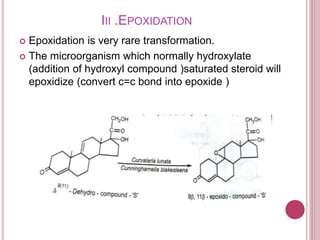
III .EPOXIDATION
 Epoxidation is very rare transformation.
 The microorganism which normally hydroxylate
(addition of hydroxyl compound )saturated steroid will
epoxidize (convert c=c bond into epoxide )
IV .AROMATIZATION
 19 – hydroxyl cholesterol and 19 – hydroxyl beta
sistosterol are converted to estrone with nacardia
restricta by aromatization.
 C – 1 – dehydrogenation with substrate lacking methyl
group at carbon 10 or suitably at carbon 19 result into
aromatization .
 Aromatization is conversion of non aromatic ring to
aromatic ring by using enzyme aromatase.
2.REDUCTION
 I .Reduction of double bond (-c=c-)–
 The enzyme oxido- reductases catalyze both
dehydrogenation and reduction reaction .
 Ring hydrogenation or reduction occurs at
1, 4 , and 16 , 1.
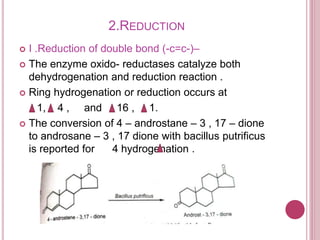
 The conversion of 4 – androstane – 3 , 17 – dione
to androsane – 3 , 17 dione with bacillus putrificus
is reported for 4 hydrogenation .
II .REDUCTION OF KETONES , ALDEHYDES AND
ACIDS
 Hydroxyl groups at C6, C11 and C17 , alpha –
methyl group at C16 and ` unsaturation
decreases reduction in steroids .
 The presence of electron withdrawing groups at C-
6 in 3 keto 4 subtrate , shift direction from
oxidation to reduction .
 Reduction of C-20 ketone occurs in presence of
streptomyces lavendulae.
3.HYDROLYSIS
 A large number of esters , lactones , beta- lactum ,
glycosides, epoxides and amides can be
hydrolyzed by using microorganism .
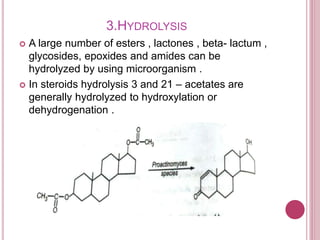
 In steroids hydrolysis 3 and 21 – acetates are
generally hydrolyzed to hydroxylation or
dehydrogenation .
4.ESTERIFICATION
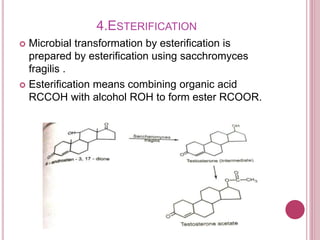
 Microbial transformation by esterification is
prepared by esterification using sacchromyces
fragilis .
 Esterification means combining organic acid
RCCOH with alcohol ROH to form ester RCOOR.
5.ISOMERISATION
 Deoxycorticosterone is prepared by isomerisation of the
double bond from Isomerization of 5 to 4 with
corynebacterium mediolanum .
 6.Amide Formation –
 Amide formation is rare microbial biotransformation .
 Smith and his coworkers reported the transformation of
steroids with streptomyces roseochromogenus .
7.HALOGENATION
 Halogenation reaction means replacement of one
or more hydrogen atom .
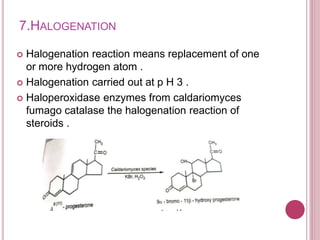
 Halogenation carried out at p H 3 .
 Haloperoxidase enzymes from caldariomyces
fumago catalase the halogenation reaction of
steroids .
8.DECARBOXYLATION
 Decarboxylation is elimination of carboxyl group .
 L –lysine can be synthesized by stereospecific
decarboxylation of meso α, α `- diaminopimelic acid
(DAP) to L-lysine .
 The reaction is catalyzed by Bacillus sphaericus .
9.CONDENSATION -
 Microbial condensation was utilized in 1934 in the
synthesis of natural ephedrine .
 Acetaldehyde reacts with benzaldehyde in presence of
fermenting yeast and gives (R)- 1- phenyl – 1 – hydroxy
– 2 – propanone .
 Propanone undergoes reductive condensation with
methylamine to yield (1R , 2S) – ephedrine .

Microbial Biotransformation.pptx

  • 1.
    MICROBIAL BIOTRANSFORMATION BY ASAWE TEJASWINIL. ASSISTANT PROFESSOR SIDHHIS INSTITUTE OF PAHRMACY THANE
  • 2.
     Microbial biotransformationis a biological process in which organic compounds are modified from one form to another form to reduce toxicity  These biotransformation reactions are catalyzed by purified enzymes present in microbial cells or pure cultures of microorganism.  Microbial enzymes are highly versatile in nature .  Microbial bioconversions are routinely used in commercial production of steroids , antibiotics , vitamins , citric acids etc .  Steroids can be produced by chemical synthesis or by microbiological transformation.  This process used as a manufacturing of pharmaceutical industries.
  • 3.
     Steroids arephysiologically active compound which include progesterone , testosterone , corticosterone etc.  Progesterone and estrogens are used as a oral contraceptives.  Scientist Mamoli and Vercellone in 1937 made the first successful Microbial biotransformation of steroid .  Peterson and Murray in 1952 reported the 11- hydroxylation of progesterone using a fungi Rhizopus arrhizus.  Steroidal biotransformation are mainly affected by bacteria , actinomycetes and fungi.
  • 4.
    ADVANTAGES  Selectivity  One ofthe main advantages of biotransformation is its high selectivity.  Biological catalysts can often produce specific products with high purity, whereas traditional chemical methods may produce unwanted by-products.  Many biotransformation reactions use renewable starting materials and produce less waste than traditional methods.  Cost-Effective  In some cases, biotransformation can be a more cost-effective alternative to traditional chemical methods.  Enzymes and microorganisms can often be produced at a relatively low cost, and the use of renewable starting materials can reduce production costs.  Mild Reaction Conditions  Biotransformation reactions can often be carried out at mild conditions such as low temperatures and atmospheric pressure, which reduces energy consumption and production costs.  Lower Environmental Impact  Biotransformation reactions often produce less toxic waste than traditional chemical methods, making it a more environmentally friendly approach.
  • 5.
    DISADVANTAGES OF BIOTRANSFORMATION Limited Substrate Range  The substrate ranges of enzymes and microorganisms used in biotransformation can be limited, which can restrict the types of compounds that can be produced.  Sensitivity to Reaction Conditions  Enzymes and microorganisms used in biotransformation can be sensitive to reaction conditions such as pH, temperature, and substrate concentration, which can limit their effectiveness.  Product Inhibition  In some cases, the product of a biotransformation reaction can inhibit the enzyme or microorganism used, which can limit the yield of the reaction.  High Cost of Purification  Purification of enzymes and microorganisms used in biotransformation can be expensive and time-consuming, which can limit the feasibility of large- scale production.  Stability Issues  Enzymes and microorganisms used in biotransformation can be unstable, which can limit their shelf life and the overall feasibility of large-scale production.
  • 6.
    METHODS OF BIOTRANSFORMATION: Transformation of organic compounds may be accomplished by use of microorganism, isolated enzyme, immobilization techniques and solvent selection.  Microbial cells serves as major tools for biotransformation .  The main process used for biotransformation is fermentation .  The fermentation is carried out in two phases:  1. Growth phase  2. Product formation phase
  • 7.
     Fermentation iscarried out in the following phases  1.phase I – Growth phase –  In the growth phase a culture is grown in a nutritionally rich medium.  The medium for the growth is simple or complex type.  Aeration and agitation(stirring ) are provided during growth and optimum temperature is maintained  Time of incubation period is depends on type of culture and environmental condition.
  • 8.
    PHASE II –TRANSFORMATION PHASE  Transformation Phase begins with addition of steroid at the end of the growth phase .  Steroids may be added simultaneously with the inoculation  Amount of steroid to be added depends upon transforming capacity of culture, toxicity of substrate or type of product.  The biotransformation occurs under controlled conditions of temperature , p H , aeration and time .  The submerged fermentation is carried out in a stainless steel tank with minimal nutritional quantities to allow maximum transformation and use of easy extraction and purification of transformation product.  The microorganisms are grown in a suitable medium for 12-72 hrs depending on bacterium and fungus at optimum temperature, pH, aeration and agitation.
  • 9.
     After thetransformation , microbial growth is separated from the fermentation liquor and extracted with a suitable solvent.  Methylene chloride, chloroform and ethyl acetate solvents are commonly used for extraction of steroids .  Product obtained from cell should be extracted separately.  The extracted samples are analyzed.
  • 10.
    APPLICATION OF MICROBIAL BIOTRANSFORMATION Transformation of steroids and sterols.  Transformation of Pollutants.  Transformation of Non-Steroid Compounds.  Transformation of Antibiotics.  Transformation of Pesticides.  Petroleum Biotransformation.
  • 11.
    APPLICATIONS OF BIOTRANSFORMATION Pharmaceutical Industry  Biotransformation is widely used in the pharmaceutical industry to produce a wide range of drugs.  Enzymatic biotransformation has been used to produce drugs like antibiotics, statins (reduce cholesterol ), and anti- inflammatory drugs.  One example is the production of semi-synthetic penicillin, which involves the use of enzymes to modify natural penicillin to improve its properties.  Food Industry  Biotransformation is also used in the food industry to produce flavors, fragrances, and other additives.  Microbial biotransformation is commonly used to produce compounds like vanillin, which is used as a flavoring agent in foods and beverages.
  • 12.
     Chemical Industry Biotransformation is also used in the chemical industry to produce a wide range of chemicals, such as detergents, solvents, and biofuels.  Enzymatic biotransformation can be used to produce chemicals like esters or amides, which are widely used in the chemical industry.  Environmental Applications  Biotransformation can also be used in environmental applications, such as the treatment of wastewater or the remediation (used to remove toxins or contaminants)of contaminated soil.  Microorganisms can be used to degrade pollutants, such as pesticides or industrial chemicals, into less harmful compounds.
  • 13.
    MICROBIAL BIOCONVERSION  Thebioconversion reactions are classified as follows:  A) Oxidation  1.Hydroxylation 2.Dehydrogenation  3.Epoxidation 4.Aromatization  B) Reduction  1.Reduction of double bond  2.Reduction of ketone , aldehyde and acids  C)Hydrolysis D) Esterification  E) Isomerization F) Amide Formation  G) Halogenation H)Decarboxylation  I) Condensation
  • 14.
    1.OXIDATION  I .Hydroxylation–  Bacteria and fungi are used for hydroxylation at non activated carbons in substrate like steroids, prostaglandins , alkaloids and hydrocarbon.  Microbial hydroxylation is done by direct replacement of hydrogen atom on given carbon .  Microbial hydroxylation of steroids at C-11 increase demand of cortisone and hydrocortisone .
  • 15.
    II .DEHYDROGENATION  Bacterialand fungal species are capable of dehydrogenation of steroids .  Addition of double bond on all 4 rings of steroid nucleus but microbes attacks the ring A
  • 16.
    III .EPOXIDATION  Epoxidationis very rare transformation.  The microorganism which normally hydroxylate (addition of hydroxyl compound )saturated steroid will epoxidize (convert c=c bond into epoxide )
  • 17.
    IV .AROMATIZATION  19– hydroxyl cholesterol and 19 – hydroxyl beta sistosterol are converted to estrone with nacardia restricta by aromatization.  C – 1 – dehydrogenation with substrate lacking methyl group at carbon 10 or suitably at carbon 19 result into aromatization .  Aromatization is conversion of non aromatic ring to aromatic ring by using enzyme aromatase.
  • 18.
    2.REDUCTION  I .Reductionof double bond (-c=c-)–  The enzyme oxido- reductases catalyze both dehydrogenation and reduction reaction .  Ring hydrogenation or reduction occurs at 1, 4 , and 16 , 1.  The conversion of 4 – androstane – 3 , 17 – dione to androsane – 3 , 17 dione with bacillus putrificus is reported for 4 hydrogenation .
  • 19.
    II .REDUCTION OFKETONES , ALDEHYDES AND ACIDS  Hydroxyl groups at C6, C11 and C17 , alpha – methyl group at C16 and ` unsaturation decreases reduction in steroids .  The presence of electron withdrawing groups at C- 6 in 3 keto 4 subtrate , shift direction from oxidation to reduction .  Reduction of C-20 ketone occurs in presence of streptomyces lavendulae.
  • 20.
    3.HYDROLYSIS  A largenumber of esters , lactones , beta- lactum , glycosides, epoxides and amides can be hydrolyzed by using microorganism .  In steroids hydrolysis 3 and 21 – acetates are generally hydrolyzed to hydroxylation or dehydrogenation .
  • 21.
    4.ESTERIFICATION  Microbial transformationby esterification is prepared by esterification using sacchromyces fragilis .  Esterification means combining organic acid RCCOH with alcohol ROH to form ester RCOOR.
  • 22.
    5.ISOMERISATION  Deoxycorticosterone isprepared by isomerisation of the double bond from Isomerization of 5 to 4 with corynebacterium mediolanum .  6.Amide Formation –  Amide formation is rare microbial biotransformation .  Smith and his coworkers reported the transformation of steroids with streptomyces roseochromogenus .
  • 23.
    7.HALOGENATION  Halogenation reactionmeans replacement of one or more hydrogen atom .  Halogenation carried out at p H 3 .  Haloperoxidase enzymes from caldariomyces fumago catalase the halogenation reaction of steroids .
  • 24.
    8.DECARBOXYLATION  Decarboxylation iselimination of carboxyl group .  L –lysine can be synthesized by stereospecific decarboxylation of meso α, α `- diaminopimelic acid (DAP) to L-lysine .  The reaction is catalyzed by Bacillus sphaericus . 9.CONDENSATION -  Microbial condensation was utilized in 1934 in the synthesis of natural ephedrine .  Acetaldehyde reacts with benzaldehyde in presence of fermenting yeast and gives (R)- 1- phenyl – 1 – hydroxy – 2 – propanone .  Propanone undergoes reductive condensation with methylamine to yield (1R , 2S) – ephedrine .