
CELL AND MOLECULAR BIOLOGY:
DEFINITIONS THEORY AND BASICS,
HISTORY AND APPLICATIONS
Dr. Pulipati Sowjanya
Professor & Head
Vignan Pharmacy College
Vadlamudi, Guntur (Dt)
CELLS
The cell (from Latin cella, meaning “small room”)
is the basic structural, functional and biological
unit of all known living organisms.
Cells are often called “building blocks of life”
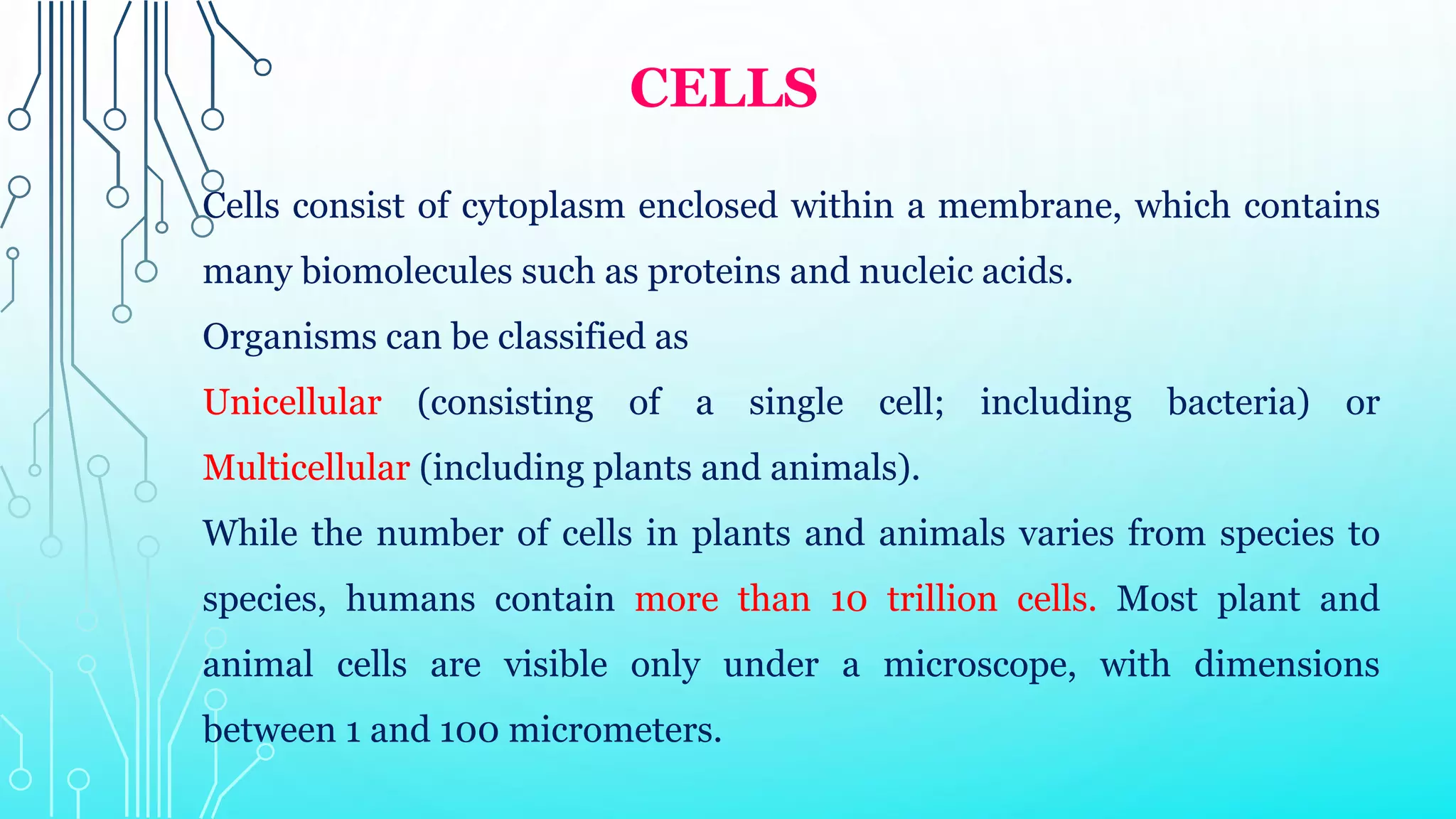
Just like bricks are the building blocks of a house
or school, cells are the building blocks of life.
A cell is the smallest unit of life that can replicate
independently
The study of cells is called cell biology or cytology
One square centimeter of your skin’s surface contains over 100,000 cells
CELLS
Cells consist of cytoplasm enclosed within a membrane, which contains
many biomolecules such as proteins and nucleic acids.
Organisms can be classified as
Unicellular (consisting of a single cell; including bacteria) or
Multicellular (including plants and animals).
While the number of cells in plants and animals varies from species to
species, humans contain more than 10 trillion cells. Most plant and
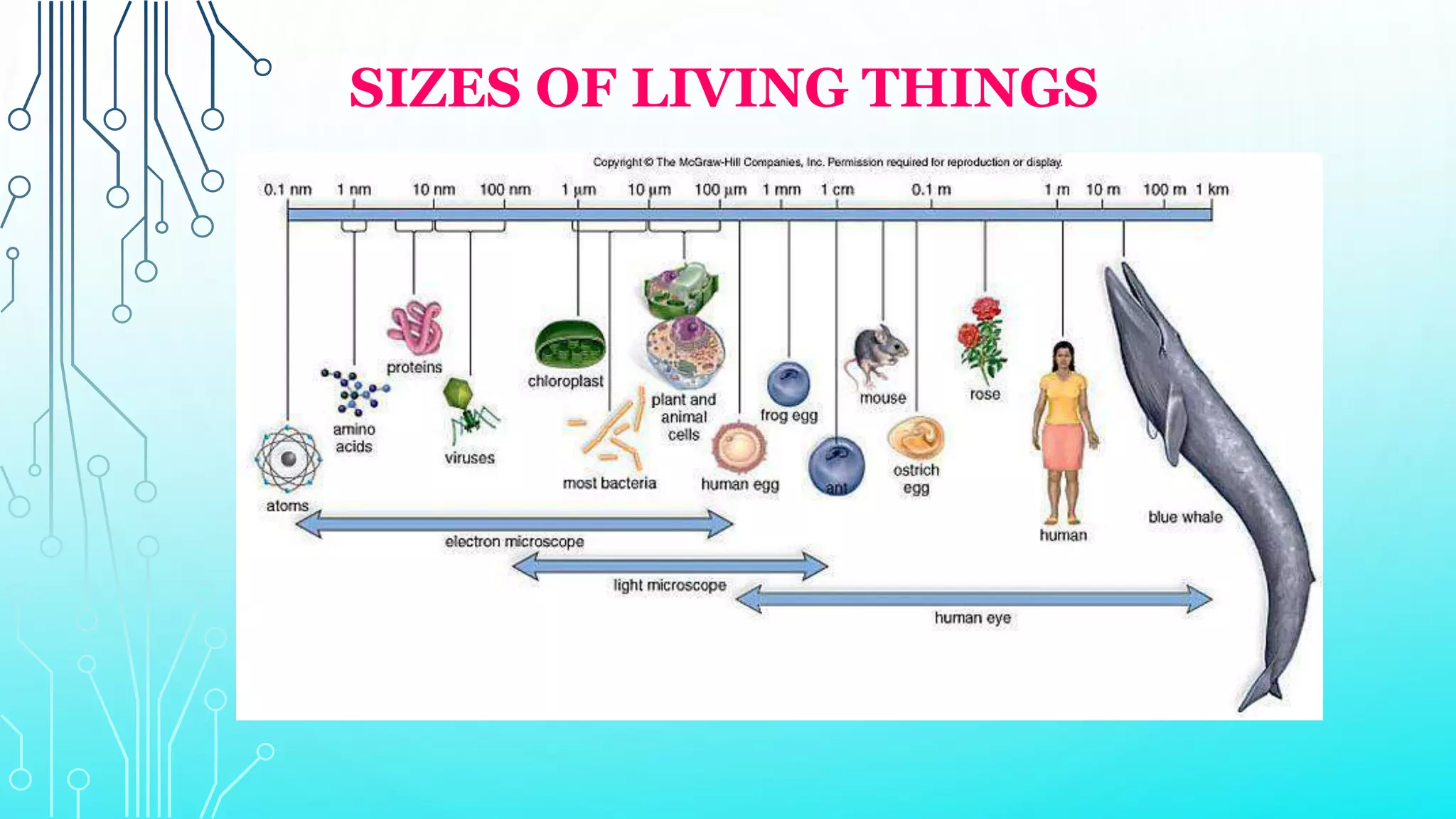
animal cells are visible only under a microscope, with dimensions
between 1 and 100 micrometers.
SIZES OF LIVING THINGS
CELL THEORY
All organisms are composed of cells
All cells come only from pre-existing cells (Rudolf Virchow)
Cells are the smallest structural and functional unit of organisms
Cells carry genetic information in the form of DNA
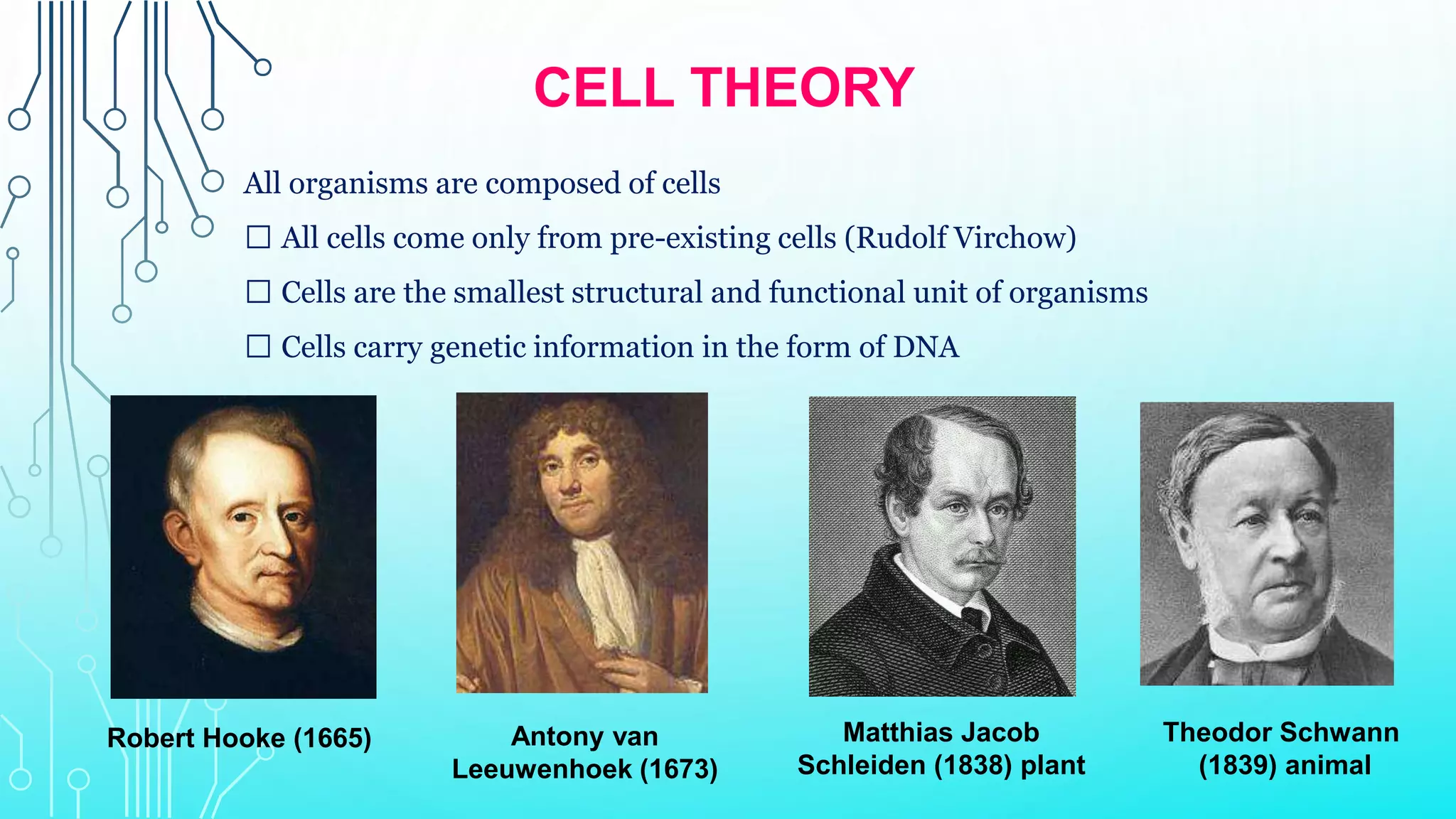
Robert Hooke (1665) Antony van
Leeuwenhoek (1673)
Matthias Jacob
Schleiden (1838) plant
Theodor Schwann
(1839) animal
VIGNAN PHARMACY COLLEGE, VADLAMUDI, GUNTUR (DT) 6
THE DEVELOPMENT OF CELL THEORY
● In 1838 and 1839, a German botanist by the name of Matthias Schleiden and German
zoologist by the name of Theodore Schwann viewed plants and animals under a
microscope and discovered that plants and animals are both made of cells.
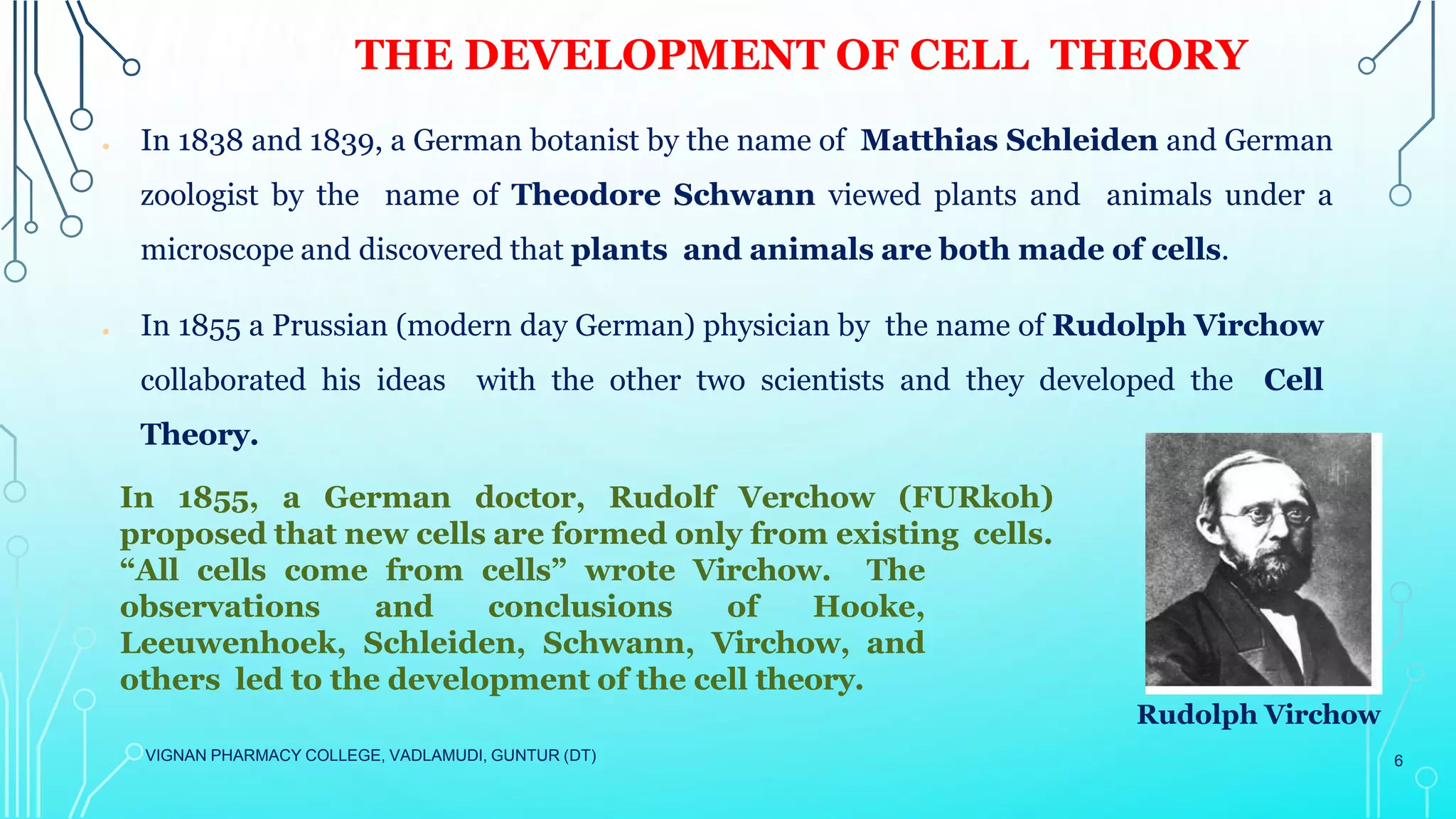
● In 1855 a Prussian (modern day German) physician by the name of Rudolph Virchow
collaborated his ideas with the other two scientists and they developed the Cell
Theory.
In 1855, a German doctor, Rudolf Verchow (FURkoh)
proposed that new cells are formed only from existing cells.
“All cells come from cells” wrote Virchow. The
observations and conclusions of Hooke,
Leeuwenhoek, Schleiden, Schwann, Virchow, and
others led to the development of the cell theory.
Rudolph Virchow
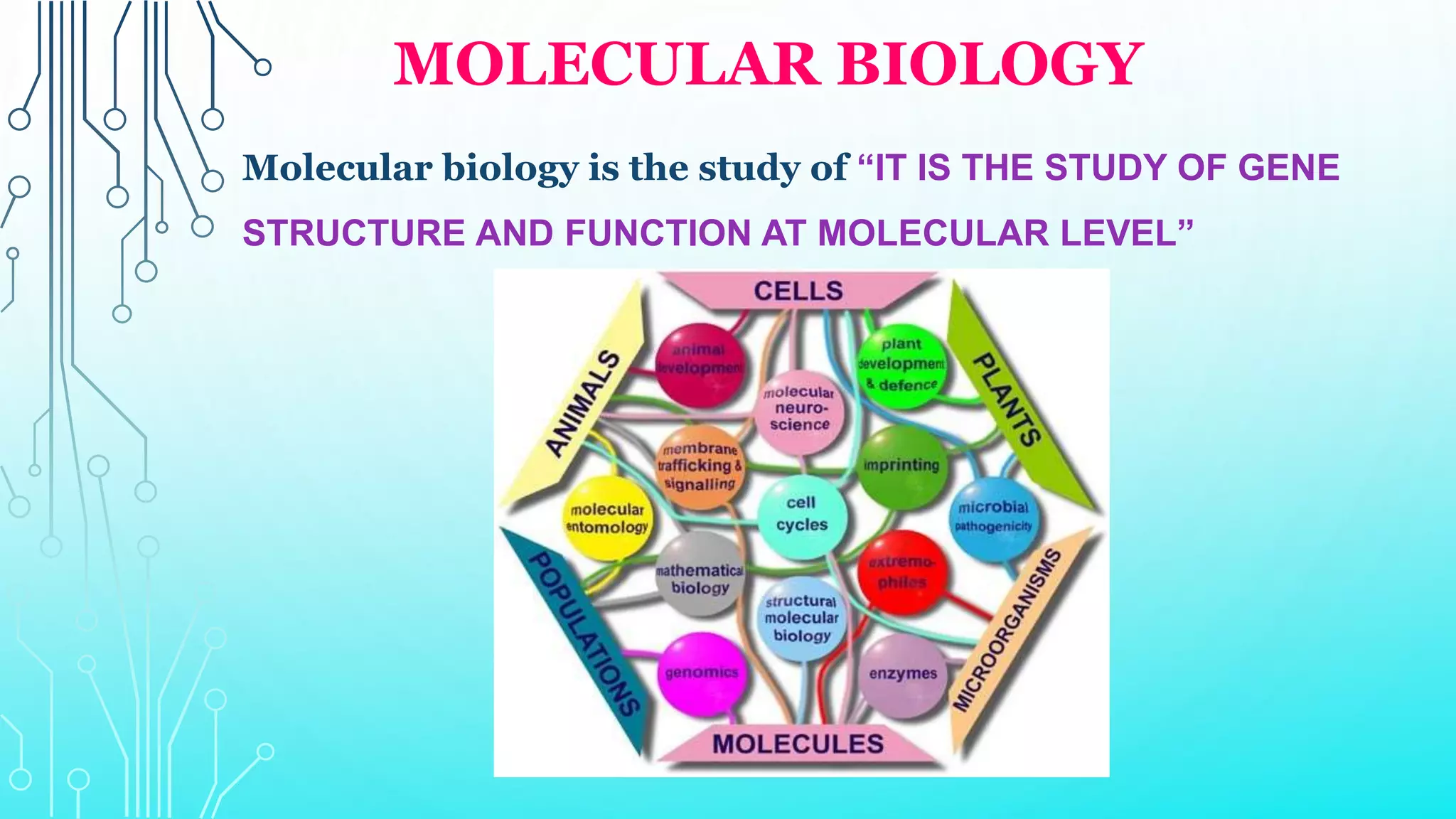
MOLECULAR BIOLOGY
Molecular biology is the study of “IT IS THE STUDY OF GENE
STRUCTURE AND FUNCTION AT MOLECULAR LEVEL”
VIGNAN PHARMACY COLLEGE, VADLAMUDI, GUNTUR (DT) 8
• Molecular biology is the branch of biology that
deals with the molecular basis of biolgical
activity.
• This field overlaps with other areas of biology and
chemistry, particularly genetics and biochemistry.
• It concerns itself with understanding and the
interactions between various systems of cells like
DNA, RNA and protein biosynthesis.
MOLECULAR BIOLOGY
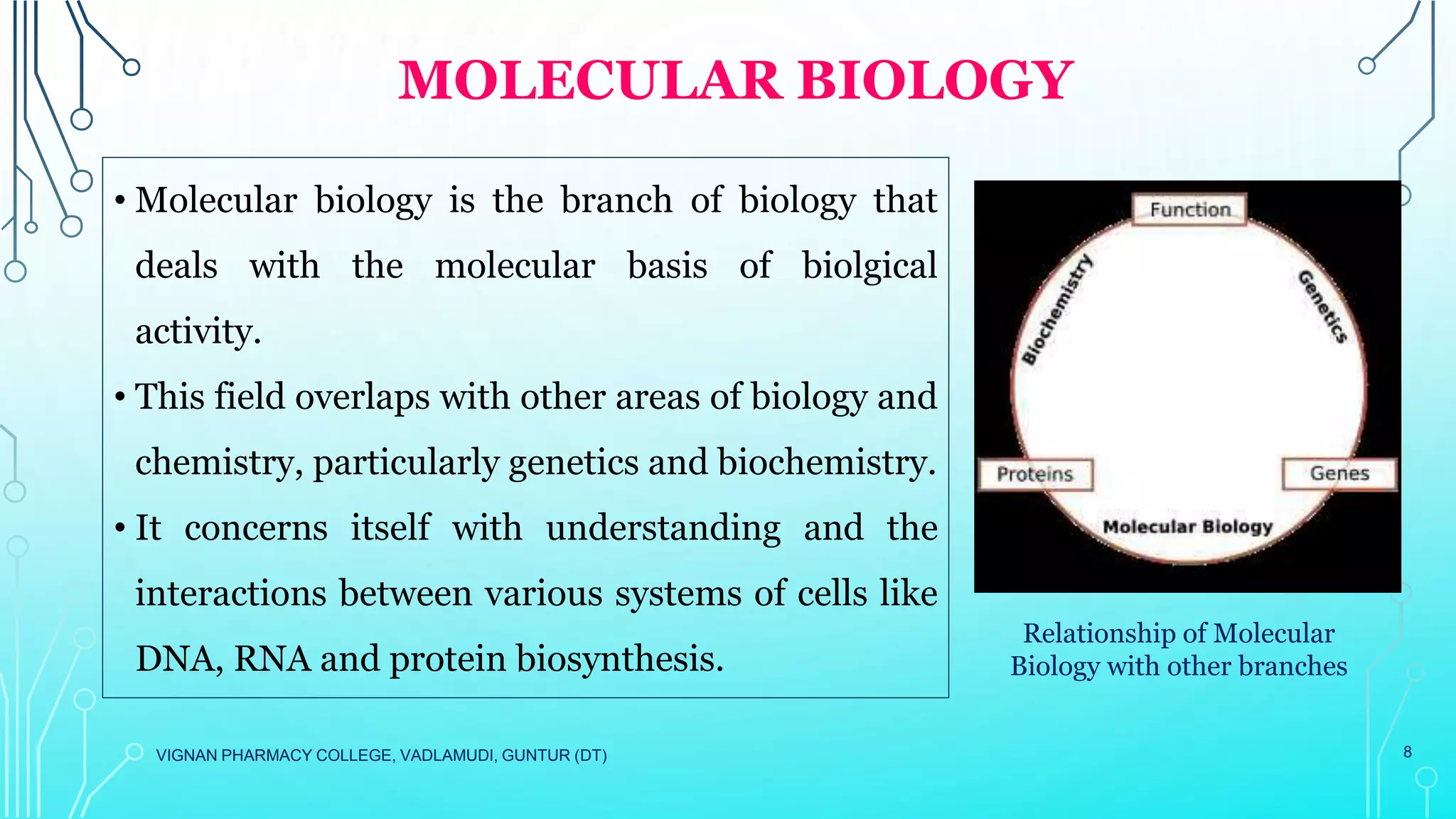
Relationship of Molecular
Biology with other branches
VIGNAN PHARMACY COLLEGE, VADLAMUDI, GUNTUR (DT)
9
MOLECULAR BIOLOGY
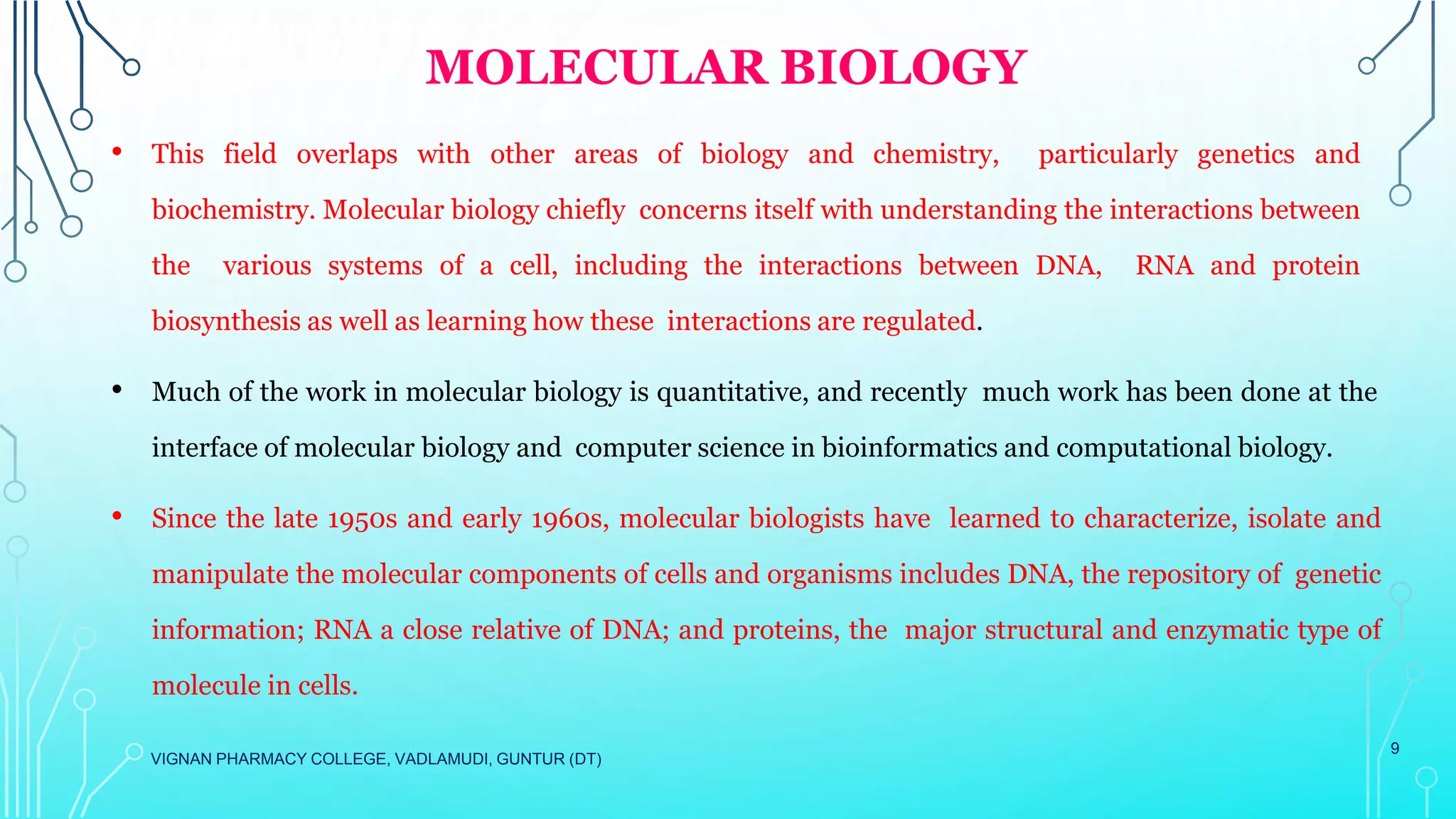
• This field overlaps with other areas of biology and chemistry, particularly genetics and
biochemistry. Molecular biology chiefly concerns itself with understanding the interactions between
the various systems of a cell, including the interactions between DNA, RNA and protein
biosynthesis as well as learning how these interactions are regulated.
• Much of the work in molecular biology is quantitative, and recently much work has been done at the
interface of molecular biology and computer science in bioinformatics and computational biology.
• Since the late 1950s and early 1960s, molecular biologists have learned to characterize, isolate and
manipulate the molecular components of cells and organisms includes DNA, the repository of genetic
information; RNA a close relative of DNA; and proteins, the major structural and enzymatic type of
molecule in cells.
VIGNAN PHARMACY COLLEGE, VADLAMUDI, GUNTUR (DT)
10
Biochemistry: Is the study of chemical substances and vital processes
occurring in living organisms.
• The study of chemistry behind biological processes and the synthesis of
biologically active molecules are examples of biochemistry.
Genetics : Is the study of effect of genetic differences on organisms.
• The study of “mutants” organisms which lack one or more functional components
with respect to the so called “wild type” or normal phenotype.
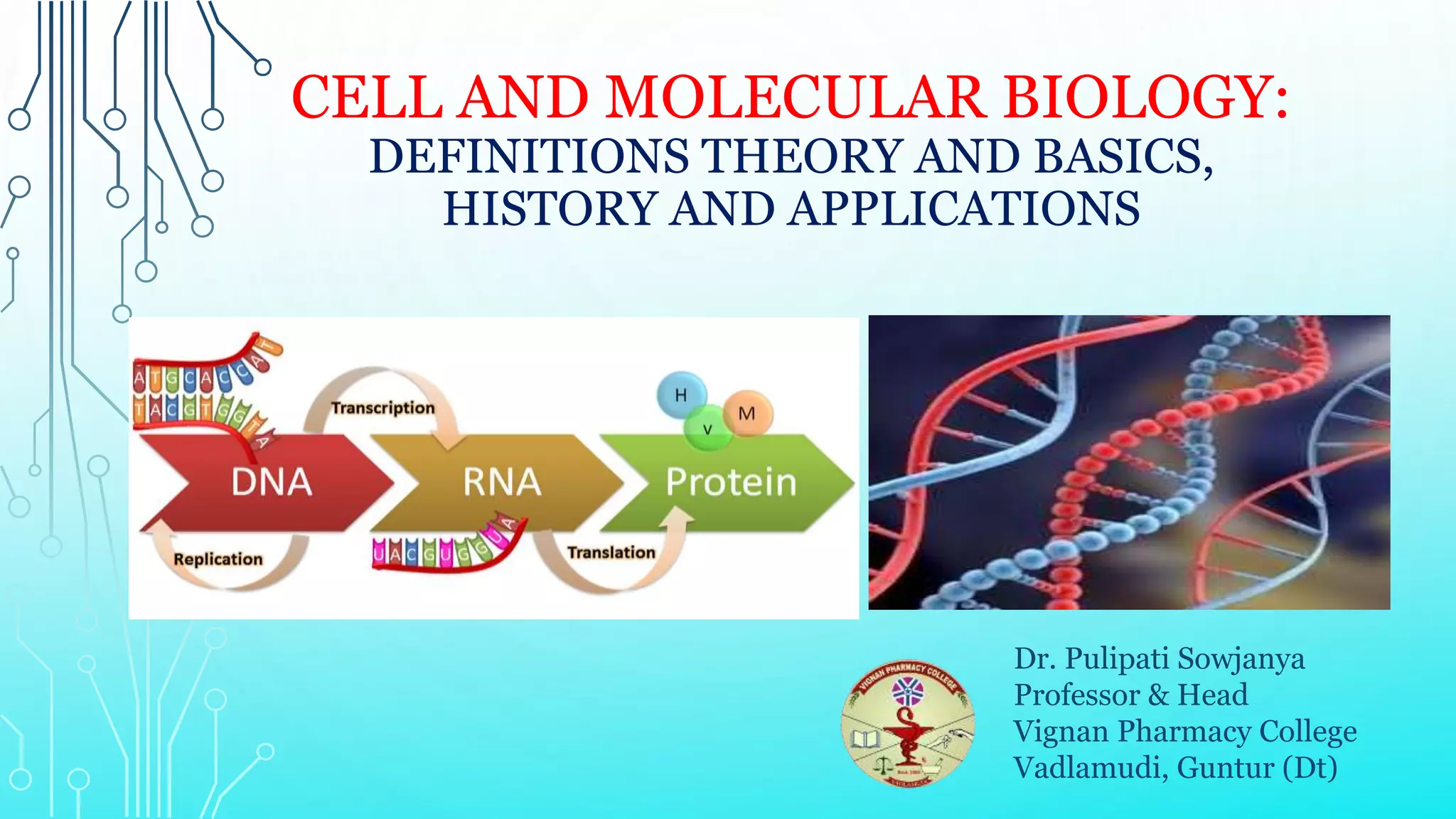
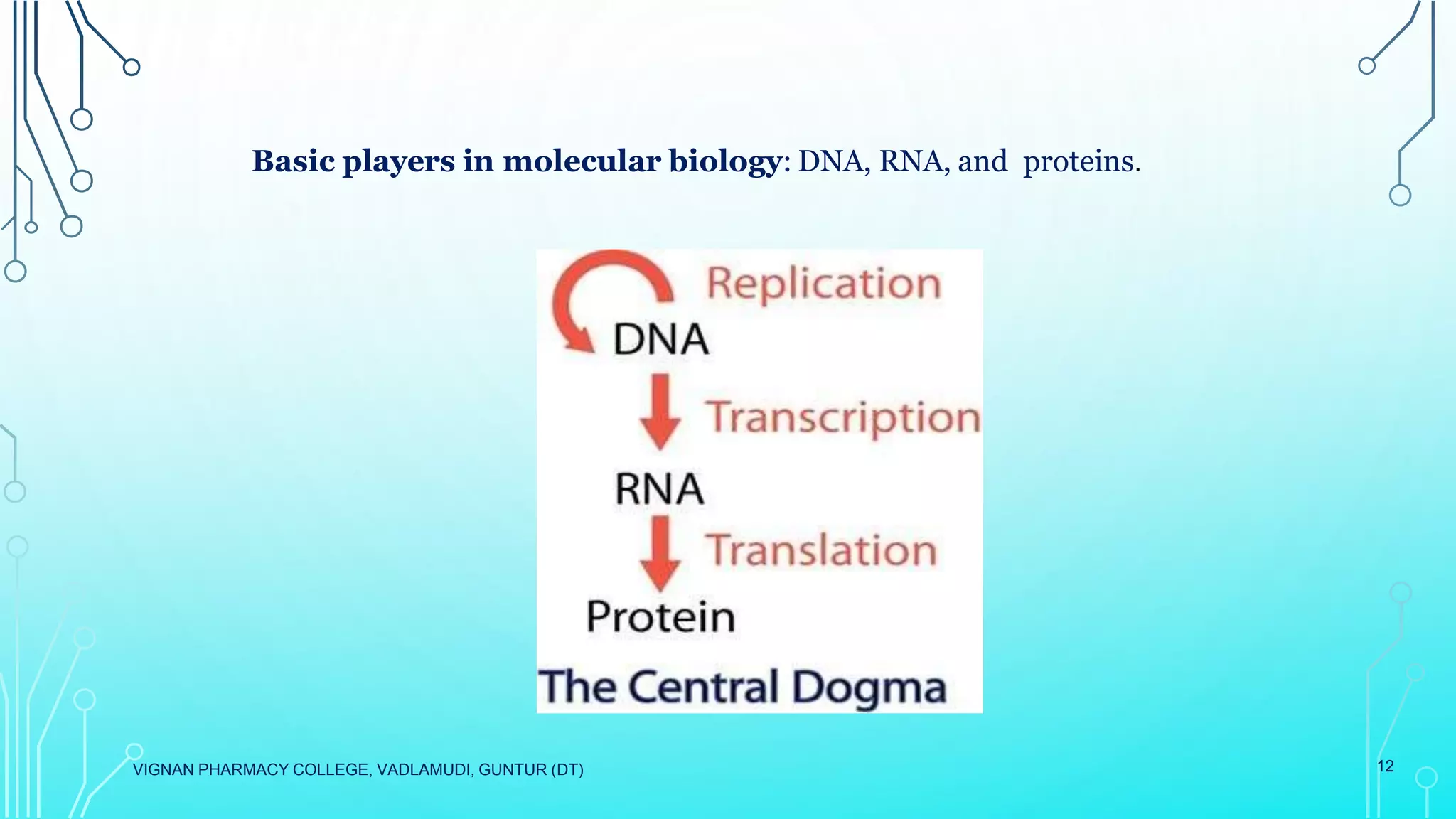
Molecular biology: Is the study of molecular process of replication,
transcription,translation and cell function.
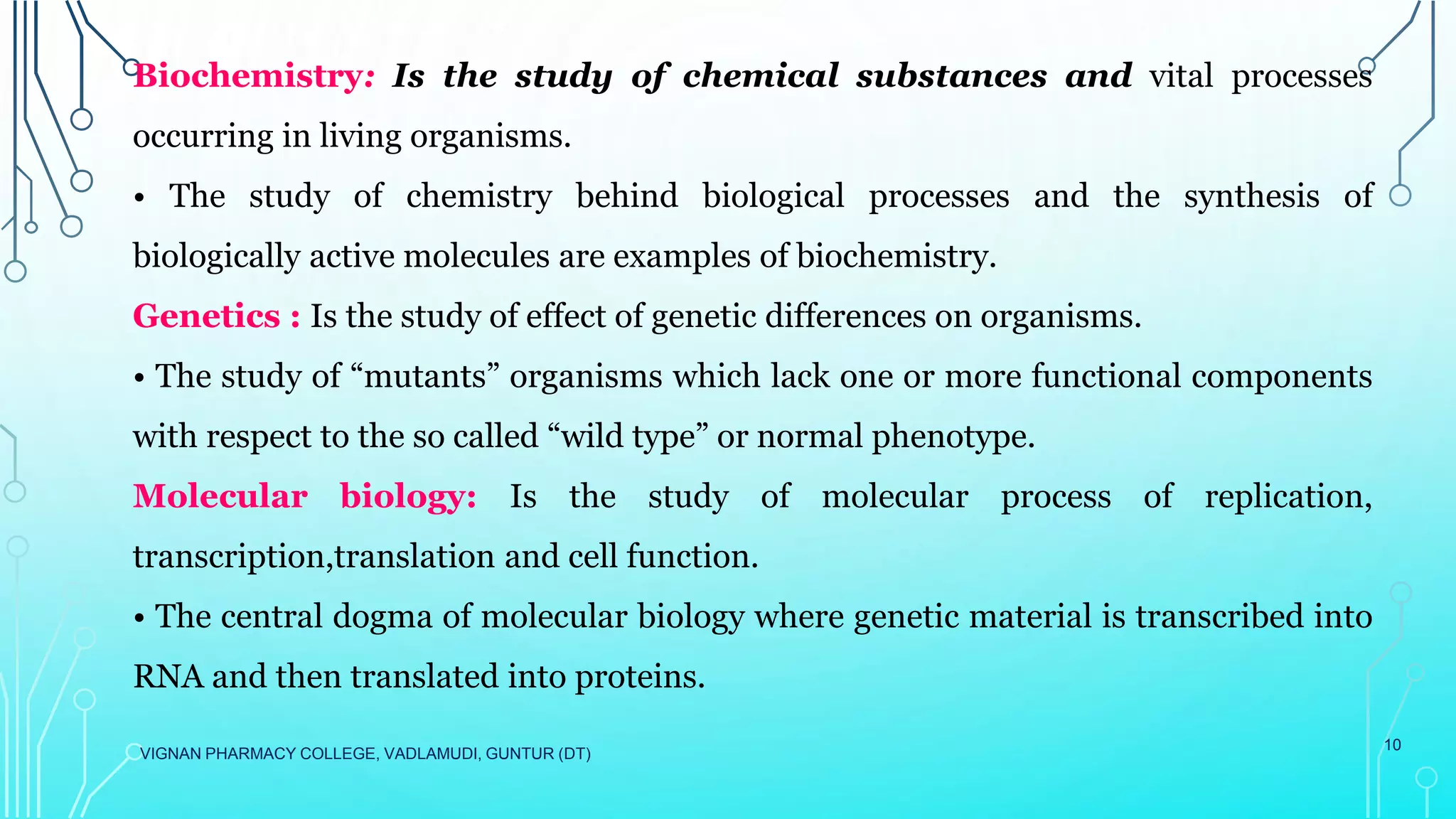
• The central dogma of molecular biology where genetic material is transcribed into
RNA and then translated into proteins.
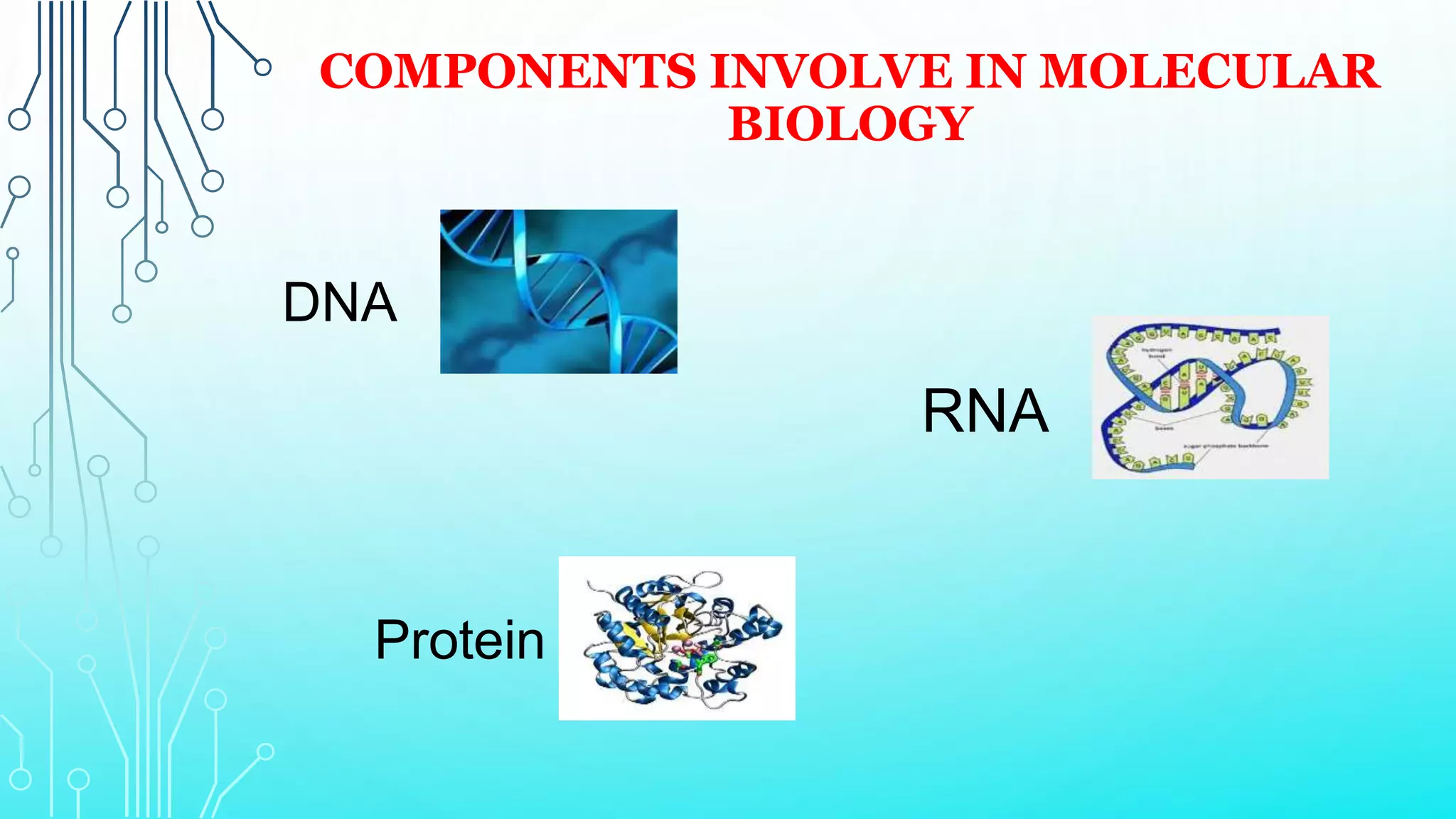
COMPONENTS INVOLVE IN MOLECULAR
BIOLOGY
DNA
RNA
Protein
VIGNAN PHARMACY COLLEGE, VADLAMUDI, GUNTUR (DT) 12
Basic players in molecular biology: DNA, RNA, and proteins.
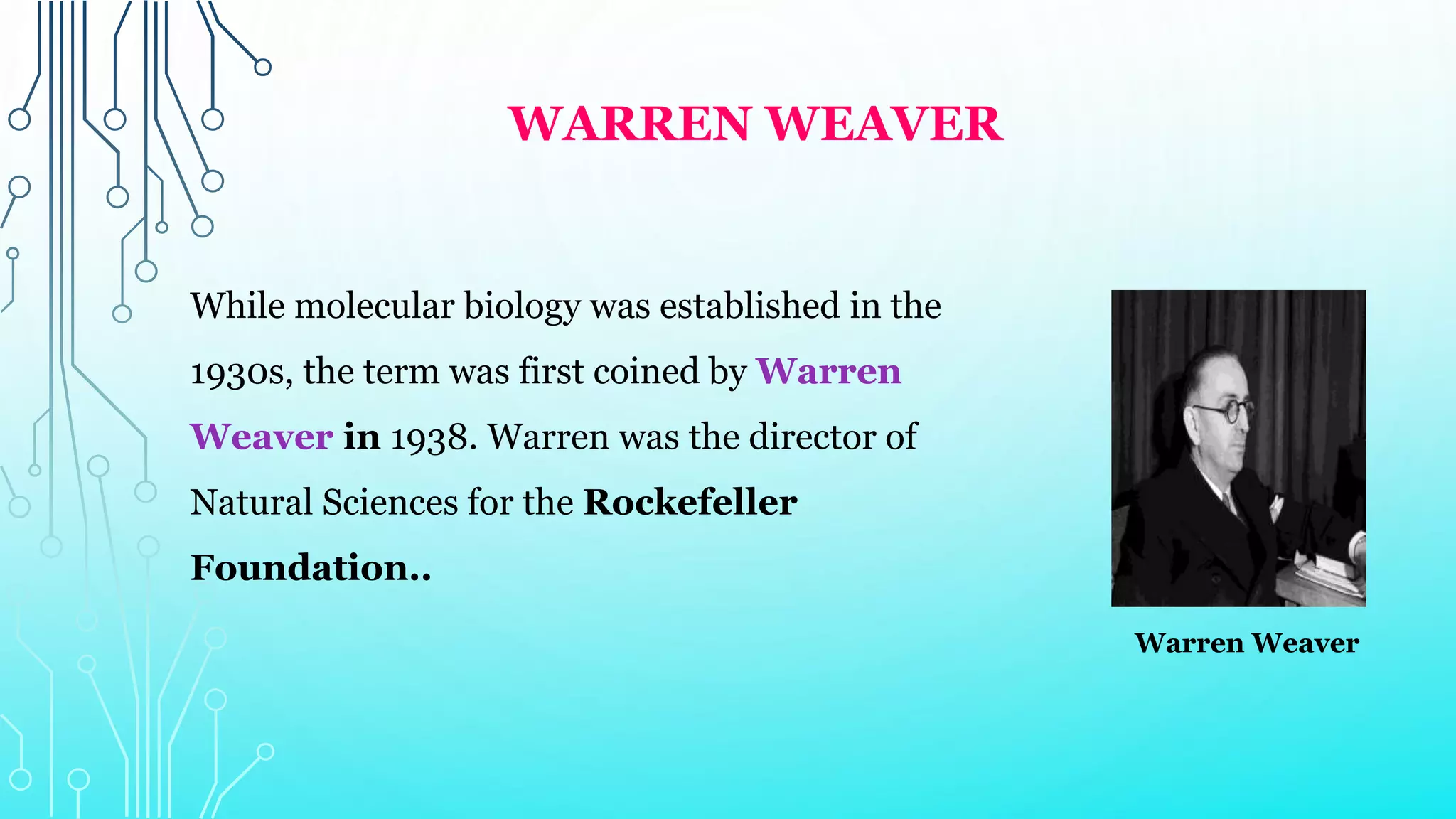
WARREN WEAVER
While molecular biology was established in the
1930s, the term was first coined by Warren
Weaver in 1938. Warren was the director of
Natural Sciences for the Rockefeller
Foundation..
Warren Weaver
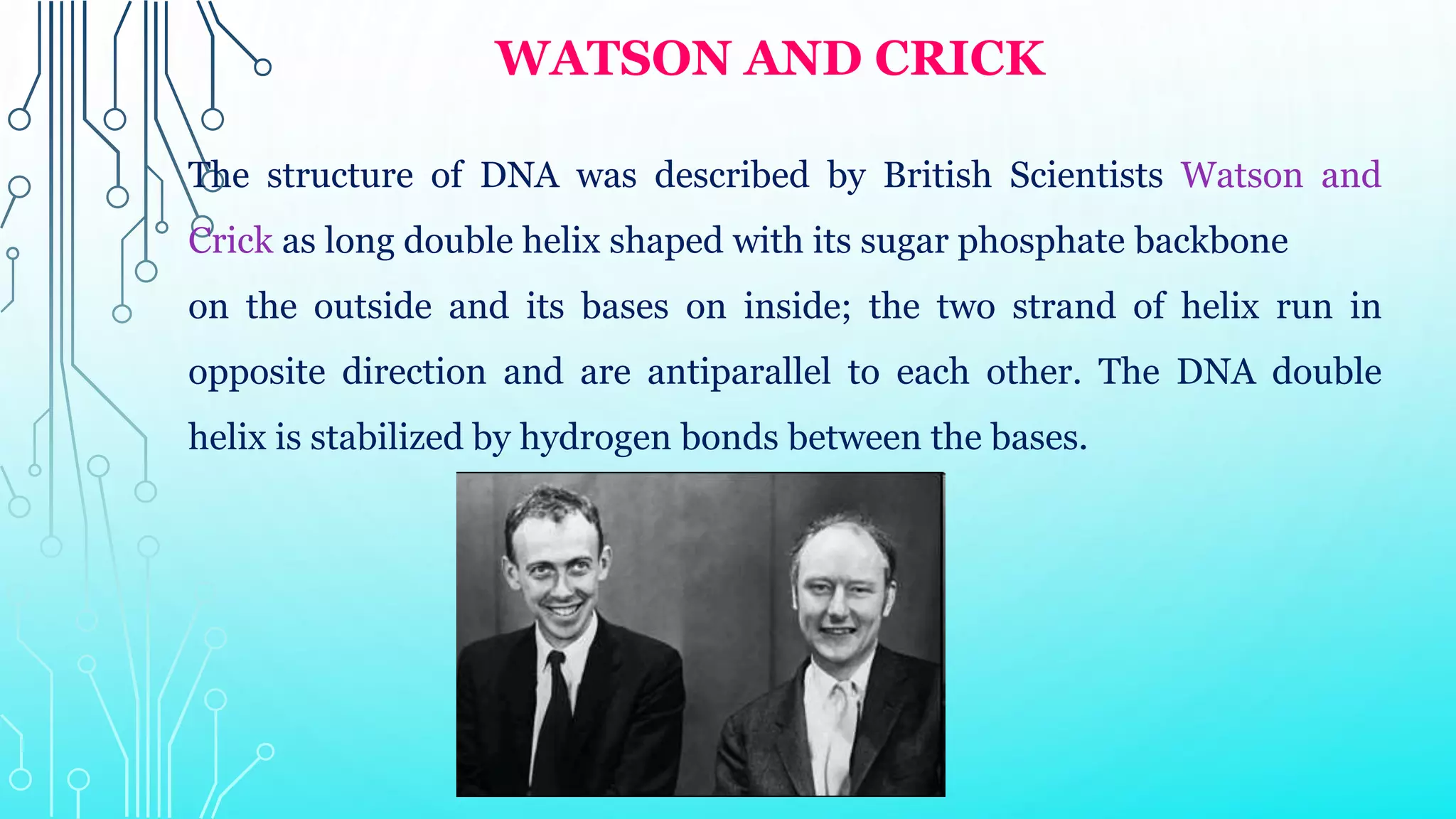
WATSON AND CRICK
The structure of DNA was described by British Scientists Watson and
Crick as long double helix shaped with its sugar phosphate backbone
on the outside and its bases on inside; the two strand of helix run in
opposite direction and are antiparallel to each other. The DNA double
helix is stabilized by hydrogen bonds between the bases.
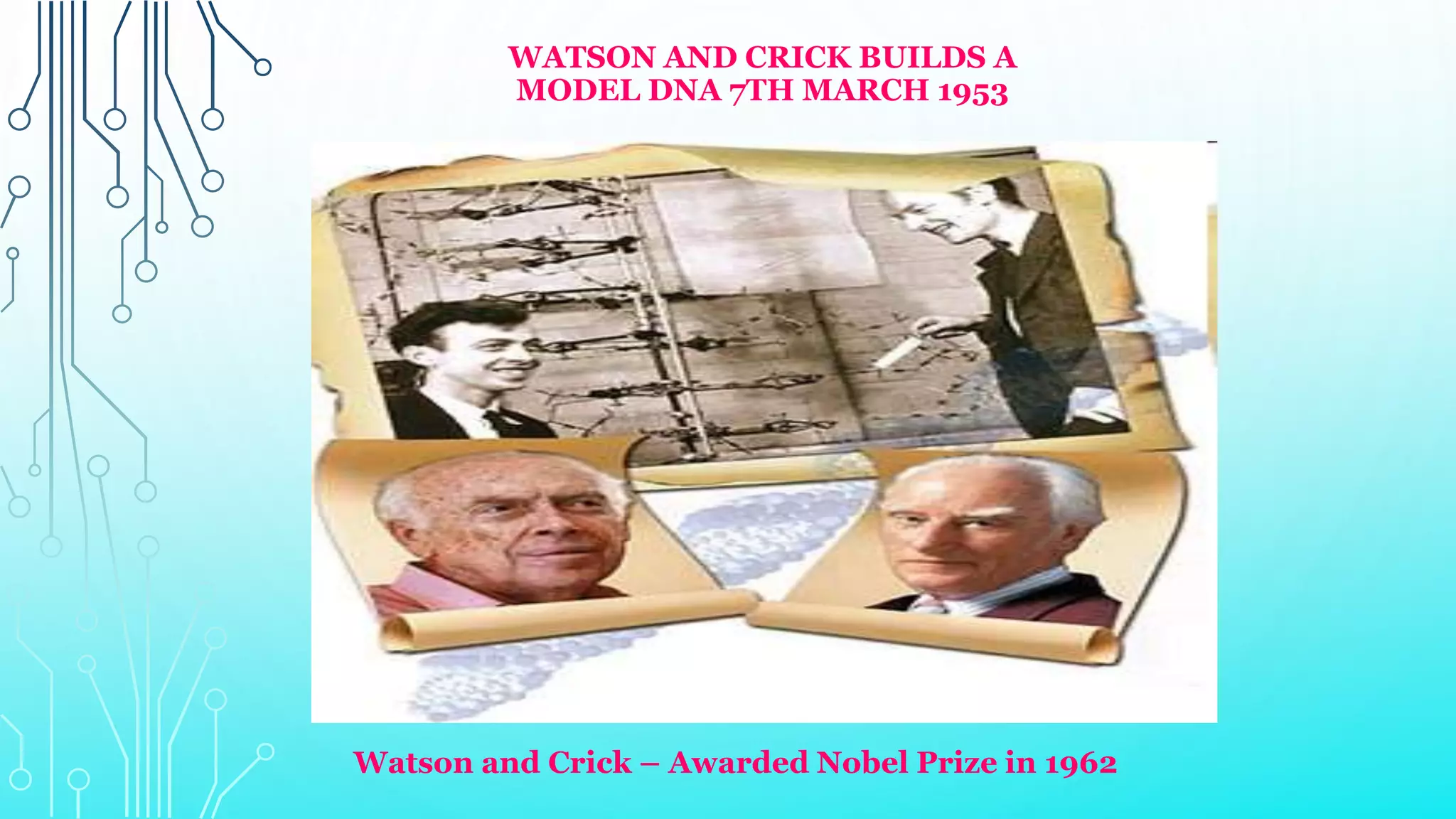
WATSON AND CRICK BUILDS A
MODEL DNA 7TH MARCH 1953
Watson and Crick – Awarded Nobel Prize in 1962
COMMON TOOLS OF MOLECULAR BIOLOGY
 Nucleic acid fractionation
Polymerase chain reaction
Probes, Hybridization
Vector, Molecular cloning
Nucleic acid enzymes
Microarray
DNA sequencing
Electrophoretic separation of nucleic acid
Detection of genes: DNA: Southern blotting
*RNA: Northern blotting
*Protein: Western blotting
VIGNAN PHARMACY COLLEGE, VADLAMUDI, GUNTUR (DT) 17
CURRENT USES OF MOLECULAR BIOLOGY
The most recent applied technologies, genetic
engineering, DNA finger-printing in the social and
forensic science, pre and postnatal diagnosis of inherited
disease, gene therapy and drug Design.
Molecular biology allows the laboratory to be predictive
in nature, it gives information that the patients may be at
risk for disease (future).
Major tool in Diagnosis of Infectious
Cell and Molecular Biology: Definitions theory and basics, History and Applications

Cell and Molecular Biology: Definitions theory and basics, History and Applications

  • 1.
    CELL AND MOLECULARBIOLOGY: DEFINITIONS THEORY AND BASICS, HISTORY AND APPLICATIONS Dr. Pulipati Sowjanya Professor & Head Vignan Pharmacy College Vadlamudi, Guntur (Dt)
  • 2.
    CELLS The cell (fromLatin cella, meaning “small room”) is the basic structural, functional and biological unit of all known living organisms. Cells are often called “building blocks of life” Just like bricks are the building blocks of a house or school, cells are the building blocks of life. A cell is the smallest unit of life that can replicate independently The study of cells is called cell biology or cytology One square centimeter of your skin’s surface contains over 100,000 cells
  • 3.
    CELLS Cells consist ofcytoplasm enclosed within a membrane, which contains many biomolecules such as proteins and nucleic acids. Organisms can be classified as Unicellular (consisting of a single cell; including bacteria) or Multicellular (including plants and animals). While the number of cells in plants and animals varies from species to species, humans contain more than 10 trillion cells. Most plant and animal cells are visible only under a microscope, with dimensions between 1 and 100 micrometers.
  • 4.
  • 5.
    CELL THEORY All organismsare composed of cells All cells come only from pre-existing cells (Rudolf Virchow) Cells are the smallest structural and functional unit of organisms Cells carry genetic information in the form of DNA Robert Hooke (1665) Antony van Leeuwenhoek (1673) Matthias Jacob Schleiden (1838) plant Theodor Schwann (1839) animal
  • 6.
    VIGNAN PHARMACY COLLEGE,VADLAMUDI, GUNTUR (DT) 6 THE DEVELOPMENT OF CELL THEORY ● In 1838 and 1839, a German botanist by the name of Matthias Schleiden and German zoologist by the name of Theodore Schwann viewed plants and animals under a microscope and discovered that plants and animals are both made of cells. ● In 1855 a Prussian (modern day German) physician by the name of Rudolph Virchow collaborated his ideas with the other two scientists and they developed the Cell Theory. In 1855, a German doctor, Rudolf Verchow (FURkoh) proposed that new cells are formed only from existing cells. “All cells come from cells” wrote Virchow. The observations and conclusions of Hooke, Leeuwenhoek, Schleiden, Schwann, Virchow, and others led to the development of the cell theory. Rudolph Virchow
  • 7.
    MOLECULAR BIOLOGY Molecular biologyis the study of “IT IS THE STUDY OF GENE STRUCTURE AND FUNCTION AT MOLECULAR LEVEL”
  • 8.
    VIGNAN PHARMACY COLLEGE,VADLAMUDI, GUNTUR (DT) 8 • Molecular biology is the branch of biology that deals with the molecular basis of biolgical activity. • This field overlaps with other areas of biology and chemistry, particularly genetics and biochemistry. • It concerns itself with understanding and the interactions between various systems of cells like DNA, RNA and protein biosynthesis. MOLECULAR BIOLOGY Relationship of Molecular Biology with other branches
  • 9.
    VIGNAN PHARMACY COLLEGE,VADLAMUDI, GUNTUR (DT) 9 MOLECULAR BIOLOGY • This field overlaps with other areas of biology and chemistry, particularly genetics and biochemistry. Molecular biology chiefly concerns itself with understanding the interactions between the various systems of a cell, including the interactions between DNA, RNA and protein biosynthesis as well as learning how these interactions are regulated. • Much of the work in molecular biology is quantitative, and recently much work has been done at the interface of molecular biology and computer science in bioinformatics and computational biology. • Since the late 1950s and early 1960s, molecular biologists have learned to characterize, isolate and manipulate the molecular components of cells and organisms includes DNA, the repository of genetic information; RNA a close relative of DNA; and proteins, the major structural and enzymatic type of molecule in cells.
  • 10.
    VIGNAN PHARMACY COLLEGE,VADLAMUDI, GUNTUR (DT) 10 Biochemistry: Is the study of chemical substances and vital processes occurring in living organisms. • The study of chemistry behind biological processes and the synthesis of biologically active molecules are examples of biochemistry. Genetics : Is the study of effect of genetic differences on organisms. • The study of “mutants” organisms which lack one or more functional components with respect to the so called “wild type” or normal phenotype. Molecular biology: Is the study of molecular process of replication, transcription,translation and cell function. • The central dogma of molecular biology where genetic material is transcribed into RNA and then translated into proteins.
  • 11.
    COMPONENTS INVOLVE INMOLECULAR BIOLOGY DNA RNA Protein
  • 12.
    VIGNAN PHARMACY COLLEGE,VADLAMUDI, GUNTUR (DT) 12 Basic players in molecular biology: DNA, RNA, and proteins.
  • 13.
    WARREN WEAVER While molecularbiology was established in the 1930s, the term was first coined by Warren Weaver in 1938. Warren was the director of Natural Sciences for the Rockefeller Foundation.. Warren Weaver
  • 14.
    WATSON AND CRICK Thestructure of DNA was described by British Scientists Watson and Crick as long double helix shaped with its sugar phosphate backbone on the outside and its bases on inside; the two strand of helix run in opposite direction and are antiparallel to each other. The DNA double helix is stabilized by hydrogen bonds between the bases.
  • 15.
    WATSON AND CRICKBUILDS A MODEL DNA 7TH MARCH 1953 Watson and Crick – Awarded Nobel Prize in 1962
  • 16.
    COMMON TOOLS OFMOLECULAR BIOLOGY  Nucleic acid fractionation Polymerase chain reaction Probes, Hybridization Vector, Molecular cloning Nucleic acid enzymes Microarray DNA sequencing Electrophoretic separation of nucleic acid Detection of genes: DNA: Southern blotting *RNA: Northern blotting *Protein: Western blotting
  • 17.
    VIGNAN PHARMACY COLLEGE,VADLAMUDI, GUNTUR (DT) 17 CURRENT USES OF MOLECULAR BIOLOGY The most recent applied technologies, genetic engineering, DNA finger-printing in the social and forensic science, pre and postnatal diagnosis of inherited disease, gene therapy and drug Design. Molecular biology allows the laboratory to be predictive in nature, it gives information that the patients may be at risk for disease (future). Major tool in Diagnosis of Infectious