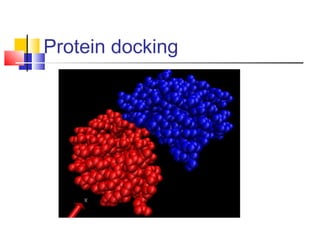
Protein docking
Saramita De Chakravarti
12/14/2012
Outline
 Physical background of protein
 Protein docking
Quantum Mechanism (QM)
 Electrons
 Nuclei
 Wave functions instead of Newton Eq.
 High computation cost
 Ab initio N4
N is # of base functions
 Semi-empirical N3
 Molecule of a couple of hundreds atoms
 Pico-second(10-12
s) behavior
Molecular Mechanism (MM)
 Atoms
 Newton equations
 Parameters from experiment and QM
 force field
 System with 100,000 atoms
 µs (10-6
s) behavior
Force field
+−+−= ∑∑ 22
)()( eq
angle
eq
bonds
b krrkU θθθ
])[()]cos(1[
2 612
ij
ji
ij
ij
i ij ij
ij
dihedral n
n
r
qq
r
B
r
A
n
V
⋅
+−+−+ ∑∑∑ ∑ > ε
γφ
kb – bond parameter
kө --- angle parameter
Vn --- dihedral energy barrier
Van Der Waal radii
Partial charge set
Solvent effect
 Oil in water
 Hydrophobic interactions
 Alcohol in water
 Hydrophilic interactions
 Explicit water
 Solvent Accessible Surface
 Surface Complementarity
Twenty Amino Acids
Sidechains
The amino acids vary in their side chains (indicated in blue in the diagram).
The eight amino acids in the orange area are nonpolar and hydrophobic.
The other amino acids are polar and hydrophilic ("water loving").
The two amino acids in the magenta box are acidic ("carboxy" group in the side chain).
The three amino acids in the light blue box are basic ("amine" group in the side chain).
Peptide bonds
Proteins
 Primary structure
 Secondary structure
 Tertiary structure
 Quaternary structure
Important forces
 Weak forces
 Delicate balance
 Electrostatic (hydrogen bonds, salt
bridges)
 Hydrophobic (sidechain packing)
Protein docking
Contents
 Why Is Docking Important?
 Why Is Docking Hard?
 Docking Scoring Criteria
 Docking Search Strategies
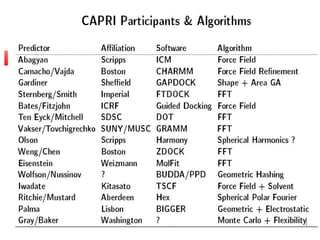
 CAPRI Participants & Algorithms
 Lessons Learnt From CAPRI
 Selected Docking References
http://www.csd.abdn.ac.uk/~dritchie/
Why Is Docking Important?
 Better understand the Machinery of Life
 Enzyme-inhibitor class
 Antibody-antigen class
 Others
 Engineered Protein Enzymes
 Protein Therapies
 Drug targets
Why Is Docking A Hard Problem?
 Large Search Space !
 Rigid Body Docking: 6D
 Flexible Docking: 3N (N normal modes)
 Structure Space: Continuous
Criteria for Good Docking
Orientations
 Low Free Energy
 Low Pseudo-Energy Based On force field
 Large Surface Burial
 Small van der Waals Overlaps
 Good H-Bonding
 Good Charge Complementarity
 Polar/Polar Contacts Favoured
 Polar/Non-Polar Contacts Disfavoured
Docking Search Strategies
 Pseudo Random
 Simulated Annealing / Monte Carlo
 Genetic Algorithms
 Directed Search
 Geometric Hashing
 Spherical Harmonic Surface Triangles
Docking Search Strategies
 Brute-Force Search
 Explicit Grid Correlations
 Fast Fourier Transform (FFT) Correlations
 Refinement Phase
 Classical or Soft Potentials (+/- Electrostatics)
 Desolvation, Solvent Dipoles...
 Visual Inspection!!
CAPRI
 Critical Assessment of PRedicted
Interactions
 http://capri.ebi.ac.uk/
 targets available (unbounded/bounded)
 Bounded (rigid)
 Unbounded (non-rigid)
 International groups participated
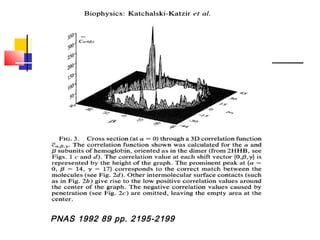
Cartesian Grid Correlations
Basic Principles
d
PNAS 1992 89 pp. 2195-2199
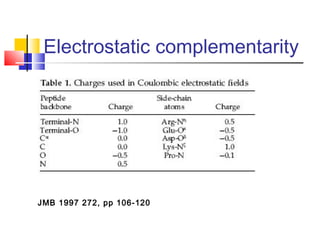
Electrostatic complementarity
JMB 1997 272, pp 106-120
The electric field by protein A
Correlation function
Binary filter to remove false positive geometries
Lessons Learnt From CAPRI
 Antibodies Often Bind Near Antigen's
Active Site
 Expect Large Conformational Change
in Enzyme/Inhibitor Docking
 Develop Better Models of Flexibility
Future Challenges For
Docking
 Better Scoring Functions
 High-Throughput Screening
 Tractable Models of Flexibility
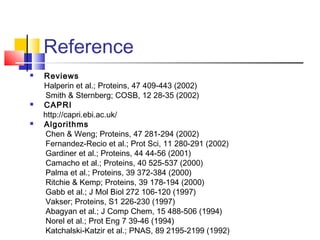
Reference
 Reviews
Halperin et al.; Proteins, 47 409-443 (2002)
Smith & Sternberg; COSB, 12 28-35 (2002)
 CAPRI
http://capri.ebi.ac.uk/
 Algorithms
Chen & Weng; Proteins, 47 281-294 (2002)
Fernandez-Recio et al.; Prot Sci, 11 280-291 (2002)
Gardiner et al.; Proteins, 44 44-56 (2001)
Camacho et al.; Proteins, 40 525-537 (2000)
Palma et al.; Proteins, 39 372-384 (2000)
Ritchie & Kemp; Proteins, 39 178-194 (2000)
Gabb et al.; J Mol Biol 272 106-120 (1997)
Vakser; Proteins, S1 226-230 (1997)
Abagyan et al.; J Comp Chem, 15 488-506 (1994)
Norel et al.; Prot Eng 7 39-46 (1994)
Katchalski-Katzir et al.; PNAS, 89 2195-2199 (1992)

Protein docking

  • 1.
    Protein docking Saramita DeChakravarti 12/14/2012
  • 2.
    Outline  Physical backgroundof protein  Protein docking
  • 3.
    Quantum Mechanism (QM) Electrons  Nuclei  Wave functions instead of Newton Eq.  High computation cost  Ab initio N4 N is # of base functions  Semi-empirical N3  Molecule of a couple of hundreds atoms  Pico-second(10-12 s) behavior
  • 4.
    Molecular Mechanism (MM) Atoms  Newton equations  Parameters from experiment and QM  force field  System with 100,000 atoms  µs (10-6 s) behavior
  • 5.
    Force field +−+−= ∑∑22 )()( eq angle eq bonds b krrkU θθθ ])[()]cos(1[ 2 612 ij ji ij ij i ij ij ij dihedral n n r qq r B r A n V ⋅ +−+−+ ∑∑∑ ∑ > ε γφ kb – bond parameter kө --- angle parameter Vn --- dihedral energy barrier Van Der Waal radii Partial charge set
  • 6.
    Solvent effect  Oilin water  Hydrophobic interactions  Alcohol in water  Hydrophilic interactions  Explicit water  Solvent Accessible Surface  Surface Complementarity
  • 7.
  • 8.
    Sidechains The amino acidsvary in their side chains (indicated in blue in the diagram). The eight amino acids in the orange area are nonpolar and hydrophobic. The other amino acids are polar and hydrophilic ("water loving"). The two amino acids in the magenta box are acidic ("carboxy" group in the side chain). The three amino acids in the light blue box are basic ("amine" group in the side chain).
  • 9.
  • 10.
    Proteins  Primary structure Secondary structure  Tertiary structure  Quaternary structure
  • 11.
    Important forces  Weakforces  Delicate balance  Electrostatic (hydrogen bonds, salt bridges)  Hydrophobic (sidechain packing)
  • 12.
  • 13.
    Contents  Why IsDocking Important?  Why Is Docking Hard?  Docking Scoring Criteria  Docking Search Strategies  CAPRI Participants & Algorithms  Lessons Learnt From CAPRI  Selected Docking References http://www.csd.abdn.ac.uk/~dritchie/
  • 14.
    Why Is DockingImportant?  Better understand the Machinery of Life  Enzyme-inhibitor class  Antibody-antigen class  Others  Engineered Protein Enzymes  Protein Therapies  Drug targets
  • 15.
    Why Is DockingA Hard Problem?  Large Search Space !  Rigid Body Docking: 6D  Flexible Docking: 3N (N normal modes)  Structure Space: Continuous
  • 16.
    Criteria for GoodDocking Orientations  Low Free Energy  Low Pseudo-Energy Based On force field  Large Surface Burial  Small van der Waals Overlaps  Good H-Bonding  Good Charge Complementarity  Polar/Polar Contacts Favoured  Polar/Non-Polar Contacts Disfavoured
  • 17.
    Docking Search Strategies Pseudo Random  Simulated Annealing / Monte Carlo  Genetic Algorithms  Directed Search  Geometric Hashing  Spherical Harmonic Surface Triangles
  • 18.
    Docking Search Strategies Brute-Force Search  Explicit Grid Correlations  Fast Fourier Transform (FFT) Correlations  Refinement Phase  Classical or Soft Potentials (+/- Electrostatics)  Desolvation, Solvent Dipoles...  Visual Inspection!!
  • 19.
    CAPRI  Critical Assessmentof PRedicted Interactions  http://capri.ebi.ac.uk/  targets available (unbounded/bounded)  Bounded (rigid)  Unbounded (non-rigid)  International groups participated
  • 21.
  • 24.
    d PNAS 1992 89pp. 2195-2199
  • 25.
  • 26.
    The electric fieldby protein A
  • 27.
    Correlation function Binary filterto remove false positive geometries
  • 28.
    Lessons Learnt FromCAPRI  Antibodies Often Bind Near Antigen's Active Site  Expect Large Conformational Change in Enzyme/Inhibitor Docking  Develop Better Models of Flexibility
  • 29.
    Future Challenges For Docking Better Scoring Functions  High-Throughput Screening  Tractable Models of Flexibility
  • 30.
    Reference  Reviews Halperin etal.; Proteins, 47 409-443 (2002) Smith & Sternberg; COSB, 12 28-35 (2002)  CAPRI http://capri.ebi.ac.uk/  Algorithms Chen & Weng; Proteins, 47 281-294 (2002) Fernandez-Recio et al.; Prot Sci, 11 280-291 (2002) Gardiner et al.; Proteins, 44 44-56 (2001) Camacho et al.; Proteins, 40 525-537 (2000) Palma et al.; Proteins, 39 372-384 (2000) Ritchie & Kemp; Proteins, 39 178-194 (2000) Gabb et al.; J Mol Biol 272 106-120 (1997) Vakser; Proteins, S1 226-230 (1997) Abagyan et al.; J Comp Chem, 15 488-506 (1994) Norel et al.; Prot Eng 7 39-46 (1994) Katchalski-Katzir et al.; PNAS, 89 2195-2199 (1992)