DOCKING SCORING FUNCTION
SAKEEL AHMED (PhD Scholar)
Department of Pharmacology (NIPER, Mohali)
 Scoring functions are the mathematical functions used to approximately
predict the binding affinity between two molecules after they have been
docked.
 The evaluation and ranking of predicted ligand conformations is a crucial
aspect of structure-based virtual screening.
 Scoring functions implemented in docking programs make simplifications in
the evaluation of modeled complexes.
 Affinity scoring functions areapplied to the energetically best pose found for
each molecule, and comparing the affinity scores for different molecules gives
their relative rank-ordering.
Scoring function
 There are three important applications of scoring functions in molecular
docking
1. The first of these is the determination of the binding mode and site of a
ligand on a protein.
2. To predict the absolute binding affinity between protein and ligand. Which
is particularly important in lead optimization.
3. To identify the potential drug hits/leads for a given protein target by
searching a large ligand database, i.e. virtual database screening.
Application of Scoring function
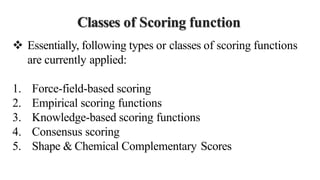
 Essentially, following types or classes of scoring functions
are currently applied:
1. Force-field-based scoring
2. Empirical scoring functions
3. Knowledge-based scoring functions
4. Consensus scoring
5. Shape & Chemical Complementary Scores
Classes of Scoring function
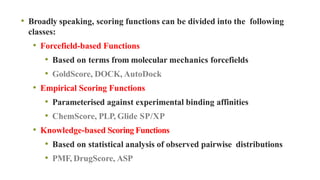
• Broadly speaking, scoring functions can be divided into the following
classes:
• Forcefield-based Functions
• Based on terms from molecular mechanics forcefields
• GoldScore, DOCK, AutoDock
• Empirical Scoring Functions
• Parameterised against experimental binding affinities
• ChemScore, PLP, Glide SP/XP
• Knowledge-based Scoring Functions
• Based on statistical analysis of observed pairwise distributions
• PMF, DrugScore, ASP
Force Field based Scoring
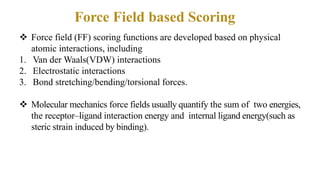
 Force field (FF) scoring functions are developed based on physical
atomic interactions, including
1. Van der Waals(VDW) interactions
2. Electrostatic interactions
3. Bond stretching/bending/torsional forces.
 Molecular mechanics force fields usually quantify the sum of two energies,
the receptor–ligand interaction energy and internal ligand energy(such as
steric strain induced by binding).
Empirical scoring functions
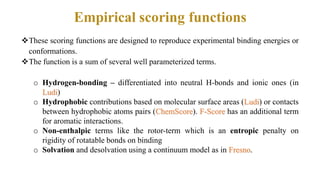
These scoring functions are designed to reproduce experimental binding energies or
conformations.
The function is a sum of several well parameterized terms.
o Hydrogen-bonding – differentiated into neutral H-bonds and ionic ones (in
Ludi)
o Hydrophobic contributions based on molecular surface areas (Ludi) or contacts
between hydrophobic atoms pairs (ChemScore). F-Score has an additional term
for aromatic interactions.
o Non-enthalpic terms like the rotor-term which is an entropic penalty on
rigidity of rotatable bonds on binding
o Solvation and desolvation using a continuum model as in Fresno.
Knowledge based scoring
Designed to reproduce experimental structures rather than binding energies.
Free energies of molecular interactions are derived from structural information on
Protein-ligand complexes contained in PDB.
Distribution of interatomic distances is converted into energy functions by inverting
Boltzmann’s law.
DrugScore includes solvent-accessibility corrections to the atom-pair potentials.
Disadvantages
Their derivation is based on the information available in the limited sets of
protein-ligand complex structures.
 Consensus scoring combines information from different scores to balance errors in
single scores and improve the Probability of identifying ‘true’ligands.
 An exemplary implementation of consensus scoring is
X-CSCORE60, which combines GOLD-like, DOCK-like, ChemScore, PMF and FlexX
scoring functions.
CONSENSUS SCORING
Shape & Chemical Complementary Scores
• Divide accessible protein surface into zones:
–Hydrophobic
–Hydrogen-bond donating
–Hydrogen-bond accepting
• Do the same for the ligand surface
• Find ligand orientation with best complementarity score
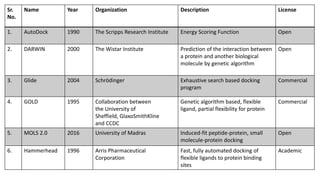
Sr.
No.
Name Year Organization Description License
1. AutoDock 1990 The Scripps Research Institute Energy Scoring Function Open
2. DARWIN 2000 The Wistar Institute Prediction of the interaction between
a protein and another biological
molecule by genetic algorithm
Open
3. Glide 2004 Schrödinger Exhaustive search based docking
program
Commercial
4. GOLD 1995 Collaboration between
the University of
Sheffield, GlaxoSmithKline
and CCDC
Genetic algorithm based, flexible
ligand, partial flexibility for protein
Commercial
5. MOLS 2.0 2016 University of Madras Induced-fit peptide-protein, small
molecule-protein docking
Open
6. Hammerhead 1996 Arris Pharmaceutical
Corporation
Fast, fully automated docking of
flexible ligands to protein binding
sites
Academic
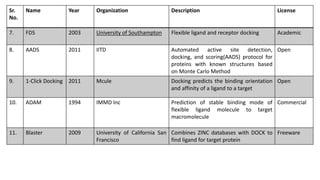
Sr.
No.
Name Year Organization Description License
7. FDS 2003 University of Southampton Flexible ligand and receptor docking Academic
8. AADS 2011 IITD Automated active site detection,
docking, and scoring(AADS) protocol for
proteins with known structures based
on Monte Carlo Method
Open
9. 1-Click Docking 2011 Mcule Docking predicts the binding orientation
and affinity of a ligand to a target
Open
10. ADAM 1994 IMMD Inc Prediction of stable binding mode of
flexible ligand molecule to target
macromolecule
Commercial
11. Blaster 2009 University of California San
Francisco
Combines ZINC databases with DOCK to
find ligand for target protein
Freeware
Docking Score Functions

Docking Score Functions

  • 1.
    DOCKING SCORING FUNCTION SAKEELAHMED (PhD Scholar) Department of Pharmacology (NIPER, Mohali)
  • 2.
     Scoring functionsare the mathematical functions used to approximately predict the binding affinity between two molecules after they have been docked.  The evaluation and ranking of predicted ligand conformations is a crucial aspect of structure-based virtual screening.  Scoring functions implemented in docking programs make simplifications in the evaluation of modeled complexes.  Affinity scoring functions areapplied to the energetically best pose found for each molecule, and comparing the affinity scores for different molecules gives their relative rank-ordering. Scoring function
  • 3.
     There arethree important applications of scoring functions in molecular docking 1. The first of these is the determination of the binding mode and site of a ligand on a protein. 2. To predict the absolute binding affinity between protein and ligand. Which is particularly important in lead optimization. 3. To identify the potential drug hits/leads for a given protein target by searching a large ligand database, i.e. virtual database screening. Application of Scoring function
  • 4.
     Essentially, followingtypes or classes of scoring functions are currently applied: 1. Force-field-based scoring 2. Empirical scoring functions 3. Knowledge-based scoring functions 4. Consensus scoring 5. Shape & Chemical Complementary Scores Classes of Scoring function
  • 5.
    • Broadly speaking,scoring functions can be divided into the following classes: • Forcefield-based Functions • Based on terms from molecular mechanics forcefields • GoldScore, DOCK, AutoDock • Empirical Scoring Functions • Parameterised against experimental binding affinities • ChemScore, PLP, Glide SP/XP • Knowledge-based Scoring Functions • Based on statistical analysis of observed pairwise distributions • PMF, DrugScore, ASP
  • 6.
    Force Field basedScoring  Force field (FF) scoring functions are developed based on physical atomic interactions, including 1. Van der Waals(VDW) interactions 2. Electrostatic interactions 3. Bond stretching/bending/torsional forces.  Molecular mechanics force fields usually quantify the sum of two energies, the receptor–ligand interaction energy and internal ligand energy(such as steric strain induced by binding).
  • 7.
    Empirical scoring functions Thesescoring functions are designed to reproduce experimental binding energies or conformations. The function is a sum of several well parameterized terms. o Hydrogen-bonding – differentiated into neutral H-bonds and ionic ones (in Ludi) o Hydrophobic contributions based on molecular surface areas (Ludi) or contacts between hydrophobic atoms pairs (ChemScore). F-Score has an additional term for aromatic interactions. o Non-enthalpic terms like the rotor-term which is an entropic penalty on rigidity of rotatable bonds on binding o Solvation and desolvation using a continuum model as in Fresno.
  • 8.
    Knowledge based scoring Designedto reproduce experimental structures rather than binding energies. Free energies of molecular interactions are derived from structural information on Protein-ligand complexes contained in PDB. Distribution of interatomic distances is converted into energy functions by inverting Boltzmann’s law. DrugScore includes solvent-accessibility corrections to the atom-pair potentials. Disadvantages Their derivation is based on the information available in the limited sets of protein-ligand complex structures.
  • 9.
     Consensus scoringcombines information from different scores to balance errors in single scores and improve the Probability of identifying ‘true’ligands.  An exemplary implementation of consensus scoring is X-CSCORE60, which combines GOLD-like, DOCK-like, ChemScore, PMF and FlexX scoring functions. CONSENSUS SCORING
  • 10.
    Shape & ChemicalComplementary Scores • Divide accessible protein surface into zones: –Hydrophobic –Hydrogen-bond donating –Hydrogen-bond accepting • Do the same for the ligand surface • Find ligand orientation with best complementarity score
  • 12.
    Sr. No. Name Year OrganizationDescription License 1. AutoDock 1990 The Scripps Research Institute Energy Scoring Function Open 2. DARWIN 2000 The Wistar Institute Prediction of the interaction between a protein and another biological molecule by genetic algorithm Open 3. Glide 2004 Schrödinger Exhaustive search based docking program Commercial 4. GOLD 1995 Collaboration between the University of Sheffield, GlaxoSmithKline and CCDC Genetic algorithm based, flexible ligand, partial flexibility for protein Commercial 5. MOLS 2.0 2016 University of Madras Induced-fit peptide-protein, small molecule-protein docking Open 6. Hammerhead 1996 Arris Pharmaceutical Corporation Fast, fully automated docking of flexible ligands to protein binding sites Academic
  • 13.
    Sr. No. Name Year OrganizationDescription License 7. FDS 2003 University of Southampton Flexible ligand and receptor docking Academic 8. AADS 2011 IITD Automated active site detection, docking, and scoring(AADS) protocol for proteins with known structures based on Monte Carlo Method Open 9. 1-Click Docking 2011 Mcule Docking predicts the binding orientation and affinity of a ligand to a target Open 10. ADAM 1994 IMMD Inc Prediction of stable binding mode of flexible ligand molecule to target macromolecule Commercial 11. Blaster 2009 University of California San Francisco Combines ZINC databases with DOCK to find ligand for target protein Freeware