An Integrated Approach to Protein-
Protein Docking
Zhiping Weng
Department of Biomedical Engineering
Bioinformatics Program
Boston University
Bioinformatics
Biomedical Engineering
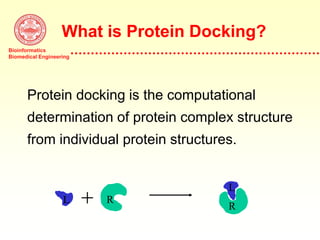
What is Protein Docking?
R
L
Protein docking is the computational
determination of protein complex structure
from individual protein structures.
L
R
Bioinformatics
Biomedical Engineering
Motivation
• Biological activity depends on the specific
recognition of proteins.
• Understand protein interaction networks in a cell
• Yield insight to thermodynamics of molecular
recognition
• The experimental determination of protein-protein
complex structures remains difficult.
Bioinformatics
Biomedical Engineering
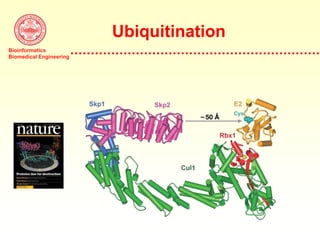
Ubiquitination
Bioinformatics
Biomedical Engineering
Experimental Tools for Studying
Protein-Protein Interactions
• 3-D structures of protein-protein
complexes: X-ray crystallography & NMR
• Binding affinity between two proteins: SPR,
titration assays
• Mutagenesis and its affect on binding
• Yeast 2-hybrid system
• Protein Chips?
Bioinformatics
Biomedical Engineering
Computational Tools for Studying
Protein-Protein Interactions
• Protein docking
• Binding affinity calculation
• Analysis of site-specific mutation
experiments
• Protein design
• The kinetics of protein-protein interactions
Bioinformatics
Biomedical Engineering
Protein-Protein Interaction
Thermodynamics
Energy
Free
Binding
:
G

R
L
R
L
L
L
R
R
L
L
R R
L L
]
][
[
]
[
ln
L
R
RL
RT
G 


water
Bioinformatics
Biomedical Engineering
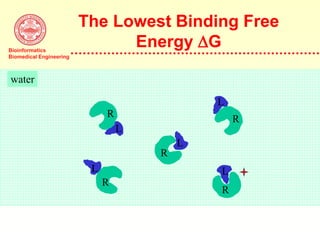
The Lowest Binding Free
Energy G
water
R
L
R
L
L
R
L
R
L
R
General Derivations
Bioinformatics
Biomedical Engineering
Two kinds of docking problems
• Bound docking
The complex structure is known. The receptor and
the ligand in the complex are pulled apart and
reassembled.
• Unbound docking
Individually determined protein structures are used.
Bioinformatics
Biomedical Engineering
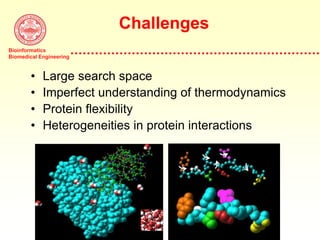
• Large search space
• Imperfect understanding of thermodynamics
• Protein flexibility
• Heterogeneities in protein interactions
Challenges
Bioinformatics
Biomedical Engineering
Divide and Conquer
• Initial stage of unbound docking
– Assume minimum binding site information
– Try to predict as many near-native structures
(hits) as possible in the top 1000, for as many
complexes as possible
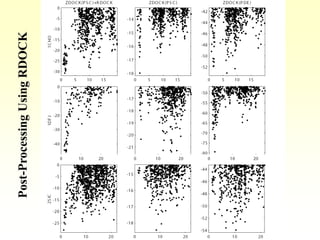
• Post-processing
– Re-rank the 1000 structures in order to pick out
near-native structures
Energy Components
Bioinformatics
Biomedical Engineering
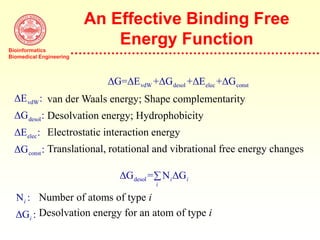
An Effective Binding Free
Energy Function
vdW desol elec const
vdW
desol
elec
const
ΔG=ΔE +ΔG +ΔE +ΔG
ΔE :
ΔG :
ΔE :
ΔG :
van der Waals energy; Shape complementarity
Desolvation energy; Hydrophobicity
Electrostatic interaction energy
Translational, rotational and vibrational free energy changes
desol
ΔG = N ΔG
N :
ΔG :
i i
i
i
i

Number of atoms of type i
Desolvation energy for an atom of type i
Bioinformatics
Biomedical Engineering
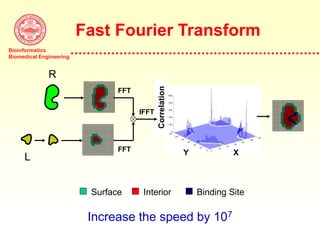
Fast Fourier Transform
Increase the speed by 107
R
L Y
Correlation
X
IFFT
FFT
FFT
Surface Interior Binding Site
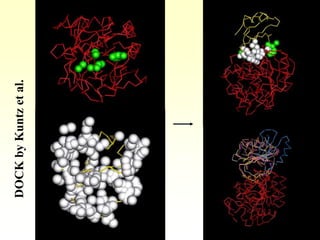
DOCK
by
Kuntz
et
al.
Bioinformatics
Biomedical Engineering
Evaluate Performance
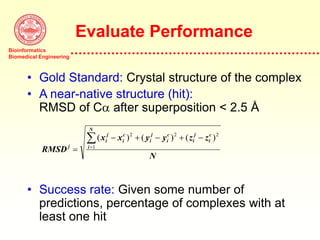
• Gold Standard: Crystal structure of the complex
• A near-native structure (hit):
RMSD of Ca after superposition < 2.5 Å
• Success rate: Given some number of
predictions, percentage of complexes with at
least one hit
RMSD
x x y y z z
N
j
i
j
i
c
i
j
i
c
i
j
i
c
i
N

    

( ) ( ) ( )
2 2 2
1
Bioinformatics
Biomedical Engineering
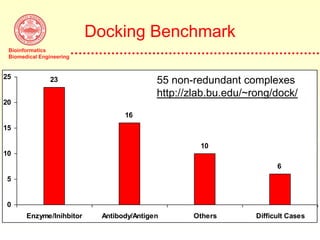
23
16
10
6
0
5
10
15
20
25
Enzyme/Inihbitor Antibody/Antigen Others Difficult Cases
Docking Benchmark
55 non-redundant complexes
http://zlab.bu.edu/~rong/dock/
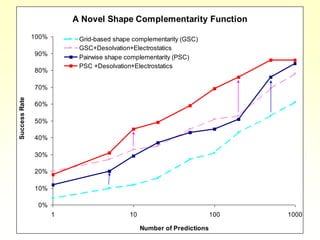
A Novel Shape Complementarity Function
0%
10%
20%
30%
40%
50%
60%
70%
80%
90%
100%
1 10 100 1000
Number of Predictions
Success
Rate
Grid-based shape complementarity (GSC)
GSC+Desolvation+Electrostatics
Pairwise shape complementarity (PSC)
PSC +Desolvation+Electrostatics
Post-Processing
Using
RDOCK
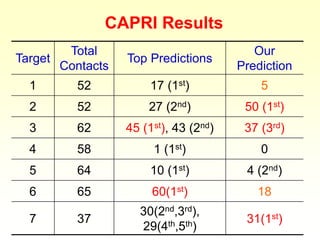
CAPRI Results
Target
Total
Contacts
Top Predictions
Our
Prediction
1 52 17 (1st) 5
2 52 27 (2nd) 50 (1st)
3 62 45 (1st), 43 (2nd) 37 (3rd)
4 58 1 (1st) 0
5 64 10 (1st) 4 (2nd)
6 65 60(1st) 18
7 37
30(2nd,3rd),
29(4th,5th)
31(1st)
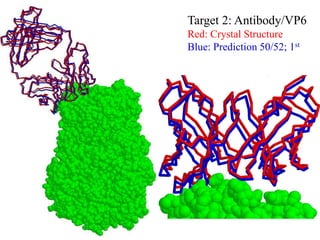
Target 2: Antibody/VP6
Red: Crystal Structure
Blue: Prediction 50/52; 1st
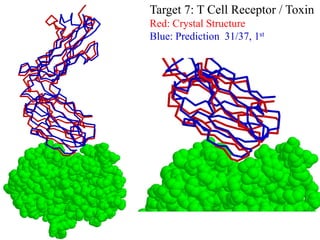
Target 7: T Cell Receptor / Toxin
Red: Crystal Structure
Blue: Prediction 31/37, 1st
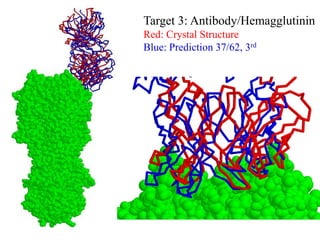
Target 3: Antibody/Hemagglutinin
Red: Crystal Structure
Blue: Prediction 37/62, 3rd
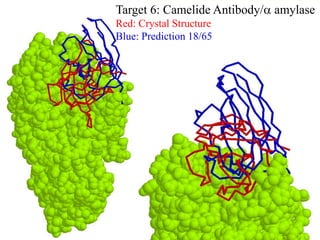
Target 6: Camelide Antibody/a amylase
Red: Crystal Structure
Blue: Prediction 18/65
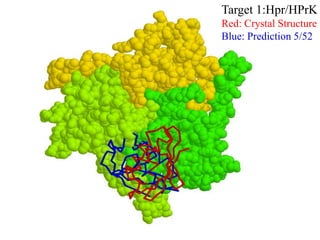
Target 1:Hpr/HPrK
Red: Crystal Structure
Blue: Prediction 5/52
Bioinformatics
Biomedical Engineering
Summary
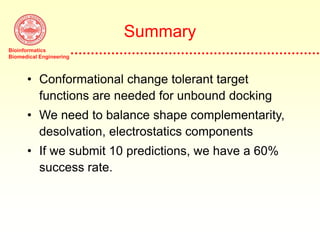
• Conformational change tolerant target
functions are needed for unbound docking
• We need to balance shape complementarity,
desolvation, electrostatics components
• If we submit 10 predictions, we have a 60%
success rate.
Bioinformatics
Biomedical Engineering
Future Work
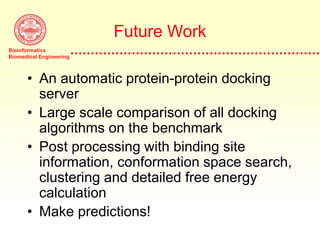
• An automatic protein-protein docking
server
• Large scale comparison of all docking
algorithms on the benchmark
• Post processing with binding site
information, conformation space search,
clustering and detailed free energy
calculation
• Make predictions!

zdockTeaching.ppt