PROSTATE BIOPSY
Dr.K.Priyatham
MCh Urology, Fellowship in Uro-oncology(RGCI)
Prashanth Hospital
• History
• Anatomy
• Indications
• Choice of Biopsy
• Preparation
• Procedure
• Complications
• Conclusion
Timeline of prostate biopsy
• Open Perineal Biopsy
• Young
1926
1930
• Transperineal needle
aspiration biopsy
• Ferguson
• Transrectal finger
guided biopsy
• Astraldi
1938
• Transrectal biopsy
using vim-Silverman
cutting needle
• Perison & Nickerson
• Transrectal guided biopsy
using Screw-tip needle
• Barringer
1954
• Transrectal finger
guided needle
aspiration biopsy
• Kauffman
• Trus to evalute prostate
(Poor quality images)
• Takashi & ouchi
1965
• Open Transrectal Biopsy
• Grabstald
• Transurethral resection biopsy
• Denton
1967
• Transrectal finger
guided needle
aspiration biopsy
• Franzen
1937 1942 1963 1967
• MR Fusion biopsy
2010’s
• Three distinct
glandular zones of
prostate described
• McNeal
1968
1974
• First Clinically useful
TRUS
• Watenabe
• Development of 7MHs
TRUS probe and
attachable needle
guided
1986
• PSA test introduced
for clinical use
• Stamey
• Modern era of prostate
biopsy sextant method
• Hodge
1996
• Peri-Prostatic
infiltration with local
anaesthetic for
analgesia
• Nash
• Extended biopsy schemes
• Eskew, Levine, Presti,
Babaian
2001
• Saturation Biopsy
• Stewart, DJavan
1980 1989 1997-2000
Timeline of prostate biopsy
OPEN PERINEAL TECHNIQUE
Transrectal guided
biopsy using Screw-
tip needle Transrectal Aspiration
Digital Guided Transrectal Biopsy Open transrectal Biopsy
TRUSHIROKI WANTANABE1974
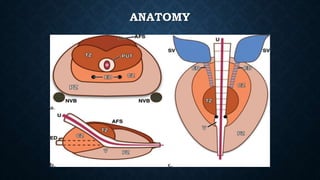
ANATOMY
• A, right lateral base;
• B, right lateral middle;
• C, right lateral apex;
• D, right medial base;
• E, right medial middle;
• F, right medial apex;
• G, left lateral base;
• H, left lateral middle;
• I, left lateral apex;
• J, left medial base;
• K, left medial middle;
• L, left medial apex;
INDICATIONS
• Abnormal serum prostate-specific antigen (PSA) level.
• Abnormal digital rectal examination (DRE) include the presence of
nodules, induration, or asymmetry.
• Patients on active surveillance
• Prior to the use of salvage local therapy to diagnose and stage the
recurrence of prostate cancer after failed radiotherapy
INDICATIONS FOR A REPEAT PROSTATE
BIOPSY
• Include the following:
• A highly suspicious DRE (digital rectal examination)
• A persistently rising serum PSA (> 0.4 – 0.75 ng/ml/yr.)
• PSA level greater than 10 ng/ml or rising.
• Presence of PIN (prostatic intraepithelial neoplasia) or
atypia on prior biopsy
• Inadequate tissue sample
CONTRAINDICATIONS
Absolute Contraindications
• Bleeding diathesis
• Acute prostatitis
• UTI
Relative Contraindications
• Intractable patient anxiety
• Failure to take antibiotic prophylaxis
• Acute painful perianal conditions like
anal fissure
Types of
prostate
biopsy
Finger-guided
Ultrasound
guided
Mri-guided
In bore
Cognitive
Fusion
Mr-fusion
Trans-rectal
biopsy
Trans-
perineal
biopsy
FINGER GUIDED BIOPSY
Transperineal Transrectal
TRANSRECTAL PROSTATE BIOPSY
TRANS PERINEAL BIOPSY
Template guided Free Hand
TRANSPERINEAL PROSTATE BIOPSY
Advantages:
• Useful in patients lacking rectum (surgical extirpation, congenital anomaly).
• Reduced infections (0-0.076% vs 1-5%)
• Improved cancer detection rates, (57% vs 41%)
• Diagnoses more clinically significant lesions (gleason >7) than TRUS biopsies (66% vs 51%)
• Even in post-prostatectomy specimens, finding correlated with TP & TR biopsies with anterior
tumors more likely to be identified with TP
• Improved anterior and apical sampling,
• Reduced false negative results
• No rectal bleeding
TRANSPERINEAL PROSTATE BIOPSY
Disadvantage:
• GeneralAnesthesiamightbeneeded.
• MorePain
• Increasedrisk of urinary retention withtransperineal biopsy route. However metaanalysis
showed same incidence
• Learning curve is more compared to transrectal route
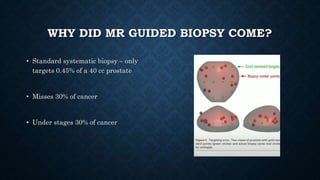
WHY DID MR GUIDED BIOPSY COME?
• Standard systematic biopsy – only
targets 0.45% of a 40 cc prostate
• Misses 30% of cancer
• Under stages 30% of cancer
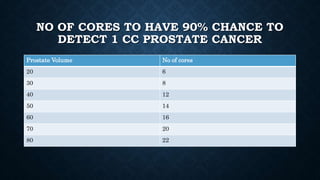
NO OF CORES TO HAVE 90% CHANCE TO
DETECT 1 CC PROSTATE CANCER
Prostate Volume No of cores
20 6
30 8
40 12
50 14
60 16
70 20
80 22
IN-BORE MULTIPARAMETRIC MAGNETIC
RESONANCE-GUIDED BIOPSY
COGNITIVE FUSION BIOPSY
MR FUSION BIOPSY
SYSTEMATIC VS TARGETED VS
COMBINATION BIOPSY
CT GUIDED TRANSPERINEAL BIOPSY
PATIENT PREPARATION
• Informed consent.
• Blood thinners should be stopped 5 days before the procedure
• High risk thromboembolism on anticoagulation- Bridge with unfractionated
heparin.
ANTIBIOTIC PROPHYLAXIS IN
TRANSPERINEAL ROUTE
• As it is a clean procedure that avoids rectal flora, quinolones or other antibiotics to cover rectal
flora may not be necessary.
• A single dose of cephalosporin only to cover skin commensals has been shown to be sufficient in
multiple single cohort series.
• Prior negative mid-stream urine test and routine surgical disinfecting preparation of the perineal
skin are mandatory
• Patients with cardiac valve replacements received amoxycillin and gentamicin, and those with
severe penicillin allergy received sulphamethoxazole. No quinolones are recommended.
ANTIBIOTIC PROPHYLAXIS IN
TRANSRECTAL ROUTE
• Based on a meta-analysis, suggested antimicrobial prophylaxis before transrectal
biopsy may consist of:
1. Targeted prophylaxis - based on rectal swab or stool culture.
2. Augmented prophylaxis - two or more different classes of antibiotics (of note: this
option is against antibiotic stewardship programmes).
3. Alternative antibiotics:
Fosfomycin trometamol (e.g., 3 g before and 3 g 24–48 hrs. after biopsy);
cephalosporin (e.g., ceftriaxone 1 g i.m; cefixime 400 mg p.o for 3 days starting 24 hrs.
before biopsy)
aminoglycoside (e.g., gentamicin 3 mg/kg i.v.; amikacin 15 mg/kg i.m).
CLEANSING ENEMA
• Home self administered enema before biopsy is recommended. Or can take oral
laxatives – one or two days before the procedure
• Decreases the amount of feces in the rectum - Produces a superior acoustic window
for prostate imaging.
• Its effect on reducing infection is debatable.
PATIENT POSITIONING
• Left lateral decubitus position with
knees and hips flexed at 90 degrees.
• Buttocks should be flush with the end
of the table to allow manipulation.
• Right lateral decubitus or lithotomy
position can also be used.
• Lithotomy position is preferred in
transperineal biopsies
PERIPROSTATIC BLOCK: MOUNT EVEREST
TECHNIQUE
APICAL INFILTRATION OF LOCAL
ANAESTHESIA
PROCEDURE
• Initial digital rectal examination
should be performed.
• Examination starts at the baseand
endsin the apex.
• Echogenicity
– Hypoechoic—61 % (Overall
accuracy of 43%.)
– Hyperechoic—2 %
– Mixed—2 %
– Not detectable isoechoic—10%-
40%
• Asymmetric enlargement
• Heterogeneous texture
COLOR AND POWER DOPPLER TRUS
• Detects prostate cancer neovascularity.
• Patients with detectable color Doppler flow
within their dominant tumor at the time of
biopsy are at 10 fold increased risk for PSA
recurrence after radical prostatectomy.
• Also associated with high gleason grade,
increased incidence of SV invasion and a
lower biochemical disease free survival rate.
ELASTOGRAPHY
• Real time sonographic imaging of the
prostate at baseline and under varying
degree of compression.
• It adds information about stiffness of
prostate tissue.
• Malignant tissue is more stiffer.
CE TRUS
• Identify microvessels in the range of
10-15 microns.
• Intravenous microbubble is used as the
contrast.
• They are constructed with air or higher
molecular weight gas agents
encapsulated for longevity in the range
1-10 microns
BIPLANAR PROSTATE IMAGING
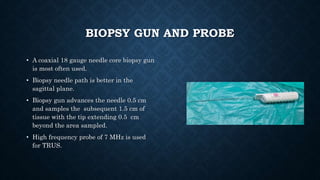
BIOPSY GUN AND PROBE
• A coaxial 18 gauge needle core biopsy gun
is most often used.
• Biopsy needle path is better in the
sagittal plane.
• Biopsy gun advances the needle 0.5 cm
and samples the subsequent 1.5 cm of
tissue with the tip extending 0.5 cm
beyond the area sampled.
• High frequency probe of 7 MHz is used
for TRUS.
Monoplanar Biplanar Triplanar
SIDE FIRE VS END FIRE
• Side-fire probe project laterally from probe axis
where as end fire probes project imaging plane
directly from the end of the probe
• Thus for side firing, probe should be in the
midline & twisting can be done to reach the
lateral aspect
• Whereas patient undergoing end fire biopsy
should be positioned at the edge of the table to
allow the ultrasound probe handle to be lowered
far enough to visualise lateral lobes
• No significant difference was found in detection
rate of prostate cancer between the end-fire and
side-fire probe in transrectal ultrasound guided
prostate biopsy, neither for detection rate of
prostate cancer in the apex by Margaretha et al
SEXTANT BIOPSY SAMPLING
• Sample from 6 sites of peripheral zone
• Onecore from the base, mid and apex bilaterally.
• WHY?
– Finding may not be cancer
– cancer is often multifocal
EXTENDED CORE BIOPSY TECHNIQUES
• Current recommendation- Six cores are
inadequate for cancer detection.
• 12 core systematic biopsy that
incorporates the apical and far lateral
cores is needed.
• Saturation biopsy 18-21 cores. (Average
21.5 cores)
OPTIMIZATION OF BIOPSY
• At the prostate base:
– Lateral biopsies will sample the peripheral zone
– Medially directed biopsies are more likely to sample the central zone
• In the mid gland:
– Medially directed biopsy in this area can traverse the peripheral zone
and predominantly sample the transition zone.
• At the prostatic apex:
– Sample the distal aspect of the transition zone.
COMPLICATIONS
PRI-MUS™ (PROSTATE RISK IDENTIFICATION
USING MICRO-ULTRASOUND)
PRI-MUS™ (PROSTATE RISK IDENTIFICATION
USING MICRO-ULTRASOUND)
Prostate Biopsy.pptx

Prostate Biopsy.pptx

  • 1.
    PROSTATE BIOPSY Dr.K.Priyatham MCh Urology,Fellowship in Uro-oncology(RGCI) Prashanth Hospital
  • 2.
    • History • Anatomy •Indications • Choice of Biopsy • Preparation • Procedure • Complications • Conclusion
  • 3.
    Timeline of prostatebiopsy • Open Perineal Biopsy • Young 1926 1930 • Transperineal needle aspiration biopsy • Ferguson • Transrectal finger guided biopsy • Astraldi 1938 • Transrectal biopsy using vim-Silverman cutting needle • Perison & Nickerson • Transrectal guided biopsy using Screw-tip needle • Barringer 1954 • Transrectal finger guided needle aspiration biopsy • Kauffman • Trus to evalute prostate (Poor quality images) • Takashi & ouchi 1965 • Open Transrectal Biopsy • Grabstald • Transurethral resection biopsy • Denton 1967 • Transrectal finger guided needle aspiration biopsy • Franzen 1937 1942 1963 1967
  • 4.
    • MR Fusionbiopsy 2010’s • Three distinct glandular zones of prostate described • McNeal 1968 1974 • First Clinically useful TRUS • Watenabe • Development of 7MHs TRUS probe and attachable needle guided 1986 • PSA test introduced for clinical use • Stamey • Modern era of prostate biopsy sextant method • Hodge 1996 • Peri-Prostatic infiltration with local anaesthetic for analgesia • Nash • Extended biopsy schemes • Eskew, Levine, Presti, Babaian 2001 • Saturation Biopsy • Stewart, DJavan 1980 1989 1997-2000 Timeline of prostate biopsy
  • 5.
  • 6.
    Transrectal guided biopsy usingScrew- tip needle Transrectal Aspiration
  • 7.
    Digital Guided TransrectalBiopsy Open transrectal Biopsy
  • 8.
  • 9.
  • 10.
    • A, rightlateral base; • B, right lateral middle; • C, right lateral apex; • D, right medial base; • E, right medial middle; • F, right medial apex; • G, left lateral base; • H, left lateral middle; • I, left lateral apex; • J, left medial base; • K, left medial middle; • L, left medial apex;
  • 11.
    INDICATIONS • Abnormal serumprostate-specific antigen (PSA) level. • Abnormal digital rectal examination (DRE) include the presence of nodules, induration, or asymmetry. • Patients on active surveillance • Prior to the use of salvage local therapy to diagnose and stage the recurrence of prostate cancer after failed radiotherapy
  • 12.
    INDICATIONS FOR AREPEAT PROSTATE BIOPSY • Include the following: • A highly suspicious DRE (digital rectal examination) • A persistently rising serum PSA (> 0.4 – 0.75 ng/ml/yr.) • PSA level greater than 10 ng/ml or rising. • Presence of PIN (prostatic intraepithelial neoplasia) or atypia on prior biopsy • Inadequate tissue sample
  • 13.
    CONTRAINDICATIONS Absolute Contraindications • Bleedingdiathesis • Acute prostatitis • UTI Relative Contraindications • Intractable patient anxiety • Failure to take antibiotic prophylaxis • Acute painful perianal conditions like anal fissure
  • 14.
  • 15.
  • 16.
  • 17.
  • 18.
    TRANSPERINEAL PROSTATE BIOPSY Advantages: •Useful in patients lacking rectum (surgical extirpation, congenital anomaly). • Reduced infections (0-0.076% vs 1-5%) • Improved cancer detection rates, (57% vs 41%) • Diagnoses more clinically significant lesions (gleason >7) than TRUS biopsies (66% vs 51%) • Even in post-prostatectomy specimens, finding correlated with TP & TR biopsies with anterior tumors more likely to be identified with TP • Improved anterior and apical sampling, • Reduced false negative results • No rectal bleeding
  • 20.
    TRANSPERINEAL PROSTATE BIOPSY Disadvantage: •GeneralAnesthesiamightbeneeded. • MorePain • Increasedrisk of urinary retention withtransperineal biopsy route. However metaanalysis showed same incidence • Learning curve is more compared to transrectal route
  • 22.
    WHY DID MRGUIDED BIOPSY COME? • Standard systematic biopsy – only targets 0.45% of a 40 cc prostate • Misses 30% of cancer • Under stages 30% of cancer
  • 23.
    NO OF CORESTO HAVE 90% CHANCE TO DETECT 1 CC PROSTATE CANCER Prostate Volume No of cores 20 6 30 8 40 12 50 14 60 16 70 20 80 22
  • 24.
  • 26.
  • 27.
  • 29.
    SYSTEMATIC VS TARGETEDVS COMBINATION BIOPSY
  • 30.
  • 32.
    PATIENT PREPARATION • Informedconsent. • Blood thinners should be stopped 5 days before the procedure • High risk thromboembolism on anticoagulation- Bridge with unfractionated heparin.
  • 33.
    ANTIBIOTIC PROPHYLAXIS IN TRANSPERINEALROUTE • As it is a clean procedure that avoids rectal flora, quinolones or other antibiotics to cover rectal flora may not be necessary. • A single dose of cephalosporin only to cover skin commensals has been shown to be sufficient in multiple single cohort series. • Prior negative mid-stream urine test and routine surgical disinfecting preparation of the perineal skin are mandatory • Patients with cardiac valve replacements received amoxycillin and gentamicin, and those with severe penicillin allergy received sulphamethoxazole. No quinolones are recommended.
  • 34.
    ANTIBIOTIC PROPHYLAXIS IN TRANSRECTALROUTE • Based on a meta-analysis, suggested antimicrobial prophylaxis before transrectal biopsy may consist of: 1. Targeted prophylaxis - based on rectal swab or stool culture. 2. Augmented prophylaxis - two or more different classes of antibiotics (of note: this option is against antibiotic stewardship programmes). 3. Alternative antibiotics: Fosfomycin trometamol (e.g., 3 g before and 3 g 24–48 hrs. after biopsy); cephalosporin (e.g., ceftriaxone 1 g i.m; cefixime 400 mg p.o for 3 days starting 24 hrs. before biopsy) aminoglycoside (e.g., gentamicin 3 mg/kg i.v.; amikacin 15 mg/kg i.m).
  • 35.
    CLEANSING ENEMA • Homeself administered enema before biopsy is recommended. Or can take oral laxatives – one or two days before the procedure • Decreases the amount of feces in the rectum - Produces a superior acoustic window for prostate imaging. • Its effect on reducing infection is debatable.
  • 36.
    PATIENT POSITIONING • Leftlateral decubitus position with knees and hips flexed at 90 degrees. • Buttocks should be flush with the end of the table to allow manipulation. • Right lateral decubitus or lithotomy position can also be used. • Lithotomy position is preferred in transperineal biopsies
  • 37.
    PERIPROSTATIC BLOCK: MOUNTEVEREST TECHNIQUE
  • 38.
    APICAL INFILTRATION OFLOCAL ANAESTHESIA
  • 39.
    PROCEDURE • Initial digitalrectal examination should be performed. • Examination starts at the baseand endsin the apex. • Echogenicity – Hypoechoic—61 % (Overall accuracy of 43%.) – Hyperechoic—2 % – Mixed—2 % – Not detectable isoechoic—10%- 40% • Asymmetric enlargement • Heterogeneous texture
  • 40.
    COLOR AND POWERDOPPLER TRUS • Detects prostate cancer neovascularity. • Patients with detectable color Doppler flow within their dominant tumor at the time of biopsy are at 10 fold increased risk for PSA recurrence after radical prostatectomy. • Also associated with high gleason grade, increased incidence of SV invasion and a lower biochemical disease free survival rate.
  • 41.
    ELASTOGRAPHY • Real timesonographic imaging of the prostate at baseline and under varying degree of compression. • It adds information about stiffness of prostate tissue. • Malignant tissue is more stiffer.
  • 42.
    CE TRUS • Identifymicrovessels in the range of 10-15 microns. • Intravenous microbubble is used as the contrast. • They are constructed with air or higher molecular weight gas agents encapsulated for longevity in the range 1-10 microns
  • 43.
  • 44.
    BIOPSY GUN ANDPROBE • A coaxial 18 gauge needle core biopsy gun is most often used. • Biopsy needle path is better in the sagittal plane. • Biopsy gun advances the needle 0.5 cm and samples the subsequent 1.5 cm of tissue with the tip extending 0.5 cm beyond the area sampled. • High frequency probe of 7 MHz is used for TRUS.
  • 45.
  • 46.
    SIDE FIRE VSEND FIRE • Side-fire probe project laterally from probe axis where as end fire probes project imaging plane directly from the end of the probe • Thus for side firing, probe should be in the midline & twisting can be done to reach the lateral aspect • Whereas patient undergoing end fire biopsy should be positioned at the edge of the table to allow the ultrasound probe handle to be lowered far enough to visualise lateral lobes • No significant difference was found in detection rate of prostate cancer between the end-fire and side-fire probe in transrectal ultrasound guided prostate biopsy, neither for detection rate of prostate cancer in the apex by Margaretha et al
  • 48.
    SEXTANT BIOPSY SAMPLING •Sample from 6 sites of peripheral zone • Onecore from the base, mid and apex bilaterally. • WHY? – Finding may not be cancer – cancer is often multifocal
  • 49.
    EXTENDED CORE BIOPSYTECHNIQUES • Current recommendation- Six cores are inadequate for cancer detection. • 12 core systematic biopsy that incorporates the apical and far lateral cores is needed. • Saturation biopsy 18-21 cores. (Average 21.5 cores)
  • 50.
    OPTIMIZATION OF BIOPSY •At the prostate base: – Lateral biopsies will sample the peripheral zone – Medially directed biopsies are more likely to sample the central zone • In the mid gland: – Medially directed biopsy in this area can traverse the peripheral zone and predominantly sample the transition zone. • At the prostatic apex: – Sample the distal aspect of the transition zone.
  • 52.
  • 54.
    PRI-MUS™ (PROSTATE RISKIDENTIFICATION USING MICRO-ULTRASOUND)
  • 55.
    PRI-MUS™ (PROSTATE RISKIDENTIFICATION USING MICRO-ULTRASOUND)

Editor's Notes

  • #6 Hugh Hampton Young, regarded as one of the Fathers of American Urology, published his open perineal technique as an effective method of performing PBx
  • #16 Artist’s illustration of technique used by Kaufman et al. A digit inserted rectally guided a transperineally inserted needle to a suspicious prostate nodule
  • #22 14 f angio cath
  • #25 IB was performed with the patient in ventral decubitus and a transrectal approach, as shown (Fig. 1), under local anaesthesia and prophylactic antibiotics. An MR-compatible needle guide was rectally inserted, associated to a biopsy device DynaTRIM (invivo corp., Gainesville, FL, USA). Median time procedure in our experience is approximately 35 minutes; a 45 minutes’ slot is booked for each patient. Expensive Time consuming Requires anaesthesia
  • #27 cognitive guidance, the biopsy operator reviews the MR images and creates a mental three-dimensional representation of the prostate and of the lesion within it. Using this representation, the biopsy operator will guide the biopsy needle in to the lesion of interest in the prostate, even if it is not visible on ultrasound (US).