Benign Prostatic
Hyperplasia
Presented by
Abdulaziz Bagasi – R1 Family Medicine NGH
Supervised by
Dr.Ahmed Sabban
March 2018
Objectives
• Definition
• Lower urinary tract symptoms (LUTS)
• Epidemiology
• Clinical manifestation
• Complications
• BPH and Prostatic cancer
• Differential Diagnosis
Objectives
• Approach to patient with LUTS
oHistory
oPhysical examination
oInvestigation
oManagement
oPrevention
Measurement of PSA
Prostate cancer and normal PSA
Prostate cancer and (PSA)
Prostate cancer and (DRE)
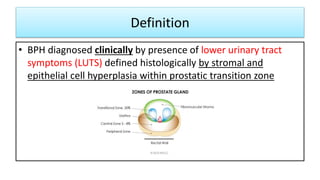
Definition
• BPH diagnosed clinically by presence of lower urinary tract
symptoms (LUTS) defined histologically by stromal and
epithelial cell hyperplasia within prostatic transition zone
Lower urinary tract symptoms (LUTS)
• Voiding or obstructive symptoms (weak or intermittent urinary
stream, straining, hesitancy)
• Storage or irritative symptoms (urgency, frequency, nocturia,
urge incontinence, urinary retention)
• Postmicturition dribbling
Epidemiology
• Who is most affected : men > 45 years old
• The prevalence :
• 8 percent in men aged 31 to 40
 40 to 50 percent in men aged 51 to 60
 More than 80 percent in men older than age 80
CLINICAL MANIFESTATIONS
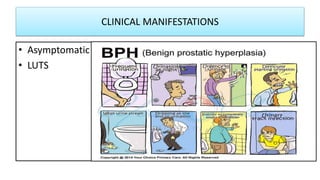
• Asymptomatic
• LUTS
Complications
In a small percentage of men, untreated BPH can cause :
o Acute urinary retention
o Recurrent UTI
o Hydronephrosis
o Renal failure
Is BPH a risk factor for
Prostate cancer ?!
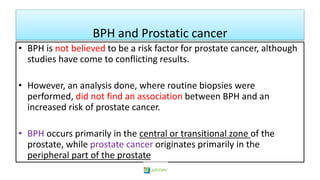
BPH and Prostatic cancer
• BPH is not believed to be a risk factor for prostate cancer, although
studies have come to conflicting results.
• However, an analysis done, where routine biopsies were
performed, did not find an association between BPH and an
increased risk of prostate cancer.
• BPH occurs primarily in the central or transitional zone of the
prostate, while prostate cancer originates primarily in the
peripheral part of the prostate
Differential Diagnosis (LUTS)
• Urethral stricture
• Bladder neck contracture
• Prostate cancer
• Urinary tract infection and acute prostatitis
• Neurogenic bladder
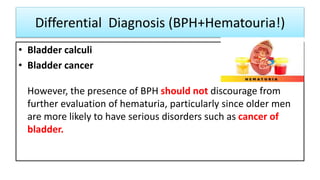
Differential Diagnosis (BPH+Hematouria!)
• Bladder calculi
• Bladder cancer
However, the presence of BPH should not discourage from
further evaluation of hematuria, particularly since older men
are more likely to have serious disorders such as cancer of
bladder.
Approach to patient with LUTS
According to
History
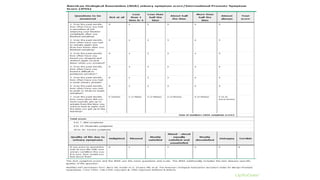
• American Urological Association (AUA) urinary symptom
score/International Prostate Symptom Score (IPSS)
• Important historical points to exclude other urologic
conditions that can mimic the symptoms of BPH
Important historical points
• History of urethral trauma, urethritis, or urethral instrumentation that could lead to
urethral stricture
• Gross hematuria or pain in the bladder region, which may be suggestive of a bladder
calculi or cancer
• Underlying neurologic disease, which might indicate a neurogenic bladder
• Cigarette smoking, which is a risk factor for bladder cancer
• Treatment with drugs that can impair bladder contractility (eg, anticholinergic
agents).
Physical examination
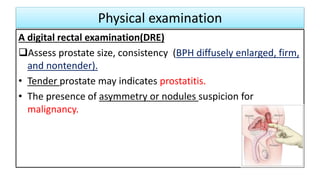
A digital rectal examination(DRE)
Assess prostate size, consistency (BPH diffusely enlarged, firm,
and nontender).
• Tender prostate may indicates prostatitis.
• The presence of asymmetry or nodules suspicion for
malignancy.
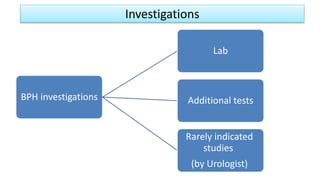
Investigations
BPH investigations
Lab
Additional tests
Rarely indicated
studies
(by Urologist)
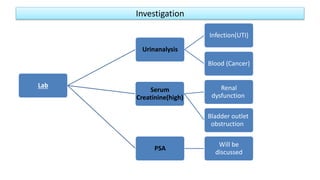
Investigation
Lab
Urinanalysis
Infection(UTI)
Blood (Cancer)
Serum
Creatinine(high)
Renal
dysfunction
Bladder outlet
obstruction
PSA
Will be
discussed
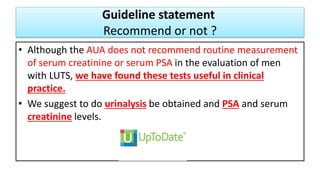
Guideline statement
Recommend or not ?
• Although the AUA does not recommend routine measurement
of serum creatinine or serum PSA in the evaluation of men
with LUTS, we have found these tests useful in clinical
practice.
• We suggest to do urinalysis be obtained and PSA and serum
creatinine levels.
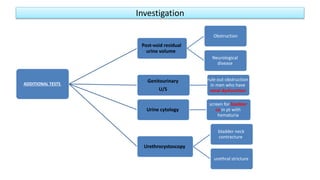
Investigation
ADDITIONAL TESTS
Post-void residual
urine volume
Obstruction
Neurological
disease
Genitourinary
U/S
rule out obstruction
in men who have
renal dysfunction
Urine cytology
screen for bladder
ca in pt with
hematuria
Urethrocystoscopy
bladder neck
contracture
urethral stricture
Investigation
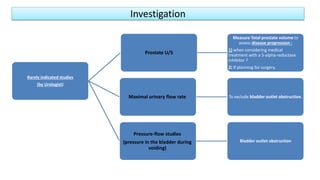
Rarely indicated studies
(by Urologist)
Prostate U/S
Measure Total prostate volume to
assess disease progression :
1) when considering medical
treatment with a 5-alpha-reductase
inhibitor ?
2) If planning for surgery.
Maximal urinary flow rate To exclude bladder outlet obstruction.
Pressure-flow studies
(pressure in the bladder during
voiding)
Bladder outlet obstruction
Measurement of PSA
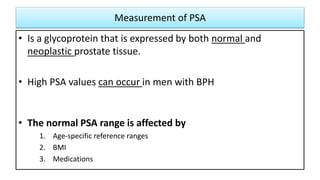
• Is a glycoprotein that is expressed by both normal and
neoplastic prostate tissue.
• High PSA values can occur in men with BPH
• The normal PSA range is affected by
1. Age-specific reference ranges
2. BMI
3. Medications
1) Age-specific reference ranges
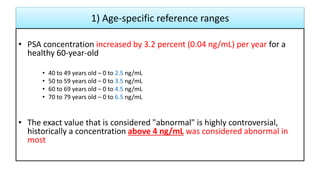
• PSA concentration increased by 3.2 percent (0.04 ng/mL) per year for a
healthy 60-year-old
• 40 to 49 years old – 0 to 2.5 ng/mL
• 50 to 59 years old – 0 to 3.5 ng/mL
• 60 to 69 years old – 0 to 4.5 ng/mL
• 70 to 79 years old – 0 to 6.5 ng/mL
• The exact value that is considered "abnormal" is highly controversial,
historically a concentration above 4 ng/mL was considered abnormal in
most
2) PSA and BMI
• Increasing BMI is associated with a lower mean PSA
concentration.
3) Medications
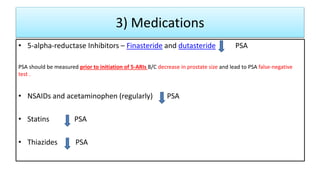
• 5-alpha-reductase Inhibitors – Finasteride and dutasteride PSA
PSA should be measured prior to initiation of 5-ARIs B/C decrease in prostate size and lead to PSA false-negative
test .
• NSAIDs and acetaminophen (regularly) PSA
• Statins PSA
• Thiazides PSA
What are the causes of elevated PSA?
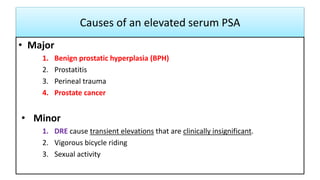
Causes of an elevated serum PSA
• Major
1. Benign prostatic hyperplasia (BPH)
2. Prostatitis
3. Perineal trauma
4. Prostate cancer
• Minor
1. DRE cause transient elevations that are clinically insignificant.
2. Vigorous bicycle riding
3. Sexual activity
Is prostate cancer always associated with high
PSA?
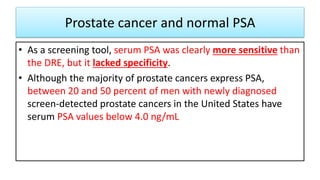
Prostate cancer and normal PSA
• As a screening tool, serum PSA was clearly more sensitive than
the DRE, but it lacked specificity.
• Although the majority of prostate cancers express PSA,
between 20 and 50 percent of men with newly diagnosed
screen-detected prostate cancers in the United States have
serum PSA values below 4.0 ng/mL
Should we always screen for prostate cancer?
Should we always do PSA+DRE for prostate
cancer screening ?
Prostate cancer screening and (PSA)
• Although screening for prostate cancer with PSA can reduce
mortality from prostate cancer, but the absolute risk reduction
is very small.
• Health care providers should periodically discuss prostate
cancer screening with men who are expected to live at least 10
years and are old enough to be at significant risk for prostate
cancer.
• In average-risk men, we suggest that discussions begin at age
50 years (Grade 2B).
Prostate cancer screening
• High-risk men include: black men; men with a family history of
prostate cancer.
• In men at high risk for prostate cancer, we suggest that discussions
begin at age 40 to 45 years (Grade 2C).
• When a decision is made to screen, we suggest that screening be
performed with PSA tests at intervals ranging from every two to
four years (Grade 2B).
• We suggest not performing digital rectal examination (DRE) as part
of screening (Grade 2C).
• We suggest Stop screening after age 69 or earlier when
comorbidities limit life expectancy to less than 10 years
Prostate cancer screening and (DRE)
• We suggest not performing digital rectal examination (DRE)
for prostate cancer screening whether alone or in
combination with PSA.
• PSA and DRE are somewhat complementary
• (PSA + DRE) increase the overall rate of cancer detection
• However, there is no high-level evidence that DRE screening
improves survival outcomes.
• Men with an abnormal DRE (if performed) or PSA level above
7 ng/mL should be referred, without further testing for a
prostate biopsy.
BPH Management
1. Watchful waiting
2. Behavioral modifications
3. Medical
4. Surgical
1) Watchful waiting
Recommended for (AUA Standard) :
• Mild symptoms of (LUTS) secondary to BPH (American
Urological Association Symptom Index [AUASI] score < 8)
• Moderate or severe symptoms (AUASI score ≥ 8) who are not
bothered by their LUTS symptoms
2) BEHAVIORAL MODIFICATIONS
• If the patients not having any discomfort from their symptoms and no evidence of
complications.
• Avoiding fluids prior to bedtime.
• Reducing consumption of caffeine and alcohol.
• Double voiding to empty the bladder more completely.
Referred to a urologist for evaluation prior to the
initiation of medical therapy
• Symptoms after invasive treatment of the urethra or prostate.
• Men <45 Y.
• Prostate exam (nodule, induration, or asymmetry) CA?
• Hematuria in the absence of infection.
• Severe symptoms (IPSS ≥20).
• Complications such as hydronephrosis or renal insufficiency.
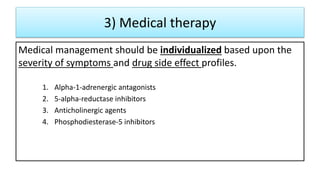
3) Medical therapy
Medical management should be individualized based upon the
severity of symptoms and drug side effect profiles.
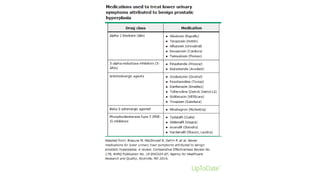
1. Alpha-1-adrenergic antagonists
2. 5-alpha-reductase inhibitors
3. Anticholinergic agents
4. Phosphodiesterase-5 inhibitors
INITIAL MEDICAL MONOTHERAPY
• Start initial treatment with an alpha-1-adrenergic antagonist
monotherapy
» In patients with mild (IPSS <8)-to-moderate (IPSS 8-19) symptoms
of (BPH)
• Because Alpha-1-adrenergic antagonists provide
immediate therapeutic benefits, while 5-alpha-
reductase inhibitors requires 6 to 12 months before
symptom improvement
1) Alpha-1-adrenergic antagonists
• The most commonly prescribed medication for BPH.
• They act by relaxing smooth muscle in the bladder neck, prostate capsule, and prostatic
urethra.
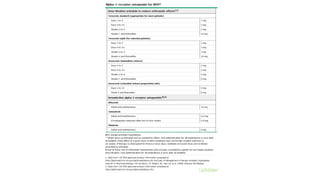
• Terazosin, doxazosin, Tamsulosin, alfuzosin, and silodosin
• Terazosin and doxazosin generally need to be initiated at bedtime (to reduce postural
hyptension soon after starting the medication) and the dose should be titrated up over
several weeks.
• More uroselective (alfuzosin, Tamsulosin, and silodosin) No need for titration as have less
hypotension.
Side effects of Alpha-1-adrenergic antagonists
1. Orthostatic hypotension (MOST IMP.)
Tamsulosin, alfuzosin, and silodosin have lower potential to cause
hypotension and syncope than either terazosin or doxazosin.
2. Ejaculatory dysfunction
By Tamsulosin and silodosin
Side effects of Alpha-1-adrenergic antagonists
3. Interaction with phosphodiesterase-5 inhibitor
 The hypotensive effects of terazosin and doxazosin can be potentiated by
concomitant use of the phosphodiesterase-5 (PDE-5) inhibitors sildenafil or
vardenafil.
 We advise men to separate the doses of alpha-1-adrenergic antagonists and
PDE-5 inhibitors by at least four hours.
 In general, we use Tamsulosin, alfuzosin, and silodosin in men who are also
using PDE-5 inhibitors
2) 5-alpha-reductase inhibitors
• They are more effective in men with larger prostates .They act
by reducing the size of the prostate gland
• Two approved medication, Finasteride and Dutasteride.
• Requires 6 to 12 months before symptom improvement.
• When to be used as initial therapy ?
 Men without ED or irritant symptoms who can't tolerate alpha blockers .
Administration
• Finasteride can be initiated and maintained at 5 mg once
daily.
• Dutasteride can be initiated and maintained at 0.5 mg once
daily.
• In contrast to the alpha-1-adrenergic antagonists, 5-alpha-
reductase inhibitors do not require titration.
Side effects of 5-ARIs
1. Sexual dysfunction (MOST COMMON)
• decreased libido and ejaculatory or erectile dysfunction.
2. PSA !
• If a patient is being screened for prostate cancer, medication effect 5-ARIs
should be taken into account when interpreting the PSA
3. increased risk of depression.
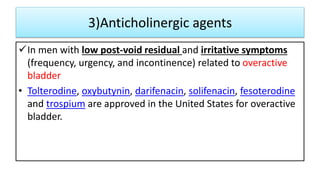
3)Anticholinergic agents
In men with low post-void residual and irritative symptoms
(frequency, urgency, and incontinence) related to overactive
bladder
• Tolterodine, oxybutynin, darifenacin, solifenacin, fesoterodine
and trospium are approved in the United States for overactive
bladder.
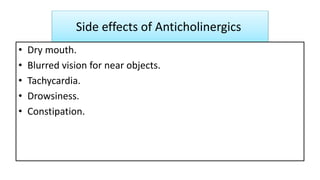
Side effects of Anticholinergics
• Dry mouth.
• Blurred vision for near objects.
• Tachycardia.
• Drowsiness.
• Constipation.
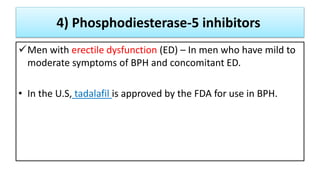
4) Phosphodiesterase-5 inhibitors
Men with erectile dysfunction (ED) – In men who have mild to
moderate symptoms of BPH and concomitant ED.
• In the U.S, tadalafil is approved by the FDA for use in BPH.
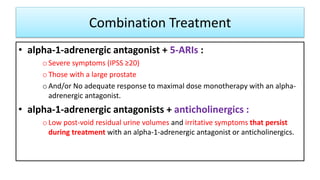
Combination Treatment
• alpha-1-adrenergic antagonist + 5-ARIs :
oSevere symptoms (IPSS ≥20)
oThose with a large prostate
oAnd/or No adequate response to maximal dose monotherapy with an alpha-
adrenergic antagonist.
• alpha-1-adrenergic antagonists + anticholinergics :
oLow post-void residual urine volumes and irritative symptoms that persist
during treatment with an alpha-1-adrenergic antagonist or anticholinergics.
Referral to urologist
If initial evaluation suggests
• Prostate cancer
• Hematuria
• Abnormal PSA
• Recurrent infection
• Palpable bladder
• History/risk of urethral stricture
• Neurologic disease
• Persistent LUTS after basic management
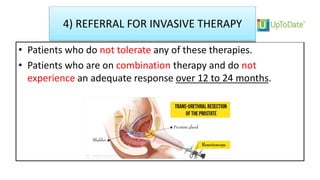
4) REFERRAL FOR INVASIVE THERAPY
• Patients who do not tolerate any of these therapies.
• Patients who are on combination therapy and do not
experience an adequate response over 12 to 24 months.
Prevention
1. Zinc supplementation decreased risk of development of
BPH (level 2 [mid-level] evidence)
2. More physically active lower frequency of LUTS (level 2 [mid-
level] evidence)
Any Questions?

benign prostatic hyperplasia by dr.bagasi

  • 1.
    Benign Prostatic Hyperplasia Presented by AbdulazizBagasi – R1 Family Medicine NGH Supervised by Dr.Ahmed Sabban March 2018
  • 2.
    Objectives • Definition • Lowerurinary tract symptoms (LUTS) • Epidemiology • Clinical manifestation • Complications • BPH and Prostatic cancer • Differential Diagnosis
  • 3.
    Objectives • Approach topatient with LUTS oHistory oPhysical examination oInvestigation oManagement oPrevention Measurement of PSA Prostate cancer and normal PSA Prostate cancer and (PSA) Prostate cancer and (DRE)
  • 4.
    Definition • BPH diagnosedclinically by presence of lower urinary tract symptoms (LUTS) defined histologically by stromal and epithelial cell hyperplasia within prostatic transition zone
  • 5.
    Lower urinary tractsymptoms (LUTS) • Voiding or obstructive symptoms (weak or intermittent urinary stream, straining, hesitancy) • Storage or irritative symptoms (urgency, frequency, nocturia, urge incontinence, urinary retention) • Postmicturition dribbling
  • 6.
    Epidemiology • Who ismost affected : men > 45 years old • The prevalence : • 8 percent in men aged 31 to 40  40 to 50 percent in men aged 51 to 60  More than 80 percent in men older than age 80
  • 7.
  • 8.
    Complications In a smallpercentage of men, untreated BPH can cause : o Acute urinary retention o Recurrent UTI o Hydronephrosis o Renal failure
  • 9.
    Is BPH arisk factor for Prostate cancer ?!
  • 10.
    BPH and Prostaticcancer • BPH is not believed to be a risk factor for prostate cancer, although studies have come to conflicting results. • However, an analysis done, where routine biopsies were performed, did not find an association between BPH and an increased risk of prostate cancer. • BPH occurs primarily in the central or transitional zone of the prostate, while prostate cancer originates primarily in the peripheral part of the prostate
  • 11.
    Differential Diagnosis (LUTS) •Urethral stricture • Bladder neck contracture • Prostate cancer • Urinary tract infection and acute prostatitis • Neurogenic bladder
  • 12.
    Differential Diagnosis (BPH+Hematouria!) •Bladder calculi • Bladder cancer However, the presence of BPH should not discourage from further evaluation of hematuria, particularly since older men are more likely to have serious disorders such as cancer of bladder.
  • 13.
    Approach to patientwith LUTS According to
  • 14.
    History • American UrologicalAssociation (AUA) urinary symptom score/International Prostate Symptom Score (IPSS) • Important historical points to exclude other urologic conditions that can mimic the symptoms of BPH
  • 16.
    Important historical points •History of urethral trauma, urethritis, or urethral instrumentation that could lead to urethral stricture • Gross hematuria or pain in the bladder region, which may be suggestive of a bladder calculi or cancer • Underlying neurologic disease, which might indicate a neurogenic bladder • Cigarette smoking, which is a risk factor for bladder cancer • Treatment with drugs that can impair bladder contractility (eg, anticholinergic agents).
  • 17.
    Physical examination A digitalrectal examination(DRE) Assess prostate size, consistency (BPH diffusely enlarged, firm, and nontender). • Tender prostate may indicates prostatitis. • The presence of asymmetry or nodules suspicion for malignancy.
  • 18.
  • 19.
  • 20.
    Guideline statement Recommend ornot ? • Although the AUA does not recommend routine measurement of serum creatinine or serum PSA in the evaluation of men with LUTS, we have found these tests useful in clinical practice. • We suggest to do urinalysis be obtained and PSA and serum creatinine levels.
  • 21.
    Investigation ADDITIONAL TESTS Post-void residual urinevolume Obstruction Neurological disease Genitourinary U/S rule out obstruction in men who have renal dysfunction Urine cytology screen for bladder ca in pt with hematuria Urethrocystoscopy bladder neck contracture urethral stricture
  • 22.
    Investigation Rarely indicated studies (byUrologist) Prostate U/S Measure Total prostate volume to assess disease progression : 1) when considering medical treatment with a 5-alpha-reductase inhibitor ? 2) If planning for surgery. Maximal urinary flow rate To exclude bladder outlet obstruction. Pressure-flow studies (pressure in the bladder during voiding) Bladder outlet obstruction
  • 23.
    Measurement of PSA •Is a glycoprotein that is expressed by both normal and neoplastic prostate tissue. • High PSA values can occur in men with BPH • The normal PSA range is affected by 1. Age-specific reference ranges 2. BMI 3. Medications
  • 24.
    1) Age-specific referenceranges • PSA concentration increased by 3.2 percent (0.04 ng/mL) per year for a healthy 60-year-old • 40 to 49 years old – 0 to 2.5 ng/mL • 50 to 59 years old – 0 to 3.5 ng/mL • 60 to 69 years old – 0 to 4.5 ng/mL • 70 to 79 years old – 0 to 6.5 ng/mL • The exact value that is considered "abnormal" is highly controversial, historically a concentration above 4 ng/mL was considered abnormal in most
  • 25.
    2) PSA andBMI • Increasing BMI is associated with a lower mean PSA concentration.
  • 26.
    3) Medications • 5-alpha-reductaseInhibitors – Finasteride and dutasteride PSA PSA should be measured prior to initiation of 5-ARIs B/C decrease in prostate size and lead to PSA false-negative test . • NSAIDs and acetaminophen (regularly) PSA • Statins PSA • Thiazides PSA
  • 27.
    What are thecauses of elevated PSA?
  • 28.
    Causes of anelevated serum PSA • Major 1. Benign prostatic hyperplasia (BPH) 2. Prostatitis 3. Perineal trauma 4. Prostate cancer • Minor 1. DRE cause transient elevations that are clinically insignificant. 2. Vigorous bicycle riding 3. Sexual activity
  • 29.
    Is prostate canceralways associated with high PSA?
  • 30.
    Prostate cancer andnormal PSA • As a screening tool, serum PSA was clearly more sensitive than the DRE, but it lacked specificity. • Although the majority of prostate cancers express PSA, between 20 and 50 percent of men with newly diagnosed screen-detected prostate cancers in the United States have serum PSA values below 4.0 ng/mL
  • 31.
    Should we alwaysscreen for prostate cancer? Should we always do PSA+DRE for prostate cancer screening ?
  • 32.
    Prostate cancer screeningand (PSA) • Although screening for prostate cancer with PSA can reduce mortality from prostate cancer, but the absolute risk reduction is very small. • Health care providers should periodically discuss prostate cancer screening with men who are expected to live at least 10 years and are old enough to be at significant risk for prostate cancer. • In average-risk men, we suggest that discussions begin at age 50 years (Grade 2B).
  • 33.
    Prostate cancer screening •High-risk men include: black men; men with a family history of prostate cancer. • In men at high risk for prostate cancer, we suggest that discussions begin at age 40 to 45 years (Grade 2C). • When a decision is made to screen, we suggest that screening be performed with PSA tests at intervals ranging from every two to four years (Grade 2B). • We suggest not performing digital rectal examination (DRE) as part of screening (Grade 2C). • We suggest Stop screening after age 69 or earlier when comorbidities limit life expectancy to less than 10 years
  • 34.
    Prostate cancer screeningand (DRE) • We suggest not performing digital rectal examination (DRE) for prostate cancer screening whether alone or in combination with PSA. • PSA and DRE are somewhat complementary • (PSA + DRE) increase the overall rate of cancer detection • However, there is no high-level evidence that DRE screening improves survival outcomes. • Men with an abnormal DRE (if performed) or PSA level above 7 ng/mL should be referred, without further testing for a prostate biopsy.
  • 36.
    BPH Management 1. Watchfulwaiting 2. Behavioral modifications 3. Medical 4. Surgical
  • 37.
    1) Watchful waiting Recommendedfor (AUA Standard) : • Mild symptoms of (LUTS) secondary to BPH (American Urological Association Symptom Index [AUASI] score < 8) • Moderate or severe symptoms (AUASI score ≥ 8) who are not bothered by their LUTS symptoms
  • 38.
    2) BEHAVIORAL MODIFICATIONS •If the patients not having any discomfort from their symptoms and no evidence of complications. • Avoiding fluids prior to bedtime. • Reducing consumption of caffeine and alcohol. • Double voiding to empty the bladder more completely.
  • 39.
    Referred to aurologist for evaluation prior to the initiation of medical therapy • Symptoms after invasive treatment of the urethra or prostate. • Men <45 Y. • Prostate exam (nodule, induration, or asymmetry) CA? • Hematuria in the absence of infection. • Severe symptoms (IPSS ≥20). • Complications such as hydronephrosis or renal insufficiency.
  • 40.
    3) Medical therapy Medicalmanagement should be individualized based upon the severity of symptoms and drug side effect profiles. 1. Alpha-1-adrenergic antagonists 2. 5-alpha-reductase inhibitors 3. Anticholinergic agents 4. Phosphodiesterase-5 inhibitors
  • 42.
    INITIAL MEDICAL MONOTHERAPY •Start initial treatment with an alpha-1-adrenergic antagonist monotherapy » In patients with mild (IPSS <8)-to-moderate (IPSS 8-19) symptoms of (BPH) • Because Alpha-1-adrenergic antagonists provide immediate therapeutic benefits, while 5-alpha- reductase inhibitors requires 6 to 12 months before symptom improvement
  • 43.
    1) Alpha-1-adrenergic antagonists •The most commonly prescribed medication for BPH. • They act by relaxing smooth muscle in the bladder neck, prostate capsule, and prostatic urethra. • Terazosin, doxazosin, Tamsulosin, alfuzosin, and silodosin • Terazosin and doxazosin generally need to be initiated at bedtime (to reduce postural hyptension soon after starting the medication) and the dose should be titrated up over several weeks. • More uroselective (alfuzosin, Tamsulosin, and silodosin) No need for titration as have less hypotension.
  • 45.
    Side effects ofAlpha-1-adrenergic antagonists 1. Orthostatic hypotension (MOST IMP.) Tamsulosin, alfuzosin, and silodosin have lower potential to cause hypotension and syncope than either terazosin or doxazosin. 2. Ejaculatory dysfunction By Tamsulosin and silodosin
  • 46.
    Side effects ofAlpha-1-adrenergic antagonists 3. Interaction with phosphodiesterase-5 inhibitor  The hypotensive effects of terazosin and doxazosin can be potentiated by concomitant use of the phosphodiesterase-5 (PDE-5) inhibitors sildenafil or vardenafil.  We advise men to separate the doses of alpha-1-adrenergic antagonists and PDE-5 inhibitors by at least four hours.  In general, we use Tamsulosin, alfuzosin, and silodosin in men who are also using PDE-5 inhibitors
  • 47.
    2) 5-alpha-reductase inhibitors •They are more effective in men with larger prostates .They act by reducing the size of the prostate gland • Two approved medication, Finasteride and Dutasteride. • Requires 6 to 12 months before symptom improvement. • When to be used as initial therapy ?  Men without ED or irritant symptoms who can't tolerate alpha blockers .
  • 48.
    Administration • Finasteride canbe initiated and maintained at 5 mg once daily. • Dutasteride can be initiated and maintained at 0.5 mg once daily. • In contrast to the alpha-1-adrenergic antagonists, 5-alpha- reductase inhibitors do not require titration.
  • 49.
    Side effects of5-ARIs 1. Sexual dysfunction (MOST COMMON) • decreased libido and ejaculatory or erectile dysfunction. 2. PSA ! • If a patient is being screened for prostate cancer, medication effect 5-ARIs should be taken into account when interpreting the PSA 3. increased risk of depression.
  • 50.
    3)Anticholinergic agents In menwith low post-void residual and irritative symptoms (frequency, urgency, and incontinence) related to overactive bladder • Tolterodine, oxybutynin, darifenacin, solifenacin, fesoterodine and trospium are approved in the United States for overactive bladder.
  • 51.
    Side effects ofAnticholinergics • Dry mouth. • Blurred vision for near objects. • Tachycardia. • Drowsiness. • Constipation.
  • 52.
    4) Phosphodiesterase-5 inhibitors Menwith erectile dysfunction (ED) – In men who have mild to moderate symptoms of BPH and concomitant ED. • In the U.S, tadalafil is approved by the FDA for use in BPH.
  • 53.
    Combination Treatment • alpha-1-adrenergicantagonist + 5-ARIs : oSevere symptoms (IPSS ≥20) oThose with a large prostate oAnd/or No adequate response to maximal dose monotherapy with an alpha- adrenergic antagonist. • alpha-1-adrenergic antagonists + anticholinergics : oLow post-void residual urine volumes and irritative symptoms that persist during treatment with an alpha-1-adrenergic antagonist or anticholinergics.
  • 54.
    Referral to urologist Ifinitial evaluation suggests • Prostate cancer • Hematuria • Abnormal PSA • Recurrent infection • Palpable bladder • History/risk of urethral stricture • Neurologic disease • Persistent LUTS after basic management
  • 55.
    4) REFERRAL FORINVASIVE THERAPY • Patients who do not tolerate any of these therapies. • Patients who are on combination therapy and do not experience an adequate response over 12 to 24 months.
  • 56.
    Prevention 1. Zinc supplementationdecreased risk of development of BPH (level 2 [mid-level] evidence) 2. More physically active lower frequency of LUTS (level 2 [mid- level] evidence)
  • 58.

Editor's Notes

  • #6 Storage — Storage symptoms, experienced during the bladder filling and storage phase of micturition, include: ●Urgency – A sudden compelling desire to pass urine that is difficult to defer ●Daytime frequency – A patient's perception that he voids too often by day ●Nocturia – The need to wake at night one or more times to void ●Urgency incontinence – Involuntary leakage accompanied by, or immediately preceded by, urgency Voiding — Voiding symptoms are those experienced at the time of urine flow and include: ●Slow stream – The individual's perception of reduced urine flow, usually compared with previous performance and sometimes compared with observations of other men. Splitting or spraying of the urine stream may be reported. ●Intermittent stream or intermittency – Urine flow that stops and starts, on one or more occasions, during micturition. ●Hesitancy – Difficulty in initiating micturition, resulting in a delay in the onset of voiding after the individual is ready to pass urine. ●Straining to void – An abdominal muscular effort used to initiate, maintain, or improve the urinary stream. ●Terminal dribble – Prolongation of the final part of micturition, when the flow has slowed to a trickle/dribble [11]. ●Dysuria – Pain, burning sensation, or general discomfort at the time of passing urine. Post-micturition — Post-micturition symptoms include: ●A sensation of incomplete emptying after passing urine ●Post-micturition dribble – The involuntary loss of urine shortly following urination, usually after leaving the toilet 
  • #9 The clinical progression of LUTS associated with BPH is highly variable. Although individual studies vary, in general, about one-third of affected men have moderate symptoms that ultimately require treatment, one-third remain stable, and one-third have some regression of symptoms in the absence of intervention.
  • #33 is the absolute difference in outcomes between one group (usually the control group) and the group receiving treatment. Absolute Risk Reduction (AAR) = CER (Control Event Rate) – EER (Experimental Event Rate)