In mathematics, the Pythagorean
theorem or Pythagoras' theorem is a relation
in Euclidean geometry among the three sides of
a right triangle (right-angled triangle). It states that
:
In any right-angled triangle, the Square of the
Hypotenuse of a Right Angled Triangle Is Equal To
The Sum of Squares of the Other Two Sides.
   The twentieth president of the United States
    gave the following proof to the Pythagoras
    Theorem. He discovered this proof five years
    before he became President. He hit upon this
    proof in 1876 during a mathematics
    discussion with some of the members of
    Congress. It was later published in the New
    England Journal of Education.
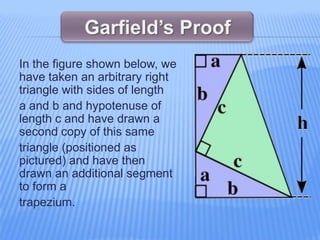
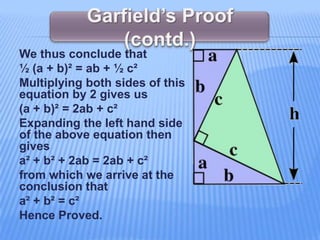
In the figure shown below, we
have taken an arbitrary right
triangle with sides of length
a and b and hypotenuse of
length c and have drawn a
second copy of this same
triangle (positioned as
pictured) and have then
drawn an additional segment
to form a
trapezium.
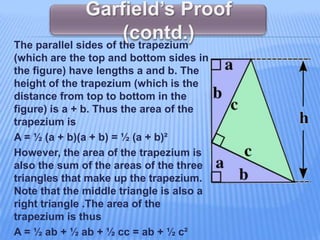
The parallel sides of the trapezium
(which are the top and bottom sides in
the figure) have lengths a and b. The
height of the trapezium (which is the
distance from top to bottom in the
figure) is a + b. Thus the area of the
trapezium is
A = ½ (a + b)(a + b) = ½ (a + b)²
However, the area of the trapezium is
also the sum of the areas of the three
triangles that make up the trapezium.
Note that the middle triangle is also a
right triangle .The area of the
trapezium is thus
A = ½ ab + ½ ab + ½ cc = ab + ½ c²
We thus conclude that
½ (a + b)² = ab + ½ c²
Multiplying both sides of this
equation by 2 gives us
(a + b)² = 2ab + c²
Expanding the left hand side
of the above equation then
gives
a² + b² + 2ab = 2ab + c²
from which we arrive at the
conclusion that
a² + b² = c²
Hence Proved.
y
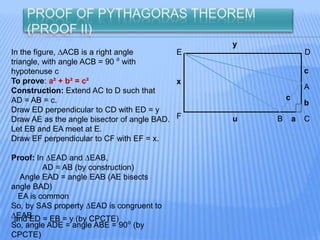
In the figure, ∆ACB is a right angle        E                   D
triangle, with angle ACB = 90 ⁰ with
hypotenuse c                                                    c
To prove: a² + b² = c²                      x
Construction: Extend AC to D such that                          A
AD = AB = c.                                            c
                                                                b
Draw ED perpendicular to CD with ED = y
Draw AE as the angle bisector of angle BAD. F   u   B       a   C
Let EB and EA meet at E.
Draw EF perpendicular to CF with EF = x.

Proof: In ∆EAD and ∆EAB,
         AD = AB (by construction)
  Angle EAD = angle EAB (AE bisects
angle BAD)
  EA is common
So, by SAS property ∆EAD is congruent to
∆EAB = EB = y (by CPCTE)
 and ED
So, angle ADE = angle ABE = 90⁰ (by
CPCTE)
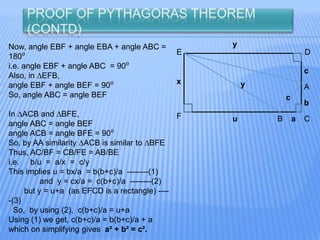
Now, angle EBF + angle EBA + angle ABC =           y
                                              E                        D
180⁰
i.e. angle EBF + angle ABC = 90⁰
                                                                       c
Also, in ∆EFB,
angle EBF + angle BEF = 90⁰                   x        y               A
So, angle ABC = angle BEF                                      c
                                                                       b
In ∆ACB and ∆BFE,                              F   u       B       a   C
angle ABC = angle BEF
angle ACB = angle BFE = 90⁰
So, by AA similarity ∆ACB is similar to ∆BFE
Thus, AC/BF = CB/FE = AB/BE
i.e. b/u = a/x = c/y
This implies u = bx/a = b(b+c)/a --------(1)
          and y = cx/a = c(b+c)/a --------(2)
     but y = u+a (as EFCD is a rectangle) ----
-(3)
  So, by using (2), c(b+c)/a = u+a
Using (1) we get, c(b+c)/a = b(b+c)/a + a
which on simplifying gives a² + b² = c².
Proof of Pythagoras Theorem (III)

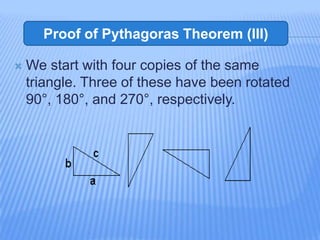
   We start with four copies of the same
    triangle. Three of these have been rotated
    90°, 180°, and 270°, respectively.
Proof of Pythagoras Theorem (III)
                     (contd)
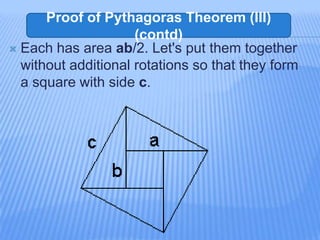
 Each has area ab/2. Let's put them together
  without additional rotations so that they form
  a square with side c.
Proof of Pythagoras Theorem (III)
                 (contd)
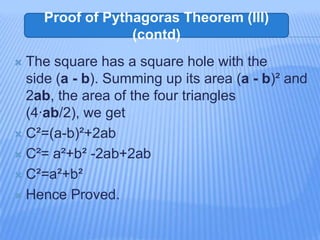
 The square has a square hole with the
  side (a - b). Summing up its area (a - b)² and
  2ab, the area of the four triangles
  (4·ab/2), we get
 C²=(a-b)²+2ab

 C²= a²+b² -2ab+2ab

 C²=a²+b²

 Hence Proved.
Pythagoras Theorem Proof (Through
                      Similarity) (IV)
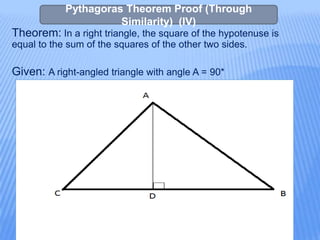
Theorem: In a right triangle, the square of the hypotenuse is
equal to the sum of the squares of the other two sides.

Given: A right-angled triangle with angle A = 90*
Pythagoras Theorem Proof (Through Similarity) (IV)
                          (contd.)
To Prove: (Hypotenuse)2 = (Base) 2 + (Perpendicular) 2
Construction: From A draw AD perpendicular to BC
Proof: In triangles ADC and BAC,
         (i) angle ADC = angle BAC                               [both
90*]
         (ii) angle C = angle C
[common]
   By AA similarity criterion,
              Triangle ADC is similar to BAC.
      Since corresponding sides are proportional in similar triangles,
               CD/AC = AC/BC
              AC2 = CD X BC
(a)

         In triangles ADB and BAC,
           (i) angle BDA = angle BAC       [both 90*]
Pythagoras Theorem Proof (Through Similarity) (IV)
                    (contd.)

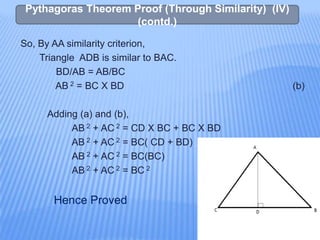
So, By AA similarity criterion,
    Triangle ADB is similar to BAC.
        BD/AB = AB/BC
        AB 2 = BC X BD                                (b)

     Adding (a) and (b),
          AB 2 + AC 2 = CD X BC + BC X BD
          AB 2 + AC 2 = BC( CD + BD)
          AB 2 + AC 2 = BC(BC)
          AB 2 + AC 2 = BC 2


       Hence Proved
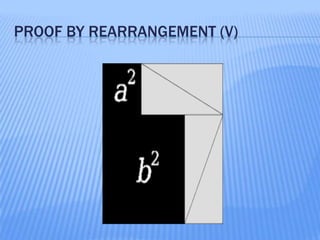
PROOF BY REARRANGEMENT (V)
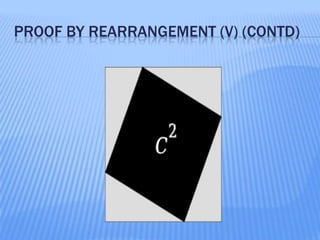
PROOF BY REARRANGEMENT (V) (CONTD)
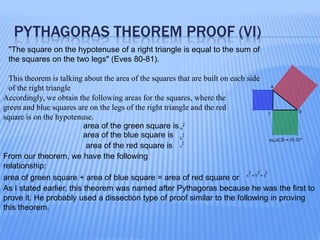
PYTHAGORAS THEOREM PROOF (VI)
 "The square on the hypotenuse of a right triangle is equal to the sum of
 the squares on the two legs" (Eves 80-81).

  This theorem is talking about the area of the squares that are built on each side
  of the right triangle
Accordingly, we obtain the following areas for the squares, where the
green and blue squares are on the legs of the right triangle and the red
square is on the hypotenuse.
                          area of the green square is
                          area of the blue square is
                           area of the red square is
From our theorem, we have the following
relationship:
area of green square + area of blue square = area of red square or
As I stated earlier, this theorem was named after Pythagoras because he was the first to
prove it. He probably used a dissection type of proof similar to the following in proving
this theorem.
Some real life uses of Pythagoras
                Theorem

Architectureand
 Construction
Navigation

Earthquake Location

Crime Scene Investigation

Arrow or Missile Trajectory
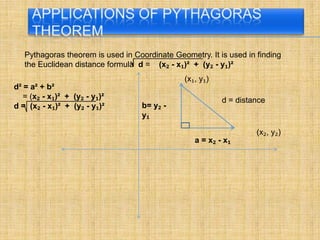
Pythagoras theorem is used in Coordinate Geometry. It is used in finding
   the Euclidean distance formula d = (x₂ - x₁)² + (y₂ - y₁)²
                                               (x₁, y₁)
d² = a² + b²
   = (x₂ - x₁)² + (y₂ - y₁)²                              d = distance
d = (x₂ - x₁)² + (y₂ - y₁)²        b= y₂ -
                                   y₁

                                                                    (x₂, y₂)
                                                  a = x₂ - x₁
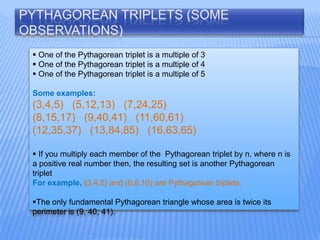
 One of the Pythagorean triplet is a multiple of 3
 One of the Pythagorean triplet is a multiple of 4
 One of the Pythagorean triplet is a multiple of 5

Some examples:
(3,4,5) (5,12,13) (7,24,25)
(8,15,17) (9,40,41) (11,60,61)
(12,35,37) (13,84,85) (16,63,65)

 If you multiply each member of the Pythagorean triplet by n, where n is
a positive real number then, the resulting set is another Pythagorean
triplet
For example, (3,4,5) and (6,8,10) are Pythagorean triplets.

The only fundamental Pythagorean triangle whose area is twice its
perimeter is (9, 40, 41).
APPLICATIONS OF CONVERSE OF
            PYTHAGORAS THEOREM

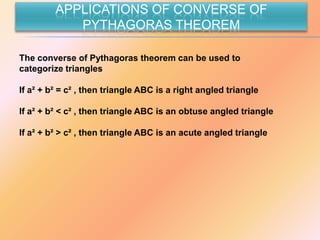
The converse of Pythagoras theorem can be used to
categorize triangles

If a² + b² = c² , then triangle ABC is a right angled triangle

If a² + b² < c² , then triangle ABC is an obtuse angled triangle

If a² + b² > c² , then triangle ABC is an acute angled triangle
Pythagorean Theorem and its various Proofs

Pythagorean Theorem and its various Proofs

  • 2.
    In mathematics, thePythagorean theorem or Pythagoras' theorem is a relation in Euclidean geometry among the three sides of a right triangle (right-angled triangle). It states that : In any right-angled triangle, the Square of the Hypotenuse of a Right Angled Triangle Is Equal To The Sum of Squares of the Other Two Sides.
  • 3.
    The twentieth president of the United States gave the following proof to the Pythagoras Theorem. He discovered this proof five years before he became President. He hit upon this proof in 1876 during a mathematics discussion with some of the members of Congress. It was later published in the New England Journal of Education.
  • 4.
    In the figureshown below, we have taken an arbitrary right triangle with sides of length a and b and hypotenuse of length c and have drawn a second copy of this same triangle (positioned as pictured) and have then drawn an additional segment to form a trapezium.
  • 5.
    The parallel sidesof the trapezium (which are the top and bottom sides in the figure) have lengths a and b. The height of the trapezium (which is the distance from top to bottom in the figure) is a + b. Thus the area of the trapezium is A = ½ (a + b)(a + b) = ½ (a + b)² However, the area of the trapezium is also the sum of the areas of the three triangles that make up the trapezium. Note that the middle triangle is also a right triangle .The area of the trapezium is thus A = ½ ab + ½ ab + ½ cc = ab + ½ c²
  • 6.
    We thus concludethat ½ (a + b)² = ab + ½ c² Multiplying both sides of this equation by 2 gives us (a + b)² = 2ab + c² Expanding the left hand side of the above equation then gives a² + b² + 2ab = 2ab + c² from which we arrive at the conclusion that a² + b² = c² Hence Proved.
  • 7.
    y In the figure,∆ACB is a right angle E D triangle, with angle ACB = 90 ⁰ with hypotenuse c c To prove: a² + b² = c² x Construction: Extend AC to D such that A AD = AB = c. c b Draw ED perpendicular to CD with ED = y Draw AE as the angle bisector of angle BAD. F u B a C Let EB and EA meet at E. Draw EF perpendicular to CF with EF = x. Proof: In ∆EAD and ∆EAB, AD = AB (by construction) Angle EAD = angle EAB (AE bisects angle BAD) EA is common So, by SAS property ∆EAD is congruent to ∆EAB = EB = y (by CPCTE) and ED So, angle ADE = angle ABE = 90⁰ (by CPCTE)
  • 8.
    Now, angle EBF+ angle EBA + angle ABC = y E D 180⁰ i.e. angle EBF + angle ABC = 90⁰ c Also, in ∆EFB, angle EBF + angle BEF = 90⁰ x y A So, angle ABC = angle BEF c b In ∆ACB and ∆BFE, F u B a C angle ABC = angle BEF angle ACB = angle BFE = 90⁰ So, by AA similarity ∆ACB is similar to ∆BFE Thus, AC/BF = CB/FE = AB/BE i.e. b/u = a/x = c/y This implies u = bx/a = b(b+c)/a --------(1) and y = cx/a = c(b+c)/a --------(2) but y = u+a (as EFCD is a rectangle) ---- -(3) So, by using (2), c(b+c)/a = u+a Using (1) we get, c(b+c)/a = b(b+c)/a + a which on simplifying gives a² + b² = c².
  • 9.
    Proof of PythagorasTheorem (III)  We start with four copies of the same triangle. Three of these have been rotated 90°, 180°, and 270°, respectively.
  • 10.
    Proof of PythagorasTheorem (III) (contd)  Each has area ab/2. Let's put them together without additional rotations so that they form a square with side c.
  • 11.
    Proof of PythagorasTheorem (III) (contd)  The square has a square hole with the side (a - b). Summing up its area (a - b)² and 2ab, the area of the four triangles (4·ab/2), we get  C²=(a-b)²+2ab  C²= a²+b² -2ab+2ab  C²=a²+b²  Hence Proved.
  • 12.
    Pythagoras Theorem Proof(Through Similarity) (IV) Theorem: In a right triangle, the square of the hypotenuse is equal to the sum of the squares of the other two sides. Given: A right-angled triangle with angle A = 90*
  • 13.
    Pythagoras Theorem Proof(Through Similarity) (IV) (contd.) To Prove: (Hypotenuse)2 = (Base) 2 + (Perpendicular) 2 Construction: From A draw AD perpendicular to BC Proof: In triangles ADC and BAC, (i) angle ADC = angle BAC [both 90*] (ii) angle C = angle C [common] By AA similarity criterion, Triangle ADC is similar to BAC. Since corresponding sides are proportional in similar triangles, CD/AC = AC/BC AC2 = CD X BC (a) In triangles ADB and BAC, (i) angle BDA = angle BAC [both 90*]
  • 14.
    Pythagoras Theorem Proof(Through Similarity) (IV) (contd.) So, By AA similarity criterion, Triangle ADB is similar to BAC. BD/AB = AB/BC AB 2 = BC X BD (b) Adding (a) and (b), AB 2 + AC 2 = CD X BC + BC X BD AB 2 + AC 2 = BC( CD + BD) AB 2 + AC 2 = BC(BC) AB 2 + AC 2 = BC 2 Hence Proved
  • 15.
  • 16.
  • 17.
    PYTHAGORAS THEOREM PROOF(VI) "The square on the hypotenuse of a right triangle is equal to the sum of the squares on the two legs" (Eves 80-81). This theorem is talking about the area of the squares that are built on each side of the right triangle Accordingly, we obtain the following areas for the squares, where the green and blue squares are on the legs of the right triangle and the red square is on the hypotenuse. area of the green square is area of the blue square is area of the red square is From our theorem, we have the following relationship: area of green square + area of blue square = area of red square or As I stated earlier, this theorem was named after Pythagoras because he was the first to prove it. He probably used a dissection type of proof similar to the following in proving this theorem.
  • 18.
    Some real lifeuses of Pythagoras Theorem Architectureand Construction Navigation Earthquake Location Crime Scene Investigation Arrow or Missile Trajectory
  • 19.
    Pythagoras theorem isused in Coordinate Geometry. It is used in finding the Euclidean distance formula d = (x₂ - x₁)² + (y₂ - y₁)² (x₁, y₁) d² = a² + b² = (x₂ - x₁)² + (y₂ - y₁)² d = distance d = (x₂ - x₁)² + (y₂ - y₁)² b= y₂ - y₁ (x₂, y₂) a = x₂ - x₁
  • 20.
     One ofthe Pythagorean triplet is a multiple of 3  One of the Pythagorean triplet is a multiple of 4  One of the Pythagorean triplet is a multiple of 5 Some examples: (3,4,5) (5,12,13) (7,24,25) (8,15,17) (9,40,41) (11,60,61) (12,35,37) (13,84,85) (16,63,65)  If you multiply each member of the Pythagorean triplet by n, where n is a positive real number then, the resulting set is another Pythagorean triplet For example, (3,4,5) and (6,8,10) are Pythagorean triplets. The only fundamental Pythagorean triangle whose area is twice its perimeter is (9, 40, 41).
  • 21.
    APPLICATIONS OF CONVERSEOF PYTHAGORAS THEOREM The converse of Pythagoras theorem can be used to categorize triangles If a² + b² = c² , then triangle ABC is a right angled triangle If a² + b² < c² , then triangle ABC is an obtuse angled triangle If a² + b² > c² , then triangle ABC is an acute angled triangle