PYTHAGORAS THEOREM
Your best friend to solve Right-angled
triangles.
Presented by
Vaishika G
1020721BD143
Overview
› Pythagoras Theorem (also called Pythagorean Theorem) is an
important topic in Mathematics, which explains the relation
between the sides of a right-angled triangle.
› Pythagoras theorem is basically used to find the length of an
unknown side and the angle of a triangle.
› By this theorem, we can derive the base, perpendicular and
hypotenuse formulas.
› The sides of the right triangle are also called Pythagorean triples.
RIGHT – ANGLED
TRIANGLE
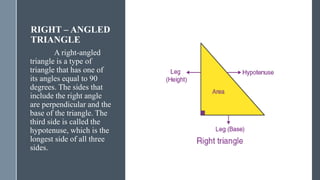
A right-angled
triangle is a type of
triangle that has one of
its angles equal to 90
degrees. The sides that
include the right angle
are perpendicular and the
base of the triangle. The
third side is called the
hypotenuse, which is the
longest side of all three
sides.
Statement
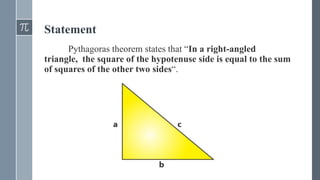
Pythagoras theorem states that “In a right-angled
triangle, the square of the hypotenuse side is equal to the sum
of squares of the other two sides“.
Formula
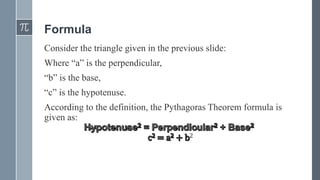
Consider the triangle given in the previous slide:
Where “a” is the perpendicular,
“b” is the base,
“c” is the hypotenuse.
According to the definition, the Pythagoras Theorem formula is
given as:
2
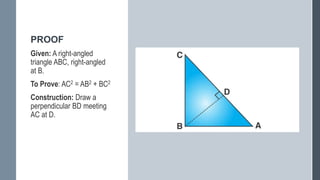
PROOF
Given: A right-angled
triangle ABC, right-angled
at B.
To Prove: AC2 = AB2 + BC2
Construction: Draw a
perpendicular BD meeting
AC at D.
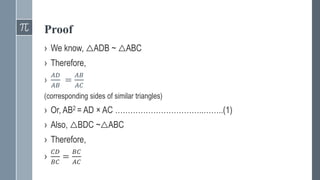
Proof
› We know, △ADB ~ △ABC
› Therefore,
›
𝐴𝐷
𝐴𝐵
=
𝐴𝐵
𝐴𝐶
(corresponding sides of similar triangles)
› Or, AB2 = AD × AC ……………………………..……..(1)
› Also, △BDC ~△ABC
› Therefore,
›
𝐶𝐷
𝐵𝐶
=
𝐵𝐶
𝐴𝐶
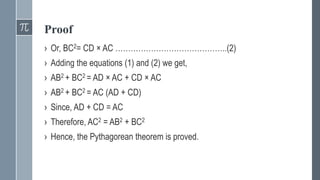
Proof
› Or, BC2= CD × AC ……………………………………..(2)
› Adding the equations (1) and (2) we get,
› AB2 + BC2 = AD × AC + CD × AC
› AB2 + BC2 = AC (AD + CD)
› Since, AD + CD = AC
› Therefore, AC2 = AB2 + BC2
› Hence, the Pythagorean theorem is proved.
Application
• To know if the triangle is a right-angled triangle or not.
• In a right-angled triangle, we can calculate the length of any side if the
other two sides are given.
• To find the diagonal of a square.
Wrapping it up
 The Pythagorean Theorem
can be used only on
_____triangles.
 When should the
Pythagorean Theorem be
used?
 What should be done first
when solving a word problem
involving the Pythagorean
Theorem?
 What must be done before
writing the answer to a
Pythagorean Theorem
problem?
 Right
 When the length of 2 sides
are known and the length of
3rd side is needed
 Draw and label triangle
 Check to see whether the
answer should be rounded or
not
PYTHAGORAS THEOREM.pptx

PYTHAGORAS THEOREM.pptx

  • 1.
    PYTHAGORAS THEOREM Your bestfriend to solve Right-angled triangles. Presented by Vaishika G 1020721BD143
  • 2.
    Overview › Pythagoras Theorem(also called Pythagorean Theorem) is an important topic in Mathematics, which explains the relation between the sides of a right-angled triangle. › Pythagoras theorem is basically used to find the length of an unknown side and the angle of a triangle. › By this theorem, we can derive the base, perpendicular and hypotenuse formulas. › The sides of the right triangle are also called Pythagorean triples.
  • 3.
    RIGHT – ANGLED TRIANGLE Aright-angled triangle is a type of triangle that has one of its angles equal to 90 degrees. The sides that include the right angle are perpendicular and the base of the triangle. The third side is called the hypotenuse, which is the longest side of all three sides.
  • 4.
    Statement Pythagoras theorem statesthat “In a right-angled triangle, the square of the hypotenuse side is equal to the sum of squares of the other two sides“.
  • 5.
    Formula Consider the trianglegiven in the previous slide: Where “a” is the perpendicular, “b” is the base, “c” is the hypotenuse. According to the definition, the Pythagoras Theorem formula is given as: 2
  • 6.
    PROOF Given: A right-angled triangleABC, right-angled at B. To Prove: AC2 = AB2 + BC2 Construction: Draw a perpendicular BD meeting AC at D.
  • 7.
    Proof › We know,△ADB ~ △ABC › Therefore, › 𝐴𝐷 𝐴𝐵 = 𝐴𝐵 𝐴𝐶 (corresponding sides of similar triangles) › Or, AB2 = AD × AC ……………………………..……..(1) › Also, △BDC ~△ABC › Therefore, › 𝐶𝐷 𝐵𝐶 = 𝐵𝐶 𝐴𝐶
  • 8.
    Proof › Or, BC2=CD × AC ……………………………………..(2) › Adding the equations (1) and (2) we get, › AB2 + BC2 = AD × AC + CD × AC › AB2 + BC2 = AC (AD + CD) › Since, AD + CD = AC › Therefore, AC2 = AB2 + BC2 › Hence, the Pythagorean theorem is proved.
  • 9.
    Application • To knowif the triangle is a right-angled triangle or not. • In a right-angled triangle, we can calculate the length of any side if the other two sides are given. • To find the diagonal of a square.
  • 10.
    Wrapping it up The Pythagorean Theorem can be used only on _____triangles.  When should the Pythagorean Theorem be used?  What should be done first when solving a word problem involving the Pythagorean Theorem?  What must be done before writing the answer to a Pythagorean Theorem problem?  Right  When the length of 2 sides are known and the length of 3rd side is needed  Draw and label triangle  Check to see whether the answer should be rounded or not