CONSTRUCTION
WORKED EXAMPLES
EXAMPLES
EXAMPLE 1
• Using a ruler, a pencil and a pair of compasses, construct triangle 𝐸𝐹𝐺, with 𝐸𝐺 =
6𝑐𝑚, < 𝐹𝐸𝐺 = 60° 𝑎𝑛𝑑 < 𝐸𝐺𝐹 = 90°.
• Measure and state the length of 𝐸𝐹.
• Measure and state the size of < 𝐸𝐹𝐺.
EXAMPLE 1- SOLUTION
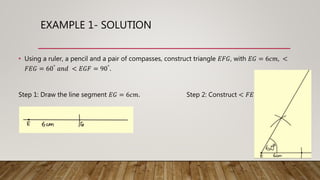
• Using a ruler, a pencil and a pair of compasses, construct triangle 𝐸𝐹𝐺, with 𝐸𝐺 = 6𝑐𝑚, <
𝐹𝐸𝐺 = 60° 𝑎𝑛𝑑 < 𝐸𝐺𝐹 = 90°.
Step 1: Draw the line segment 𝐸𝐺 = 6𝑐𝑚. Step 2: Construct < 𝐹𝐸𝐺 = 60°
EXAMPLE 1- SOLUTION CONT’D
• Using a ruler, a pencil and a pair of compasses, construct triangle 𝐸𝐹𝐺, with 𝐸𝐺 = 6𝑐𝑚, <
𝐹𝐸𝐺 = 60° 𝑎𝑛𝑑 < 𝐸𝐺𝐹 = 90°.
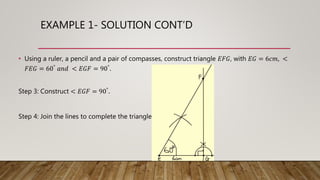
Step 3: Construct < 𝐸𝐺𝐹 = 90°.
Step 4: Join the lines to complete the triangle.
EXAMPLE 1- SOLUTION CONT’D
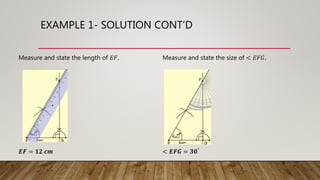
Measure and state the length of 𝐸𝐹. Measure and state the size of < 𝐸𝐹𝐺.
𝑬𝑭 = 𝟏𝟐 𝒄𝒎 < 𝑬𝑭𝑮 = 𝟑𝟎°
EXAMPLE 2
Using a ruler, a pencil and a pair of compasses, construct
• a triangle 𝑃𝑄𝑅, with 𝑃𝑄 = 8𝑐𝑚, 𝑃𝑅 = 6 𝑐𝑚 𝑎𝑛𝑑 𝑎𝑛𝑔𝑙𝑒 𝑃 = 60°.
• a line segment 𝑅𝑋, which is perpendicular to 𝑃𝑄 and meets 𝑃𝑄 at 𝑋.
• Measure and state the size of < 𝑄𝑅𝑋.
EXAMPLE 2- SOLUTION
Using a ruler, a pencil and a pair of compasses, construct
• a triangle 𝑃𝑄𝑅, with 𝑃𝑄 = 8𝑐𝑚, 𝑃𝑅 = 6 𝑐𝑚 𝑎𝑛𝑑 𝑎𝑛𝑔𝑙𝑒 𝑃 = 60°.
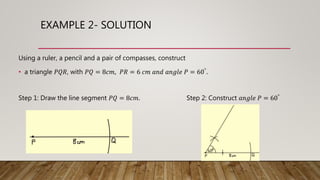
Step 1: Draw the line segment 𝑃𝑄 = 8𝑐𝑚. Step 2: Construct 𝑎𝑛𝑔𝑙𝑒 𝑃 = 60°
EXAMPLE 2- SOLUTION CONT’D.
Using a ruler, a pencil and a pair of compasses, construct
• a triangle 𝑃𝑄𝑅, with 𝑃𝑄 = 8𝑐𝑚, 𝑃𝑅 = 6 𝑐𝑚 𝑎𝑛𝑑 𝑎𝑛𝑔𝑙𝑒 𝑃 = 60°.
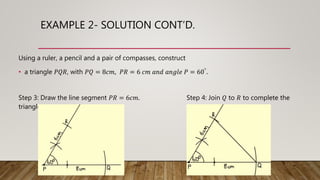
Step 3: Draw the line segment 𝑃𝑅 = 6𝑐𝑚. Step 4: Join 𝑄 to 𝑅 to complete the
triangle.
EXAMPLE 2- SOLUTION CONT’D.
Using a ruler, a pencil and a pair of compasses, construct
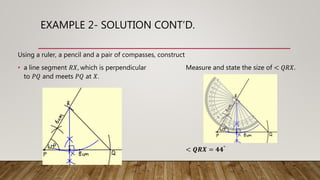
• a line segment 𝑅𝑋, which is perpendicular Measure and state the size of < 𝑄𝑅𝑋.
to 𝑃𝑄 and meets 𝑃𝑄 at 𝑋.
< 𝑸𝑹𝑿 = 𝟒𝟒°
EXAMPLE 3
Using a ruler, a pencil and a pair of compasses, construct
• The trapezium 𝐴𝐵𝐶𝐷, with 𝐴𝐵 = 8𝑐𝑚, 𝐵𝐴𝐷 = 60°, 𝐴𝐷 = 6 𝑐𝑚,
𝐴𝐵𝐶 = 90°, and 𝐴𝐵 parallel to 𝐶𝐷.
EXAMPLE 3- SOLUTION
Using a ruler, a pencil and a pair of compasses, construct
• The trapezium 𝐴𝐵𝐶𝐷, with 𝐴𝐵 = 8𝑐𝑚, 𝐵𝐴𝐷 = 60°, 𝐴𝐷 = 6 𝑐𝑚,
𝐴𝐵𝐶 = 90°, and 𝐴𝐵 parallel to 𝐶𝐷.
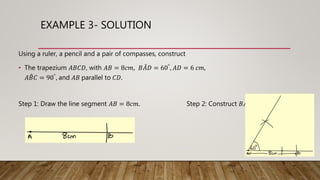
Step 1: Draw the line segment 𝐴𝐵 = 8𝑐𝑚. Step 2: Construct 𝐵𝐴𝐷 = 60°
EXAMPLE 3- SOLUTION CONT’D.
Using a ruler, a pencil and a pair of compasses, construct
• The trapezium 𝐴𝐵𝐶𝐷, with 𝐴𝐵 = 8𝑐𝑚, 𝐵𝐴𝐷 = 60°, 𝐴𝐷 = 6 𝑐𝑚,
𝐴𝐵𝐶 = 90°, and 𝐴𝐵 parallel to 𝐶𝐷.
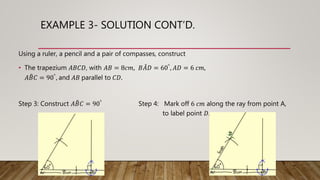
Step 3: Construct 𝐴𝐵𝐶 = 90° Step 4: Mark off 6 𝑐𝑚 along the ray from point A,
to label point 𝐷.
EXAMPLE 3- SOLUTION CONT’D.
Using a ruler, a pencil and a pair of compasses, construct
• The trapezium 𝐴𝐵𝐶𝐷, with 𝐴𝐵 = 8𝑐𝑚, 𝐵𝐴𝐷 = 60°, 𝐴𝐷 = 6 𝑐𝑚,
𝐴𝐵𝐶 = 90°, and 𝐴𝐵 parallel to 𝐶𝐷.
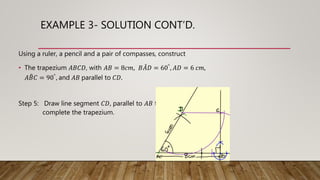
Step 5: Draw line segment 𝐶𝐷, parallel to 𝐴𝐵 to
complete the trapezium.
THE END.

Geometric constructions

  • 1.
  • 2.
  • 3.
    EXAMPLE 1 • Usinga ruler, a pencil and a pair of compasses, construct triangle 𝐸𝐹𝐺, with 𝐸𝐺 = 6𝑐𝑚, < 𝐹𝐸𝐺 = 60° 𝑎𝑛𝑑 < 𝐸𝐺𝐹 = 90°. • Measure and state the length of 𝐸𝐹. • Measure and state the size of < 𝐸𝐹𝐺.
  • 4.
    EXAMPLE 1- SOLUTION •Using a ruler, a pencil and a pair of compasses, construct triangle 𝐸𝐹𝐺, with 𝐸𝐺 = 6𝑐𝑚, < 𝐹𝐸𝐺 = 60° 𝑎𝑛𝑑 < 𝐸𝐺𝐹 = 90°. Step 1: Draw the line segment 𝐸𝐺 = 6𝑐𝑚. Step 2: Construct < 𝐹𝐸𝐺 = 60°
  • 5.
    EXAMPLE 1- SOLUTIONCONT’D • Using a ruler, a pencil and a pair of compasses, construct triangle 𝐸𝐹𝐺, with 𝐸𝐺 = 6𝑐𝑚, < 𝐹𝐸𝐺 = 60° 𝑎𝑛𝑑 < 𝐸𝐺𝐹 = 90°. Step 3: Construct < 𝐸𝐺𝐹 = 90°. Step 4: Join the lines to complete the triangle.
  • 6.
    EXAMPLE 1- SOLUTIONCONT’D Measure and state the length of 𝐸𝐹. Measure and state the size of < 𝐸𝐹𝐺. 𝑬𝑭 = 𝟏𝟐 𝒄𝒎 < 𝑬𝑭𝑮 = 𝟑𝟎°
  • 7.
    EXAMPLE 2 Using aruler, a pencil and a pair of compasses, construct • a triangle 𝑃𝑄𝑅, with 𝑃𝑄 = 8𝑐𝑚, 𝑃𝑅 = 6 𝑐𝑚 𝑎𝑛𝑑 𝑎𝑛𝑔𝑙𝑒 𝑃 = 60°. • a line segment 𝑅𝑋, which is perpendicular to 𝑃𝑄 and meets 𝑃𝑄 at 𝑋. • Measure and state the size of < 𝑄𝑅𝑋.
  • 8.
    EXAMPLE 2- SOLUTION Usinga ruler, a pencil and a pair of compasses, construct • a triangle 𝑃𝑄𝑅, with 𝑃𝑄 = 8𝑐𝑚, 𝑃𝑅 = 6 𝑐𝑚 𝑎𝑛𝑑 𝑎𝑛𝑔𝑙𝑒 𝑃 = 60°. Step 1: Draw the line segment 𝑃𝑄 = 8𝑐𝑚. Step 2: Construct 𝑎𝑛𝑔𝑙𝑒 𝑃 = 60°
  • 9.
    EXAMPLE 2- SOLUTIONCONT’D. Using a ruler, a pencil and a pair of compasses, construct • a triangle 𝑃𝑄𝑅, with 𝑃𝑄 = 8𝑐𝑚, 𝑃𝑅 = 6 𝑐𝑚 𝑎𝑛𝑑 𝑎𝑛𝑔𝑙𝑒 𝑃 = 60°. Step 3: Draw the line segment 𝑃𝑅 = 6𝑐𝑚. Step 4: Join 𝑄 to 𝑅 to complete the triangle.
  • 10.
    EXAMPLE 2- SOLUTIONCONT’D. Using a ruler, a pencil and a pair of compasses, construct • a line segment 𝑅𝑋, which is perpendicular Measure and state the size of < 𝑄𝑅𝑋. to 𝑃𝑄 and meets 𝑃𝑄 at 𝑋. < 𝑸𝑹𝑿 = 𝟒𝟒°
  • 11.
    EXAMPLE 3 Using aruler, a pencil and a pair of compasses, construct • The trapezium 𝐴𝐵𝐶𝐷, with 𝐴𝐵 = 8𝑐𝑚, 𝐵𝐴𝐷 = 60°, 𝐴𝐷 = 6 𝑐𝑚, 𝐴𝐵𝐶 = 90°, and 𝐴𝐵 parallel to 𝐶𝐷.
  • 12.
    EXAMPLE 3- SOLUTION Usinga ruler, a pencil and a pair of compasses, construct • The trapezium 𝐴𝐵𝐶𝐷, with 𝐴𝐵 = 8𝑐𝑚, 𝐵𝐴𝐷 = 60°, 𝐴𝐷 = 6 𝑐𝑚, 𝐴𝐵𝐶 = 90°, and 𝐴𝐵 parallel to 𝐶𝐷. Step 1: Draw the line segment 𝐴𝐵 = 8𝑐𝑚. Step 2: Construct 𝐵𝐴𝐷 = 60°
  • 13.
    EXAMPLE 3- SOLUTIONCONT’D. Using a ruler, a pencil and a pair of compasses, construct • The trapezium 𝐴𝐵𝐶𝐷, with 𝐴𝐵 = 8𝑐𝑚, 𝐵𝐴𝐷 = 60°, 𝐴𝐷 = 6 𝑐𝑚, 𝐴𝐵𝐶 = 90°, and 𝐴𝐵 parallel to 𝐶𝐷. Step 3: Construct 𝐴𝐵𝐶 = 90° Step 4: Mark off 6 𝑐𝑚 along the ray from point A, to label point 𝐷.
  • 14.
    EXAMPLE 3- SOLUTIONCONT’D. Using a ruler, a pencil and a pair of compasses, construct • The trapezium 𝐴𝐵𝐶𝐷, with 𝐴𝐵 = 8𝑐𝑚, 𝐵𝐴𝐷 = 60°, 𝐴𝐷 = 6 𝑐𝑚, 𝐴𝐵𝐶 = 90°, and 𝐴𝐵 parallel to 𝐶𝐷. Step 5: Draw line segment 𝐶𝐷, parallel to 𝐴𝐵 to complete the trapezium.
  • 15.