Trigonometry:
The Six Trigonometry Ratios
Grade 9 Mathematics
-Keizar Paul B. Gonzales
Lesson 1
01 Illustrate the six trigonometric ratios: sine, cosine, tangent, secant,
cosecant, and cotangent;
Objectives
Introduction to Trigonometry Ratios:
02 Find the value of the six trigonometric ratios from the given triangle;
and
Unlocking Trigonometric Secrets:
03 Appreciate the importance of trigonometry in real life situations.
Using Trigonometry in Everyday
Contexts:
Trigonometry
9
Trigonometry
9
Trigonometry
9
Trigonometry
9
Trigonometry
9
Guide
Questions
1. What comes to your mind when you heard about
triangles?
2. In your opinion, How can trigonometry be used in
surveying to measure distances and angles
accurately when mapping land or constructing
buildings?
3. How ancient people discovered Trigonometry?
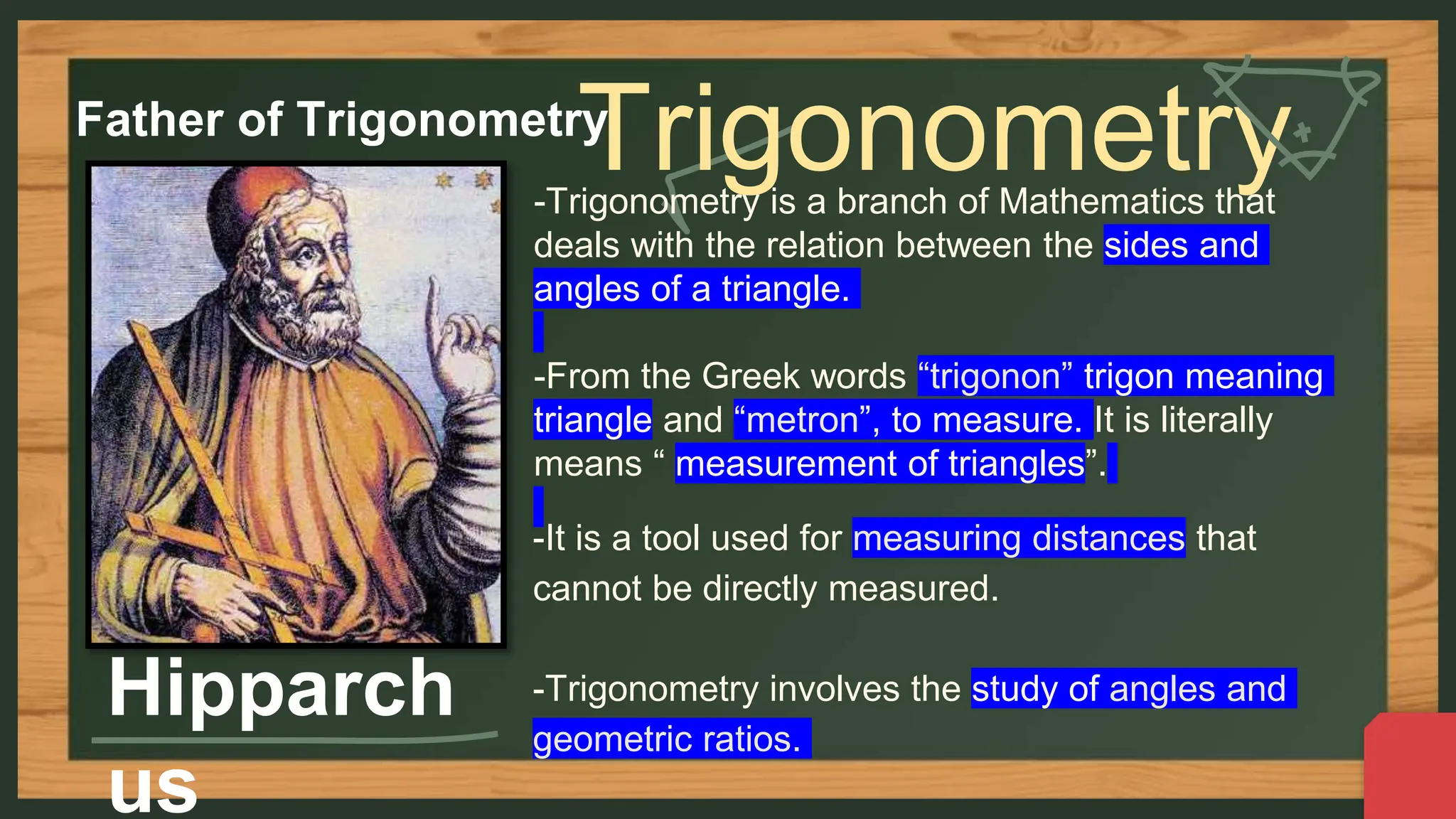
-Trigonometry is a branch of Mathematics that
deals with the relation between the sides and
angles of a triangle.
-From the Greek words “trigonon” trigon meaning
triangle and “metron”, to measure. It is literally
means “ measurement of triangles”.
Trigonometry
-It is a tool used for measuring distances that
cannot be directly measured.
-Trigonometry involves the study of angles and
geometric ratios.
Hipparch
us
Father of Trigonometry
Right Triangle Trigonometry
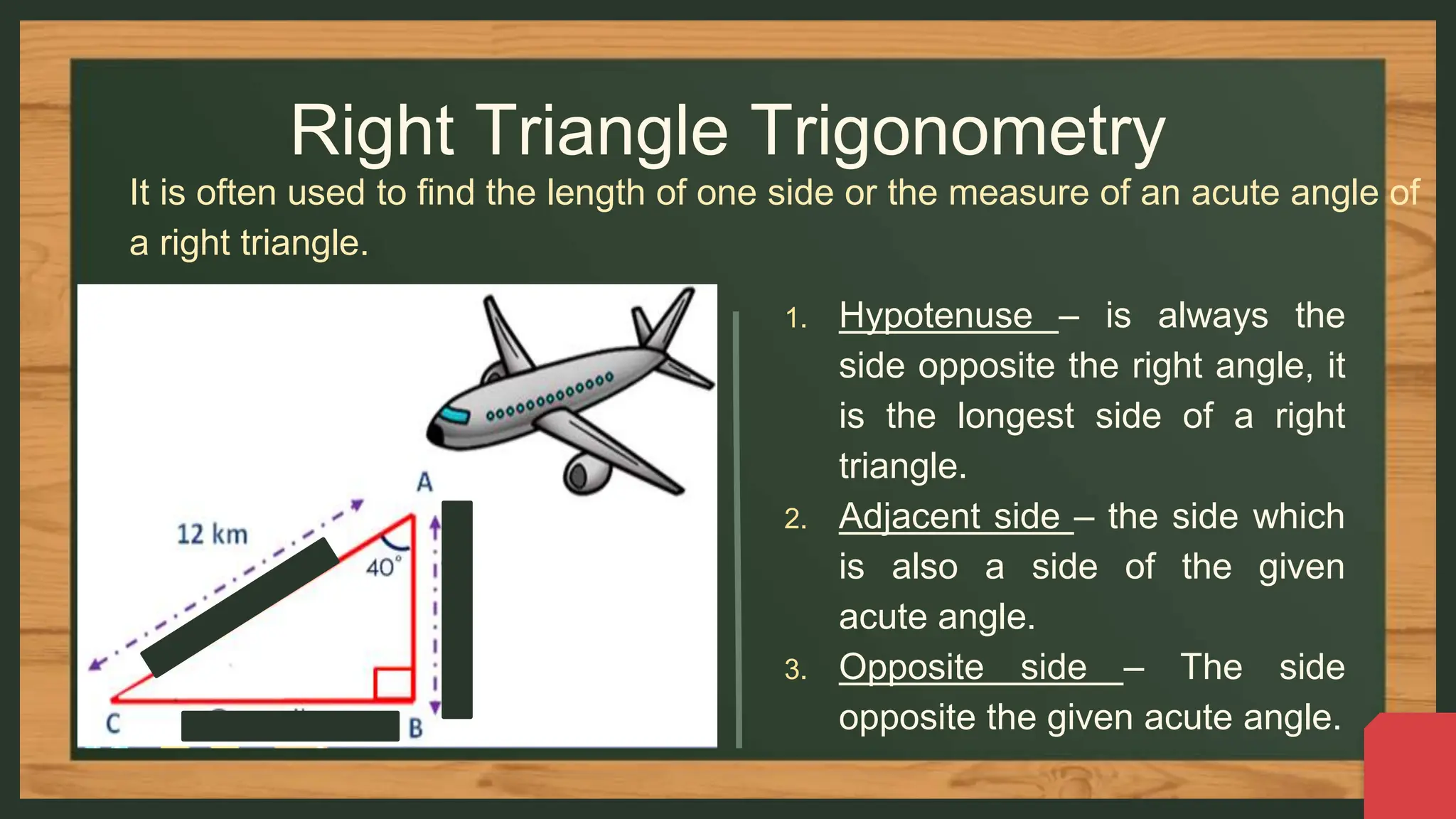
It is often used to find the length of one side or the measure of an acute angle of
a right triangle.
1. Hypotenuse – is always the
side opposite the right angle, it
is the longest side of a right
triangle.
2. Adjacent side – the side which
is also a side of the given
acute angle.
3. Opposite side – The side
opposite the given acute angle.
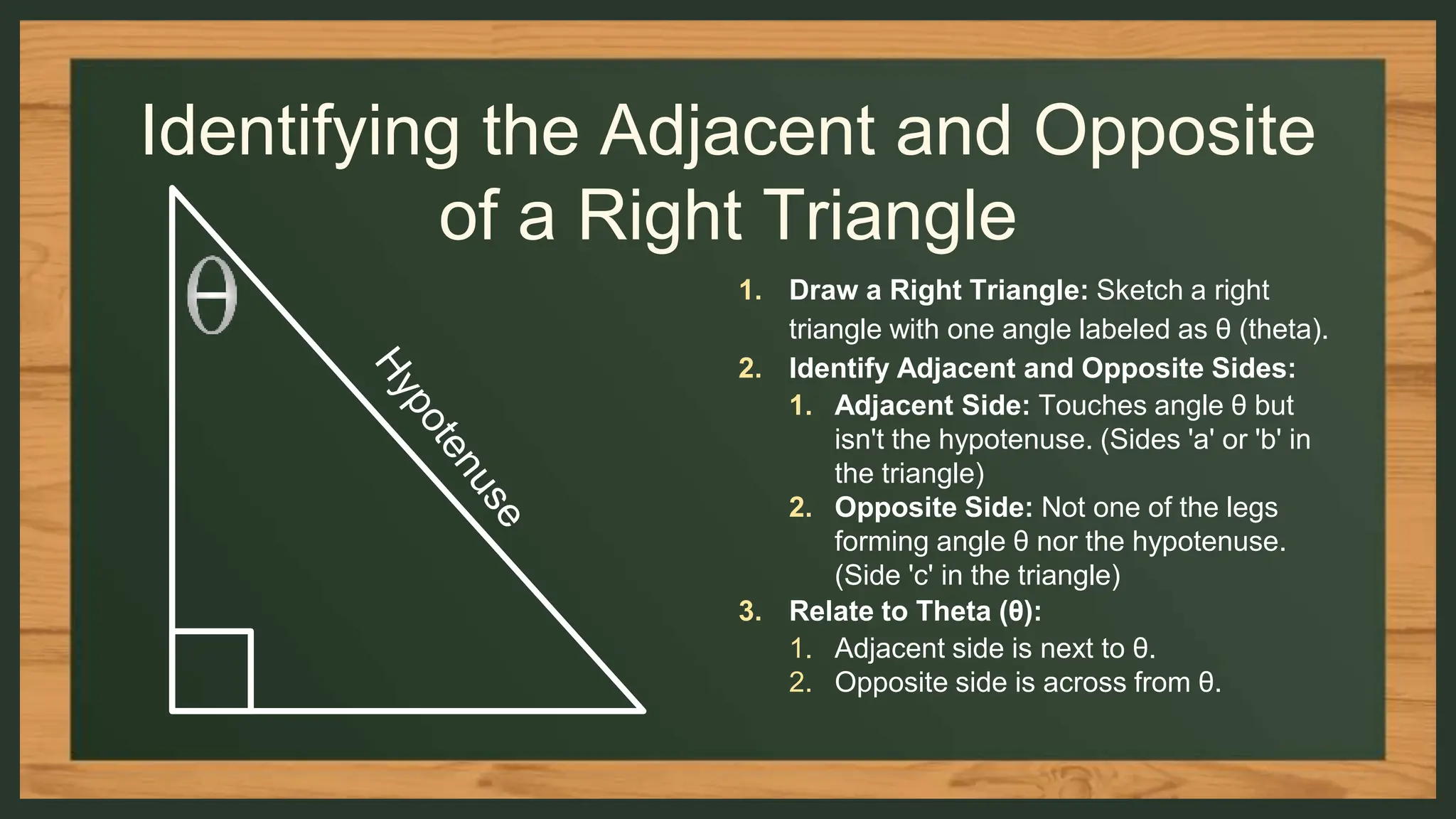
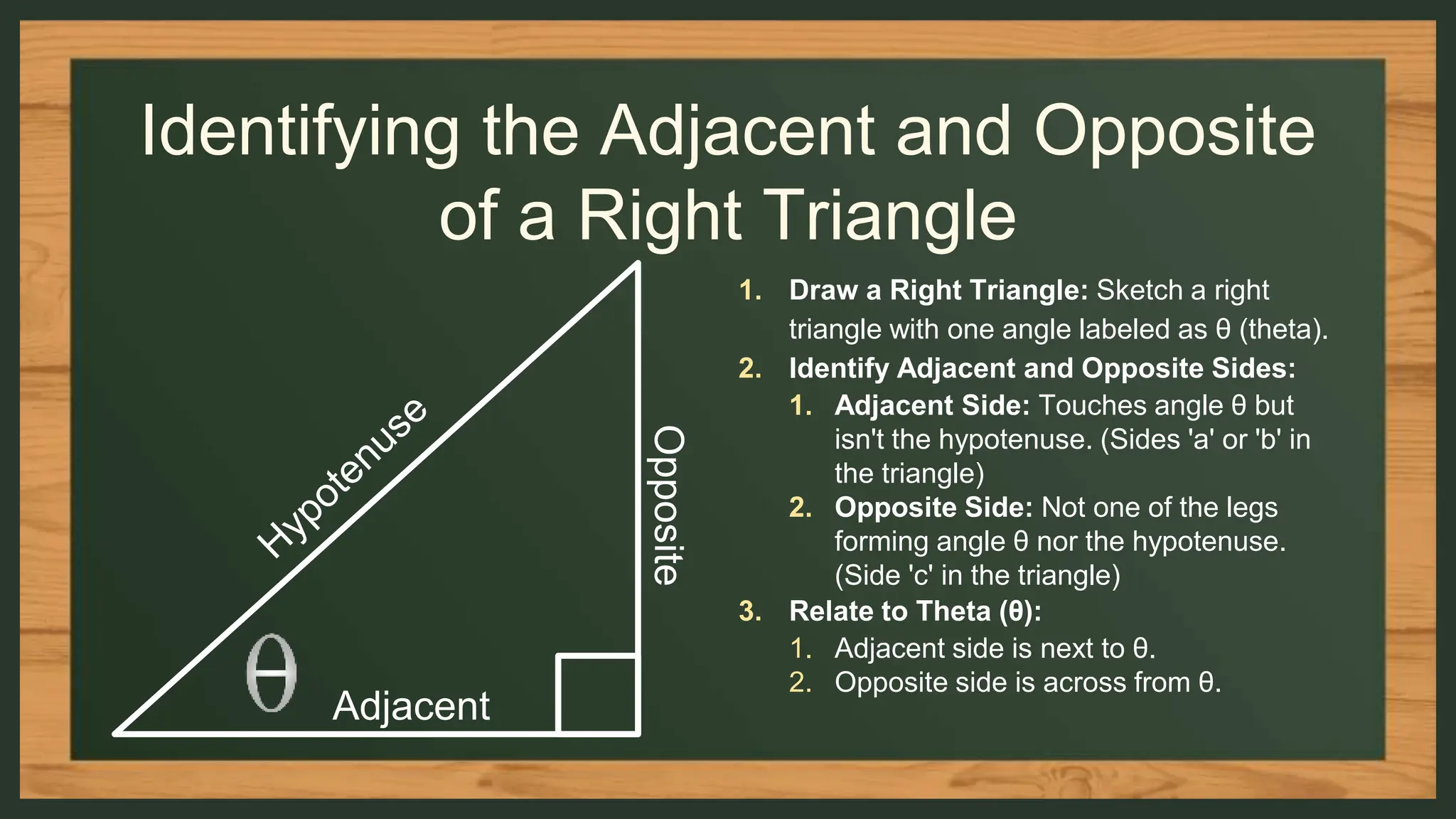
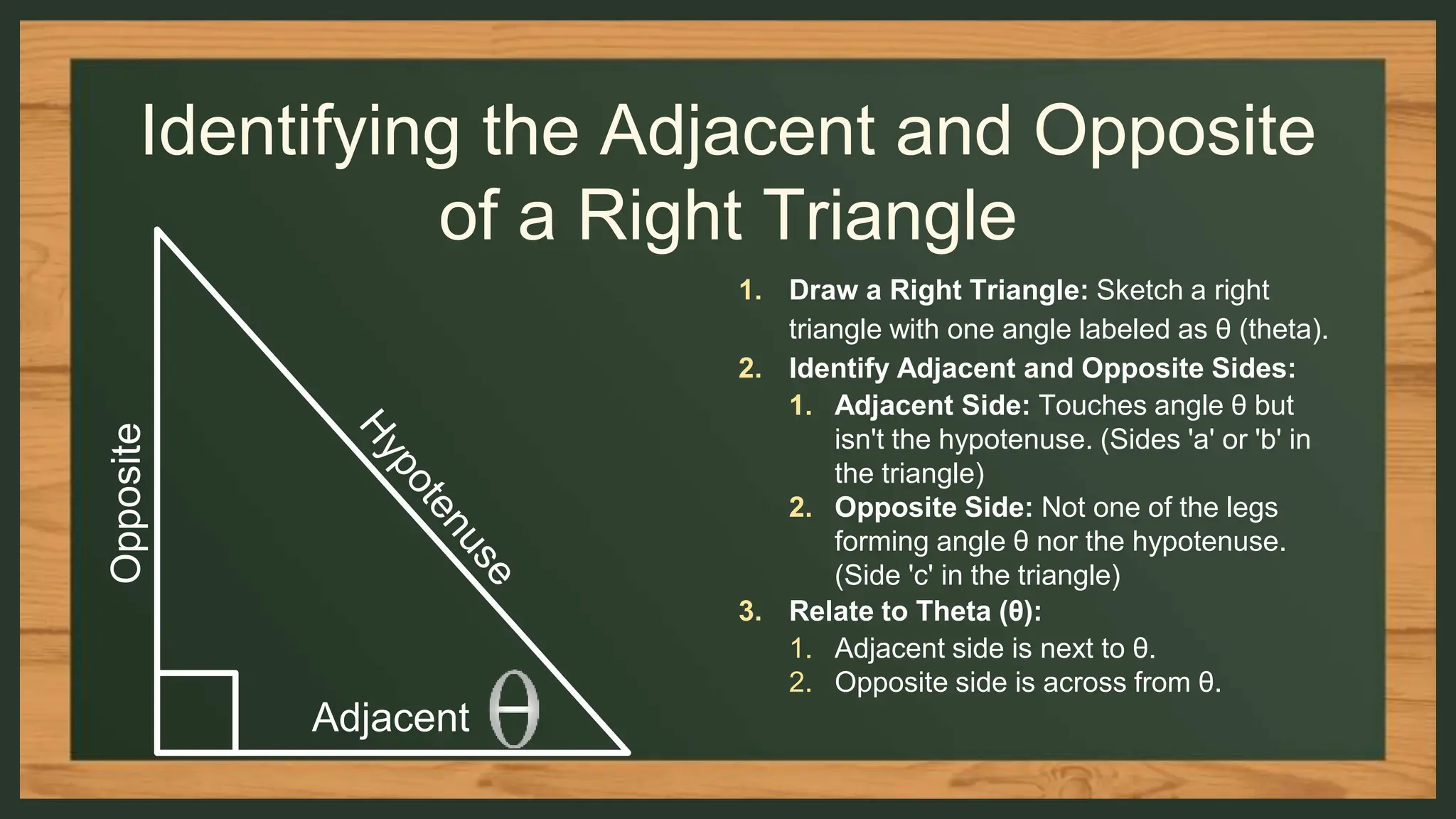
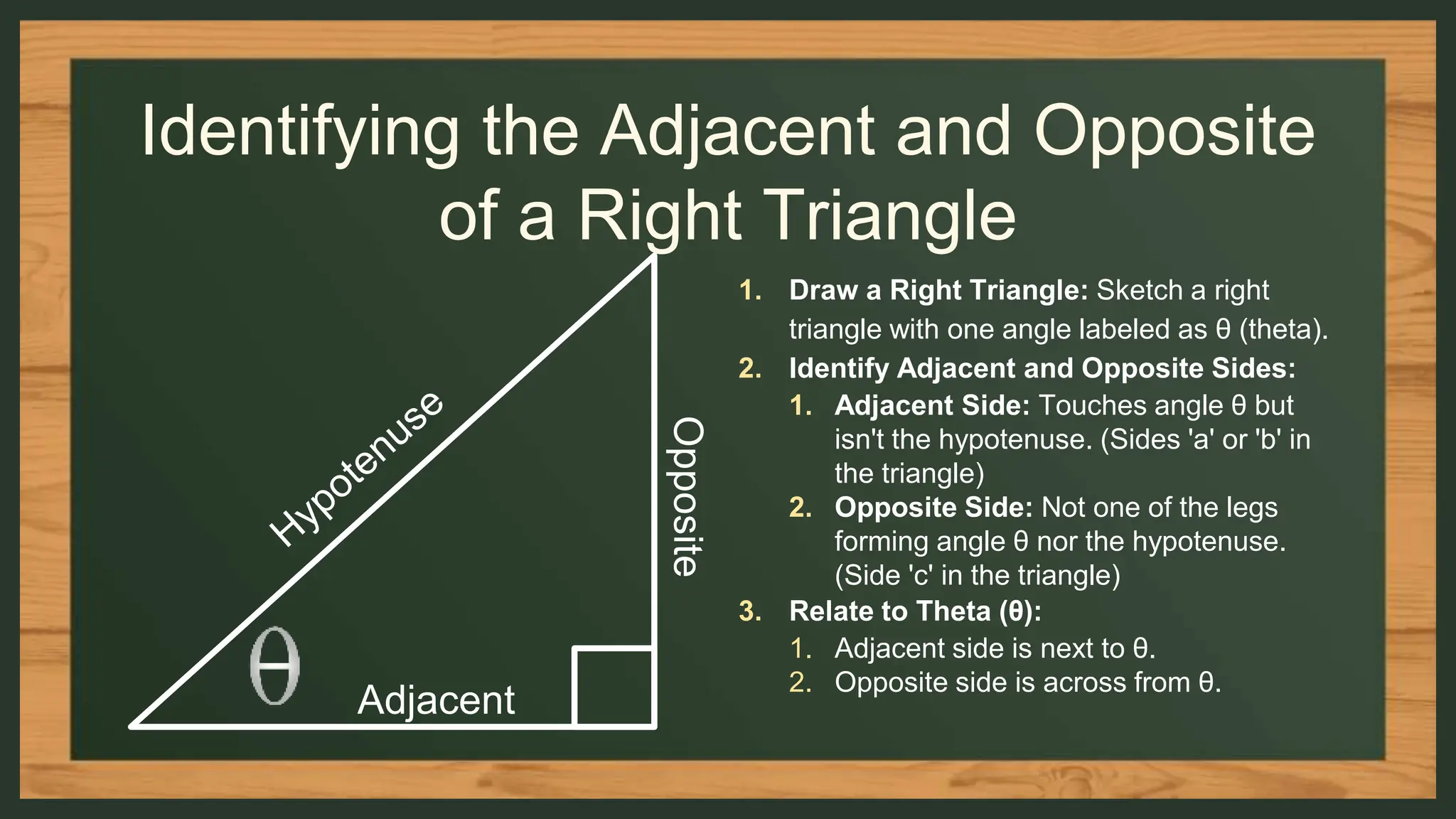
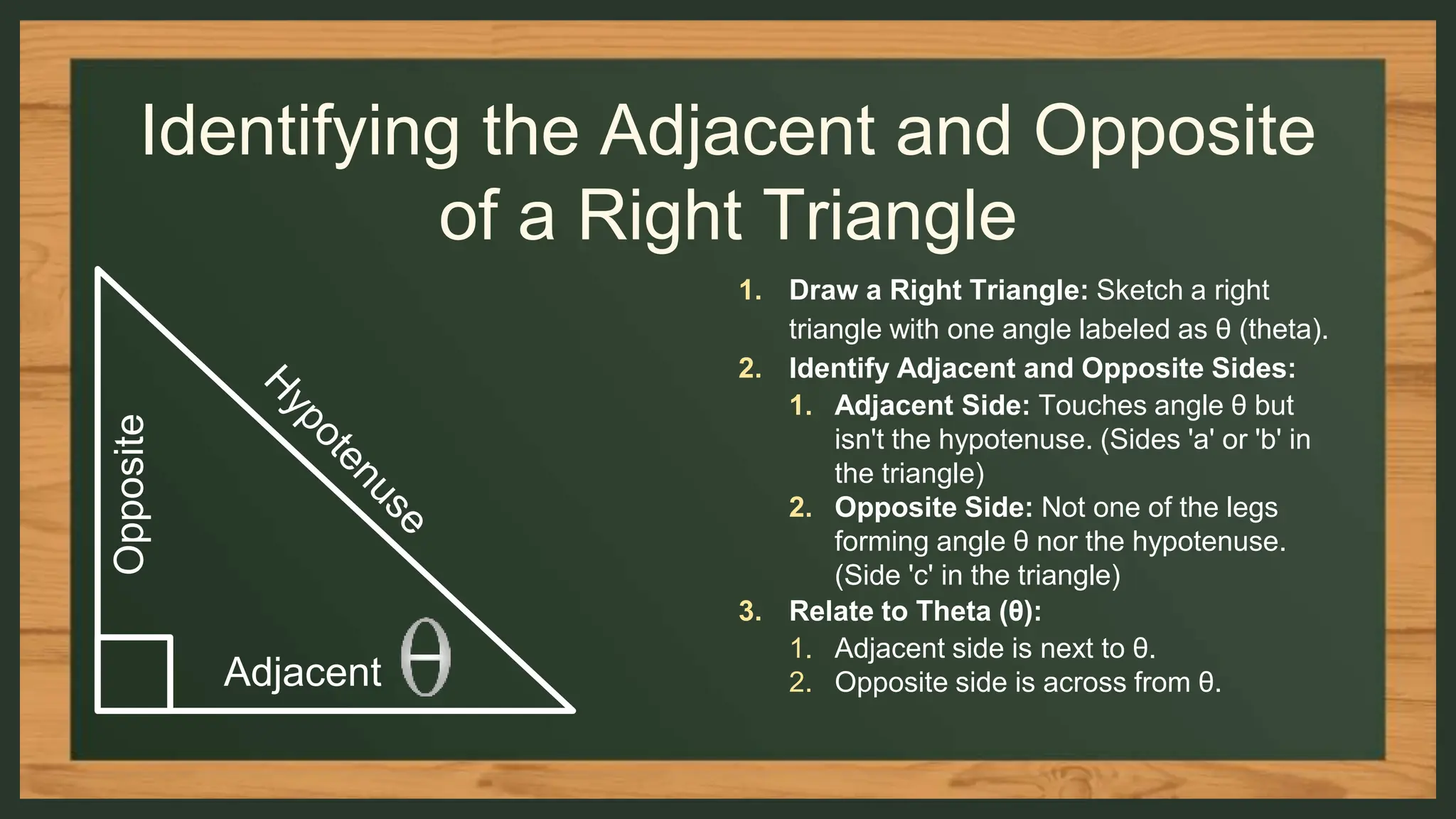
1. Draw a Right Triangle: Sketch a right
triangle with one angle labeled as θ (theta).
2. Identify Adjacent and Opposite Sides:
1. Adjacent Side: Touches angle θ but
isn't the hypotenuse. (Sides 'a' or 'b' in
the triangle)
2. Opposite Side: Not one of the legs
forming angle θ nor the hypotenuse.
(Side 'c' in the triangle)
3. Relate to Theta (θ):
1. Adjacent side is next to θ.
2. Opposite side is across from θ.
How do you know which is Adjacent
and Opposite?
What is Theta (θ)?
Theta (θ) is a symbol used to
represent an angle in
mathematics, particularly in
geometry and trigonometry.
It's like a placeholder for an
unknown or specified angle in
equations and diagrams.
1. Draw a Right Triangle: Sketch a right
triangle with one angle labeled as θ (theta).
2. Identify Adjacent and Opposite Sides:
1. Adjacent Side: Touches angle θ but
isn't the hypotenuse. (Sides 'a' or 'b' in
the triangle)
2. Opposite Side: Not one of the legs
forming angle θ nor the hypotenuse.
(Side 'c' in the triangle)
3. Relate to Theta (θ):
1. Adjacent side is next to θ.
2. Opposite side is across from θ.
Identifying the Adjacent and Opposite
of a Right Triangle
Adjacent
Opposite
1. Draw a Right Triangle: Sketch a right
triangle with one angle labeled as θ (theta).
2. Identify Adjacent and Opposite Sides:
1. Adjacent Side: Touches angle θ but
isn't the hypotenuse. (Sides 'a' or 'b' in
the triangle)
2. Opposite Side: Not one of the legs
forming angle θ nor the hypotenuse.
(Side 'c' in the triangle)
3. Relate to Theta (θ):
1. Adjacent side is next to θ.
2. Opposite side is across from θ.
Identifying the Adjacent and Opposite
of a Right Triangle
1. Draw a Right Triangle: Sketch a right
triangle with one angle labeled as θ (theta).
2. Identify Adjacent and Opposite Sides:
1. Adjacent Side: Touches angle θ but
isn't the hypotenuse. (Sides 'a' or 'b' in
the triangle)
2. Opposite Side: Not one of the legs
forming angle θ nor the hypotenuse.
(Side 'c' in the triangle)
3. Relate to Theta (θ):
1. Adjacent side is next to θ.
2. Opposite side is across from θ.
Identifying the Adjacent and Opposite
of a Right Triangle
Opposite
Adjacent
1. Draw a Right Triangle: Sketch a right
triangle with one angle labeled as θ (theta).
2. Identify Adjacent and Opposite Sides:
1. Adjacent Side: Touches angle θ but
isn't the hypotenuse. (Sides 'a' or 'b' in
the triangle)
2. Opposite Side: Not one of the legs
forming angle θ nor the hypotenuse.
(Side 'c' in the triangle)
3. Relate to Theta (θ):
1. Adjacent side is next to θ.
2. Opposite side is across from θ.
Identifying the Adjacent and Opposite
of a Right Triangle
1. Draw a Right Triangle: Sketch a right
triangle with one angle labeled as θ (theta).
2. Identify Adjacent and Opposite Sides:
1. Adjacent Side: Touches angle θ but
isn't the hypotenuse. (Sides 'a' or 'b' in
the triangle)
2. Opposite Side: Not one of the legs
forming angle θ nor the hypotenuse.
(Side 'c' in the triangle)
3. Relate to Theta (θ):
1. Adjacent side is next to θ.
2. Opposite side is across from θ.
Identifying the Adjacent and Opposite
of a Right Triangle
Opposite
Adjacent
1. Draw a Right Triangle: Sketch a right
triangle with one angle labeled as θ (theta).
2. Identify Adjacent and Opposite Sides:
1. Adjacent Side: Touches angle θ but
isn't the hypotenuse. (Sides 'a' or 'b' in
the triangle)
2. Opposite Side: Not one of the legs
forming angle θ nor the hypotenuse.
(Side 'c' in the triangle)
3. Relate to Theta (θ):
1. Adjacent side is next to θ.
2. Opposite side is across from θ.
Identifying the Adjacent and Opposite
of a Right Triangle
1. Draw a Right Triangle: Sketch a right
triangle with one angle labeled as θ (theta).
2. Identify Adjacent and Opposite Sides:
1. Adjacent Side: Touches angle θ but
isn't the hypotenuse. (Sides 'a' or 'b' in
the triangle)
2. Opposite Side: Not one of the legs
forming angle θ nor the hypotenuse.
(Side 'c' in the triangle)
3. Relate to Theta (θ):
1. Adjacent side is next to θ.
2. Opposite side is across from θ.
Identifying the Adjacent and Opposite
of a Right Triangle
Opposite
Adjacent
Identifying the Adjacent and Opposite
of a Right Triangle
Hypotenuse
1. Draw a Right Triangle: Sketch a right
triangle with one angle labeled as θ (theta).
2. Identify Adjacent and Opposite Sides:
1. Adjacent Side: Touches angle θ but
isn't the hypotenuse. (Sides 'a' or 'b' in
the triangle)
2. Opposite Side: Not one of the legs
forming angle θ nor the hypotenuse.
(Side 'c' in the triangle)
3. Relate to Theta (θ):
1. Adjacent side is next to θ.
2. Opposite side is across from θ.
Identifying the Adjacent and Opposite
of a Right Triangle
1. Draw a Right Triangle: Sketch a right
triangle with one angle labeled as θ (theta).
2. Identify Adjacent and Opposite Sides:
1. Adjacent Side: Touches angle θ but
isn't the hypotenuse. (Sides 'a' or 'b' in
the triangle)
2. Opposite Side: Not one of the legs
forming angle θ nor the hypotenuse.
(Side 'c' in the triangle)
3. Relate to Theta (θ):
1. Adjacent side is next to θ.
2. Opposite side is across from θ.
Opposite
Adjacent
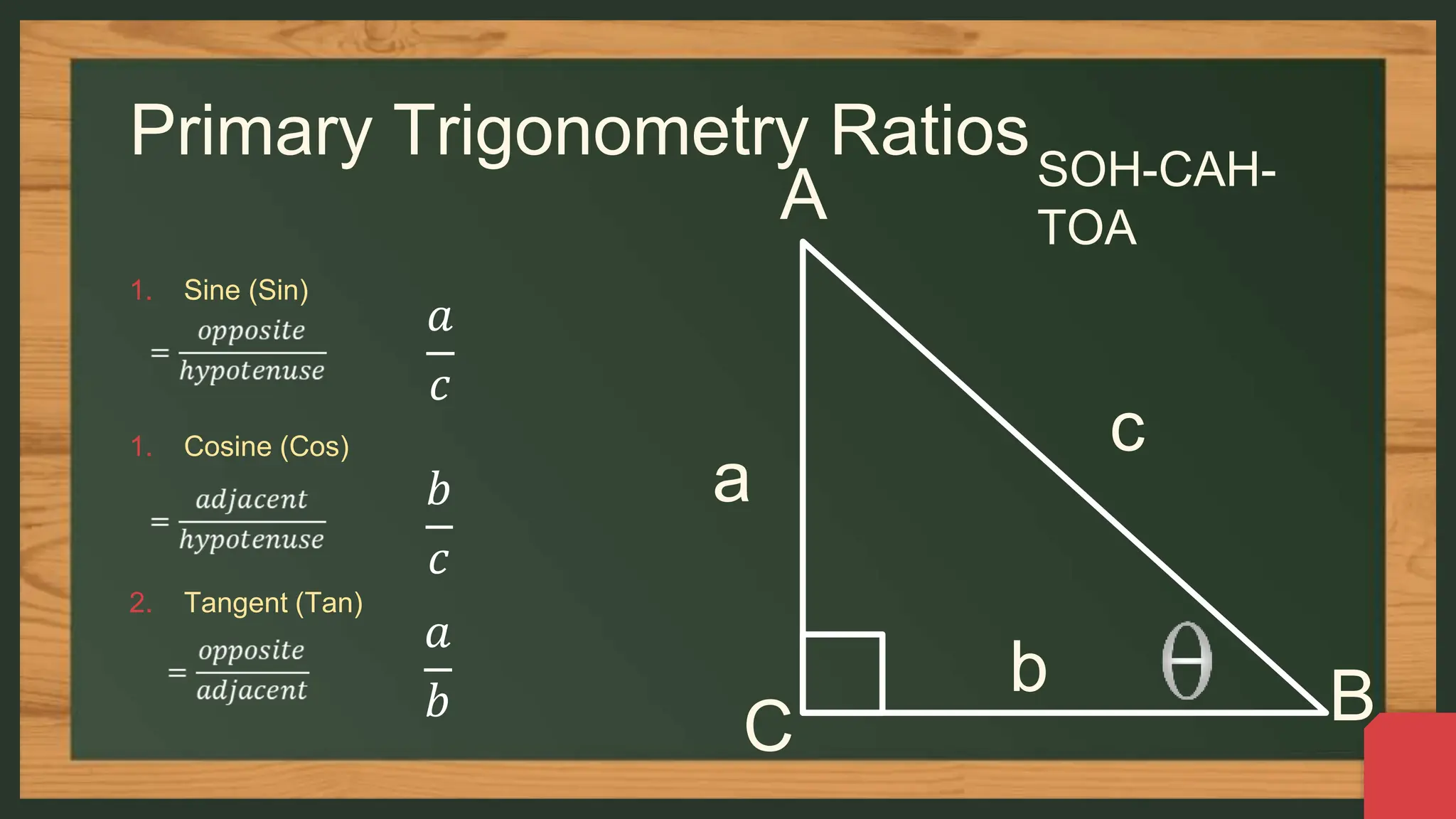
Primary Trigonometry Ratios
1. Sine (Sin)
1. Cosine (Cos)
2. Tangent (Tan)
A
B
C
a
b
c
SOH-CAH-
TOA
𝑎
𝑐
𝑏
𝑐
𝑎
𝑏
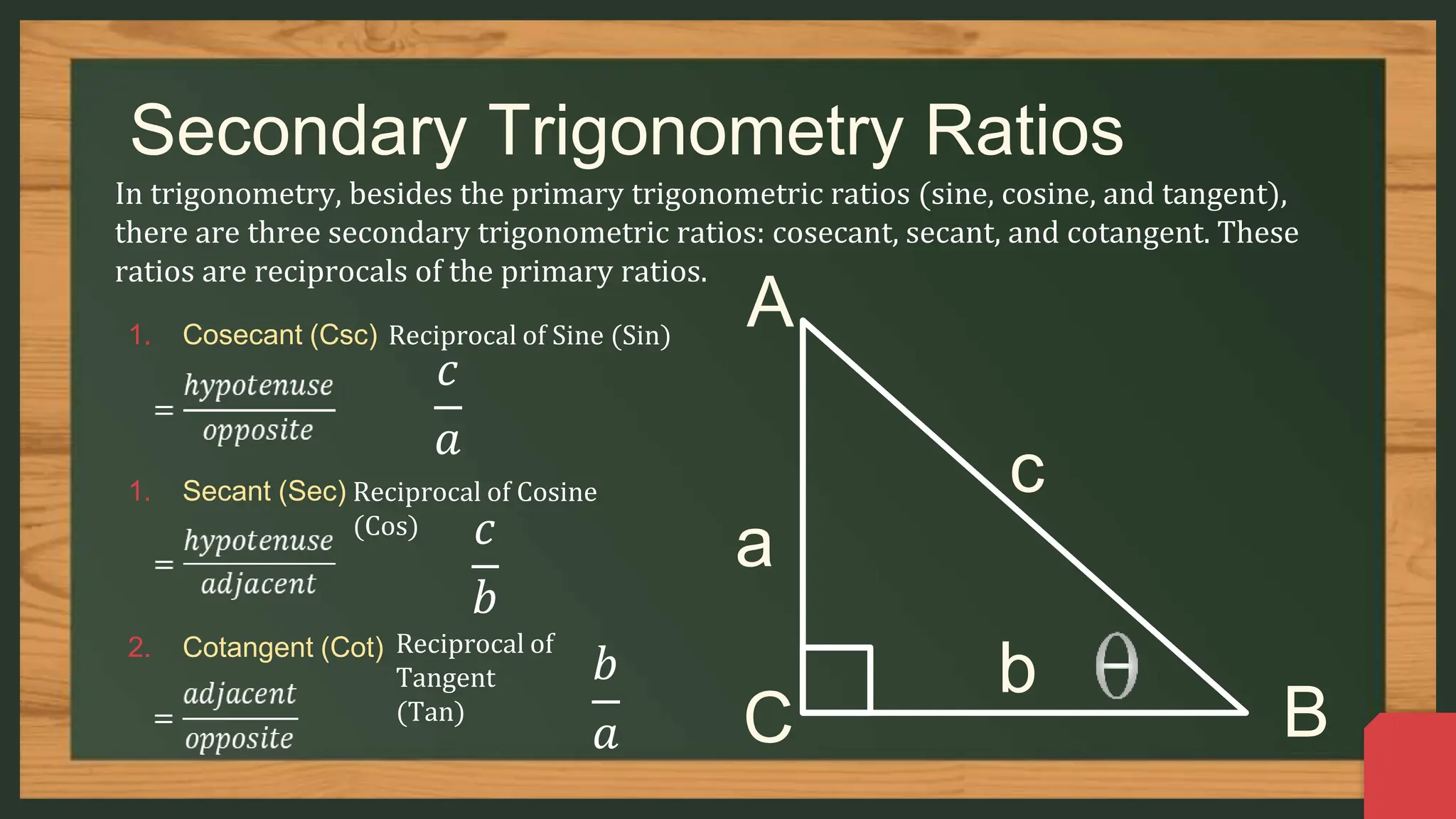
Secondary Trigonometry Ratios
1. Cosecant (Csc)
1. Secant (Sec)
2. Cotangent (Cot)
A
B
C
a
b
c
In trigonometry, besides the primary trigonometric ratios (sine, cosine, and tangent),
there are three secondary trigonometric ratios: cosecant, secant, and cotangent. These
ratios are reciprocals of the primary ratios.
Reciprocal of Sine (Sin)
Reciprocal of Cosine
(Cos)
Reciprocal of
Tangent
(Tan)
𝑐
𝑎
𝑐
𝑏
𝑏
𝑎
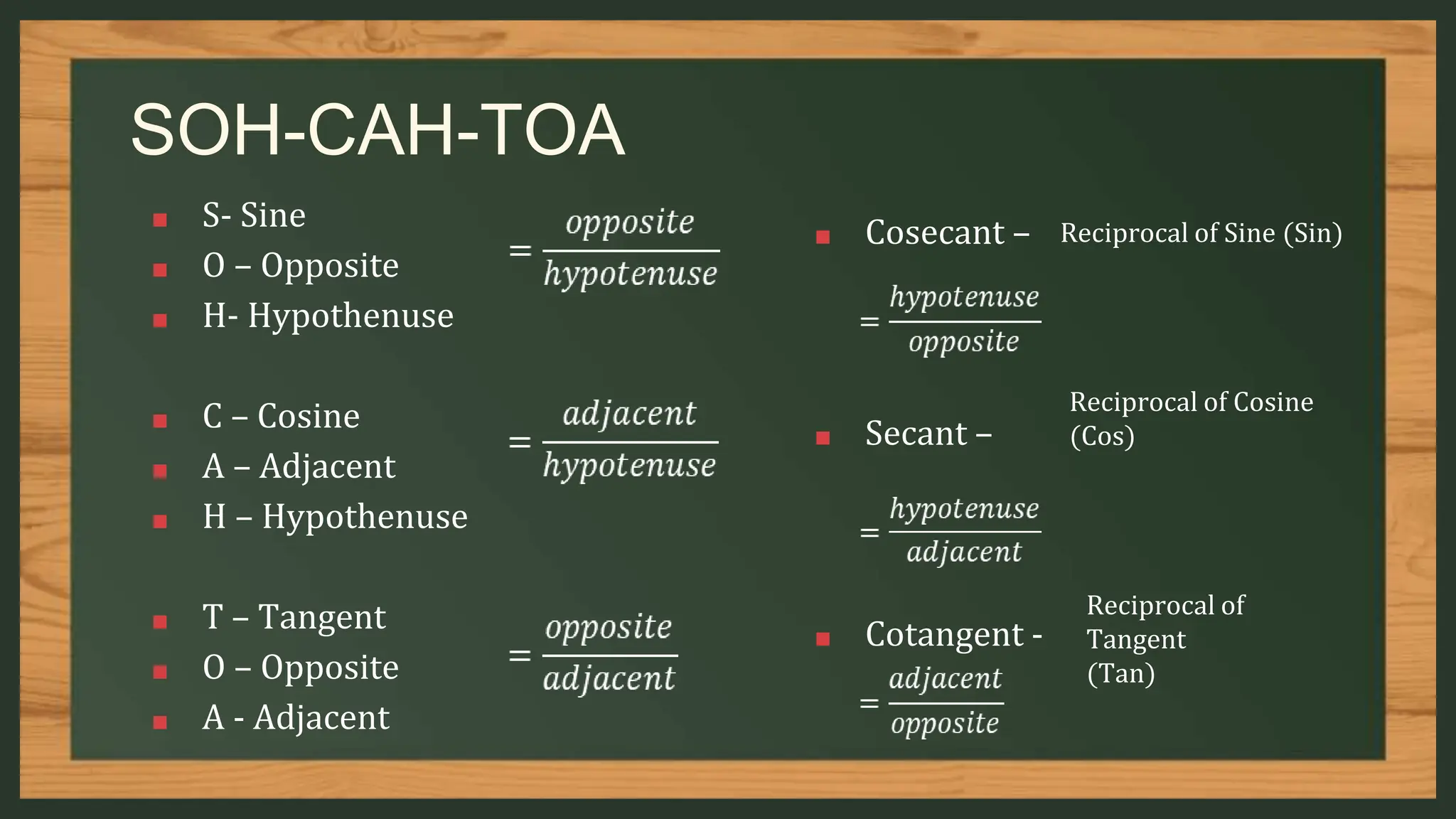
SOH-CAH-TOA
■ S- Sine
■ O – Opposite
■ H- Hypothenuse
■ C – Cosine
■ A – Adjacent
■ H – Hypothenuse
■ T – Tangent
■ O – Opposite
■ A - Adjacent
■ Cosecant –
■ Secant –
■ Cotangent -
Reciprocal of Sine (Sin)
Reciprocal of Cosine
(Cos)
Reciprocal of
Tangent
(Tan)
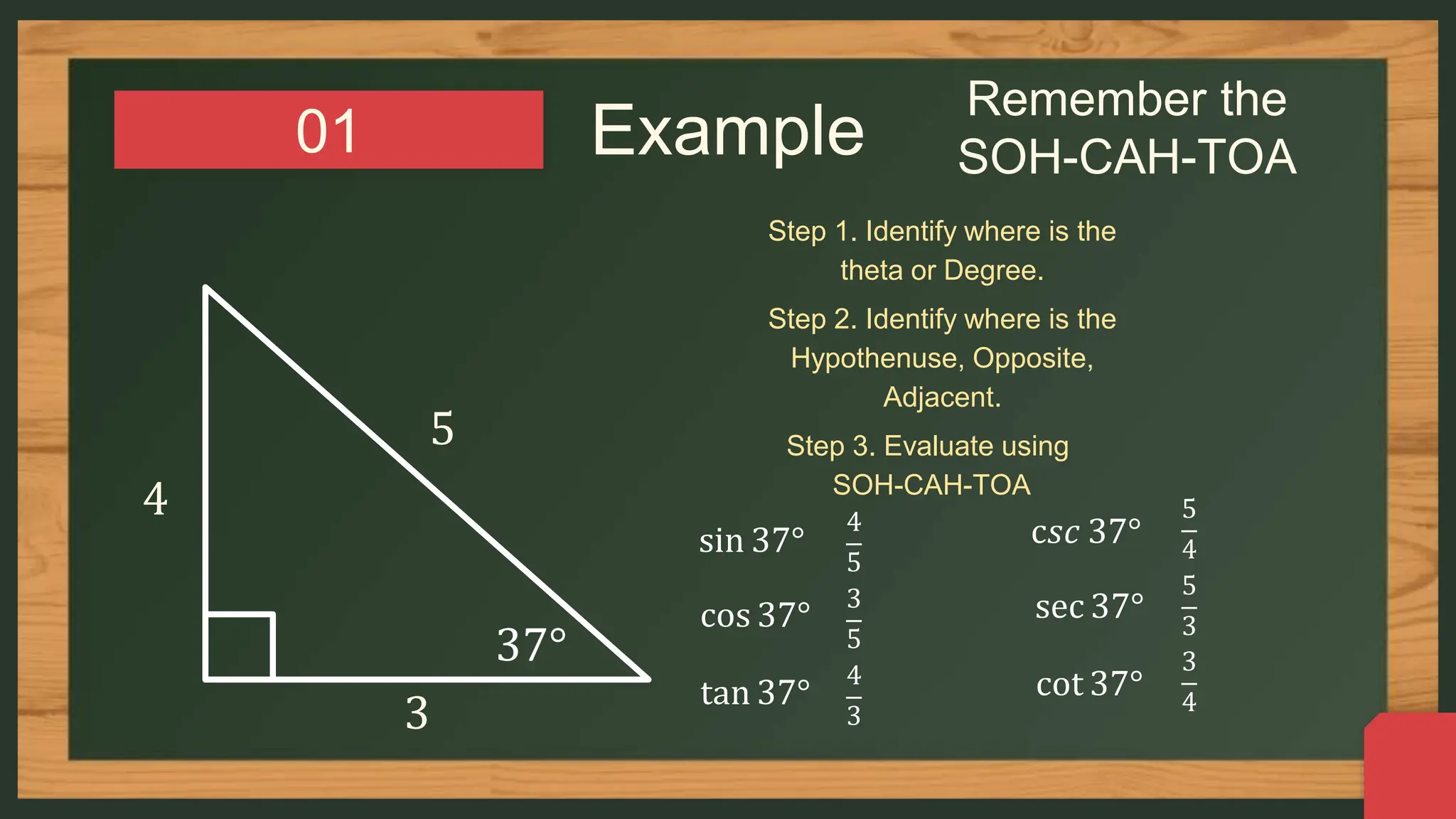
Example
5
Remember the
SOH-CAH-TOA
Step 1. Identify where is the
theta or Degree.
01
37°
3
4
Step 2. Identify where is the
Hypothenuse, Opposite,
Adjacent.
Step 3. Evaluate using
SOH-CAH-TOA
sin 37°
cos 37°
tan 37°
c𝑠𝑐 37°
sec 37°
cot 37°
4
5
3
5
4
3
5
4
5
3
3
4
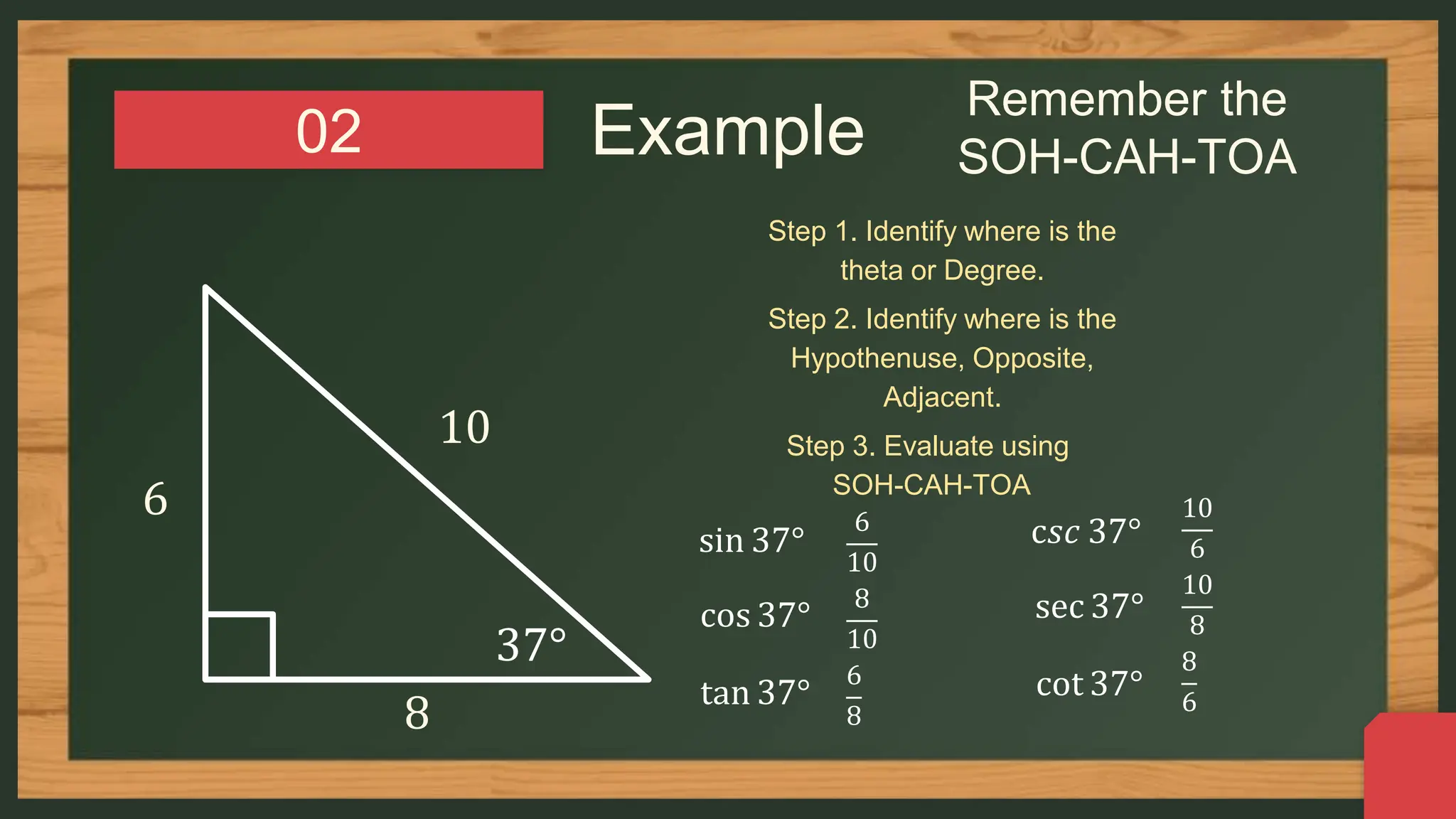
Example
10
Remember the
SOH-CAH-TOA
Step 1. Identify where is the
theta or Degree.
02
37°
8
6
Step 2. Identify where is the
Hypothenuse, Opposite,
Adjacent.
Step 3. Evaluate using
SOH-CAH-TOA
sin 37°
cos 37°
tan 37°
c𝑠𝑐 37°
sec 37°
cot 37°
6
10
8
10
6
8
10
6
10
8
8
6
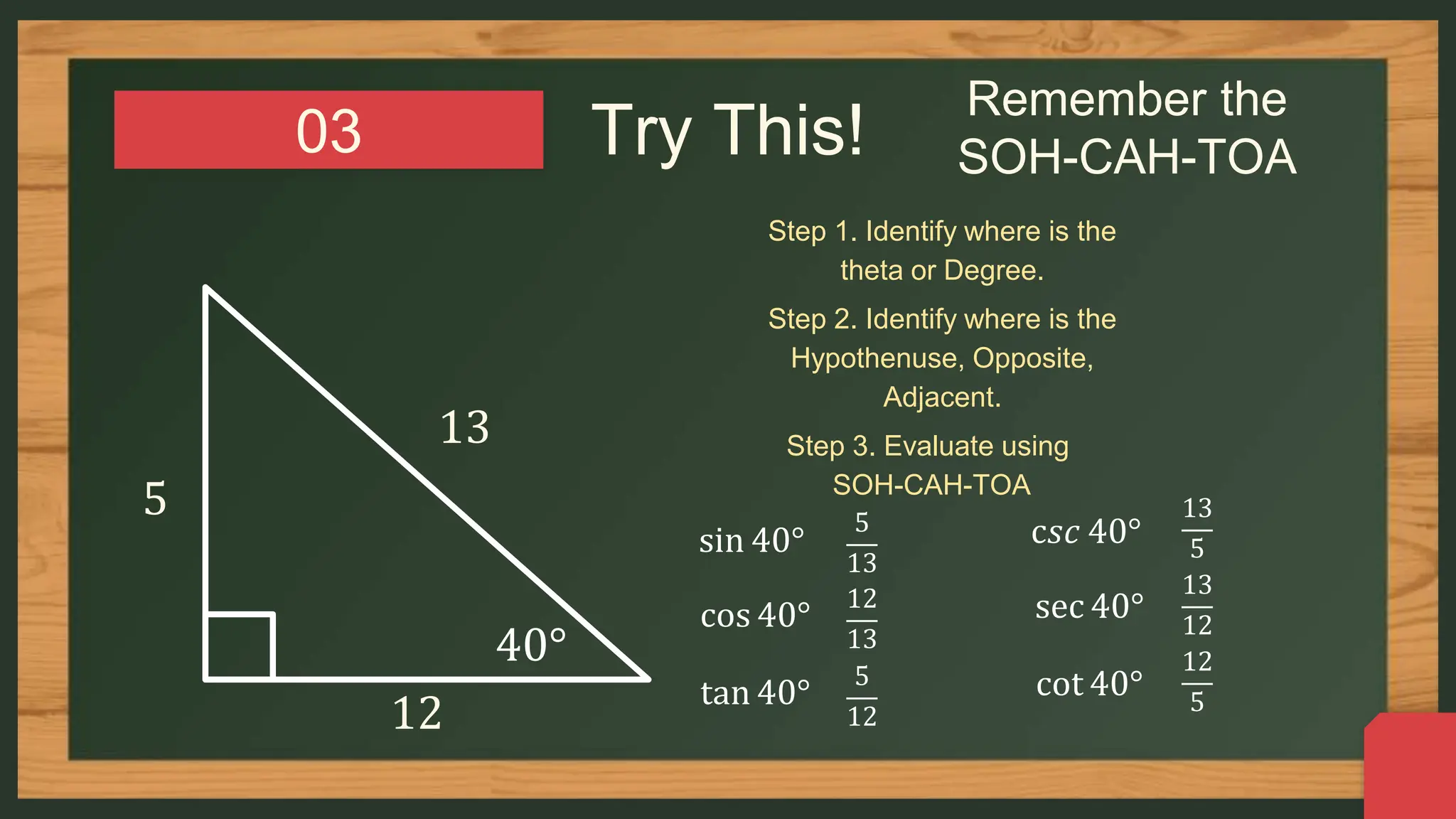
Try This!
13
Remember the
SOH-CAH-TOA
Step 1. Identify where is the
theta or Degree.
03
40°
12
5
Step 2. Identify where is the
Hypothenuse, Opposite,
Adjacent.
Step 3. Evaluate using
SOH-CAH-TOA
sin 40°
cos 40°
tan 40°
c𝑠𝑐 40°
sec 40°
cot 40°
5
13
12
13
5
12
13
5
13
12
12
5
Try This!
13
Remember the
SOH-CAH-TOA
Step 1. Identify where is the
theta or Degree.
04
12
5
Step 2. Identify where is the
Hypothenuse, Opposite,
Adjacent.
Step 3. Evaluate using
SOH-CAH-TOA
sin 𝜃
cos 𝜃
tan 𝜃
c𝑠𝑐 𝜃
sec 𝜃
cot 𝜃
5
13
12
13
5
12
13
5
13
12
12
5
Example
x
Remember the
SOH-CAH-TOA
Step 1. Identify where is the theta or Degree.
05
24
7
Step 2. Identify where is the Hypothenuse,
Opposite, Adjacent.
Step 3. Evaluate using SOH-CAH-TOA
sin 𝜃
cos 𝜃
tan 𝜃
c𝑠𝑐 𝜃
sec 𝜃
cot 𝜃
7
25
24
25
7
24
25
7
25
24
24
7
Step 3. find the missing value using Pythagorean
Theorem
𝑐 = 𝑎2 + 𝑏2
𝑐 = 72 + 242
𝑐 = 49 + 576
𝑐 = 49 + 576
𝑐 = 625
𝑐 = 25
25
Example
06
x
3
10
𝑐 = 𝑎2 + 𝑏2
𝑐 = 32 + ( 10)2
𝑐 = 9 + 10
𝑐 = 19
19
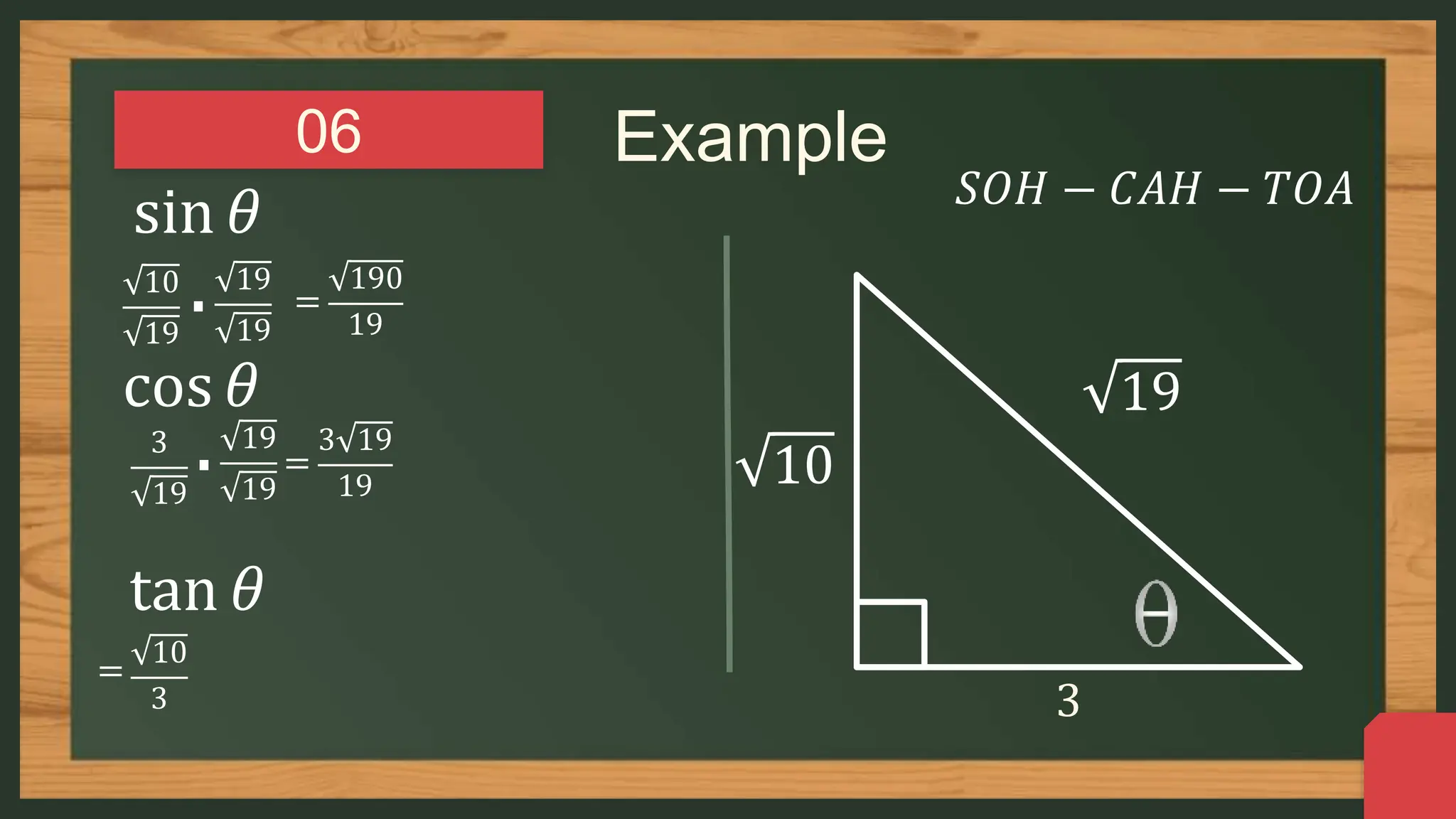
Example
06
3
10
19
sin 𝜃
cos 𝜃
tan 𝜃
𝑆𝑂𝐻 − 𝐶𝐴𝐻 − 𝑇𝑂𝐴
10
19
19
19
.
= 3 19
19
3
19
19
19
.
= 190
19
10
3
=
Example
06
3
10
19
csc 𝜃
s𝑒𝑐 𝜃
cot 𝜃
𝑆𝑂𝐻 − 𝐶𝐴𝐻 − 𝑇𝑂𝐴
19
10
10
10
.
= 19
3
= 190
10
3
10
= 3 10
10
10
10
.
Example
06
3
10
19
csc 𝜃
s𝑒𝑐 𝜃
cot 𝜃
𝑆𝑂𝐻 − 𝐶𝐴𝐻 − 𝑇𝑂𝐴
19
10
10
10
.
= 19
3
= 190
10
3
10
= 3 10
10
10
10
.
Assignment
Make an acronym on a piece of Bond paper (any size)
using the trigonometric functions (6): sine, cosine,
tangent, cotangent, secant, and cosecant, that are related
in Math. (No Short Cut)
Example: (Do not copy the example)
S- Statistics
I- Imaginary Numbers
N- Number Theory
E- Exponential
—Keizar
“Life is like a trigonometry, every degree
has a different unique answer, but every
situation it becomes theta, when you
leave it, it still unknown for future
situation.

Trigonometry Ratios Grade 9 Mathematics.pptx

  • 1.
    Trigonometry: The Six TrigonometryRatios Grade 9 Mathematics -Keizar Paul B. Gonzales Lesson 1
  • 2.
    01 Illustrate thesix trigonometric ratios: sine, cosine, tangent, secant, cosecant, and cotangent; Objectives Introduction to Trigonometry Ratios: 02 Find the value of the six trigonometric ratios from the given triangle; and Unlocking Trigonometric Secrets: 03 Appreciate the importance of trigonometry in real life situations. Using Trigonometry in Everyday Contexts:
  • 3.
  • 4.
  • 5.
  • 6.
  • 7.
  • 8.
    Guide Questions 1. What comesto your mind when you heard about triangles? 2. In your opinion, How can trigonometry be used in surveying to measure distances and angles accurately when mapping land or constructing buildings? 3. How ancient people discovered Trigonometry?
  • 9.
    -Trigonometry is abranch of Mathematics that deals with the relation between the sides and angles of a triangle. -From the Greek words “trigonon” trigon meaning triangle and “metron”, to measure. It is literally means “ measurement of triangles”. Trigonometry -It is a tool used for measuring distances that cannot be directly measured. -Trigonometry involves the study of angles and geometric ratios. Hipparch us Father of Trigonometry
  • 10.
    Right Triangle Trigonometry Itis often used to find the length of one side or the measure of an acute angle of a right triangle. 1. Hypotenuse – is always the side opposite the right angle, it is the longest side of a right triangle. 2. Adjacent side – the side which is also a side of the given acute angle. 3. Opposite side – The side opposite the given acute angle.
  • 11.
    1. Draw aRight Triangle: Sketch a right triangle with one angle labeled as θ (theta). 2. Identify Adjacent and Opposite Sides: 1. Adjacent Side: Touches angle θ but isn't the hypotenuse. (Sides 'a' or 'b' in the triangle) 2. Opposite Side: Not one of the legs forming angle θ nor the hypotenuse. (Side 'c' in the triangle) 3. Relate to Theta (θ): 1. Adjacent side is next to θ. 2. Opposite side is across from θ. How do you know which is Adjacent and Opposite? What is Theta (θ)? Theta (θ) is a symbol used to represent an angle in mathematics, particularly in geometry and trigonometry. It's like a placeholder for an unknown or specified angle in equations and diagrams.
  • 12.
    1. Draw aRight Triangle: Sketch a right triangle with one angle labeled as θ (theta). 2. Identify Adjacent and Opposite Sides: 1. Adjacent Side: Touches angle θ but isn't the hypotenuse. (Sides 'a' or 'b' in the triangle) 2. Opposite Side: Not one of the legs forming angle θ nor the hypotenuse. (Side 'c' in the triangle) 3. Relate to Theta (θ): 1. Adjacent side is next to θ. 2. Opposite side is across from θ. Identifying the Adjacent and Opposite of a Right Triangle Adjacent Opposite
  • 13.
    1. Draw aRight Triangle: Sketch a right triangle with one angle labeled as θ (theta). 2. Identify Adjacent and Opposite Sides: 1. Adjacent Side: Touches angle θ but isn't the hypotenuse. (Sides 'a' or 'b' in the triangle) 2. Opposite Side: Not one of the legs forming angle θ nor the hypotenuse. (Side 'c' in the triangle) 3. Relate to Theta (θ): 1. Adjacent side is next to θ. 2. Opposite side is across from θ. Identifying the Adjacent and Opposite of a Right Triangle
  • 14.
    1. Draw aRight Triangle: Sketch a right triangle with one angle labeled as θ (theta). 2. Identify Adjacent and Opposite Sides: 1. Adjacent Side: Touches angle θ but isn't the hypotenuse. (Sides 'a' or 'b' in the triangle) 2. Opposite Side: Not one of the legs forming angle θ nor the hypotenuse. (Side 'c' in the triangle) 3. Relate to Theta (θ): 1. Adjacent side is next to θ. 2. Opposite side is across from θ. Identifying the Adjacent and Opposite of a Right Triangle Opposite Adjacent
  • 15.
    1. Draw aRight Triangle: Sketch a right triangle with one angle labeled as θ (theta). 2. Identify Adjacent and Opposite Sides: 1. Adjacent Side: Touches angle θ but isn't the hypotenuse. (Sides 'a' or 'b' in the triangle) 2. Opposite Side: Not one of the legs forming angle θ nor the hypotenuse. (Side 'c' in the triangle) 3. Relate to Theta (θ): 1. Adjacent side is next to θ. 2. Opposite side is across from θ. Identifying the Adjacent and Opposite of a Right Triangle
  • 16.
    1. Draw aRight Triangle: Sketch a right triangle with one angle labeled as θ (theta). 2. Identify Adjacent and Opposite Sides: 1. Adjacent Side: Touches angle θ but isn't the hypotenuse. (Sides 'a' or 'b' in the triangle) 2. Opposite Side: Not one of the legs forming angle θ nor the hypotenuse. (Side 'c' in the triangle) 3. Relate to Theta (θ): 1. Adjacent side is next to θ. 2. Opposite side is across from θ. Identifying the Adjacent and Opposite of a Right Triangle Opposite Adjacent
  • 17.
    1. Draw aRight Triangle: Sketch a right triangle with one angle labeled as θ (theta). 2. Identify Adjacent and Opposite Sides: 1. Adjacent Side: Touches angle θ but isn't the hypotenuse. (Sides 'a' or 'b' in the triangle) 2. Opposite Side: Not one of the legs forming angle θ nor the hypotenuse. (Side 'c' in the triangle) 3. Relate to Theta (θ): 1. Adjacent side is next to θ. 2. Opposite side is across from θ. Identifying the Adjacent and Opposite of a Right Triangle
  • 18.
    1. Draw aRight Triangle: Sketch a right triangle with one angle labeled as θ (theta). 2. Identify Adjacent and Opposite Sides: 1. Adjacent Side: Touches angle θ but isn't the hypotenuse. (Sides 'a' or 'b' in the triangle) 2. Opposite Side: Not one of the legs forming angle θ nor the hypotenuse. (Side 'c' in the triangle) 3. Relate to Theta (θ): 1. Adjacent side is next to θ. 2. Opposite side is across from θ. Identifying the Adjacent and Opposite of a Right Triangle Opposite Adjacent
  • 19.
    Identifying the Adjacentand Opposite of a Right Triangle Hypotenuse 1. Draw a Right Triangle: Sketch a right triangle with one angle labeled as θ (theta). 2. Identify Adjacent and Opposite Sides: 1. Adjacent Side: Touches angle θ but isn't the hypotenuse. (Sides 'a' or 'b' in the triangle) 2. Opposite Side: Not one of the legs forming angle θ nor the hypotenuse. (Side 'c' in the triangle) 3. Relate to Theta (θ): 1. Adjacent side is next to θ. 2. Opposite side is across from θ.
  • 20.
    Identifying the Adjacentand Opposite of a Right Triangle 1. Draw a Right Triangle: Sketch a right triangle with one angle labeled as θ (theta). 2. Identify Adjacent and Opposite Sides: 1. Adjacent Side: Touches angle θ but isn't the hypotenuse. (Sides 'a' or 'b' in the triangle) 2. Opposite Side: Not one of the legs forming angle θ nor the hypotenuse. (Side 'c' in the triangle) 3. Relate to Theta (θ): 1. Adjacent side is next to θ. 2. Opposite side is across from θ. Opposite Adjacent
  • 21.
    Primary Trigonometry Ratios 1.Sine (Sin) 1. Cosine (Cos) 2. Tangent (Tan) A B C a b c SOH-CAH- TOA 𝑎 𝑐 𝑏 𝑐 𝑎 𝑏
  • 22.
    Secondary Trigonometry Ratios 1.Cosecant (Csc) 1. Secant (Sec) 2. Cotangent (Cot) A B C a b c In trigonometry, besides the primary trigonometric ratios (sine, cosine, and tangent), there are three secondary trigonometric ratios: cosecant, secant, and cotangent. These ratios are reciprocals of the primary ratios. Reciprocal of Sine (Sin) Reciprocal of Cosine (Cos) Reciprocal of Tangent (Tan) 𝑐 𝑎 𝑐 𝑏 𝑏 𝑎
  • 23.
    SOH-CAH-TOA ■ S- Sine ■O – Opposite ■ H- Hypothenuse ■ C – Cosine ■ A – Adjacent ■ H – Hypothenuse ■ T – Tangent ■ O – Opposite ■ A - Adjacent ■ Cosecant – ■ Secant – ■ Cotangent - Reciprocal of Sine (Sin) Reciprocal of Cosine (Cos) Reciprocal of Tangent (Tan)
  • 24.
    Example 5 Remember the SOH-CAH-TOA Step 1.Identify where is the theta or Degree. 01 37° 3 4 Step 2. Identify where is the Hypothenuse, Opposite, Adjacent. Step 3. Evaluate using SOH-CAH-TOA sin 37° cos 37° tan 37° c𝑠𝑐 37° sec 37° cot 37° 4 5 3 5 4 3 5 4 5 3 3 4
  • 25.
    Example 10 Remember the SOH-CAH-TOA Step 1.Identify where is the theta or Degree. 02 37° 8 6 Step 2. Identify where is the Hypothenuse, Opposite, Adjacent. Step 3. Evaluate using SOH-CAH-TOA sin 37° cos 37° tan 37° c𝑠𝑐 37° sec 37° cot 37° 6 10 8 10 6 8 10 6 10 8 8 6
  • 26.
    Try This! 13 Remember the SOH-CAH-TOA Step1. Identify where is the theta or Degree. 03 40° 12 5 Step 2. Identify where is the Hypothenuse, Opposite, Adjacent. Step 3. Evaluate using SOH-CAH-TOA sin 40° cos 40° tan 40° c𝑠𝑐 40° sec 40° cot 40° 5 13 12 13 5 12 13 5 13 12 12 5
  • 27.
    Try This! 13 Remember the SOH-CAH-TOA Step1. Identify where is the theta or Degree. 04 12 5 Step 2. Identify where is the Hypothenuse, Opposite, Adjacent. Step 3. Evaluate using SOH-CAH-TOA sin 𝜃 cos 𝜃 tan 𝜃 c𝑠𝑐 𝜃 sec 𝜃 cot 𝜃 5 13 12 13 5 12 13 5 13 12 12 5
  • 28.
    Example x Remember the SOH-CAH-TOA Step 1.Identify where is the theta or Degree. 05 24 7 Step 2. Identify where is the Hypothenuse, Opposite, Adjacent. Step 3. Evaluate using SOH-CAH-TOA sin 𝜃 cos 𝜃 tan 𝜃 c𝑠𝑐 𝜃 sec 𝜃 cot 𝜃 7 25 24 25 7 24 25 7 25 24 24 7 Step 3. find the missing value using Pythagorean Theorem 𝑐 = 𝑎2 + 𝑏2 𝑐 = 72 + 242 𝑐 = 49 + 576 𝑐 = 49 + 576 𝑐 = 625 𝑐 = 25 25
  • 29.
    Example 06 x 3 10 𝑐 = 𝑎2+ 𝑏2 𝑐 = 32 + ( 10)2 𝑐 = 9 + 10 𝑐 = 19 19
  • 30.
    Example 06 3 10 19 sin 𝜃 cos 𝜃 tan𝜃 𝑆𝑂𝐻 − 𝐶𝐴𝐻 − 𝑇𝑂𝐴 10 19 19 19 . = 3 19 19 3 19 19 19 . = 190 19 10 3 =
  • 31.
    Example 06 3 10 19 csc 𝜃 s𝑒𝑐 𝜃 cot𝜃 𝑆𝑂𝐻 − 𝐶𝐴𝐻 − 𝑇𝑂𝐴 19 10 10 10 . = 19 3 = 190 10 3 10 = 3 10 10 10 10 .
  • 32.
    Example 06 3 10 19 csc 𝜃 s𝑒𝑐 𝜃 cot𝜃 𝑆𝑂𝐻 − 𝐶𝐴𝐻 − 𝑇𝑂𝐴 19 10 10 10 . = 19 3 = 190 10 3 10 = 3 10 10 10 10 .
  • 33.
    Assignment Make an acronymon a piece of Bond paper (any size) using the trigonometric functions (6): sine, cosine, tangent, cotangent, secant, and cosecant, that are related in Math. (No Short Cut) Example: (Do not copy the example) S- Statistics I- Imaginary Numbers N- Number Theory E- Exponential
  • 34.
    —Keizar “Life is likea trigonometry, every degree has a different unique answer, but every situation it becomes theta, when you leave it, it still unknown for future situation.