
Quick Facts on Pythagoras
• He was born at Samos in 570 B.C.
• His main interests were in
Metaphysics, Music, Mathematics
, Ethics and Politics.
• His notable works were Musica
universalis, Golden
ratio, Pythagorean
tuning, Pythagorean theorem.
• He died at Metapontum in 495
B.C when he was aged around 75
yrs.
Quick Facts on Pythagoras
The present country of Samos The ruined city of Metapontum
Life of Pythagoras
• His father, Mnesarchus, was a gem merchant. His
mother's name was Pythais. Pythagoras had two or
three brothers.
• Some historians say that Pythagoras was married
to a woman named Theano and had a daughter
Damo, and a son named Telauges, who succeeded
Pythagoras as a teacher and possibly taught
Empedocles.
• Pythagoras was well educated, and he played the
lyre throughout his lifetime, knew poetry and
recited Homer.
• Pythagoras left Samos for Egypt in about 535 B.C.
to study with the priests in the temples. Many of
the practices of the society he created later in
Italy can be traced to the beliefs of Egyptian
priests, such as the codes of secrecy, striving for
purity, and refusal to eat beans or to wear animal
skins as clothing.
Life of Pythagoras
• In 520 BC, Pythagoras, left Babylon and
returned to Samos, and sometime later
began a school called The Semicircle. His
methods of teaching were not popular with
the leaders of Samos, and their desire for
him to become involved in politics did not
appeal to him, so he left.
• Pythagoras settled in Crotona, a Greek
colony in southern Italy, about 518 BC, and
founded a philosophical and religious school
where his many followers lived and worked.
The Pythagoreans lived by rules of behavior,
including when they spoke, what they wore
and what they ate. Pythagoras was the
Master of the society, and the followers,
both men and women, who also lived there,
were known as mathematikoi.
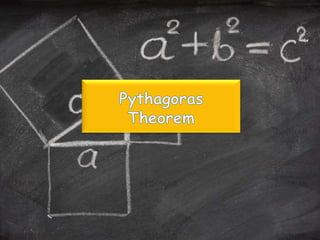
Pythagoras Theorem
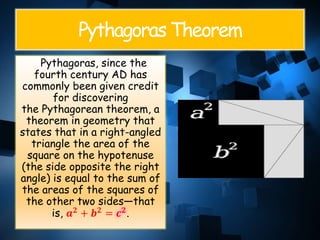
Pythagoras, since the
fourth century AD has
commonly been given credit
for discovering
the Pythagorean theorem, a
theorem in geometry that
states that in a right-angled
triangle the area of the
square on the hypotenuse
(the side opposite the right
angle) is equal to the sum of
the areas of the squares of
the other two sides—that
is, 𝒂 𝟐 + 𝒃 𝟐 = 𝒄 𝟐.
Pythagoras Theorem
REFERENCES
• Wikipedia
• Google Images
Pythagoras and Pythagorean theorem

Pythagoras and Pythagorean theorem

  • 2.
    Quick Facts onPythagoras • He was born at Samos in 570 B.C. • His main interests were in Metaphysics, Music, Mathematics , Ethics and Politics. • His notable works were Musica universalis, Golden ratio, Pythagorean tuning, Pythagorean theorem. • He died at Metapontum in 495 B.C when he was aged around 75 yrs.
  • 3.
    Quick Facts onPythagoras The present country of Samos The ruined city of Metapontum
  • 5.
    Life of Pythagoras •His father, Mnesarchus, was a gem merchant. His mother's name was Pythais. Pythagoras had two or three brothers. • Some historians say that Pythagoras was married to a woman named Theano and had a daughter Damo, and a son named Telauges, who succeeded Pythagoras as a teacher and possibly taught Empedocles. • Pythagoras was well educated, and he played the lyre throughout his lifetime, knew poetry and recited Homer. • Pythagoras left Samos for Egypt in about 535 B.C. to study with the priests in the temples. Many of the practices of the society he created later in Italy can be traced to the beliefs of Egyptian priests, such as the codes of secrecy, striving for purity, and refusal to eat beans or to wear animal skins as clothing.
  • 6.
    Life of Pythagoras •In 520 BC, Pythagoras, left Babylon and returned to Samos, and sometime later began a school called The Semicircle. His methods of teaching were not popular with the leaders of Samos, and their desire for him to become involved in politics did not appeal to him, so he left. • Pythagoras settled in Crotona, a Greek colony in southern Italy, about 518 BC, and founded a philosophical and religious school where his many followers lived and worked. The Pythagoreans lived by rules of behavior, including when they spoke, what they wore and what they ate. Pythagoras was the Master of the society, and the followers, both men and women, who also lived there, were known as mathematikoi.
  • 8.
    Pythagoras Theorem Pythagoras, sincethe fourth century AD has commonly been given credit for discovering the Pythagorean theorem, a theorem in geometry that states that in a right-angled triangle the area of the square on the hypotenuse (the side opposite the right angle) is equal to the sum of the areas of the squares of the other two sides—that is, 𝒂 𝟐 + 𝒃 𝟐 = 𝒄 𝟐.
  • 9.
  • 10.