Pythagorean Theorem
by Bobby Stecher
mark.stecher@maconstate.edu
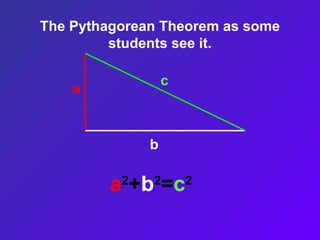
The Pythagorean Theorem as some
students see it.
a
c
b
a2
+b2
=c2
a2
+b2
=c2
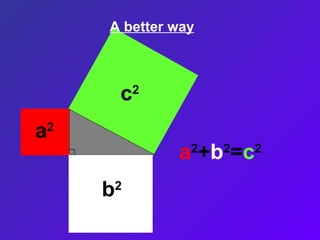
A better way
a2
b2
c2
c
b
a
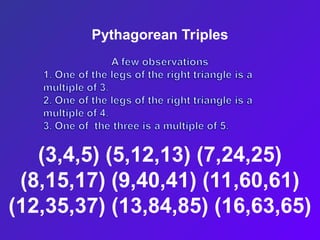
Pythagorean Triples
(3,4,5) (5,12,13) (7,24,25)
(8,15,17) (9,40,41) (11,60,61)
(12,35,37) (13,84,85) (16,63,65)
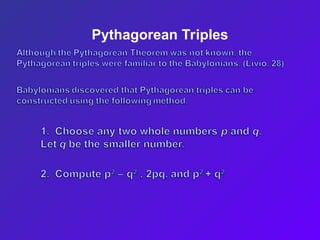
Pythagorean Triples
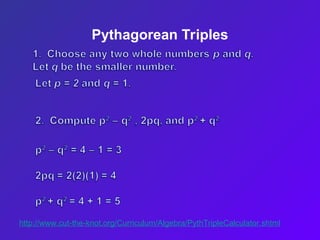
Pythagorean Triples
http://www.cut-the-knot.org/Curriculum/Algebra/PythTripleCalculator.shtml
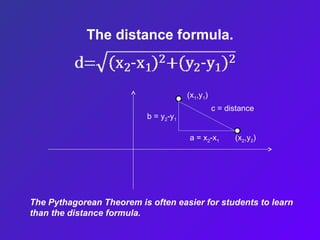
The distance formula.
(x1,y1)
(x2,y2)
a = x2-x1
b = y2-y1
c = distance
The Pythagorean Theorem is often easier for students to learn
than the distance formula.
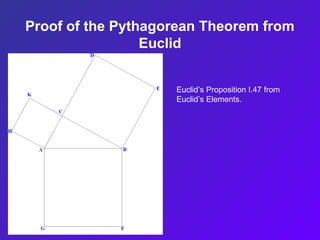
Proof of the Pythagorean Theorem from
Euclid
Euclid’s Proposition I.47 from
Euclid’s Elements.
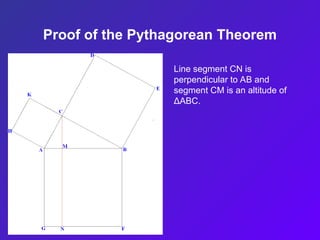
Proof of the Pythagorean Theorem
Line segment CN is
perpendicular to AB and
segment CM is an altitude of
ΔABC.
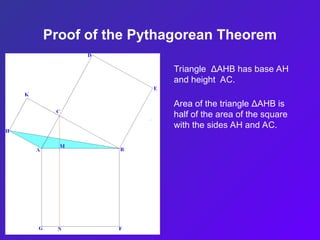
Proof of the Pythagorean Theorem
Triangle ΔAHB has base AH
and height AC.
Area of the triangle ΔAHB is
half of the area of the square
with the sides AH and AC.
Proof of the Pythagorean Theorem
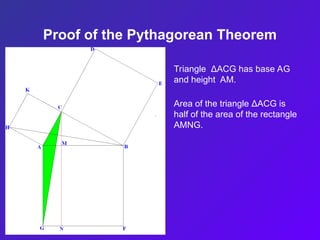
Triangle ΔACG has base AG
and height AM.
Area of the triangle ΔACG is
half of the area of the rectangle
AMNG.
Proof of the Pythagorean Theorem
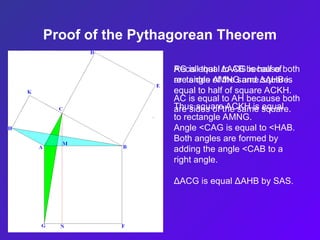
AG is equal to AB because both
are sides of the same square.
ΔACG is equal ΔAHB by SAS.
AC is equal to AH because both
are sides of the same square.
Angle <CAG is equal to <HAB.
Both angles are formed by
adding the angle <CAB to a
right angle.
Recall that ΔACG is half of
rectangle AMNG and ΔAHB is
equal to half of square ACKH.
Thus square ACKH is equal
to rectangle AMNG.
Proof of the Pythagorean Theorem
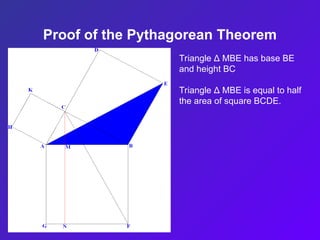
Triangle Δ MBE has base BE
and height BC
Triangle Δ MBE is equal to half
the area of square BCDE.
Proof of the Pythagorean Theorem
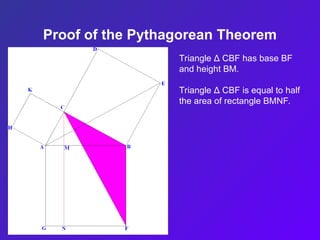
Triangle Δ CBF has base BF
and height BM.
Triangle Δ CBF is equal to half
the area of rectangle BMNF.
Proof of the Pythagorean Theorem
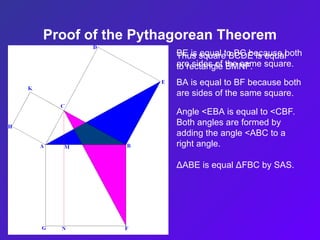
BE is equal to BC because both
are sides of the same square.
ΔABE is equal ΔFBC by SAS.
BA is equal to BF because both
are sides of the same square.
Angle <EBA is equal to <CBF.
Both angles are formed by
adding the angle <ABC to a
right angle.
Thus square BCDE is equal
to rectangle BMNF.
World Wide Web java applet for
Euclid’s proof.
http://www.ies.co.jp/math/java/geo/pythafv/y
hafv.html
Additional Proofs of the
Pythagorean Theorem.
Proof by former president James Garfield.
http://jwilson.coe.uga.edu/emt669/Student.Folders/Huberty.Gr
eg/Pythagorean.html
More than 70 more proofs.
http://www.cut-the-knot.org/pythagoras/
A simple hands on proof for
students.
Step 1: Cut four identical right triangles from a piece of paper.
a
b
c
A simple hands on proof for
students.
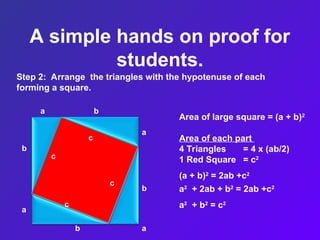
Step 2: Arrange the triangles with the hypotenuse of each
forming a square.
a
b
c
b
b
a
a
b
c
c
c
a
Area of large square = (a + b)2
Area of each part
4 Triangles = 4 x (ab/2)
1 Red Square = c2
(a + b)2
= 2ab +c2
a2
+ 2ab + b2
= 2ab +c2
a2
+ b2
= c2
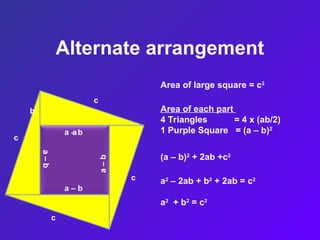
Alternate arrangement
Area of large square = c2
Area of each part
4 Triangles = 4 x (ab/2)
1 Purple Square = (a – b)2
(a – b)2
+ 2ab +c2
a2
– 2ab + b2
+ 2ab = c2
a2
+ b2
= c2
b
c
a – b
c
c
c
a
a – b
a
–
b
a
–
b
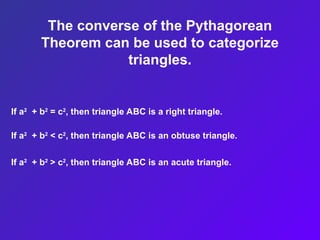
The converse of the Pythagorean
Theorem can be used to categorize
triangles.
If a2
+ b2
= c2
, then triangle ABC is a right triangle.
If a2
+ b2
< c2
, then triangle ABC is an obtuse triangle.
If a2
+ b2
> c2
, then triangle ABC is an acute triangle.
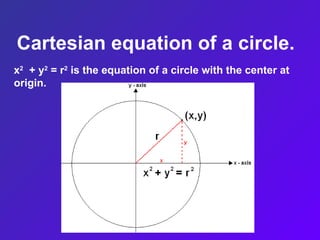
Cartesian equation of a circle.
x2
+ y2
= r2
is the equation of a circle with the center at
origin.
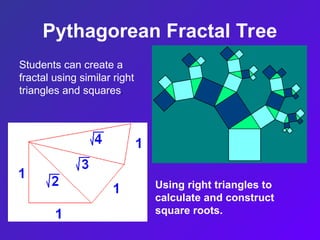
Pythagorean Fractal Tree
Students can create a
fractal using similar right
triangles and squares.
Using right triangles to
calculate and construct
square roots.
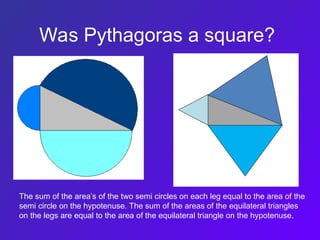
Was Pythagoras a square?
The sum of the area’s of the two semi circles on each leg equal to the area of the
semi circle on the hypotenuse. The sum of the areas of the equilateral triangles
on the legs are equal to the area of the equilateral triangle on the hypotenuse.
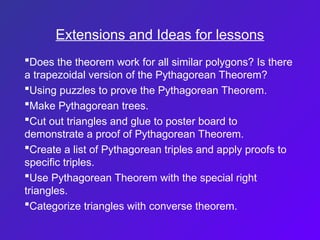
Extensions and Ideas for lessons
Does the theorem work for all similar polygons? Is there
a trapezoidal version of the Pythagorean Theorem?
Using puzzles to prove the Pythagorean Theorem.
Make Pythagorean trees.
Cut out triangles and glue to poster board to
demonstrate a proof of Pythagorean Theorem.
Create a list of Pythagorean triples and apply proofs to
specific triples.
Use Pythagorean Theorem with the special right
triangles.
Categorize triangles with converse theorem.
References
Boyer, Carl B. and Merzbach, Uta C. A History of Mathematics 2nd
ed. New York: John Wiley & Sons, 1968.
Burger, Edward B. and Starbird, Michael. Coincidences, Chaos,
and All That Math Jazz. New York: W.W. Norton & Company,
2005.
Gullberg, Jan. Mathematics: From the Birth of Numbers. New
York: W.W. Norton & Company, 1997.
Livio, Mario. The Golden Ratio. New York: Broadway Books, 2002.
http://www.contracosta.edu/math/pythagoras.htm
http://www.cut-the-knot.org/
http://www.contracosta.edu/math/pythagoras.htm
Links
• http://www.contracosta.edu/math/pythagoras.htm
• http://www.cut-the-knot.org/
• http://www.contracosta.edu/math/pythagoras.htm
• http://www.ies.co.jp/math/java/geo/pythafv/yhafv.html
• http://jwilson.coe.uga.edu/emt669/Student.Folders/
Huberty.Greg/Pythagorean.html
• http://www.cut-the-knot.org/pythagoras/

THE PYTHAGOREAN THEOREM - UNDERSTANDING AND LEARNING

  • 1.
    Pythagorean Theorem by BobbyStecher mark.stecher@maconstate.edu
  • 2.
    The Pythagorean Theoremas some students see it. a c b a2 +b2 =c2
  • 3.
  • 4.
    Pythagorean Triples (3,4,5) (5,12,13)(7,24,25) (8,15,17) (9,40,41) (11,60,61) (12,35,37) (13,84,85) (16,63,65)
  • 5.
  • 6.
  • 7.
    The distance formula. (x1,y1) (x2,y2) a= x2-x1 b = y2-y1 c = distance The Pythagorean Theorem is often easier for students to learn than the distance formula.
  • 8.
    Proof of thePythagorean Theorem from Euclid Euclid’s Proposition I.47 from Euclid’s Elements.
  • 9.
    Proof of thePythagorean Theorem Line segment CN is perpendicular to AB and segment CM is an altitude of ΔABC.
  • 10.
    Proof of thePythagorean Theorem Triangle ΔAHB has base AH and height AC. Area of the triangle ΔAHB is half of the area of the square with the sides AH and AC.
  • 11.
    Proof of thePythagorean Theorem Triangle ΔACG has base AG and height AM. Area of the triangle ΔACG is half of the area of the rectangle AMNG.
  • 12.
    Proof of thePythagorean Theorem AG is equal to AB because both are sides of the same square. ΔACG is equal ΔAHB by SAS. AC is equal to AH because both are sides of the same square. Angle <CAG is equal to <HAB. Both angles are formed by adding the angle <CAB to a right angle. Recall that ΔACG is half of rectangle AMNG and ΔAHB is equal to half of square ACKH. Thus square ACKH is equal to rectangle AMNG.
  • 13.
    Proof of thePythagorean Theorem Triangle Δ MBE has base BE and height BC Triangle Δ MBE is equal to half the area of square BCDE.
  • 14.
    Proof of thePythagorean Theorem Triangle Δ CBF has base BF and height BM. Triangle Δ CBF is equal to half the area of rectangle BMNF.
  • 15.
    Proof of thePythagorean Theorem BE is equal to BC because both are sides of the same square. ΔABE is equal ΔFBC by SAS. BA is equal to BF because both are sides of the same square. Angle <EBA is equal to <CBF. Both angles are formed by adding the angle <ABC to a right angle. Thus square BCDE is equal to rectangle BMNF.
  • 16.
    World Wide Webjava applet for Euclid’s proof. http://www.ies.co.jp/math/java/geo/pythafv/y hafv.html
  • 17.
    Additional Proofs ofthe Pythagorean Theorem. Proof by former president James Garfield. http://jwilson.coe.uga.edu/emt669/Student.Folders/Huberty.Gr eg/Pythagorean.html More than 70 more proofs. http://www.cut-the-knot.org/pythagoras/
  • 18.
    A simple handson proof for students. Step 1: Cut four identical right triangles from a piece of paper. a b c
  • 19.
    A simple handson proof for students. Step 2: Arrange the triangles with the hypotenuse of each forming a square. a b c b b a a b c c c a Area of large square = (a + b)2 Area of each part 4 Triangles = 4 x (ab/2) 1 Red Square = c2 (a + b)2 = 2ab +c2 a2 + 2ab + b2 = 2ab +c2 a2 + b2 = c2
  • 20.
    Alternate arrangement Area oflarge square = c2 Area of each part 4 Triangles = 4 x (ab/2) 1 Purple Square = (a – b)2 (a – b)2 + 2ab +c2 a2 – 2ab + b2 + 2ab = c2 a2 + b2 = c2 b c a – b c c c a a – b a – b a – b
  • 21.
    The converse ofthe Pythagorean Theorem can be used to categorize triangles. If a2 + b2 = c2 , then triangle ABC is a right triangle. If a2 + b2 < c2 , then triangle ABC is an obtuse triangle. If a2 + b2 > c2 , then triangle ABC is an acute triangle.
  • 22.
    Cartesian equation ofa circle. x2 + y2 = r2 is the equation of a circle with the center at origin.
  • 23.
    Pythagorean Fractal Tree Studentscan create a fractal using similar right triangles and squares. Using right triangles to calculate and construct square roots.
  • 24.
    Was Pythagoras asquare? The sum of the area’s of the two semi circles on each leg equal to the area of the semi circle on the hypotenuse. The sum of the areas of the equilateral triangles on the legs are equal to the area of the equilateral triangle on the hypotenuse.
  • 25.
    Extensions and Ideasfor lessons Does the theorem work for all similar polygons? Is there a trapezoidal version of the Pythagorean Theorem? Using puzzles to prove the Pythagorean Theorem. Make Pythagorean trees. Cut out triangles and glue to poster board to demonstrate a proof of Pythagorean Theorem. Create a list of Pythagorean triples and apply proofs to specific triples. Use Pythagorean Theorem with the special right triangles. Categorize triangles with converse theorem.
  • 26.
    References Boyer, Carl B.and Merzbach, Uta C. A History of Mathematics 2nd ed. New York: John Wiley & Sons, 1968. Burger, Edward B. and Starbird, Michael. Coincidences, Chaos, and All That Math Jazz. New York: W.W. Norton & Company, 2005. Gullberg, Jan. Mathematics: From the Birth of Numbers. New York: W.W. Norton & Company, 1997. Livio, Mario. The Golden Ratio. New York: Broadway Books, 2002. http://www.contracosta.edu/math/pythagoras.htm http://www.cut-the-knot.org/ http://www.contracosta.edu/math/pythagoras.htm
  • 27.
    Links • http://www.contracosta.edu/math/pythagoras.htm • http://www.cut-the-knot.org/ •http://www.contracosta.edu/math/pythagoras.htm • http://www.ies.co.jp/math/java/geo/pythafv/yhafv.html • http://jwilson.coe.uga.edu/emt669/Student.Folders/ Huberty.Greg/Pythagorean.html • http://www.cut-the-knot.org/pythagoras/