PROJECTION
LITHOGRAPHY
BY MUHAMMAD FARZAM UDDIN
CONTENTS
• INTRODUCTION
• SYSTEMATIC FIGURE
• TYPES OF PROJECTION PRINTING
• ADVANTAGES
• CONCLUSION
Introduction
• Development lies between in mid 1980’s.
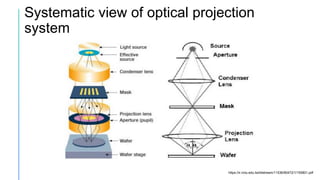
• An optical system focuses on the light
source and reduce mask image for
exposure on the surface.
• Some distance between mask and wafer.
• System focus to insert image of mask on
wafer.
• Not a single step revealing process.
Systematic view of optical projection
system
https://ir.nctu.edu.tw/bitstream/11536/80472/1/155801.pdf
Types of
projection
printing
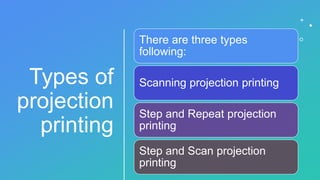
There are three types
following:
Scanning projection printing
Step and Repeat projection
printing
Step and Scan projection
printing
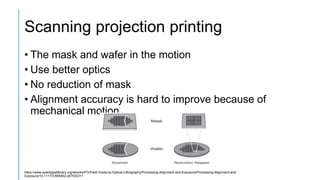
Scanning projection printing
• The mask and wafer in the motion
• Use better optics
• No reduction of mask
• Alignment accuracy is hard to improve because of
mechanical motion
https://www.spiedigitallibrary.org/ebooks/FG/Field-Guide-to-Optical-Lithography/Processing-Alignment-and-Exposure/Processing-Alignment-and-
Exposure/10.1117/3.665802.p6?SSO=1
Step and Repeat projection printing
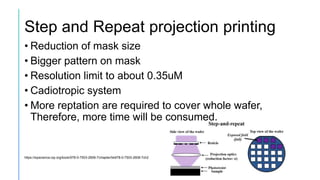
• Reduction of mask size
• Bigger pattern on mask
• Resolution limit to about 0.35uM
• Cadiotropic system
• More reptation are required to cover whole wafer,
Therefore, more time will be consumed.
https://iopscience.iop.org/book/978-0-7503-2608-7/chapter/bk978-0-7503-2608-7ch2
Step and Scan projection printing
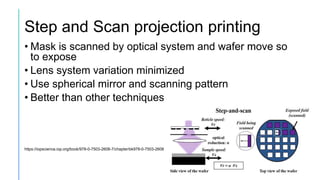
• Mask is scanned by optical system and wafer move so
to expose
• Lens system variation minimized
• Use spherical mirror and scanning pattern
• Better than other techniques
https://iopscience.iop.org/book/978-0-7503-2608-7/chapter/bk978-0-7503-2608-7ch2
Advantages
No damage to mask compare to contact lithography
High resolution compare to proximity lithography
Low production cost
Ease production of smaller dimension pattern
Improved mass production
Conclusio
n
Smaller resolution
Lens system reduces
diffraction error
Decreasing wavelength and
increasing NA good resolution
Features smaller than 100nm
achieved in production line
THANK
YOU!

Projection lithography

  • 1.
  • 2.
    CONTENTS • INTRODUCTION • SYSTEMATICFIGURE • TYPES OF PROJECTION PRINTING • ADVANTAGES • CONCLUSION
  • 3.
    Introduction • Development liesbetween in mid 1980’s. • An optical system focuses on the light source and reduce mask image for exposure on the surface. • Some distance between mask and wafer. • System focus to insert image of mask on wafer. • Not a single step revealing process.
  • 4.
    Systematic view ofoptical projection system https://ir.nctu.edu.tw/bitstream/11536/80472/1/155801.pdf
  • 5.
    Types of projection printing There arethree types following: Scanning projection printing Step and Repeat projection printing Step and Scan projection printing
  • 6.
    Scanning projection printing •The mask and wafer in the motion • Use better optics • No reduction of mask • Alignment accuracy is hard to improve because of mechanical motion https://www.spiedigitallibrary.org/ebooks/FG/Field-Guide-to-Optical-Lithography/Processing-Alignment-and-Exposure/Processing-Alignment-and- Exposure/10.1117/3.665802.p6?SSO=1
  • 7.
    Step and Repeatprojection printing • Reduction of mask size • Bigger pattern on mask • Resolution limit to about 0.35uM • Cadiotropic system • More reptation are required to cover whole wafer, Therefore, more time will be consumed. https://iopscience.iop.org/book/978-0-7503-2608-7/chapter/bk978-0-7503-2608-7ch2
  • 8.
    Step and Scanprojection printing • Mask is scanned by optical system and wafer move so to expose • Lens system variation minimized • Use spherical mirror and scanning pattern • Better than other techniques https://iopscience.iop.org/book/978-0-7503-2608-7/chapter/bk978-0-7503-2608-7ch2
  • 9.
    Advantages No damage tomask compare to contact lithography High resolution compare to proximity lithography Low production cost Ease production of smaller dimension pattern Improved mass production
  • 10.
    Conclusio n Smaller resolution Lens systemreduces diffraction error Decreasing wavelength and increasing NA good resolution Features smaller than 100nm achieved in production line
  • 11.