IMMUNIZATION
Dr Lipilekha Patnaik
Professor, Community Medicine
Institute of Medical Sciences & SUM Hospital
Siksha ‘O’ Anusandhan deemed to be University
Bhubaneswar, Odisha
Email- lipilekhapatnaik@soa.ac.in
SESSION OUTLINE
• History
• What is immunization
• Why immunization
• How vaccine works
• Types of Vaccines
• Universal Immunization Programme
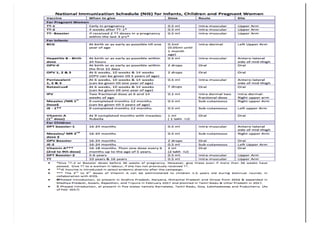
• National Immunization schedule
• Cold chain and vaccines
• Mission Indradhanush
• Achievements
BEGINNING OF VACCINATION
• Six Killer disease
• • Poliomyelitis, • Tuberculosis, • Diphtheria,
• • Pertussis, • Tetanus
• Measles
• In 1796, Jenner took pus from the hand of a
milkmaid with cowpox, scratched it into the arm
of an 8-year-old boy.
• Six weeks later inoculated the boy with
smallpox, afterwards observing that he did not
catch smallpox.
• Jenner extended his studies and in 1798
reported that his vaccine was safe in children
and adults.
Contd..
IMMUNIZATION
• Immunization is a process of protecting an
individual from a disease through introduction of
live attenuated, killed or organisms or antibodies in
the individual system.
• Immunization is the process of protecting an
individual by active or passive method.
• The immunizing agents are
Vaccines, Immunoglobulins and antisera
ACTIVE VS PASSIVE IMMUNIZATION
Active
§ Killed or live attenuated
organism injectedwhich
can induce immune
response
§ Long term
§ Immune system plays role
§ Ex-Hepatitis B vaccine,
DPT, Inactivated polio
vaccine, Measles-rubella
(MMR) combined vaccine
Passive
• Transfer of antibodies
• Short term
• No role of immune system
• Ex- Anti Tetanus, serum,
Anti Rabies
immunoglobulin etc
WHY IMMUNIZATION
• Prevention of deadly and debilitating
diseases.
• Keeps child from suffering through a
preventable illness.
• Less doctor visits
• No hospitalization
HOW VACCINE WORKS
• Development of active immunity,Humoral or cell mediated or
both.
• Humoral immunity - by secretion of antiobodies from B- cells.
• Cell mediated immunity - mediated byT- cells. Eg. In BCG,CMI &
Delayed type of hypersensitivity.
• Education of reticuloendothelial system of body and production
of memory cells or primed cells by both B & T cells.That is
devolopment of immunobiological memory.
COMMUNICABLE DISEASES AND
VACCINES AVAILABLE
• TB – BCG
• Measle, Mumps, Rubella - MMR
• Chicken Pox - Varicella
• Diptheria, Tetanus, Pertussis (aka Whooping Cough) - DPT
• Hepatitis (A and B) – HepA, HepB
• Polio – OPV, IPV
• Rotavirus – RVV
• Pneumoccus– PCV
• Haemophilusinfluenzae B- Hib
TYPES OF VACCINES
• Live, attenuated vaccines
• Inactivated vaccines
• Subunit vaccines
• Toxoids
LIVE VACCINES
• Live, attenuated vaccines contain a version of the
living microbe that has been weakened in the lab
so it can’t cause disease.
• Because a live, attenuated vaccine is the closest
thing to a natural infection, these vaccines are
good “teachers” of the immune system.
• Example: Vaccines against polio (OPV),
measles, mumps, rubella and chickenpox
INACTIVATED VACCINES
• Scientists produceinactivated vaccines by killing
the disease-causing microbe with chemicals, heat,
or radiation. Such vaccines are more stable and
safer than live vaccines.
• Because dead microbes can’t mutate back to their
disease-causing state.
• Example:Vaccines against influenza, inactivated
polio vaccine, hepatitis A etc.
TOXOIDS
• For bacteria that secrete toxins, or harmful
chemicals, a toxoid might be the answer.
• These vaccines are used when a bacterial toxin is
the main cause of illness.
• Scientists have found that they can inactivate toxins
by treating them with formalin. Such “detoxified”
toxins, called toxoids, are safe for use in vaccines.
• Example: Diphtheria,Tetanus toxoid
SUBUNIT VACCINE
• Instead of the entire microbe, subunit vaccines
include only the antigens that best stimulate the
immune system.
• Because subunit vaccines contain only the
essential antigens and not all the other molecules
that make up the microbe.
• Example: Plague immunization.
CELLULAR FRACTIONS
• Meningococcal vaccine from the polysaccharide
antigen of the cell wall.
• Pneumococcal vaccine from the polysaccharide
capsule of the organism.
COMBINATIONS
The aim is to
– simplify administration.
- reduce costs
-minimise the no. of contacts with the health
system.
Eg. DPT, DT, MMR, DPT& Hep.B, DPT, Hep B &
Hib, Hep A & B etc.
MAJOR CONSTITUENTS OF VACCINE
1) Active immunizing antigens-
• Live virus, killed bacteria, Toxoids
2) Suspending fluid-
• Sterile water, saline or tissue culture fluid.
3) Preservatives, stabilizers, & antibiotics-
• Thiomersal. Neomycin, kanamycin.
4) Adjuvants- Al salts frequently used.
UNIVERSAL IMMUNIZATION PROGRAMME
• In 1974, Expanded program of Immunization (EPI) organized
by WHO
• It was called Expanded because:
• Adding more disease controlling antigens of vaccination
schedules.
• Extending coverage to all corners of a country.
• On 19 November 1985, GOI renamed EPI program, modifying
the schedule as ‘Universal Immunization Program’
• ‘Universal’immunization is, therefore, best interpreted as
implying the ideal that no child should be denied immunization
against tuberculosis, diphtheria, whooping cough, tetanus,
polio and measles.
IF A DOSE IS MISSED……..
• Give the dose at the next opportunity irrespective of the
time gap
• Do not start the schedule all over again
TETANUS TOXOID
• Intramuscular– upper arm – 0.5 ml
• Pregnancy – 2 doses - 1st dose as early as possible and second
dose after 4 weeks of first dose and before 36 weeks of
pregnancy
• TT booster for both boys and girls at 10 yearsand 16 years
• Primary course of immunization consists of 2 doses of tetanus
toxoid at intervalsof 1-2 months.
• The booster dose should be given a year after the initial doses.
• It should be stored between 4 and 10 deg C.
BCG
¨ WHO recommended Danish 1331 strain to be used.
¨ Initial dose birth or as early as possible till one year of age
¨ 0.1 ml (0.05ml until one month of age)
¨ Intra-dermal
¨ Left upper arm
¨ Freeze dried is more stable. Diluent is Normal saline.
HEPATITIS B
• Birth dose – within 24 hours of birth
• 0.5 ml
• Intramuscular
• Antero-lateral aspect of mid-thigh
• Rest three doses at 6 weeks, 10 weeks and 14 weeks
• It should be stored at 2 to 8 deg C.
• 1 ml in adults, 05ml in children <10 yrs, given IM. Mostly used 0,1,6 m schedule.
ORAL POLIO VACCINE
¨ Zero dose – at birth
¨ 2 drops
¨ Oral
¨ First, second and third doses at 6,10 and 14 weeks with Pentavalent-1, 2 and 3
¨ OPV booster with DPT booster at 16-24 months
PENTAVALENT VACCINE
• Simultaneous immunization againstdiphtheria, Pertuisis & Tetanus,
Hep B, Hib.
• Stored at 4-8 degree C.
• Given 0.5 ml IM at anterolat. aspect of thigh.
• Primary 3 doses with a booster in 16 -24 months. DT 5-6 yrs.
• C/I –progressive neurological diseases.
ROTAVIRAL VACCINE
• 3 doses given in 6th, 10th and 14th weeks.
• Can be given till one year of age
• G9P human strain.
• Dose - 5 drops/0.5 ml orally
• for prevention of diarrhoea among infants due to rotavirus.
IPV
• 2 fractional doses given in 6th and 14th weeks.
• Dose – 0.1 ml
• Given intradermally in Right upper arm
JAPANESE ENCEPHALITIS
• SA 14-14-2 vaccine
• 0.5 ml, 2 doses
• 9 months and16-24 months
• Subcutaneous
• Left upper arm
MR VACCINE
• Bivalent Live atteunated against measles and rubella.
• Given 0.5 ml SC at 9-12 and 16-24 months.
• Stored 2-8 deg C
• Strain- Measles-Edmonstorn-zagreb, Rubella- Wilstar RA27/3
• Reactions- Fever, Resp. symp.s, Lymphadenitis or parotitis
DPT
• Primary doses were in pentavalent vaccine.
• One booster at 16-24 m with OPV booster (antero-lateral side of mid-thigh) and
second booster at 5-6 years (upper arm)
• 0.5 ml
• Intra-muscular
VITAMIN A
• 1st dose – 1 ml (1 IU) - along-with Measles first dose - Oral
• Subsequent 8 doses (2 ml or 2 lakh IU) every six months till 5 years of age starting
with DPT first booster at 16-24 months
• Use only plastic spoon provided withVitamin A solution
Vaccines
and
Cold Chain
VACCINES
¨ Live attenuated – BCG,Measles and OPV
¨ Inactivated killed –Whole–cell pertussis,hepatitis B
¨ Toxoid – Diphtheria,Tetanus
¨ All vaccines should be stored at plus 2 to plus 8 degrees
ideally in Ice Lined Refrigerators.
¨ BCG and Measles vaccines are in powder form and
come with diluents. Reconstitution is needed before
use.
¨ Use reconstituted BCG and Measles vaccines within 4
hours of reconstitution and JE within 2 hours of
reconstitution if kept at +2 to +8 degrees
Cold
WHY HAVE THE COLD CHAIN?
If vaccines are exposed to excessive
they may lose their potency or effectiveness.
Heat
Light
HEAT DAMAGE
• Heat damage is cumulative effect
• Reconstituted vaccine is most sensitive to heat
and light.
• Measles and BCG vaccines should not be used 4
hrs after reconstitution and JE 2 hrs after
reconstitution
• Temperature of diluents & vaccine must be same
during reconstitution
HEAT SENSITIVITY
• BCG (after reconstitution)
• OPV
• Measles (before and after reconstitution)
• DPT
• BCG (before reconstitution)
• DT
• TT
• HepB
LEAST SENSITIVE
MOST SENSITIVE
SENSITIVITY FROM FREEZING
• Hep B
• DPT
• DT
• TT
LEAST SENSITIVE
MOST SENSITIVE
COLD CHAIN
• System of storage & transport of vaccines at low temp. from the manufacturer to the
actual vaccination site.
Manufacturer
Airport
State/Region
District store
Health centre
Outreach
Subcentre
COLD CHAIN
• Walk-in-cold rooms-at regional levels.
• Deep freezers-for making ice packs and storage of OPV.
• Ice-lined refrigerators-at PHC level.
REMEMBER
• All vaccines tend to lose potency on exposure
to heat above +80 C
• Some vaccines (Hep B,TT,DPT) lose potency
when exposed to freezing temperatures
• Some vaccines are sensitive to light (BCG, Measles).
• The damage is irreversible
• Physical appearance of the vaccine may remain
unchanged but potency might be lost.
VACCINE CARRIERS
• Used for carrying vaccines (16-20
vials) and diluents from PHC to the
outreach session sites.
• With 4 conditioned icepacks maintain
inside temperature of 2-80C for 12
hours.
• Close the lid of the carrier tightly.
• Never use any day carriers with 2
icepacks or thermos flask for
carrying vaccines.
USABLE AND UNUSABLE STAGES OF VVM
MISSION INDRADHANUSH
• The Government of India launched Mission Indradhanushon
25th December 2014,to cover children who are either
unvaccinatedor partially vaccinated against seven vaccine
preventable diseases,i.e., diphtheria,whoopingcough,tetanus,
polio,tuberculosis,measles and hepatitis B.
• The goal is to vaccinate all less than 2 years and under-fiveson
demand by the year 2020.
• The drive was througha “catch-up” campaign mode. The
mission was technically supported byWHO,UNICEF, Rotary
International and otherdonorpartners.
ACHIEVEMENTS:
• The biggest achievementof the immunization program is the
eradication of small pox.
• One more significant milestoneis that India is free of
Poliomyelitis caused by Wild Polio Virus (WPV) .
• Vaccination has contributedsignificantly to the declinein the
cases and deaths due to the Vaccine Preventable Diseases (VPDs).
OPTIONAL VACCINES
• Pneumococcal vaccine
• Typhoid vaccine
• MMR vaccine
• Hepatitis A vaccine
• Chicken pox vaccine
• Flu vaccine
• Meningococcal vaccine
VACCINES FOR ADULTS
• HepatitisA
• Hepatitis B
• Chicken pox vaccine
• Human Papilloma Virus vaccine
• Flu vaccine
• Pneumococcalvaccine
• Meningococcalvaccine
Immunization
Immunization
Immunization

Immunization

  • 1.
    IMMUNIZATION Dr Lipilekha Patnaik Professor,Community Medicine Institute of Medical Sciences & SUM Hospital Siksha ‘O’ Anusandhan deemed to be University Bhubaneswar, Odisha Email- lipilekhapatnaik@soa.ac.in
  • 6.
    SESSION OUTLINE • History •What is immunization • Why immunization • How vaccine works • Types of Vaccines • Universal Immunization Programme • National Immunization schedule • Cold chain and vaccines • Mission Indradhanush • Achievements
  • 8.
  • 9.
    • Six Killerdisease • • Poliomyelitis, • Tuberculosis, • Diphtheria, • • Pertussis, • Tetanus • Measles • In 1796, Jenner took pus from the hand of a milkmaid with cowpox, scratched it into the arm of an 8-year-old boy. • Six weeks later inoculated the boy with smallpox, afterwards observing that he did not catch smallpox. • Jenner extended his studies and in 1798 reported that his vaccine was safe in children and adults. Contd..
  • 11.
    IMMUNIZATION • Immunization isa process of protecting an individual from a disease through introduction of live attenuated, killed or organisms or antibodies in the individual system. • Immunization is the process of protecting an individual by active or passive method. • The immunizing agents are Vaccines, Immunoglobulins and antisera
  • 12.
    ACTIVE VS PASSIVEIMMUNIZATION Active § Killed or live attenuated organism injectedwhich can induce immune response § Long term § Immune system plays role § Ex-Hepatitis B vaccine, DPT, Inactivated polio vaccine, Measles-rubella (MMR) combined vaccine Passive • Transfer of antibodies • Short term • No role of immune system • Ex- Anti Tetanus, serum, Anti Rabies immunoglobulin etc
  • 13.
    WHY IMMUNIZATION • Preventionof deadly and debilitating diseases. • Keeps child from suffering through a preventable illness. • Less doctor visits • No hospitalization
  • 18.
    HOW VACCINE WORKS •Development of active immunity,Humoral or cell mediated or both. • Humoral immunity - by secretion of antiobodies from B- cells. • Cell mediated immunity - mediated byT- cells. Eg. In BCG,CMI & Delayed type of hypersensitivity. • Education of reticuloendothelial system of body and production of memory cells or primed cells by both B & T cells.That is devolopment of immunobiological memory.
  • 19.
    COMMUNICABLE DISEASES AND VACCINESAVAILABLE • TB – BCG • Measle, Mumps, Rubella - MMR • Chicken Pox - Varicella • Diptheria, Tetanus, Pertussis (aka Whooping Cough) - DPT • Hepatitis (A and B) – HepA, HepB • Polio – OPV, IPV • Rotavirus – RVV • Pneumoccus– PCV • Haemophilusinfluenzae B- Hib
  • 20.
    TYPES OF VACCINES •Live, attenuated vaccines • Inactivated vaccines • Subunit vaccines • Toxoids
  • 21.
    LIVE VACCINES • Live,attenuated vaccines contain a version of the living microbe that has been weakened in the lab so it can’t cause disease. • Because a live, attenuated vaccine is the closest thing to a natural infection, these vaccines are good “teachers” of the immune system. • Example: Vaccines against polio (OPV), measles, mumps, rubella and chickenpox
  • 22.
    INACTIVATED VACCINES • Scientistsproduceinactivated vaccines by killing the disease-causing microbe with chemicals, heat, or radiation. Such vaccines are more stable and safer than live vaccines. • Because dead microbes can’t mutate back to their disease-causing state. • Example:Vaccines against influenza, inactivated polio vaccine, hepatitis A etc.
  • 23.
    TOXOIDS • For bacteriathat secrete toxins, or harmful chemicals, a toxoid might be the answer. • These vaccines are used when a bacterial toxin is the main cause of illness. • Scientists have found that they can inactivate toxins by treating them with formalin. Such “detoxified” toxins, called toxoids, are safe for use in vaccines. • Example: Diphtheria,Tetanus toxoid
  • 24.
    SUBUNIT VACCINE • Insteadof the entire microbe, subunit vaccines include only the antigens that best stimulate the immune system. • Because subunit vaccines contain only the essential antigens and not all the other molecules that make up the microbe. • Example: Plague immunization.
  • 25.
    CELLULAR FRACTIONS • Meningococcalvaccine from the polysaccharide antigen of the cell wall. • Pneumococcal vaccine from the polysaccharide capsule of the organism.
  • 26.
    COMBINATIONS The aim isto – simplify administration. - reduce costs -minimise the no. of contacts with the health system. Eg. DPT, DT, MMR, DPT& Hep.B, DPT, Hep B & Hib, Hep A & B etc.
  • 27.
    MAJOR CONSTITUENTS OFVACCINE 1) Active immunizing antigens- • Live virus, killed bacteria, Toxoids 2) Suspending fluid- • Sterile water, saline or tissue culture fluid. 3) Preservatives, stabilizers, & antibiotics- • Thiomersal. Neomycin, kanamycin. 4) Adjuvants- Al salts frequently used.
  • 28.
    UNIVERSAL IMMUNIZATION PROGRAMME •In 1974, Expanded program of Immunization (EPI) organized by WHO • It was called Expanded because: • Adding more disease controlling antigens of vaccination schedules. • Extending coverage to all corners of a country. • On 19 November 1985, GOI renamed EPI program, modifying the schedule as ‘Universal Immunization Program’ • ‘Universal’immunization is, therefore, best interpreted as implying the ideal that no child should be denied immunization against tuberculosis, diphtheria, whooping cough, tetanus, polio and measles.
  • 30.
    IF A DOSEIS MISSED…….. • Give the dose at the next opportunity irrespective of the time gap • Do not start the schedule all over again
  • 31.
    TETANUS TOXOID • Intramuscular–upper arm – 0.5 ml • Pregnancy – 2 doses - 1st dose as early as possible and second dose after 4 weeks of first dose and before 36 weeks of pregnancy • TT booster for both boys and girls at 10 yearsand 16 years • Primary course of immunization consists of 2 doses of tetanus toxoid at intervalsof 1-2 months. • The booster dose should be given a year after the initial doses. • It should be stored between 4 and 10 deg C.
  • 32.
    BCG ¨ WHO recommendedDanish 1331 strain to be used. ¨ Initial dose birth or as early as possible till one year of age ¨ 0.1 ml (0.05ml until one month of age) ¨ Intra-dermal ¨ Left upper arm ¨ Freeze dried is more stable. Diluent is Normal saline.
  • 33.
    HEPATITIS B • Birthdose – within 24 hours of birth • 0.5 ml • Intramuscular • Antero-lateral aspect of mid-thigh • Rest three doses at 6 weeks, 10 weeks and 14 weeks • It should be stored at 2 to 8 deg C. • 1 ml in adults, 05ml in children <10 yrs, given IM. Mostly used 0,1,6 m schedule.
  • 34.
    ORAL POLIO VACCINE ¨Zero dose – at birth ¨ 2 drops ¨ Oral ¨ First, second and third doses at 6,10 and 14 weeks with Pentavalent-1, 2 and 3 ¨ OPV booster with DPT booster at 16-24 months
  • 35.
    PENTAVALENT VACCINE • Simultaneousimmunization againstdiphtheria, Pertuisis & Tetanus, Hep B, Hib. • Stored at 4-8 degree C. • Given 0.5 ml IM at anterolat. aspect of thigh. • Primary 3 doses with a booster in 16 -24 months. DT 5-6 yrs. • C/I –progressive neurological diseases.
  • 36.
    ROTAVIRAL VACCINE • 3doses given in 6th, 10th and 14th weeks. • Can be given till one year of age • G9P human strain. • Dose - 5 drops/0.5 ml orally • for prevention of diarrhoea among infants due to rotavirus.
  • 37.
    IPV • 2 fractionaldoses given in 6th and 14th weeks. • Dose – 0.1 ml • Given intradermally in Right upper arm
  • 38.
    JAPANESE ENCEPHALITIS • SA14-14-2 vaccine • 0.5 ml, 2 doses • 9 months and16-24 months • Subcutaneous • Left upper arm
  • 39.
    MR VACCINE • BivalentLive atteunated against measles and rubella. • Given 0.5 ml SC at 9-12 and 16-24 months. • Stored 2-8 deg C • Strain- Measles-Edmonstorn-zagreb, Rubella- Wilstar RA27/3 • Reactions- Fever, Resp. symp.s, Lymphadenitis or parotitis
  • 40.
    DPT • Primary doseswere in pentavalent vaccine. • One booster at 16-24 m with OPV booster (antero-lateral side of mid-thigh) and second booster at 5-6 years (upper arm) • 0.5 ml • Intra-muscular
  • 41.
    VITAMIN A • 1stdose – 1 ml (1 IU) - along-with Measles first dose - Oral • Subsequent 8 doses (2 ml or 2 lakh IU) every six months till 5 years of age starting with DPT first booster at 16-24 months • Use only plastic spoon provided withVitamin A solution
  • 42.
  • 43.
    VACCINES ¨ Live attenuated– BCG,Measles and OPV ¨ Inactivated killed –Whole–cell pertussis,hepatitis B ¨ Toxoid – Diphtheria,Tetanus ¨ All vaccines should be stored at plus 2 to plus 8 degrees ideally in Ice Lined Refrigerators. ¨ BCG and Measles vaccines are in powder form and come with diluents. Reconstitution is needed before use. ¨ Use reconstituted BCG and Measles vaccines within 4 hours of reconstitution and JE within 2 hours of reconstitution if kept at +2 to +8 degrees
  • 44.
    Cold WHY HAVE THECOLD CHAIN? If vaccines are exposed to excessive they may lose their potency or effectiveness. Heat Light
  • 45.
    HEAT DAMAGE • Heatdamage is cumulative effect • Reconstituted vaccine is most sensitive to heat and light. • Measles and BCG vaccines should not be used 4 hrs after reconstitution and JE 2 hrs after reconstitution • Temperature of diluents & vaccine must be same during reconstitution
  • 46.
    HEAT SENSITIVITY • BCG(after reconstitution) • OPV • Measles (before and after reconstitution) • DPT • BCG (before reconstitution) • DT • TT • HepB LEAST SENSITIVE MOST SENSITIVE
  • 47.
    SENSITIVITY FROM FREEZING •Hep B • DPT • DT • TT LEAST SENSITIVE MOST SENSITIVE
  • 48.
    COLD CHAIN • Systemof storage & transport of vaccines at low temp. from the manufacturer to the actual vaccination site. Manufacturer Airport State/Region District store Health centre Outreach Subcentre
  • 49.
    COLD CHAIN • Walk-in-coldrooms-at regional levels. • Deep freezers-for making ice packs and storage of OPV. • Ice-lined refrigerators-at PHC level.
  • 50.
    REMEMBER • All vaccinestend to lose potency on exposure to heat above +80 C • Some vaccines (Hep B,TT,DPT) lose potency when exposed to freezing temperatures • Some vaccines are sensitive to light (BCG, Measles). • The damage is irreversible • Physical appearance of the vaccine may remain unchanged but potency might be lost.
  • 51.
    VACCINE CARRIERS • Usedfor carrying vaccines (16-20 vials) and diluents from PHC to the outreach session sites. • With 4 conditioned icepacks maintain inside temperature of 2-80C for 12 hours. • Close the lid of the carrier tightly. • Never use any day carriers with 2 icepacks or thermos flask for carrying vaccines.
  • 52.
    USABLE AND UNUSABLESTAGES OF VVM
  • 54.
    MISSION INDRADHANUSH • TheGovernment of India launched Mission Indradhanushon 25th December 2014,to cover children who are either unvaccinatedor partially vaccinated against seven vaccine preventable diseases,i.e., diphtheria,whoopingcough,tetanus, polio,tuberculosis,measles and hepatitis B. • The goal is to vaccinate all less than 2 years and under-fiveson demand by the year 2020. • The drive was througha “catch-up” campaign mode. The mission was technically supported byWHO,UNICEF, Rotary International and otherdonorpartners.
  • 56.
    ACHIEVEMENTS: • The biggestachievementof the immunization program is the eradication of small pox. • One more significant milestoneis that India is free of Poliomyelitis caused by Wild Polio Virus (WPV) . • Vaccination has contributedsignificantly to the declinein the cases and deaths due to the Vaccine Preventable Diseases (VPDs).
  • 57.
    OPTIONAL VACCINES • Pneumococcalvaccine • Typhoid vaccine • MMR vaccine • Hepatitis A vaccine • Chicken pox vaccine • Flu vaccine • Meningococcal vaccine
  • 58.
    VACCINES FOR ADULTS •HepatitisA • Hepatitis B • Chicken pox vaccine • Human Papilloma Virus vaccine • Flu vaccine • Pneumococcalvaccine • Meningococcalvaccine