GOOD
EVENING
PRESENTED BY,
MRS. B.kalPaNa, M.SC (N)
aSSo. PRoFESSoR
DEPT oF CoMMUNITY HEalTH NURSING
SREE NaRaYaNa NURSING CollEGE
NElloRE
Why?
Epidemiological studies are based on
sick and well people to determine the
crucial difference between those who get
disease and those who are
spared…………….
An epidemiological studies are
aimed to find…………….
 Nature and extent of the disease
 Causative agent
 Sources of infection
 Period of communicability
 Mode of transmission
 Susceptibility of population
 Incubation period
 Method of prevention and control
“ The epidemiological
investigation to health
problems involves the two
basic approaches”
Epidemiological approach
a. Asking questions
b. Making comparisons
a. Asking Questions
The key information can be approached
through a series of questions
Related to health events
 What are the actual and potential health
problems its manifestations and
characteristics?
 Who are affected, with reference to age,
sex, social class………?
 Where are they occur in terms of place?
 Which populations are increased at
risk?
 When does it happen in terms of day,
month, season etc……….?
 Why does it happen in terms of
contributing or causative factors?
 Which problems have declined?
 Which problems are increasing or have
the risk to increase?
Related to health action
 What can be done to reduce the problem
and its consequences?
 How can it be prevented in the future?
 What action should be taken by the
community to prevent and manage the
problem?
 Action taken by the health services?
 Action taken by other sectors?
 Where and for whom these activities
carried out?
 What resources are required in future?
 How are the activities to be organized?
 What difficulties may arise, and how it
has to overcome?
b. Making Comparisons
This approach is to make comparisons and
draw inferences.
Comparison may be made
between different population at a given time
eg. Rural with urban population
between sub group of population
eg. Male with female population
between various periods of observation
eg. Different seasons
• Case Counts
• Rates
• Ratios
• Proportions
Tools of
Measurement
Case Counts
 The case count refers to the
number of cases of a disease or
other health phenomenon being
studied
 eg Number of cases of Still births
 It Can be useful for allocation of
health resources
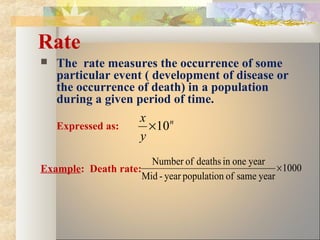
Rate
 The rate measures the occurrence of some
particular event ( development of disease or
the occurrence of death) in a population
during a given period of time.
Expressed as:
Example: Death rate:
n
y
x
10×
1000
yearsameofpopulationyear-Mid
yearoneindeathsofNumber
×
 A rate comprises the following
elements- Numerator,
denominator, time specification
and multiplier.
 The time specification is usually a
calendar year
 The rate is expressed per 1000 or
some other round figure like
100,000.
Various categories of rates
1. Crude rate: These are actual observation
rates. Eg: Birth rate, Death rate
Crude rates are un standardized rates
2. Specific rate: These are the actual
observed rates due to specific causes
(tuberculosis) occurring in specific groups
(age-sex) during specific time period
(annual, monthly, weekly)
3. Standardized rates: These are obtained
by direct or indirect method of
standardization
Eg: age and sex standardized rates
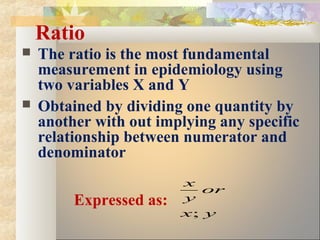
Ratio
 The ratio is the most fundamental
measurement in epidemiology using
two variables X and Y
 Obtained by dividing one quantity by
another with out implying any specific
relationship between numerator and
denominator
Expressed as:
yx
or
y
x
;
The number of children with
scabies at a certain time
The number of children with
malnutrition at a certain time
Other examples: Sex-ratio,
Doctor-population ratio,
Child-woman ratio
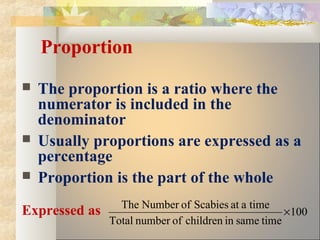
Proportion
 The proportion is a ratio where the
numerator is included in the
denominator
 Usually proportions are expressed as a
percentage
 Proportion is the part of the whole
Expressed as 100
timesameinchildrenofnumberTotal
timeaatScabiesofNumberThe
×
Numerator: It refers to the number of times
an event has occurred in a population
during specified time period.
It is a component of denominator
Denominator: It may be related to the
population or related to the total event
Related to population: Mid year population
Related to total events: Number of accidents
for 1000 vehicles
OUR ROLE
• Screening
• Notification
• Evaluation of Health
Services
• Management
• Prevention and control
References
ActivEpi CD-ROM; Kleinbaum
ActivEpi Companion Textbook;
Kleinbaum, Sullivan, Barker
Epidemiology in Medicine,
Hennekens
THANK U…

Epidemiological approach

  • 1.
    GOOD EVENING PRESENTED BY, MRS. B.kalPaNa,M.SC (N) aSSo. PRoFESSoR DEPT oF CoMMUNITY HEalTH NURSING SREE NaRaYaNa NURSING CollEGE NElloRE
  • 2.
    Why? Epidemiological studies arebased on sick and well people to determine the crucial difference between those who get disease and those who are spared…………….
  • 3.
    An epidemiological studiesare aimed to find…………….  Nature and extent of the disease  Causative agent  Sources of infection  Period of communicability  Mode of transmission  Susceptibility of population  Incubation period  Method of prevention and control
  • 4.
    “ The epidemiological investigationto health problems involves the two basic approaches” Epidemiological approach
  • 5.
    a. Asking questions b.Making comparisons
  • 6.
    a. Asking Questions Thekey information can be approached through a series of questions Related to health events  What are the actual and potential health problems its manifestations and characteristics?
  • 7.
     Who areaffected, with reference to age, sex, social class………?  Where are they occur in terms of place?  Which populations are increased at risk?  When does it happen in terms of day, month, season etc……….?
  • 8.
     Why doesit happen in terms of contributing or causative factors?  Which problems have declined?  Which problems are increasing or have the risk to increase?
  • 9.
    Related to healthaction  What can be done to reduce the problem and its consequences?  How can it be prevented in the future?  What action should be taken by the community to prevent and manage the problem?
  • 10.
     Action takenby the health services?  Action taken by other sectors?  Where and for whom these activities carried out?  What resources are required in future?  How are the activities to be organized?  What difficulties may arise, and how it has to overcome?
  • 11.
    b. Making Comparisons Thisapproach is to make comparisons and draw inferences. Comparison may be made between different population at a given time eg. Rural with urban population between sub group of population eg. Male with female population between various periods of observation eg. Different seasons
  • 12.
    • Case Counts •Rates • Ratios • Proportions Tools of Measurement
  • 13.
    Case Counts  Thecase count refers to the number of cases of a disease or other health phenomenon being studied  eg Number of cases of Still births  It Can be useful for allocation of health resources
  • 14.
    Rate  The ratemeasures the occurrence of some particular event ( development of disease or the occurrence of death) in a population during a given period of time. Expressed as: Example: Death rate: n y x 10× 1000 yearsameofpopulationyear-Mid yearoneindeathsofNumber ×
  • 15.
     A ratecomprises the following elements- Numerator, denominator, time specification and multiplier.  The time specification is usually a calendar year  The rate is expressed per 1000 or some other round figure like 100,000.
  • 16.
    Various categories ofrates 1. Crude rate: These are actual observation rates. Eg: Birth rate, Death rate Crude rates are un standardized rates 2. Specific rate: These are the actual observed rates due to specific causes (tuberculosis) occurring in specific groups (age-sex) during specific time period (annual, monthly, weekly)
  • 17.
    3. Standardized rates:These are obtained by direct or indirect method of standardization Eg: age and sex standardized rates
  • 18.
    Ratio  The ratiois the most fundamental measurement in epidemiology using two variables X and Y  Obtained by dividing one quantity by another with out implying any specific relationship between numerator and denominator Expressed as: yx or y x ;
  • 19.
    The number ofchildren with scabies at a certain time The number of children with malnutrition at a certain time Other examples: Sex-ratio, Doctor-population ratio, Child-woman ratio
  • 20.
    Proportion  The proportionis a ratio where the numerator is included in the denominator  Usually proportions are expressed as a percentage  Proportion is the part of the whole Expressed as 100 timesameinchildrenofnumberTotal timeaatScabiesofNumberThe ×
  • 21.
    Numerator: It refersto the number of times an event has occurred in a population during specified time period. It is a component of denominator Denominator: It may be related to the population or related to the total event Related to population: Mid year population Related to total events: Number of accidents for 1000 vehicles
  • 22.
    OUR ROLE • Screening •Notification • Evaluation of Health Services • Management • Prevention and control
  • 23.
    References ActivEpi CD-ROM; Kleinbaum ActivEpiCompanion Textbook; Kleinbaum, Sullivan, Barker Epidemiology in Medicine, Hennekens
  • 24.

Editor's Notes

  • #10 Answers to the above questions may provide clues to disease etiology, and help the epidemiologist to guide planning and evaluation
  • #12 By