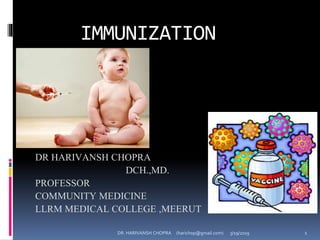

IMMUNIZATION
DR HARIVANSH CHOPRA
DCH.,MD.
PROFESSOR
COMMUNITY MEDICINE
LLRM MEDICAL COLLEGE ,MEERUT
DR. HARIVANSH CHOPRA (harichop@gmail.com) 3/19/2019 1
OBJECTIVES
1. To study what is
Immunization,history,
various schdedules and
programmes .
2. To study about passive
immunization inVPD
3. TO study how to
describe a vaccine
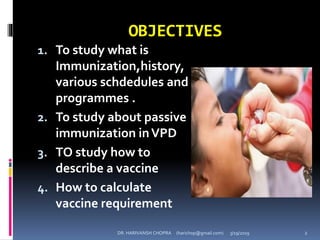
4. How to calculate
vaccine requirement
DR. HARIVANSH CHOPRA (harichop@gmail.com) 3/19/2019 2
IMMUNISATION
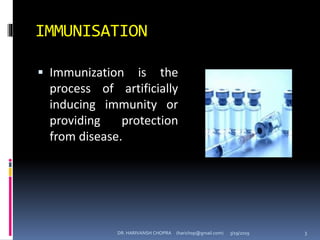
 Immunization is the
process of artificially
inducing immunity or
providing protection
from disease.
DR. HARIVANSH CHOPRA (harichop@gmail.com) 3/19/2019 3
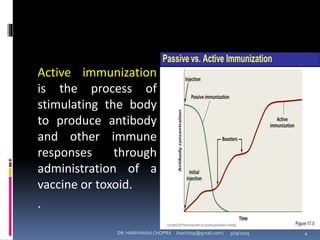
Active immunization
is the process of
stimulating the body
to produce antibody
and other immune
responses through
administration of a
vaccine or toxoid.
.
DR. HARIVANSH CHOPRA (harichop@gmail.com) 3/19/2019 4
DR. HARIVANSH CHOPRA (harichop@gmail.com)
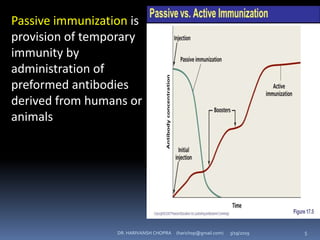
Passive immunization is
provision of temporary
immunity by
administration of
preformed antibodies
derived from humans or
animals
3/19/2019 5
Process of generation of
immunity after vaccination
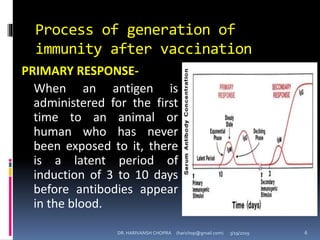
PRIMARY RESPONSE-
When an antigen is
administered for the first
time to an animal or
human who has never
been exposed to it, there
is a latent period of
induction of 3 to 10 days
before antibodies appear
in the blood.
DR. HARIVANSH CHOPRA (harichop@gmail.com) 3/19/2019 6
Process of generation of
immunity after vaccination
PRIMARY RESPONSE-
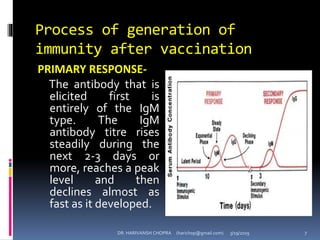
The antibody that is
elicited first is
entirely of the IgM
type. The IgM
antibody titre rises
steadily during the
next 2-3 days or
more, reaches a peak
level and then
declines almost as
fast as it developed.
DR. HARIVANSH CHOPRA (harichop@gmail.com) 3/19/2019 7
Process of generation of
immunity after vaccination
PRIMARY RESPONSE-
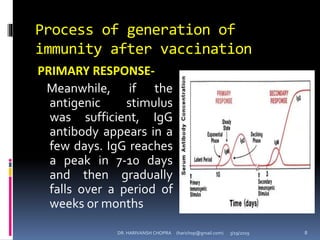
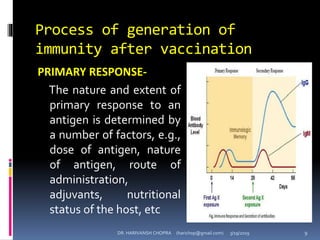
Meanwhile, if the
antigenic stimulus
was sufficient, IgG
antibody appears in a
few days. IgG reaches
a peak in 7-10 days
and then gradually
falls over a period of
weeks or months
DR. HARIVANSH CHOPRA (harichop@gmail.com) 3/19/2019 8
Process of generation of
immunity after vaccination
PRIMARY RESPONSE-
The nature and extent of
primary response to an
antigen is determined by
a number of factors, e.g.,
dose of antigen, nature
of antigen, route of
administration,
adjuvants, nutritional
status of the host, etc
DR. HARIVANSH CHOPRA (harichop@gmail.com) 3/19/2019 9
Process of generation of
immunity after vaccination
PRIMARY RESPONSE-
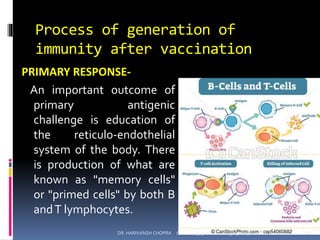
An important outcome of
primary antigenic
challenge is education of
the reticulo-endothelial
system of the body. There
is production of what are
known as "memory cells"
or "primed cells" by both B
andT lymphocytes.
DR. HARIVANSH CHOPRA (harichop@gmail.com) 3/19/2019 10
DR. HARIVANSH CHOPRA (harichop@gmail.com)
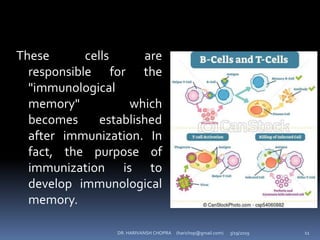
These cells are
responsible for the
"immunological
memory" which
becomes established
after immunization. In
fact, the purpose of
immunization is to
develop immunological
memory.
3/19/2019 11
SECONDARY (BOOSTER)
RESPONSE-
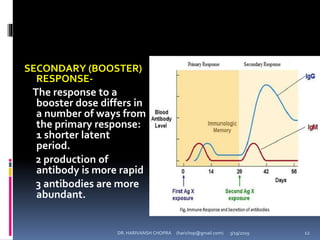
The response to a
booster dose differs in
a number of ways from
the primary response:
1 shorter latent
period.
2 production of
antibody is more rapid
3 antibodies are more
abundant.
DR. HARIVANSH CHOPRA (harichop@gmail.com) 3/19/2019 12
SECONDARY (BOOSTER)
RESPONSE-
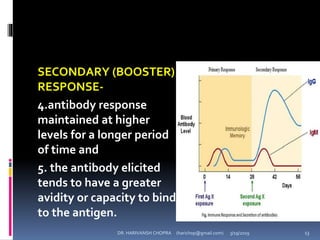
4.antibody response
maintained at higher
levels for a longer period
of time and
5. the antibody elicited
tends to have a greater
avidity or capacity to bind
to the antigen.
DR. HARIVANSH CHOPRA (harichop@gmail.com) 3/19/2019 13
Vaccine
Term derive from
“vaccae=cow”.
So immunization agent
is known as vaccine.
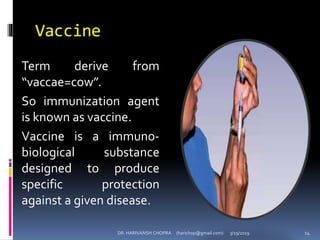
Vaccine is a immuno-
biological substance
designed to produce
specific protection
against a given disease.
DR. HARIVANSH CHOPRA (harichop@gmail.com) 3/19/2019 14
Type of vaccine
1.Live vaccine.
2.Inactivated or killed vaccine.
3.SUB UNITVACCINES
A.Toxoids .
B.Protein vaccine
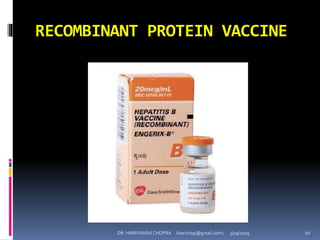
C.RECOMBINANT protein vaccine
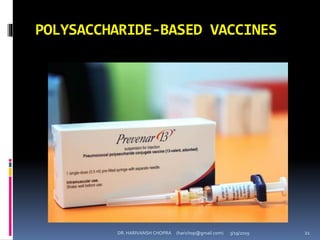
D.Polysaccharide-based vaccines
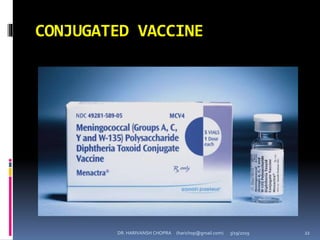
E.Conjugated vaccine
4.Combination
DR. HARIVANSH CHOPRA (harichop@gmail.com) 3/19/2019 15
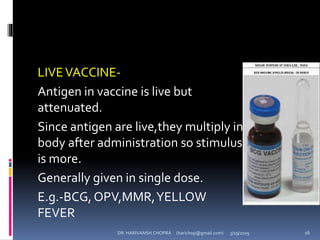
LIVEVACCINE-
Antigen in vaccine is live but
attenuated.
Since antigen are live,they multiply in
body after administration so stimulus
is more.
Generally given in single dose.
E.g.-BCG,OPV,MMR,YELLOW
FEVER
DR. HARIVANSH CHOPRA (harichop@gmail.com) 3/19/2019 16
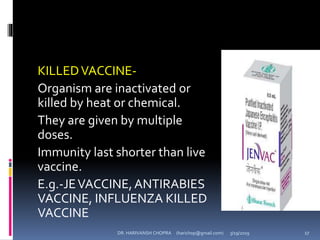
KILLEDVACCINE-
Organism are inactivated or
killed by heat or chemical.
They are given by multiple
doses.
Immunity last shorter than live
vaccine.
E.g.-JEVACCINE,ANTIRABIES
VACCINE, INFLUENZA KILLED
VACCINE
DR. HARIVANSH CHOPRA (harichop@gmail.com) 3/19/2019 17
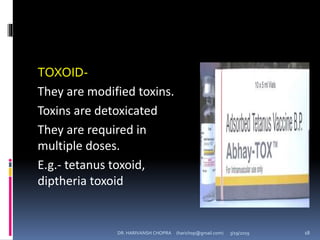
TOXOID-
They are modified toxins.
Toxins are detoxicated
They are required in
multiple doses.
E.g.- tetanus toxoid,
diptheria toxoid
DR. HARIVANSH CHOPRA (harichop@gmail.com) 3/19/2019 18
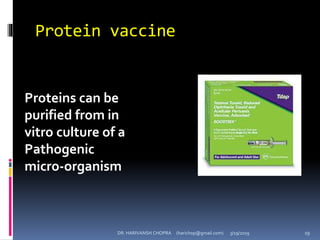
Protein vaccine
DR. HARIVANSH CHOPRA (harichop@gmail.com)
Proteins can be
purified from in
vitro culture of a
Pathogenic
micro-organism
3/19/2019 19
RECOMBINANT PROTEIN VACCINE
DR. HARIVANSH CHOPRA (harichop@gmail.com) 3/19/2019 20
POLYSACCHARIDE-BASED VACCINES
DR. HARIVANSH CHOPRA (harichop@gmail.com) 3/19/2019 21
CONJUGATED VACCINE
DR. HARIVANSH CHOPRA (harichop@gmail.com) 3/19/2019 22
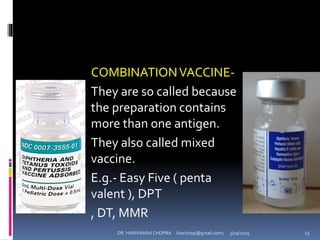
COMBINATIONVACCINE-
They are so called because
the preparation contains
more than one antigen.
They also called mixed
vaccine.
E.g.- Easy Five ( penta
valent ), DPT
, DT, MMR
DR. HARIVANSH CHOPRA (harichop@gmail.com) 3/19/2019 23
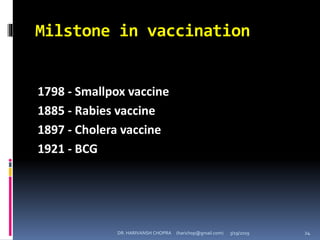
Milstone in vaccination
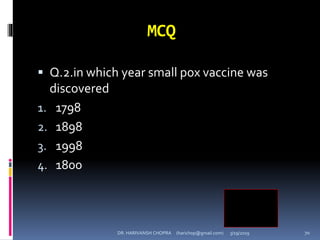
1798 - Smallpox vaccine
1885 - Rabies vaccine
1897 - Cholera vaccine
1921 - BCG
DR. HARIVANSH CHOPRA (harichop@gmail.com) 3/19/2019 24
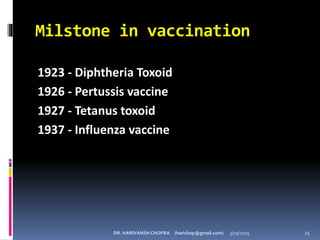
Milstone in vaccination
1923 - Diphtheria Toxoid
1926 - Pertussis vaccine
1927 - Tetanus toxoid
1937 - Influenza vaccine
DR. HARIVANSH CHOPRA (harichop@gmail.com) 3/19/2019 25
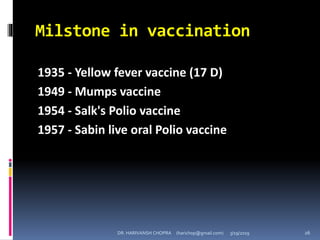
Milstone in vaccination
1935 - Yellow fever vaccine (17 D)
1949 - Mumps vaccine
1954 - Salk's Polio vaccine
1957 - Sabin live oral Polio vaccine
DR. HARIVANSH CHOPRA (harichop@gmail.com) 3/19/2019 26
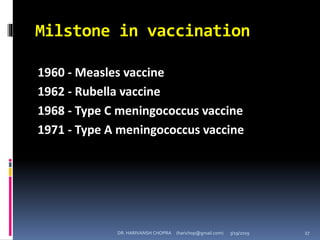
Milstone in vaccination
1960 - Measles vaccine
1962 - Rubella vaccine
1968 - Type C meningococcus vaccine
1971 - Type A meningococcus vaccine
DR. HARIVANSH CHOPRA (harichop@gmail.com) 3/19/2019 27
Milstone in vaccination
1980- smallpox declared eradicated from the
world.
1981- meningococcal polysaccharide vaccine,
group A,C,Y W135 combined ( Menomune ).
1982- hepatitis B vaccine.
1983- pneumococcal vaccine 23 valent.
1988- worldwide polio eradication initiative
launched.
DR. HARIVANSH CHOPRA (harichop@gmail.com) 3/19/2019 28
Milstone in vaccination
1990- the vaccine adverse reporting system (
VAERS ), a national programme monitoring the
safety of vaccine established.
1991- hepatitis B vaccine recommended for all
infant.
1991- acellular pertusis vaccine licensed for use
in older children aged 15 month to 6 year.
1993- JE vaccine.
2003- first adult immunisation schedule
introduced.
DR. HARIVANSH CHOPRA (harichop@gmail.com) 3/19/2019 29
Milstone in vaccination
 2004- Pediarix, a vaccine that combines the
DTaP, IPV & Hep B vaccines, into one shot , is
approved.
 2006- Gardasil, the first HPV vaccine is
approved.
 2008- Rotarix, a two dose rotavirus vaccine is
approved.
 2009- influenza- A ( H1N1 ) Vaccine approved.
DR. HARIVANSH CHOPRA (harichop@gmail.com) 3/19/2019 30
DR. HARIVANSH CHOPRA (harichop@gmail.com) 3/19/2019 31
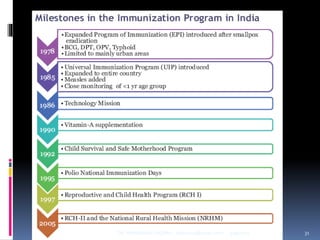
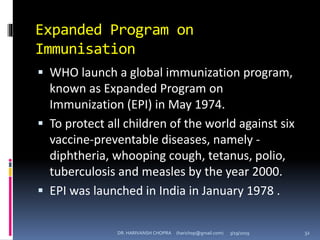
Expanded Program on
Immunisation
 WHO launch a global immunization program,
known as Expanded Program on
Immunization (EPI) in May 1974.
 To protect all children of the world against six
vaccine-preventable diseases, namely -
diphtheria, whooping cough, tetanus, polio,
tuberculosis and measles by the year 2000.
 EPI was launched in India in January 1978 .
DR. HARIVANSH CHOPRA (harichop@gmail.com) 3/19/2019 32
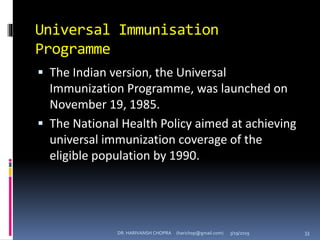
Universal Immunisation
Programme
 The Indian version, the Universal
Immunization Programme, was launched on
November 19, 1985.
 The National Health Policy aimed at achieving
universal immunization coverage of the
eligible population by 1990.
DR. HARIVANSH CHOPRA (harichop@gmail.com) 3/19/2019 33
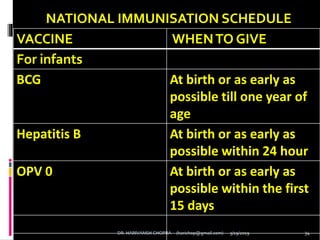
VACCINE WHENTO GIVE
For infants
BCG At birth or as early as
possible till one year of
age
Hepatitis B At birth or as early as
possible within 24 hour
OPV 0 At birth or as early as
possible within the first
15 days
NATIONAL IMMUNISATION SCHEDULE
DR. HARIVANSH CHOPRA (harichop@gmail.com) 3/19/2019 34
DR. HARIVANSH CHOPRA (harichop@gmail.com)
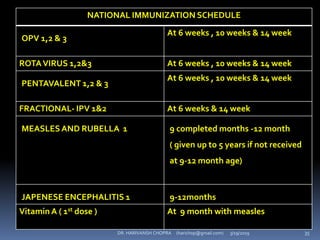
NATIONAL IMMUNIZATION SCHEDULE
OPV 1,2 & 3
At 6 weeks , 10 weeks & 14 week
ROTAVIRUS 1,2&3 At 6 weeks , 10 weeks & 14 week
PENTAVALENT 1,2 & 3
At 6 weeks , 10 weeks & 14 week
FRACTIONAL- IPV 1&2 At 6 weeks & 14 week
MEASLESAND RUBELLA 1 9 completed months -12 month
( given up to 5 years if not received
at 9-12 month age)
JAPENESE ENCEPHALITIS 1 9-12months
Vitamin A ( 1st dose ) At 9 month with measles
3/19/2019 35
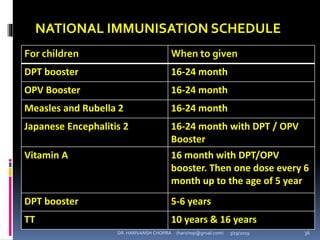
NATIONAL IMMUNISATION SCHEDULE
For children When to given
DPT booster 16-24 month
OPV Booster 16-24 month
Measles and Rubella 2 16-24 month
Japanese Encephalitis 2 16-24 month with DPT / OPV
Booster
Vitamin A 16 month with DPT/OPV
booster. Then one dose every 6
month up to the age of 5 year
DPT booster 5-6 years
TT 10 years & 16 years
DR. HARIVANSH CHOPRA (harichop@gmail.com) 3/19/2019 36
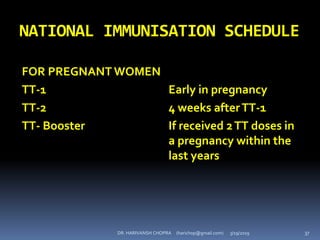
NATIONAL IMMUNISATION SCHEDULE
FOR PREGNANT WOMEN
TT-1
TT-2
TT- Booster
Early in pregnancy
4 weeks afterTT-1
If received 2TT doses in
a pregnancy within the
last years
DR. HARIVANSH CHOPRA (harichop@gmail.com) 3/19/2019 37
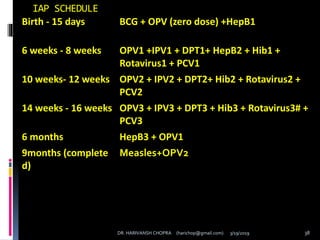
IAP SCHEDULE
Birth - 15 days BCG + OPV (zero dose) +HepB1
6 weeks - 8 weeks OPV1 +IPV1 + DPT1+ HepB2 + Hib1 +
Rotavirus1 + PCV1
10 weeks- 12 weeks OPV2 + IPV2 + DPT2+ Hib2 + Rotavirus2 +
PCV2
14 weeks - 16 weeks OPV3 + IPV3 + DPT3 + Hib3 + Rotavirus3# +
PCV3
6 months HepB3 + OPV1
9months (complete
d)
Measles+OPV2
DR. HARIVANSH CHOPRA (harichop@gmail.com) 3/19/2019 38
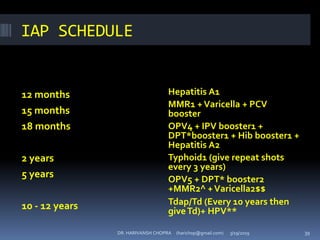
IAP SCHEDULE
12 months
15 months
18 months
2 years
5 years
10 - 12 years
Hepatitis A1
MMR1 +Varicella + PCV
booster
OPV4 + IPV booster1 +
DPT*booster1 + Hib booster1 +
Hepatitis A2
Typhoid1 (give repeat shots
every 3 years)
OPV5 + DPT* booster2
+MMR2^ +Varicella2$$
Tdap/Td (Every 10 years then
giveTd)+ HPV**
DR. HARIVANSH CHOPRA (harichop@gmail.com) 3/19/2019 39
Passive immunization in VPD
Passive immunization is a short-term expedient
useful only when exposure to infection has just
occurred or is imminent within the next few
days. The duration of immunity induced is short
and variable (1-6 weeks).
DR. HARIVANSH CHOPRA (harichop@gmail.com) 3/19/2019 40
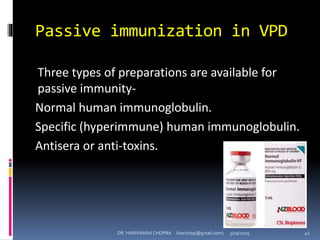
Passive immunization in VPD
Three types of preparations are available for
passive immunity-
Normal human immunoglobulin.
Specific (hyperimmune) human immunoglobulin.
Antisera or anti-toxins.
DR. HARIVANSH CHOPRA (harichop@gmail.com) 3/19/2019 41
Passive immunization is applied in following
vaccine preventable disease-
Diphtheria,
Tetanus,
Hepatitis B
Rabies
& Measles.
DR. HARIVANSH CHOPRA (harichop@gmail.com) 3/19/2019 42
DIPTHERIAANTITIOXIN-
DOSE:
Prophylactic: 500 to 2000 units by subcutaneous
or intramuscular injection;
Therapeutic: 10,000 to 30,000 units by
intramuscular injection or 40,000 to 100,000
units by intravenous injection in 2 divided doses
with an interval of 12 to 24 hours.
DR. HARIVANSH CHOPRA (harichop@gmail.com) 3/19/2019 43
DR. HARIVANSH CHOPRA
(harichop@gmail.com)
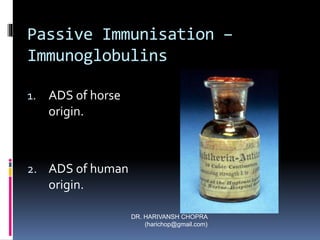
Passive Immunisation –
Immunoglobulins
1. ADS of horse
origin.
2. ADS of human
origin.
DR. HARIVANSH CHOPRA (harichop@gmail.com)
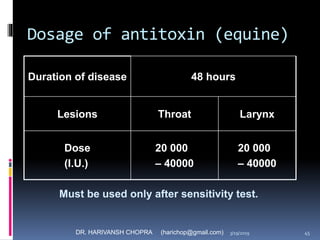
Dosage of antitoxin (equine)
Duration of disease 48 hours
Lesions Throat Larynx
Dose
(I.U.)
20 000
– 40000
20 000
– 40000
Must be used only after sensitivity test.
3/19/2019 45
DR. HARIVANSH CHOPRA (harichop@gmail.com)
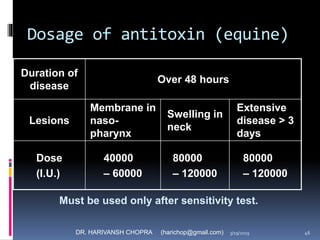
Dosage of antitoxin (equine)
Duration of
disease
Over 48 hours
Lesions
Membrane in
naso-
pharynx
Swelling in
neck
Extensive
disease > 3
days
Dose
(I.U.)
40000
– 60000
80000
– 120000
80000
– 120000
Must be used only after sensitivity test.
3/19/2019 46
DR. HARIVANSH CHOPRA (harichop@gmail.com)
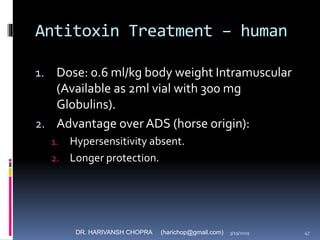
Antitoxin Treatment – human
1. Dose: 0.6 ml/kg body weight Intramuscular
(Available as 2ml vial with 300 mg
Globulins).
2. Advantage over ADS (horse origin):
1. Hypersensitivity absent.
2. Longer protection.
3/19/2019 47
MEASLES IMMUNOGLOBULIN (HUMAN )
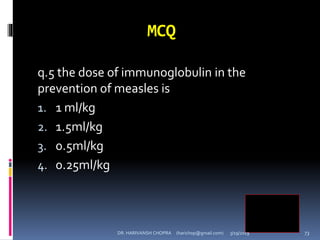
DOSE- recommended by WHO is 0.25 ml per kg
of body weight. It should be given within 3-4
days of exposure.
The person passively immunized should be given
live measles vaccine 8-12 weeks later.
DR. HARIVANSH CHOPRA (harichop@gmail.com) 3/19/2019 48
HEPATITIS B IMMUNOGLOBIN-
The recommended dose is 0.05 to 0.07 ml/kg of
body weight ; two doses should be given 30 days
apart . HBIG provides short-term passive
protection which lasts approximately 3 months .
Since the median incubation period is said to be
lower than 100 days , two doses of HBIG given
one month apart should suffice.
DR. HARIVANSH CHOPRA (harichop@gmail.com) 3/19/2019 49
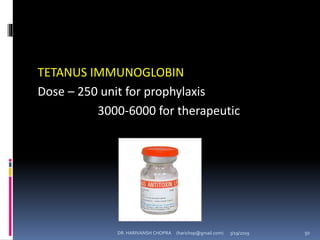
TETANUS IMMUNOGLOBIN
Dose – 250 unit for prophylaxis
3000-6000 for therapeutic
DR. HARIVANSH CHOPRA (harichop@gmail.com) 3/19/2019 50
HOW TO DESCRIBE A VACCINE
whenever one describe a vaccine it must be
done under the following heads
Type
Content
Dose
Time of administration
No of doses including boosters
DR. HARIVANSH CHOPRA (harichop@gmail.com) 3/19/2019 53
HOW TO DESCRIBE A VACCINE
Diluent if any
Time after reconstitution
Efficacy
Storage
Side effects
contraindications
DR. HARIVANSH CHOPRA (harichop@gmail.com) 3/19/2019 54
DR. HARIVANSH CHOPRA
(harichop@gmail.com)
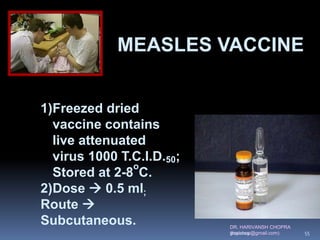
1)Freezed dried
vaccine contains
live attenuated
virus 1000 T.C.I.D.50;
Stored at 2-8
o
C.
2)Dose  0.5 ml;
Route 
Subcutaneous.
MEASLES VACCINE
3/19/2019 55
DR. HARIVANSH CHOPRA
(harichop@gmail.com)
3.Time of administration  9 months in India.
According to W.H.O if child is
malnourished,
1st dose is b/w 6-8 months;
2nd dose after 1 year.
4.Efficacy of Vaccine – 95%if given after one
year. At nine months -85%
5.Duration of immunity– Lifelong.
MEASLES VACCINE
3/19/2019 56
DR. HARIVANSH CHOPRA (harichop@gmail.com)
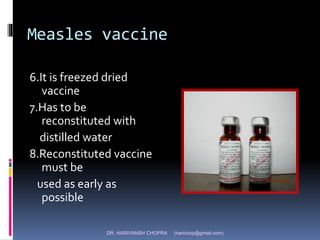
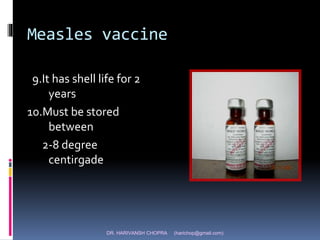
Measles vaccine
6.It is freezed dried
vaccine
7.Has to be
reconstituted with
distilled water
8.Reconstituted vaccine
must be
used as early as
possible
DR. HARIVANSH CHOPRA (harichop@gmail.com)
Measles vaccine
9.It has shell life for 2
years
10.Must be stored
between
2-8 degree
centirgade
DR. HARIVANSH CHOPRA
(harichop@gmail.com)
Recent W.H.O. recommendation –
1st dose of measles 9 months.
2nd dose of M.M.R. – 15 months.
This vaccine may also be given to
contacting person.
MEASLES VACCINE
3/19/2019 59
DR. HARIVANSH CHOPRA (harichop@gmail.com)
Complications of vaccine
1. Fever
2. Rash
3. Rarely S.S.P.E
4. T.S.S
DR. HARIVANSH CHOPRA
(harichop@gmail.com)
1.Impaired cell-mediated immunity.
2.Convulsions.
3.Patient on steroids.
4.Pregnancy.
CONTRAINDICATIONS
TO MEASLES VACCINE
3/19/2019 61
DR. HARIVANSH CHOPRA
(harichop@gmail.com)
5.Active T.B.
6.Acute infectious disease.
7.Generalized allergy.
CONTRAINDICATIONS
TO MEASLES VACCINE
3/19/2019 62
How to calculate vaccine requirement
There are two ways to calculate vaccine
requirement-
1- based on real number of beneficiaries in
community.
2-based on , Birth Rate and IMR.
DR. HARIVANSH CHOPRA (harichop@gmail.com) 3/19/2019 63
Method 1-
A) count the total number of beneficiaries, like
infant, pregnant mother etc.
B) multiply it with total number of dose of
vaccine to be given.
C) now multiply it with wastage factor for
different vaccines
DR. HARIVANSH CHOPRA (harichop@gmail.com) 3/19/2019 64
Eg- if there are 100 infant. Number of doses of
BCG require will be
100× 1 × 1.33= 133 doses
Since vial of BCG come in doses of 10.
So needed vial will be= 133/10= 13.3 i.e. 14
DR. HARIVANSH CHOPRA (harichop@gmail.com) 3/19/2019 65
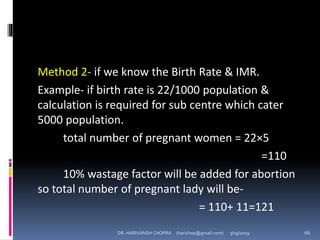
Method 2- if we know the Birth Rate & IMR.
Example- if birth rate is 22/1000 population &
calculation is required for sub centre which cater
5000 population.
total number of pregnant women = 22×5
=110
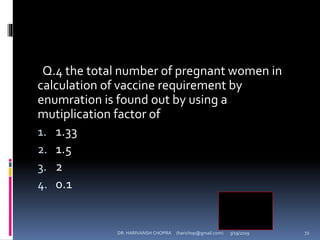
10% wastage factor will be added for abortion
so total number of pregnant lady will be-
= 110+ 11=121
DR. HARIVANSH CHOPRA (harichop@gmail.com) 3/19/2019 66
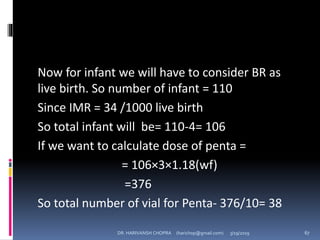
Now for infant we will have to consider BR as
live birth. So number of infant = 110
Since IMR = 34 /1000 live birth
So total infant will be= 110-4= 106
If we want to calculate dose of penta =
= 106×3×1.18(wf)
=376
So total number of vial for Penta- 376/10= 38
DR. HARIVANSH CHOPRA (harichop@gmail.com) 3/19/2019 67
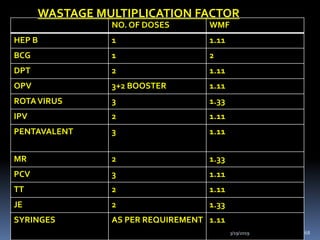
DR. HARIVANSHCHOPRA (harichop@gmail.com)
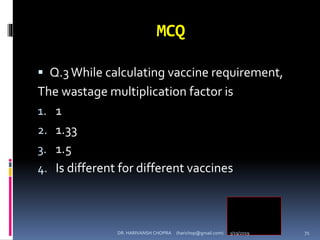
NO. OF DOSES WMF
HEP B 1 1.11
BCG 1 2
DPT 2 1.11
OPV 3+2 BOOSTER 1.11
ROTAVIRUS 3 1.33
IPV 2 1.11
PENTAVALENT 3 1.11
MR 2 1.33
PCV 3 1.11
TT 2 1.11
JE 2 1.33
SYRINGES AS PER REQUIREMENT 1.11
WASTAGE MULTIPLICATION FACTOR
3/19/2019 68
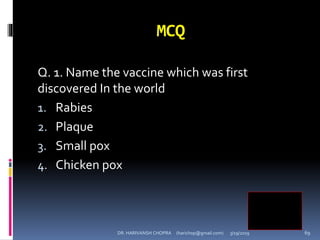
MCQ
Q. 1. Name the vaccine which was first
discovered In the world
1. Rabies
2. Plaque
3. Small pox
4. Chicken pox
3
DR. HARIVANSH CHOPRA (harichop@gmail.com) 3/19/2019 69
MCQ
 Q.2.in which year small pox vaccine was
discovered
1. 1798
2. 1898
3. 1998
4. 1800
1
DR. HARIVANSH CHOPRA (harichop@gmail.com) 3/19/2019 70
MCQ
 Q.3While calculating vaccine requirement,
The wastage multiplication factor is
1. 1
2. 1.33
3. 1.5
4. Is different for different vaccines
4
DR. HARIVANSH CHOPRA (harichop@gmail.com) 3/19/2019 71
Q.4 the total number of pregnant women in
calculation of vaccine requirement by
enumration is found out by using a
mutiplication factor of
1. 1.33
2. 1.5
3. 2
4. 0.1
3
DR. HARIVANSH CHOPRA (harichop@gmail.com) 3/19/2019 72
MCQ
q.5 the dose of immunoglobulin in the
prevention of measles is
1. 1 ml/kg
2. 1.5ml/kg
3. 0.5ml/kg
4. 0.25ml/kg
4
DR. HARIVANSH CHOPRA (harichop@gmail.com) 3/19/2019 73
3/19/2019 74DR. HARIVANSH CHOPRA (harichop@gmail.com)

Immunization

  • 1.
    IMMUNIZATION DR HARIVANSH CHOPRA DCH.,MD. PROFESSOR COMMUNITYMEDICINE LLRM MEDICAL COLLEGE ,MEERUT DR. HARIVANSH CHOPRA (harichop@gmail.com) 3/19/2019 1
  • 2.
    OBJECTIVES 1. To studywhat is Immunization,history, various schdedules and programmes . 2. To study about passive immunization inVPD 3. TO study how to describe a vaccine 4. How to calculate vaccine requirement DR. HARIVANSH CHOPRA (harichop@gmail.com) 3/19/2019 2
  • 3.
    IMMUNISATION  Immunization isthe process of artificially inducing immunity or providing protection from disease. DR. HARIVANSH CHOPRA (harichop@gmail.com) 3/19/2019 3
  • 4.
    Active immunization is theprocess of stimulating the body to produce antibody and other immune responses through administration of a vaccine or toxoid. . DR. HARIVANSH CHOPRA (harichop@gmail.com) 3/19/2019 4
  • 5.
    DR. HARIVANSH CHOPRA(harichop@gmail.com) Passive immunization is provision of temporary immunity by administration of preformed antibodies derived from humans or animals 3/19/2019 5
  • 6.
    Process of generationof immunity after vaccination PRIMARY RESPONSE- When an antigen is administered for the first time to an animal or human who has never been exposed to it, there is a latent period of induction of 3 to 10 days before antibodies appear in the blood. DR. HARIVANSH CHOPRA (harichop@gmail.com) 3/19/2019 6
  • 7.
    Process of generationof immunity after vaccination PRIMARY RESPONSE- The antibody that is elicited first is entirely of the IgM type. The IgM antibody titre rises steadily during the next 2-3 days or more, reaches a peak level and then declines almost as fast as it developed. DR. HARIVANSH CHOPRA (harichop@gmail.com) 3/19/2019 7
  • 8.
    Process of generationof immunity after vaccination PRIMARY RESPONSE- Meanwhile, if the antigenic stimulus was sufficient, IgG antibody appears in a few days. IgG reaches a peak in 7-10 days and then gradually falls over a period of weeks or months DR. HARIVANSH CHOPRA (harichop@gmail.com) 3/19/2019 8
  • 9.
    Process of generationof immunity after vaccination PRIMARY RESPONSE- The nature and extent of primary response to an antigen is determined by a number of factors, e.g., dose of antigen, nature of antigen, route of administration, adjuvants, nutritional status of the host, etc DR. HARIVANSH CHOPRA (harichop@gmail.com) 3/19/2019 9
  • 10.
    Process of generationof immunity after vaccination PRIMARY RESPONSE- An important outcome of primary antigenic challenge is education of the reticulo-endothelial system of the body. There is production of what are known as "memory cells" or "primed cells" by both B andT lymphocytes. DR. HARIVANSH CHOPRA (harichop@gmail.com) 3/19/2019 10
  • 11.
    DR. HARIVANSH CHOPRA(harichop@gmail.com) These cells are responsible for the "immunological memory" which becomes established after immunization. In fact, the purpose of immunization is to develop immunological memory. 3/19/2019 11
  • 12.
    SECONDARY (BOOSTER) RESPONSE- The responseto a booster dose differs in a number of ways from the primary response: 1 shorter latent period. 2 production of antibody is more rapid 3 antibodies are more abundant. DR. HARIVANSH CHOPRA (harichop@gmail.com) 3/19/2019 12
  • 13.
    SECONDARY (BOOSTER) RESPONSE- 4.antibody response maintainedat higher levels for a longer period of time and 5. the antibody elicited tends to have a greater avidity or capacity to bind to the antigen. DR. HARIVANSH CHOPRA (harichop@gmail.com) 3/19/2019 13
  • 14.
    Vaccine Term derive from “vaccae=cow”. Soimmunization agent is known as vaccine. Vaccine is a immuno- biological substance designed to produce specific protection against a given disease. DR. HARIVANSH CHOPRA (harichop@gmail.com) 3/19/2019 14
  • 15.
    Type of vaccine 1.Livevaccine. 2.Inactivated or killed vaccine. 3.SUB UNITVACCINES A.Toxoids . B.Protein vaccine C.RECOMBINANT protein vaccine D.Polysaccharide-based vaccines E.Conjugated vaccine 4.Combination DR. HARIVANSH CHOPRA (harichop@gmail.com) 3/19/2019 15
  • 16.
    LIVEVACCINE- Antigen in vaccineis live but attenuated. Since antigen are live,they multiply in body after administration so stimulus is more. Generally given in single dose. E.g.-BCG,OPV,MMR,YELLOW FEVER DR. HARIVANSH CHOPRA (harichop@gmail.com) 3/19/2019 16
  • 17.
    KILLEDVACCINE- Organism are inactivatedor killed by heat or chemical. They are given by multiple doses. Immunity last shorter than live vaccine. E.g.-JEVACCINE,ANTIRABIES VACCINE, INFLUENZA KILLED VACCINE DR. HARIVANSH CHOPRA (harichop@gmail.com) 3/19/2019 17
  • 18.
    TOXOID- They are modifiedtoxins. Toxins are detoxicated They are required in multiple doses. E.g.- tetanus toxoid, diptheria toxoid DR. HARIVANSH CHOPRA (harichop@gmail.com) 3/19/2019 18
  • 19.
    Protein vaccine DR. HARIVANSHCHOPRA (harichop@gmail.com) Proteins can be purified from in vitro culture of a Pathogenic micro-organism 3/19/2019 19
  • 20.
    RECOMBINANT PROTEIN VACCINE DR.HARIVANSH CHOPRA (harichop@gmail.com) 3/19/2019 20
  • 21.
    POLYSACCHARIDE-BASED VACCINES DR. HARIVANSHCHOPRA (harichop@gmail.com) 3/19/2019 21
  • 22.
    CONJUGATED VACCINE DR. HARIVANSHCHOPRA (harichop@gmail.com) 3/19/2019 22
  • 23.
    COMBINATIONVACCINE- They are socalled because the preparation contains more than one antigen. They also called mixed vaccine. E.g.- Easy Five ( penta valent ), DPT , DT, MMR DR. HARIVANSH CHOPRA (harichop@gmail.com) 3/19/2019 23
  • 24.
    Milstone in vaccination 1798- Smallpox vaccine 1885 - Rabies vaccine 1897 - Cholera vaccine 1921 - BCG DR. HARIVANSH CHOPRA (harichop@gmail.com) 3/19/2019 24
  • 25.
    Milstone in vaccination 1923- Diphtheria Toxoid 1926 - Pertussis vaccine 1927 - Tetanus toxoid 1937 - Influenza vaccine DR. HARIVANSH CHOPRA (harichop@gmail.com) 3/19/2019 25
  • 26.
    Milstone in vaccination 1935- Yellow fever vaccine (17 D) 1949 - Mumps vaccine 1954 - Salk's Polio vaccine 1957 - Sabin live oral Polio vaccine DR. HARIVANSH CHOPRA (harichop@gmail.com) 3/19/2019 26
  • 27.
    Milstone in vaccination 1960- Measles vaccine 1962 - Rubella vaccine 1968 - Type C meningococcus vaccine 1971 - Type A meningococcus vaccine DR. HARIVANSH CHOPRA (harichop@gmail.com) 3/19/2019 27
  • 28.
    Milstone in vaccination 1980-smallpox declared eradicated from the world. 1981- meningococcal polysaccharide vaccine, group A,C,Y W135 combined ( Menomune ). 1982- hepatitis B vaccine. 1983- pneumococcal vaccine 23 valent. 1988- worldwide polio eradication initiative launched. DR. HARIVANSH CHOPRA (harichop@gmail.com) 3/19/2019 28
  • 29.
    Milstone in vaccination 1990-the vaccine adverse reporting system ( VAERS ), a national programme monitoring the safety of vaccine established. 1991- hepatitis B vaccine recommended for all infant. 1991- acellular pertusis vaccine licensed for use in older children aged 15 month to 6 year. 1993- JE vaccine. 2003- first adult immunisation schedule introduced. DR. HARIVANSH CHOPRA (harichop@gmail.com) 3/19/2019 29
  • 30.
    Milstone in vaccination 2004- Pediarix, a vaccine that combines the DTaP, IPV & Hep B vaccines, into one shot , is approved.  2006- Gardasil, the first HPV vaccine is approved.  2008- Rotarix, a two dose rotavirus vaccine is approved.  2009- influenza- A ( H1N1 ) Vaccine approved. DR. HARIVANSH CHOPRA (harichop@gmail.com) 3/19/2019 30
  • 31.
    DR. HARIVANSH CHOPRA(harichop@gmail.com) 3/19/2019 31
  • 32.
    Expanded Program on Immunisation WHO launch a global immunization program, known as Expanded Program on Immunization (EPI) in May 1974.  To protect all children of the world against six vaccine-preventable diseases, namely - diphtheria, whooping cough, tetanus, polio, tuberculosis and measles by the year 2000.  EPI was launched in India in January 1978 . DR. HARIVANSH CHOPRA (harichop@gmail.com) 3/19/2019 32
  • 33.
    Universal Immunisation Programme  TheIndian version, the Universal Immunization Programme, was launched on November 19, 1985.  The National Health Policy aimed at achieving universal immunization coverage of the eligible population by 1990. DR. HARIVANSH CHOPRA (harichop@gmail.com) 3/19/2019 33
  • 34.
    VACCINE WHENTO GIVE Forinfants BCG At birth or as early as possible till one year of age Hepatitis B At birth or as early as possible within 24 hour OPV 0 At birth or as early as possible within the first 15 days NATIONAL IMMUNISATION SCHEDULE DR. HARIVANSH CHOPRA (harichop@gmail.com) 3/19/2019 34
  • 35.
    DR. HARIVANSH CHOPRA(harichop@gmail.com) NATIONAL IMMUNIZATION SCHEDULE OPV 1,2 & 3 At 6 weeks , 10 weeks & 14 week ROTAVIRUS 1,2&3 At 6 weeks , 10 weeks & 14 week PENTAVALENT 1,2 & 3 At 6 weeks , 10 weeks & 14 week FRACTIONAL- IPV 1&2 At 6 weeks & 14 week MEASLESAND RUBELLA 1 9 completed months -12 month ( given up to 5 years if not received at 9-12 month age) JAPENESE ENCEPHALITIS 1 9-12months Vitamin A ( 1st dose ) At 9 month with measles 3/19/2019 35
  • 36.
    NATIONAL IMMUNISATION SCHEDULE Forchildren When to given DPT booster 16-24 month OPV Booster 16-24 month Measles and Rubella 2 16-24 month Japanese Encephalitis 2 16-24 month with DPT / OPV Booster Vitamin A 16 month with DPT/OPV booster. Then one dose every 6 month up to the age of 5 year DPT booster 5-6 years TT 10 years & 16 years DR. HARIVANSH CHOPRA (harichop@gmail.com) 3/19/2019 36
  • 37.
    NATIONAL IMMUNISATION SCHEDULE FORPREGNANT WOMEN TT-1 TT-2 TT- Booster Early in pregnancy 4 weeks afterTT-1 If received 2TT doses in a pregnancy within the last years DR. HARIVANSH CHOPRA (harichop@gmail.com) 3/19/2019 37
  • 38.
    IAP SCHEDULE Birth -15 days BCG + OPV (zero dose) +HepB1 6 weeks - 8 weeks OPV1 +IPV1 + DPT1+ HepB2 + Hib1 + Rotavirus1 + PCV1 10 weeks- 12 weeks OPV2 + IPV2 + DPT2+ Hib2 + Rotavirus2 + PCV2 14 weeks - 16 weeks OPV3 + IPV3 + DPT3 + Hib3 + Rotavirus3# + PCV3 6 months HepB3 + OPV1 9months (complete d) Measles+OPV2 DR. HARIVANSH CHOPRA (harichop@gmail.com) 3/19/2019 38
  • 39.
    IAP SCHEDULE 12 months 15months 18 months 2 years 5 years 10 - 12 years Hepatitis A1 MMR1 +Varicella + PCV booster OPV4 + IPV booster1 + DPT*booster1 + Hib booster1 + Hepatitis A2 Typhoid1 (give repeat shots every 3 years) OPV5 + DPT* booster2 +MMR2^ +Varicella2$$ Tdap/Td (Every 10 years then giveTd)+ HPV** DR. HARIVANSH CHOPRA (harichop@gmail.com) 3/19/2019 39
  • 40.
    Passive immunization inVPD Passive immunization is a short-term expedient useful only when exposure to infection has just occurred or is imminent within the next few days. The duration of immunity induced is short and variable (1-6 weeks). DR. HARIVANSH CHOPRA (harichop@gmail.com) 3/19/2019 40
  • 41.
    Passive immunization inVPD Three types of preparations are available for passive immunity- Normal human immunoglobulin. Specific (hyperimmune) human immunoglobulin. Antisera or anti-toxins. DR. HARIVANSH CHOPRA (harichop@gmail.com) 3/19/2019 41
  • 42.
    Passive immunization isapplied in following vaccine preventable disease- Diphtheria, Tetanus, Hepatitis B Rabies & Measles. DR. HARIVANSH CHOPRA (harichop@gmail.com) 3/19/2019 42
  • 43.
    DIPTHERIAANTITIOXIN- DOSE: Prophylactic: 500 to2000 units by subcutaneous or intramuscular injection; Therapeutic: 10,000 to 30,000 units by intramuscular injection or 40,000 to 100,000 units by intravenous injection in 2 divided doses with an interval of 12 to 24 hours. DR. HARIVANSH CHOPRA (harichop@gmail.com) 3/19/2019 43
  • 44.
    DR. HARIVANSH CHOPRA (harichop@gmail.com) PassiveImmunisation – Immunoglobulins 1. ADS of horse origin. 2. ADS of human origin.
  • 45.
    DR. HARIVANSH CHOPRA(harichop@gmail.com) Dosage of antitoxin (equine) Duration of disease 48 hours Lesions Throat Larynx Dose (I.U.) 20 000 – 40000 20 000 – 40000 Must be used only after sensitivity test. 3/19/2019 45
  • 46.
    DR. HARIVANSH CHOPRA(harichop@gmail.com) Dosage of antitoxin (equine) Duration of disease Over 48 hours Lesions Membrane in naso- pharynx Swelling in neck Extensive disease > 3 days Dose (I.U.) 40000 – 60000 80000 – 120000 80000 – 120000 Must be used only after sensitivity test. 3/19/2019 46
  • 47.
    DR. HARIVANSH CHOPRA(harichop@gmail.com) Antitoxin Treatment – human 1. Dose: 0.6 ml/kg body weight Intramuscular (Available as 2ml vial with 300 mg Globulins). 2. Advantage over ADS (horse origin): 1. Hypersensitivity absent. 2. Longer protection. 3/19/2019 47
  • 48.
    MEASLES IMMUNOGLOBULIN (HUMAN) DOSE- recommended by WHO is 0.25 ml per kg of body weight. It should be given within 3-4 days of exposure. The person passively immunized should be given live measles vaccine 8-12 weeks later. DR. HARIVANSH CHOPRA (harichop@gmail.com) 3/19/2019 48
  • 49.
    HEPATITIS B IMMUNOGLOBIN- Therecommended dose is 0.05 to 0.07 ml/kg of body weight ; two doses should be given 30 days apart . HBIG provides short-term passive protection which lasts approximately 3 months . Since the median incubation period is said to be lower than 100 days , two doses of HBIG given one month apart should suffice. DR. HARIVANSH CHOPRA (harichop@gmail.com) 3/19/2019 49
  • 50.
    TETANUS IMMUNOGLOBIN Dose –250 unit for prophylaxis 3000-6000 for therapeutic DR. HARIVANSH CHOPRA (harichop@gmail.com) 3/19/2019 50
  • 51.
    HOW TO DESCRIBEA VACCINE whenever one describe a vaccine it must be done under the following heads Type Content Dose Time of administration No of doses including boosters DR. HARIVANSH CHOPRA (harichop@gmail.com) 3/19/2019 53
  • 52.
    HOW TO DESCRIBEA VACCINE Diluent if any Time after reconstitution Efficacy Storage Side effects contraindications DR. HARIVANSH CHOPRA (harichop@gmail.com) 3/19/2019 54
  • 53.
    DR. HARIVANSH CHOPRA (harichop@gmail.com) 1)Freezeddried vaccine contains live attenuated virus 1000 T.C.I.D.50; Stored at 2-8 o C. 2)Dose  0.5 ml; Route  Subcutaneous. MEASLES VACCINE 3/19/2019 55
  • 54.
    DR. HARIVANSH CHOPRA (harichop@gmail.com) 3.Timeof administration  9 months in India. According to W.H.O if child is malnourished, 1st dose is b/w 6-8 months; 2nd dose after 1 year. 4.Efficacy of Vaccine – 95%if given after one year. At nine months -85% 5.Duration of immunity– Lifelong. MEASLES VACCINE 3/19/2019 56
  • 55.
    DR. HARIVANSH CHOPRA(harichop@gmail.com) Measles vaccine 6.It is freezed dried vaccine 7.Has to be reconstituted with distilled water 8.Reconstituted vaccine must be used as early as possible
  • 56.
    DR. HARIVANSH CHOPRA(harichop@gmail.com) Measles vaccine 9.It has shell life for 2 years 10.Must be stored between 2-8 degree centirgade
  • 57.
    DR. HARIVANSH CHOPRA (harichop@gmail.com) RecentW.H.O. recommendation – 1st dose of measles 9 months. 2nd dose of M.M.R. – 15 months. This vaccine may also be given to contacting person. MEASLES VACCINE 3/19/2019 59
  • 58.
    DR. HARIVANSH CHOPRA(harichop@gmail.com) Complications of vaccine 1. Fever 2. Rash 3. Rarely S.S.P.E 4. T.S.S
  • 59.
    DR. HARIVANSH CHOPRA (harichop@gmail.com) 1.Impairedcell-mediated immunity. 2.Convulsions. 3.Patient on steroids. 4.Pregnancy. CONTRAINDICATIONS TO MEASLES VACCINE 3/19/2019 61
  • 60.
    DR. HARIVANSH CHOPRA (harichop@gmail.com) 5.ActiveT.B. 6.Acute infectious disease. 7.Generalized allergy. CONTRAINDICATIONS TO MEASLES VACCINE 3/19/2019 62
  • 61.
    How to calculatevaccine requirement There are two ways to calculate vaccine requirement- 1- based on real number of beneficiaries in community. 2-based on , Birth Rate and IMR. DR. HARIVANSH CHOPRA (harichop@gmail.com) 3/19/2019 63
  • 62.
    Method 1- A) countthe total number of beneficiaries, like infant, pregnant mother etc. B) multiply it with total number of dose of vaccine to be given. C) now multiply it with wastage factor for different vaccines DR. HARIVANSH CHOPRA (harichop@gmail.com) 3/19/2019 64
  • 63.
    Eg- if thereare 100 infant. Number of doses of BCG require will be 100× 1 × 1.33= 133 doses Since vial of BCG come in doses of 10. So needed vial will be= 133/10= 13.3 i.e. 14 DR. HARIVANSH CHOPRA (harichop@gmail.com) 3/19/2019 65
  • 64.
    Method 2- ifwe know the Birth Rate & IMR. Example- if birth rate is 22/1000 population & calculation is required for sub centre which cater 5000 population. total number of pregnant women = 22×5 =110 10% wastage factor will be added for abortion so total number of pregnant lady will be- = 110+ 11=121 DR. HARIVANSH CHOPRA (harichop@gmail.com) 3/19/2019 66
  • 65.
    Now for infantwe will have to consider BR as live birth. So number of infant = 110 Since IMR = 34 /1000 live birth So total infant will be= 110-4= 106 If we want to calculate dose of penta = = 106×3×1.18(wf) =376 So total number of vial for Penta- 376/10= 38 DR. HARIVANSH CHOPRA (harichop@gmail.com) 3/19/2019 67
  • 66.
    DR. HARIVANSHCHOPRA (harichop@gmail.com) NO.OF DOSES WMF HEP B 1 1.11 BCG 1 2 DPT 2 1.11 OPV 3+2 BOOSTER 1.11 ROTAVIRUS 3 1.33 IPV 2 1.11 PENTAVALENT 3 1.11 MR 2 1.33 PCV 3 1.11 TT 2 1.11 JE 2 1.33 SYRINGES AS PER REQUIREMENT 1.11 WASTAGE MULTIPLICATION FACTOR 3/19/2019 68
  • 67.
    MCQ Q. 1. Namethe vaccine which was first discovered In the world 1. Rabies 2. Plaque 3. Small pox 4. Chicken pox 3 DR. HARIVANSH CHOPRA (harichop@gmail.com) 3/19/2019 69
  • 68.
    MCQ  Q.2.in whichyear small pox vaccine was discovered 1. 1798 2. 1898 3. 1998 4. 1800 1 DR. HARIVANSH CHOPRA (harichop@gmail.com) 3/19/2019 70
  • 69.
    MCQ  Q.3While calculatingvaccine requirement, The wastage multiplication factor is 1. 1 2. 1.33 3. 1.5 4. Is different for different vaccines 4 DR. HARIVANSH CHOPRA (harichop@gmail.com) 3/19/2019 71
  • 70.
    Q.4 the totalnumber of pregnant women in calculation of vaccine requirement by enumration is found out by using a mutiplication factor of 1. 1.33 2. 1.5 3. 2 4. 0.1 3 DR. HARIVANSH CHOPRA (harichop@gmail.com) 3/19/2019 72
  • 71.
    MCQ q.5 the doseof immunoglobulin in the prevention of measles is 1. 1 ml/kg 2. 1.5ml/kg 3. 0.5ml/kg 4. 0.25ml/kg 4 DR. HARIVANSH CHOPRA (harichop@gmail.com) 3/19/2019 73
  • 72.
    3/19/2019 74DR. HARIVANSHCHOPRA (harichop@gmail.com)