EDU: 05.9 : PEDAGOGIC CONTENT KNOWLEDGE ANALYSIS
- NATURAL SCIENCE
ONLINE ASSIGNMENT
Resource Unit
Submitted to Submitted by
Dr. Sojia John Soumya S R
Assistant Professor in First Sem BE.d
Natural Science Natural Science
MTTC ,Pathanapuram MTTC,Pathanapuram
RESOURCE UNIT
A resource unit is a collection of suggested teaching and learning activities organised
upon a given unit. As the term indicates it is a resource for teaching. It is prepared by
a group of teachers for the use of many. Resource unit is much more comprehensive
than a teaching unit. It provides sources of materials from which teachers can select
according to their needs. Resource unit differs from teaching units in purpose,scope and
organisation. It is a broad reservoir of teaching, content, activities and materials. In
short, to an ordinary teacher, a resource unit acts as an excellent reference with respect.
to concepts, objectives, learning experiences, experiments, outdoor activities, tools of
evaluation, assignments and even references.
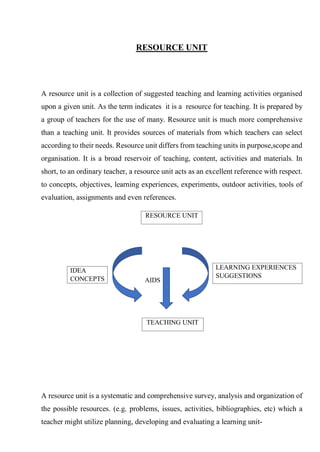
AIDS
TEACHING UNIT
A resource unit is a systematic and comprehensive survey, analysis and organization of
the possible resources. (e.g. problems, issues, activities, bibliographies, etc) which a
teacher might utilize planning, developing and evaluating a learning unit-
RESOURCE UNIT
IDEA
CONCEPTS
LEARNING EXPERIENCES
SUGGESTIONS
Meaning
 Type of material which a teacher use in his pre-planning.
 Resource for teaching
 Reservoir of teaching content, objectives, learning experiences etc.
Importance of Resource Unit
 Promoting teacher growth
 Form of pre-planning
 Evolve several learning units
 Handling individual differences
 Suggest teaching materials and learning materials etc.
Characteristics of Resources Unit
 All resources are useful.
 All resources are limited
 All resources are interrelated
 Resources are accessible
Resource units are accumulated and nonprescriptive packages of curriculum materials
and information that can enhance a given teaching learning situations. It was a boon to
teaching in larger more integrated units of instruction, rather than in isolated and
discrete daily lessons. A teaching or curricular resource unit is a set of lessons on a topic
with a unified purpose, set of learning content or activities that elicit learning
experiences to facilitate the purpose, organizational plans to translate the purposes into
practice and evaluation to determine the success of the plans to meet on revise the
designated purposes. Harold Alberty and Ralph Tyler each contributed much to the
development of the idea of resource units that facilitate instructional units, by collecting
on designating sources of information.
Objectives
The primary objectives of the Education Resource unit are:
1. To procure, store and distribute curriculum resources to schools and keep stock
records both in hard and electronic copy of all incoming and distributed
curriculum resources in an excel-based spreadsheet stock control system.
2. To do assessment of curriculum resources shortage and request for reprinting of
curriculum resources for the schools in the Solomon Islands.
3. To inform the divisional head and the Ministry what has been done. Also to
provide advice to Education Authorities and schools to build adequate and good
quality storage, maintenance and management for sustainability of curriculum
resources.
4. To address the achievements, challenges and the way forward.
Advantages of using Resource Unit
 You can group various resources with similar attributes, providing a quick view
of similar storage objects.
 Resource pools provide a single logical unit for provisioning.
 You can simplify physical resource management by managing a pool of resources
as a single entity.
 You can configure your system to automatically provision storage from resources
pools are available when needed.
Objectives of Resource Unit According to Students
 Knowledge Objective
 Skill Objective
 Interest Objective
 Attitude objective
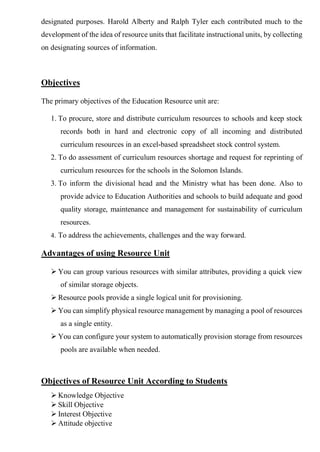
Field of Resource Unit
Types of Teaching Material Used in
Resource Unit
Printed Material Non-Printed Material
1.Self-directed Material 1.Audio Resources 2. Visual Resources 3. Audio-Visual Resources
2.Newspaper a.Television a.Chart a.Computer
3.Journal and Research Magazines b. Radio b.Posture b.Television
4.Text books c.Diagram c.Teleconferencing
5.Encyclopedia d.Graph
6.Dictionary e.Overhead Projector
7.Atlas
8.Books
Steps in the preparation of a Resource Unit
1. Title
2. Introduction - Briefly indicate the social, scientific and pedagogical significance
of the unit.
3. General Objectives -Briefly indicate the learning outcome which are expected
by learning the curricular materials in the unit. Objectives are stated in terms of
behavioural dimension.
4. Content Analysis - This is the most important step which determines the quality
of the Resource unit. Content is analysed in depth and elaboration and presented
in the form of a series of paragraphs.
5. Activities-General and specific methods of teaching, as well as activities of
various kinds meant for teachers and pupils are decided. Activities like
experimentation, demonstration, project, collection, group work, field trips,
discussion etc are described explicitly to be of help to the teacher. Activities for
the complete treatment of the unit are to be described.
6. Teaching material and sources-Materials for teacher's use and pupil's use are
mentioned and listed. Audio visual materials for teaching,their sources and
preparation as well as use are described, suggestions regarding reading materials
for teachers and pupils are to be made.
7. Evaluation Procedures - The evaluation procedures suitable for the unit have to
be described. This may include sample tests, classroom evaluation techniques,
methods of evaluating pupil work i.e., projects, experiments, collection,
improvisation, discussion etc.
8. Editing.
Difference between Resource unit and Teaching unit
Resource Unit Teaching unit
Prepared by a group of teachers for the
use of many
It is prepared by a single teacher.
It is much more comprehensive than a
teaching unit
It is less comprehensive
Purpose, scope and organisation is broad Propose, scope and organisation is not
broad.
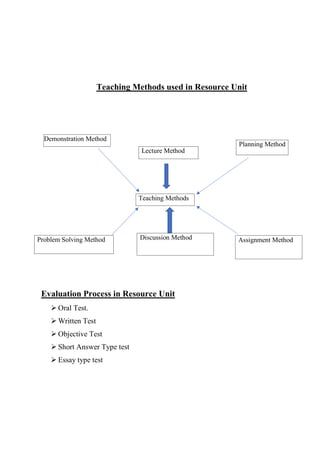
Teaching Methods used in Resource Unit
Demonstration Method
Lecture Method
Teaching Methods
Evaluation Process in Resource Unit
 Oral Test.
 Written Test
 Objective Test
 Short Answer Type test
 Essay type test
Planning Method
Assignment Method
Problem Solving Method Discussion Method

RESOURCE UNIT.pdf

  • 1.
    EDU: 05.9 :PEDAGOGIC CONTENT KNOWLEDGE ANALYSIS - NATURAL SCIENCE ONLINE ASSIGNMENT Resource Unit Submitted to Submitted by Dr. Sojia John Soumya S R Assistant Professor in First Sem BE.d Natural Science Natural Science MTTC ,Pathanapuram MTTC,Pathanapuram
  • 2.
    RESOURCE UNIT A resourceunit is a collection of suggested teaching and learning activities organised upon a given unit. As the term indicates it is a resource for teaching. It is prepared by a group of teachers for the use of many. Resource unit is much more comprehensive than a teaching unit. It provides sources of materials from which teachers can select according to their needs. Resource unit differs from teaching units in purpose,scope and organisation. It is a broad reservoir of teaching, content, activities and materials. In short, to an ordinary teacher, a resource unit acts as an excellent reference with respect. to concepts, objectives, learning experiences, experiments, outdoor activities, tools of evaluation, assignments and even references. AIDS TEACHING UNIT A resource unit is a systematic and comprehensive survey, analysis and organization of the possible resources. (e.g. problems, issues, activities, bibliographies, etc) which a teacher might utilize planning, developing and evaluating a learning unit- RESOURCE UNIT IDEA CONCEPTS LEARNING EXPERIENCES SUGGESTIONS
  • 3.
    Meaning  Type ofmaterial which a teacher use in his pre-planning.  Resource for teaching  Reservoir of teaching content, objectives, learning experiences etc. Importance of Resource Unit  Promoting teacher growth  Form of pre-planning  Evolve several learning units  Handling individual differences  Suggest teaching materials and learning materials etc. Characteristics of Resources Unit  All resources are useful.  All resources are limited  All resources are interrelated  Resources are accessible Resource units are accumulated and nonprescriptive packages of curriculum materials and information that can enhance a given teaching learning situations. It was a boon to teaching in larger more integrated units of instruction, rather than in isolated and discrete daily lessons. A teaching or curricular resource unit is a set of lessons on a topic with a unified purpose, set of learning content or activities that elicit learning experiences to facilitate the purpose, organizational plans to translate the purposes into practice and evaluation to determine the success of the plans to meet on revise the
  • 4.
    designated purposes. HaroldAlberty and Ralph Tyler each contributed much to the development of the idea of resource units that facilitate instructional units, by collecting on designating sources of information. Objectives The primary objectives of the Education Resource unit are: 1. To procure, store and distribute curriculum resources to schools and keep stock records both in hard and electronic copy of all incoming and distributed curriculum resources in an excel-based spreadsheet stock control system. 2. To do assessment of curriculum resources shortage and request for reprinting of curriculum resources for the schools in the Solomon Islands. 3. To inform the divisional head and the Ministry what has been done. Also to provide advice to Education Authorities and schools to build adequate and good quality storage, maintenance and management for sustainability of curriculum resources. 4. To address the achievements, challenges and the way forward. Advantages of using Resource Unit  You can group various resources with similar attributes, providing a quick view of similar storage objects.  Resource pools provide a single logical unit for provisioning.  You can simplify physical resource management by managing a pool of resources as a single entity.  You can configure your system to automatically provision storage from resources pools are available when needed. Objectives of Resource Unit According to Students  Knowledge Objective  Skill Objective  Interest Objective  Attitude objective
  • 5.
    Field of ResourceUnit Types of Teaching Material Used in Resource Unit Printed Material Non-Printed Material 1.Self-directed Material 1.Audio Resources 2. Visual Resources 3. Audio-Visual Resources 2.Newspaper a.Television a.Chart a.Computer 3.Journal and Research Magazines b. Radio b.Posture b.Television 4.Text books c.Diagram c.Teleconferencing 5.Encyclopedia d.Graph 6.Dictionary e.Overhead Projector 7.Atlas 8.Books Steps in the preparation of a Resource Unit 1. Title 2. Introduction - Briefly indicate the social, scientific and pedagogical significance of the unit. 3. General Objectives -Briefly indicate the learning outcome which are expected by learning the curricular materials in the unit. Objectives are stated in terms of behavioural dimension.
  • 6.
    4. Content Analysis- This is the most important step which determines the quality of the Resource unit. Content is analysed in depth and elaboration and presented in the form of a series of paragraphs. 5. Activities-General and specific methods of teaching, as well as activities of various kinds meant for teachers and pupils are decided. Activities like experimentation, demonstration, project, collection, group work, field trips, discussion etc are described explicitly to be of help to the teacher. Activities for the complete treatment of the unit are to be described. 6. Teaching material and sources-Materials for teacher's use and pupil's use are mentioned and listed. Audio visual materials for teaching,their sources and preparation as well as use are described, suggestions regarding reading materials for teachers and pupils are to be made. 7. Evaluation Procedures - The evaluation procedures suitable for the unit have to be described. This may include sample tests, classroom evaluation techniques, methods of evaluating pupil work i.e., projects, experiments, collection, improvisation, discussion etc. 8. Editing. Difference between Resource unit and Teaching unit Resource Unit Teaching unit Prepared by a group of teachers for the use of many It is prepared by a single teacher. It is much more comprehensive than a teaching unit It is less comprehensive Purpose, scope and organisation is broad Propose, scope and organisation is not broad.
  • 7.
    Teaching Methods usedin Resource Unit Demonstration Method Lecture Method Teaching Methods Evaluation Process in Resource Unit  Oral Test.  Written Test  Objective Test  Short Answer Type test  Essay type test Planning Method Assignment Method Problem Solving Method Discussion Method