Presented by:
Pearl Kathleen R. Abucay
Maricel J. Cubian
Narcisa R. Peru
Arnie Joy A. Felicilda
Project Method
Definition
Project method
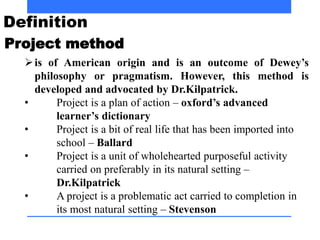
is of American origin and is an outcome of Dewey’s
philosophy or pragmatism. However, this method is
developed and advocated by Dr.Kilpatrick.
• Project is a plan of action – oxford’s advanced
learner’s dictionary
• Project is a bit of real life that has been imported into
school – Ballard
• Project is a unit of wholehearted purposeful activity
carried on preferably in its natural setting –
Dr.Kilpatrick
• A project is a problematic act carried to completion in
its most natural setting – Stevenson
Basic principles of Project Method
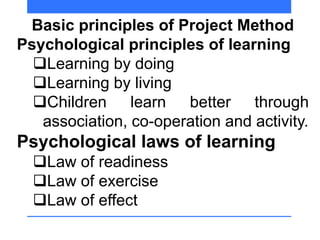
Psychological principles of learning
Learning by doing
Learning by living
Children learn better through
association, co-operation and activity.
Psychological laws of learning
Law of readiness
Law of exercise
Law of effect
Procedures of Project Method
Step 1. Creating the situation:
The teacher creates problematic situation in
front of students while creating the appropriate
situation student’s interest and abilities should be
given due importance.
Step 2. Proposing and choosing the project:
While choosing a problem teacher should
stimulate discussions by making suggestions. The
proposed project should be according to the rear
need of students. The purpose of the project
should be well defined and understood by the
children.
Procedures of Project Method
Step 3. Planning the project:
for the success of the project, planning
of project is very import. The children should
plan out the project under the guidance of
their teacher.
Step 4. Execution of the project:
every child should contribute actively in
the execution of the project. It is the longest
step in the project.
Procedures of Project Method
Step 5. Evaluation of the project:
when the project is completed the teacher
and the children should evaluate it jointly discussed
whether the objectives of the project have been
achieved or not.
Step 6. Recording of the project:
the children maintain a complete record of the
project work. While recording the project some
points like how the project was planned, what
discussion were made, how duties were assigned,
hot it was evaluate etc. should be kept in mind.
Advantages
This is based on various psychological laws
and principles.
It develops self-confidence and self-discipline
among the students
It provides ample scope for training.
It provides score for independent work and
individual development.
It promotes habits of critical thinking and
encourages the students to adopt problem-
solving methods.
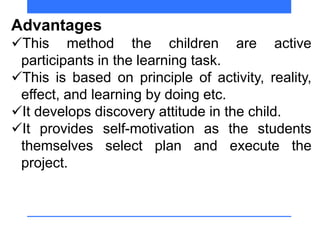
Advantages
This method the children are active
participants in the learning task.
This is based on principle of activity, reality,
effect, and learning by doing etc.
It develops discovery attitude in the child.
It provides self-motivation as the students
themselves select plan and execute the
project.
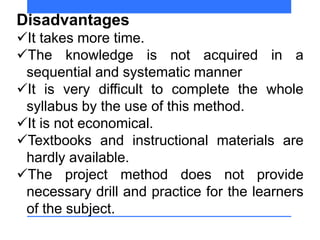
Disadvantages
It takes more time.
The knowledge is not acquired in a
sequential and systematic manner
It is very difficult to complete the whole
syllabus by the use of this method.
It is not economical.
Textbooks and instructional materials are
hardly available.
The project method does not provide
necessary drill and practice for the learners
of the subject.
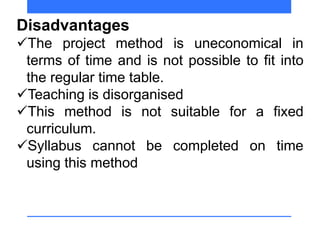
Disadvantages
The project method is uneconomical in
terms of time and is not possible to fit into
the regular time table.
Teaching is disorganised
This method is not suitable for a fixed
curriculum.
Syllabus cannot be completed on time
using this method
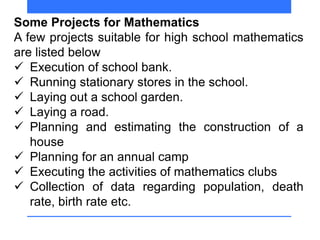
Some Projects for Mathematics
A few projects suitable for high school mathematics
are listed below
 Execution of school bank.
 Running stationary stores in the school.
 Laying out a school garden.
 Laying a road.
 Planning and estimating the construction of a
house
 Planning for an annual camp
 Executing the activities of mathematics clubs
 Collection of data regarding population, death
rate, birth rate etc.
Conclusion
Though project method provides a
practical approach to learning. It is difficult to
follow this method for teaching mathematics.
However this method may be tried along with
formal classroom teaching without disturbing
the school timetable. This method leads to
understanding and develops the ability to
apply knowledge. The teacher has to work as
a careful guide during the execution of the
project.
project-method (1).pptx

project-method (1).pptx

  • 1.
    Presented by: Pearl KathleenR. Abucay Maricel J. Cubian Narcisa R. Peru Arnie Joy A. Felicilda Project Method
  • 2.
    Definition Project method is ofAmerican origin and is an outcome of Dewey’s philosophy or pragmatism. However, this method is developed and advocated by Dr.Kilpatrick. • Project is a plan of action – oxford’s advanced learner’s dictionary • Project is a bit of real life that has been imported into school – Ballard • Project is a unit of wholehearted purposeful activity carried on preferably in its natural setting – Dr.Kilpatrick • A project is a problematic act carried to completion in its most natural setting – Stevenson
  • 3.
    Basic principles ofProject Method Psychological principles of learning Learning by doing Learning by living Children learn better through association, co-operation and activity. Psychological laws of learning Law of readiness Law of exercise Law of effect
  • 4.
    Procedures of ProjectMethod Step 1. Creating the situation: The teacher creates problematic situation in front of students while creating the appropriate situation student’s interest and abilities should be given due importance. Step 2. Proposing and choosing the project: While choosing a problem teacher should stimulate discussions by making suggestions. The proposed project should be according to the rear need of students. The purpose of the project should be well defined and understood by the children.
  • 5.
    Procedures of ProjectMethod Step 3. Planning the project: for the success of the project, planning of project is very import. The children should plan out the project under the guidance of their teacher. Step 4. Execution of the project: every child should contribute actively in the execution of the project. It is the longest step in the project.
  • 6.
    Procedures of ProjectMethod Step 5. Evaluation of the project: when the project is completed the teacher and the children should evaluate it jointly discussed whether the objectives of the project have been achieved or not. Step 6. Recording of the project: the children maintain a complete record of the project work. While recording the project some points like how the project was planned, what discussion were made, how duties were assigned, hot it was evaluate etc. should be kept in mind.
  • 7.
    Advantages This is basedon various psychological laws and principles. It develops self-confidence and self-discipline among the students It provides ample scope for training. It provides score for independent work and individual development. It promotes habits of critical thinking and encourages the students to adopt problem- solving methods.
  • 8.
    Advantages This method thechildren are active participants in the learning task. This is based on principle of activity, reality, effect, and learning by doing etc. It develops discovery attitude in the child. It provides self-motivation as the students themselves select plan and execute the project.
  • 9.
    Disadvantages It takes moretime. The knowledge is not acquired in a sequential and systematic manner It is very difficult to complete the whole syllabus by the use of this method. It is not economical. Textbooks and instructional materials are hardly available. The project method does not provide necessary drill and practice for the learners of the subject.
  • 10.
    Disadvantages The project methodis uneconomical in terms of time and is not possible to fit into the regular time table. Teaching is disorganised This method is not suitable for a fixed curriculum. Syllabus cannot be completed on time using this method
  • 11.
    Some Projects forMathematics A few projects suitable for high school mathematics are listed below  Execution of school bank.  Running stationary stores in the school.  Laying out a school garden.  Laying a road.  Planning and estimating the construction of a house  Planning for an annual camp  Executing the activities of mathematics clubs  Collection of data regarding population, death rate, birth rate etc.
  • 12.
    Conclusion Though project methodprovides a practical approach to learning. It is difficult to follow this method for teaching mathematics. However this method may be tried along with formal classroom teaching without disturbing the school timetable. This method leads to understanding and develops the ability to apply knowledge. The teacher has to work as a careful guide during the execution of the project.