This document discusses the project method of teaching and learning. It defines a project as a "problematic act carried to completion in its natural setting" and "a whole-hearted, purposeful activity." A project must be problematic, aimed at a definite goal, purposeful and natural in procedure, directed by students, and emphasize a single complete activity unit. The project method takes learning beyond the classroom into a natural setting, allows for self-expression, and establishes positive knowledge. There are four main types of projects: producer, consumer, problem, and drill. Organizing successful projects involves creating situations, selecting problems, planning purposefully, avoiding interruptions, carefully supervising execution, and evaluating.
INTRODUCTION
A project isa bit of real life that has been
imparted into the school mainly, in
project method “ learning by living” and
“learning by doing” this life has
spontaneity, purpose, significance,
interest, and freedom.
3.
DEFINITION
“A projectis a problematic act carried to
completion in its natural setting.”
-Stevenson.
“A whole – hearted, purposeful activity
proceeding in a social environment.”
- Dr.Kilpartrick.
4.
TO BE APROJECT, THE LEARNING
ACTIVITY MUST BE:
1. Problematic in nature.
2. Aimed at a definite, attainable goal.
3. Purposeful, natural and life like in its
procedure to attain the goal.
4. Directed and planned by the students.
5. Practical in nature with emphasis on single
and complete unit of purposeful activity.
5.
CHARACTERISTICS OF
PROJECT METHOD:
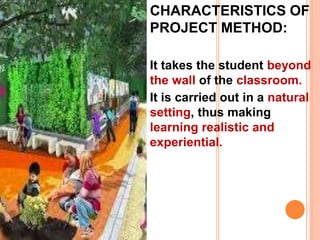
Ittakes the student beyond
the wall of the classroom.
It is carried out in a natural
setting, thus making
learning realistic and
experiential.
6.
CONTD…..
Project methodgives an opportunity for self-
expression.
The experiment of the project method want to
reset the whole curriculum and break all the
barriers of subject.
A project can be a large unit of appreciational
learning.
It is a complete surrender to the child’s point of
view.
It establish a positive knowledge.
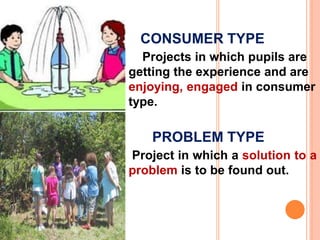
CONSUMER TYPE
Projects inwhich pupils are
getting the experience and are
enjoying, engaged in consumer
type.
PROBLEM TYPE
Project in which a solution to a
problem is to be found out.
9.
DRILL TYPE
An activityonce performed, is
repeated to acquire greater skill, e.g
swimming or singing.
Project method involves all type of
mental and manipulative activities.
10.
According to thepurposes and the
objectives by which the learning
activities are unified and shaped.
1.Projects calling for the production
of some physical or material
product.
2.Learning project, acquisition of
some ability. Intellectual or problem
project.
11.
ESSENTIALS
Bearing on agreat number of
subject, knowledge acquired
through it.
It should be timely.
It should be challenging and
feasible.
12.
ORGANIZING A PROJECT
1.Creating situation and selection of the
problem. He should see that the project
are educative and according to the
capacity of the pupils.
2. Planning and purposeful.
3. Avoid interruption.
4. Execution of the project. The teacher
should carefully supervise the pupils.
5. Evaluation should be done by both
pupils and teacher.
13.
MERITS
1.Follows the psychologicallaws of learning
Law of readiness.
Law of exercise.
Law of effect.
2.Gives freedom to the pupils.
3.Suited to the psychological concept of
maturation.
4.Social values derives.
5.Training for social adjustment.
6.Saves children from insincerity and
superficiality.
7.Trains for a democratic way of life.
14.
CONTD….
8.Learning through practicalproblem
solving.
9.Student and the teacher grow.
10.Intrinsic standard of evaluation set up.
11.Satisfaction of completing the whole
task.
12.Economical.
13. Ideal for science work.
15.
LIMITATIONS
Learning haphazard.
Communication subordinated.
Practical difficulties.
Time consuming.
Leave gaps in pupil’s knowledge.
Ignore working from simple to complex.
Less satisfactory.
Results in incomplete mastery of tools of
learning.
16.
TEACHER’S ROLE
Needsmature experience.
Skillful guide.
Helpful.
Good prompter.
Relation between the pupils and teacher are
to be closer and informal.
She must be a director.
Keen observer.
Store of knowledge.
Project is based on correlated teaching.