Building Science II [BLD 61303]
Project 2: Integration Project
Chia Cheng Wei
0322091
Tutor: Azim Sulaiman
Table of content
1.0 Introduction
2.0 Daylight Analysis
2.1 Daylight factor analysis
2.1.1 Space A: Magazine and Newspaper Area (First floor)
2.2 Artificial lighting
2.2.1 Space A: Magazine and Newspaper Area
2.2.2 Space B: Fiction and Non-fiction Area (2nd floor)
3.0 Reference
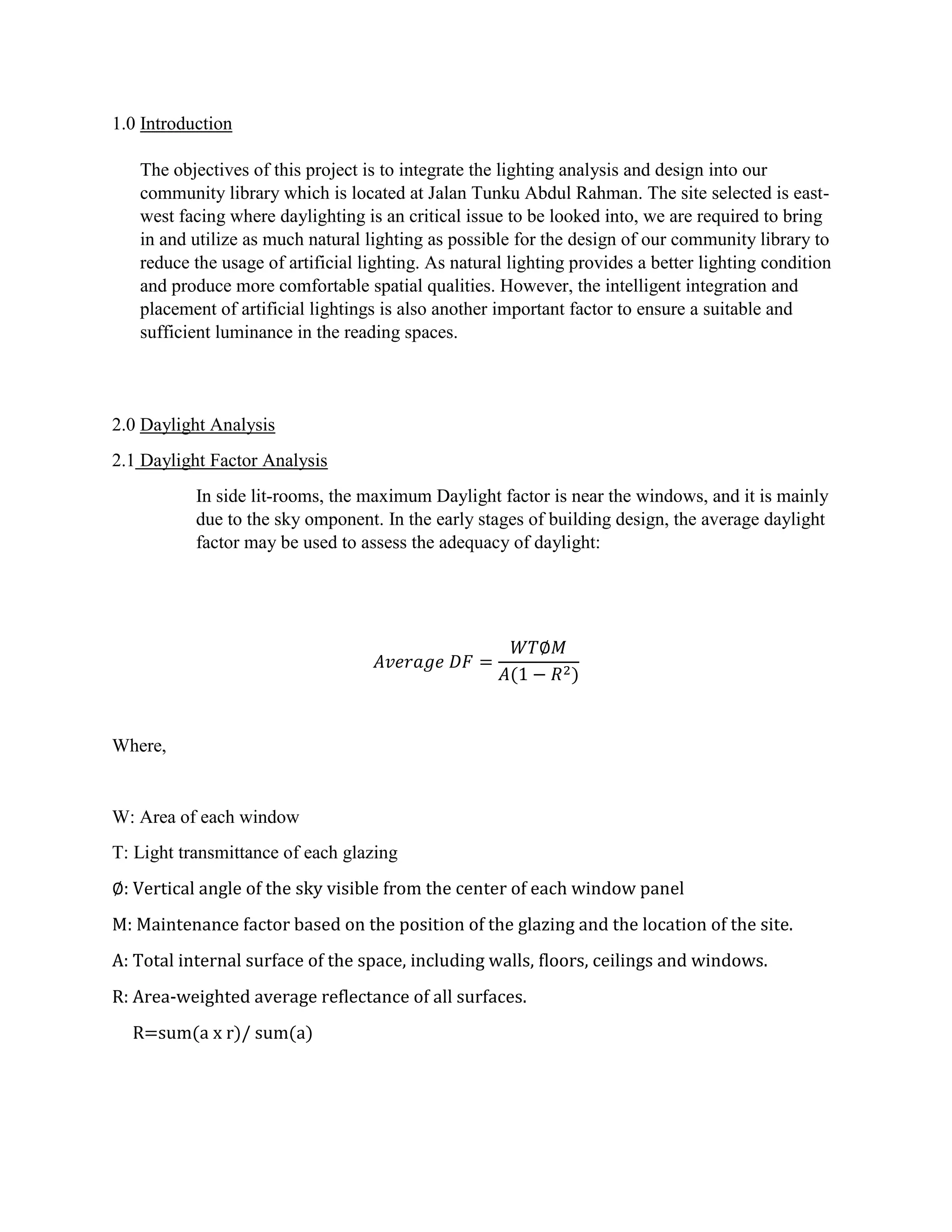
1.0 Introduction
The objectives of this project is to integrate the lighting analysis and design into our
community library which is located at Jalan Tunku Abdul Rahman. The site selected is east-
west facing where daylighting is an critical issue to be looked into, we are required to bring
in and utilize as much natural lighting as possible for the design of our community library to
reduce the usage of artificial lighting. As natural lighting provides a better lighting condition
and produce more comfortable spatial qualities. However, the intelligent integration and
placement of artificial lightings is also another important factor to ensure a suitable and
sufficient luminance in the reading spaces.
2.0 Daylight Analysis
2.1 Daylight Factor Analysis
In side lit-rooms, the maximum Daylight factor is near the windows, and it is mainly
due to the sky omponent. In the early stages of building design, the average daylight
factor may be used to assess the adequacy of daylight:
𝐴𝑣𝑒𝑟𝑎𝑔𝑒 𝐷𝐹 =
𝑊𝑇∅𝑀
𝐴(1 − 𝑅2)
Where,
W: Area of each window
T: Light transmittance of each glazing
∅: Vertical angle of the sky visible from the center of each window panel
M: Maintenance factor based on the position of the glazing and the location of the site.
A: Total internal surface of the space, including walls, floors, ceilings and windows.
R: Area-weighted average reflectance of all surfaces.
R=sum(a x r)/ sum(a)
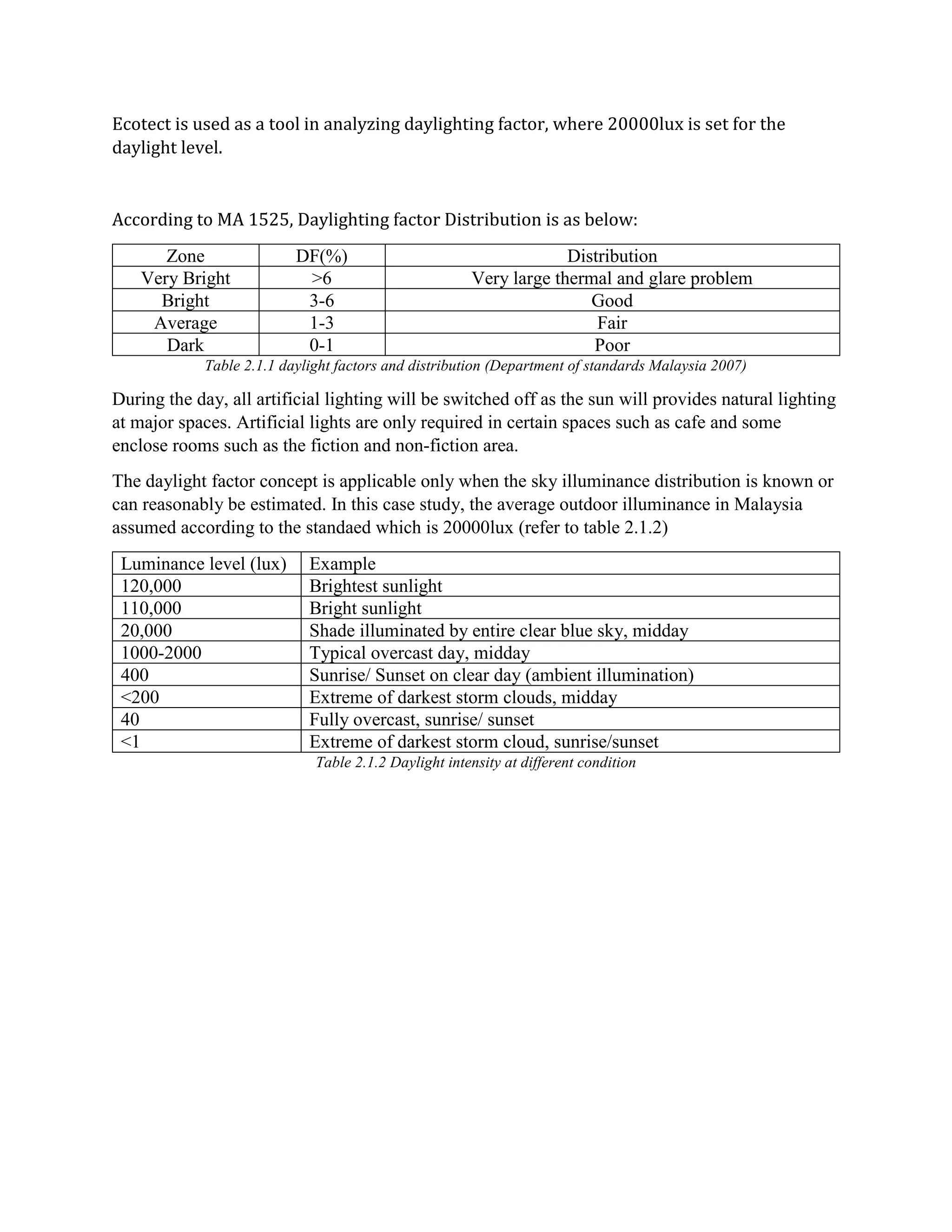
Ecotect is used as a tool in analyzing daylighting factor, where 20000lux is set for the
daylight level.
According to MA 1525, Daylighting factor Distribution is as below:
Zone DF(%) Distribution
Very Bright >6 Very large thermal and glare problem
Bright 3-6 Good
Average 1-3 Fair
Dark 0-1 Poor
Table 2.1.1 daylight factors and distribution (Department of standards Malaysia 2007)
During the day, all artificial lighting will be switched off as the sun will provides natural lighting
at major spaces. Artificial lights are only required in certain spaces such as cafe and some
enclose rooms such as the fiction and non-fiction area.
The daylight factor concept is applicable only when the sky illuminance distribution is known or
can reasonably be estimated. In this case study, the average outdoor illuminance in Malaysia
assumed according to the standaed which is 20000lux (refer to table 2.1.2)
Luminance level (lux) Example
120,000 Brightest sunlight
110,000 Bright sunlight
20,000 Shade illuminated by entire clear blue sky, midday
1000-2000 Typical overcast day, midday
400 Sunrise/ Sunset on clear day (ambient illumination)
<200 Extreme of darkest storm clouds, midday
40 Fully overcast, sunrise/ sunset
<1 Extreme of darkest storm cloud, sunrise/sunset
Table 2.1.2 Daylight intensity at different condition
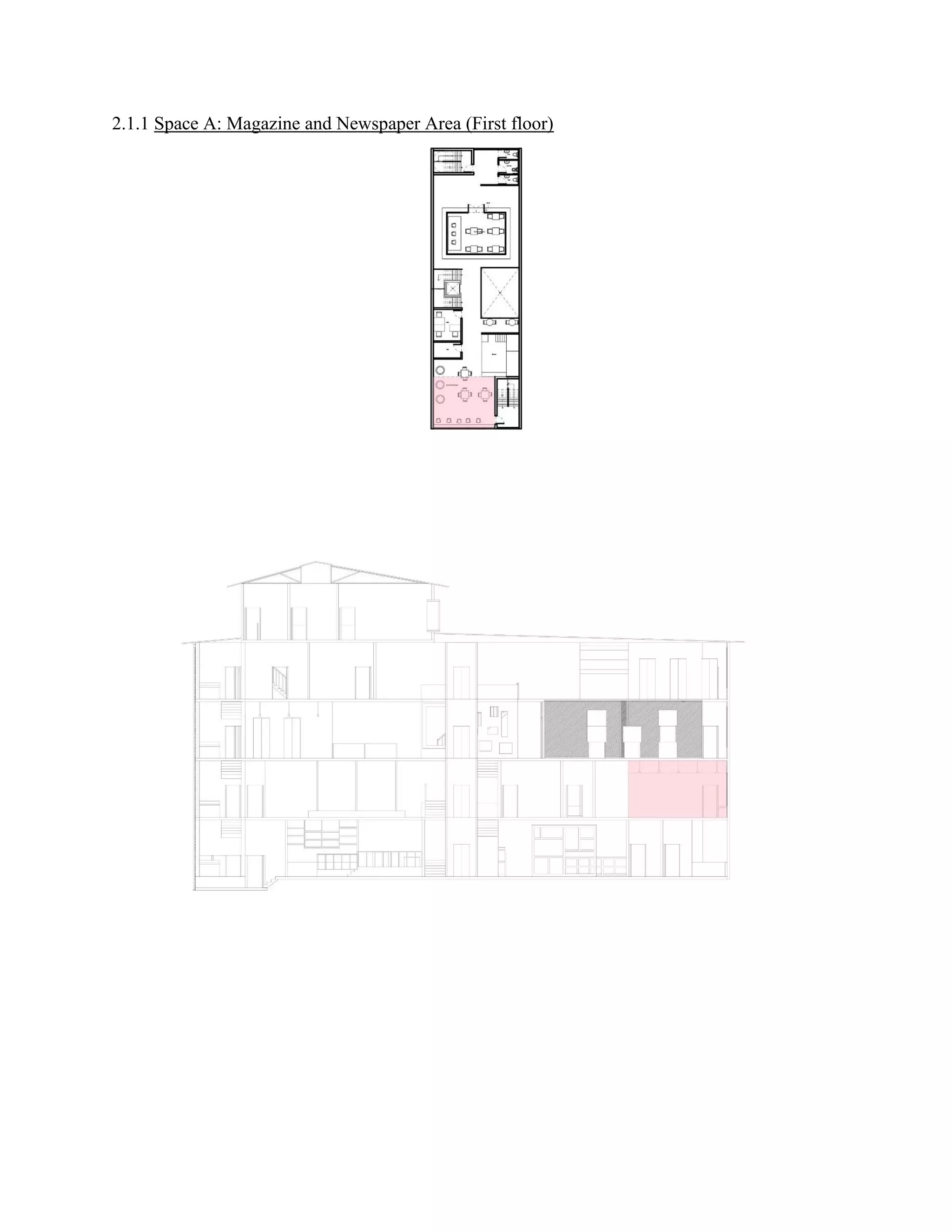
2.1.1 Space A: Magazine and Newspaper Area (First floor)
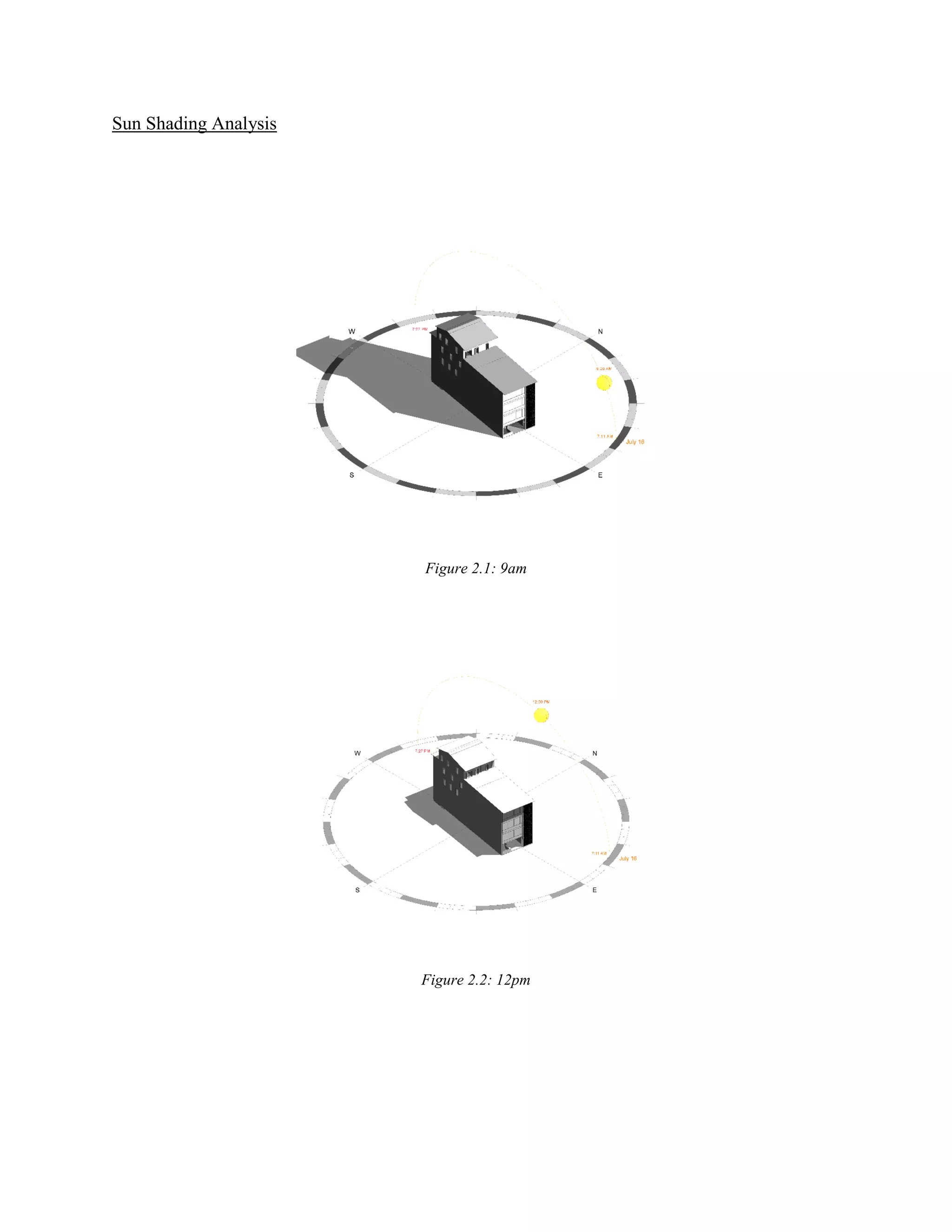
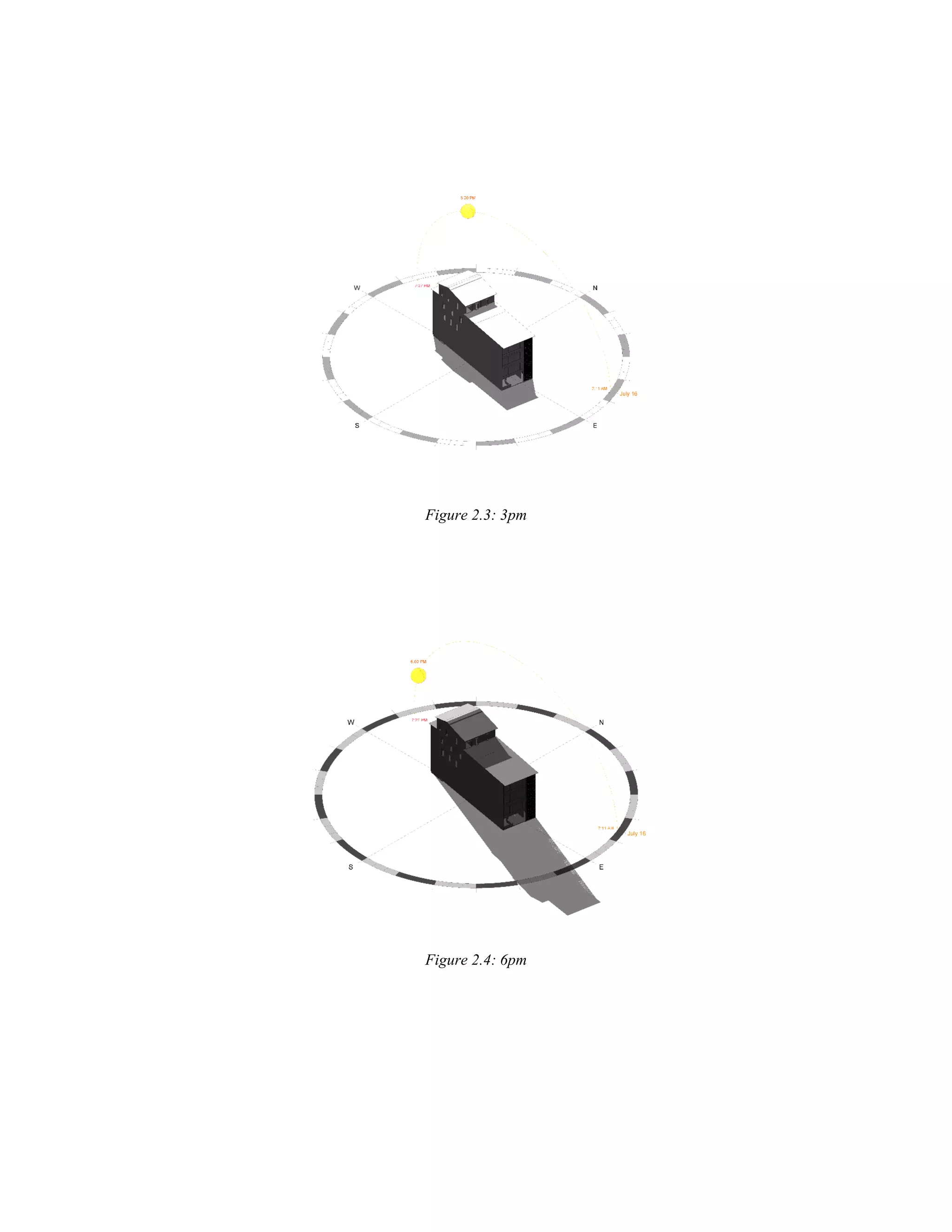
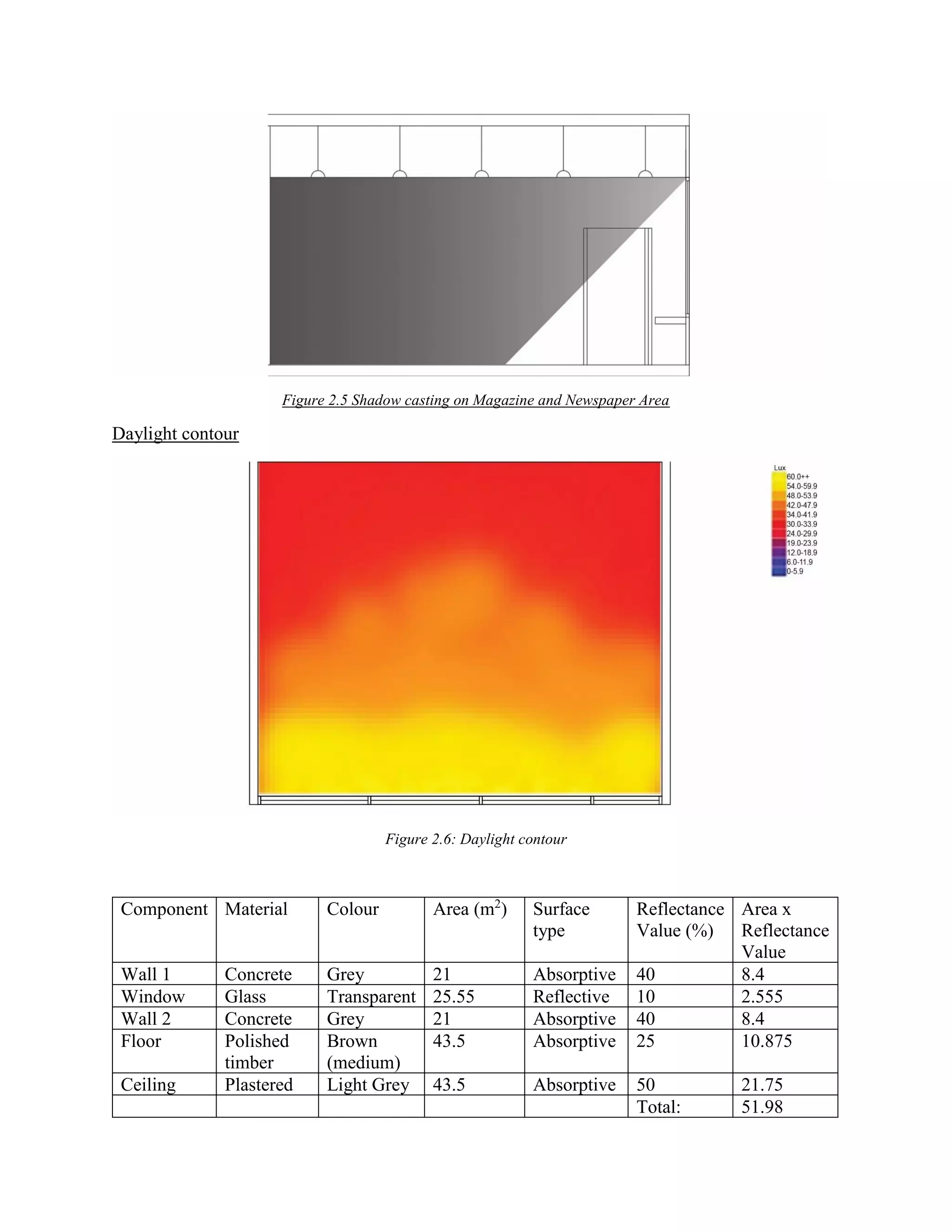
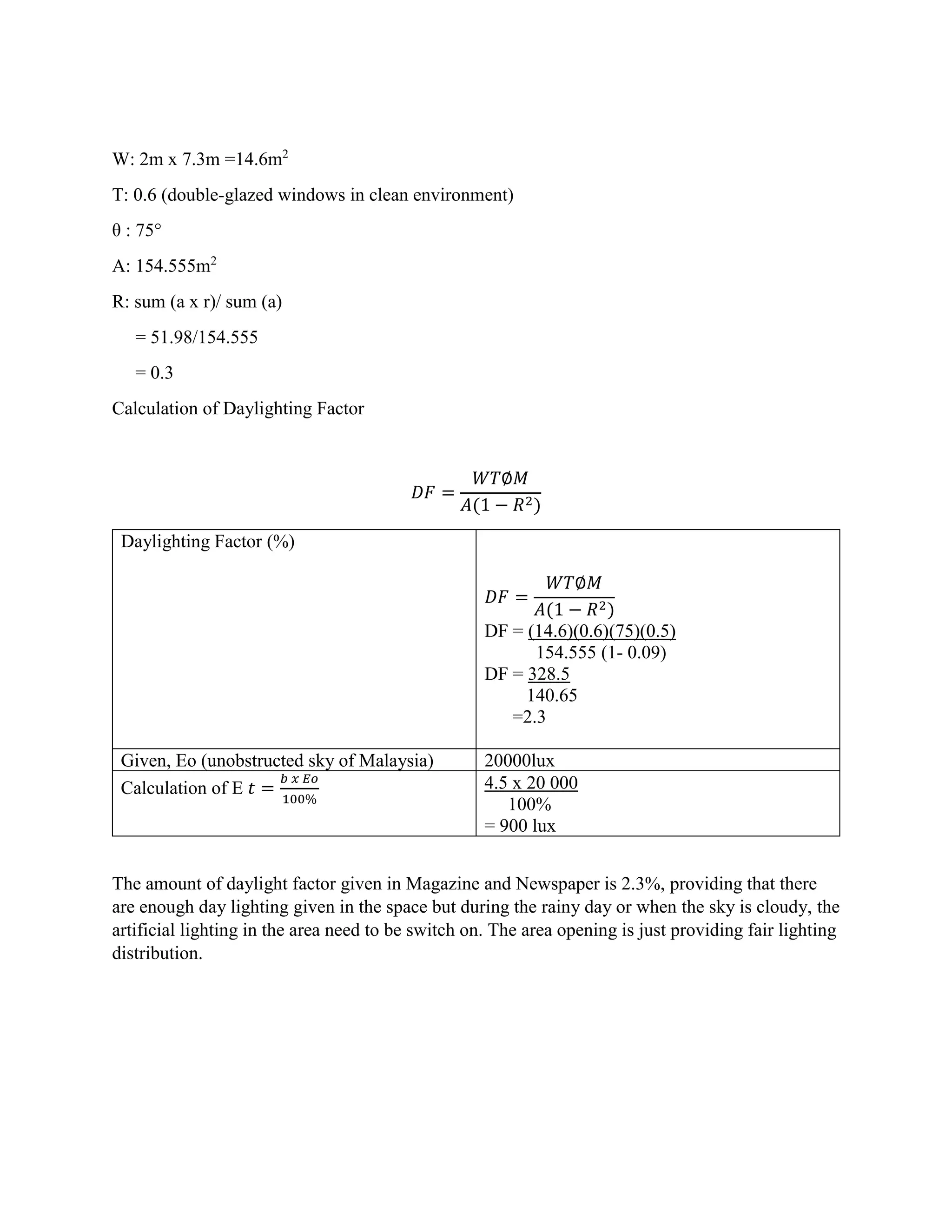
Sun Shading Analysis
Figure 2.1: 9am
Figure 2.2: 12pm
Figure 2.3: 3pm
Figure 2.4: 6pm
Figure 2.5 Shadow casting on Magazine and Newspaper Area
Daylight contour
Figure 2.6: Daylight contour
Component Material Colour Area (m2
) Surface
type
Reflectance
Value (%)
Area x
Reflectance
Value
Wall 1 Concrete Grey 21 Absorptive 40 8.4
Window Glass Transparent 25.55 Reflective 10 2.555
Wall 2 Concrete Grey 21 Absorptive 40 8.4
Floor Polished
timber
Brown
(medium)
43.5 Absorptive 25 10.875
Ceiling Plastered Light Grey 43.5 Absorptive 50 21.75
Total: 51.98
W: 2m x 7.3m =14.6m2
T: 0.6 (double-glazed windows in clean environment)
θ : 75°
A: 154.555m2
R: sum (a x r)/ sum (a)
= 51.98/154.555
= 0.3
Calculation of Daylighting Factor
𝐷𝐹 =
𝑊𝑇∅𝑀
𝐴(1 − 𝑅2)
Daylighting Factor (%)
𝐷𝐹 =
𝑊𝑇∅𝑀
𝐴(1 − 𝑅2)
DF = (14.6)(0.6)(75)(0.5)
154.555 (1- 0.09)
DF = 328.5
140.65
=2.3
Given, Eo (unobstructed sky of Malaysia) 20000lux
Calculation of E 𝑡 =
𝑏 𝑥 𝐸𝑜
100%
4.5 x 20 000
100%
= 900 lux
The amount of daylight factor given in Magazine and Newspaper is 2.3%, providing that there
are enough day lighting given in the space but during the rainy day or when the sky is cloudy, the
artificial lighting in the area need to be switch on. The area opening is just providing fair lighting
distribution.
2.2 Artificial Lighting Analysis
Lumen Method
Lumen method is commonly used technique of lighting design, which is valid, if the light fittings
(luminaires) are to be mounted overhead in a regular pattern. The luminous flux output (lumens)
of each lamp needs to be known as well as the details of the luminaires and the room surfaces. It
can be calculated using the formula:
𝑁 =
𝐸 𝑥 𝐴
𝐹 𝑥 𝑈𝐹 𝑥 𝑀𝐹
Where,
N: Number of lamps required
E: Illuminance level required (lux)
A: Area at working plane height (m2
)
F: Average luminous flux from each lamp (lm)
UF: utilization factor, an allowance for the light distribution of the luminaire and room surfaces.
MF: Maintenance factor, an allowance for reduced light output because of deterioration and dirt.
Room Index
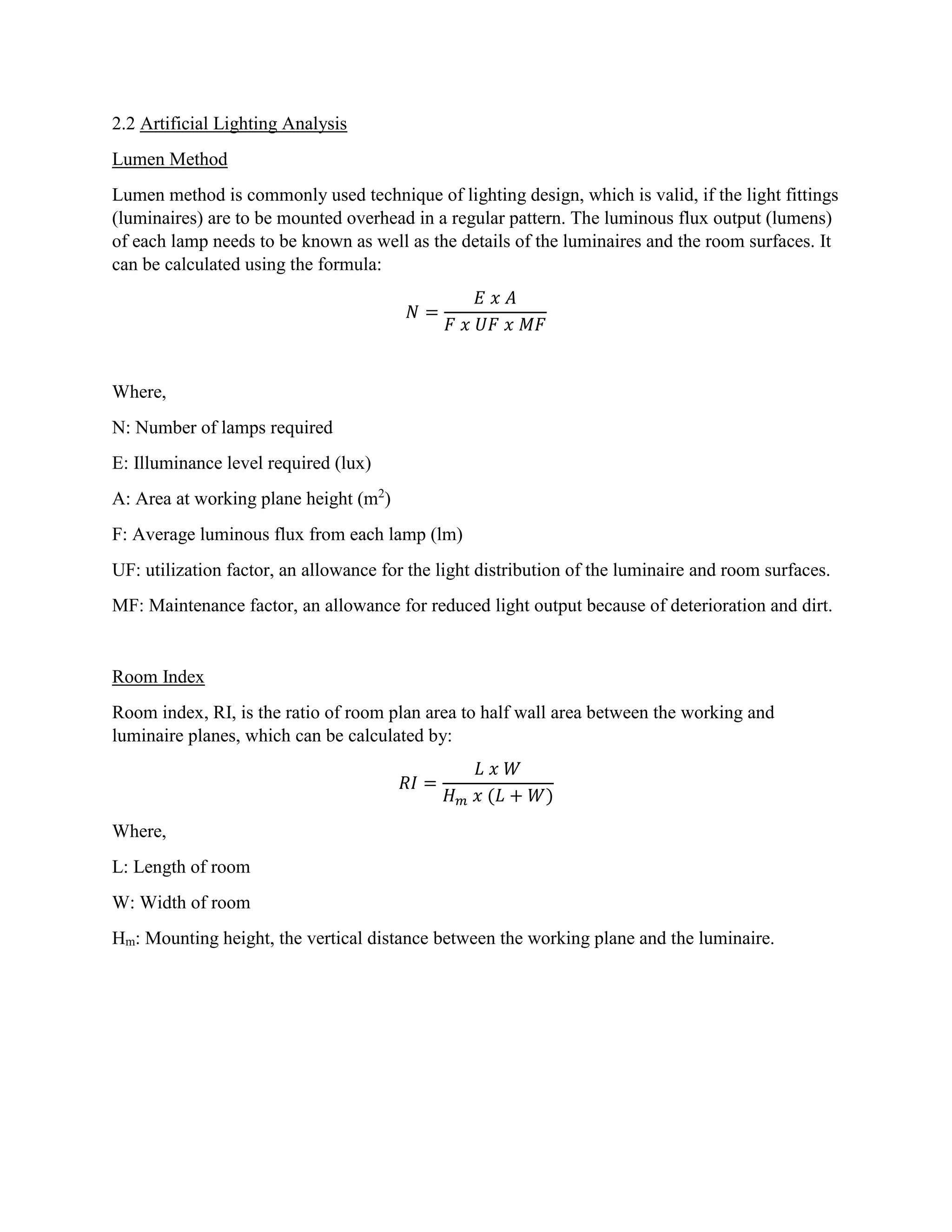
Room index, RI, is the ratio of room plan area to half wall area between the working and
luminaire planes, which can be calculated by:
𝑅𝐼 =
𝐿 𝑥 𝑊
𝐻 𝑚 𝑥 (𝐿 + 𝑊)
Where,
L: Length of room
W: Width of room
Hm: Mounting height, the vertical distance between the working plane and the luminaire.
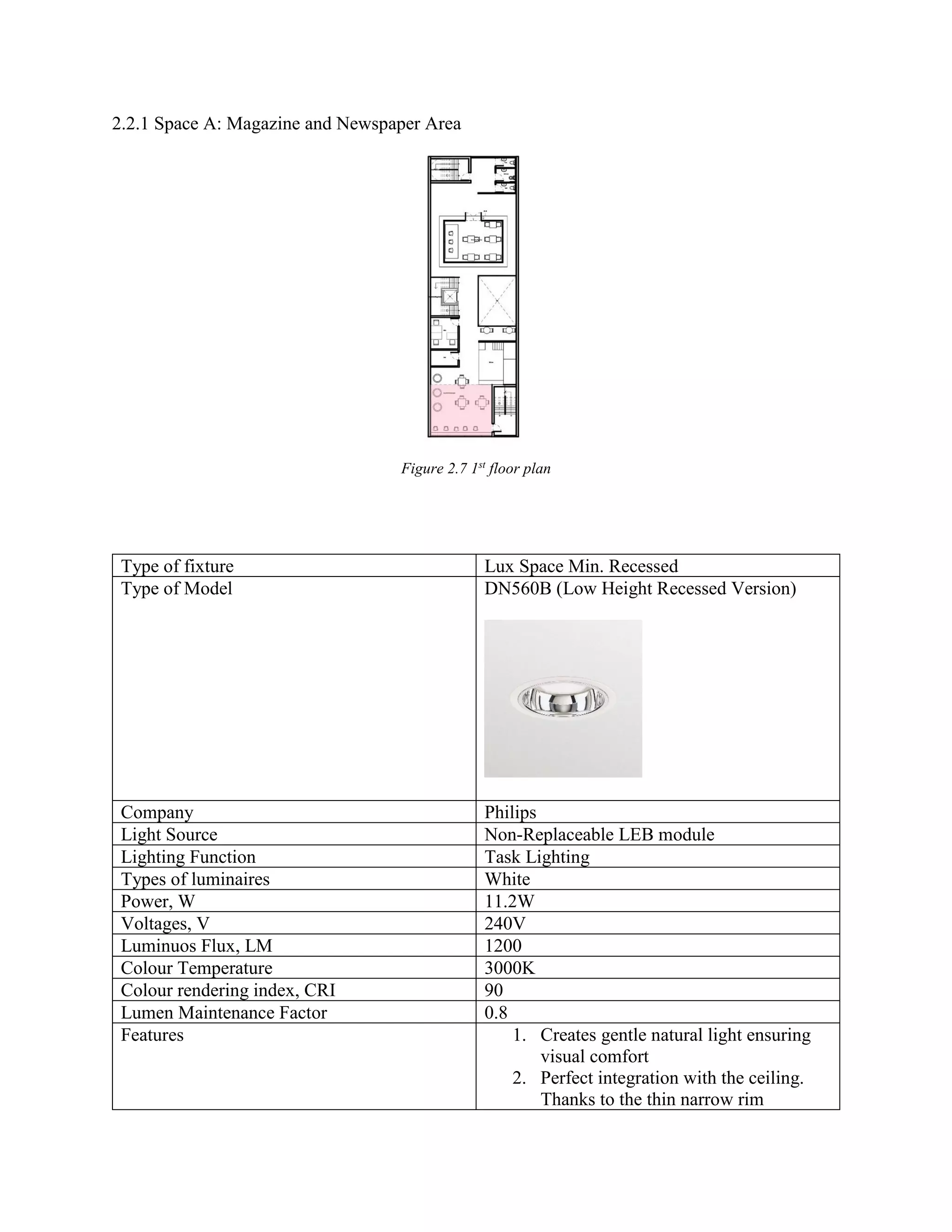
2.2.1 Space A: Magazine and Newspaper Area
Figure 2.7 1st
floor plan
Type of fixture Lux Space Min. Recessed
Type of Model DN560B (Low Height Recessed Version)
Company Philips
Light Source Non-Replaceable LEB module
Lighting Function Task Lighting
Types of luminaires White
Power, W 11.2W
Voltages, V 240V
Luminuos Flux, LM 1200
Colour Temperature 3000K
Colour rendering index, CRI 90
Lumen Maintenance Factor 0.8
Features 1. Creates gentle natural light ensuring
visual comfort
2. Perfect integration with the ceiling.
Thanks to the thin narrow rim
Location Magazine and Newspaper Area
Dimension of space (m) Length(L): 7.3
Width(W): 6m
Height of the ceiling: 2.7
Total floor area (m2
) 43.5
Height of luminaires (m) 2.7
Height of working plane (m) 0.8
Mounting height 2.7
Standard Illumination required according to
MS1525
400
Reflectance factor Ceiling (white plastered ceiling) = 0.7
Wall (White painted wall) = 0.5
Working plane (wooden deck) = 0.1
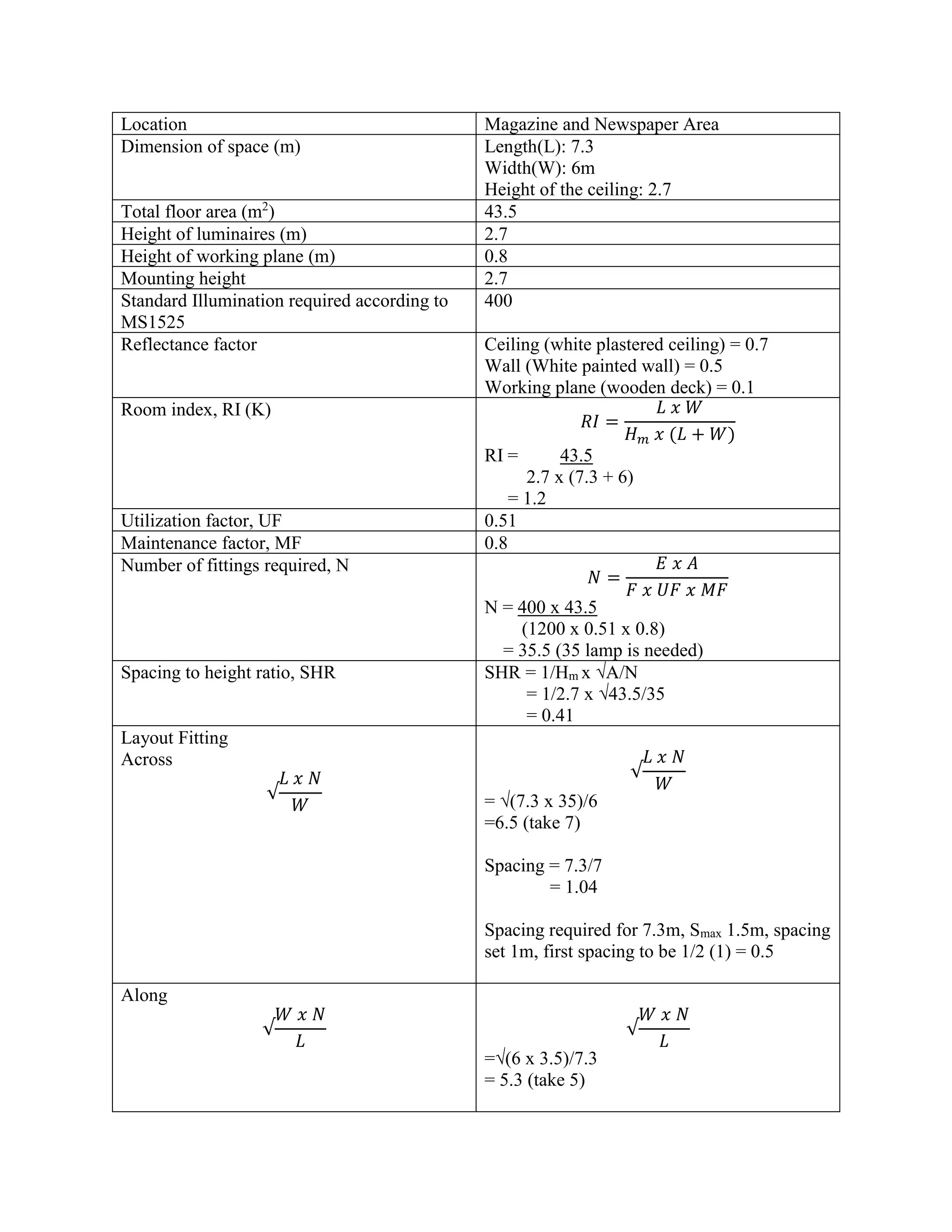
Room index, RI (K)
𝑅𝐼 =
𝐿 𝑥 𝑊
𝐻 𝑚 𝑥 (𝐿 + 𝑊)
RI = 43.5
2.7 x (7.3 + 6)
= 1.2
Utilization factor, UF 0.51
Maintenance factor, MF 0.8
Number of fittings required, N
𝑁 =
𝐸 𝑥 𝐴
𝐹 𝑥 𝑈𝐹 𝑥 𝑀𝐹
N = 400 x 43.5
(1200 x 0.51 x 0.8)
= 35.5 (35 lamp is needed)
Spacing to height ratio, SHR SHR = 1/Hm x √A/N
= 1/2.7 x √43.5/35
= 0.41
Layout Fitting
Across
√
𝐿 𝑥 𝑁
𝑊
√
𝐿 𝑥 𝑁
𝑊
= √(7.3 x 35)/6
=6.5 (take 7)
Spacing = 7.3/7
= 1.04
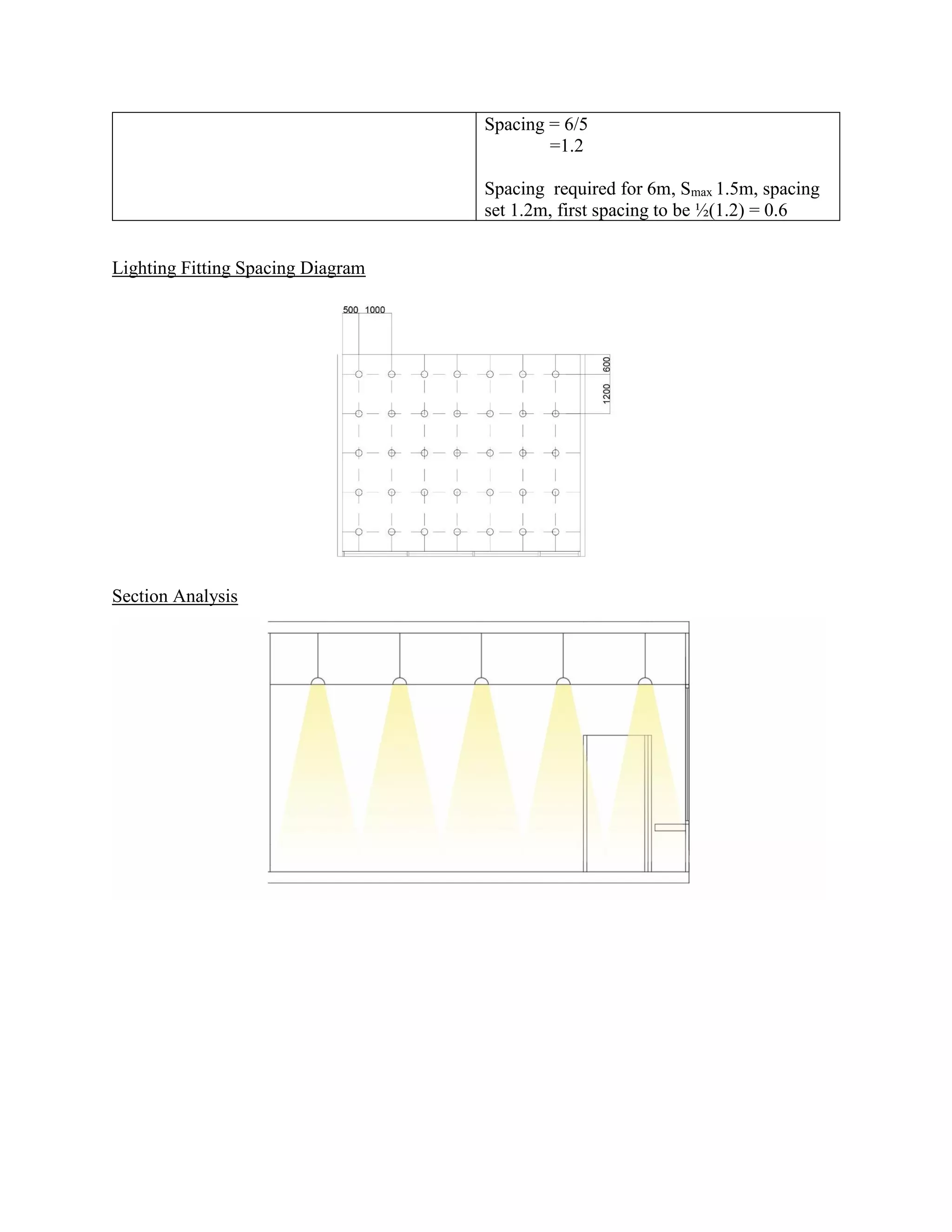
Spacing required for 7.3m, Smax 1.5m, spacing
set 1m, first spacing to be 1/2 (1) = 0.5
Along
√
𝑊 𝑥 𝑁
𝐿
√
𝑊 𝑥 𝑁
𝐿
=√(6 x 3.5)/7.3
= 5.3 (take 5)
Spacing = 6/5
=1.2
Spacing required for 6m, Smax 1.5m, spacing
set 1.2m, first spacing to be ½(1.2) = 0.6
Lighting Fitting Spacing Diagram
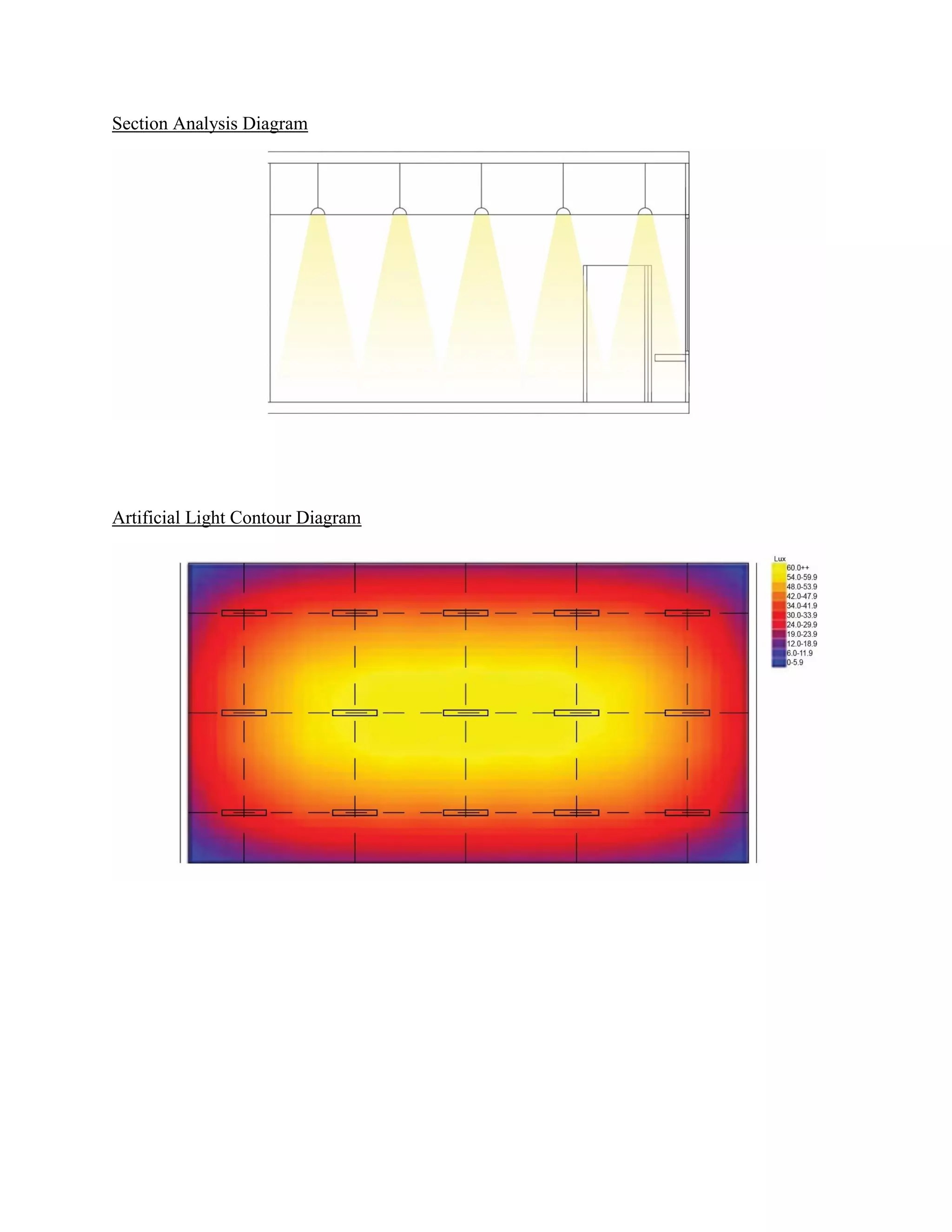
Section Analysis
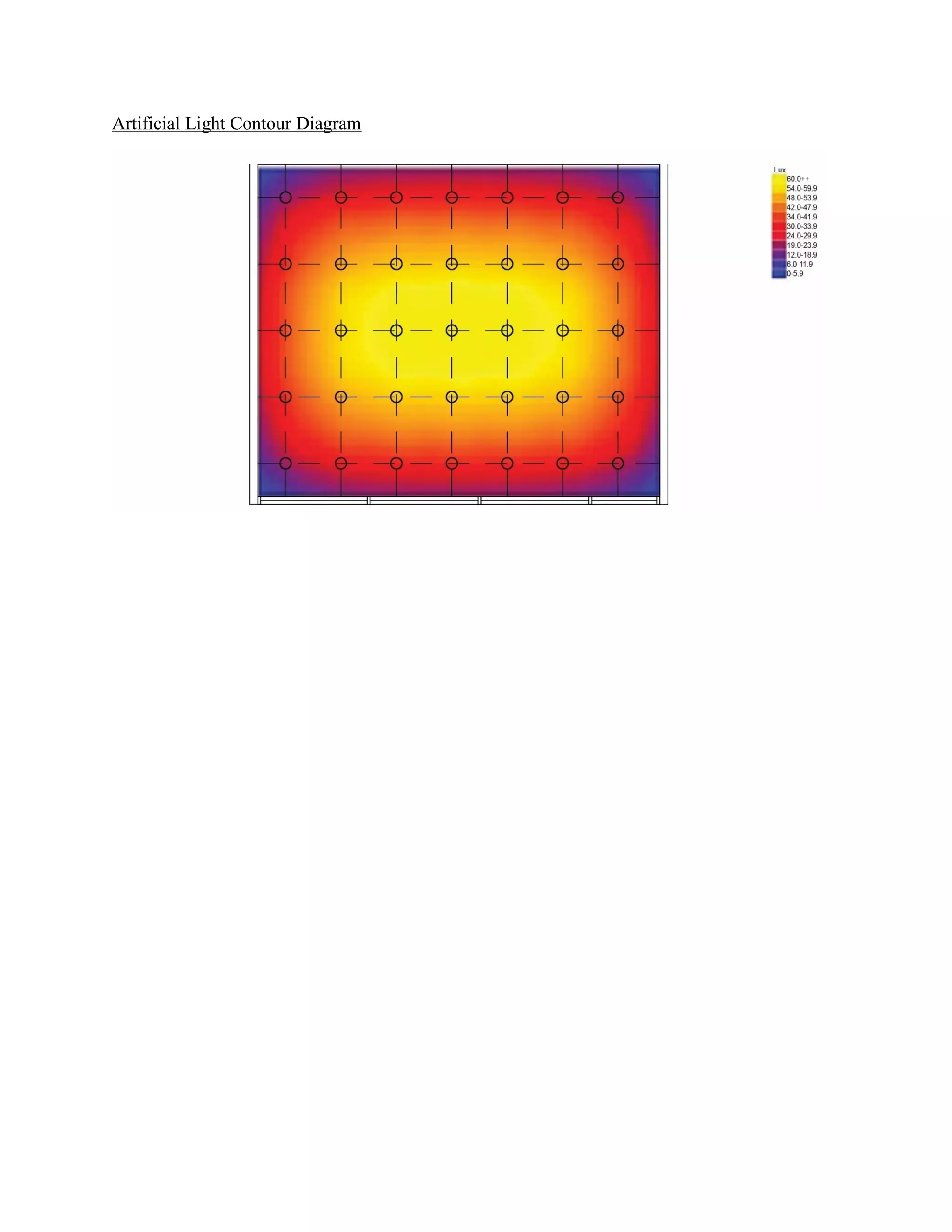
Artificial Light Contour Diagram
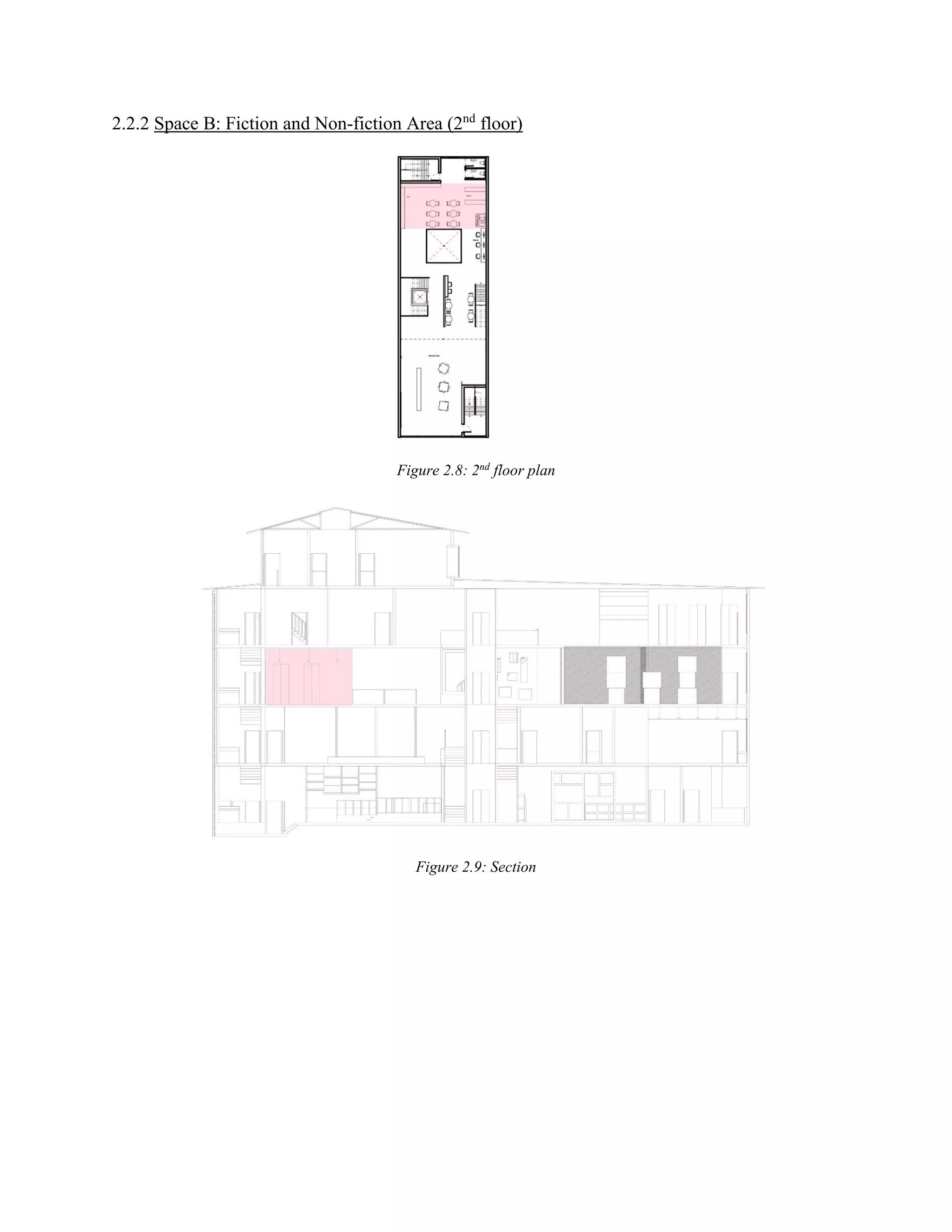
2.2.2 Space B: Fiction and Non-fiction Area (2nd
floor)
Figure 2.8: 2nd
floor plan
Figure 2.9: Section
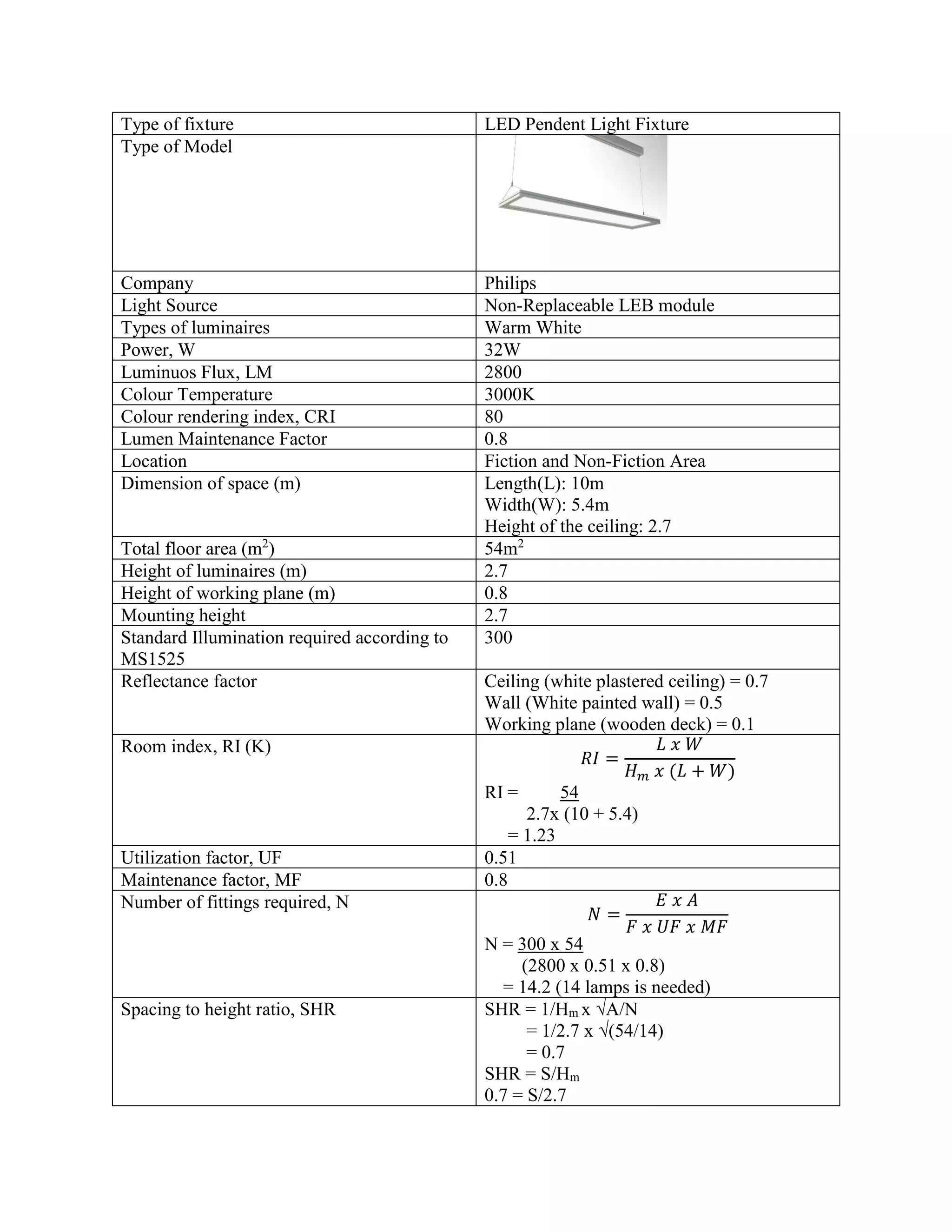
Type of fixture LED Pendent Light Fixture
Type of Model
Company Philips
Light Source Non-Replaceable LEB module
Types of luminaires Warm White
Power, W 32W
Luminuos Flux, LM 2800
Colour Temperature 3000K
Colour rendering index, CRI 80
Lumen Maintenance Factor 0.8
Location Fiction and Non-Fiction Area
Dimension of space (m) Length(L): 10m
Width(W): 5.4m
Height of the ceiling: 2.7
Total floor area (m2
) 54m2
Height of luminaires (m) 2.7
Height of working plane (m) 0.8
Mounting height 2.7
Standard Illumination required according to
MS1525
300
Reflectance factor Ceiling (white plastered ceiling) = 0.7
Wall (White painted wall) = 0.5
Working plane (wooden deck) = 0.1
Room index, RI (K)
𝑅𝐼 =
𝐿 𝑥 𝑊
𝐻 𝑚 𝑥 (𝐿 + 𝑊)
RI = 54
2.7x (10 + 5.4)
= 1.23
Utilization factor, UF 0.51
Maintenance factor, MF 0.8
Number of fittings required, N
𝑁 =
𝐸 𝑥 𝐴
𝐹 𝑥 𝑈𝐹 𝑥 𝑀𝐹
N = 300 x 54
(2800 x 0.51 x 0.8)
= 14.2 (14 lamps is needed)
Spacing to height ratio, SHR SHR = 1/Hm x √A/N
= 1/2.7 x √(54/14)
= 0.7
SHR = S/Hm
0.7 = S/2.7
S = 2m
Layout Fitting
Across
√
𝐿 𝑥 𝑁
𝑊
√
𝐿 𝑥 𝑁
𝑊
= √(10 x 14)/5.4
=5.1 (take 5)
Spacing = 10/5
= 2
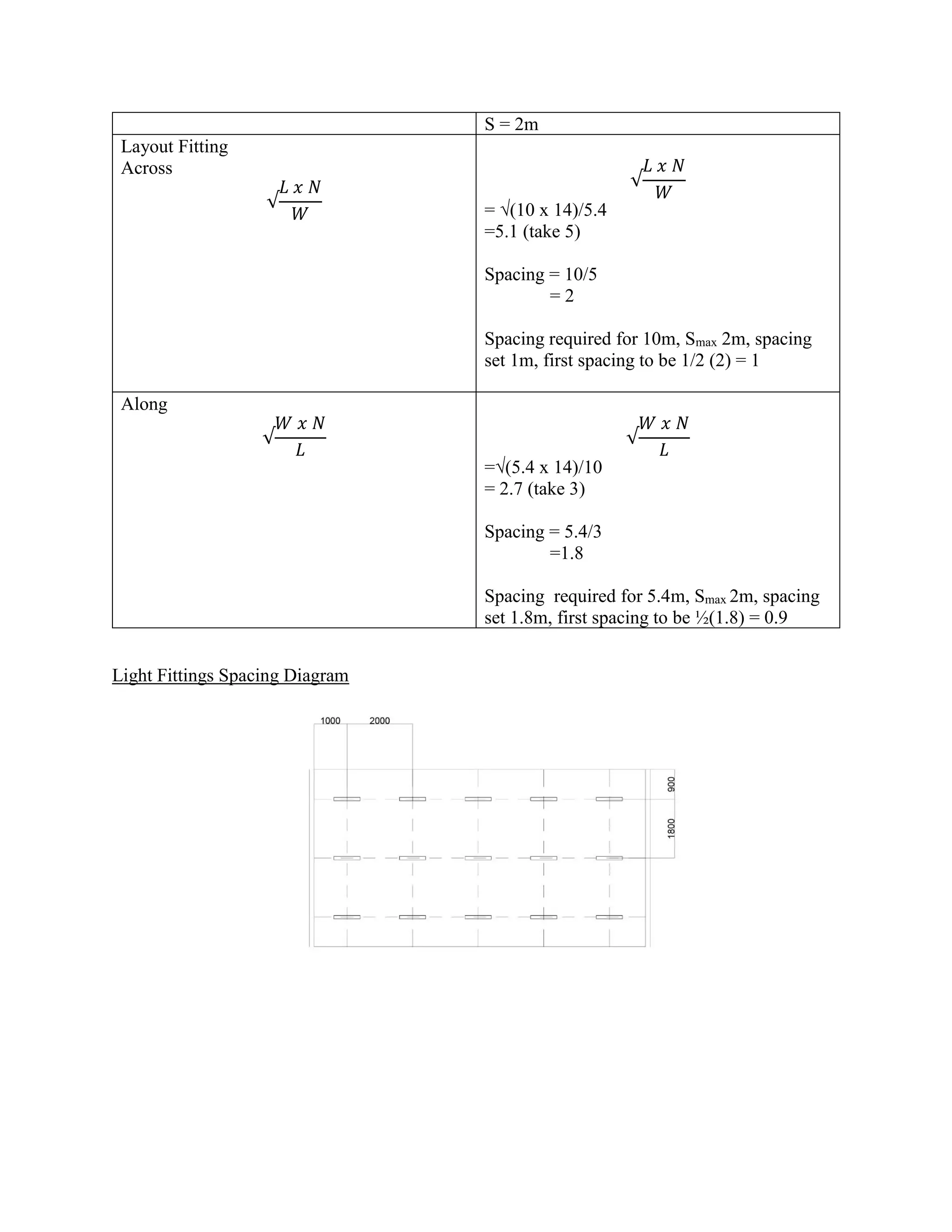
Spacing required for 10m, Smax 2m, spacing
set 1m, first spacing to be 1/2 (2) = 1
Along
√
𝑊 𝑥 𝑁
𝐿
√
𝑊 𝑥 𝑁
𝐿
=√(5.4 x 14)/10
= 2.7 (take 3)
Spacing = 5.4/3
=1.8
Spacing required for 5.4m, Smax 2m, spacing
set 1.8m, first spacing to be ½(1.8) = 0.9
Light Fittings Spacing Diagram
Section Analysis Diagram
Artificial Light Contour Diagram
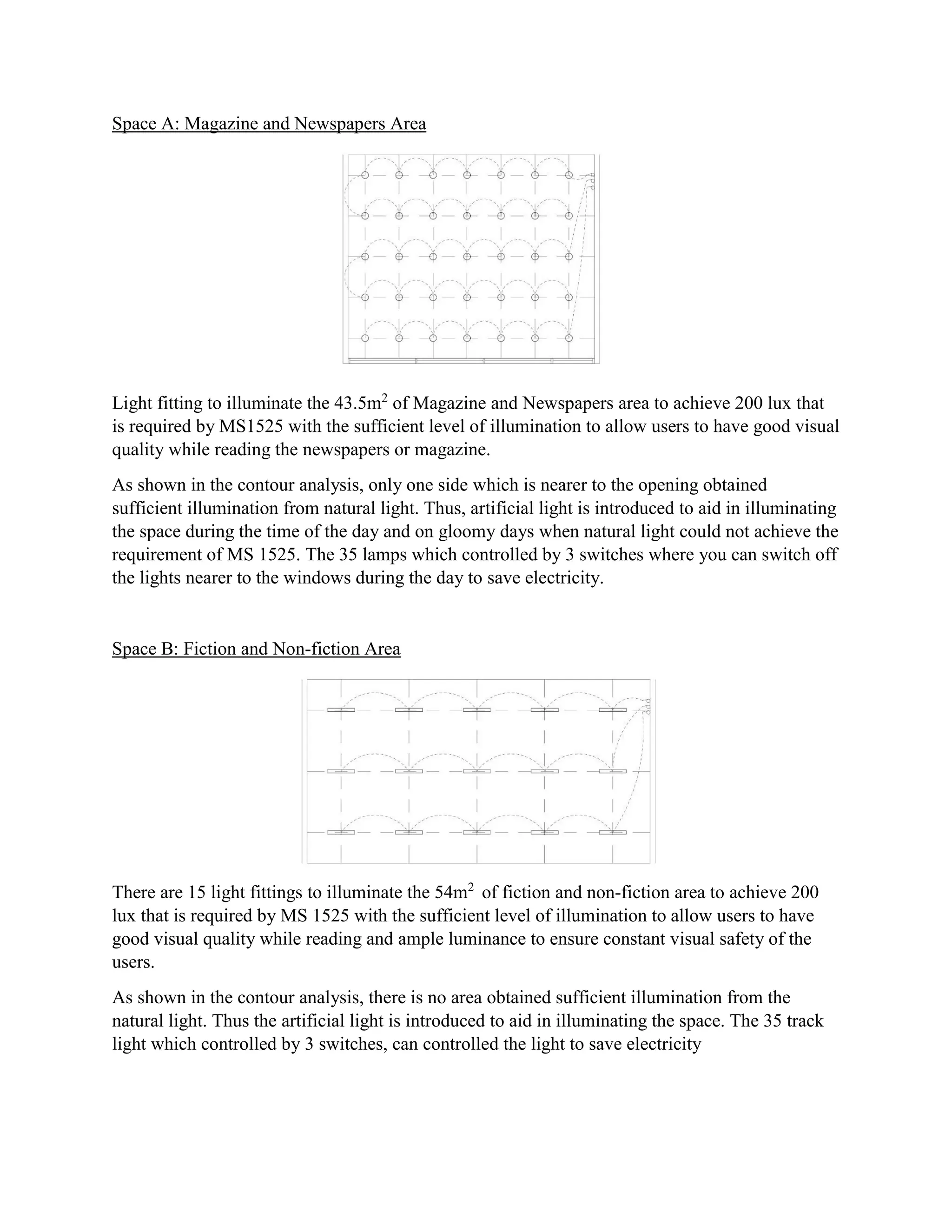
Space A: Magazine and Newspapers Area
Light fitting to illuminate the 43.5m2
of Magazine and Newspapers area to achieve 200 lux that
is required by MS1525 with the sufficient level of illumination to allow users to have good visual
quality while reading the newspapers or magazine.
As shown in the contour analysis, only one side which is nearer to the opening obtained
sufficient illumination from natural light. Thus, artificial light is introduced to aid in illuminating
the space during the time of the day and on gloomy days when natural light could not achieve the
requirement of MS 1525. The 35 lamps which controlled by 3 switches where you can switch off
the lights nearer to the windows during the day to save electricity.
Space B: Fiction and Non-fiction Area
There are 15 light fittings to illuminate the 54m2
of fiction and non-fiction area to achieve 200
lux that is required by MS 1525 with the sufficient level of illumination to allow users to have
good visual quality while reading and ample luminance to ensure constant visual safety of the
users.
As shown in the contour analysis, there is no area obtained sufficient illumination from the
natural light. Thus the artificial light is introduced to aid in illuminating the space. The 35 track
light which controlled by 3 switches, can controlled the light to save electricity
3.0 Reference
(n.d.). Retrieved July 16, 2017, from
http://docs.agi32.com/AGi32/Content/adding_calculation_points/Calculations_Daylight_Factor_
Concepts.htm
MS 1525 2014. (n.d.). Retrieved July 16, 2017, from
https://www.scribd.com/doc/297929846/MS-1525-2014
Muneer, T. (2000). Windows in buildings: thermal, acoustic, visual, and solar performance.
Oxford: Architectural Press.

Project 2

  • 1.
    Building Science II[BLD 61303] Project 2: Integration Project Chia Cheng Wei 0322091 Tutor: Azim Sulaiman
  • 2.
    Table of content 1.0Introduction 2.0 Daylight Analysis 2.1 Daylight factor analysis 2.1.1 Space A: Magazine and Newspaper Area (First floor) 2.2 Artificial lighting 2.2.1 Space A: Magazine and Newspaper Area 2.2.2 Space B: Fiction and Non-fiction Area (2nd floor) 3.0 Reference
  • 3.
    1.0 Introduction The objectivesof this project is to integrate the lighting analysis and design into our community library which is located at Jalan Tunku Abdul Rahman. The site selected is east- west facing where daylighting is an critical issue to be looked into, we are required to bring in and utilize as much natural lighting as possible for the design of our community library to reduce the usage of artificial lighting. As natural lighting provides a better lighting condition and produce more comfortable spatial qualities. However, the intelligent integration and placement of artificial lightings is also another important factor to ensure a suitable and sufficient luminance in the reading spaces. 2.0 Daylight Analysis 2.1 Daylight Factor Analysis In side lit-rooms, the maximum Daylight factor is near the windows, and it is mainly due to the sky omponent. In the early stages of building design, the average daylight factor may be used to assess the adequacy of daylight: 𝐴𝑣𝑒𝑟𝑎𝑔𝑒 𝐷𝐹 = 𝑊𝑇∅𝑀 𝐴(1 − 𝑅2) Where, W: Area of each window T: Light transmittance of each glazing ∅: Vertical angle of the sky visible from the center of each window panel M: Maintenance factor based on the position of the glazing and the location of the site. A: Total internal surface of the space, including walls, floors, ceilings and windows. R: Area-weighted average reflectance of all surfaces. R=sum(a x r)/ sum(a)
  • 4.
    Ecotect is usedas a tool in analyzing daylighting factor, where 20000lux is set for the daylight level. According to MA 1525, Daylighting factor Distribution is as below: Zone DF(%) Distribution Very Bright >6 Very large thermal and glare problem Bright 3-6 Good Average 1-3 Fair Dark 0-1 Poor Table 2.1.1 daylight factors and distribution (Department of standards Malaysia 2007) During the day, all artificial lighting will be switched off as the sun will provides natural lighting at major spaces. Artificial lights are only required in certain spaces such as cafe and some enclose rooms such as the fiction and non-fiction area. The daylight factor concept is applicable only when the sky illuminance distribution is known or can reasonably be estimated. In this case study, the average outdoor illuminance in Malaysia assumed according to the standaed which is 20000lux (refer to table 2.1.2) Luminance level (lux) Example 120,000 Brightest sunlight 110,000 Bright sunlight 20,000 Shade illuminated by entire clear blue sky, midday 1000-2000 Typical overcast day, midday 400 Sunrise/ Sunset on clear day (ambient illumination) <200 Extreme of darkest storm clouds, midday 40 Fully overcast, sunrise/ sunset <1 Extreme of darkest storm cloud, sunrise/sunset Table 2.1.2 Daylight intensity at different condition
  • 5.
    2.1.1 Space A:Magazine and Newspaper Area (First floor)
  • 6.
    Sun Shading Analysis Figure2.1: 9am Figure 2.2: 12pm
  • 7.
  • 8.
    Figure 2.5 Shadowcasting on Magazine and Newspaper Area Daylight contour Figure 2.6: Daylight contour Component Material Colour Area (m2 ) Surface type Reflectance Value (%) Area x Reflectance Value Wall 1 Concrete Grey 21 Absorptive 40 8.4 Window Glass Transparent 25.55 Reflective 10 2.555 Wall 2 Concrete Grey 21 Absorptive 40 8.4 Floor Polished timber Brown (medium) 43.5 Absorptive 25 10.875 Ceiling Plastered Light Grey 43.5 Absorptive 50 21.75 Total: 51.98
  • 9.
    W: 2m x7.3m =14.6m2 T: 0.6 (double-glazed windows in clean environment) θ : 75° A: 154.555m2 R: sum (a x r)/ sum (a) = 51.98/154.555 = 0.3 Calculation of Daylighting Factor 𝐷𝐹 = 𝑊𝑇∅𝑀 𝐴(1 − 𝑅2) Daylighting Factor (%) 𝐷𝐹 = 𝑊𝑇∅𝑀 𝐴(1 − 𝑅2) DF = (14.6)(0.6)(75)(0.5) 154.555 (1- 0.09) DF = 328.5 140.65 =2.3 Given, Eo (unobstructed sky of Malaysia) 20000lux Calculation of E 𝑡 = 𝑏 𝑥 𝐸𝑜 100% 4.5 x 20 000 100% = 900 lux The amount of daylight factor given in Magazine and Newspaper is 2.3%, providing that there are enough day lighting given in the space but during the rainy day or when the sky is cloudy, the artificial lighting in the area need to be switch on. The area opening is just providing fair lighting distribution.
  • 10.
    2.2 Artificial LightingAnalysis Lumen Method Lumen method is commonly used technique of lighting design, which is valid, if the light fittings (luminaires) are to be mounted overhead in a regular pattern. The luminous flux output (lumens) of each lamp needs to be known as well as the details of the luminaires and the room surfaces. It can be calculated using the formula: 𝑁 = 𝐸 𝑥 𝐴 𝐹 𝑥 𝑈𝐹 𝑥 𝑀𝐹 Where, N: Number of lamps required E: Illuminance level required (lux) A: Area at working plane height (m2 ) F: Average luminous flux from each lamp (lm) UF: utilization factor, an allowance for the light distribution of the luminaire and room surfaces. MF: Maintenance factor, an allowance for reduced light output because of deterioration and dirt. Room Index Room index, RI, is the ratio of room plan area to half wall area between the working and luminaire planes, which can be calculated by: 𝑅𝐼 = 𝐿 𝑥 𝑊 𝐻 𝑚 𝑥 (𝐿 + 𝑊) Where, L: Length of room W: Width of room Hm: Mounting height, the vertical distance between the working plane and the luminaire.
  • 11.
    2.2.1 Space A:Magazine and Newspaper Area Figure 2.7 1st floor plan Type of fixture Lux Space Min. Recessed Type of Model DN560B (Low Height Recessed Version) Company Philips Light Source Non-Replaceable LEB module Lighting Function Task Lighting Types of luminaires White Power, W 11.2W Voltages, V 240V Luminuos Flux, LM 1200 Colour Temperature 3000K Colour rendering index, CRI 90 Lumen Maintenance Factor 0.8 Features 1. Creates gentle natural light ensuring visual comfort 2. Perfect integration with the ceiling. Thanks to the thin narrow rim
  • 12.
    Location Magazine andNewspaper Area Dimension of space (m) Length(L): 7.3 Width(W): 6m Height of the ceiling: 2.7 Total floor area (m2 ) 43.5 Height of luminaires (m) 2.7 Height of working plane (m) 0.8 Mounting height 2.7 Standard Illumination required according to MS1525 400 Reflectance factor Ceiling (white plastered ceiling) = 0.7 Wall (White painted wall) = 0.5 Working plane (wooden deck) = 0.1 Room index, RI (K) 𝑅𝐼 = 𝐿 𝑥 𝑊 𝐻 𝑚 𝑥 (𝐿 + 𝑊) RI = 43.5 2.7 x (7.3 + 6) = 1.2 Utilization factor, UF 0.51 Maintenance factor, MF 0.8 Number of fittings required, N 𝑁 = 𝐸 𝑥 𝐴 𝐹 𝑥 𝑈𝐹 𝑥 𝑀𝐹 N = 400 x 43.5 (1200 x 0.51 x 0.8) = 35.5 (35 lamp is needed) Spacing to height ratio, SHR SHR = 1/Hm x √A/N = 1/2.7 x √43.5/35 = 0.41 Layout Fitting Across √ 𝐿 𝑥 𝑁 𝑊 √ 𝐿 𝑥 𝑁 𝑊 = √(7.3 x 35)/6 =6.5 (take 7) Spacing = 7.3/7 = 1.04 Spacing required for 7.3m, Smax 1.5m, spacing set 1m, first spacing to be 1/2 (1) = 0.5 Along √ 𝑊 𝑥 𝑁 𝐿 √ 𝑊 𝑥 𝑁 𝐿 =√(6 x 3.5)/7.3 = 5.3 (take 5)
  • 13.
    Spacing = 6/5 =1.2 Spacingrequired for 6m, Smax 1.5m, spacing set 1.2m, first spacing to be ½(1.2) = 0.6 Lighting Fitting Spacing Diagram Section Analysis
  • 14.
  • 15.
    2.2.2 Space B:Fiction and Non-fiction Area (2nd floor) Figure 2.8: 2nd floor plan Figure 2.9: Section
  • 16.
    Type of fixtureLED Pendent Light Fixture Type of Model Company Philips Light Source Non-Replaceable LEB module Types of luminaires Warm White Power, W 32W Luminuos Flux, LM 2800 Colour Temperature 3000K Colour rendering index, CRI 80 Lumen Maintenance Factor 0.8 Location Fiction and Non-Fiction Area Dimension of space (m) Length(L): 10m Width(W): 5.4m Height of the ceiling: 2.7 Total floor area (m2 ) 54m2 Height of luminaires (m) 2.7 Height of working plane (m) 0.8 Mounting height 2.7 Standard Illumination required according to MS1525 300 Reflectance factor Ceiling (white plastered ceiling) = 0.7 Wall (White painted wall) = 0.5 Working plane (wooden deck) = 0.1 Room index, RI (K) 𝑅𝐼 = 𝐿 𝑥 𝑊 𝐻 𝑚 𝑥 (𝐿 + 𝑊) RI = 54 2.7x (10 + 5.4) = 1.23 Utilization factor, UF 0.51 Maintenance factor, MF 0.8 Number of fittings required, N 𝑁 = 𝐸 𝑥 𝐴 𝐹 𝑥 𝑈𝐹 𝑥 𝑀𝐹 N = 300 x 54 (2800 x 0.51 x 0.8) = 14.2 (14 lamps is needed) Spacing to height ratio, SHR SHR = 1/Hm x √A/N = 1/2.7 x √(54/14) = 0.7 SHR = S/Hm 0.7 = S/2.7
  • 17.
    S = 2m LayoutFitting Across √ 𝐿 𝑥 𝑁 𝑊 √ 𝐿 𝑥 𝑁 𝑊 = √(10 x 14)/5.4 =5.1 (take 5) Spacing = 10/5 = 2 Spacing required for 10m, Smax 2m, spacing set 1m, first spacing to be 1/2 (2) = 1 Along √ 𝑊 𝑥 𝑁 𝐿 √ 𝑊 𝑥 𝑁 𝐿 =√(5.4 x 14)/10 = 2.7 (take 3) Spacing = 5.4/3 =1.8 Spacing required for 5.4m, Smax 2m, spacing set 1.8m, first spacing to be ½(1.8) = 0.9 Light Fittings Spacing Diagram
  • 18.
  • 19.
    Space A: Magazineand Newspapers Area Light fitting to illuminate the 43.5m2 of Magazine and Newspapers area to achieve 200 lux that is required by MS1525 with the sufficient level of illumination to allow users to have good visual quality while reading the newspapers or magazine. As shown in the contour analysis, only one side which is nearer to the opening obtained sufficient illumination from natural light. Thus, artificial light is introduced to aid in illuminating the space during the time of the day and on gloomy days when natural light could not achieve the requirement of MS 1525. The 35 lamps which controlled by 3 switches where you can switch off the lights nearer to the windows during the day to save electricity. Space B: Fiction and Non-fiction Area There are 15 light fittings to illuminate the 54m2 of fiction and non-fiction area to achieve 200 lux that is required by MS 1525 with the sufficient level of illumination to allow users to have good visual quality while reading and ample luminance to ensure constant visual safety of the users. As shown in the contour analysis, there is no area obtained sufficient illumination from the natural light. Thus the artificial light is introduced to aid in illuminating the space. The 35 track light which controlled by 3 switches, can controlled the light to save electricity
  • 20.
    3.0 Reference (n.d.). RetrievedJuly 16, 2017, from http://docs.agi32.com/AGi32/Content/adding_calculation_points/Calculations_Daylight_Factor_ Concepts.htm MS 1525 2014. (n.d.). Retrieved July 16, 2017, from https://www.scribd.com/doc/297929846/MS-1525-2014 Muneer, T. (2000). Windows in buildings: thermal, acoustic, visual, and solar performance. Oxford: Architectural Press.