1	
  
Content
1.0 Lighting
1.1 Daylight Factor Pg. 2-6
1.2 Artificial Lighting Pg. 7-12
1.3 PSALI Pg.13-18
2.0 Acoustic
2.1 Reverberation Time Pg. 19-23
2.2 Sound Transmission Loss Pg. 23-27
2	
  
1.0 Lighting
1.1Daylight Factor
Daylight Factor is the ratio between the actual illuminance at a point inside a room
and the illuminance possible from an unobstructed hemisphere of the same sky.
Unit: percentage
Daylight factor can be expressed by the following formula
𝐷𝐹 =
𝐸𝑖
𝐸𝑜
×100
Where
DF= daylight factor at a chosen reference point in the room (per cent)
Ei= illuminance at the reference point (lx)
Eo= illuminance at the point if the sky was unobstructed (lx)
Table 1 Recommended Daylight Factor by MS1525
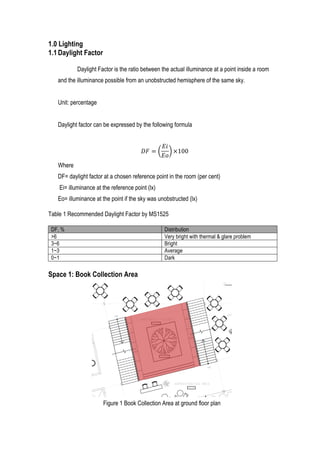
Space 1: Book Collection Area
DF, % Distribution
>6 Very bright with thermal & glare problem
3~6 Bright
1~3 Average
0~1 Dark
Figure 1 Book Collection Area at ground floor plan
3	
  
Daylight Factor
Using the daylight factor formula, illuminance of the book collection area can be calculated.
          𝐷𝐹 =
𝐸𝑖
𝐸𝑜
×100
22.34 =
𝐸𝑖
32000
×100
𝐸𝑖       =
22.34
100
×32000
Ei = 7148.8 lux
Floor Area/ m² 43.74
Area of façade exposed to sunlight/ m² 54.00
Area of skylight/ m² 43.74
Exposed Façade & Skylight Area to
Floor Area Ratio
54 + 43.74
43.74
=22.34%
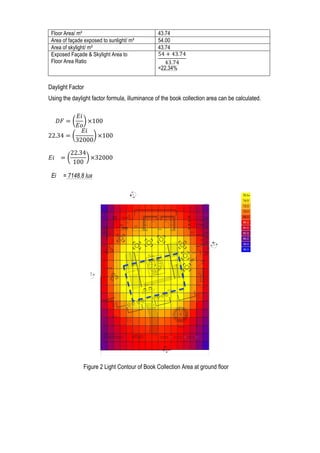
Figure 2 Light Contour of Book Collection Area at ground floor
4	
  
Table 2 Typical Daylight Levels
Location Average Daylight Factor Minimum daylight factor Surface
General Ofiice 5 2 Desks
Classroom 5 2 Desks
Entrance Hall 2 0.6 Working Plane
Library 5 1.5 Tables
Drawing Office 5 2.5 Boards
Sports Day 5 3.5 Working Plane
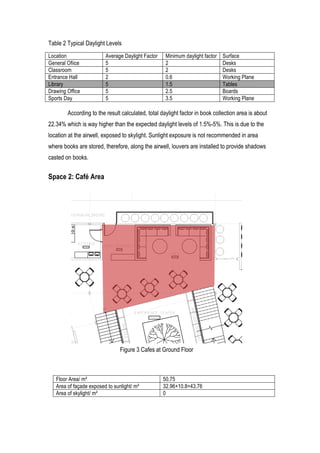
According to the result calculated, total daylight factor in book collection area is about
22.34% which is way higher than the expected daylight levels of 1.5%-5%. This is due to the
location at the airwell, exposed to skylight. Sunlight exposure is not recommended in area
where books are stored, therefore, along the airwell, louvers are installed to provide shadows
casted on books.
Space 2: Café Area
Floor Area/ m² 50.75
Area of façade exposed to sunlight/ m² 32.96+10.8=43.76
Area of skylight/ m² 0
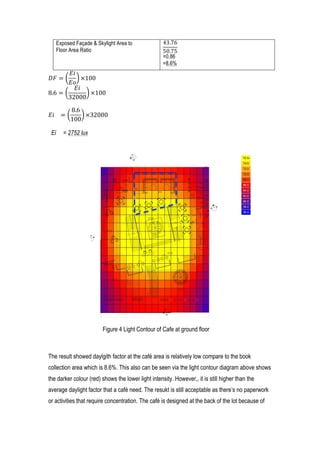
Figure 3 Cafes at Ground Floor
5	
  
𝐷𝐹 =
𝐸𝑖
𝐸𝑜
×100
8.6 =
𝐸𝑖
32000
×100
𝐸𝑖       =
8.6
100
×32000
Ei = 2752 lux
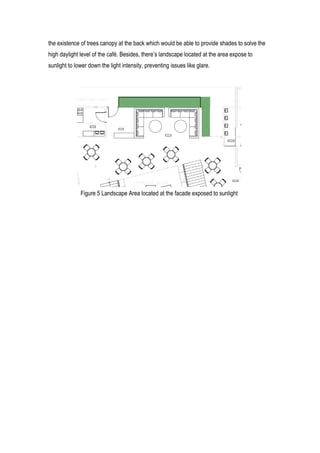
The result showed daylgith factor at the café area is relatively low compare to the book
collection area which is 8.6%. This also can be seen via the light contour diagram above shows
the darker colour (red) shows the lower light intensity. However,, it is still higher than the
average daylight factor that a café need. The resukt is still acceptable as there’s no paperwork
or activities that require concentration. The café is designed at the back of the lot because of
Exposed Façade & Skylight Area to
Floor Area Ratio
43.76
50.75
=0.86
=8.6%
Figure 4 Light Contour of Cafe at ground floor
6	
  
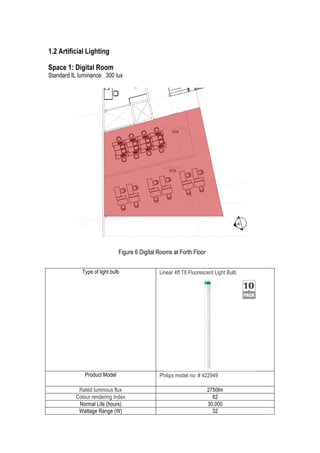
the existence of trees canopy at the back which would be able to provide shades to solve the
high daylight level of the café. Besides, there’s landscape located at the area expose to
sunlight to lower down the light intensity, preventing issues like glare.
Figure 5 Landscape Area located at the facade exposed to sunlight
7	
  
1.2 Artificial Lighting
Space 1: Digital Room
Standard IL luminance: 300 lux
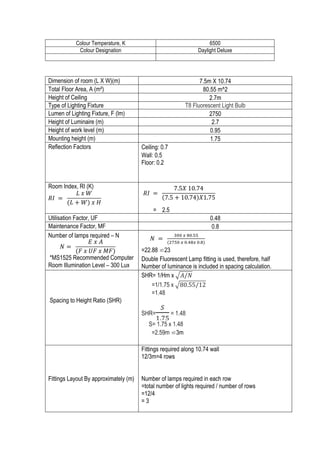
Type of light bulb Linear 4ft T8 Fluorescent Light Bulb
Product Model Philips model no: # 422949
Rated luminous flux 2750lm
Colour rendering Index 82
Normal Life (hours) 30,000
Wattage Range (W) 32
Figure 6 Digital Rooms at Forth Floor
8	
  
Colour Temperature, K 6500
Colour Designation Daylight Deluxe
Dimension of room (L X W)(m) 7.5m X 10.74
Total Floor Area, A (m²) 80.55 m^2
Height of Ceiling 2.7m
Type of Lighting Fixture T8 Fluorescent Light Bulb
Lumen of Lighting Fixture, F (lm) 2750
Height of Luminaire (m) 2.7
Height of work level (m) 0.95
Mounting height (m) 1.75
Reflection Factors Ceiling: 0.7
Wall: 0.5
Floor: 0.2
Room Index, RI (K)
= 2.5
Utilisation Factor, UF 0.48
Maintenance Factor, MF 0.8
Number of lamps required – N
*MS1525 Recommended Computer
Room Illumination Level – 300 Lux
=22.88 ⋍23
Double Fluorescent Lamp fitting is used, therefore, half
Number of luminance is included in spacing calculation.
Spacing to Height Ratio (SHR)
SHR= 1/Hm x 𝐴/𝑁
=1/1.75 x 80.55/12
=1.48
SHR=
!
!.!"
= 1.48
S= 1.75 x 1.48
=2.59m ⋍3m
Fittings Layout By approximately (m)
Fittings required along 10.74 wall
12/3m=4 rows
Number of lamps required in each row
=total number of lights required / number of rows
=12/4
= 3
𝑁   =   
!""  !  !".!!
(!"#$  !  !.!"!  !.!)


𝑁 =   
𝐸  𝑥  𝐴
(𝐹  𝑥  𝑈𝐹  𝑥  𝑀𝐹)
	
  
𝑅𝐼   =   
𝐿  𝑥  𝑊
(𝐿 + 𝑊)  𝑥  𝐻
	
  
𝑅𝐼   =   
7.5𝑋  10.74
7.5 + 10.74 𝑋1.75


9	
  
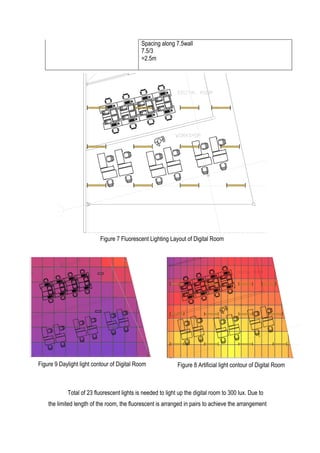
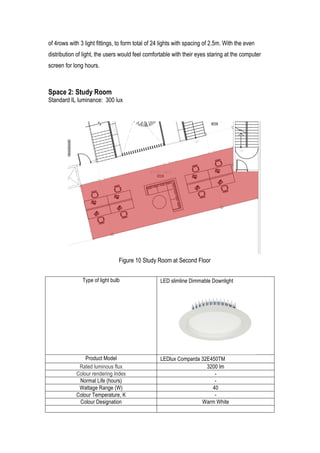
Total of 23 fluorescent lights is needed to light up the digital room to 300 lux. Due to
the limited length of the room, the fluorescent is arranged in pairs to achieve the arrangement
Spacing along 7.5wall
7.5/3
=2.5m
Figure 7 Fluorescent Lighting Layout of Digital Room
Figure 9 Daylight light contour of Digital Room Figure 8 Artificial light contour of Digital Room
10	
  
of 4rows with 3 light fittings, to form total of 24 lights with spacing of 2.5m. With the even
distribution of light, the users would feel comfortable with their eyes staring at the computer
screen for long hours.
Space 2: Study Room
Standard IL luminance: 300 lux
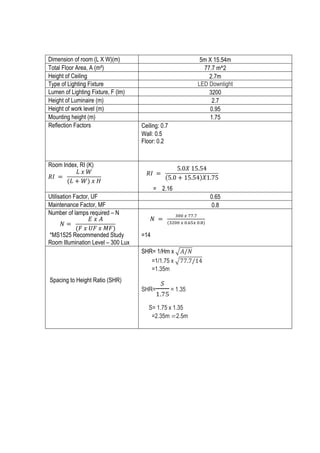
Type of light bulb LED slimline Dimmable Downlight
Product Model LEDlux Comparda 32E450TM
Rated luminous flux 3200 lm
Colour rendering Index -
Normal Life (hours) -
Wattage Range (W) 40
Colour Temperature, K -
Colour Designation Warm White
Figure 10 Study Room at Second Floor
11	
  
Dimension of room (L X W)(m) 5m X 15.54m
Total Floor Area, A (m²) 77.7 m^2
Height of Ceiling 2.7m
Type of Lighting Fixture LED Downlight
Lumen of Lighting Fixture, F (lm) 3200
Height of Luminaire (m) 2.7
Height of work level (m) 0.95
Mounting height (m) 1.75
Reflection Factors Ceiling: 0.7
Wall: 0.5
Floor: 0.2
Room Index, RI (K)
= 2.16
Utilisation Factor, UF 0.65
Maintenance Factor, MF 0.8
Number of lamps required – N
*MS1525 Recommended Study
Room Illumination Level – 300 Lux
=14
Spacing to Height Ratio (SHR)
SHR= 1/Hm x 𝐴/𝑁
=1/1.75 x 77.7/14
=1.35m
SHR=
!
!.!"
= 1.35
S= 1.75 x 1.35
=2.35m ⋍2.5m
𝑁 =   
𝐸  𝑥  𝐴
(𝐹  𝑥  𝑈𝐹  𝑥  𝑀𝐹)
	
  
𝑅𝐼   =   
𝐿  𝑥  𝑊
(𝐿 + 𝑊)  𝑥  𝐻
	
  
𝑅𝐼   =   
5.0𝑋  15.54
5.0 + 15.54 𝑋1.75


𝑁   =   
!""  !  !!.!
(!"##  !  !.!"!  !.!)


12	
  
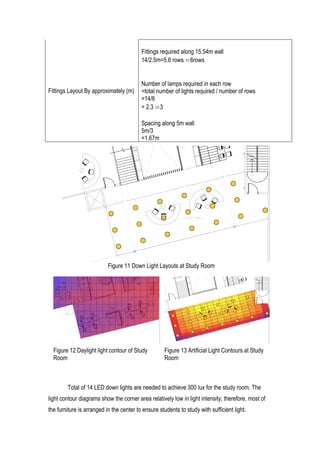
Total of 14 LED down lights are needed to achieve 300 lux for the study room. The
light contour diagrams show the corner area relatively low in light intensity; therefore, most of
the furniture is arranged in the center to ensure students to study with sufficient light.
Fittings Layout By approximately (m)
Fittings required along 15.54m wall
14/2.5m=5.6 rows ⋍6rows
Number of lamps required in each row
=total number of lights required / number of rows
=14/6
= 2.3 ⋍3
Spacing along 5m wall
5m/3
=1.67m
Figure 11 Down Light Layouts at Study Room
Figure 12 Daylight light contour of Study
Room
Figure 13 Artificial Light Contours at Study
Room
13	
  
1.3 PSALI – Permanent Supplementary Artificial Lighting of Interiors
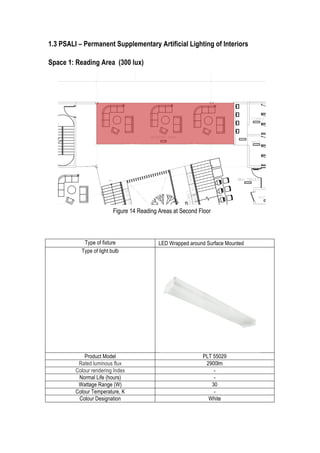
Space 1: Reading Area (300 lux)
Type of fixture LED Wrapped around Surface Mounted
Type of light bulb
Product Model PLT 55029
Rated luminous flux 2900lm
Colour rendering Index -
Normal Life (hours) -
Wattage Range (W) 30
Colour Temperature, K -
Colour Designation White
Figure 14 Reading Areas at Second Floor
14	
  
Dimension of room (L X W)(m) 3.7m X 12.44m
Total Floor Area, A (m²) 46 m^2
Height of Ceiling 2.7
Type of Lighting Fixture LED Wrapped around
Lumen of Lighting Fixture, F (lm) 2900
Height of Luminaire (m) 2.7
Height of work level (m) 0.95
Mounting height (m) 1.75
Reflection Factors Ceiling: 0.7
Wall: 0.5
Floor: 0.2
Room Index, RI (K)
= 1.63
Utilisation Factor, UF 0.43
Maintenance Factor, MF 0.8
Number of lamps required – N
*MS1525 Recommended Reading
Illumination Level – 300 Lux = 19.2 ⋍ 19
Spacing to Height Ratio (SHR)
SHR= 1/Hm x 𝐴/𝑁
=1/1.75x 64/19
=1.05
SHR=
!
!.!"
= 1.05
S= 1.75 x 1.05
=1.8
Fittings Layout By approximately (m)
Fittings required along 12.44m wall
19/1.8 =10.55rows
⋍11 rows
Number of lamps required in each row
=total number of lights required / number of rows
=19/11
=1.7
⋍2
Spacing along 3.7mwall
3.7/2
=1.85m
𝑅𝐼   =   
𝐿  𝑥  𝑊
(𝐿 + 𝑊)  𝑥  𝐻
	
  
𝑅𝐼   =   
3.7  𝑋  12.44
3.7 + 12.44 1.75


𝑁 =   
𝐸  𝑥  𝐴
(𝐹  𝑥  𝑈𝐹  𝑥  𝑀𝐹)
	
  
15	
  
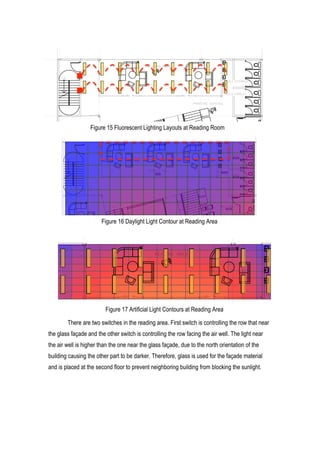
There are two switches in the reading area. First switch is controlling the row that near
the glass façade and the other switch is controlling the row facing the air well. The light near
the air well is higher than the one near the glass façade, due to the north orientation of the
building causing the other part to be darker. Therefore, glass is used for the façade material
and is placed at the second floor to prevent neighboring building from blocking the sunlight.
Figure 15 Fluorescent Lighting Layouts at Reading Room
Figure 16 Daylight Light Contour at Reading Area
Figure 17 Artificial Light Contours at Reading Area
16	
  
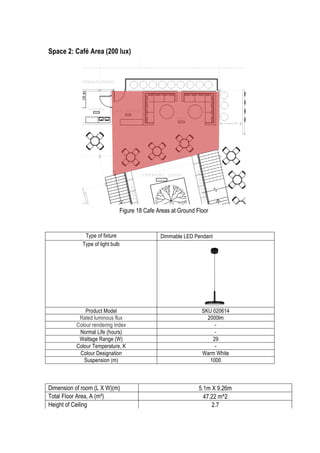
Space 2: Café Area (200 lux)
Type of fixture Dimmable LED Pendant
Type of light bulb
Product Model SKU 020614
Rated luminous flux 2000lm
Colour rendering Index -
Normal Life (hours) -
Wattage Range (W) 29
Colour Temperature, K -
Colour Designation Warm White
Suspension (m) 1000
Dimension of room (L X W)(m) 5.1m X 9.26m
Total Floor Area, A (m²) 47.22 m^2
Height of Ceiling 2.7
Figure 18 Cafe Areas at Ground Floor
17	
  
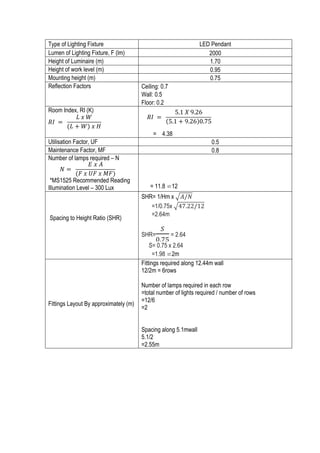
Type of Lighting Fixture LED Pendant
Lumen of Lighting Fixture, F (lm) 2000
Height of Luminaire (m) 1.70
Height of work level (m) 0.95
Mounting height (m) 0.75
Reflection Factors Ceiling: 0.7
Wall: 0.5
Floor: 0.2
Room Index, RI (K)
= 4.38
Utilisation Factor, UF 0.5
Maintenance Factor, MF 0.8
Number of lamps required – N
*MS1525 Recommended Reading
Illumination Level – 300 Lux = 11.8 ⋍12
Spacing to Height Ratio (SHR)
SHR= 1/Hm x 𝐴/𝑁
=1/0.75x 47.22/12
=2.64m
SHR=
!
!.!"
= 2.64
S= 0.75 x 2.64
=1.98 ⋍2m
Fittings Layout By approximately (m)
Fittings required along 12.44m wall
12/2m = 6rows
Number of lamps required in each row
=total number of lights required / number of rows
=12/6
=2
Spacing along 5.1mwall
5.1/2
=2.55m
𝑅𝐼   =   
𝐿  𝑥  𝑊
(𝐿 + 𝑊)  𝑥  𝐻
	
  
𝑅𝐼   =   
5.1  𝑋  9.26
5.1 + 9.26 0.75


𝑁 =   
𝐸  𝑥  𝐴
(𝐹  𝑥  𝑈𝐹  𝑥  𝑀𝐹)
	
  
18	
  
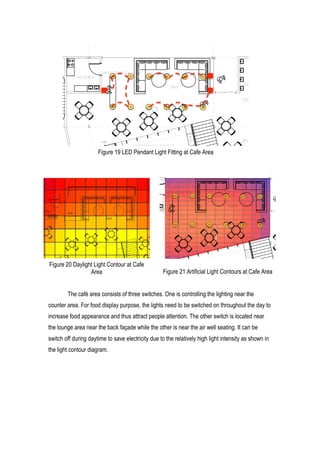
The café area consists of three switches. One is controlling the lighting near the
counter area. For food display purpose, the lights need to be switched on throughout the day to
increase food appearance and thus attract people attention. The other switch is located near
the lounge area near the back façade while the other is near the air well seating. It can be
switch off during daytime to save electricity due to the relatively high light intensity as shown in
the light contour diagram.
Figure 19 LED Pendant Light Fitting at Cafe Area
Figure 20 Daylight Light Contour at Cafe
Area Figure 21 Artificial Light Contours at Cafe Area
19	
  
2. Acoustic
2.1 Reverberation Time (RT)
Reverberation time is defined as the length of time required for the sound to decay
60 decibels from its initial level. The desirable reverberation time will vary depending on
the function of the room. Higher reverberation time aids the sound to carry and add more
characters to the acoustic. Too much reverberation time would have caused the sound to
lost its clarity in a confusing echo.
Reverberation time is calculated as the formula:
Reverberation Time, RT = (0.16xV)/A
To use this formula, the volume of the room, surface area of each material of the room,
and absorption coefficient of those materials must be known. Absorption coefficient is
measured in specialized laboratories rating from 0-1 decimal.
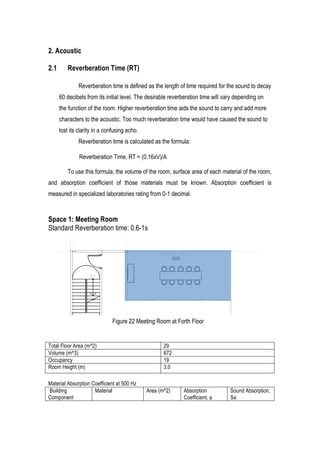
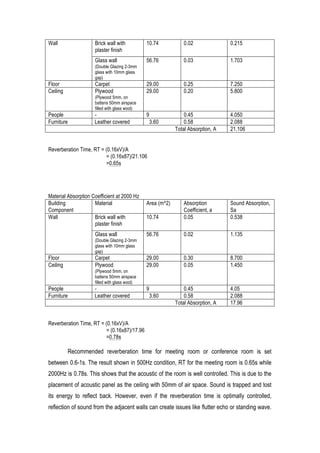
Space 1: Meeting Room
Standard Reverberation time: 0.6-1s
Total Floor Area (m^2) 29
Volume (m^3) 872
Occupancy 19
Room Height (m) 3.0
Material Absorption Coefficient at 500 Hz
Building
Component
Material Area (m^2) Absorption
Coefficient, a
Sound Absorption,
Sa
Figure 22 Meeting Room at Forth Floor
20	
  
Wall Brick wall with
plaster finish
10.74 0.02 0.215
Glass wall
(Double Glazing 2-3mm
glass with 10mm glass
gap)
56.76 0.03 1.703
Floor Carpet 29.00 0.25 7.250
Ceiling Plywood
(Plywood 5mm, on
battens 50mm airspace
filled with glass wool)
29.00 0.20 5.800
People - 9 0.45 4.050
Furniture Leather covered 3.60 0.58 2.088
Total Absorption, A 21.106
Reverberation Time, RT = (0.16xV)/A
= (0.16x87)/21.106
=0.65s
Material Absorption Coefficient at 2000 Hz
Building
Component
Material Area (m^2) Absorption
Coefficient, a
Sound Absorption,
Sa
Wall Brick wall with
plaster finish
10.74 0.05 0.538
Glass wall
(Double Glazing 2-3mm
glass with 10mm glass
gap)
56.76 0.02 1.135
Floor Carpet 29.00 0.30 8.700
Ceiling Plywood
(Plywood 5mm, on
battens 50mm airspace
filled with glass wool)
29.00 0.05 1.450
People - 9 0.45 4.05
Furniture Leather covered 3.60 0.58 2.088
Total Absorption, A 17.96
Reverberation Time, RT = (0.16xV)/A
= (0.16x87)/17.96
=0.78s
Recommended reverberation time for meeting room or conference room is set
between 0.6-1s. The result shown in 500Hz condition, RT for the meeting room is 0.65s while
2000Hz is 0.78s. This shows that the acoustic of the room is well controlled. This is due to the
placement of acoustic panel as the ceiling with 50mm of air space. Sound is trapped and lost
its energy to reflect back. However, even if the reverberation time is optimally controlled,
reflection of sound from the adjacent walls can create issues like flutter echo or standing wave.
21	
  
Ideally, one side of the wall is covered with acoustic absorptive material. A desirable sound
level plays an essential role in making a presentation a success.
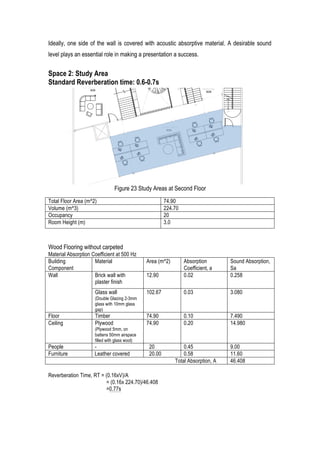
Space 2: Study Area
Standard Reverberation time: 0.6-0.7s
Total Floor Area (m^2) 74.90
Volume (m^3) 224.70
Occupancy 20
Room Height (m) 3.0
Wood Flooring without carpeted
Material Absorption Coefficient at 500 Hz
Building
Component
Material Area (m^2) Absorption
Coefficient, a
Sound Absorption,
Sa
Wall Brick wall with
plaster finish
12.90 0.02 0.258
Glass wall
(Double Glazing 2-3mm
glass with 10mm glass
gap)
102.67 0.03 3.080
Floor Timber 74.90 0.10 7.490
Ceiling Plywood
(Plywood 5mm, on
battens 50mm airspace
filled with glass wool)
74.90 0.20 14.980
People - 20 0.45 9.00
Furniture Leather covered 20.00 0.58 11.60
Total Absorption, A 46.408
Reverberation Time, RT = (0.16xV)/A
= (0.16x 224.70)/46.408
=0.77s
Figure 23 Study Areas at Second Floor
22	
  
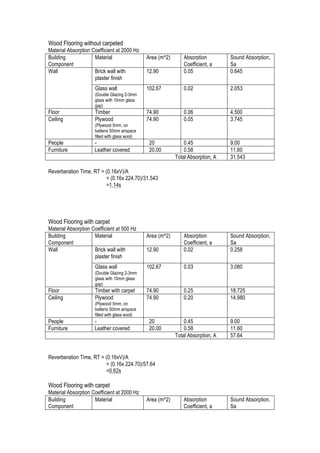
Wood Flooring without carpeted
Material Absorption Coefficient at 2000 Hz
Building
Component
Material Area (m^2) Absorption
Coefficient, a
Sound Absorption,
Sa
Wall Brick wall with
plaster finish
12.90 0.05 0.645
Glass wall
(Double Glazing 2-3mm
glass with 10mm glass
gap)
102.67 0.02 2.053
Floor Timber 74.90 0.06 4.500
Ceiling Plywood
(Plywood 5mm, on
battens 50mm airspace
filled with glass wool)
74.90 0.05 3.745
People - 20 0.45 9.00
Furniture Leather covered 20.00 0.58 11.60
Total Absorption, A 31.543
Reverberation Time, RT = (0.16xV)/A
= (0.16x 224.70)/31.543
=1.14s
Wood Flooring with carpet
Material Absorption Coefficient at 500 Hz
Building
Component
Material Area (m^2) Absorption
Coefficient, a
Sound Absorption,
Sa
Wall Brick wall with
plaster finish
12.90 0.02 0.258
Glass wall
(Double Glazing 2-3mm
glass with 10mm glass
gap)
102.67 0.03 3.080
Floor Timber with carpet 74.90 0.25 18.725
Ceiling Plywood
(Plywood 5mm, on
battens 50mm airspace
filled with glass wool)
74.90 0.20 14.980
People - 20 0.45 9.00
Furniture Leather covered 20.00 0.58 11.60
Total Absorption, A 57.64
Reverberation Time, RT = (0.16xV)/A
= (0.16x 224.70)/57.64
=0.62s
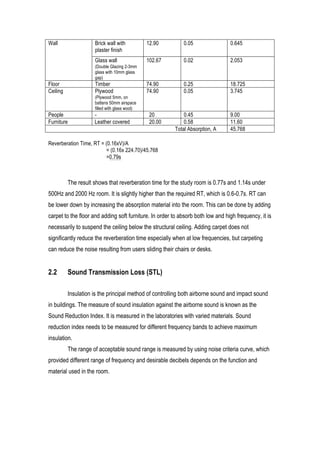
Wood Flooring with carpet
Material Absorption Coefficient at 2000 Hz
Building
Component
Material Area (m^2) Absorption
Coefficient, a
Sound Absorption,
Sa
23	
  
Wall Brick wall with
plaster finish
12.90 0.05 0.645
Glass wall
(Double Glazing 2-3mm
glass with 10mm glass
gap)
102.67 0.02 2.053
Floor Timber 74.90 0.25 18.725
Ceiling Plywood
(Plywood 5mm, on
battens 50mm airspace
filled with glass wool)
74.90 0.05 3.745
People - 20 0.45 9.00
Furniture Leather covered 20.00 0.58 11.60
Total Absorption, A 45.768
Reverberation Time, RT = (0.16xV)/A
= (0.16x 224.70)/45.768
=0.79s
The result shows that reverberation time for the study room is 0.77s and 1.14s under
500Hz and 2000 Hz room. It is slightly higher than the required RT, which is 0.6-0.7s. RT can
be lower down by increasing the absorption material into the room. This can be done by adding
carpet to the floor and adding soft furniture. In order to absorb both low and high frequency, it is
necessarily to suspend the ceiling below the structural ceiling. Adding carpet does not
significantly reduce the reverberation time especially when at low frequencies, but carpeting
can reduce the noise resulting from users sliding their chairs or desks.
2.2 Sound Transmission Loss (STL)
Insulation is the principal method of controlling both airborne sound and impact sound
in buildings. The measure of sound insulation against the airborne sound is known as the
Sound Reduction Index. It is measured in the laboratories with varied materials. Sound
reduction index needs to be measured for different frequency bands to achieve maximum
insulation.
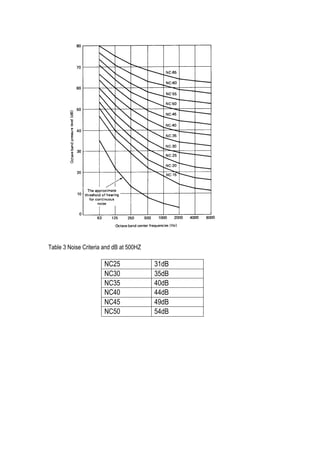
The range of acceptable sound range is measured by using noise criteria curve, which
provided different range of frequency and desirable decibels depends on the function and
material used in the room.
24	
  
Table 3 Noise Criteria and dB at 500HZ
NC25 31dB
NC30 35dB
NC35 40dB
NC40 44dB
NC45 49dB
NC50 54dB
25	
  
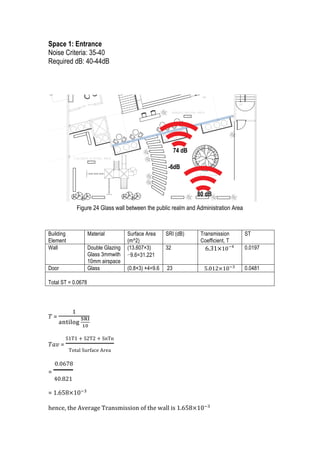
Space 1: Entrance
Noise Criteria: 35-40
Required dB: 40-44dB
Building
Element
Material Surface Area
(m^2)
SRI (dB) Transmission
Coefficient, T
ST
Wall Double Glazing
Glass 3mmwith
10mm airspace
(13.607×3)
−9.6=31.221
32 6.31×10⁻⁴ 0.0197
Door Glass (0.8×3) ×4=9.6 23 5.012×10!! 0.0481
Total ST = 0.0678


𝑇	
  =	
  
!
!"#$%&'  
!"#
!"


𝑇𝑎𝑣	
  =	
  
S1T1  +  S2T2  +  SnTn
Total  Surface  Area


=	
  
  0.0678
40.821


=	
  1.658×10!!


hence,	
  the	
  Average	
  Transmission	
  of	
  the	
  wall	
  is	
  1.658×10!!
	
  
Figure 24 Glass wall between the public realm and Administration Area
80 dB
74 dB
-6dB
26	
  
SRI=	
  10	
   𝐿 𝑜𝑔10	
  
!
!"#  
	
  
=	
  10	
   𝐿 𝑜𝑔10	
  
1
1.658×10
−3
	
  
=	
  27.8dB	


Hence,	
  the	
  Overall	
  SRI	
  of	
  the	
  wall	
  is	
  38.2	
  dB	
  
74dB	
  –	
  27.8dB	
  =	
  46.2dB	


The landscape area reduces the 80 dB noise levels from the street by 6dB; therefore
the total of 74dB is entering the building. The glass wall then reduces the noise by 27.8dB.
Total noise level at the entrance is 46.2dB. According to the NC curve, at 500Hz, the required
NC at the entrance is 35-40, which is equivalent to 40-44 db. The resultant value is more than
the standard by 2.2dB. This is due to the low SRI value of the glass. There’s available
insulating glass for example triple insulating glass, which can achieve until 41 STC value. The
existence of sliding door can also increase the noise level at the entrance. Therefore, a
suggestion of double entrance is preferred. Have double entrance can prevent the noise from
the street from directly enter the building.
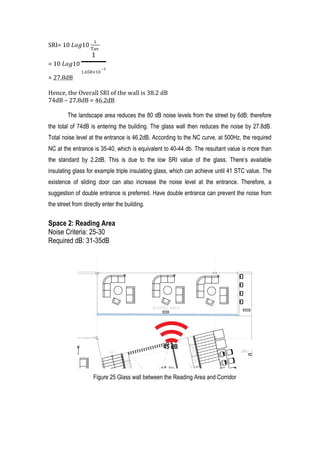
Space 2: Reading Area
Noise Criteria: 25-30
Required dB: 31-35dB
Figure 25 Glass wall between the Reading Area and Corridor
45 dB
27	
  
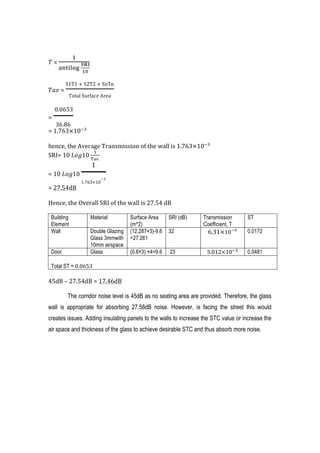
𝑇	
  =	
  
!
!"#$%&'  
!"#
!"


𝑇𝑎𝑣	
  =	
  
S1T1  +  S2T2  +  SnTn
Total  Surface  Area


=	
  
  0.0653
36.86
	
  
=	
  1.763×10!!


hence,	
  the	
  Average	
  Transmission	
  of	
  the	
  wall	
  is	
  1.763×10!!
	
  
SRI=	
  10	
   𝐿 𝑜𝑔10	
  
!
!"#  
	
  
=	
  10	
   𝐿 𝑜𝑔10	
  
1
1.763×10
−3
	
  
=	
  27.54dB	


Hence,	
  the	
  Overall	
  SRI	
  of	
  the	
  wall	
  is	
  27.54	
  dB	


45dB	
  –	
  27.54dB	
  =	
  17.46dB	
  
The corridor noise level is 45dB as no seating area are provided. Therefore, the glass
wall is appropriate for absorbing 27.58dB noise. However, is facing the street this would
creates issues. Adding insulating panels to the walls to increase the STC value or increase the
air space and thickness of the glass to achieve desirable STC and thus absorb more noise.
Building
Element
Material Surface Area
(m^2)
SRI (dB) Transmission
Coefficient, T
ST
Wall Double Glazing
Glass 3mmwith
10mm airspace
(12.287×3)-9.6
=27.261
32 6.31×10⁻⁴ 0.0172
Door Glass (0.8×3) ×4=9.6 23 5.012×10!! 0.0481
Total ST = 0.0653

Bb science project 2

  • 1.
    1   Content 1.0 Lighting 1.1Daylight Factor Pg. 2-6 1.2 Artificial Lighting Pg. 7-12 1.3 PSALI Pg.13-18 2.0 Acoustic 2.1 Reverberation Time Pg. 19-23 2.2 Sound Transmission Loss Pg. 23-27
  • 2.
    2   1.0 Lighting 1.1DaylightFactor Daylight Factor is the ratio between the actual illuminance at a point inside a room and the illuminance possible from an unobstructed hemisphere of the same sky. Unit: percentage Daylight factor can be expressed by the following formula 𝐷𝐹 = 𝐸𝑖 𝐸𝑜 ×100 Where DF= daylight factor at a chosen reference point in the room (per cent) Ei= illuminance at the reference point (lx) Eo= illuminance at the point if the sky was unobstructed (lx) Table 1 Recommended Daylight Factor by MS1525 Space 1: Book Collection Area DF, % Distribution >6 Very bright with thermal & glare problem 3~6 Bright 1~3 Average 0~1 Dark Figure 1 Book Collection Area at ground floor plan
  • 3.
    3   Daylight Factor Usingthe daylight factor formula, illuminance of the book collection area can be calculated.          𝐷𝐹 = 𝐸𝑖 𝐸𝑜 ×100 22.34 = 𝐸𝑖 32000 ×100 𝐸𝑖       = 22.34 100 ×32000 Ei = 7148.8 lux Floor Area/ m² 43.74 Area of façade exposed to sunlight/ m² 54.00 Area of skylight/ m² 43.74 Exposed Façade & Skylight Area to Floor Area Ratio 54 + 43.74 43.74 =22.34% Figure 2 Light Contour of Book Collection Area at ground floor
  • 4.
    4   Table 2Typical Daylight Levels Location Average Daylight Factor Minimum daylight factor Surface General Ofiice 5 2 Desks Classroom 5 2 Desks Entrance Hall 2 0.6 Working Plane Library 5 1.5 Tables Drawing Office 5 2.5 Boards Sports Day 5 3.5 Working Plane According to the result calculated, total daylight factor in book collection area is about 22.34% which is way higher than the expected daylight levels of 1.5%-5%. This is due to the location at the airwell, exposed to skylight. Sunlight exposure is not recommended in area where books are stored, therefore, along the airwell, louvers are installed to provide shadows casted on books. Space 2: Café Area Floor Area/ m² 50.75 Area of façade exposed to sunlight/ m² 32.96+10.8=43.76 Area of skylight/ m² 0 Figure 3 Cafes at Ground Floor
  • 5.
    5   𝐷𝐹 = 𝐸𝑖 𝐸𝑜 ×100 8.6= 𝐸𝑖 32000 ×100 𝐸𝑖       = 8.6 100 ×32000 Ei = 2752 lux The result showed daylgith factor at the café area is relatively low compare to the book collection area which is 8.6%. This also can be seen via the light contour diagram above shows the darker colour (red) shows the lower light intensity. However,, it is still higher than the average daylight factor that a café need. The resukt is still acceptable as there’s no paperwork or activities that require concentration. The café is designed at the back of the lot because of Exposed Façade & Skylight Area to Floor Area Ratio 43.76 50.75 =0.86 =8.6% Figure 4 Light Contour of Cafe at ground floor
  • 6.
    6   the existenceof trees canopy at the back which would be able to provide shades to solve the high daylight level of the café. Besides, there’s landscape located at the area expose to sunlight to lower down the light intensity, preventing issues like glare. Figure 5 Landscape Area located at the facade exposed to sunlight
  • 7.
    7   1.2 ArtificialLighting Space 1: Digital Room Standard IL luminance: 300 lux Type of light bulb Linear 4ft T8 Fluorescent Light Bulb Product Model Philips model no: # 422949 Rated luminous flux 2750lm Colour rendering Index 82 Normal Life (hours) 30,000 Wattage Range (W) 32 Figure 6 Digital Rooms at Forth Floor
  • 8.
    8   Colour Temperature,K 6500 Colour Designation Daylight Deluxe Dimension of room (L X W)(m) 7.5m X 10.74 Total Floor Area, A (m²) 80.55 m^2 Height of Ceiling 2.7m Type of Lighting Fixture T8 Fluorescent Light Bulb Lumen of Lighting Fixture, F (lm) 2750 Height of Luminaire (m) 2.7 Height of work level (m) 0.95 Mounting height (m) 1.75 Reflection Factors Ceiling: 0.7 Wall: 0.5 Floor: 0.2 Room Index, RI (K) = 2.5 Utilisation Factor, UF 0.48 Maintenance Factor, MF 0.8 Number of lamps required – N *MS1525 Recommended Computer Room Illumination Level – 300 Lux =22.88 ⋍23 Double Fluorescent Lamp fitting is used, therefore, half Number of luminance is included in spacing calculation. Spacing to Height Ratio (SHR) SHR= 1/Hm x 𝐴/𝑁 =1/1.75 x 80.55/12 =1.48 SHR= ! !.!" = 1.48 S= 1.75 x 1.48 =2.59m ⋍3m Fittings Layout By approximately (m) Fittings required along 10.74 wall 12/3m=4 rows Number of lamps required in each row =total number of lights required / number of rows =12/4 = 3 𝑁   =   !""  !  !".!! (!"#$  !  !.!"!  !.!)     𝑁 =   𝐸  𝑥  𝐴 (𝐹  𝑥  𝑈𝐹  𝑥  𝑀𝐹)   𝑅𝐼   =   𝐿  𝑥  𝑊 (𝐿 + 𝑊)  𝑥  𝐻   𝑅𝐼   =   7.5𝑋  10.74 7.5 + 10.74 𝑋1.75                
  • 9.
    9   Total of23 fluorescent lights is needed to light up the digital room to 300 lux. Due to the limited length of the room, the fluorescent is arranged in pairs to achieve the arrangement Spacing along 7.5wall 7.5/3 =2.5m Figure 7 Fluorescent Lighting Layout of Digital Room Figure 9 Daylight light contour of Digital Room Figure 8 Artificial light contour of Digital Room
  • 10.
    10   of 4rowswith 3 light fittings, to form total of 24 lights with spacing of 2.5m. With the even distribution of light, the users would feel comfortable with their eyes staring at the computer screen for long hours. Space 2: Study Room Standard IL luminance: 300 lux Type of light bulb LED slimline Dimmable Downlight Product Model LEDlux Comparda 32E450TM Rated luminous flux 3200 lm Colour rendering Index - Normal Life (hours) - Wattage Range (W) 40 Colour Temperature, K - Colour Designation Warm White Figure 10 Study Room at Second Floor
  • 11.
    11   Dimension ofroom (L X W)(m) 5m X 15.54m Total Floor Area, A (m²) 77.7 m^2 Height of Ceiling 2.7m Type of Lighting Fixture LED Downlight Lumen of Lighting Fixture, F (lm) 3200 Height of Luminaire (m) 2.7 Height of work level (m) 0.95 Mounting height (m) 1.75 Reflection Factors Ceiling: 0.7 Wall: 0.5 Floor: 0.2 Room Index, RI (K) = 2.16 Utilisation Factor, UF 0.65 Maintenance Factor, MF 0.8 Number of lamps required – N *MS1525 Recommended Study Room Illumination Level – 300 Lux =14 Spacing to Height Ratio (SHR) SHR= 1/Hm x 𝐴/𝑁 =1/1.75 x 77.7/14 =1.35m SHR= ! !.!" = 1.35 S= 1.75 x 1.35 =2.35m ⋍2.5m 𝑁 =   𝐸  𝑥  𝐴 (𝐹  𝑥  𝑈𝐹  𝑥  𝑀𝐹)   𝑅𝐼   =   𝐿  𝑥  𝑊 (𝐿 + 𝑊)  𝑥  𝐻   𝑅𝐼   =   5.0𝑋  15.54 5.0 + 15.54 𝑋1.75                 𝑁   =   !""  !  !!.! (!"##  !  !.!"!  !.!)    
  • 12.
    12   Total of14 LED down lights are needed to achieve 300 lux for the study room. The light contour diagrams show the corner area relatively low in light intensity; therefore, most of the furniture is arranged in the center to ensure students to study with sufficient light. Fittings Layout By approximately (m) Fittings required along 15.54m wall 14/2.5m=5.6 rows ⋍6rows Number of lamps required in each row =total number of lights required / number of rows =14/6 = 2.3 ⋍3 Spacing along 5m wall 5m/3 =1.67m Figure 11 Down Light Layouts at Study Room Figure 12 Daylight light contour of Study Room Figure 13 Artificial Light Contours at Study Room
  • 13.
    13   1.3 PSALI– Permanent Supplementary Artificial Lighting of Interiors Space 1: Reading Area (300 lux) Type of fixture LED Wrapped around Surface Mounted Type of light bulb Product Model PLT 55029 Rated luminous flux 2900lm Colour rendering Index - Normal Life (hours) - Wattage Range (W) 30 Colour Temperature, K - Colour Designation White Figure 14 Reading Areas at Second Floor
  • 14.
    14   Dimension ofroom (L X W)(m) 3.7m X 12.44m Total Floor Area, A (m²) 46 m^2 Height of Ceiling 2.7 Type of Lighting Fixture LED Wrapped around Lumen of Lighting Fixture, F (lm) 2900 Height of Luminaire (m) 2.7 Height of work level (m) 0.95 Mounting height (m) 1.75 Reflection Factors Ceiling: 0.7 Wall: 0.5 Floor: 0.2 Room Index, RI (K) = 1.63 Utilisation Factor, UF 0.43 Maintenance Factor, MF 0.8 Number of lamps required – N *MS1525 Recommended Reading Illumination Level – 300 Lux = 19.2 ⋍ 19 Spacing to Height Ratio (SHR) SHR= 1/Hm x 𝐴/𝑁 =1/1.75x 64/19 =1.05 SHR= ! !.!" = 1.05 S= 1.75 x 1.05 =1.8 Fittings Layout By approximately (m) Fittings required along 12.44m wall 19/1.8 =10.55rows ⋍11 rows Number of lamps required in each row =total number of lights required / number of rows =19/11 =1.7 ⋍2 Spacing along 3.7mwall 3.7/2 =1.85m 𝑅𝐼   =   𝐿  𝑥  𝑊 (𝐿 + 𝑊)  𝑥  𝐻   𝑅𝐼   =   3.7  𝑋  12.44 3.7 + 12.44 1.75                 𝑁 =   𝐸  𝑥  𝐴 (𝐹  𝑥  𝑈𝐹  𝑥  𝑀𝐹)  
  • 15.
    15   There aretwo switches in the reading area. First switch is controlling the row that near the glass façade and the other switch is controlling the row facing the air well. The light near the air well is higher than the one near the glass façade, due to the north orientation of the building causing the other part to be darker. Therefore, glass is used for the façade material and is placed at the second floor to prevent neighboring building from blocking the sunlight. Figure 15 Fluorescent Lighting Layouts at Reading Room Figure 16 Daylight Light Contour at Reading Area Figure 17 Artificial Light Contours at Reading Area
  • 16.
    16   Space 2:Café Area (200 lux) Type of fixture Dimmable LED Pendant Type of light bulb Product Model SKU 020614 Rated luminous flux 2000lm Colour rendering Index - Normal Life (hours) - Wattage Range (W) 29 Colour Temperature, K - Colour Designation Warm White Suspension (m) 1000 Dimension of room (L X W)(m) 5.1m X 9.26m Total Floor Area, A (m²) 47.22 m^2 Height of Ceiling 2.7 Figure 18 Cafe Areas at Ground Floor
  • 17.
    17   Type ofLighting Fixture LED Pendant Lumen of Lighting Fixture, F (lm) 2000 Height of Luminaire (m) 1.70 Height of work level (m) 0.95 Mounting height (m) 0.75 Reflection Factors Ceiling: 0.7 Wall: 0.5 Floor: 0.2 Room Index, RI (K) = 4.38 Utilisation Factor, UF 0.5 Maintenance Factor, MF 0.8 Number of lamps required – N *MS1525 Recommended Reading Illumination Level – 300 Lux = 11.8 ⋍12 Spacing to Height Ratio (SHR) SHR= 1/Hm x 𝐴/𝑁 =1/0.75x 47.22/12 =2.64m SHR= ! !.!" = 2.64 S= 0.75 x 2.64 =1.98 ⋍2m Fittings Layout By approximately (m) Fittings required along 12.44m wall 12/2m = 6rows Number of lamps required in each row =total number of lights required / number of rows =12/6 =2 Spacing along 5.1mwall 5.1/2 =2.55m 𝑅𝐼   =   𝐿  𝑥  𝑊 (𝐿 + 𝑊)  𝑥  𝐻   𝑅𝐼   =   5.1  𝑋  9.26 5.1 + 9.26 0.75                 𝑁 =   𝐸  𝑥  𝐴 (𝐹  𝑥  𝑈𝐹  𝑥  𝑀𝐹)  
  • 18.
    18   The caféarea consists of three switches. One is controlling the lighting near the counter area. For food display purpose, the lights need to be switched on throughout the day to increase food appearance and thus attract people attention. The other switch is located near the lounge area near the back façade while the other is near the air well seating. It can be switch off during daytime to save electricity due to the relatively high light intensity as shown in the light contour diagram. Figure 19 LED Pendant Light Fitting at Cafe Area Figure 20 Daylight Light Contour at Cafe Area Figure 21 Artificial Light Contours at Cafe Area
  • 19.
    19   2. Acoustic 2.1Reverberation Time (RT) Reverberation time is defined as the length of time required for the sound to decay 60 decibels from its initial level. The desirable reverberation time will vary depending on the function of the room. Higher reverberation time aids the sound to carry and add more characters to the acoustic. Too much reverberation time would have caused the sound to lost its clarity in a confusing echo. Reverberation time is calculated as the formula: Reverberation Time, RT = (0.16xV)/A To use this formula, the volume of the room, surface area of each material of the room, and absorption coefficient of those materials must be known. Absorption coefficient is measured in specialized laboratories rating from 0-1 decimal. Space 1: Meeting Room Standard Reverberation time: 0.6-1s Total Floor Area (m^2) 29 Volume (m^3) 872 Occupancy 19 Room Height (m) 3.0 Material Absorption Coefficient at 500 Hz Building Component Material Area (m^2) Absorption Coefficient, a Sound Absorption, Sa Figure 22 Meeting Room at Forth Floor
  • 20.
    20   Wall Brickwall with plaster finish 10.74 0.02 0.215 Glass wall (Double Glazing 2-3mm glass with 10mm glass gap) 56.76 0.03 1.703 Floor Carpet 29.00 0.25 7.250 Ceiling Plywood (Plywood 5mm, on battens 50mm airspace filled with glass wool) 29.00 0.20 5.800 People - 9 0.45 4.050 Furniture Leather covered 3.60 0.58 2.088 Total Absorption, A 21.106 Reverberation Time, RT = (0.16xV)/A = (0.16x87)/21.106 =0.65s Material Absorption Coefficient at 2000 Hz Building Component Material Area (m^2) Absorption Coefficient, a Sound Absorption, Sa Wall Brick wall with plaster finish 10.74 0.05 0.538 Glass wall (Double Glazing 2-3mm glass with 10mm glass gap) 56.76 0.02 1.135 Floor Carpet 29.00 0.30 8.700 Ceiling Plywood (Plywood 5mm, on battens 50mm airspace filled with glass wool) 29.00 0.05 1.450 People - 9 0.45 4.05 Furniture Leather covered 3.60 0.58 2.088 Total Absorption, A 17.96 Reverberation Time, RT = (0.16xV)/A = (0.16x87)/17.96 =0.78s Recommended reverberation time for meeting room or conference room is set between 0.6-1s. The result shown in 500Hz condition, RT for the meeting room is 0.65s while 2000Hz is 0.78s. This shows that the acoustic of the room is well controlled. This is due to the placement of acoustic panel as the ceiling with 50mm of air space. Sound is trapped and lost its energy to reflect back. However, even if the reverberation time is optimally controlled, reflection of sound from the adjacent walls can create issues like flutter echo or standing wave.
  • 21.
    21   Ideally, oneside of the wall is covered with acoustic absorptive material. A desirable sound level plays an essential role in making a presentation a success. Space 2: Study Area Standard Reverberation time: 0.6-0.7s Total Floor Area (m^2) 74.90 Volume (m^3) 224.70 Occupancy 20 Room Height (m) 3.0 Wood Flooring without carpeted Material Absorption Coefficient at 500 Hz Building Component Material Area (m^2) Absorption Coefficient, a Sound Absorption, Sa Wall Brick wall with plaster finish 12.90 0.02 0.258 Glass wall (Double Glazing 2-3mm glass with 10mm glass gap) 102.67 0.03 3.080 Floor Timber 74.90 0.10 7.490 Ceiling Plywood (Plywood 5mm, on battens 50mm airspace filled with glass wool) 74.90 0.20 14.980 People - 20 0.45 9.00 Furniture Leather covered 20.00 0.58 11.60 Total Absorption, A 46.408 Reverberation Time, RT = (0.16xV)/A = (0.16x 224.70)/46.408 =0.77s Figure 23 Study Areas at Second Floor
  • 22.
    22   Wood Flooringwithout carpeted Material Absorption Coefficient at 2000 Hz Building Component Material Area (m^2) Absorption Coefficient, a Sound Absorption, Sa Wall Brick wall with plaster finish 12.90 0.05 0.645 Glass wall (Double Glazing 2-3mm glass with 10mm glass gap) 102.67 0.02 2.053 Floor Timber 74.90 0.06 4.500 Ceiling Plywood (Plywood 5mm, on battens 50mm airspace filled with glass wool) 74.90 0.05 3.745 People - 20 0.45 9.00 Furniture Leather covered 20.00 0.58 11.60 Total Absorption, A 31.543 Reverberation Time, RT = (0.16xV)/A = (0.16x 224.70)/31.543 =1.14s Wood Flooring with carpet Material Absorption Coefficient at 500 Hz Building Component Material Area (m^2) Absorption Coefficient, a Sound Absorption, Sa Wall Brick wall with plaster finish 12.90 0.02 0.258 Glass wall (Double Glazing 2-3mm glass with 10mm glass gap) 102.67 0.03 3.080 Floor Timber with carpet 74.90 0.25 18.725 Ceiling Plywood (Plywood 5mm, on battens 50mm airspace filled with glass wool) 74.90 0.20 14.980 People - 20 0.45 9.00 Furniture Leather covered 20.00 0.58 11.60 Total Absorption, A 57.64 Reverberation Time, RT = (0.16xV)/A = (0.16x 224.70)/57.64 =0.62s Wood Flooring with carpet Material Absorption Coefficient at 2000 Hz Building Component Material Area (m^2) Absorption Coefficient, a Sound Absorption, Sa
  • 23.
    23   Wall Brickwall with plaster finish 12.90 0.05 0.645 Glass wall (Double Glazing 2-3mm glass with 10mm glass gap) 102.67 0.02 2.053 Floor Timber 74.90 0.25 18.725 Ceiling Plywood (Plywood 5mm, on battens 50mm airspace filled with glass wool) 74.90 0.05 3.745 People - 20 0.45 9.00 Furniture Leather covered 20.00 0.58 11.60 Total Absorption, A 45.768 Reverberation Time, RT = (0.16xV)/A = (0.16x 224.70)/45.768 =0.79s The result shows that reverberation time for the study room is 0.77s and 1.14s under 500Hz and 2000 Hz room. It is slightly higher than the required RT, which is 0.6-0.7s. RT can be lower down by increasing the absorption material into the room. This can be done by adding carpet to the floor and adding soft furniture. In order to absorb both low and high frequency, it is necessarily to suspend the ceiling below the structural ceiling. Adding carpet does not significantly reduce the reverberation time especially when at low frequencies, but carpeting can reduce the noise resulting from users sliding their chairs or desks. 2.2 Sound Transmission Loss (STL) Insulation is the principal method of controlling both airborne sound and impact sound in buildings. The measure of sound insulation against the airborne sound is known as the Sound Reduction Index. It is measured in the laboratories with varied materials. Sound reduction index needs to be measured for different frequency bands to achieve maximum insulation. The range of acceptable sound range is measured by using noise criteria curve, which provided different range of frequency and desirable decibels depends on the function and material used in the room.
  • 24.
    24   Table 3Noise Criteria and dB at 500HZ NC25 31dB NC30 35dB NC35 40dB NC40 44dB NC45 49dB NC50 54dB
  • 25.
    25   Space 1:Entrance Noise Criteria: 35-40 Required dB: 40-44dB Building Element Material Surface Area (m^2) SRI (dB) Transmission Coefficient, T ST Wall Double Glazing Glass 3mmwith 10mm airspace (13.607×3) −9.6=31.221 32 6.31×10⁻⁴ 0.0197 Door Glass (0.8×3) ×4=9.6 23 5.012×10!! 0.0481 Total ST = 0.0678       𝑇  =   ! !"#$%&'   !"# !"       𝑇𝑎𝑣  =   S1T1  +  S2T2  +  SnTn Total  Surface  Area     =    0.0678 40.821     =  1.658×10!!     hence,  the  Average  Transmission  of  the  wall  is  1.658×10!!   Figure 24 Glass wall between the public realm and Administration Area 80 dB 74 dB -6dB
  • 26.
    26   SRI=  10   𝐿 𝑜𝑔10   ! !"#     =  10   𝐿 𝑜𝑔10   1 1.658×10 −3   =  27.8dB     Hence,  the  Overall  SRI  of  the  wall  is  38.2  dB   74dB  –  27.8dB  =  46.2dB     The landscape area reduces the 80 dB noise levels from the street by 6dB; therefore the total of 74dB is entering the building. The glass wall then reduces the noise by 27.8dB. Total noise level at the entrance is 46.2dB. According to the NC curve, at 500Hz, the required NC at the entrance is 35-40, which is equivalent to 40-44 db. The resultant value is more than the standard by 2.2dB. This is due to the low SRI value of the glass. There’s available insulating glass for example triple insulating glass, which can achieve until 41 STC value. The existence of sliding door can also increase the noise level at the entrance. Therefore, a suggestion of double entrance is preferred. Have double entrance can prevent the noise from the street from directly enter the building. Space 2: Reading Area Noise Criteria: 25-30 Required dB: 31-35dB Figure 25 Glass wall between the Reading Area and Corridor 45 dB
  • 27.
    27   𝑇  =   ! !"#$%&'   !"# !"       𝑇𝑎𝑣  =   S1T1  +  S2T2  +  SnTn Total  Surface  Area     =    0.0653 36.86   =  1.763×10!!     hence,  the  Average  Transmission  of  the  wall  is  1.763×10!!   SRI=  10   𝐿 𝑜𝑔10   ! !"#     =  10   𝐿 𝑜𝑔10   1 1.763×10 −3   =  27.54dB     Hence,  the  Overall  SRI  of  the  wall  is  27.54  dB     45dB  –  27.54dB  =  17.46dB   The corridor noise level is 45dB as no seating area are provided. Therefore, the glass wall is appropriate for absorbing 27.58dB noise. However, is facing the street this would creates issues. Adding insulating panels to the walls to increase the STC value or increase the air space and thickness of the glass to achieve desirable STC and thus absorb more noise. Building Element Material Surface Area (m^2) SRI (dB) Transmission Coefficient, T ST Wall Double Glazing Glass 3mmwith 10mm airspace (12.287×3)-9.6 =27.261 32 6.31×10⁻⁴ 0.0172 Door Glass (0.8×3) ×4=9.6 23 5.012×10!! 0.0481 Total ST = 0.0653