SCHOOL OF ARCHITECTURE, BUILDING & DESIGN
BLD 61303 | BUILDING SCIENCE II
PROJECT PART 2 |
INTEGRATION PROJECT
NAME | KHOR YEN MIN
ID | 0318149
TUTOR | AR. EDWIN CHAN
PROJECT 2 |INTERGRATION PROJECT
2BLD 61303 | BUILDING SCIENCE II
TABLE OF CONTENT
1.0 INTRODUCTION
1.1 Site Introduction
1.2 Site Analysis – Sun Path Diagram
1.3 Overall Floor Plans
2.0 SPACE A – ICT SPACE
2.1 Daylight Analysis
2.1.1 Daylight Contour
2.1.2 Daylight Distribution Factor (Calculation)
2.2 Artificial Light Analysis
2.2.1 Lumen Method (Calculation)
2.2.2 Reflected Ceiling Plan
2.2.3 Artificial Light Contour
2.3 PSALI
3.0 SPACE B – QUIET READING SPACE
3.1 Artificial Light Analysis
3.1.1 Lumen Method (Calculation)
3.1.2 Reflected Ceiling Plan
3.1.3 Artificial Light Contour
3
4
5 – 6
7
8
9
10
11
12 – 13
14
14
15
16
17 – 18
19
19
PROJECT 2 |INTERGRATION PROJECT
3BLD 61303 | BUILDING SCIENCE II
1.0 INTRODUCTION
1.1 Site Introduction
Site is located on the famous textile street, Jalan Tuanku Abdul Rahman which, is a major one-way
road located in Kuala Lumpur Malaysia, on the coordinates 3.141756, 101.698069. The front façade of the
building is receiving morning sun (Figure 1.2.1) whereas the back façade of the building is receiving a
morning sun (Figure 1.2.2).
PROJECT 2 |INTERGRATION PROJECT
4BLD 61303 | BUILDING SCIENCE II
1.2 Site Analysis – Sun Path Diagram
Figure 1.2.1 – Sun Path Diagram | 10AM
Figure 1.2.1 – Sun Path Diagram | 4PM
PROJECT 2 |INTERGRATION PROJECT
5BLD 61303 | BUILDING SCIENCE II
1.3 Overall Floor Plans (Scale 1:200)
1.3.1 Ground Floor Plan 1.3.2 First Floor Plan
PROJECT 2 |INTERGRATION PROJECT
6BLD 61303 | BUILDING SCIENCE II
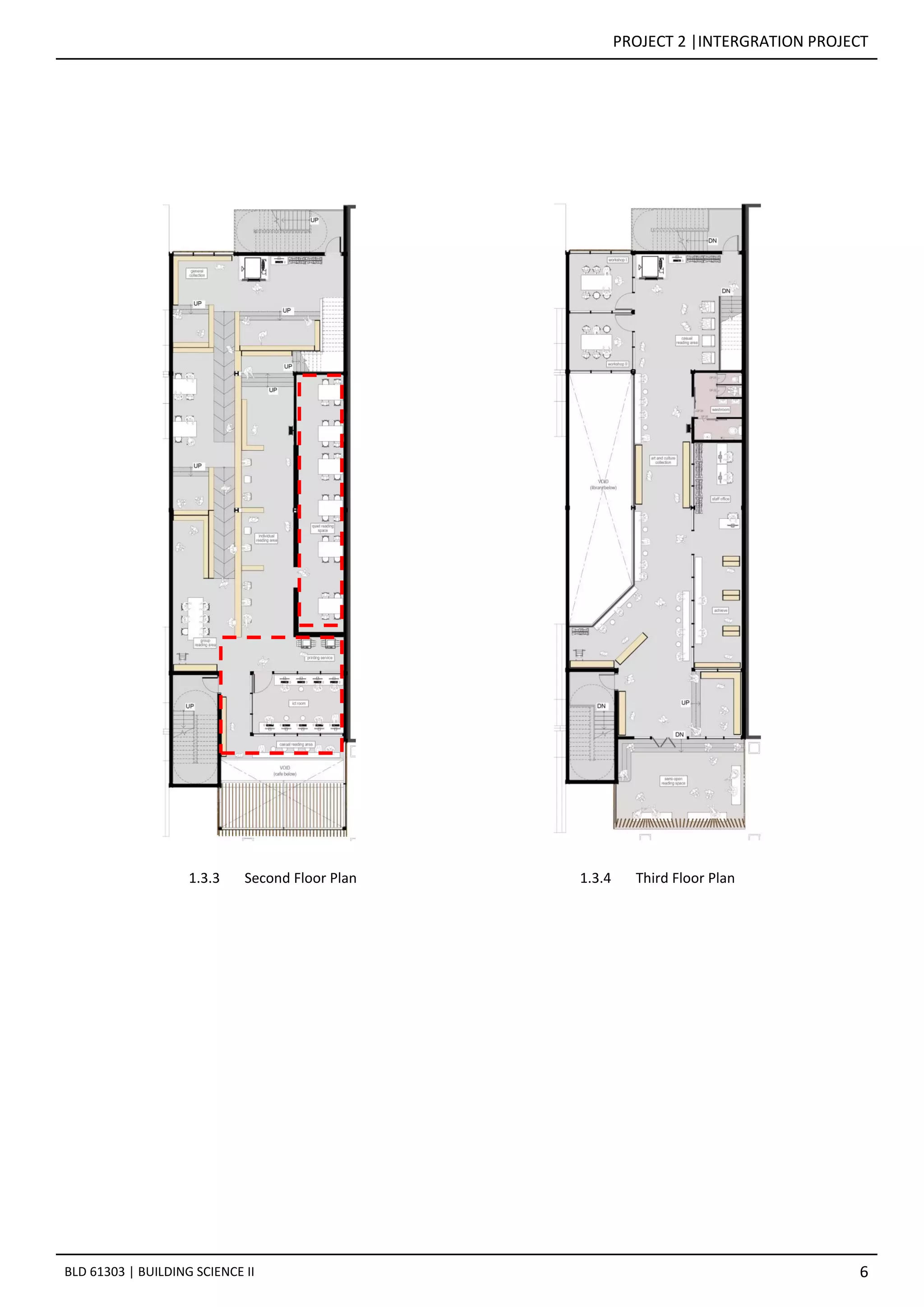
1.3.3 Second Floor Plan 1.3.4 Third Floor Plan
PROJECT 2 |INTERGRATION PROJECT
7BLD 61303 | BUILDING SCIENCE II
2.0 SPACE A : ICT SPACE
Figure 2.0.1 Floor Plan of ICT Space
The ICT Space is located at the second floor overlooking the café below, facing the front louvered façade
(east facing). Thus the space is receiving patially coverage of daylight in the morning as shown in Figure
2.0.2.
Figure 2.0.2 [Sectional Perspective A-A] The space is receiving partial daylight from morning sun at 10.00AM
Figure 2.0.3` [Sectional Perspective A-A] The space has no daylight from evening sun at 5.00PM
PROJECT 2 |INTERGRATION PROJECT
8BLD 61303 | BUILDING SCIENCE II
2.1 DAYLIGHT ANALYSIS
Daylight Factor & Distribution
In side-lit room, the maximum DF is near the windows and it is mainly due to the sky component. In the
early stages of building design, the average daylight factor may be used to assess the adequacy of daylight:
𝐴𝑣𝑒𝑟𝑎𝑔𝑒 𝐷𝐹 =
𝑊
𝐴
×
𝑇𝜃
(1 − 𝑅)
Where, W is the area of the windows (m
2
)
A is the total area of the internal surfaces (m
2
)
T is the glass transmittance corrected for dirt
Θ is the visible sky angle in degrees from the centre of the window
R is the average reflectance of area A
Zone Daylight Factor (%) Distribution
Very bright >6 Large (Involved thermal and glare problem)
Bright 3-6 Good
Average 1-3 Fair
Dark 0-1 Poor
Table 1 daylight factor & distribution (Department of standards Malaysia, 2007)
PROJECT 2 |INTERGRATION PROJECT
9BLD 61303 | BUILDING SCIENCE II
2.1.1 Daylight Contour
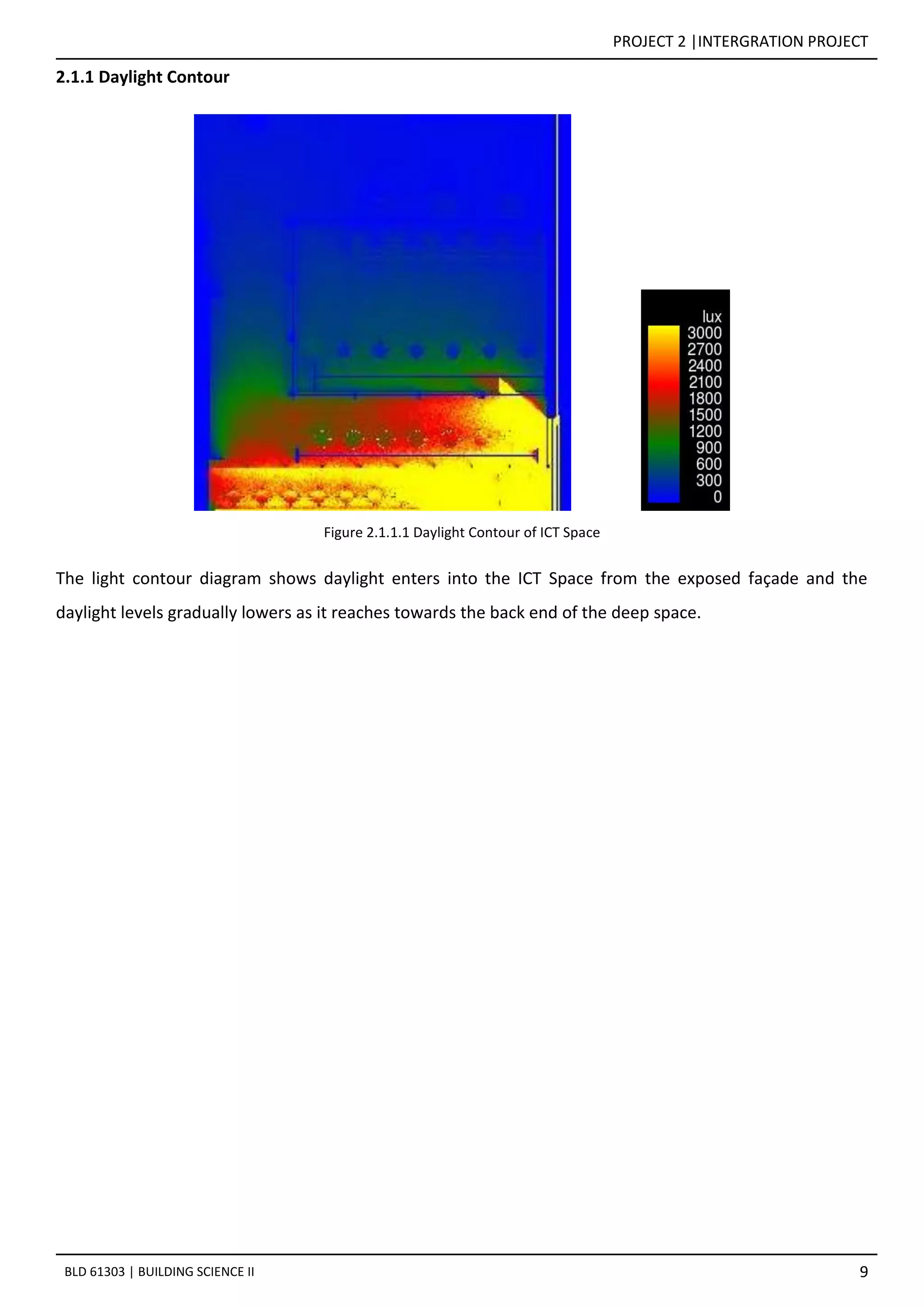
Figure 2.1.1.1 Daylight Contour of ICT Space
The light contour diagram shows daylight enters into the ICT Space from the exposed façade and the
daylight levels gradually lowers as it reaches towards the back end of the deep space.
PROJECT 2 |INTERGRATION PROJECT
10BLD 61303 | BUILDING SCIENCE II
2.1.2 Daylight Distrubution Factor
Dimension of ICT Space (m) L : 7.1m W : 7.3m
Floor Area (m2
) 51.8m2
Area of window (m2
), W = 2.5m x 7.3m
= 18.25m2
Total area of internal surfaces (m2
), A = 2 (7.1m x 7.3m) + 2 (7.3m x 4m) + (7.1m x 4m) + (3m x 4m)
= 103.66m2
+ 58.4m2
+ 28.4m2
+ 12m2
= 202.5 m2
Glass transmittance, T 0.6
Visible sky angle from center of window, θ 72
Average reflectance of area (concrete), R 0.275
Average Daylight Factor
Average DF =
W
A
×
Tθ
(1 − R)
=
18.25 𝑚2
202.5 𝑚2
×
0.6(72)
(1 − 0.275)
= 0.09 x 59.6
= 5.4%
The ICT Space falls under the criteria of good distribution of day light factor between 3-6% and has lower
standard room illumination level recommended by MS1525 (exhibit insensitive to light). Hence, Low-E
Glass panels are installed to allow natural lighting to brighten the space as it has been setback 3m to create
buffer zone.
PROJECT 2 |INTERGRATION PROJECT
11BLD 61303 | BUILDING SCIENCE II
2.2 Artificial Light Analysis
Lumen Method
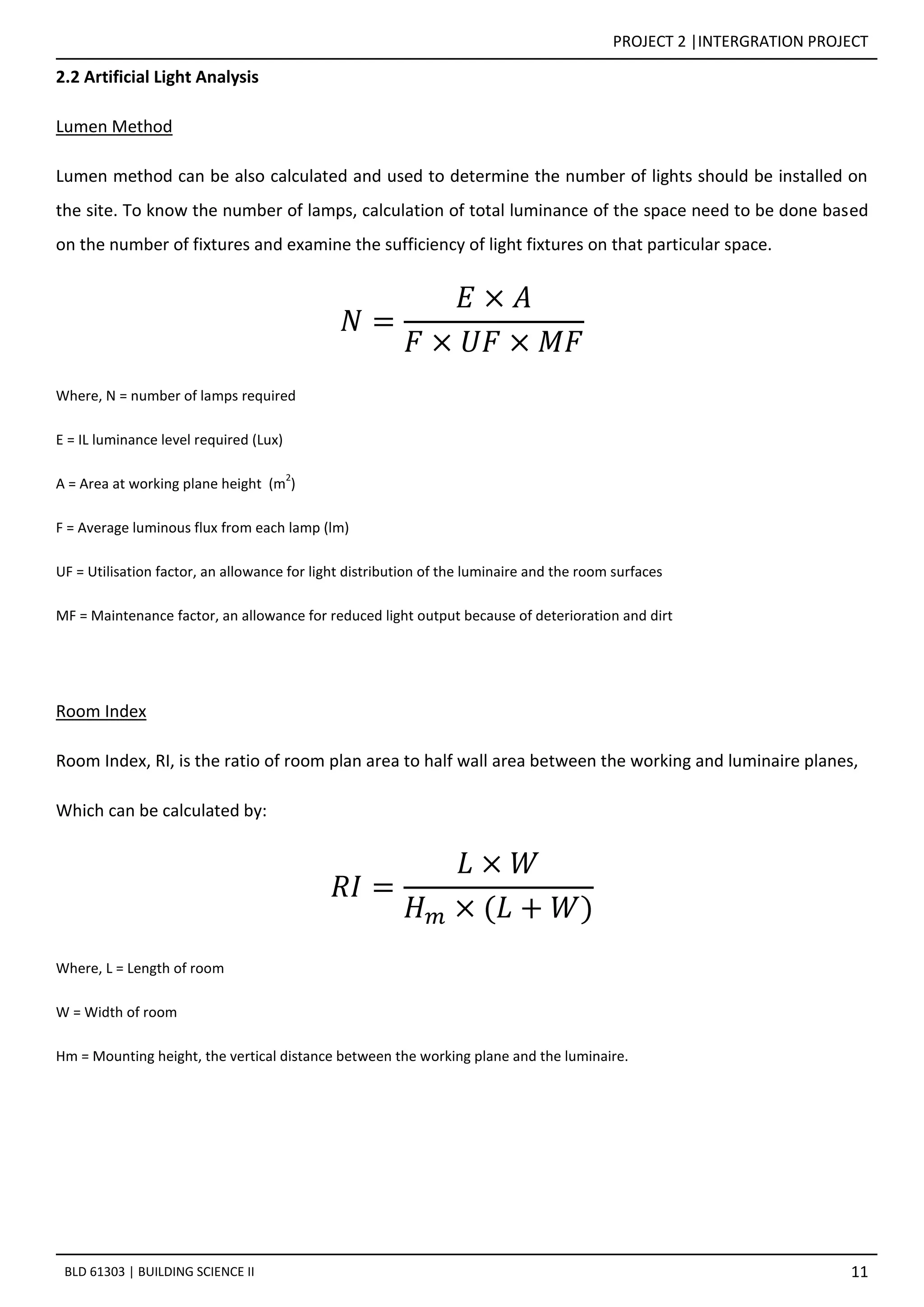
Lumen method can be also calculated and used to determine the number of lights should be installed on
the site. To know the number of lamps, calculation of total luminance of the space need to be done based
on the number of fixtures and examine the sufficiency of light fixtures on that particular space.
𝑁 =
𝐸 × 𝐴
𝐹 × 𝑈𝐹 × 𝑀𝐹
Where, N = number of lamps required
E = IL luminance level required (Lux)
A = Area at working plane height (m
2
)
F = Average luminous flux from each lamp (lm)
UF = Utilisation factor, an allowance for light distribution of the luminaire and the room surfaces
MF = Maintenance factor, an allowance for reduced light output because of deterioration and dirt
Room Index
Room Index, RI, is the ratio of room plan area to half wall area between the working and luminaire planes,
Which can be calculated by:
𝑅𝐼 =
𝐿 × 𝑊
𝐻 𝑚 × (𝐿 + 𝑊)
Where, L = Length of room
W = Width of room
Hm = Mounting height, the vertical distance between the working plane and the luminaire.
PROJECT 2 |INTERGRATION PROJECT
12BLD 61303 | BUILDING SCIENCE II
2.2.1 Lumen Method
Properties of light fixtures
Types of fixture Surface mounted LED downlight
Types of light bulb
Materials of fixtures Aluminium casing with frosted glass
Product Brand and Code V-TAC, VT-1805 RD
Nominal life (hours) >20,000 hrs
Wattage Range (w) 75w
CRI >80
Colour Temperature (Kelvin) 3000K
Colour Designation White
Lumens (lm) 1440lm
Lumen method calculation
Location ICT Space
Dimension of room (m) L : 7.1m W : 7.3m
Total Floor Area (m2
) 51.8 m2
Types of lighting fixtures Surface mounted LED downlight
Luminous flux of lighting, F (lm) 1440lm
Height of luminaires (m) 4.0m
Height of working plane (m) 1.1m
Mounting Height (Hm) 2.9m
Standard Illumination recommended by MS1525, E (lux) 300 lux
Reflectance Factor White painted ceiling (0.8)
White painted concrete wall (0.50)
Grey concrete surface (0.275)
Room Index RI/(K)
𝑅𝐼 =
𝐿 × 𝑊
𝐻 𝑚 × (𝐿 + 𝑊)
=
7.1𝑚 × 7.3𝑚
2.9m × (7.1𝑚 + 7.3𝑚)
= 1.24
PROJECT 2 |INTERGRATION PROJECT
13BLD 61303 | BUILDING SCIENCE II
Utilization Factor (UF) 0.56 (Based on UF table)
Maintenance Factor (MF) 0.8 (standard)
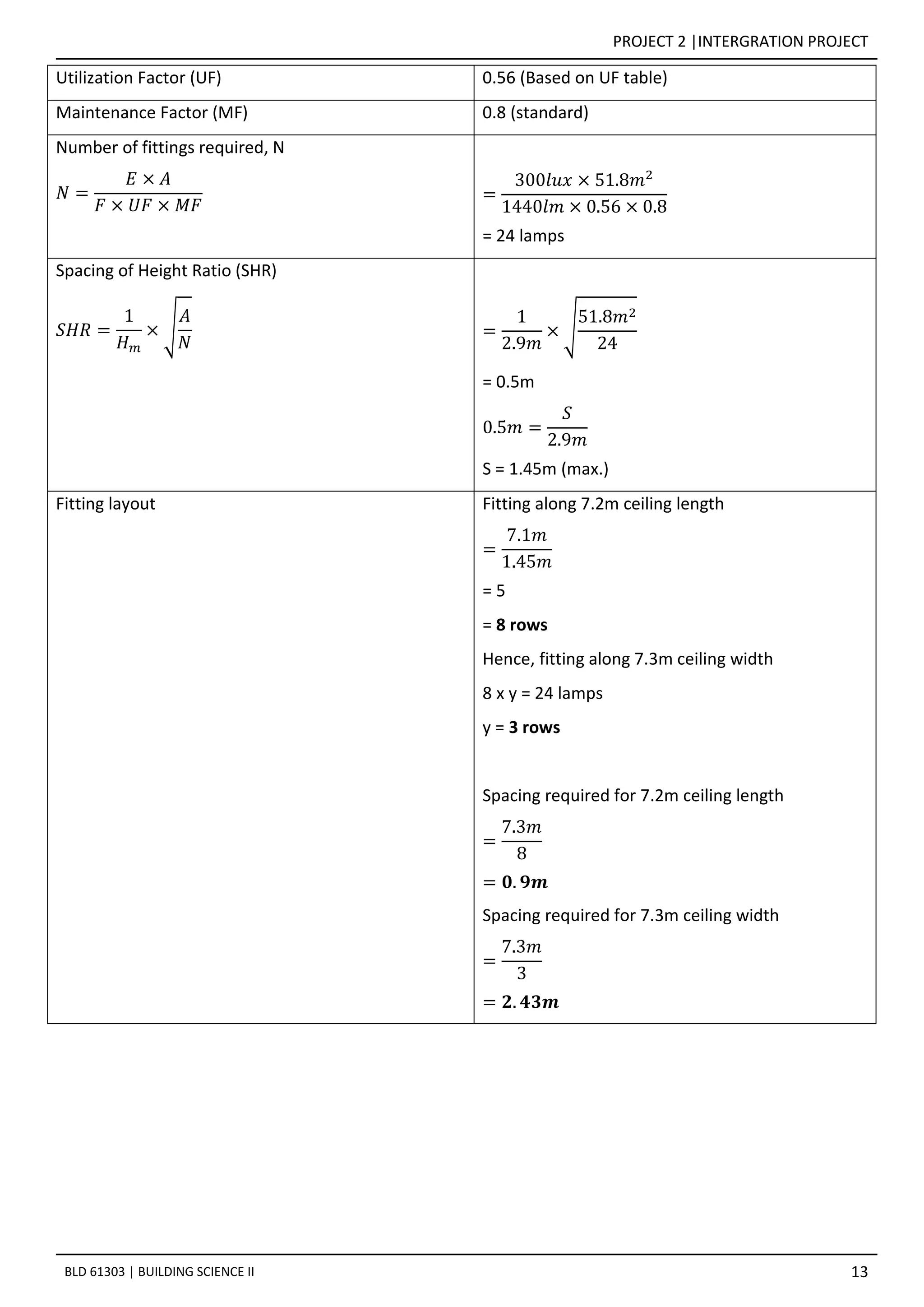
Number of fittings required, N
𝑁 =
𝐸 × 𝐴
𝐹 × 𝑈𝐹 × 𝑀𝐹
=
300𝑙𝑢𝑥 × 51.8𝑚2
1440𝑙𝑚 × 0.56 × 0.8
= 24 lamps
Spacing of Height Ratio (SHR)
𝑆𝐻𝑅 =
1
𝐻 𝑚
× √
𝐴
𝑁
=
1
2.9𝑚
× √
51.8𝑚2
24
= 0.5m
0.5𝑚 =
𝑆
2.9𝑚
S = 1.45m (max.)
Fitting layout Fitting along 7.2m ceiling length
=
7.1𝑚
1.45𝑚
= 5
= 8 rows
Hence, fitting along 7.3m ceiling width
8 x y = 24 lamps
y = 3 rows
Spacing required for 7.2m ceiling length
=
7.3𝑚
8
= 𝟎. 𝟗𝒎
Spacing required for 7.3m ceiling width
=
7.3𝑚
3
= 𝟐. 𝟒𝟑𝒎
PROJECT 2 |INTERGRATION PROJECT
14BLD 61303 | BUILDING SCIENCE II
2.2.2 Reflected Ceiling Plan
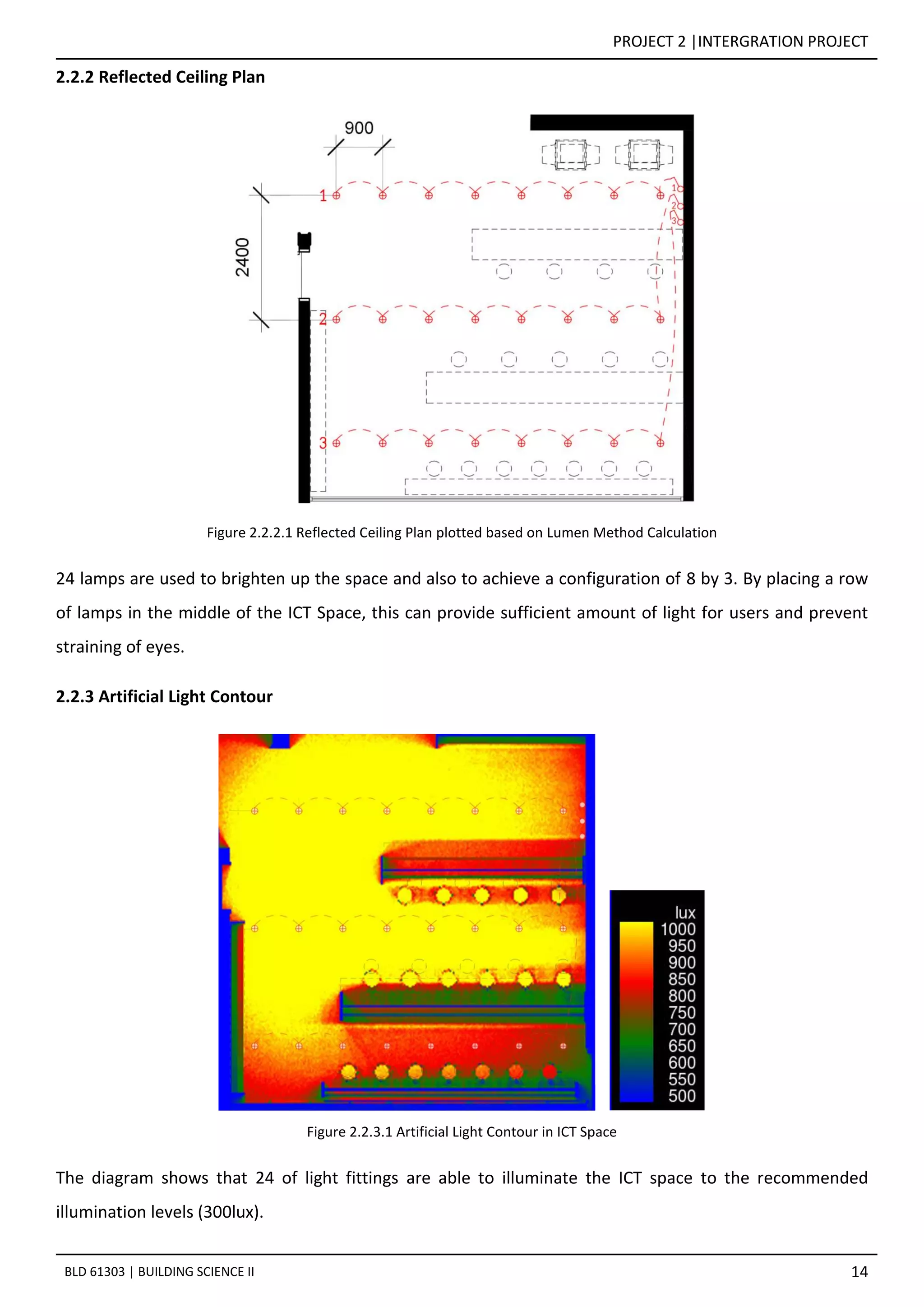
Figure 2.2.2.1 Reflected Ceiling Plan plotted based on Lumen Method Calculation
24 lamps are used to brighten up the space and also to achieve a configuration of 8 by 3. By placing a row
of lamps in the middle of the ICT Space, this can provide sufficient amount of light for users and prevent
straining of eyes.
2.2.3 Artificial Light Contour
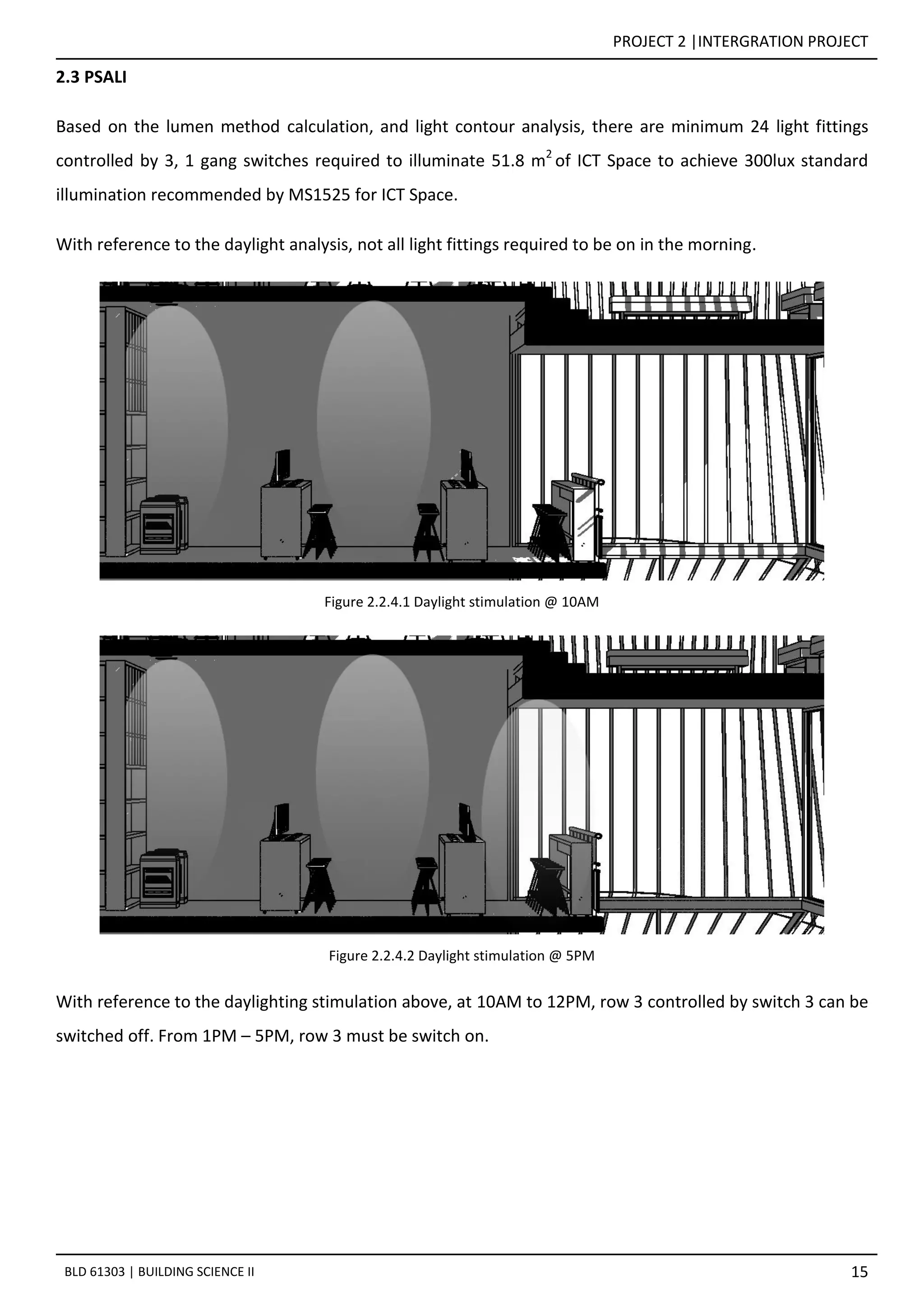
Figure 2.2.3.1 Artificial Light Contour in ICT Space
The diagram shows that 24 of light fittings are able to illuminate the ICT space to the recommended
illumination levels (300lux).
PROJECT 2 |INTERGRATION PROJECT
15BLD 61303 | BUILDING SCIENCE II
2.3 PSALI
Based on the lumen method calculation, and light contour analysis, there are minimum 24 light fittings
controlled by 3, 1 gang switches required to illuminate 51.8 m2
of ICT Space to achieve 300lux standard
illumination recommended by MS1525 for ICT Space.
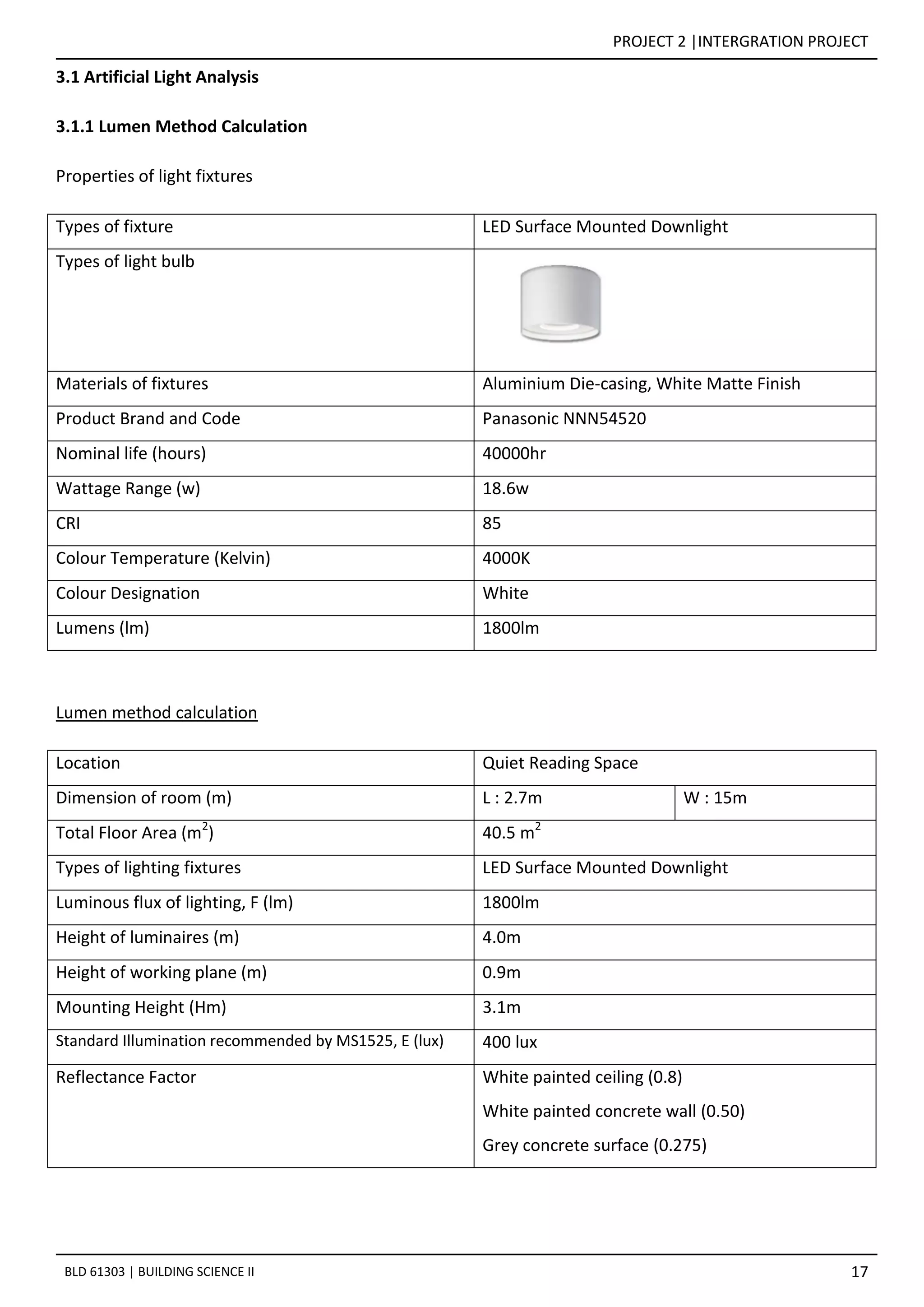
With reference to the daylight analysis, not all light fittings required to be on in the morning.
Figure 2.2.4.1 Daylight stimulation @ 10AM
Figure 2.2.4.2 Daylight stimulation @ 5PM
With reference to the daylighting stimulation above, at 10AM to 12PM, row 3 controlled by switch 3 can be
switched off. From 1PM – 5PM, row 3 must be switch on.
PROJECT 2 |INTERGRATION PROJECT
16BLD 61303 | BUILDING SCIENCE II
3.0 SPACE B : QUIET READING SPACE
Figure 3.0.1 Floor Plan of Quiet Reading Space
The enclosed Quiet Reading Space is located on the second floor. This room does not have openings as this
is to maintain the privacy. Thus, this space does not receive daylight as shown in Figure 3.0.2 and Figure
3.0.3.
Figure 3.0.2 [Sectional Perspective B-B] The space has zero daylight throughout the day
PROJECT 2 |INTERGRATION PROJECT
17BLD 61303 | BUILDING SCIENCE II
3.1 Artificial Light Analysis
3.1.1 Lumen Method Calculation
Properties of light fixtures
Types of fixture LED Surface Mounted Downlight
Types of light bulb
Materials of fixtures Aluminium Die-casing, White Matte Finish
Product Brand and Code Panasonic NNN54520
Nominal life (hours) 40000hr
Wattage Range (w) 18.6w
CRI 85
Colour Temperature (Kelvin) 4000K
Colour Designation White
Lumens (lm) 1800lm
Lumen method calculation
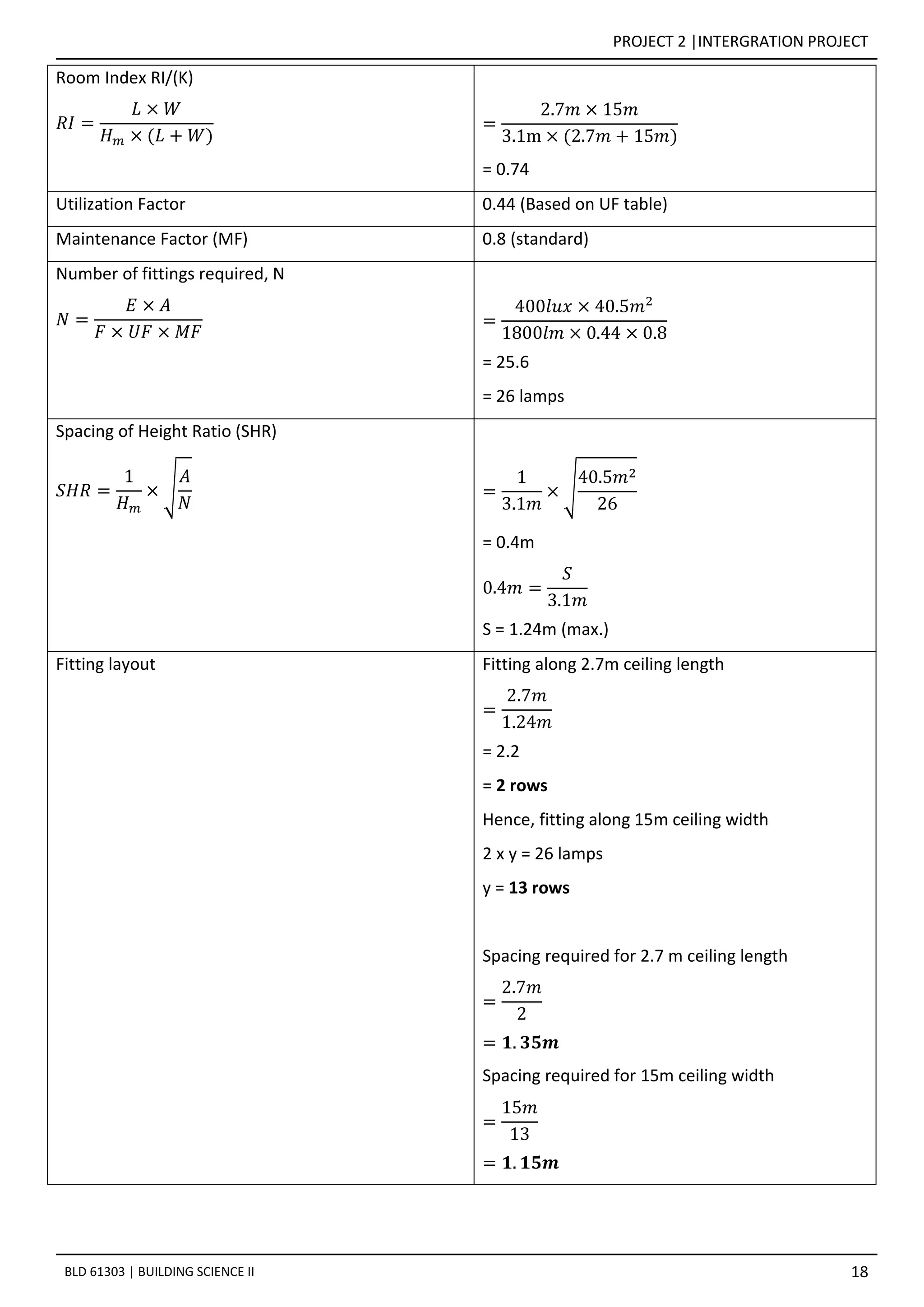
Location Quiet Reading Space
Dimension of room (m) L : 2.7m W : 15m
Total Floor Area (m2
) 40.5 m2
Types of lighting fixtures LED Surface Mounted Downlight
Luminous flux of lighting, F (lm) 1800lm
Height of luminaires (m) 4.0m
Height of working plane (m) 0.9m
Mounting Height (Hm) 3.1m
Standard Illumination recommended by MS1525, E (lux) 400 lux
Reflectance Factor White painted ceiling (0.8)
White painted concrete wall (0.50)
Grey concrete surface (0.275)
PROJECT 2 |INTERGRATION PROJECT
18BLD 61303 | BUILDING SCIENCE II
Room Index RI/(K)
𝑅𝐼 =
𝐿 × 𝑊
𝐻 𝑚 × (𝐿 + 𝑊)
=
2.7𝑚 × 15𝑚
3.1m × (2.7𝑚 + 15𝑚)
= 0.74
Utilization Factor 0.44 (Based on UF table)
Maintenance Factor (MF) 0.8 (standard)
Number of fittings required, N
𝑁 =
𝐸 × 𝐴
𝐹 × 𝑈𝐹 × 𝑀𝐹
=
400𝑙𝑢𝑥 × 40.5𝑚2
1800𝑙𝑚 × 0.44 × 0.8
= 25.6
= 26 lamps
Spacing of Height Ratio (SHR)
𝑆𝐻𝑅 =
1
𝐻 𝑚
× √
𝐴
𝑁
=
1
3.1𝑚
× √
40.5𝑚2
26
= 0.4m
0.4𝑚 =
𝑆
3.1𝑚
S = 1.24m (max.)
Fitting layout Fitting along 2.7m ceiling length
=
2.7𝑚
1.24𝑚
= 2.2
= 2 rows
Hence, fitting along 15m ceiling width
2 x y = 26 lamps
y = 13 rows
Spacing required for 2.7 m ceiling length
=
2.7𝑚
2
= 𝟏. 𝟑𝟓𝒎
Spacing required for 15m ceiling width
=
15𝑚
13
= 𝟏. 𝟏𝟓𝒎
PROJECT 2 |INTERGRATION PROJECT
19BLD 61303 | BUILDING SCIENCE II
3.1.2 Reflected Ceiling Plan
Figure 3.1.2.1 Reflected Ceiling Plan plotted based on Lumen Method Calculation
26 lamps are used to brighten up the space and also to achieve a configuration of 13 by 2. This can provide
sufficient amount of light for users. By separating the light fitting into six sets, illumination of space can be
controlled. If table 1 is not used, lights can be switch off to conserve energy.
3.1.3 Artificial Light Contour
Figure 3.1.2.1 Artificial Light Contour in Quiet Reading Space
Based on the lumen method calculation and light contour analysis, the 26 light fittings controlled by 2, 3
gang switches required to illuminate 40.5m2
of the reading space to achieve 400lux standard illumination
recommended by MS1525 for reading area. All light fittings required to be used throughout the day in
order to achieve recommended illumination levels (400lux). This is because no daylight enters to illuminate
the space.

community lib bsci

  • 1.
    SCHOOL OF ARCHITECTURE,BUILDING & DESIGN BLD 61303 | BUILDING SCIENCE II PROJECT PART 2 | INTEGRATION PROJECT NAME | KHOR YEN MIN ID | 0318149 TUTOR | AR. EDWIN CHAN
  • 2.
    PROJECT 2 |INTERGRATIONPROJECT 2BLD 61303 | BUILDING SCIENCE II TABLE OF CONTENT 1.0 INTRODUCTION 1.1 Site Introduction 1.2 Site Analysis – Sun Path Diagram 1.3 Overall Floor Plans 2.0 SPACE A – ICT SPACE 2.1 Daylight Analysis 2.1.1 Daylight Contour 2.1.2 Daylight Distribution Factor (Calculation) 2.2 Artificial Light Analysis 2.2.1 Lumen Method (Calculation) 2.2.2 Reflected Ceiling Plan 2.2.3 Artificial Light Contour 2.3 PSALI 3.0 SPACE B – QUIET READING SPACE 3.1 Artificial Light Analysis 3.1.1 Lumen Method (Calculation) 3.1.2 Reflected Ceiling Plan 3.1.3 Artificial Light Contour 3 4 5 – 6 7 8 9 10 11 12 – 13 14 14 15 16 17 – 18 19 19
  • 3.
    PROJECT 2 |INTERGRATIONPROJECT 3BLD 61303 | BUILDING SCIENCE II 1.0 INTRODUCTION 1.1 Site Introduction Site is located on the famous textile street, Jalan Tuanku Abdul Rahman which, is a major one-way road located in Kuala Lumpur Malaysia, on the coordinates 3.141756, 101.698069. The front façade of the building is receiving morning sun (Figure 1.2.1) whereas the back façade of the building is receiving a morning sun (Figure 1.2.2).
  • 4.
    PROJECT 2 |INTERGRATIONPROJECT 4BLD 61303 | BUILDING SCIENCE II 1.2 Site Analysis – Sun Path Diagram Figure 1.2.1 – Sun Path Diagram | 10AM Figure 1.2.1 – Sun Path Diagram | 4PM
  • 5.
    PROJECT 2 |INTERGRATIONPROJECT 5BLD 61303 | BUILDING SCIENCE II 1.3 Overall Floor Plans (Scale 1:200) 1.3.1 Ground Floor Plan 1.3.2 First Floor Plan
  • 6.
    PROJECT 2 |INTERGRATIONPROJECT 6BLD 61303 | BUILDING SCIENCE II 1.3.3 Second Floor Plan 1.3.4 Third Floor Plan
  • 7.
    PROJECT 2 |INTERGRATIONPROJECT 7BLD 61303 | BUILDING SCIENCE II 2.0 SPACE A : ICT SPACE Figure 2.0.1 Floor Plan of ICT Space The ICT Space is located at the second floor overlooking the café below, facing the front louvered façade (east facing). Thus the space is receiving patially coverage of daylight in the morning as shown in Figure 2.0.2. Figure 2.0.2 [Sectional Perspective A-A] The space is receiving partial daylight from morning sun at 10.00AM Figure 2.0.3` [Sectional Perspective A-A] The space has no daylight from evening sun at 5.00PM
  • 8.
    PROJECT 2 |INTERGRATIONPROJECT 8BLD 61303 | BUILDING SCIENCE II 2.1 DAYLIGHT ANALYSIS Daylight Factor & Distribution In side-lit room, the maximum DF is near the windows and it is mainly due to the sky component. In the early stages of building design, the average daylight factor may be used to assess the adequacy of daylight: 𝐴𝑣𝑒𝑟𝑎𝑔𝑒 𝐷𝐹 = 𝑊 𝐴 × 𝑇𝜃 (1 − 𝑅) Where, W is the area of the windows (m 2 ) A is the total area of the internal surfaces (m 2 ) T is the glass transmittance corrected for dirt Θ is the visible sky angle in degrees from the centre of the window R is the average reflectance of area A Zone Daylight Factor (%) Distribution Very bright >6 Large (Involved thermal and glare problem) Bright 3-6 Good Average 1-3 Fair Dark 0-1 Poor Table 1 daylight factor & distribution (Department of standards Malaysia, 2007)
  • 9.
    PROJECT 2 |INTERGRATIONPROJECT 9BLD 61303 | BUILDING SCIENCE II 2.1.1 Daylight Contour Figure 2.1.1.1 Daylight Contour of ICT Space The light contour diagram shows daylight enters into the ICT Space from the exposed façade and the daylight levels gradually lowers as it reaches towards the back end of the deep space.
  • 10.
    PROJECT 2 |INTERGRATIONPROJECT 10BLD 61303 | BUILDING SCIENCE II 2.1.2 Daylight Distrubution Factor Dimension of ICT Space (m) L : 7.1m W : 7.3m Floor Area (m2 ) 51.8m2 Area of window (m2 ), W = 2.5m x 7.3m = 18.25m2 Total area of internal surfaces (m2 ), A = 2 (7.1m x 7.3m) + 2 (7.3m x 4m) + (7.1m x 4m) + (3m x 4m) = 103.66m2 + 58.4m2 + 28.4m2 + 12m2 = 202.5 m2 Glass transmittance, T 0.6 Visible sky angle from center of window, θ 72 Average reflectance of area (concrete), R 0.275 Average Daylight Factor Average DF = W A × Tθ (1 − R) = 18.25 𝑚2 202.5 𝑚2 × 0.6(72) (1 − 0.275) = 0.09 x 59.6 = 5.4% The ICT Space falls under the criteria of good distribution of day light factor between 3-6% and has lower standard room illumination level recommended by MS1525 (exhibit insensitive to light). Hence, Low-E Glass panels are installed to allow natural lighting to brighten the space as it has been setback 3m to create buffer zone.
  • 11.
    PROJECT 2 |INTERGRATIONPROJECT 11BLD 61303 | BUILDING SCIENCE II 2.2 Artificial Light Analysis Lumen Method Lumen method can be also calculated and used to determine the number of lights should be installed on the site. To know the number of lamps, calculation of total luminance of the space need to be done based on the number of fixtures and examine the sufficiency of light fixtures on that particular space. 𝑁 = 𝐸 × 𝐴 𝐹 × 𝑈𝐹 × 𝑀𝐹 Where, N = number of lamps required E = IL luminance level required (Lux) A = Area at working plane height (m 2 ) F = Average luminous flux from each lamp (lm) UF = Utilisation factor, an allowance for light distribution of the luminaire and the room surfaces MF = Maintenance factor, an allowance for reduced light output because of deterioration and dirt Room Index Room Index, RI, is the ratio of room plan area to half wall area between the working and luminaire planes, Which can be calculated by: 𝑅𝐼 = 𝐿 × 𝑊 𝐻 𝑚 × (𝐿 + 𝑊) Where, L = Length of room W = Width of room Hm = Mounting height, the vertical distance between the working plane and the luminaire.
  • 12.
    PROJECT 2 |INTERGRATIONPROJECT 12BLD 61303 | BUILDING SCIENCE II 2.2.1 Lumen Method Properties of light fixtures Types of fixture Surface mounted LED downlight Types of light bulb Materials of fixtures Aluminium casing with frosted glass Product Brand and Code V-TAC, VT-1805 RD Nominal life (hours) >20,000 hrs Wattage Range (w) 75w CRI >80 Colour Temperature (Kelvin) 3000K Colour Designation White Lumens (lm) 1440lm Lumen method calculation Location ICT Space Dimension of room (m) L : 7.1m W : 7.3m Total Floor Area (m2 ) 51.8 m2 Types of lighting fixtures Surface mounted LED downlight Luminous flux of lighting, F (lm) 1440lm Height of luminaires (m) 4.0m Height of working plane (m) 1.1m Mounting Height (Hm) 2.9m Standard Illumination recommended by MS1525, E (lux) 300 lux Reflectance Factor White painted ceiling (0.8) White painted concrete wall (0.50) Grey concrete surface (0.275) Room Index RI/(K) 𝑅𝐼 = 𝐿 × 𝑊 𝐻 𝑚 × (𝐿 + 𝑊) = 7.1𝑚 × 7.3𝑚 2.9m × (7.1𝑚 + 7.3𝑚) = 1.24
  • 13.
    PROJECT 2 |INTERGRATIONPROJECT 13BLD 61303 | BUILDING SCIENCE II Utilization Factor (UF) 0.56 (Based on UF table) Maintenance Factor (MF) 0.8 (standard) Number of fittings required, N 𝑁 = 𝐸 × 𝐴 𝐹 × 𝑈𝐹 × 𝑀𝐹 = 300𝑙𝑢𝑥 × 51.8𝑚2 1440𝑙𝑚 × 0.56 × 0.8 = 24 lamps Spacing of Height Ratio (SHR) 𝑆𝐻𝑅 = 1 𝐻 𝑚 × √ 𝐴 𝑁 = 1 2.9𝑚 × √ 51.8𝑚2 24 = 0.5m 0.5𝑚 = 𝑆 2.9𝑚 S = 1.45m (max.) Fitting layout Fitting along 7.2m ceiling length = 7.1𝑚 1.45𝑚 = 5 = 8 rows Hence, fitting along 7.3m ceiling width 8 x y = 24 lamps y = 3 rows Spacing required for 7.2m ceiling length = 7.3𝑚 8 = 𝟎. 𝟗𝒎 Spacing required for 7.3m ceiling width = 7.3𝑚 3 = 𝟐. 𝟒𝟑𝒎
  • 14.
    PROJECT 2 |INTERGRATIONPROJECT 14BLD 61303 | BUILDING SCIENCE II 2.2.2 Reflected Ceiling Plan Figure 2.2.2.1 Reflected Ceiling Plan plotted based on Lumen Method Calculation 24 lamps are used to brighten up the space and also to achieve a configuration of 8 by 3. By placing a row of lamps in the middle of the ICT Space, this can provide sufficient amount of light for users and prevent straining of eyes. 2.2.3 Artificial Light Contour Figure 2.2.3.1 Artificial Light Contour in ICT Space The diagram shows that 24 of light fittings are able to illuminate the ICT space to the recommended illumination levels (300lux).
  • 15.
    PROJECT 2 |INTERGRATIONPROJECT 15BLD 61303 | BUILDING SCIENCE II 2.3 PSALI Based on the lumen method calculation, and light contour analysis, there are minimum 24 light fittings controlled by 3, 1 gang switches required to illuminate 51.8 m2 of ICT Space to achieve 300lux standard illumination recommended by MS1525 for ICT Space. With reference to the daylight analysis, not all light fittings required to be on in the morning. Figure 2.2.4.1 Daylight stimulation @ 10AM Figure 2.2.4.2 Daylight stimulation @ 5PM With reference to the daylighting stimulation above, at 10AM to 12PM, row 3 controlled by switch 3 can be switched off. From 1PM – 5PM, row 3 must be switch on.
  • 16.
    PROJECT 2 |INTERGRATIONPROJECT 16BLD 61303 | BUILDING SCIENCE II 3.0 SPACE B : QUIET READING SPACE Figure 3.0.1 Floor Plan of Quiet Reading Space The enclosed Quiet Reading Space is located on the second floor. This room does not have openings as this is to maintain the privacy. Thus, this space does not receive daylight as shown in Figure 3.0.2 and Figure 3.0.3. Figure 3.0.2 [Sectional Perspective B-B] The space has zero daylight throughout the day
  • 17.
    PROJECT 2 |INTERGRATIONPROJECT 17BLD 61303 | BUILDING SCIENCE II 3.1 Artificial Light Analysis 3.1.1 Lumen Method Calculation Properties of light fixtures Types of fixture LED Surface Mounted Downlight Types of light bulb Materials of fixtures Aluminium Die-casing, White Matte Finish Product Brand and Code Panasonic NNN54520 Nominal life (hours) 40000hr Wattage Range (w) 18.6w CRI 85 Colour Temperature (Kelvin) 4000K Colour Designation White Lumens (lm) 1800lm Lumen method calculation Location Quiet Reading Space Dimension of room (m) L : 2.7m W : 15m Total Floor Area (m2 ) 40.5 m2 Types of lighting fixtures LED Surface Mounted Downlight Luminous flux of lighting, F (lm) 1800lm Height of luminaires (m) 4.0m Height of working plane (m) 0.9m Mounting Height (Hm) 3.1m Standard Illumination recommended by MS1525, E (lux) 400 lux Reflectance Factor White painted ceiling (0.8) White painted concrete wall (0.50) Grey concrete surface (0.275)
  • 18.
    PROJECT 2 |INTERGRATIONPROJECT 18BLD 61303 | BUILDING SCIENCE II Room Index RI/(K) 𝑅𝐼 = 𝐿 × 𝑊 𝐻 𝑚 × (𝐿 + 𝑊) = 2.7𝑚 × 15𝑚 3.1m × (2.7𝑚 + 15𝑚) = 0.74 Utilization Factor 0.44 (Based on UF table) Maintenance Factor (MF) 0.8 (standard) Number of fittings required, N 𝑁 = 𝐸 × 𝐴 𝐹 × 𝑈𝐹 × 𝑀𝐹 = 400𝑙𝑢𝑥 × 40.5𝑚2 1800𝑙𝑚 × 0.44 × 0.8 = 25.6 = 26 lamps Spacing of Height Ratio (SHR) 𝑆𝐻𝑅 = 1 𝐻 𝑚 × √ 𝐴 𝑁 = 1 3.1𝑚 × √ 40.5𝑚2 26 = 0.4m 0.4𝑚 = 𝑆 3.1𝑚 S = 1.24m (max.) Fitting layout Fitting along 2.7m ceiling length = 2.7𝑚 1.24𝑚 = 2.2 = 2 rows Hence, fitting along 15m ceiling width 2 x y = 26 lamps y = 13 rows Spacing required for 2.7 m ceiling length = 2.7𝑚 2 = 𝟏. 𝟑𝟓𝒎 Spacing required for 15m ceiling width = 15𝑚 13 = 𝟏. 𝟏𝟓𝒎
  • 19.
    PROJECT 2 |INTERGRATIONPROJECT 19BLD 61303 | BUILDING SCIENCE II 3.1.2 Reflected Ceiling Plan Figure 3.1.2.1 Reflected Ceiling Plan plotted based on Lumen Method Calculation 26 lamps are used to brighten up the space and also to achieve a configuration of 13 by 2. This can provide sufficient amount of light for users. By separating the light fitting into six sets, illumination of space can be controlled. If table 1 is not used, lights can be switch off to conserve energy. 3.1.3 Artificial Light Contour Figure 3.1.2.1 Artificial Light Contour in Quiet Reading Space Based on the lumen method calculation and light contour analysis, the 26 light fittings controlled by 2, 3 gang switches required to illuminate 40.5m2 of the reading space to achieve 400lux standard illumination recommended by MS1525 for reading area. All light fittings required to be used throughout the day in order to achieve recommended illumination levels (400lux). This is because no daylight enters to illuminate the space.