SCHOOL ARCHITECTURE, BUILDING AND DESIGN
Bachelor of Science (Honours) in Architecture
BUILDING SCIENCE 2 [BLD 61303/ARC 3413]
Project 2: Integration Project with Architectural Design Studio V
NAME: KOH SUNG JIE
ID: 0318912
TUTOR: MR. AZIM SULAIMAN
Table of Contents
1.0 Introduction
1.1 Aims and Objectives 1
1.2 Project Description 1
1.3 Site Analysis 2
1.4 Floor Plans 3
2.0 Lighting Analysis/Proposal
2.1 Daylight Factor Analysis 5
2.1.1 Space A: Panoramic Reading Area 6
2.1.2 Effective methods of glare control and prevention 8
2.2 Artificial Lighting Analysis 9
2.2.1 Space A: Panoramic Reading Area 10
2.2.2 Space B: Pocket Shops 13
2.3 PSALI 16
3.0 References 18
1
1.0 Introduction
1.1 Aims and Objectives
This project aims to integrate the understanding of the principles of lighting design in the context of the final
design project of Architectural Design Studio 5. It encompasses on artificial and daylighting systems as well
as implementing PSALI design strategies.
The objectives are as follows:
• To show understanding of artificial lighting and daylighting strategies (PSALI) in the design.
• To solve design problems in relation to sustainability issues.
• To design spaces incorporating artificial and daylighting.
1.2 Project Description
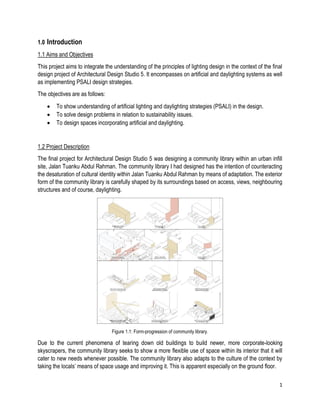
The final project for Architectural Design Studio 5 was designing a community library within an urban infill
site, Jalan Tuanku Abdul Rahman. The community library I had designed has the intention of counteracting
the desaturation of cultural identity within Jalan Tuanku Abdul Rahman by means of adaptation. The exterior
form of the community library is carefully shaped by its surroundings based on access, views, neighbouring
structures and of course, daylighting.
Figure 1.1: Form-progression of community library.
Due to the current phenomena of tearing down old buildings to build newer, more corporate-looking
skyscrapers, the community library seeks to show a more flexible use of space within its interior that it will
cater to new needs whenever possible. The community library also adapts to the culture of the context by
taking the locals’ means of space usage and improving it. This is apparent especially on the ground floor.
2
1.3 Site Analysis
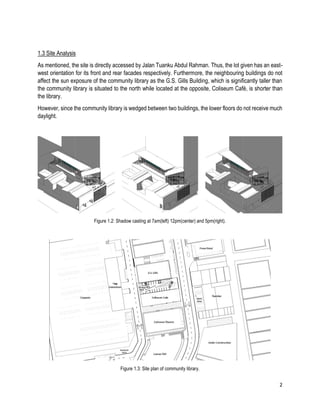
As mentioned, the site is directly accessed by Jalan Tuanku Abdul Rahman. Thus, the lot given has an east-
west orientation for its front and rear facades respectively. Furthermore, the neighbouring buildings do not
affect the sun exposure of the community library as the G.S. Gills Building, which is significantly taller than
the community library is situated to the north while located at the opposite, Coliseum Café, is shorter than
the library.
However, since the community library is wedged between two buildings, the lower floors do not receive much
daylight.
Figure 1.2: Shadow casting at 7am(left) 12pm(center) and 5pm(right).
Figure 1.3: Site plan of community library.
3
1.4 Floor plans
Figure 1.4: Ground floor plan and selected Space B (yellow).
Figure 1.5: First floor plan.
Figure 1.6: Second floor plan.
4
Figure 1.7: Third floor plan and selected Space A (yellow).
5
2.0Lighting Analysis/Proposal
2.1 Daylight Factor Analysis
Daylight Factor is a ratio that represents the amount of illumination available indoor relative to the
illumination present outdoors at the same time under overcast skies.
𝐴𝑣𝑒𝑟𝑎𝑔𝑒 𝐷𝐹 =
𝑊
𝐴
×
𝑇𝜃
(1 − 𝑅)
W = area of windows (m2)
A = total area of internal surfaces (m2)
T = glass transmittance
Θ = visible sky angle from center of window (°)
R = average reflectance of A
Zone DF (%) Distribution
Very Bright >6 Large (including thermal and glare problem)
Bright 3-6 Good
Average 1-3 Fair
Dark 0-1 Poor
Figure 2.1.1: Daylight factors and distribution. (Department of Standards Malaysia, 2007)
Illuminance (lux) Example
120,000 Brightest sunlight
110,000 Bright sunlight
20,000 Shade illuminated by entire clear blue sky
1000-2000 Typical overcast day, midday
400 Sunrise/sunset on clear day (ambient illumination)
<200 Extreme of darkest storm clouds, midday
40 Fully overcast, sunrise/ sunset
<1 Extreme darkest storm clouds, sunrise/sunset
Figure 2.1.2: Daylight intensity at different conditions.
6
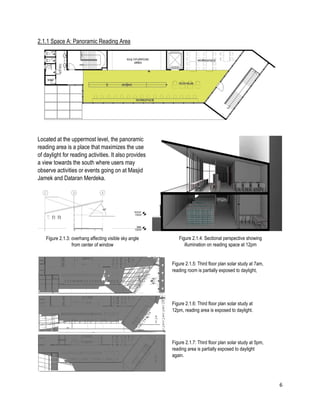
2.1.1 Space A: Panoramic Reading Area
Located at the uppermost level, the panoramic
reading area is a place that maximizes the use
of daylight for reading activities. It also provides
a view towards the south where users may
observe activities or events going on at Masjid
Jamek and Dataran Merdeka.
Figure 2.1.4: Sectional perspective showing
illumination on reading space at 12pm
Figure 2.1.5: Third floor plan solar study at 7am,
reading room is partially exposed to daylight,
Figure 2.1.6: Third floor plan solar study at
12pm, reading area is exposed to daylight.
Figure 2.1.7: Third floor plan solar study at 5pm,
reading area is partially exposed to daylight
again.
Figure 2.1.3: overhang affecting visible sky angle
from center of window
7
Floor area (m2) 98.3
W: Area of windows (m2) 80.1
A: Total area of internal surfaces (m2) Floor: 98.3
Ceiling: 100.6
Window: 80.1
Walls: 54.3
Total: 333.3
T: glass transmittance 0.6 (double glazed window in clean environment)
Θ: visible sky angle from center of window (°) 48 (refer to Figure 2.1.3)
R: average reflectance of A 98.3(0.3) + 80.1(0.8) + 100.6(0.8) + 54.3(0.5)
333.3
=
29.49 + 64.08 + 80.48 + 27.15
333.3
=
201.2
333.3
= 0.6
Average DF 𝑊
𝐴
×
𝑇𝜃
(1 − 𝑅)
=
80.1
333.3
×
0.6(48)
(1 − 0.6)
= 0.2×72
= 14.4
Internal illuminance (lux)
*external illuminance of shade illuminated by
entire clear blue sky used
𝐷𝐹 =
𝐸𝑖
𝐸𝑜
×100%
14 =
𝐸𝑖
20000
×100%
𝐸𝑖 =
14.4
100
×20000
= 2880
8
Based on the average Daylight Factor calculation, the result is more than 6% so it is concluded that the
space is considered very bright and its distribution is large. This poses a problem as users might
experience thermal discomfort or glare.
The internal illuminance is 2880 lux, which is way beyond the recommended MS1525 standard of 500 lux
for a reading space. This is also proven in the lighting contour below.
2.1.2 Effective methods of glare control and prevention
To counteract with the overwhelming daylight factor, luminance can be reduced by minimizing exposure or
diffusing light. These are two examples of glare control:
1. Installing louvers near glass panel.
Louvers is a traditional method to mitigate glare or thermal disturbance. It is widely used in
Malaysia; thus, it is also a very contextual solution.
2. Installing blinders on the interior end of the window.
Blinders give users the freedom to allow or deny exposure of light especially at different times to
the users’ own preference. This is a more flexible method to maximize usage of daylight within the
reading space.
Figure 2.1.8: Lighting contour of third floor plan at 12pm.
Figure 2.1.9: Louvers on a modern building.
Figure 2.1.10: Blinders to mitigate glare.
9
2.2 Artificial Lighting Analysis
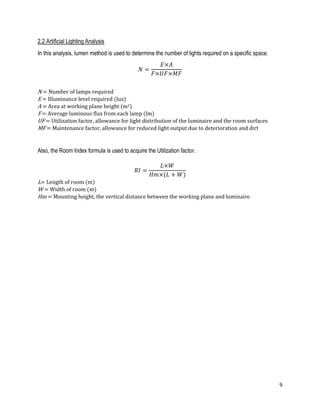
In this analysis, lumen method is used to determine the number of lights required on a specific space.
𝑁 =
𝐸×𝐴
𝐹×𝑈𝐹×𝑀𝐹
N = Number of lamps required
E = Illuminance level required (lux)
A = Area at working plane height (m2)
F = Average luminous flux from each lamp (lm)
UF = Utilization factor, allowance for light distribution of the luminaire and the room surfaces
MF = Maintenance factor, allowance for reduced light output due to deterioration and dirt
Also, the Room Index formula is used to acquire the Utilization factor.
𝑅𝐼 =
𝐿×𝑊
𝐻𝑚×(𝐿 + 𝑊)
L= Length of room (m)
W = Width of room (m)
Hm = Mounting height, the vertical distance between the working plane and luminaire
10
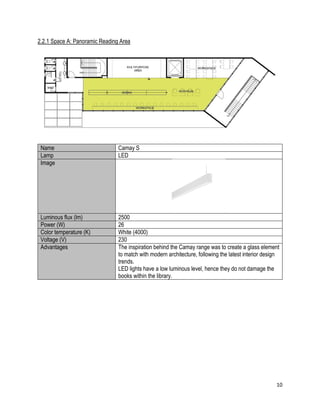
2.2.1 Space A: Panoramic Reading Area
Name Camay S
Lamp LED
Image
Luminous flux (lm) 2500
Power (W) 26
Color temperature (K) White (4000)
Voltage (V) 230
Advantages The inspiration behind the Camay range was to create a glass element
to match with modern architecture, following the latest interior design
trends.
LED lights have a low luminous level, hence they do not damage the
books within the library.
11
E: Illuminance level required (lux) 500 (MS 1525 recommendation for reading and book shelving)
A: Area at working plane height (m2) 98.5
F: Average luminous flux from each
lamp (lm)
2500
RI: Room Index
𝑅𝐼 =
𝐿×𝑊
𝐻𝑚×(𝐿 + 𝑊)
=
4.9×22
13.5 − 10.8×(4.9 + 22)
=
107.8
2.7×(26.9)
= 1.5
Reflectance Ceiling: exposed light gray concrete – 0.8
Wall: Glass walls – 0.8
Floor: Carpeting – 0.3
UF: Utilization factor 0.63
MF: Maintenance factor 0.8
N: Number of lamps required
𝑁 =
𝐸×𝐴
𝐹×𝑈𝐹×𝑀𝐹
=
500×98.3
2500×0.63×0.8
=
49150
1260
= 39
Figure 2.2.1: Space A spacing diagram before cutting the shape.
The suspended lights are arranged in a 13x3 manner to fulfill the minimum requirement of 39 lamps. The
distance between the suspended lamps are no less than 1.5m.
12
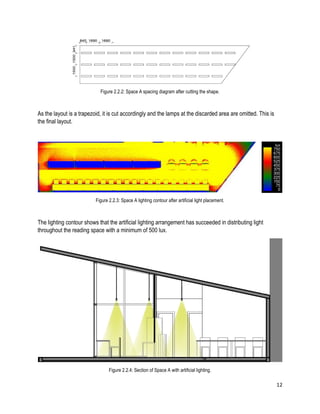
Figure 2.2.2: Space A spacing diagram after cutting the shape.
As the layout is a trapezoid, it is cut accordingly and the lamps at the discarded area are omitted. This is
the final layout.
Figure 2.2.3: Space A lighting contour after artificial light placement.
The lighting contour shows that the artificial lighting arrangement has succeeded in distributing light
throughout the reading space with a minimum of 500 lux.
Figure 2.2.4: Section of Space A with artificial lighting.
13
2.2.1 Space B: Pocket Shops
Located deep in the center of the ground floor, the pocket shops require artificial light in order to function for
the community library.
Name Canvas C
Lamp LED
Image
Luminous flux (lm) 3500
Power (W) 31
Color temperature (K) White (4000)
Voltage (V) 230
Advantages By placing the aesthetical accent on the frame, the contrast between lit
and non-lit surfaces is softened and the perception of depth is
changed. For fixture personalization, colour is introduced, while
different sizes allow you to play with a variety of combinations.
14
E: Illuminance level required (lux) 500 (MS 1525 recommendation for general shops)
A: Area at working plane height (m2) 53.4
F: Average luminous flux from each
lamp (lm)
3500
RI: Room Index
𝑅𝐼 =
𝐿×𝑊
𝐻𝑚×(𝐿 + 𝑊)
=
2.95×19.3
3.2×(2.95 + 19.3)
=
56.9
66.8
= 0.85
Reflectance Ceiling: white acoustic tiles – 0.8
Wall: light colored walls – 0.5
Floor: timber flooring – 0.1
UF: Utilization factor 0.42
MF: Maintenance factor 0.8
N: Number of lamps required
𝑁 =
𝐸×𝐴
𝐹×𝑈𝐹×𝑀𝐹
=
500×53.4
3500×0.42×0.8
=
26700
1176
= 22.7
Figure 2.2.5: Space B spacing diagram before cutting the shape.
With the requirement of more than 22 lamps, it is decided to arrange 24 lamps in a 12x2 format in order to
have the lowest even number possible. The point lamps fulfills the requirement of spacing no less than
1.0m.
15
Figure 2.2.6: Space B spacing diagram after cutting the shape.
Similar to the reading space, the layout is irregular. The shape is cut accordingly and the lamps at the
discarded area are omitted. This is the final layout.
Figure 2.2.7: Space B lighting contour after artificial light placement.
The lighting contour shows that the artificial lighting arrangement has succeeded in distributing light
throughout the shop area with the MS1525 recommendation of 200-750 lux.
Figure 2.2.8: Section of Space B with artificial lighting
16
2.3 PSALI
2.3.1 Space A: Panoramic Reading Area
To reduce daylight factor, louvers are installed outside near the window. Based on Figure 2.3.1, the
illuminance has drastically dropped compared to Figure 2.1.8.
Figure 2.3.1: Lighting contour of third floor plan at 12pm with louvers.
Figure 2.3.2: Lighting groups for PSALI scheme.
To utilize daylight to its maximum and supplement that with artificial light as needed, the lighting layout is
split into two groups. Based on Figure 2.3.2, the suspended lights of yellow are switched on during the day
and night while the orange group are only used during the night.
Figure 2.3.3: Condition of reading area with only daylight without artificial light.
17
This is because the area behind the bookshelf has insufficient lighting during the day, thus the yellow group
of lamps will compensate for it.
Figure 2.3.4: Reading area when the yellow group of lights are switched on.
Figure 2.3.5: Section of PSALI scheme.
18
3.0References
Augustesen, C. (2006). Lighting Design (1st ed.). Munich: Edition Detail.
Winchip, S. (2011). Fundamentals of lighting (1st ed.). New York: Fairchild Books.
Tilton, E., Bostwick, A., & Ranck, S. (1928). Essentials in library planning (1st ed.). Chicago: American
Library Association.
Ander, G. (2003). Daylighting performance and design. New Jersey: John Wiley & Sons.
Controlling glare. (n.d.). Retrieved 10 July 2017, from http://www.archlighting.com/projects/controlling-
glare_o.
Reflectance. (n.d.). Retrived 10 July 2017, from
http://www.lrc.rpi.edu/education/learning/terminology/reflectance.asp.

Building Science 2 Final Project Report

  • 1.
    SCHOOL ARCHITECTURE, BUILDINGAND DESIGN Bachelor of Science (Honours) in Architecture BUILDING SCIENCE 2 [BLD 61303/ARC 3413] Project 2: Integration Project with Architectural Design Studio V NAME: KOH SUNG JIE ID: 0318912 TUTOR: MR. AZIM SULAIMAN
  • 2.
    Table of Contents 1.0Introduction 1.1 Aims and Objectives 1 1.2 Project Description 1 1.3 Site Analysis 2 1.4 Floor Plans 3 2.0 Lighting Analysis/Proposal 2.1 Daylight Factor Analysis 5 2.1.1 Space A: Panoramic Reading Area 6 2.1.2 Effective methods of glare control and prevention 8 2.2 Artificial Lighting Analysis 9 2.2.1 Space A: Panoramic Reading Area 10 2.2.2 Space B: Pocket Shops 13 2.3 PSALI 16 3.0 References 18
  • 3.
    1 1.0 Introduction 1.1 Aimsand Objectives This project aims to integrate the understanding of the principles of lighting design in the context of the final design project of Architectural Design Studio 5. It encompasses on artificial and daylighting systems as well as implementing PSALI design strategies. The objectives are as follows: • To show understanding of artificial lighting and daylighting strategies (PSALI) in the design. • To solve design problems in relation to sustainability issues. • To design spaces incorporating artificial and daylighting. 1.2 Project Description The final project for Architectural Design Studio 5 was designing a community library within an urban infill site, Jalan Tuanku Abdul Rahman. The community library I had designed has the intention of counteracting the desaturation of cultural identity within Jalan Tuanku Abdul Rahman by means of adaptation. The exterior form of the community library is carefully shaped by its surroundings based on access, views, neighbouring structures and of course, daylighting. Figure 1.1: Form-progression of community library. Due to the current phenomena of tearing down old buildings to build newer, more corporate-looking skyscrapers, the community library seeks to show a more flexible use of space within its interior that it will cater to new needs whenever possible. The community library also adapts to the culture of the context by taking the locals’ means of space usage and improving it. This is apparent especially on the ground floor.
  • 4.
    2 1.3 Site Analysis Asmentioned, the site is directly accessed by Jalan Tuanku Abdul Rahman. Thus, the lot given has an east- west orientation for its front and rear facades respectively. Furthermore, the neighbouring buildings do not affect the sun exposure of the community library as the G.S. Gills Building, which is significantly taller than the community library is situated to the north while located at the opposite, Coliseum Café, is shorter than the library. However, since the community library is wedged between two buildings, the lower floors do not receive much daylight. Figure 1.2: Shadow casting at 7am(left) 12pm(center) and 5pm(right). Figure 1.3: Site plan of community library.
  • 5.
    3 1.4 Floor plans Figure1.4: Ground floor plan and selected Space B (yellow). Figure 1.5: First floor plan. Figure 1.6: Second floor plan.
  • 6.
    4 Figure 1.7: Thirdfloor plan and selected Space A (yellow).
  • 7.
    5 2.0Lighting Analysis/Proposal 2.1 DaylightFactor Analysis Daylight Factor is a ratio that represents the amount of illumination available indoor relative to the illumination present outdoors at the same time under overcast skies. 𝐴𝑣𝑒𝑟𝑎𝑔𝑒 𝐷𝐹 = 𝑊 𝐴 × 𝑇𝜃 (1 − 𝑅) W = area of windows (m2) A = total area of internal surfaces (m2) T = glass transmittance Θ = visible sky angle from center of window (°) R = average reflectance of A Zone DF (%) Distribution Very Bright >6 Large (including thermal and glare problem) Bright 3-6 Good Average 1-3 Fair Dark 0-1 Poor Figure 2.1.1: Daylight factors and distribution. (Department of Standards Malaysia, 2007) Illuminance (lux) Example 120,000 Brightest sunlight 110,000 Bright sunlight 20,000 Shade illuminated by entire clear blue sky 1000-2000 Typical overcast day, midday 400 Sunrise/sunset on clear day (ambient illumination) <200 Extreme of darkest storm clouds, midday 40 Fully overcast, sunrise/ sunset <1 Extreme darkest storm clouds, sunrise/sunset Figure 2.1.2: Daylight intensity at different conditions.
  • 8.
    6 2.1.1 Space A:Panoramic Reading Area Located at the uppermost level, the panoramic reading area is a place that maximizes the use of daylight for reading activities. It also provides a view towards the south where users may observe activities or events going on at Masjid Jamek and Dataran Merdeka. Figure 2.1.4: Sectional perspective showing illumination on reading space at 12pm Figure 2.1.5: Third floor plan solar study at 7am, reading room is partially exposed to daylight, Figure 2.1.6: Third floor plan solar study at 12pm, reading area is exposed to daylight. Figure 2.1.7: Third floor plan solar study at 5pm, reading area is partially exposed to daylight again. Figure 2.1.3: overhang affecting visible sky angle from center of window
  • 9.
    7 Floor area (m2)98.3 W: Area of windows (m2) 80.1 A: Total area of internal surfaces (m2) Floor: 98.3 Ceiling: 100.6 Window: 80.1 Walls: 54.3 Total: 333.3 T: glass transmittance 0.6 (double glazed window in clean environment) Θ: visible sky angle from center of window (°) 48 (refer to Figure 2.1.3) R: average reflectance of A 98.3(0.3) + 80.1(0.8) + 100.6(0.8) + 54.3(0.5) 333.3 = 29.49 + 64.08 + 80.48 + 27.15 333.3 = 201.2 333.3 = 0.6 Average DF 𝑊 𝐴 × 𝑇𝜃 (1 − 𝑅) = 80.1 333.3 × 0.6(48) (1 − 0.6) = 0.2×72 = 14.4 Internal illuminance (lux) *external illuminance of shade illuminated by entire clear blue sky used 𝐷𝐹 = 𝐸𝑖 𝐸𝑜 ×100% 14 = 𝐸𝑖 20000 ×100% 𝐸𝑖 = 14.4 100 ×20000 = 2880
  • 10.
    8 Based on theaverage Daylight Factor calculation, the result is more than 6% so it is concluded that the space is considered very bright and its distribution is large. This poses a problem as users might experience thermal discomfort or glare. The internal illuminance is 2880 lux, which is way beyond the recommended MS1525 standard of 500 lux for a reading space. This is also proven in the lighting contour below. 2.1.2 Effective methods of glare control and prevention To counteract with the overwhelming daylight factor, luminance can be reduced by minimizing exposure or diffusing light. These are two examples of glare control: 1. Installing louvers near glass panel. Louvers is a traditional method to mitigate glare or thermal disturbance. It is widely used in Malaysia; thus, it is also a very contextual solution. 2. Installing blinders on the interior end of the window. Blinders give users the freedom to allow or deny exposure of light especially at different times to the users’ own preference. This is a more flexible method to maximize usage of daylight within the reading space. Figure 2.1.8: Lighting contour of third floor plan at 12pm. Figure 2.1.9: Louvers on a modern building. Figure 2.1.10: Blinders to mitigate glare.
  • 11.
    9 2.2 Artificial LightingAnalysis In this analysis, lumen method is used to determine the number of lights required on a specific space. 𝑁 = 𝐸×𝐴 𝐹×𝑈𝐹×𝑀𝐹 N = Number of lamps required E = Illuminance level required (lux) A = Area at working plane height (m2) F = Average luminous flux from each lamp (lm) UF = Utilization factor, allowance for light distribution of the luminaire and the room surfaces MF = Maintenance factor, allowance for reduced light output due to deterioration and dirt Also, the Room Index formula is used to acquire the Utilization factor. 𝑅𝐼 = 𝐿×𝑊 𝐻𝑚×(𝐿 + 𝑊) L= Length of room (m) W = Width of room (m) Hm = Mounting height, the vertical distance between the working plane and luminaire
  • 12.
    10 2.2.1 Space A:Panoramic Reading Area Name Camay S Lamp LED Image Luminous flux (lm) 2500 Power (W) 26 Color temperature (K) White (4000) Voltage (V) 230 Advantages The inspiration behind the Camay range was to create a glass element to match with modern architecture, following the latest interior design trends. LED lights have a low luminous level, hence they do not damage the books within the library.
  • 13.
    11 E: Illuminance levelrequired (lux) 500 (MS 1525 recommendation for reading and book shelving) A: Area at working plane height (m2) 98.5 F: Average luminous flux from each lamp (lm) 2500 RI: Room Index 𝑅𝐼 = 𝐿×𝑊 𝐻𝑚×(𝐿 + 𝑊) = 4.9×22 13.5 − 10.8×(4.9 + 22) = 107.8 2.7×(26.9) = 1.5 Reflectance Ceiling: exposed light gray concrete – 0.8 Wall: Glass walls – 0.8 Floor: Carpeting – 0.3 UF: Utilization factor 0.63 MF: Maintenance factor 0.8 N: Number of lamps required 𝑁 = 𝐸×𝐴 𝐹×𝑈𝐹×𝑀𝐹 = 500×98.3 2500×0.63×0.8 = 49150 1260 = 39 Figure 2.2.1: Space A spacing diagram before cutting the shape. The suspended lights are arranged in a 13x3 manner to fulfill the minimum requirement of 39 lamps. The distance between the suspended lamps are no less than 1.5m.
  • 14.
    12 Figure 2.2.2: SpaceA spacing diagram after cutting the shape. As the layout is a trapezoid, it is cut accordingly and the lamps at the discarded area are omitted. This is the final layout. Figure 2.2.3: Space A lighting contour after artificial light placement. The lighting contour shows that the artificial lighting arrangement has succeeded in distributing light throughout the reading space with a minimum of 500 lux. Figure 2.2.4: Section of Space A with artificial lighting.
  • 15.
    13 2.2.1 Space B:Pocket Shops Located deep in the center of the ground floor, the pocket shops require artificial light in order to function for the community library. Name Canvas C Lamp LED Image Luminous flux (lm) 3500 Power (W) 31 Color temperature (K) White (4000) Voltage (V) 230 Advantages By placing the aesthetical accent on the frame, the contrast between lit and non-lit surfaces is softened and the perception of depth is changed. For fixture personalization, colour is introduced, while different sizes allow you to play with a variety of combinations.
  • 16.
    14 E: Illuminance levelrequired (lux) 500 (MS 1525 recommendation for general shops) A: Area at working plane height (m2) 53.4 F: Average luminous flux from each lamp (lm) 3500 RI: Room Index 𝑅𝐼 = 𝐿×𝑊 𝐻𝑚×(𝐿 + 𝑊) = 2.95×19.3 3.2×(2.95 + 19.3) = 56.9 66.8 = 0.85 Reflectance Ceiling: white acoustic tiles – 0.8 Wall: light colored walls – 0.5 Floor: timber flooring – 0.1 UF: Utilization factor 0.42 MF: Maintenance factor 0.8 N: Number of lamps required 𝑁 = 𝐸×𝐴 𝐹×𝑈𝐹×𝑀𝐹 = 500×53.4 3500×0.42×0.8 = 26700 1176 = 22.7 Figure 2.2.5: Space B spacing diagram before cutting the shape. With the requirement of more than 22 lamps, it is decided to arrange 24 lamps in a 12x2 format in order to have the lowest even number possible. The point lamps fulfills the requirement of spacing no less than 1.0m.
  • 17.
    15 Figure 2.2.6: SpaceB spacing diagram after cutting the shape. Similar to the reading space, the layout is irregular. The shape is cut accordingly and the lamps at the discarded area are omitted. This is the final layout. Figure 2.2.7: Space B lighting contour after artificial light placement. The lighting contour shows that the artificial lighting arrangement has succeeded in distributing light throughout the shop area with the MS1525 recommendation of 200-750 lux. Figure 2.2.8: Section of Space B with artificial lighting
  • 18.
    16 2.3 PSALI 2.3.1 SpaceA: Panoramic Reading Area To reduce daylight factor, louvers are installed outside near the window. Based on Figure 2.3.1, the illuminance has drastically dropped compared to Figure 2.1.8. Figure 2.3.1: Lighting contour of third floor plan at 12pm with louvers. Figure 2.3.2: Lighting groups for PSALI scheme. To utilize daylight to its maximum and supplement that with artificial light as needed, the lighting layout is split into two groups. Based on Figure 2.3.2, the suspended lights of yellow are switched on during the day and night while the orange group are only used during the night. Figure 2.3.3: Condition of reading area with only daylight without artificial light.
  • 19.
    17 This is becausethe area behind the bookshelf has insufficient lighting during the day, thus the yellow group of lamps will compensate for it. Figure 2.3.4: Reading area when the yellow group of lights are switched on. Figure 2.3.5: Section of PSALI scheme.
  • 20.
    18 3.0References Augustesen, C. (2006).Lighting Design (1st ed.). Munich: Edition Detail. Winchip, S. (2011). Fundamentals of lighting (1st ed.). New York: Fairchild Books. Tilton, E., Bostwick, A., & Ranck, S. (1928). Essentials in library planning (1st ed.). Chicago: American Library Association. Ander, G. (2003). Daylighting performance and design. New Jersey: John Wiley & Sons. Controlling glare. (n.d.). Retrieved 10 July 2017, from http://www.archlighting.com/projects/controlling- glare_o. Reflectance. (n.d.). Retrived 10 July 2017, from http://www.lrc.rpi.edu/education/learning/terminology/reflectance.asp.