ISABELLA THOBURN COLLEGE,LUCKNOW
PAPER 3: TECHNOLOGICAL PERSPECTIVE OF EDUCATION
Submitted to-
Dr. Mrs. R.S.Joseph,
Department of Bachelor of Education ,
Isabella Thoburn College ,
Lucknow
Submitted by-
Name- Anjali Yadav
Class- B.Ed. Sem-1
College Roll no.-B.Ed.G/2024/32
Topic: Programmed Instruction :Meaning and its Relevance
2.
Programmed
Instruction: Unleashing
the Powerof Adaptive
Learning
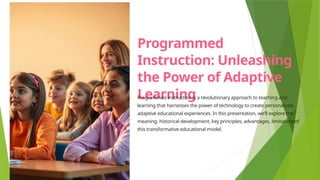
Programmed instruction is a revolutionary approach to teaching and
learning that harnesses the power of technology to create personalized,
adaptive educational experiences. In this presentation, we'll explore the
meaning, historical development, key principles, advantages, limitationsof
this transformative educational model.
3.
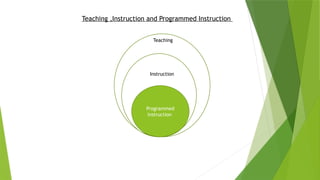
Introduction:
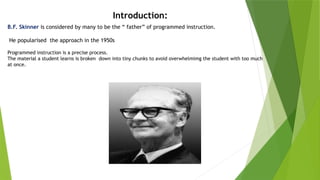
B.F. Skinner isconsidered by many to be the “ father” of programmed instruction.
He popularised the approach in the 1950s
Programmed instruction is a precise process.
The material a student learns is broken down into tiny chunks to avoid overwhelmimg the student with too much
at once.
4.
What is ProgrammedInstruction?
Definition
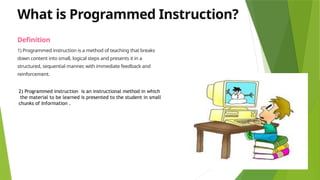
1) Programmed instruction is a method of teaching that breaks
down content into small, logical steps and presents it in a
structured, sequential manner, with immediate feedback and
reinforcement.
2) Programmed instruction is an instructional method in which
the material to be learned is presented to the student in small
chunks of Information .
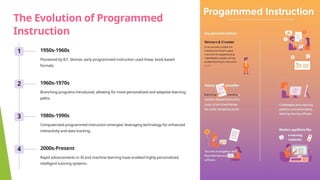
The Evolution ofProgrammed
Instruction
1 1950s-1960s
Pioneered by B.F. Skinner, early programmed instruction used linear, book-based
formats.
2 1960s-1970s
Branching programs introduced, allowing for more personalized and adaptive learning
paths.
3 1980s-1990s
Computerized programmed instruction emerged, leveraging technology for enhanced
interactivity and data tracking.
4 2000s-Present
Rapid advancements in AI and machine learning have enabled highly personalized,
intelligent tutoring systems.
7.
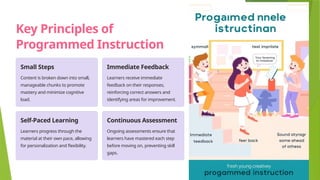
Key Principles of
ProgrammedInstruction
Small Steps
Content is broken down into small,
manageable chunks to promote
mastery and minimize cognitive
load.
Immediate Feedback
Learners receive immediate
feedback on their responses,
reinforcing correct answers and
identifying areas for improvement.
Self-Paced Learning
Learners progress through the
material at their own pace, allowing
for personalization and flexibility.
Continuous Assessment
Ongoing assessments ensure that
learners have mastered each step
before moving on, preventing skill
gaps.
8.
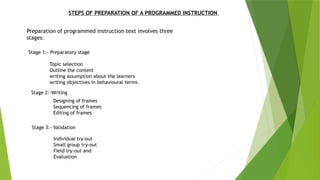
STEPS OF PREPARATIONOF A PROGRAMMED INSTRUCTION
Preparation of programmed instruction text involves three
stages:
Stage 1:- Preparatory stage
Topic selection
Outline the content
writing assumption about the learners
writing objectives in behavioural terms
Stage 2:-Writing
Designing of frames
Sequencing of frames
Editing of frames
Stage 3:- Validation
Individual try-out
Small group try-out
Field try-out and
Evaluation
9.
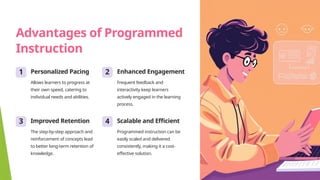
Advantages of Programmed
Instruction
1Personalized Pacing
Allows learners to progress at
their own speed, catering to
individual needs and abilities.
2 Enhanced Engagement
Frequent feedback and
interactivity keep learners
actively engaged in the learning
process.
3 Improved Retention
The step-by-step approach and
reinforcement of concepts lead
to better long-term retention of
knowledge.
4 Scalable and Efficient
Programmed instruction can be
easily scaled and delivered
consistently, making it a cost-
effective solution.
10.
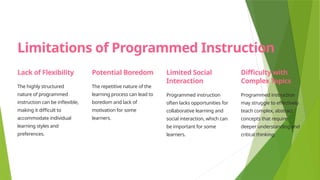
Limitations of ProgrammedInstruction
Lack of Flexibility
The highly structured
nature of programmed
instruction can be inflexible,
making it difficult to
accommodate individual
learning styles and
preferences.
Potential Boredom
The repetitive nature of the
learning process can lead to
boredom and lack of
motivation for some
learners.
Limited Social
Interaction
Programmed instruction
often lacks opportunities for
collaborative learning and
social interaction, which can
be important for some
learners.
Difficulty with
Complex Topics
Programmed instruction
may struggle to effectively
teach complex, abstract
concepts that require
deeper understanding and
critical thinking.
11.
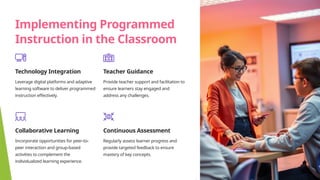
Implementing Programmed
Instruction inthe Classroom
Technology Integration
Leverage digital platforms and adaptive
learning software to deliver programmed
instruction effectively.
Teacher Guidance
Provide teacher support and facilitation to
ensure learners stay engaged and
address any challenges.
Collaborative Learning
Incorporate opportunities for peer-to-
peer interaction and group-based
activities to complement the
individualized learning experience.
Continuous Assessment
Regularly assess learner progress and
provide targeted feedback to ensure
mastery of key concepts.
12.
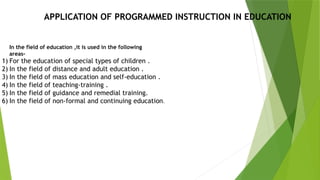
APPLICATION OF PROGRAMMEDINSTRUCTION IN EDUCATION
In the field of education ,it is used in the following
areas-
1) For the education of special types of children .
2) In the field of distance and adult education .
3) In the field of mass education and self-education .
4) In the field of teaching-training .
5) In the field of guidance and remedial training.
6) In the field of non-formal and continuing education.
13.
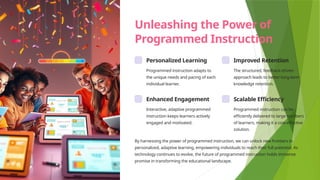
Unleashing the Powerof
Programmed Instruction
Personalized Learning
Programmed instruction adapts to
the unique needs and pacing of each
individual learner.
Improved Retention
The structured, feedback-driven
approach leads to better long-term
knowledge retention.
Enhanced Engagement
Interactive, adaptive programmed
instruction keeps learners actively
engaged and motivated.
Scalable Efficiency
Programmed instruction can be
efficiently delivered to large numbers
of learners, making it a cost-effective
solution.
By harnessing the power of programmed instruction, we can unlock new frontiers in
personalized, adaptive learning, empowering individuals to reach their full potential. As
technology continues to evolve, the future of programmed instruction holds immense
promise in transforming the educational landscape.
14.
REFERENCES
The content forthe presentation has been taken from the following sources :
1) EDUCATIONAL TECHNOLOGY BY Dr.Kulwinder Pal
2) www.slideshare.net
3)Artificial intelligence